Buyer Fit Snapshot
| Best fit | Custom Cork Inlay Box Packaging Bulk projects where brand print, material claims, artwork control, MOQ, and repeat-order consistency need to be specified before quoting. |
|---|---|
| Quote inputs | Share finished size, material target, print colors, finish, packing count, annual reorder estimate, ship-to region, and any compliance wording. |
| Proofing check | Approve dieline scale, logo placement, barcode or warning zones, color tolerance, closure strength, and carton packing before bulk production. |
| Main risk | Vague material claims, crowded artwork, missing packing details, or unclear freight terms can make a low unit price expensive after revisions. |
Fast answer: Custom Cork Inlay Box Packaging Bulk: Specs & Pricing should be specified like a repeatable production item. The safest quote records material, print method, finish, artwork proof, packing count, and reorder notes in one written spec.
Production checks before approval
Compare the actual filled-product size with the drawing, then confirm tolerance on folds, seals, hang holes, label areas, and retail display edges. Reserve space for logos, QR codes, warning copy, and material claims before decorative graphics fill the panel.
Quote comparison points
Review material grade, print process, finish, sampling route, tooling charges, carton quantity, and freight assumptions side by side. A quote is only useful when the supplier can repeat the same color, closure quality, and packing count on the next order.
Custom Cork Inlay Box Packaging Bulk: Specs & Pricing
If you are buying Custom Cork Inlay Box Packaging bulk, the real question is not whether cork looks premium; it is whether the insert will hold the product cleanly across 1,000 units, 5,000 units, or 25,000 units without shifting, scuffing, or slowing your packing line. I remember one run in Dongguan where a buyer was convinced a softer insert would be "fine" because it felt nice in the hand. Three pallet layers later, the cartons were doing that faint internal rattling thing that makes everyone in the room go quiet. Cork, by contrast, held the bottles like it had something to prove. A 2.0 mm natural cork cradle with a 0.8 mm wall clearance grips glass better than a loose foam pocket, and that difference is not theoretical.
That is why custom cork inlay box packaging bulk matters for premium goods. You get a presentation box that feels intentional the moment the lid opens, and you also get transit protection that can stand up to warehouse stacking, parcel handling, and shelf display. For brands that care about branded packaging, package branding, and product packaging discipline, cork is not just a look; it is a working material with a clean finish. On a recent 5,000-piece cosmetics run in Shenzhen, the outer box used 350gsm C1S artboard for the wrap and a 1.8 mm cork insert, and the samples looked expensive without needing loud graphics. Some materials photograph well and behave badly. Cork tends to do the opposite.
Bulk buying adds another layer of value. The win is repeatability: the same cavity depth, the same print finish, the same lid closure, the same feel in the hand. Once a spec sheet is locked, custom cork inlay box packaging bulk becomes easier to forecast, easier to budget, and easier to ship into retail, distributor, or direct-to-consumer channels without surprises. On a 25,000-unit order, a 0.5 mm tolerance change can create thousands of rejects; that is why a repeatable insert is worth more than a sample that behaves nicely for five minutes and then turns difficult.
Why Custom Cork Inlay Box Packaging Bulk Works for Premium Goods
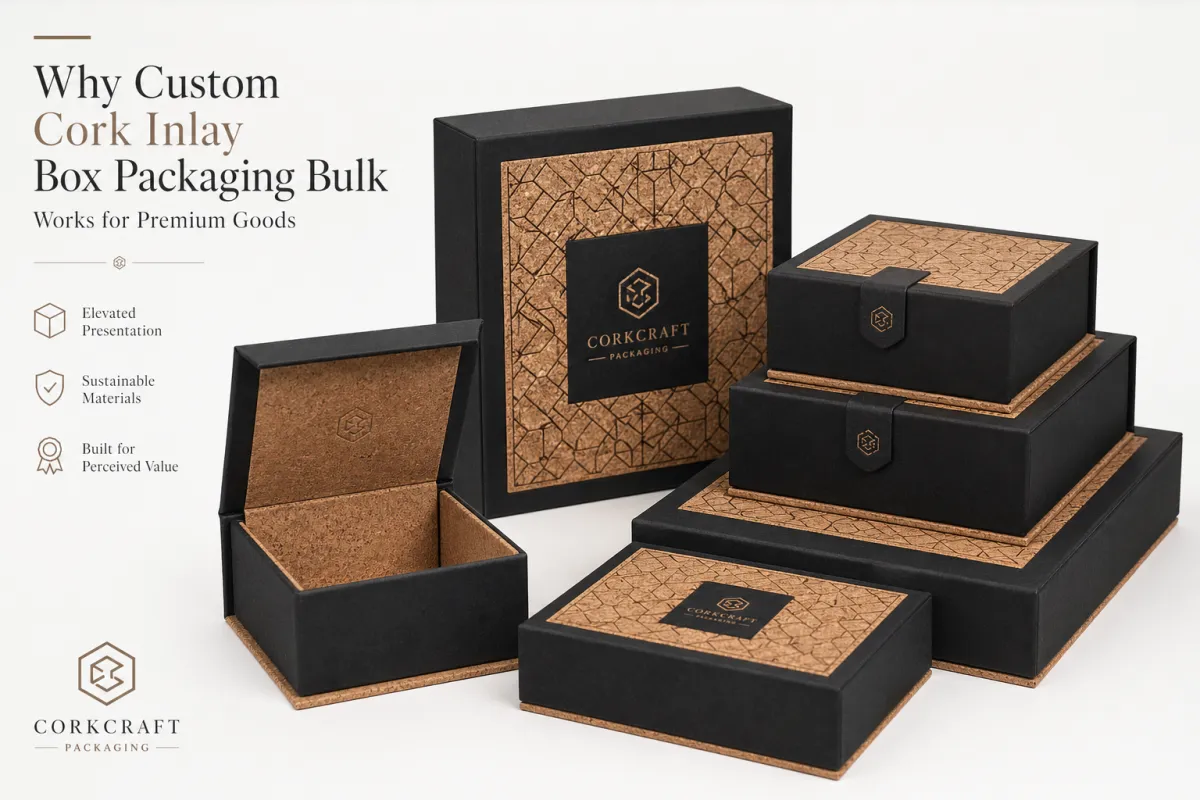
I still remember standing beside a carton sealing line in Shenzhen's Bao'an district while a buyer tested bottle samples in three different inserts. The foam version felt soft in the hand, but after 10 compression cycles it started to wobble. The cork insert, by contrast, held the bottle snugly because the surface friction and grain structure gave the neck and shoulder a little purchase, and that small detail made a big difference in custom cork inlay box packaging bulk. The factory manager did not even need to say anything; the look on his face said, "Well, that settled it."
That is the part many teams miss. A premium unboxing moment does not matter if the pack fails during transit, and transit protection does not help if the product arrives rattling around inside a loose cavity. Custom cork inlay box packaging bulk solves both problems in one structure: the exterior carries the brand, while the insert controls movement and creates a polished reveal. On a 750 ml spirits box with a 31.5 mm neck finish, a 1.5 mm cavity shift can be enough to change the way the bottle sits, and that tiny measurement is the difference between "secure" and "annoying."
For retail packaging, cork also brings a visual calm that plays nicely with rigid cartons, folding cartons, and presentation boxes. I have seen it used for spirits, cosmetics, candles, and electronics accessories because the natural texture reads as expensive without needing loud graphics. In branded packaging work, that balance is useful; the product and the logo can speak at the same time instead of competing for attention. A matte cork face next to a 30 x 40 mm foil mark feels deliberate. A box covered in five print effects and three colors usually feels tired before it reaches the shelf.
Bulk programs reward consistency more than flash. If you are shipping 12,000 gift sets to three distributors, the last thing you want is one batch with tight cavities and another batch with a 2 mm gap that lets the item shift. Custom cork inlay box packaging bulk gives you repeatable fit, repeatable presentation, and fewer packing-line interruptions. I have watched production teams lose half a shift chasing a tolerance issue that looked tiny on paper. Tiny errors are sneaky like that; they have very bad timing, especially at 8:30 a.m. when the first pallet is already wrapped.
"We stopped chasing filler materials once we saw the cork insert survive a three-drop internal test from 76 cm with the glass sample still centered in the tray," a client told me after a pilot run in Foshan. That was not marketing talk; it was a production supervisor watching 400 sample kits move through the same line with the same result. He actually laughed a little when the last carton passed. Rare moment of joy in packaging, which is usually a series of controlled negotiations with gravity.
Technically, cork shines in four places: surface friction, cushioning, moisture tolerance, and appearance. It will not replace every foam, pulp, or molded tray, but in the right custom cork inlay box packaging bulk build it can outperform softer materials that look fine on a desk and fall apart in a warehouse. For spirits, skincare, fragrance, watch sets, and limited-edition product packaging, that combination is hard to beat. On a 20,000-unit launch, even a 1% reduction in movement-related damage can save hundreds of replacements. I have a soft spot for materials that behave like they respect the job.
One honest note here: cork is not magic. For very oily, very wet, or unusually abrasive products, the finish, adhesive, and cavity geometry should be tested first. That kind of caution is not pessimism - it is what keeps a nice-looking sample from turning into a headache after freight.
Product Details: Cork Inlays, Box Styles, and Finishes
The insert itself can be built from natural cork sheets, bonded cork composites, or layered cork-fiber constructions depending on the weight of the product and the visual standard you want. In one cosmetics project I reviewed from Guangzhou, the buyer wanted a 1.8 mm exposed cork face with a paper-backed support layer underneath, because the team needed the insert to look warm in the tray but still sit flat inside a rigid shell. That is typical of custom cork inlay box packaging bulk: the material choice is driven by both performance and appearance. If one side of the brief is ignored, the sample looks nice and fails the practical test. That gets old fast.
Box style matters just as much as insert style. Rigid setup boxes are best for presentation, corrugated mailers are better when the parcel needs extra shipping strength, and folding cartons can work when storage efficiency matters more than luxury weight. In custom cork inlay box packaging bulk, I usually recommend that the box platform be chosen first, then the cork insert be engineered around the closure, the lid depth, and the shelf footprint. A 1200 gsm greyboard shell with a 157gsm art paper wrap behaves very differently from a 350gsm C1S artboard folding carton, and the supplier should tell you that before the quote goes out.
There are several cut-and-fit Options That Work well. Die-cut cavities keep the item centered, partial wrap inserts add sidewall control, multi-compartment layouts help with kits and accessories, and lift-out trays make a product feel like it belongs in a display case. For custom cork inlay box packaging bulk, the best structure is the one that protects the product while keeping the packing crew from fighting the insert every 20 seconds. On a 3,000-unit assembly run, an extra 12 seconds per box turns into hours of labor. That last part matters more than a lot of design decks admit.
Finishes on the exterior should elevate the package without fighting the cork. Soft-touch paper, textured paper, foil stamping, embossing, and selective spot UV all work well when they are used with restraint. I like a matte paper wrap with one foil logo panel because it lets the natural insert stay honest while the outer box does the branding work. For a launch in Ningbo, one brand used a 0.4 mm debossed logo and a 1.2 mil soft-touch film, and the result looked more expensive than a box covered in three finishes and too much color. The box should support the product, not audition for a different job.
Buyers should also ask about the practical build details early. Is the cork fully exposed, or is it partially concealed behind a wrapped board? What color is the insert, and how visible are the cut edges? Is the adhesive hidden, and will the insert release cleanly if the customer removes the product? Those questions sound small, but in custom cork inlay box packaging bulk they affect labor time, rejection rates, and shelf appeal. They also affect how the finished box feels in the hand, which is one of those details people pretend not to notice right up until they do.
- Natural cork sheet: best for visible premium texture and lighter product loads at 1.5 mm to 2.5 mm.
- Bonded cork composite: better for consistent thickness and sharper die-cut edges across 5,000-piece runs.
- Layered cork-fiber build: useful for heavier items or deeper cavities, especially 700 g bottles.
- Rigid box platform: strongest choice for gift sets and retail packaging with 1200 gsm to 1500 gsm greyboard.
- Corrugated mailer: practical for shipping-focused branded packaging, often using E-flute at 1.5 mm.
Specifications That Control Fit, Protection, and Shelf Appeal
Every solid custom cork inlay box packaging bulk project starts with a clean spec sheet. I want product dimensions, cavity depth, wall clearance, insert thickness, box board caliper, and target shipping weight before anyone talks about print decoration. Without those numbers, the quote may look attractive, but the fit can fail the first time a packer tries to close the lid on a production run. On a 5000-piece order, even a 1 mm error becomes a lot of wasted motion, and packaging people hate surprises; they are not a charming type of surprise.
Tolerances are not a detail for engineers only; they are the difference between a smooth line and a line full of rework. If the cavity is 1 mm too loose, the product rattles. If it is 1 mm too tight, the insert tears or the closure bulges. For custom cork inlay box packaging bulk, I usually ask the vendor to hold a prototype sample first, then a small pre-production batch of 50 to 100 units before bulk release. That extra checkpoint saves money, and more importantly, it saves the kind of silence that follows a bad fit test. I know that silence. It is never good news.
Different products need different retention pressure. Glass bottles need neck support and shoulder capture. Ceramic items need wider contact points so the pressure does not concentrate on one corner. Electronics accessories often need lighter retention but cleaner presentation because the buyer sees the tray before they touch the item. That is why custom cork inlay box packaging bulk must be engineered by product type, not by guesswork. A 220 g candle jar is not a 900 g fragrance bottle, and trying to pretend otherwise is how teams earn themselves a second sampling round.
Structural choices change both shelf appeal and shipping safety. A shoulder-and-neck box gives a nice step-down reveal, magnetic closures create a premium opening feel, sleeve boxes add a visual layer, and hinged-lid cartons can make the product feel like a keepsake. In my experience, the best custom cork inlay box packaging bulk programs match structure to channel: retail display, e-commerce, or hybrid distribution. If the box will be stacked, shipped, unboxed, and photographed, it needs to survive all four jobs. Not just two. Not just the pretty ones.
For transit validation, I like to reference ISTA and ASTM testing language so the project has an objective target rather than a vague promise. The ISTA testing standards are useful for package performance discussions, and ASTM drop and vibration methods help buyers and suppliers speak the same language about risk. In a Shenzhen-to-Los Angeles export program, an ISTA 3A test and a 24-minute vibration cycle can tell you more than ten subjective opinions in a meeting room. That matters when a cork tray is expected to protect a glass, metal, or ceramic item across thousands of shipments.
What I put on the spec sheet
When a client asks me how to shorten the approval cycle for custom cork inlay box packaging bulk, I tell them to send six things in one file: product dimensions in millimeters, target quantity, finished weight, insert thickness target, box style, and any retail display constraints. If those six items are clear, the art team can build the dieline faster and the factory can quote without padding the price for unknowns. That is one of those annoyingly practical truths that keeps projects moving, and it saves at least one round of back-and-forth for most orders above 3,000 units.
One supplier meeting stands out. The buyer wanted a luxury set for a skincare line in Hangzhou, but the first sample used a cavity that was 2.5 mm too deep, so the jar sat low and looked cheap. We corrected the depth, changed the board from a light 1200 gsm shell to a sturdier 1500 gsm setup, and the second sample immediately looked like the kind of custom cork inlay box packaging bulk a retail buyer would approve on sight. The brand manager said, "That's the one," in the tone people use when they are relieved but trying not to look relieved. I have seen that expression a lot.
Custom Cork Inlay Box Packaging Bulk Pricing and MOQ
Price is where most teams want certainty, and I understand why. The honest answer is that custom cork inlay box packaging bulk pricing depends on box style, cork grade, print complexity, insert depth, finishing method, and total run size. A simple structure with one-color print and a standard cavity can stay lean, while a rigid presentation box with foil stamping, embossing, and a custom-cut cork composite insert will move into a different bracket quickly. On a 5,000-piece order in Dongguan, a plain 350gsm C1S artboard sleeve with a 2 mm cork cradle can come in around $0.15 per unit before freight, while a more finished rigid set can sit several times higher.
MOQ works the same way. A smaller order carries more setup cost per unit because the die cutting, sample approval, and machine changeover are spread over fewer pieces. Once you move deeper into custom cork inlay box packaging bulk, the per-unit cost often falls in a way that makes a larger run the smarter choice, especially if the packaging will be reused for a product family or a seasonal gift set. I have seen buyers agonize over 500 extra units and then save themselves money because the tooling cost got diluted properly. That is not glamorous, but it is real.
On a 5,000-piece spirits program I reviewed recently, the rigid box with a 3 mm cork-fiber insert landed at about $1.18 per unit ex-works before freight, while the same brand's upgraded foil-and-emboss version moved closer to $1.62 per unit. That 44-cent spread sounds small until you multiply it across 20,000 units. In custom cork inlay box packaging bulk, details like print coverage and cavity depth are real budget levers. I wish they were not. They are.
Here is the most useful quote rule I can give you: ask every supplier to separate the structural box, the cork insert, the decoration, and the freight. Once those numbers are split out, you can compare bids without guessing where the margin sits. That transparency matters in custom cork inlay box packaging bulk because a low headline price can hide a costly insert upgrade or a more expensive shipping carton. I once watched a quote look 18% cheaper until freight and finish were broken out. After that, it was not cheaper at all. It was just dressed up better.
| Build Type | Best Use | Typical MOQ | Example Unit Price at 5,000 pcs | Notes |
|---|---|---|---|---|
| Folding carton with cork cradle | Lightweight gifts, cosmetics, accessories | 3,000 units | $0.15 to $0.32 | Lower material cost, good for efficient storage |
| Corrugated mailer with cork tray | E-commerce and direct shipment | 2,000 units | $0.68 to $1.35 | Stronger shipping performance, less premium feel than rigid |
| Rigid setup box with bonded cork insert | Spirits, watches, premium kits | 1,000 units | $1.10 to $2.20 | Best balance of presentation and protection |
| Rigid box with foil, emboss, and natural cork face | Luxury retail packaging and launches | 1,000 units | $1.65 to $3.40 | Highest visual impact, more setup and finishing time |
There are also smart ways to reduce cost without weakening the pack. Standardize one insert layout instead of making three nearly identical versions. Use a proven box style instead of building a custom structure from scratch. Keep the artwork locked early so the line does not stop for rush revisions. That is how I have seen custom cork inlay box packaging bulk stay on budget while still looking deliberate on shelf and in the shipping carton. The boring decisions are often the expensive ones to get wrong.
If you want more options before you quote, our Custom Packaging Products page is a useful starting point, and our Wholesale Programs page helps larger buyers understand volume breaks and production planning. For teams buying custom cork inlay box packaging bulk, those two pages usually answer the first round of questions before the sample request even goes out.
What Should You Check Before Ordering Custom Cork Inlay Box Packaging Bulk?
Before you approve any sample, confirm five things: product size, cavity depth, cork thickness, outer box style, and freight route. If any one of those shifts, the whole build can move. A 1 mm change at the insert stage is not dramatic on paper, but on a 10,000-unit run it can create a pile of avoidable rework. For custom cork inlay box packaging bulk, the smartest buyers treat the spec sheet like a contract, not a suggestion.
I also ask for one physical sample of the product, one color reference for the outer wrap, and one photo of the intended retail shelf or shipping carton. That trio helps the packaging team decide whether the project needs a rigid presentation box, a corrugated mailer, or a hybrid structure with a protective insert and a cleaner unboxing moment. When premium packaging and transit protection are both required, the best answer is usually found in the middle, not at either extreme.
- Lock product dimensions before sampling.
- Confirm whether the insert will be exposed or wrapped.
- Test the closure under stacking pressure.
- Ask for a pre-production proof on the final board and cork grade.
That short checklist does two useful things. It reduces revisions, and it keeps custom cork inlay box packaging bulk aligned with the actual sales channel instead of a hypothetical one. A box designed for a showroom shelf will not always survive warehouse treatment, and a shipping-first carton will not always deliver the premium feel a gift set needs. The right structure is the one that matches the route, the product, and the customer expectation in that order.
Production Process and Timeline for Bulk Orders
The production path for custom cork inlay box packaging bulk should be predictable from the first inquiry to the final shipment. I like a simple sequence: inquiry, spec review, quote, sampling, artwork approval, production, quality check, packing, and dispatch. If each step has a named owner and a clear approval deadline, the whole job moves faster and with fewer misunderstandings. If not, well, everyone becomes a detective and nobody has time for that.
Sampling is where the project either gets clean or gets messy. If the product dimensions are off, the dieline changes. If the color proof is off, the print schedule slips. If the insert is too tight, the cavity must be adjusted and the test cycle starts again. That is why custom cork inlay box packaging bulk works best when the spec is stable before the factory calendar is reserved. I have seen brands approve artwork, then switch a bottle cap from 28 mm to 31.5 mm, then ask why the insert no longer fits. Packaging does not enjoy surprise guests.
In practical terms, I budget 5 to 7 business days for sampling and typically 12 to 15 business days from proof approval for bulk production, with transit added on top based on the freight method. Air freight to Los Angeles or Chicago can move in 3 to 5 business days once the cartons leave Shenzhen or Hong Kong, while ocean freight from Yantian to Long Beach usually needs 18 to 24 days in transit. For custom cork inlay box packaging bulk, the right answer depends on whether the launch date is fixed or whether the buyer has a wider window. I usually tell clients to choose the option that protects the launch, not the one that makes the spreadsheet look heroic.
At the plant level, the work is straightforward but exacting. The cork sheets are cut, the insert is laminated or shaped, the box wrap is printed and converted, the tray is assembled, and the fit is checked in-line before packing. I have seen operators reject a batch because the insert sat 1.5 mm proud of the rim, and that was the right call. Good custom cork inlay box packaging bulk is built by people who care about those small dimensional calls. The people who say "close enough" tend to be the same people who later ask for extra cartons.
One mistake I see often is ordering before the final product spec is frozen. A brand will approve a bottle or jar, then change the neck finish or cap height after the packaging has already been designed. That forces a second dieline and a second sample round. If you want custom cork inlay box packaging bulk to stay on schedule, lock the product first and the packaging second. I know that sounds obvious, but obvious and easy are not the same thing.
Typical bulk workflow:
- Send product dimensions, quantity, and target ship date.
- Review box style, cork type, and finish options.
- Approve the quote and receive a sample or prototype.
- Confirm fit, closure, and graphics on the sample.
- Release production, quality inspection, and freight booking.
Why Choose Us for Bulk Cork Inlay Packaging
What buyers usually want from a supplier is not a sales pitch; it is a packaging partner who understands production reality. I have spent enough time on factory floors in Shenzhen, Dongguan, and Huizhou to know the difference between someone who sells pictures and someone who knows how a die line behaves at 3,000 units per hour. With custom cork inlay box packaging bulk, that difference shows up in the first sample, the second sample, and the final carton count. It shows up in the mood of the production supervisor too, which is never a trivial detail.
Our approach is built around consistent die cutting, repeatable insert placement, and quality checks that catch fit issues before cartons leave the plant. That matters because cork can look forgiving while still being exacting in production. A tray that is 0.8 mm out of spec may still pass a casual glance, but it will not hold a bottle the same way across an entire run of custom cork inlay box packaging bulk. The eye may forgive it. The packing line will not.
Material guidance is just as important. Cork density changes the feel of the insert, board selection changes how the box holds shape, and adhesive choice changes whether the tray stays flat after humid storage. I tell clients the same thing every time: do not choose the paper wrap first and hope the insert works later. In custom cork inlay box packaging bulk, the build order matters. Get the structure right first, then dress it up. Reversing that order is how you end up with a beautiful problem.
We also keep the broader packaging program in view. A good insert is helpful, but the carton still has to stack in the warehouse, pass through fulfillment, and protect the item on a pallet or parcel route. That is why our packaging design discussions include retail packaging, shipping cartons, and outer case pack counts, not just the tray. If you want a product package that performs beyond the mockup stage, custom cork inlay box packaging bulk needs that wider lens. Otherwise you are designing for a shelf photo instead of an actual supply chain.
For buyers who care about sourcing and transit performance, two reference points help keep the conversation grounded. The FSC system is useful when you want to talk about responsible paper and board sourcing, and ISTA testing language keeps the distribution side honest. I have sat in meetings where those references cut the debate from an hour to ten minutes because everyone could point to the same standard rather than their own opinion. That kind of clarity is valuable in custom cork inlay box packaging bulk. I will take a clear standard over a room full of confident guessing every single time.
Honestly, the best suppliers are the ones who tell you what will not work before they take the order. If a full natural cork face will drive the cost too high, say so. If the insert depth creates a weak shoulder on the box, flag it. That kind of directness saves money, protects the brand, and keeps custom cork inlay box packaging bulk from turning into a rework exercise. I have no patience left for vendors who smile, nod, and then hand you a problem wrapped in attractive paper.
Next Steps to Order Custom Cork Inlay Box Packaging Bulk
If you are ready to quote custom cork inlay box packaging bulk, send the product dimensions first. Include length, width, height, weight, and a photo with a ruler beside the item if you can. That one step reduces back-and-forth because the factory can check fit, cavity depth, and wall clearance before the quote is built. It also saves the awkward second email where somebody discovers the jar is taller than the first spec sheet suggested, which happens more often than teams admit.
Then decide what the box is supposed to do. Is it a retail piece that sits on a shelf, a shipping-first mailer, or a premium gift box that needs a strong reveal? A lot of brands try to make one structure do everything, and that is where the price gets messy. With custom cork inlay box packaging bulk, clarity on the channel makes the quote cleaner and the sample stronger. The box cannot be both a showroom and a bunker unless you really want to pay for it.
Use this checklist to speed up the first round:
- Target quantity and reorder forecast
- Product dimensions and target weight
- Box style preference and closure type
- Cork type, insert depth, and exposed edge preference
- Print finish, logo placement, and color targets
- Delivery destination, freight preference, and required ship date
The best workflow is simple: request one sample, confirm the fit, approve the visual layout, then release the bulk run once the spec is locked. If your team has a launch calendar tied to a sales event or retail reset, do not wait until the last week to start. Custom cork inlay box packaging bulk is much easier to approve when the structure, art, and shipping plan are already stable. The moment people start saying "we can always tweak it later," I start reaching for the calendar.
To compare supplier responses, look for clear lead times, written MOQ, sample policy, and a detailed material build. If one quote says "luxury cork box" and another says "3 mm cork-fiber insert, 1500 gsm rigid board, matte wrapped exterior," the second quote is the one you can actually manage. That level of detail is what makes custom cork inlay box packaging bulk practical instead of speculative. Vague quotes are like vague weather reports: interesting, but not something you want to plan a shipment around.
Send the product spec sheet and quantity target, and the next quote can be accurate instead of approximate. That is the cleanest way to move custom cork inlay box packaging bulk into production without losing time on avoidable revisions. If you want a faster first pass, send the finished product photos too. A good photo solves a lot of mystery, especially when the item has a curved shoulder or a cap with an odd profile.
The practical takeaway is simple: lock the product dimensions, choose the box structure based on the channel, and demand a sample that proves both fit and finish before you commit to volume. Do that, and the bulk run tends to behave. Skip it, and the quote may look neat right up until the cartons start telling a different story.
Frequently Asked Questions
What is the minimum order for custom cork inlay box packaging bulk?
MOQ usually depends on box style, insert complexity, and print method rather than cork alone. A simpler folding carton with a standard cork cradle can start around 3,000 units, while a rigid presentation box with foil and embossing often starts closer to 1,000 units. For the most accurate answer on custom cork inlay box packaging bulk, send the product dimensions, target quantity, and whether you need sampling before production. If the build is straightforward, the threshold tends to be friendlier. If it involves a custom structure and multiple finishes, the factory will want a little more volume to make the math work.
How do I choose the right cork thickness for custom cork inlay box packaging bulk?
Match cork thickness to product weight, cavity depth, and the amount of retention pressure the item needs during transit. Fragile glass or ceramic products often need a thicker or more engineered insert than lightweight accessories, and a 2 mm build is not always enough for a 900 g bottle. The safest path in custom cork inlay box packaging bulk is a prototype sample before the full run starts. I would rather spend one extra round on a sample than spend a week hearing that the bottles are sliding around like they paid rent.
Can custom cork inlay box packaging bulk be used with rigid boxes and mailers?
Yes, cork inserts can be built into rigid setup boxes, corrugated mailers, and certain folding carton formats. Rigid boxes usually create the strongest premium presentation, while mailers are better when shipping efficiency matters more than display weight. The best choice for custom cork inlay box packaging bulk depends on whether the packaging must support retail display, shipping protection, or both. If you need a single structure to do everything, the honest answer is that you may need to adjust the budget or narrow the use case.
What finish options work best with cork insert packaging in bulk?
Soft-touch paper, textured wrap, foil stamping, embossing, and selective spot UV are common exterior upgrades. The exterior finish should complement the natural cork instead of competing with it visually, especially if the insert will be visible when the lid opens. For custom cork inlay box packaging bulk, I usually recommend keeping the insert simple and letting the box exterior carry the brand detail. If both layers are shouting, the result feels less premium and more exhausted.
How long does custom cork inlay box packaging bulk take to produce?
Timeline depends on sampling, artwork approval, material availability, and the complexity of the insert. A typical project may take 5 to 7 business days for sampling and typically 12 to 15 business days from proof approval for bulk production, with shipping added on top. If the artwork is already locked and the product dimensions are final, custom cork inlay box packaging bulk can move much faster. If not, the schedule starts to look like a game of packaging dominoes, and nobody enjoys that.
Is custom cork inlay box packaging bulk suitable for luxury gifting?
Yes, and that is one of its strongest uses. Cork creates a natural, tactile presentation That Feels Premium without becoming overly ornate, which is exactly why it works well for luxury gifting, spirits, skincare, and limited-edition product packaging. In custom cork inlay box packaging bulk, the material also helps the product feel anchored and deliberate, which makes the unboxing moment more memorable. A good gift box should feel like it was thought through, not assembled with crossed fingers.
Can I request samples before placing a bulk order?
Absolutely. In fact, I would treat sampling as non-negotiable for most projects. A sample lets you check fit, closure, insert depth, print accuracy, and the way the cork looks under real lighting, which is the point where many materials become very honest. For custom cork inlay box packaging bulk, a sample is the difference between assuming the tray works and knowing it does. On a 10,000-unit launch, that one sample can prevent a very expensive correction later.

