Buyer Fit Snapshot
| Best fit | Custom Corrugated Box Inserts projects where brand print, material claims, artwork control, MOQ, and repeat-order consistency need to be specified before quoting. |
|---|---|
| Quote inputs | Share finished size, material target, print colors, finish, packing count, annual reorder estimate, ship-to region, and any compliance wording. |
| Proofing check | Approve dieline scale, logo placement, barcode or warning zones, color tolerance, closure strength, and carton packing before bulk production. |
| Main risk | Vague material claims, crowded artwork, missing packing details, or unclear freight terms can make a low unit price expensive after revisions. |
Fast answer: Custom Corrugated Box Inserts: Design, Cost, and Fit should be specified like a repeatable production item. The safest quote records material, print method, finish, artwork proof, packing count, and reorder notes in one written spec.
Production checks before approval
Compare the actual filled-product size with the drawing, then confirm tolerance on folds, seals, hang holes, label areas, and retail display edges. Reserve space for logos, QR codes, warning copy, and material claims before decorative graphics fill the panel.
Quote comparison points
Review material grade, print process, finish, sampling route, tooling charges, carton quantity, and freight assumptions side by side. A quote is only useful when the supplier can repeat the same color, closure quality, and packing count on the next order.
Custom Corrugated Box Inserts: Design, Cost, and Fit
A carton can pass a drop test and still fail in the real world if the product bounces around inside it. That is the problem Custom Corrugated Box inserts solve. They lock the product down, protect weak points, and turn packaging from “good enough” into something built around the item instead of just around the box.
What Are Custom Corrugated Box Inserts?
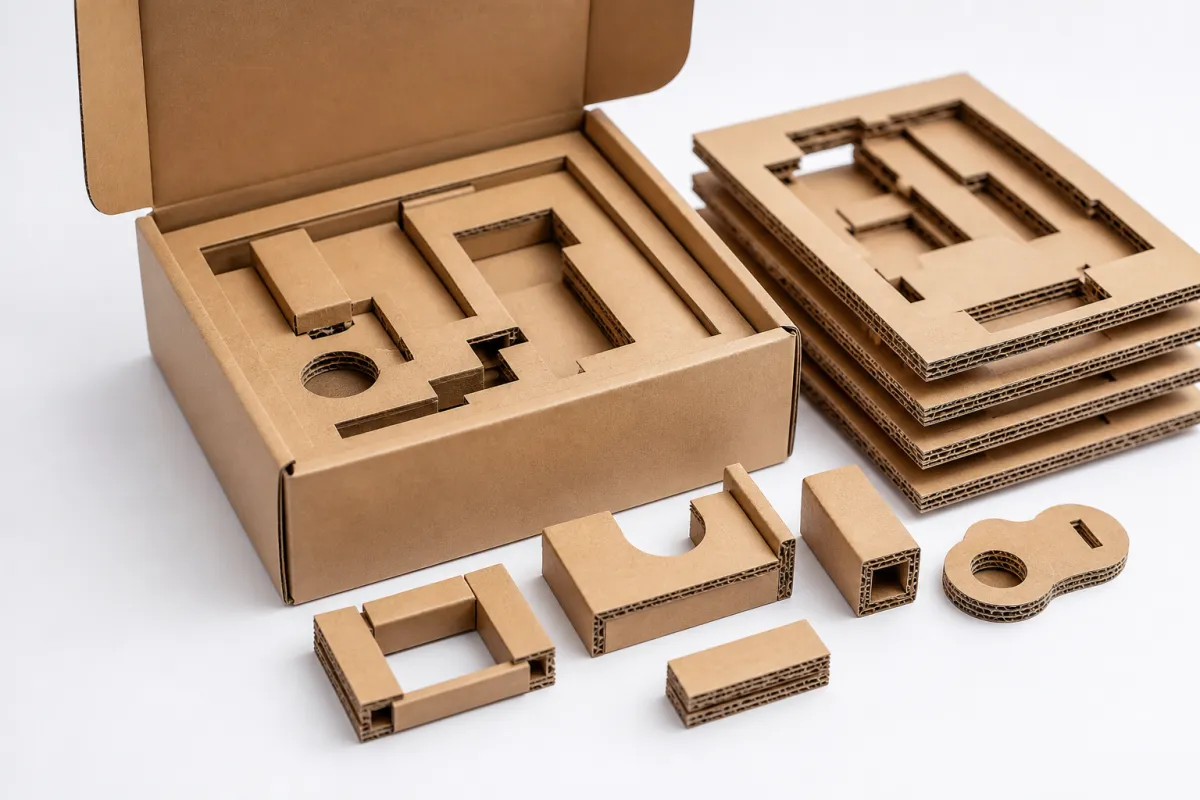
Custom corrugated box inserts are die-cut, scored, folded, or glued corrugated structures placed inside a carton to hold a product in a fixed position. They can cradle one item, separate several items, build compartments, or suspend a fragile piece away from the outer walls of the box. In plain English, they turn dead space into a packaging system with a job.
That difference matters more than people expect. Void fill can stop movement, but it rarely does much else. A real insert manages load path and contact points. It keeps glass away from corners, keeps electronics from knocking into each other, and keeps cosmetic cartons from arriving looking like they lost a fight. For brands using branded packaging, the insert also shapes the opening experience, the product reveal, and the overall feel of the package. Sloppy insert, sloppy impression. Pretty simple.
Several forms of custom corrugated box inserts show up again and again. Partitions create grids for bottles, jars, or glassware. Trays hold a product from underneath and often leave the top visible. Cradles support odd shapes like pumps, dispensers, and hand tools. Sleeves wrap around a product or a group of components. End caps keep an item centered inside a larger carton. The right choice depends on weight, surface finish, packout speed, and how ugly the shipping lane gets.
The simplest way to think about it: void fill occupies space, while engineered inserts control motion. One reacts after the fact. The other is designed on purpose. That is why custom corrugated box inserts show up so often in electronics, cosmetics, subscription kits, specialty foods, retail packaging, and industrial parts programs. They protect product packaging from impact and abrasion, and they can make custom printed boxes feel more polished without stuffing the inside with visual noise.
Most teams start paying attention to inserts after the damage reports get annoying. That is usually late. A better move is to treat custom corrugated box inserts as part of the structural system from the beginning, not as a patch for a shipper that already failed. If the product is valuable, awkward, fragile, or sold as premium, the insert is not an accessory. It is part of the package branding story and part of the protection plan.
I have seen brands spend weeks arguing over board graphics and then ship a premium kit with loose product inside. The box looked nice. The product arrived rattling around. That kind of mismatch is avoidable, and honestly, it is a little embarrassing when it happens.
A good insert stays out of the way. If it calls attention to itself during transit, it probably is not doing enough.
How Custom Corrugated Box Inserts Work in Transit
Custom corrugated box inserts work by limiting movement and spreading shock. Not glamorous. Still useful. During a drop, vibration event, or compression load in a truck or warehouse, the product wants to shift. Once it has room to accelerate, it gathers force and slams into a wall, corner, divider, or another product. An insert changes that story by holding the item in place, distributing force across a larger surface, and keeping the fragile side from becoming the impact side.
In transit, the carton itself handles compression while the insert controls geometry. Think of the outer box as the shell and the insert as the fit system. A 32 ECT single-wall carton may work for many consumer shipments, but if the product floats inside it, the board grade alone does not save you. Custom corrugated box inserts cut edge contact, stop corner-to-corner impact, and keep multiple units separated so vibration does not turn them into a pile of small, expensive problems.
The best insert style depends on the failure mode. Partitions work well for bottles or jars. Trays are useful when speed and presentation matter. Cradles support awkward shapes and keep pressure off labels, caps, or decorative surfaces. Sleeves help with multi-piece kits. End caps are common for electronics, glassware, or items that need to stay centered with cushioning at both ends. A well-specified system does more than protect. It also tells the packer exactly where the product goes, which cuts down on mistakes.
Fit tolerance matters more than many teams admit. A few millimeters of movement can be enough for scuffing, rattling, or a weak point getting punched through. Make the insert too tight and packout slows down while crush risk goes up. Good custom corrugated box inserts land in the narrow middle: snug enough to immobilize, forgiving enough to run at scale. That is why prototyping matters. A drawing can look perfect and still fail when a real person tries to load 500 boxes in a shift.
There is a brand side too. Faster packout, cleaner placement, and fewer orientation errors help fulfillment. If a warehouse team can drop an item into an insert and know it will land correctly every time, labor becomes easier to predict. If the box opens to a neat layout, the customer sees care instead of chaos. That is one reason custom corrugated box inserts often outperform loose fill in retail packaging programs where presentation matters almost as much as protection.
For testing, many teams use ISTA shipment testing standards as a baseline, especially when they need a repeatable way to compare designs. ISTA is useful, but it is not the whole story. A solid lab result still needs a reality check against your carrier mix, stack height, climate, and product sensitivity. Lab data is a start, not a magic stamp.
Custom Corrugated Box Inserts: Cost Drivers and Pricing
Price is where packaging conversations stop being theoretical. Custom corrugated box inserts can be cheap at scale and weirdly expensive on short runs. Both are normal. Unit price depends on board grade, flute profile, die complexity, number of folds, glue points, print coverage, and how many unique SKUs the insert has to support. Add a tricky shape or a multi-piece build and the quote climbs fast. Simplify the geometry and the cost usually drops.
For a rough U.S. ballpark, a simple single-wall insert in volume may land around $0.18-$0.35 per unit. More complex structures, especially at lower volumes, can move into the $0.45-$0.90 range or higher. The spread is wide because setup costs matter. Tooling, sample production, cutting dies, and labor setup hit small runs hard, while larger runs spread those costs across more units. If you only order a few hundred pieces, custom corrugated box inserts may feel overpriced. If you order several thousand and cut breakage, they start looking like a bargain.
The cleanest way to judge cost is not by the insert price alone. Look at the full system. If the insert reduces breakage by even a few percentage points, the savings can outrun the extra material cost. The same goes for labor. If packout gets faster, if the station needs fewer materials, or if the outer carton can ship in a smaller cube, the economics change fast. Custom corrugated box inserts affect direct material cost, freight, labor, returns, and replacement product. Ignoring half of that picture is how budgets get weird.
| Option | Typical Use | Cost Behavior | Best Fit Notes |
|---|---|---|---|
| Corrugated inserts | Consumer goods, kits, glass, electronics | Moderate tooling, lower unit cost at volume | Good for recyclability, branding, and repeat SKUs |
| Foam inserts | Very fragile or highly polished products | Higher material cost, often strong cushioning | Useful when soft contact and high resilience matter |
| Molded pulp | Eco-focused consumer packaging | Tooling can be higher, unit cost varies by volume | Works well for surface protection and sustainability goals |
| Loose fill | General shipping void fill | Low initial cost, higher labor and mess risk | Not a true engineered fit solution |
That table leaves out an obvious truth. Corrugated is not always the absolute cheapest protection medium, but it often wins on cost, speed, printability, and recyclability as a group. Foam can beat it on cushioning for very delicate items, though sustainability targets and package branding may suffer. Molded pulp can look great and fit fiber-based recycling goals, but it is not always the fastest way to build a tight kit. Loose fill is easy to buy and annoying to trust.
Budgeting gets easier once you standardize. If three products can share one insert family with small cut changes, procurement gets simpler and tooling costs shrink. Prototyping helps too. A sample that saves one percent of damage is not enough if the assembly takes twice as long. That is why strong custom corrugated box inserts conversations include protection and packout labor in the same spreadsheet. Material is only one line item. Reality is the rest.
If you are reworking the outer carton too, pairing inserts with Custom Shipping Boxes keeps the whole structure aligned instead of forcing one part to compensate for the other. If the project includes labels, accessories, or secondary packaging, browsing Custom Packaging Products may surface a simpler system than the one originally sketched.
Custom Corrugated Box Inserts: Step-by-Step Spec Process
Good specs make good packages. With custom corrugated box inserts, the process should start with a clear brief, not a vague request for “something protective.” The supplier needs product dimensions, weight, fragility, surface sensitivity, and the exact carton the insert must fit into. They also need to know whether the goal is drop protection, multi-item separation, display presentation, faster fulfillment, or all four. If the goal is fuzzy, the design will be fuzzy too. Packaging does not magically fix vague instructions.
A practical spec process usually moves through these steps:
- Measure the product and carton - include length, width, height, weight, and any protrusions, tabs, caps, or weak points.
- Define the failure mode - cracking, denting, scuffing, rattling, label damage, or packout confusion.
- Choose the insert structure - tray, partition, cradle, sleeve, end cap, or a hybrid.
- Develop a CAD or dieline concept - this is where fit and fold logic start to matter.
- Prototype and assemble - a real packout often reveals problems that a drawing hides.
- Test in a full carton - not just the insert by itself, but the entire shipping system.
- Revise and approve - usually one round is enough for simple programs, more for complex kits.
That sequence sounds tidy. The real world rarely is. The packaging team may want protection, operations may want speed, and marketing may want a cleaner reveal. Custom corrugated box inserts work best when those voices show up early. Bring fulfillment in late and you risk designing something that looks elegant on screen but slows the line in practice. Leave marketing out and you may end up with a structurally fine insert that kills the unboxing moment. Fun times.
Timeline depends on complexity. A simple insert with clear measurements might move from brief to sample quickly. A multi-part system with several SKUs can take multiple prototypes and a lot of internal approval. A realistic production cycle for custom corrugated box inserts often includes several business days for design, sample cutting, review, and revision, followed by a production slot that depends on volume and plant workload. For many buyers, the slowest part is not engineering. It is waiting for someone to say yes.
Standards help here. If the package needs formal validation, use the test plan as a shared language. ASTM and ISTA methods give teams a common benchmark, especially when comparing two insert designs without turning it into an opinion contest. If the product is sensitive enough to justify it, test after conditioning, vibration, and drop events instead of after a gentle hand carry. Custom corrugated box inserts should be judged the way they will actually be used.
Bring packers into the sample review too. They will notice whether a tab catches, whether orientation is obvious, and whether the insert fails under real hand speed. Those are not tiny details. They are the details that decide whether a design survives contact with fulfillment.
Common Mistakes When Choosing Box Inserts
Most failures with custom corrugated box inserts are not dramatic design disasters. They are small assumptions piled on top of each other. The first mistake is sizing the insert only to the product dimensions and ignoring movement. A product rarely behaves like a static drawing. It has tolerances, film, labels, caps, and human handling to deal with. Leave a little extra room in the wrong direction and the item can shift enough to wear through a corner or slam into another component.
The second mistake is over-specifying board strength. More board does not automatically mean more protection. Sometimes the real problem is geometry. A better fold, a tighter fit, or a different flute profile solves the issue without making the whole thing thicker. That matters because extra board raises cost, makes packing harder, and creates more waste than necessary. Custom corrugated box inserts should be built for the actual failure point, not for the comforting idea that thicker always means better.
The third mistake is ignoring labor. An insert that takes 15 extra seconds to assemble can quietly become expensive across a large run. If it is hard to orient, annoying to lock, or confusing for seasonal staff, the loss shows up as mispacks and damaged goods. The best custom corrugated box inserts do not just protect the product; they help the packer do the same thing the same way every time.
The fourth mistake is trusting a lab result without a shipping reality check. A package can do fine in a controlled drop test and still struggle in the field because of vibration, stacking, humidity, or a rough carrier route. A small pilot lane is useful for exactly this reason. It shows how the package behaves with real pallets, real handling, and real return data. For reference, the EPA recycling guidance is a good reminder to think about end-of-life material choices while you are fixing transit risk.
The fifth mistake is building mixed-material designs that are hard to recycle or too bulky for efficient shipping. A solution can protect well and still create a sustainability headache if it combines too many materials or uses more fiber than the product needs. FSC-certified fiber options may fit some programs better, especially where paper-based presentation matters. Even then, the point is not to add “eco” features out of habit. It is to choose the lightest structure that still protects.
Some brands also treat sustainability and performance like enemies. They are not. A well-fitted fiber insert can reduce breakage, cut replacements, and lower the total material burden. The real waste is a packaging system that ships damaged goods, then ships them again. I wish that was rare. It is not.
Expert Tips for Better Protection and Lower Waste
Once the basics are in place, the next gains usually come from simplification. The smartest custom corrugated box inserts programs are rarely the most ornate. They are the ones that fit multiple products with a small family of designs, pack quickly, and use just enough material to do the job. If three SKUs can share one insert architecture with a few cut changes, the operational payoff can be bigger than the design effort required to pull it off.
Start with families, not one-offs. A good packaging team looks for common dimensions across product lines and builds insert platforms around them. That reduces SKU sprawl, simplifies procurement, and makes reordering easier. It also supports stronger package branding, because the customer sees a coherent system rather than a random pile of packaging decisions. If you need outer cartons that match that logic, pairing inserts with Custom Shipping Boxes keeps the inner and outer structures aligned.
Use structural features before adding material. Locking tabs, score lines, and strategic cutouts can remove excess board while keeping the geometry stable. A small notch may be enough to improve pack speed or make the part self-locating. That beats making the board heavier just to feel safe. In many custom corrugated box inserts projects, the lightest version that still protects ends up being the strongest business choice.
Test the full carton, not the insert on its own. That sounds obvious, and somehow teams still miss it. A standalone insert can look perfect on a bench and then fail once it is loaded into the real box with closures, labels, dunnage, and carrier forces in play. If you are using custom corrugated box inserts for a premium retail packaging program, test the open-and-close sequence too. The customer’s first impression starts before they touch the product.
Measure the outcome, not the assumption. Before-and-after damage data should be part of the project. Track return reasons, breakage rates, labor time, and cube utilization. If the redesign lowers damage by 30 percent but increases packout time by 20 percent, that may still be a win or it may not. The numbers tell the story better than the sample table does. That is why the best use of custom corrugated box inserts is rarely guesswork. It is controlled improvement.
Presentation matters too. Clean edges, clear orientation cues, and a thoughtful reveal can turn a protective insert into part of the unboxing sequence. For direct-to-consumer brands, that detail can support product packaging, retail packaging, and branded packaging at the same time. The insert becomes part of the experience, not just the padding.
I also like to see teams leave a little room for future changes. Products get tweaked. Labels move. Closures change. If the insert only fits one exact version and the product is still in flux, you are setting yourself up for a second round of tooling. A small amount of design flexibility can save a lot of pain later.
The strongest packaging programs usually look boring on a spreadsheet and impressive in a damage report.
What to Do Next Before You Order Inserts
If you are preparing to buy custom corrugated box inserts, start with the products that cause the most pain. Not the prettiest SKU. Not the easiest one. The one that drives the highest damage cost, the most packing confusion, or the most customer complaints. Those are the cases where an insert redesign can pay back fastest. A small pilot on one high-risk item often teaches more than a broad but vague revamp across ten products.
Next, measure the full system. Write down the product dimensions, the current carton, the clearance you actually want, and the failure mode you are trying to fix. If the item is fragile, note where it breaks. If it is scuffed, note the contact points. If packers get confused, note the steps where errors happen. Good custom corrugated box inserts are built from facts like those, not from a generic request for “more protection.”
Then ask for a prototype with a specific board grade, a fit note, and a test plan. The more concrete the brief, the better the quote. A supplier can only design accurately when they know whether you want 32 ECT single-wall, a deeper flute for structure, or a stronger build for stacking and transport stress. If the product is heavy, sharp-edged, or costly to replace, say so plainly. Custom corrugated box inserts do not need to be overbuilt, but they do need to be honest about the load they will carry.
Run a small pilot lane before you lock the design. Compare damage rates, labor time, material use, and shipping cost against your current setup. If the numbers improve, expand the test. If they do not, revise the geometry instead of pretending the first version was close enough. In practice, a good insert program often goes through one clean revision cycle before volume production. That is normal. What matters is learning early rather than after a costly rollout.
At this stage, the simplest winning design is usually the right one. The goal is not to make the insert visually complex. The goal is to make it stable, fast to pack, and efficient to ship over time. That is the sweet spot for custom corrugated box inserts: strong enough to protect, simple enough to run, and efficient enough to justify itself after the first batch of returns data comes in.
If you need a broader packaging refresh, that is a good moment to review the rest of the system through Custom Packaging Products. Sometimes the best insert design is one that gets paired with a better carton, fewer filler materials, and a cleaner packout flow.
The move here is straightforward: pick the product that breaks most, measure the real failure points, prototype a fit that controls movement, and test it in the same lane it will actually ship through. Do that first, and custom corrugated box inserts stop being a guess and start being a packaging decision you can defend with data.
Custom corrugated box inserts should earn their place by reducing damage, improving pack speed, and making the package feel intentional from the first lift to the final unboxing. Pick the right structure, test it in real conditions, and keep the design honest about the product’s actual risks. Do that, and custom corrugated box inserts stop being a packaging line item and start acting like a measurable business tool.
What are custom corrugated box inserts used for?
They keep products from shifting inside the carton, which lowers breakage and scuffing. They also separate multiple items so glass, electronics, or accessories do not hit each other in transit. In a lot of programs, custom corrugated box inserts also improve packout consistency, which helps reduce labor errors and returns.
How do I choose the right thickness for custom corrugated box inserts?
Start with product weight, fragility, and the roughness of the shipping lane. Heavier or sharper-edge items often need stronger board, deeper structure, or a double-wall approach. Prototype the design before ordering volume so you can confirm fit and protection instead of guessing, especially with custom corrugated box inserts that carry expensive or delicate products.
Are corrugated inserts better than foam inserts?
Corrugated is often better when recyclability, lower tooling cost, and print-friendly branding matter. Foam can still win for extreme cushioning or very delicate products that need soft, high-resilience support. The best choice depends on damage data, not preference, so compare both on real shipments when possible and let the results decide whether custom corrugated box inserts are enough on their own.
How long does it take to develop custom corrugated box inserts?
Simple designs can move from brief to sample quickly if dimensions and packout rules are clear. Complex inserts usually take longer because fit, assembly, and transit testing may require several revisions. Timeline often depends less on design time and more on how fast stakeholders approve samples and test results, which is why custom corrugated box inserts projects move fastest when the brief is specific.
What information does a supplier need to quote custom corrugated box inserts?
Provide product dimensions, weight, carton size, and how much movement the item can safely tolerate. Share order quantity, print requirements, and whether the insert must be fast to assemble on a packing line. Include shipping conditions and any known failure points so the quote reflects real protection needs and the supplier can recommend the right custom corrugated box inserts structure.

