Buyer Fit Snapshot
| Best fit | Custom Corrugated Die Cutting projects where brand print, material claims, artwork control, MOQ, and repeat-order consistency need to be specified before quoting. |
|---|---|
| Quote inputs | Share finished size, material target, print colors, finish, packing count, annual reorder estimate, ship-to region, and any compliance wording. |
| Proofing check | Approve dieline scale, logo placement, barcode or warning zones, color tolerance, closure strength, and carton packing before bulk production. |
| Main risk | Vague material claims, crowded artwork, missing packing details, or unclear freight terms can make a low unit price expensive after revisions. |
Fast answer: Custom Corrugated Die Cutting: Process, Cost, and Uses should be specified like a repeatable production item. The safest quote records material, print method, finish, artwork proof, packing count, and reorder notes in one written spec.
Production checks before approval
Compare the actual filled-product size with the drawing, then confirm tolerance on folds, seals, hang holes, label areas, and retail display edges. Reserve space for logos, QR codes, warning copy, and material claims before decorative graphics fill the panel.
Quote comparison points
Review material grade, print process, finish, sampling route, tooling charges, carton quantity, and freight assumptions side by side. A quote is only useful when the supplier can repeat the same color, closure quality, and packing count on the next order.
A box that looks more specialized can sometimes cost less to ship. That sounds backward until you run the numbers: custom corrugated die cutting can reduce void fill, lower damage claims, and trim dimensional-weight charges in one move. For a packaging buyer, that is not a style choice. It is a logistics decision with real money attached, and the savings often show up in places that are easy to miss on the first quote.
The best packaging design is rarely the one that looks simplest on paper. The better choice is the one that protects the product, packs fast enough for the line, and survives freight without creating extra waste. That is why custom corrugated die cutting keeps showing up in product packaging, retail packaging, branded packaging, and subscription programs where unboxing matters almost as much as strength.
Below, I walk through how the process works, what Actually Drives Cost, and where this format pays off. I also point out the places buyers often miss, because the hidden problems usually show up after the first production run, not during the quote stage. In my experience, that is where the real lessons live, and they are often a little less tidy than the spec sheet would suggest.
A carton that fits better rarely looks exciting on a quote sheet, but it often looks better on freight damage reports, pallet utilization, and customer satisfaction.
What Is Custom Corrugated Die Cutting?
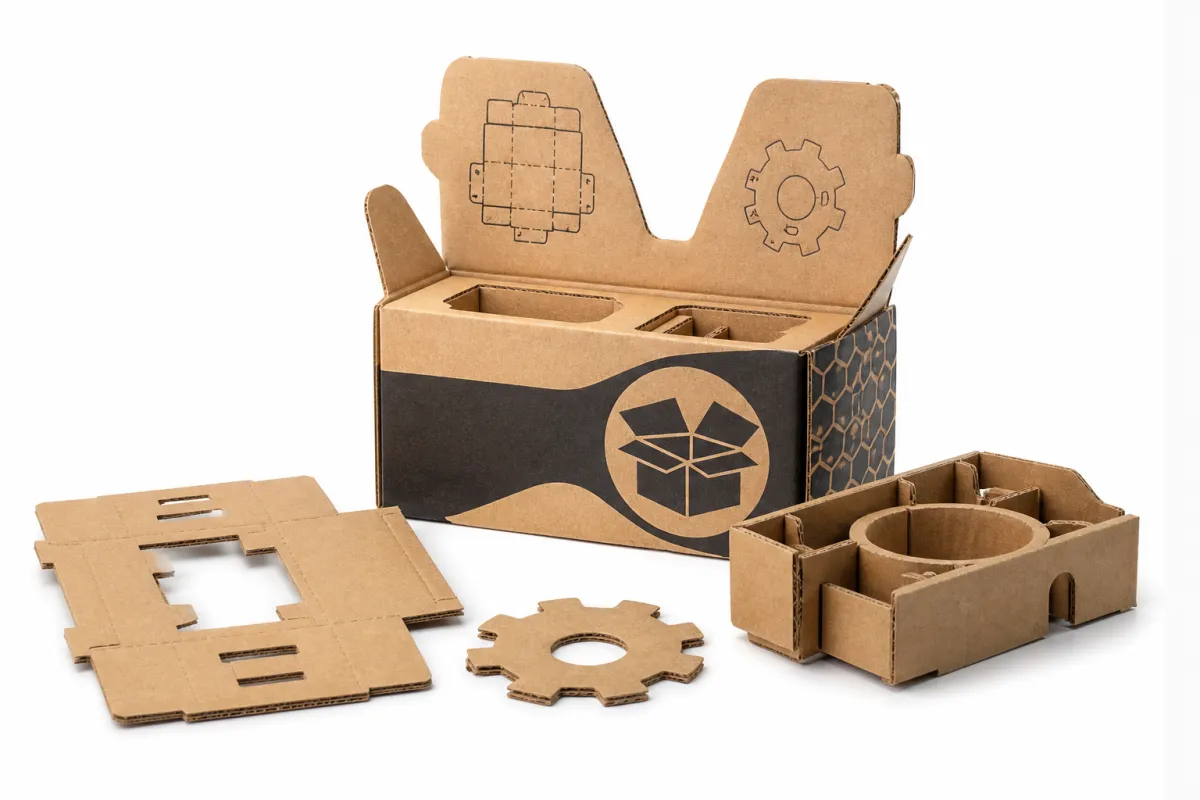
Custom corrugated die cutting is the process of cutting corrugated board into a precise shape with a steel-rule die. That die acts like a custom template. It trims, scores, perforates, and forms board into structures that a standard slotted carton cannot produce cleanly. Handles, tabs, locking flaps, display openings, mailer-style closures, inserts, and nested compartments all become possible once the board is cut to fit the product instead of the other way around.
That precision matters more than many buyers expect. A regular box can be fine for a basic shipper, but once a product has an odd footprint, a fragile surface, or a premium presentation requirement, custom corrugated die cutting can make the package fit the product instead of forcing the product to adapt to the box. That usually means less movement inside the carton, less filler, and a better first impression when the customer opens it.
A box that looks more specialized can still ship cheaper. Better fit can reduce cube size, and cube size affects dimensional-weight charges in parcel networks. Tighter sizing can also improve pallet efficiency, which matters when a warehouse is paying to move air instead of product. For many brands, custom corrugated die cutting is one of the few packaging decisions that influences protection, freight cost, and presentation at the same time.
From a packaging buyer's point of view, this is where standard cartons stop being enough. The format starts to matter when one or more of these conditions show up:
- The product is awkwardly shaped or has accessories that need a fixed location.
- The contents are fragile, glossy, or easy to scratch.
- The pack needs to look polished for retail packaging or direct-to-consumer shipping.
- Multiple items must be kitted together in one carton.
- Unused space is driving up shipping cost or damage risk.
There is also a branding angle. Custom corrugated die cutting can be paired with custom printed boxes, windows, tear strips, or presentation folds that improve package branding without turning the design into something expensive or fragile. Embossing is more common in paperboard than corrugated, yet the same visual thinking applies: the package can signal quality through structure, not only through ink coverage.
If you are comparing packaging formats, it helps to remember that the question is not whether a stock carton can work. The better question is what the total cost of using the wrong carton looks like. For some programs, the answer includes filler material, rework, labor, freight penalties, and product returns. For others, it is simply too much air in the box. A good packaging decision should be able to stand up to that kind of scrutiny without getting slippery about the numbers.
If you want to compare related formats, our Custom Packaging Products page is a useful starting point, and our Custom Shipping Boxes selection can help you see where a die-cut structure fits in a broader packaging line.
Custom Corrugated Die Cutting Process and Timeline
The usual custom corrugated die cutting workflow starts with the product, not the box. Good converters ask for exact outside dimensions, weight, accessories, shipping mode, and the intended handling environment before drawing anything. That sounds basic, but it is the point where many projects go off track. If the spec sheet is vague, the dieline is built on assumptions, and assumptions tend to get expensive once production starts.
The process usually looks like this:
- Spec gathering and use-case review.
- Dieline development, including cut lines, score lines, and closures.
- Tooling or die fabrication.
- Board selection by flute, grade, and liner weight.
- Test cutting, folding, and assembly checks.
- Printing, if the job includes branding or product information.
- Final die cutting, gluing, finishing, and packout verification.
That sequence can move quickly or slowly depending on how clean the inputs are. A simple, rework-free custom corrugated die cutting project with an existing die and approved artwork may move through production in roughly 7-12 business days. A first-time design with prototypes, revisions, and a new steel-rule die can take 2-4 weeks, sometimes longer if board stock or print scheduling is tight.
Delays usually do not happen in the cutting itself. They come from missing details, late artwork changes, or a design that has not been pressure-tested against real handling. The most common problems I see are:
- Product dimensions measured without accounting for inserts, coatings, or closure thickness.
- Late changes to logos, barcode placement, or warning text.
- Unclear stack limits for pallet loads.
- Tabs that are too small to hold under vibration or compression.
- Wrong assumptions about crush direction or flute orientation.
One practical way to reduce friction is to ask for a prototype before production approval. That sample can reveal whether the package assembles cleanly, whether the part shifts during closing, and whether the board choice is strong enough for the load. For a fragile product or a premium branded packaging program, that small test is cheap insurance. It is also the point where a buyer can catch the little annoyances that no render will ever show you.
Custom corrugated die cutting also behaves differently by order size. Short runs can move fast once the die exists, but the economics are less forgiving because setup is spread across fewer cartons. Larger runs take more planning, yet they often improve per-unit cost and packing consistency. That is one reason many teams start with a pilot run, then scale only after fit and shipping performance are proven.
For testing, a packaging engineer will often look at an ISTA profile or a similar transit method, especially for parcel shipments. If the pack is going through e-commerce channels, ISTA is a practical reference point for distribution testing, while EPA sustainable materials guidance is useful when a brand wants to balance protection with waste reduction.
Key Factors That Affect Fit, Strength, and Performance
Custom corrugated die cutting is only as good as the board underneath it. A beautiful dieline built on the wrong board grade still fails. The three variables that matter most are flute profile, liner strength, and board construction. In simple terms: the flute controls cushioning and stack behavior, the liners control surface quality and strength, and the overall board grade controls how the package survives compression, moisture, and handling abuse.
For lighter retail packaging or e-commerce inserts, E-flute and B-flute are often attractive because they score cleanly and print well. For heavier shippers, C-flute or double-wall constructions may be more appropriate. A 32 ECT single-wall board may be fine for some parcel items, but if the load is stack-heavy or the product is dense, 44 ECT or a stronger construction may be a safer call. That is not always the answer, because product geometry and distribution route matter too, but it is a useful starting point.
Fit is the next layer. A package can look tight on a mockup and still allow too much movement once the real item goes in. That is where inserts, partitions, lock features, and clearance allowances earn their keep. In custom corrugated die cutting, a few millimeters can change the assembly experience, the product protection level, and the amount of void fill needed in production.
The shipping environment matters just as much. A carton that performs fine on a local pallet route may fail once it sees long-haul parcel movement, temperature swings, or humidity. Corrugated board loses performance when moisture rises, and warehouse compression can expose weak score lines or poorly placed cutouts. If the product is valuable, the packaging should be tested in conditions close to real use, not only on a designer's screen.
Branding matters too. Buyers often think of custom corrugated die cutting as a technical decision only, but it can shape the entire customer experience. Die-cut windows, tear-away openings, tuck-in flaps, and retail-ready structures make the package feel intentional. Add a clean print layout or a simple one-color logo, and the box becomes part of the product story instead of background noise.
A good converter will ask whether the pack is meant for:
- Parcel shipping with repeated touchpoints.
- Palletized freight with compression on top.
- Retail display where visual appeal matters.
- Kitting or subscription fulfillment where packout speed matters.
- Long-term storage where humidity and stacking are a concern.
That is why custom corrugated die cutting often beats a generic custom printed box on performance. The difference is not only the print. It is the geometry. A box with the right folds, scores, and closures can save labor at the packing table and reduce the chance that a product shifts during transit.
One more practical note: not every feature belongs on corrugated board. Deep embossing, delicate pop-outs, and ultra-fine details can be difficult or wasteful if the board is too heavy or the structure is too large. Good packaging design respects the material. It does not fight it. That restraint usually makes the final pack stronger, cleaner, and easier to run on the line.
Custom Corrugated Die Cutting Cost, Pricing, and MOQ
The cost of custom corrugated die cutting usually breaks into four buckets: tooling, board, print, and labor. Tooling is the up-front expense for the die. Board cost changes with flute, grade, and liner composition. Print cost depends on coverage, number of colors, and whether the job uses flexo, litho-lamination, or digital methods. Labor rises when the structure is complex, nested, or difficult to assemble.
For a rough planning range, a simple steel-rule die might cost $250-$700. More complex multi-feature tools can land between $800 and $1,500 or more. Unit pricing can vary widely, but many projects fall somewhere around $0.55-$2.50 per unit depending on size, print coverage, board grade, and quantity. A 500-piece run will almost always cost more per box than a 5,000-piece run, because setup is being spread across fewer units.
MOQ is where buyers feel the tension. Lower minimums are attractive, especially for launch programs and seasonal products, but they usually carry a higher unit price. Larger volumes improve economics faster, yet they demand more storage and more confidence in the design. In custom corrugated die cutting, the right MOQ is not the biggest one available. It is the smallest one that still gives you a useful unit cost and enough room to validate the pack.
Here is a simple comparison that many teams find useful during sourcing:
| Packaging Option | Tooling Cost | Typical Unit Cost | Best Use Case | Main Tradeoff |
|---|---|---|---|---|
| Stock corrugated carton | $0 | $0.35-$1.00 | Simple, predictable shipments | Loose fit and extra filler |
| Modified standard carton | $50-$200 | $0.45-$1.20 | Minor size adjustments | Limited geometry and branding |
| Custom corrugated die cutting | $250-$1,500+ | $0.55-$2.50 | Odd shapes, inserts, retail-ready features | More setup and design time |
The cheapest quote is not always the lowest total cost. That is the trap. A slightly more expensive custom corrugated die cutting spec can lower filler usage, reduce packing labor, and cut damages enough to beat a cheaper box on total landed cost. I have seen programs where the box price rose by a few cents, but the overall distribution spend still went down because there were fewer returns and less manual packing.
Hidden costs matter too. Sample rounds, freight, rush fees, storage, and rework can quietly change the final number. If a buyer approves a dieline without checking tolerance or stack behavior, the project may need a second sample or a board change. That extra round often costs more than simply testing earlier. For that reason, the right way to evaluate custom corrugated die cutting is to look at unit cost, damage risk, labor, and transit performance together.
Brands that care about product packaging economics should also ask whether the design allows for print consolidation. If the same structure can support seasonal art, SKU changes, or a reusable base with changeable sleeves, the long-term cost can improve. That is particularly useful in branded packaging programs where the outer presentation changes more often than the product dimensions.
Step-by-Step: How to Order Custom Corrugated Die Cutting
The cleanest way to order custom corrugated die cutting is to start with a short, accurate spec sheet. Do not begin with the artwork. Begin with the product. Give the supplier exact dimensions, the packed weight, the number of components, the shipping method, and any fragility notes. If the box is going to a parcel network, say so. If it will be palletized, say that too. The more honest the input, the less guessing in the die line.
Once the product details are clear, the packaging team should define what the box must do. Protect the item? Hold a set of parts? Present well on shelf? Speed up fulfillment? One package can do several of those things, but it helps to rank them. A structure optimized for warehouse speed may not be the same one that looks best in retail packaging. That tradeoff is normal, and custom corrugated die cutting handles it well if the priorities are set early.
Next comes the dieline review. This is where score lines, tuck flaps, cutouts, partitions, and closure features are mapped out. Ask the converter to show the fit with real dimensions, not just a sketch. If the product needs foam, pulp, paperboard, or corrugated inserts, those should be designed at the same time. A good dieline is not just a shape; it is a packing sequence.
Then request a prototype or sample run. This is the step many teams skip, and it is usually the expensive mistake. A sample can reveal whether the carton opens too slowly, whether the product rattles, and whether the tabs are too tight for a busy line. For custom corrugated die cutting, a prototype is especially useful if the item is fragile, premium, or sold in high volume. Small errors multiply quickly when a line packs hundreds of units an hour.
After sample approval, lock the specs. That means confirming:
- Board grade and flute direction.
- Print method and ink coverage.
- Die cut dimensions and tolerance targets.
- Carton count per bundle and pallet pattern.
- Assembly method, including glue or locking features.
If you are comparing production capabilities, our Manufacturing Capabilities page is useful for understanding how print, conversion, and finishing fit together. That matters because custom corrugated die cutting often works best as part of a broader packaging workflow, not as a stand-alone order.
One more buyer tip: approve the artwork only after the structure is locked. Artwork changes late in the process can shift barcode placement, hide cut lines, or create print conflicts near folds. I have seen clean structural concepts become messy simply because the label, logo, and legal copy were approved out of sequence. Keep the package and the print plan aligned from the start.
For brands with multiple SKUs, it can help to standardize one or two base sizes and vary inserts rather than rebuilding every carton from scratch. That approach often reduces MOQ pressure and keeps custom corrugated die cutting efficient across a product line. It is not right for every item, but for a family of related products it can save time and simplify procurement.
Common Mistakes in Custom Corrugated Die Cutting
The most common mistake in custom corrugated die cutting is designing for appearance alone. A graceful shape on screen can fail in the warehouse if the walls are too thin, the score lines are too tight, or the load shifts during vibration. A package should look good, yes. More than that, it should survive reality.
Tolerance errors come next. Many teams measure the product, add a little clearance, and assume that is enough. It usually is not. Once you account for inserts, coatings, folds, and human variation on the pack line, the usable space changes. A design that is 2 mm too tight may still close in a mockup but slow down a real production run. In custom corrugated die cutting, small dimensional mistakes often become labor problems before they become shipping problems.
Another issue is feature overload. Tiny tabs, too many unique folds, or decorative cutouts can look clever and still slow everything down. Each extra feature adds a chance for tear-out, misalignment, or scrap. That is especially true on lower-volume runs where setup time is already significant. Simpler structures often win because they are easier to cut, fold, and ship.
Testing gaps are another quiet failure point. A package that passes visual inspection can still fail in transit. Drop testing, vibration testing, and compression checks are worth the time, especially if the product has a high replacement cost. For parcel programs, an ISTA-based sequence is a practical benchmark. For freight and pallet loads, compression and stacking checks matter more. In either case, custom corrugated die cutting should be verified under conditions that resemble the actual distribution path.
Here are the mistakes I would watch for most closely:
- Not measuring the product with accessories attached.
- Ignoring how fast the pack must be assembled.
- Choosing a board grade that is too light for the load.
- Forgetting how humidity affects corrugated performance.
- Skipping prototype approval because the first sample looks close enough.
There is also a branding mistake that shows up more often than people admit. Teams sometimes overload the box with graphics and lose the structure. A clean logo, one clear message, and good fit often outperform a crowded design. That is true in branded packaging, custom printed boxes, and retail packaging alike. Structure carries more weight than decoration when the customer receives the box crushed at one corner.
If a project includes multiple packaging formats, keep the line of sight clear. Compare the carton against any inner trays, sleeves, or accessories before locking production. A small mismatch between components can create friction at fulfillment, and friction shows up as labor cost. That is why custom corrugated die cutting should be treated as part of the whole product packaging system, not only the outer shell.
Expert Tips and Next Steps for Smarter Packaging
If you want better results from custom corrugated die cutting, start with a one-page spec sheet. Keep it practical: product dimensions, weight, board preference, shipping mode, target quantity, and whether the package must support retail display or warehouse stacking. That document does not need to be fancy. It needs to be accurate.
My strongest recommendation is to ask for two versions of the concept if the project is important. One version should be tuned for the lowest unit cost. The other should be tuned for protection or packing speed. When you compare them, do not just compare box price. Compare total cost, including labor, filler, freight, and expected damage risk. That comparison usually reveals the better option in a way a single quote never can.
For fragile goods, premium goods, or high-volume launches, insist on a pilot run or a physical sample approval. A small design flaw can become a large-scale problem once the carton is on a shipping line. That is especially true if the design uses insert tabs, unusual folds, or close tolerances. Custom corrugated die cutting works best when the final approval is based on real handling, not a render.
It also pays to think about future changes. Can the structure hold the same product if the accessory set changes? Can the print survive a seasonal update? Can the design support a light branding refresh without a full rebuild? Those questions help brands avoid unnecessary retooling and keep packaging design flexible. They also make procurement easier because the packaging system is not locked into a single fragile setup.
If you are still deciding between formats, compare the packaging structure against your broader line. Our Custom Packaging Products catalog can help you see the range of options, while Custom Shipping Boxes can show where a die-cut design is the right answer and where a simpler format is enough. A good packaging program is not about forcing every job into one structure. It is about matching the structure to the actual risk.
Here is the implementation checklist I would use:
- Verify product measurements with accessories in place.
- Confirm board grade, flute, and print method.
- Review the dieline with packout speed in mind.
- Test fit, stack strength, and transit performance.
- Approve the production proof only after sample review.
- Scale only after the box performs in real conditions.
If the packaging supports retail branding, keep the visual system restrained and deliberate. A simple logo, clean typography, and a structural feature that adds function will usually feel more premium than a busy surface. That is where package branding becomes more convincing: not louder, but better built. In the right program, custom corrugated die cutting does more than hold the product. It supports the whole buying experience.
When the design, tooling, and volume line up, custom corrugated die cutting can reduce filler, improve freight handoffs, and make the product easier to handle from plant to customer. That is the real value. Not just a custom shape, but a packaging system that fits the product, the pallet, and the business model. The practical takeaway is simple: start with the product dimensions, test a physical sample before volume, and judge the box by its full landed cost rather than the unit price alone.
What products are best for custom corrugated die cutting?
Products with unusual shapes, fragile surfaces, or accessory kits benefit most because custom corrugated die cutting can add precise inserts, cutouts, and secure closures. It is especially useful when standard cartons waste too much space or do not protect the product well during parcel or pallet shipping. Common fits include electronics, cosmetics, subscription kits, industrial parts, and retail-ready packaging.
How does custom corrugated die cutting differ from regular carton making?
Regular cartons usually follow simple fold patterns, while custom corrugated die cutting creates custom cut lines, folds, locks, handles, windows, and inserts. Die-cut packaging is more precise and flexible, but it can require more upfront setup and tooling than stock box styles. The payoff is better product fit, faster packing in some workflows, and stronger brand presentation.
How long does custom corrugated die cutting usually take?
Timelines depend on whether the die already exists, how complex the design is, and how quickly artwork and specs are approved. Prototype rounds add time, but they can prevent costly mistakes later in production and shipping. Rush jobs are possible, yet they often cost more and leave less room for testing.
What affects custom corrugated die cutting cost the most?
Tooling, material grade, print requirements, order quantity, and the number of unique cut features all influence price. Smaller orders usually have a higher unit cost because setup is spread across fewer cartons. The cheapest quote is not always the lowest total cost if it leads to damage, slower packing, or extra filler.
How can I reduce waste in a custom corrugated die cutting project?
Start with accurate product dimensions and shipping requirements so the design does not oversize the carton. Standardize insert sizes and limit unnecessary features that increase scrap or complicate manufacturing. Test a prototype before full production to catch fit issues before material is committed at scale.

