Buyer Fit Snapshot
| Best fit | Custom Mailer Bag Pricing projects where brand print, material claims, artwork control, MOQ, and repeat-order consistency need to be specified before quoting. |
|---|---|
| Quote inputs | Share finished size, material target, print colors, finish, packing count, annual reorder estimate, ship-to region, and any compliance wording. |
| Proofing check | Approve dieline scale, logo placement, barcode or warning zones, color tolerance, closure strength, and carton packing before bulk production. |
| Main risk | Vague material claims, crowded artwork, missing packing details, or unclear freight terms can make a low unit price expensive after revisions. |
Fast answer: Custom Mailer Bag Pricing: What Actually Drives Cost should be specified like a repeatable production item. The safest quote records material, print method, finish, artwork proof, packing count, and reorder notes in one written spec.
Production checks before approval
Compare the actual filled-product size with the drawing, then confirm tolerance on folds, seals, hang holes, label areas, and retail display edges. Reserve space for logos, QR codes, warning copy, and material claims before decorative graphics fill the panel.
Quote comparison points
Review material grade, print process, finish, sampling route, tooling charges, carton quantity, and freight assumptions side by side. A quote is only useful when the supplier can repeat the same color, closure quality, and packing count on the next order.
Custom mailer bag pricing can look tidy on paper, but once you get into material gauge, print coverage, artwork setup, freight, and order size, the number starts behaving a lot less like a shelf tag and a lot more like a manufacturing formula. That is the part that tends to frustrate buyers: they want one clean per-bag figure, while suppliers are pricing a bundle of choices that all nudge the final result in different directions. A quote that seems simple often has several moving parts tucked inside it.
From the buyer side, the better question is not, "What does one mailer cost?" It is, "What combination of size, film, print, and shipping gives me the best landed cost without weakening protection or making the pack look off-brand?" Once you frame it that way, custom mailer bag pricing gets a lot easier to manage. The number is rarely random. It usually comes from predictable inputs, and most of those inputs can be adjusted if you know where the cost pressure sits.
That matters because packaging has to do more than move a product from point A to point B. It has to protect the item, support branded packaging, carry a clear piece of package branding, and still stay inside a margin target that may already be tight. The same pressure shows up across Custom Packaging Products, from inserts to custom printed boxes, though mailers often get closer scrutiny because shipping and material costs are sitting right on top of each other.
Here is the practical side of it: if you understand how custom mailer bag pricing is built, it becomes much easier to compare suppliers, spot missing costs, and decide whether a cheaper quote is actually cheaper. That is the real goal here, not a perfect formula. Packaging pricing is messy. The trick is knowing which parts of the mess matter most.
Why Custom Mailer Bag Pricing Feels Hard to Pin Down
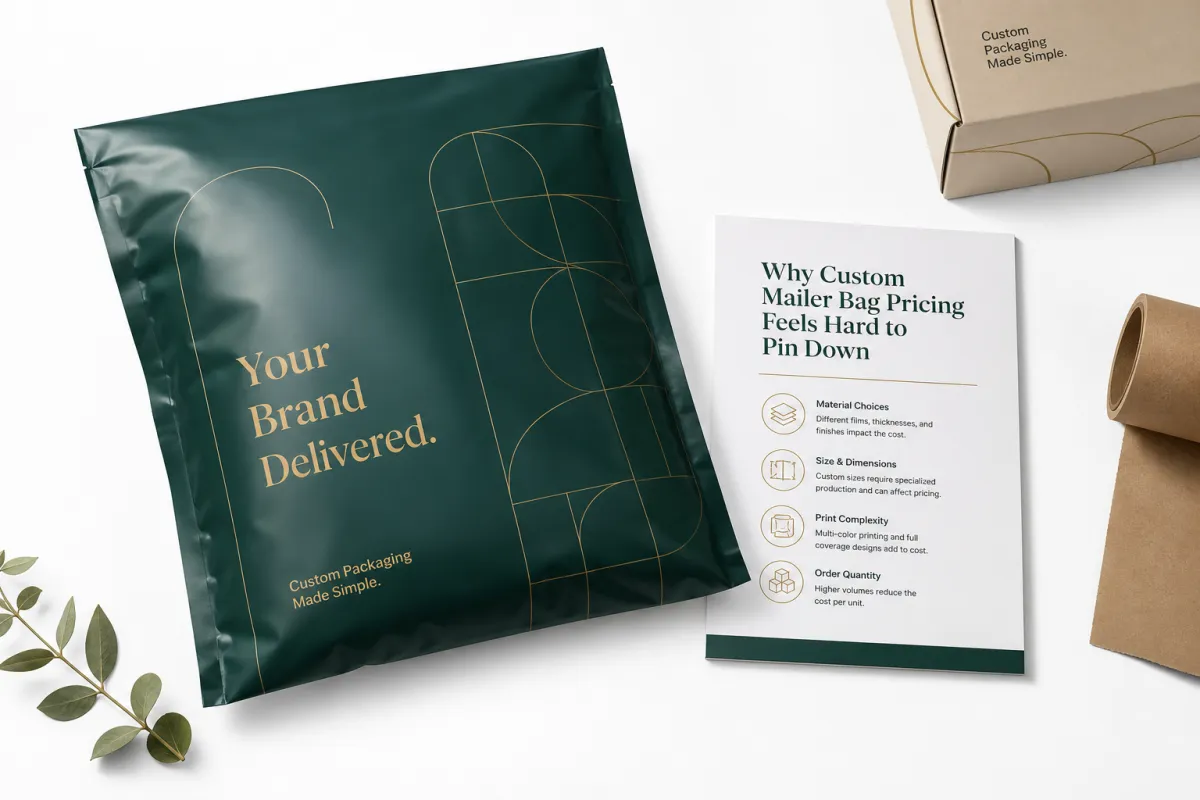
Picture two poly mailers side by side. Same width. Same height. Same basic shape. One comes back at a low number, while the other lands 18% higher. That gap usually has nothing to do with a supplier being inconsistent or casual. It usually comes down to material gauge, print method, bag construction, and the way the order moves through the supply chain. In practice, custom mailer bag pricing behaves less like retail pricing and more like a recipe with several ingredients that all matter.
The tension is easy to understand. Buyers want a single number because budgeting works better that way. Suppliers are looking at resin cost, setup time, minimum order quantity, waste allowance, carton configuration, and freight. If a quote feels uneven, the first step is checking whether the compared offers are built on the same basis. Very often, they are not. One supplier may quote ex-works, another FOB, and a third may already include inland freight. That alone can make custom mailer bag pricing look much more scattered than it really is.
There is also a mental trap at work. A plain-looking mailer can feel basic, so buyers assume the price should be basic too. But even the simplest bag may use a different resin blend, a different film thickness, or a different sealing format. A 2.5 mil bag and a 3.0 mil bag do not behave the same in production or in transit. Print changes the picture too. A one-color logo on a single panel is not the same economic event as a full-bleed graphic with multiple colors and tighter registration. Once that difference is visible, custom mailer bag pricing starts to make more sense.
The core reality is plain enough: price is usually not arbitrary. It responds to a handful of inputs that buyers can see, ask about, and tune. I have seen a lot of packaging teams save time just by getting those inputs lined up before asking for a quote. That saves everybody a round or two of back-and-forth, and honestly, it keeps the conversation grounded.
What Custom Mailer Bag Pricing Actually Includes
A useful quote should tell you what you are paying for, not only what the final number is. The basic building blocks of custom mailer bag pricing usually include the substrate or film, finished bag dimensions, printing method, closure style, finish, and order quantity. A careful supplier should also show whether setup, plates, proofs, and freight are inside the quote or sitting outside it.
The biggest line item is usually the film itself. Standard polyethylene, recycled-content polyethylene, and compostable films all behave differently. Different gauges do too. A 2.0 mil film will not price the same as a 3.0 mil film, and a heavy-duty bag for premium apparel will use more resin than a bag built for lightweight accessories. Those choices show up directly in custom mailer bag pricing.
Print comes next. Flexographic printing may require plates, while digital output can avoid some of that setup cost but carry a higher unit price on longer runs. If the artwork is simple, the economics can stay favorable. If the bag needs full-wrap artwork, multiple spot colors, or a special finish, the quote rises. That is where custom mailer bag pricing often surprises people, because the jump from a small logo to full coverage can be bigger than expected.
Minimum order quantity matters too. A lower MOQ is convenient, but convenience is not free. Setup cost still has to be spread across fewer units, so the per-bag number climbs. That is why a 2,500-piece run and a 10,000-piece run can feel like two different products even when the bag itself is identical. For many buyers, especially growing brands, this is the point where custom mailer bag pricing stops being a quote and starts becoming a volume strategy.
Separating unit price from landed cost helps a lot. Unit price is the bag alone. Landed cost includes freight, duties, taxes, cartonization, and sometimes warehousing or receiving charges. A quote that looks 7% cheaper can end up costing more after the shipment clears. That is why comparing only the per-bag number is one of the fastest ways to misread custom mailer bag pricing.
One of the fastest ways to misread custom mailer bag pricing is to compare a unit price that excludes freight with a landed price that already includes it.
For a clearer view, here is a simple comparison of common mailer options and the price pressure each one tends to create. The figures below are directional, not guaranteed, because order size, artwork, and freight all change the result. If a supplier gives you a quote that falls outside these rough patterns, that does not mean the quote is wrong; it just means another variable is probably in play.
| Option | Typical effect on custom mailer bag pricing | Best fit |
|---|---|---|
| Standard polyethylene, one-color logo | Usually the lowest per-unit cost among custom options; setup cost is spread across volume | High-volume ecommerce shipments and simple brand presentation |
| Recycled-content polyethylene | Often 8% to 18% higher than standard PE, depending on resin market conditions and order size | Brands with a sustainability message that still need durable shipping performance |
| Compostable film | Frequently 2x or more versus standard PE, especially on smaller runs | Premium programs and launches where sustainability claims matter a lot |
| Full-bleed multi-color print | Raises ink, plate, and press time, so the cost step is often noticeable | Retail packaging, fashion drops, and visual-first package branding |
| Added security or convenience features | Tear strip, double seal, or handle options increase both material and setup costs | High-trust shipments, returns-heavy categories, or premium unboxing |
If you are already balancing mailers with labels, cartons, and inserts, it can help to compare the bag program against Custom Poly Mailers and other shipping formats together. A packaging decision made in isolation often looks cheaper than a packaging system designed with the whole order flow in mind. That is especially true when ecommerce fulfillment, retail packaging, and brand experience all overlap.
One more detail buyers sometimes miss: artwork revisions can cost time and money even before production starts. Some suppliers include one proof cycle. Others charge for extra changes. If the design is still moving, custom mailer bag pricing may be only part of the story; the artwork process can quietly add cost too. That is a little annoying, sure, but it is normal. A design that keeps changing has to be rechecked somewhere, and that usually shows up on the quote.
Key Factors Behind Custom Mailer Bag Pricing
Material choice is the first big lever. Standard polyethylene usually gives the lowest base cost. Recycled-content film tends to sit above that, though not always by a dramatic amount if supply is stable and the run is large enough. Compostable materials usually sit much higher because the resin itself is more expensive and the processing window is tighter. That is why two quotes for similar-looking bags can diverge so sharply inside custom mailer bag pricing.
Size is the second lever, and it is more complicated than many people expect. Larger bags consume more film, which is obvious. Less obvious is that larger dimensions can change the production setup, carton count, pallet pattern, and freight density. A bag that ships efficiently in a standard master carton can have a lower landed cost than a bag that wastes cube space. Bigger usually costs more, yes, but not only because of resin. Size affects the whole custom mailer bag pricing equation.
Print complexity is the third lever. One-color branding on a single panel is often far cheaper than full coverage graphics, metallic effects, or multiple print passes. Strong visual design does not always require heavy ink coverage, either. Many brands get better results from a restrained layout, a deliberate type system, and good contrast. That is a packaging choice as much as a budget choice, and it applies across product packaging, retail packaging, and branded packaging.
Functional extras matter as well. Tear strips make opening easier. Double adhesive strips support returns. Tamper-evident closures can improve trust for apparel, accessories, and subscription shipments. Handles can help with carry-out use. Each feature adds value, and each feature also adds material, setup time, or both. In other words, the feature set and custom mailer bag pricing move together.
Volume is the final major lever, and it may be the strongest one. Suppliers can often offer better tiers if a buyer can commit to a larger run or a predictable reorder schedule. That does not mean every team should overbuy. It means forecast discipline matters. A brand that knows it will reorder every quarter can often negotiate a better structure than a brand treating every run as a one-off. In practice, custom mailer bag pricing rewards consistency.
Quality belongs in the same conversation. A cheaper quote that trims film thickness too far can raise failure risk during transit. Parcel testing methods such as ISTA protocols help keep the discussion grounded, because compression, drops, and vibration are real conditions, not theoretical ones. If a mailer tears in transit, the real cost is not the bag price; it is the replacement shipment, customer service time, and damage to brand trust. For that reason, custom mailer bag pricing should be read alongside performance requirements, not apart from them.
Once sustainability enters the brief, the conversation shifts again. Recycled content can support public claims if chain-of-custody documentation is solid, and paper-heavy packaging systems may involve FSC sourcing on the fiber side. On the film side, some buyers also look at ASTM-based performance claims or local recycling guidance from the EPA. Those factors do not automatically make the bag more expensive, but they can shape material selection and therefore shape custom mailer bag pricing. I would be cautious here, though: a sustainability label is not a substitute for performance data. If the bag fails in transit, the greener option still turns into a costly one.
Here is a practical comparison of how the main levers usually stack up:
- Film: usually the largest base cost driver because every bag starts with material.
- Print: often the sharpest swing factor once artwork becomes more complex.
- Quantity: often the biggest influence on unit price because fixed setup gets spread out.
- Freight: can dominate the landed number when the shipment is small or the route is long.
- Features: useful, but each extra option nudges custom mailer bag pricing upward.
If a quote feels out of line, this is the section to inspect first. Most of the time, the gap is traceable. That is good news. It means custom mailer bag pricing can be managed instead of guessed.
Custom Mailer Bag Pricing Timeline: From Quote to Delivery
The timeline matters because time affects price. A supplier working with a relaxed schedule has more room to fit your order into production, choose a cost-effective shipping mode, and reduce last-minute changes. A rushed order compresses all of that. That is why custom mailer bag pricing and lead time are tied together much more tightly than many buyers expect.
The process usually starts with a brief. Size, film type, bag style, closure, artwork, quantity, and destination all need to be clear. If the brief is vague, the first quote will be vague too. Artwork review comes next, and that is where many delays appear. Even a simple logo needs proper color setup, bleed, and placement. If the design is still changing, the supplier cannot lock the production specs. That uncertainty can push custom mailer bag pricing upward because the order becomes harder to schedule.
Proofing follows. Some suppliers send a digital proof. Others provide a physical sample or a pre-production proof. A digital proof is faster, but a physical sample is often better when the bag has a closure feature, a heavy print load, or a size that must fit a specific product. Approval speed matters more than people realize. Every day lost in proofing can change the schedule, and schedule changes can change custom mailer bag pricing if the order slips into a less efficient production window.
Production comes after approval. On many standard runs, buyers often see something like 10 to 18 business days after proof approval, though the exact number depends on factory load, material availability, and print method. If the bag uses specialty film or highly decorated graphics, the window may stretch longer. If the supplier is local and the design is simple, it may be shorter. The point is not to memorize one timeline. The point is to understand that custom mailer bag pricing often includes an implicit time premium when the order needs to move fast.
Shipping closes out the timeline, and it can reshape the quote more than expected. Ocean freight favors larger, planned runs. Air freight favors emergencies, not savings. For small orders, shipping can exceed the value of the bags themselves if the supplier is far away. A very cheap unit quote can still produce an expensive order total. Once again, custom mailer bag pricing only makes sense when the shipping mode is part of the discussion.
To make the timeline concrete, here is a typical sequence:
- Submit the brief and artwork.
- Receive the initial quote and confirm the Incoterms.
- Review the proof and request revisions if needed.
- Approve the final artwork and sample, if one is used.
- Move into production and quality check.
- Ship by the agreed mode and confirm receiving.
That flow sounds orderly, but it is often where delays pile up. A small artwork change can reset the proof clock. A late approval can push the order into the next production window. A missed freight assumption can alter the landed total. For teams tracking margin closely, those are not minor details. They directly shape custom mailer bag pricing and the actual cost of getting product to the customer on time.
A useful mindset shift helps here. The "cheapest" quote is not necessarily the best if it arrives too late, ships too slowly, or forces an emergency replenishment later. A quote that matches the schedule and inventory plan may be the lower-risk, lower-total-cost option. That is often the smarter read on custom mailer bag pricing. It is a little less exciting than chasing the lowest line, but it usually saves more money in the end.
How to Compare Quotes Without Missing Hidden Costs
The cleanest way to compare suppliers is to normalize the quote first. Make sure every supplier is quoting the same bag size, the same film gauge, the same print count, the same quantity, and the same delivery terms. Without that, custom mailer bag pricing comparisons can mislead you in either direction. One quote may look high simply because it includes freight. Another may look low because it leaves setup costs out.
Start by asking for a line-by-line breakdown. At minimum, the quote should show the bag spec, print method, quantity break, setup or plate cost, proofing charge if any, freight assumption, and tax treatment. Ask whether the price includes spare overage for production waste, because some suppliers build that into the quote while others do not. If you are comparing quotes on a spreadsheet, this is the column structure that keeps custom mailer bag pricing honest.
Then check the language. Vague terms like "standard finish," "typical closure," or "estimated shipping" are clues that more information is still buried. A clear quote will tell you whether the order is FOB, EXW, or DDP. That matters. If you do not know who is paying freight, import duty, or domestic delivery, the price comparison is incomplete. This is a common place where poor procurement decisions begin, because custom mailer bag pricing can look lower right up until the receiving invoice lands.
A simple quote worksheet helps. It does not need to be fancy. It only needs to show enough detail that decision-makers can compare the true landed cost, not only the quoted unit cost. If a supplier is friendly but unclear, ask for the missing number. If a supplier is aggressive on price but light on detail, ask again. That habit alone can save a brand a meaningful amount across a year of purchases.
Here is a comparison method that works well in practice:
- Match all specs first: size, film, print, closure, and quantity.
- Normalize freight terms so every quote is either landed or not landed.
- Pull out setup, plates, and artwork charges into separate rows.
- Compare the repeat-order price, not just the first-run price.
- Check whether the bag supports the same performance standard and transit route.
That fifth step matters more than it sounds. If the bag is being used for ecommerce fulfillment, it should hold up under parcel handling, not merely look good in a sample photo. If the same packaging program also touches custom printed boxes or mixed-SKU kits, the bag needs to fit the broader shipping method rather than one isolated item. Good package branding is not only visual. It is operational.
For teams balancing multiple packaging formats, the comparison should include the surrounding materials too. A low-cost bag may not be the real savings if it causes more void fill, more labor, or a higher damage rate. Custom mailer bag pricing needs to be read alongside picking time, packing time, and returns impact. That broader view tends to produce better decisions than chasing the lowest line item.
One more point: repeat orders deserve their own conversation. The first order usually includes setup and proofing. Reorders may be cheaper if artwork and tooling stay the same. Ask how those economics change on the next run. That is often where the most honest picture of custom mailer bag pricing appears.
Common Mistakes That Inflate Cost
The first mistake is treating different materials as if they were interchangeable. A virgin polyethylene film, a recycled-content film, and a compostable film may all be called mailers, but they do not price the same and they do not perform the same. If a buyer compares them without noting the differences, custom mailer bag pricing will seem inconsistent when the real issue is that the inputs were never equal.
The second mistake is underestimating print coverage. A small front logo is one thing. Full-wrap artwork is another. Some teams approve a design on screen and only realize later that the print area covers more surface than expected. Ink use, color count, plate count, and press time all rise. That is how a modest branding upgrade turns into a material budget change. In other words, custom mailer bag pricing can rise fast when visual ambition outruns the brief.
The third mistake is ignoring freight and import charges. A quote that looks attractive on paper may become expensive the moment it crosses a border or has to move by air instead of ocean. Even domestic freight can swing the total materially if the order is small. If your procurement team is comparing supplier A against supplier B, make sure both are quoted on the same delivery basis. Otherwise, custom mailer bag pricing is only half visible.
The fourth mistake is choosing the wrong size. Oversized bags waste film, increase freight cube, and can create a sloppy presentation. Undersized bags create packing headaches and may lead to reorders or product damage. A bag that saves a cent or two but forces a rework downstream is not really saving money. This is one of those packaging decisions where the cheapest option can become the most expensive in aggregate, which is why custom mailer bag pricing should always be checked against actual product dimensions and packing flow.
The fifth mistake is over-customization. Extra seals, extra coatings, extra colors, extra finishes, extra everything. Each add-on sounds minor on its own. Put three or four together and the budget can move well beyond target. From a packaging design standpoint, restraint often wins. A clean, high-contrast layout can carry a strong message without turning the bag into a cost-heavy project. That advice applies just as much to custom mailer bag pricing as it does to other forms of branded packaging.
There is also a strategic mistake worth naming: forgetting to plan the program around the reorder cycle. A team that buys reactively often pays more because every order is rushed. A team that plans ahead can choose better freight, better quantities, and less expensive production windows. That difference can be bigger than many people expect. It is one reason some brands manage their mailers almost as a core supply chain item rather than an ad hoc print job. I have seen that shift save more than a small discount ever would.
If the goal is lower total spend, not just a lower quote, then the best move is to examine the whole use case. How often is the mailer used? What products fit inside? How much damage is acceptable? What is the acceptable lead time? Those questions create better custom mailer bag pricing outcomes than simply asking for a lower number. A cheaper bag that creates more replacements is not cheaper at all, and the budget usually tells on itself pretty quickly.
Expert Tips for Better Custom Mailer Bag Pricing Decisions
Start with tiered pricing. Ask for several quantity breaks so you can see where the unit cost actually drops. Many buyers discover that moving from a small run to a more standard production size changes custom mailer bag pricing far more than changing suppliers does. That is useful because it turns the decision into a volume and forecast question, not just a procurement showdown.
Keep the design disciplined. Standard sizes, fewer colors, and restrained finishing usually lower cost without hurting the brand. A bold logo, clean typography, and thoughtful contrast can do more for recognition than a heavy-handed print build. This is where package branding and economics meet. Good packaging design does not need to be expensive to be memorable. It just needs to be clear.
Plan inventory earlier than feels necessary. That simple habit can save money in two places: production and freight. When the timeline is calm, you can often use slower shipping modes, avoid rush premiums, and give the supplier room to fit the order efficiently into the schedule. For many companies, that is the biggest hidden savings lever in custom mailer bag pricing. If the team is always waiting until the last minute, the quote will tend to remind you of it.
Standardize a few core SKUs if your portfolio allows it. A brand with multiple product lines can often reduce complexity by using one or two mailer formats across several categories. That makes purchasing easier, improves forecast accuracy, and reduces repeated setup. It also makes future quotes easier to benchmark. If you are already using Custom Packaging Products across several channels, standardization can bring real discipline to the packaging system.
Use the right supplier conversation. Instead of asking only "What is your best price?" ask "What does your price include, and what would change the price up or down?" That question tends to surface useful detail. It may reveal that a slightly larger order lowers the unit cost sharply, or that a different closure format improves productivity. Either way, custom mailer bag pricing gets easier to control when the conversation is specific.
It also helps to ask for a repeat-order assumption. If the design is unlikely to change, ask what the next run would cost with plates, tooling, and artwork already in place. That can show whether the first run is expensive because of setup or because the product itself is expensive. Those are two very different situations, and they lead to different purchasing decisions.
For Brands That Sell apparel, accessories, or subscription items, look at the whole unboxing sequence. A mailer that feels flimsy can damage the perception of the product inside. A mailer that is too expensive can hurt margin. The right point is somewhere in the middle, and finding it is exactly what custom mailer bag pricing should help you do. The goal is not the cheapest bag in isolation. It is the best total value for product packaging, retail packaging, and ecommerce fulfillment combined.
If you need a practical checklist, use this one:
- Confirm exact dimensions and material gauge.
- Ask whether freight, duty, and proofing are included.
- Request quantity breaks at several tiers.
- Compare repeat-order pricing against the first run.
- Match the bag spec to real shipping conditions, not just a sample photo.
Those five steps will not eliminate every surprise, but they will eliminate most of the avoidable ones. And that is usually enough to make custom mailer bag pricing feel less mysterious and far more controllable.
Final Takeaway on Custom Mailer Bag Pricing
The best way to think about custom mailer bag pricing is as a system, not a sticker. Material, size, print, features, quantity, proofing, freight, and lead time all shape the final number. Once you start reading quotes that way, the differences stop looking arbitrary. They become explainable, and more important, adjustable.
If a quote looks low, check what is missing. If it looks high, check what is included. If the bag is meant to carry a brand identity as well as a product, weigh the savings against damage risk, setup cost, and shipping efficiency. That is where the smartest packaging decisions usually happen. And if the program includes other formats like custom printed boxes or coordinated inserts, the same discipline will improve the whole packaging stack.
For teams that want a repeatable process, the formula is straightforward: gather exact specs, request comparable quotes, confirm landed cost, and plan the reorder cycle before inventory gets tight. Do that well, and custom mailer bag pricing becomes predictable rather than reactive. That is the difference between chasing quotes and running a packaging program that actually supports the business. The practical takeaway is simple: lock the spec, compare landed cost, and build enough lead time that the quote reflects your real needs instead of an emergency.
FAQ
How much does custom mailer bag pricing usually vary by order size?
It often drops in tiers as quantity rises because setup and production costs are spread across more units. The biggest savings usually appear when moving from a very small run to a more standard production quantity, especially if the artwork and bag specs stay the same. Ask for multiple quantity breaks so you can see where custom mailer bag pricing starts to improve.
What affects custom mailer bag pricing the most?
Material thickness, bag size, and print coverage usually have the largest impact. Freight and packaging method can also matter a lot if the bags are shipping long distances or internationally. Special features like extra seals or handles can push custom mailer bag pricing higher even when the bag looks simple.
Is printed custom mailer bag pricing much higher than plain bags?
Yes, printing usually adds cost, but the increase depends on color count, coverage, and method. A small one-color logo may add only a modest premium, while full-wrap branding is much more expensive. If branding matters, ask whether simpler artwork can deliver most of the impact at a lower custom mailer bag pricing point.
How long does custom mailer bag pricing usually take from quote to delivery?
Quotes may come quickly, but the full process depends on proofing, sample approval, and production capacity. Lead time often stretches when artwork revisions or final approvals are delayed. Rush timelines can increase cost because they limit production and shipping flexibility, which is why custom mailer bag pricing and timeline should be reviewed together.
What is the easiest way to lower custom mailer bag pricing without hurting quality?
Use standard sizes, simplify the print design, and avoid unnecessary add-ons. Request tiered quotes so you can see whether a slightly larger order lowers the unit cost enough to justify it. Compare landed cost, not just unit price, because cheaper shipping or fewer hidden fees may matter more than a tiny per-bag discount in custom mailer bag pricing.

