Buyer Fit Snapshot
| Best fit | Custom Corrugated Display Bins projects where brand print, material claims, artwork control, MOQ, and repeat-order consistency need to be specified before quoting. |
|---|---|
| Quote inputs | Share finished size, material target, print colors, finish, packing count, annual reorder estimate, ship-to region, and any compliance wording. |
| Proofing check | Approve dieline scale, logo placement, barcode or warning zones, color tolerance, closure strength, and carton packing before bulk production. |
| Main risk | Vague material claims, crowded artwork, missing packing details, or unclear freight terms can make a low unit price expensive after revisions. |
Fast answer: Custom Corrugated Display Bins: Design, Costs, and Fit should be specified like a repeatable production item. The safest quote records material, print method, finish, artwork proof, packing count, and reorder notes in one written spec.
Production checks before approval
Compare the actual filled-product size with the drawing, then confirm tolerance on folds, seals, hang holes, label areas, and retail display edges. Reserve space for logos, QR codes, warning copy, and material claims before decorative graphics fill the panel.
Quote comparison points
Review material grade, print process, finish, sampling route, tooling charges, carton quantity, and freight assumptions side by side. A quote is only useful when the supplier can repeat the same color, closure quality, and packing count on the next order.
Custom Corrugated Display bins are one of those packaging pieces that look simple right up until they have to survive a real store. Then all the little decisions show up. Board grade. Flute choice. Load path. Graphics. Refill behavior. Store labor. Suddenly it is not “just a bin.” It is a retail tool that has to hold product, sell product, and stay standing after a few dozen hands have picked through it.
I like these programs because they expose sloppy thinking fast. If the display is weak, people see it. If the refill path is awkward, store teams will tell you. If the graphics are loud but the structure wobbles, the whole thing feels cheap. That is why custom corrugated display bins matter so much for brands that need product to move off the shelf, off a pallet, or off a temporary promo table without building a permanent fixture from scratch.
Custom Corrugated Display Bins: Design, Costs, and Fit sits right at the intersection of merchandising, packaging engineering, and retail operations. The best versions combine branded packaging with a structure that can travel through distribution, land on the floor, and still look intentional after the first wave of shoppers gets to it. That sounds obvious. In practice, it is where a lot of teams get tangled up.
Brands usually reach for these displays during seasonal launches, promotions, clearance events, and fast-turn items that need a little more presence than a plain shipper can provide. They are not the same as standard shipping containers or custom printed boxes. A shipping case protects product. A display bin also has to earn attention. That extra job changes everything.
People miss that part all the time. A good display bin is structure, graphics, and logistics rolled into one package. When those pieces line up, custom corrugated display bins can improve sell-through, reduce handling friction, and make replenishment less annoying for store staff. I have seen small format displays outperform much fancier retail fixtures simply because they were easier to understand and easier to refill.
What Are Custom Corrugated Display Bins?
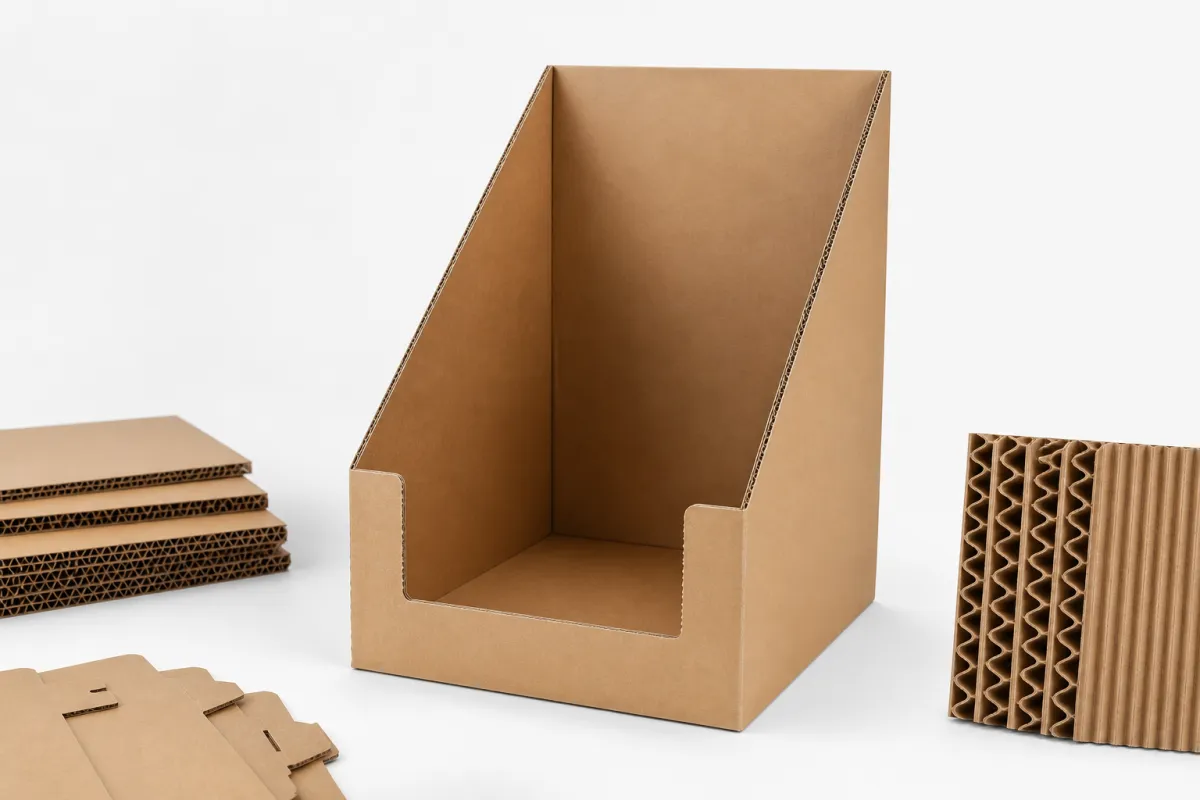
Custom corrugated display bins are merchandising containers made from corrugated board and built for a specific product, footprint, and retail job. They usually ship flat, then assemble into a floor display, counter unit, or pallet-ready presentation on site. You will see them holding snack packs, beauty kits, health items, hardware accessories, and a lot of other SKUs that benefit from being visible instead of buried in a generic case.
The difference between a basic tray and custom corrugated display bins is purpose. A tray can hold things. A display bin is designed around a product load, shopper behavior, and the exact space it needs to live in. That may sound like a small distinction. It is not. A bin built for a six-SKU bundle on a pallet endcap behaves very differently from a compact counter bin near checkout.
Most buyers use custom corrugated display bins when visibility matters as much as capacity. A stack of cases can sit untouched and never earn its keep. A well-built bin places the product in front of the shopper, makes the offer easy to understand, and helps the item feel like an intentional purchase instead of random inventory. That is especially useful for limited-time promotions, seasonal products, and price-point items where impulse matters.
There is also a practical reason teams keep coming back to custom corrugated display bins: they are relatively quick to produce, lighter than permanent fixtures, and easier to adapt when the SKU mix changes. If the promotion shifts from three items to one hero SKU, the structure can often be adjusted without rebuilding the whole program. That flexibility matters when the launch date is fixed and nobody has time for drama.
A display bin looks basic from across the aisle. Up close, it is doing a lot of work: carrying load, carrying graphics, and carrying the store team through the refill cycle.
From an industry standpoint, custom corrugated display bins sit between shipping packaging and permanent retail fixtures. They borrow the protective logic of corrugated board, but the real job is merchandising. They also fit into broader Custom Packaging Products programs, because the display often has to match the shipper, the shelf carton, and the brand system shoppers already recognize.
Think of them as a package with three jobs. Protect the product in transit. Present the product on the floor. Make restocking simple enough that store teams do not start resenting the display by week two. That last part is not glamorous, but it is where a lot of programs live or die.
How Custom Corrugated Display Bins Work on the Sales Floor
The anatomy of custom corrugated display bins is usually straightforward, but every piece affects how the display behaves once it is filled and touched by real shoppers. A typical bin includes a base, side walls, a front lip, a back panel, and sometimes a header card or topper for branding. Many designs also use dividers, inserts, or floor supports to keep product upright and reduce the mess that happens when people grab from the front row and move everything else with it.
Those structural choices matter more than most people expect. Flute direction, score placement, glue tabs, and reinforcement points all affect whether custom corrugated display bins hold shape after a few days on the floor or start to bow under load. A good bin does not need to look heavy. It needs to behave intelligently. Usually that means the load is carried through the side walls and base instead of hanging all its hopes on the front panel with the big graphic.
On the sales floor, the bin has to do two things at once. It has to invite the shopper in, and it has to stay orderly after a bunch of people have already picked through it. That is where custom corrugated display bins earn their keep. A good opening angle, a clear product face, and a front lip that does not block access can make a display feel full without making it impossible to shop. The right layout also shortens refill time, which matters when store teams are busy and kinda running on fumes.
Graphics matter too, but They Work Best when the structure supports them. Bright panels, strong brand marks, and a clean message hierarchy can grab attention from across an aisle. Still, the display has to stay square once customers start pulling product. For that reason, custom corrugated display bins should be treated as part of package branding as much as part of corrugated construction. The image gets the stop. The structure keeps the stop usable.
Here is the simplest way to think about the main parts:
- Base: carries product weight and resists sagging.
- Side walls: stabilize the stack and define the merchandising zone.
- Front lip: holds product in place while keeping access open.
- Back panel or header: supports branding and helps the bin read from a distance.
- Dividers or inserts: organize multiple SKUs and reduce movement inside the bin.
One detail people overlook is refill behavior. Custom corrugated display bins are often stocked by a store associate who has a few minutes and zero interest in solving a puzzle. If the structure makes restocking awkward, the display will get worse even if it looked great on day one. A smarter design gives the worker a clean top-fill path, a predictable pack pattern, and enough stiffness that the bin does not deform every time a case goes in.
For shipments that have to make it through distribution before they ever reach the floor, it helps to think about transport stress early. Standards from groups such as the ISTA can give teams a better framework for compression, vibration, and drop concerns, especially when custom corrugated display bins move through a full retail supply chain instead of a short, controlled route.
Key Design Factors for Custom Corrugated Display Bins
The product itself is the first design input for custom corrugated display bins. Weight, dimensions, package shape, and stack behavior all affect what the display can safely carry. A bin for lightweight sachets is a very different animal from a bin holding glass jars or multipacks. If the merchandise wants to tilt, settle, crush, or slide, the display needs to account for that with board choice, internal support, or compartment design. The bin should fit the product, not bully it into compliance.
The retail environment is the second major input. A display on a wide-open endcap can tolerate a larger footprint and a louder header. A display in a crowded aisle may need a smaller profile and a lower visual horizon. Some custom corrugated display bins are designed to sit on pallets; others are meant for shelves or countertops. Footprint, aisle clearance, nearby traffic, and expected dwell time all shape the final structure. A bin for a two-week promotion can be lighter than one meant to sit in store for a month.
Board grade and flute choice matter a lot too. For lighter loads and sharper print reproduction, a thinner board can be enough. For heavier products or rougher handling, a stronger flute profile or reinforced wall structure may make more sense. There is no universal answer, because custom corrugated display bins live at the intersection of durability, print quality, and cost. The right call depends on what is being carried and how long the display has to survive in the wild. Good packaging design avoids overbuilding where the load is light and underbuilding where the corners will get crushed.
Branding decisions can be just as important as board selection. A display bin may only have a few seconds to communicate the offer, so the message hierarchy has to stay tight. Strong product names, a simple promotional claim, and readable color contrast usually work better than crowded copy. If the shopper has to stop and decode the bin, the design is already asking for too much. Good custom corrugated display bins are readable from a distance and still make sense up close, which sounds simple until you watch people try to do it badly.
Retail compliance needs a seat at the table too. Some stores have dimensional limits, pallet rules, edge-safety requirements, or sustainability expectations that affect what can be accepted. In some programs, the brand may also need FSC-certified materials or a clear recycling path, which is where a system like the FSC becomes relevant. For buyers, these details are not side notes; they decide whether custom corrugated display bins get approved and supported once they arrive.
Here are the main questions I ask before I approve a structure:
- How much does the heaviest filled unit weigh?
- Will the display be refilled from the top, the front, or both?
- Does the retailer require pallet compatibility or a specific footprint?
- Is the product a single SKU, a family of SKUs, or a mixed set?
- How long does the display need to hold up before it is replaced?
One of the biggest mistakes teams make is treating custom corrugated display bins like a graphics project with a little structure attached. The better mindset is the reverse. Start with weight, fill pattern, retail environment, and replenishment behavior, then build the branding around that. That is the difference between a display that looks good in a render and one that actually holds up on the sales floor.
Custom Corrugated Display Bins: Cost and Pricing Factors
Cost for custom corrugated display bins usually comes down to six main variables: size, board strength, print coverage, quantity, die complexity, and finishing. A larger footprint uses more material. A heavier board grade costs more. Full-color graphics across multiple panels raise press time and ink usage. Complex cut lines or special inserts add tooling and setup work. If the display needs coatings, moisture resistance, or specialty treatments, the price climbs again. None of that is mysterious. It is just how corrugated manufacturing works.
Run size makes a bigger difference than many buyers expect. Small runs often carry a higher unit cost because setup and tooling get spread across fewer pieces. Larger programs usually improve unit economics, which is why custom corrugated display bins are often quoted in quantity tiers rather than as one flat number. For a run in the low thousands, the per-unit price can be very different from a run in the tens of thousands, even if the design looks almost identical on paper.
To make the conversation more concrete, here is a simple pricing framework for custom corrugated display bins. These are illustrative ranges for common retail programs, and the final number will depend on structure, artwork, and volume.
| Display Type | Typical Use | Build Characteristics | Indicative Unit Range |
|---|---|---|---|
| Counter bin | Small impulse items, checkout add-ons | Lightweight board, compact footprint, simple print | $0.70-$1.50 |
| Floor bin | Promotional items, seasonal launches | Midweight board, header card, dividers or inserts | $1.80-$3.80 |
| Heavy-duty pallet display | Bulk packages, higher-load promotions | Stronger corrugate, reinforced base, more complex die | $4.50-$9.00+ |
Those numbers are not a promise, and they should not be treated like a quote. They still help frame the economics of custom corrugated display bins. A bin that looks inexpensive on a unit basis may still be expensive once freight, assembly labor, storage, and handling show up. That is why smart buyers ask for landed cost, not just the factory price. A display that is cheaper on paper but slower to assemble can quietly eat the savings in the store.
It helps to look beyond unit price and think about the full program value. If custom corrugated display bins increase sell-through by making the product more visible, if they reduce store labor by making refill easier, or if they protect the product better than a loose open tray, they may support margin in ways that do not show up in a simple quote comparison. That is the real packaging trade-off: you are not only buying corrugated, you are buying floor performance.
Some of the easiest costs to miss sit around the edges of the project. Sampling can add time and money. Freight can swing depending on volume and destination. Warehousing may be necessary if the launch date does not match delivery. Artwork revisions can force extra proof rounds. Assembly labor may need to be counted if the store team will not build the display on site. When teams price custom corrugated display bins, they should ask for the whole picture.
A useful way to keep spending focused is to put budget into the things shoppers will actually notice: structure that stays square, graphics they can read, and a fill pattern that stays tidy. Do not pay for decorative complexity that does nothing to help the item sell. For many brands, custom corrugated display bins work best when the structure is efficient, the print is disciplined, and the budget goes into load-bearing strength where it matters.
Custom Corrugated Display Bins: Process and Timeline
The process for custom corrugated display bins usually starts with information, not artwork. Before design begins, a good supplier or packaging team should gather product dimensions, unit weight, case count, retail footprint, shipping method, and any store or retailer restrictions. Brand files matter too, but the structure has to be built around the real use case first. If that part is vague, the rest of the project tends to drift.
After the initial brief, the engineering or concept phase begins. This is where dielines get developed, load paths are mapped, and the merchandise layout is tested against the available footprint. The team decides whether the display needs a floor box, a header card, a divider set, or a stronger base. For custom corrugated display bins, this is the stage where a lot of future problems can be prevented. A better score line or a stronger side wall can save the whole program from falling apart later.
Samples and prototypes are worth their weight here, especially if the product is heavy, the shape is unusual, or the retailer has strict requirements. A structural sample shows whether the product fits the way everyone thought it would. It also exposes awkward refill behavior, weak folds, or graphics that do not line up with the physical build. A print proof checks color, hierarchy, and message placement. In a careful program, both matter because custom corrugated display bins have to work on two levels: the structure must hold, and the messaging must sell.
For many jobs, the rough timeline looks like this:
- Brief and measurement collection: 1-3 business days, depending on how quickly product specs arrive.
- Concept and engineering: 2-5 business days for a straightforward display, longer for reinforced or multi-piece builds.
- Prototype or structural sample: 5-7 business days, sometimes more if special tooling is needed.
- Artwork proofing and revisions: 1-5 business days per round, depending on stakeholder review.
- Production: often 7-15 business days after approval, with complex work taking longer.
- Freight and delivery: 2-5 business days for many domestic shipments, more for larger or split orders.
That means a simple custom corrugated display bins program can move in a few weeks, while a more complex launch with retailer approvals, multiple revisions, or specialty finishing may take longer. The biggest delays usually come from approvals and revisions, not from the corrugate itself. If the launch date is fixed, the safest move is to start early enough to allow at least one sample round before production is locked.
One more practical note: the schedule needs to account for who is reviewing what. Marketing may care most about the message and color. Operations may care about fill speed and shipping cost. The retailer may care about footprint and compliance. When those stakeholders are aligned early, custom corrugated display bins move forward more cleanly. When they are brought in late, the project usually gets stuck in avoidable revisions.
If the display will travel through broader distribution, it is worth checking the shipper style too. In some programs, Custom Shipping Boxes and the display bin should be developed together so the shipping case supports the retail presentation instead of fighting it. That saves time, reduces repacks, and makes the whole package system feel more deliberate.
Common Mistakes to Avoid with Display Bin Projects
The most common mistake with custom corrugated display bins is designing for graphics first and structure second. A beautiful display that buckles under load is not a win; it is a problem with a pretty face. If the product is heavy, if the store is rough on displays, or if replenishment is frequent, the structure has to be strong enough before anyone starts fussing over finishing touches. Good packaging design keeps those priorities in the right order.
Another mistake is ignoring how the bin behaves after the first few shoppers have used it. Many custom corrugated display bins look great when they are full, then get messy once stock is pulled from the front or the center of gravity shifts. If the design does not support orderly refill and easy front-facing presentation, the display can look tired very quickly. That is especially true for promotions in high-traffic areas where the product gets handled constantly.
Board choice can go wrong in both directions. Some teams pick board that is too light for the product or the environment, which leads to bowing, crushed corners, or product spill. Others overspec every layer and pay for strength they do not need. The goal with custom corrugated display bins is not maximum board at any cost. It is the right board for the actual load, the actual store conditions, and the actual duration of the promotion.
Retailer rules are another place where programs get tripped up. If the footprint is wrong, the bin may not fit the intended location. If the pallet compatibility is off, the store team may reject it. If the design ignores edge safety, foldability, or recycling expectations, it can create a headache before the first unit is sold. A noncompliant display is expensive even if the unit price looked attractive. That is why custom corrugated display bins should always be checked against retailer specs before production starts.
There is also a temptation to overcomplicate the finish. Extra coatings, oversized headers, too many insert variations, or decorative elements that do not help selling can add cost and slow the schedule without improving shopper response. In many cases, a cleaner structure and a sharper message perform better than a crowded, overbuilt display. The strongest custom corrugated display bins are usually the ones that feel simple because the design work was done carefully, not because the team cut corners.
- Do not approve a display without testing the product load.
- Do not assume a good render means a good floor build.
- Do not ignore refill behavior after the first day.
- Do not let retailer rules get reviewed at the end.
- Do not spend on graphics that do not improve readability.
The better habit is to treat custom corrugated display bins as a package system, not a one-off art exercise. When the design, the load, the store environment, and the logistics are aligned, the display does its job quietly and well. When they are not, every weakness shows up on the floor.
Expert Tips and Next Steps for a Better Display Bin Program
If you are planning custom corrugated display bins for the first time, start with one SKU family, one region, or one seasonal test. That gives the team a chance to learn from real store behavior before rolling the structure into a bigger rollout. A smaller test run can reveal whether the fill pattern makes sense, whether the graphics read properly, and whether the display survives actual handling without distortion. That kind of feedback beats guessing from a mockup. Guessing is cheap right up until the program fails.
Ask for both a structural sample and a print proof whenever the timeline allows it. The structural sample tells you whether the bin can support the load, whether the pack-out is practical, and whether the customer-facing shape feels stable. The print proof tells you whether the color, logo placement, and message hierarchy feel right. For custom corrugated display bins, those are different checks, and skipping one usually creates avoidable risk.
Build a basic measurement plan before launch. It does not need to be fancy. Sell-through, refill time, damage rate, and store labor impact are enough to start. If the display sells well but requires constant restocking, that is useful information. If it looks sharp but falls apart in week two, that matters too. The smartest custom corrugated display bins programs get judged on merchandising performance and operational ease, not appearance alone.
Versioning can pay off too. A heavier product may need a stronger base. A premium line may need a cleaner graphic treatment. A mixed-SKU promotion may need dividers, while a single-item feature may not. Instead of forcing one structure to do every job, consider a family of custom corrugated display bins that share a visual language but adjust the build where the load or store condition changes. That approach often performs better without making the program look messy.
From a sourcing point of view, it helps to have the right inputs ready before you ask for a quote. Gather the product dimensions, package weights, target quantities, shipping method, retail constraints, brand files, and a launch window. Then compare a few custom corrugated display bins concepts side by side. One may be cheaper but weaker. Another may cost a bit more but be easier to replenish and safer in transit. The best choice is usually the one that fits both the floor and the budget instead of making one side lose badly.
For teams that want a wider packaging system around the display, pairing the project with Custom Packaging Products can keep the shipper, the shelf carton, and the display language aligned. That kind of consistency matters more than people think, because shoppers and store teams both notice when the package family feels coordinated. It makes the brand look more deliberate, and it makes the execution easier to trust.
My practical advice is simple: start with the product load, design for the store that will actually hold the display, and keep the budget focused on the parts of custom corrugated display bins that affect strength and sell-through. If you do that, you are far more likely to end up with a display that holds product, supports the brand, and earns its place on the floor. That is the point. The rest is just decoration.
How much do custom corrugated display bins usually cost?
Cost depends on size, board grade, print coverage, quantity, and how complex the structure is. Small runs usually carry a higher unit price because setup and tooling are spread across fewer pieces, while larger runs improve unit economics. Freight, samples, and finishing choices can change the total program cost, so it is smarter to compare landed cost rather than only the base quote for custom corrugated display bins.
What is the typical lead time for custom corrugated display bins?
Lead time usually includes concepting, engineering, proofing, production, and shipping, so the schedule is driven by approvals as much as manufacturing. Simple designs move faster, while heavy products, special finishes, or retailer review cycles add time. The safest plan is to leave room for at least one prototype or proof round before the launch date if the custom corrugated display bins are part of a timed promotion.
Which products work best in custom corrugated display bins?
They work well for packaged items that benefit from visibility, easy access, and quick replenishment. Products with moderate weight, consistent packaging, and promotional demand are usually the easiest fit. If the product is unusually heavy, unstable, or fragile, the bin may need inserts, reinforcement, or a different display format, because not every item is a natural fit for custom corrugated display bins.
Do custom corrugated display bins need a prototype first?
A prototype is highly recommended when the design carries weight, has unusual dimensions, or must meet strict retail requirements. A sample can reveal fit issues, weak folds, and awkward refill behavior before a full production run starts. For simpler projects, a print proof and structural review may be enough, but testing still reduces risk with custom corrugated display bins.
How can I make custom corrugated display bins stronger without raising cost too much?
Use the right board grade and flute structure for the product load instead of overspecifying every part of the display. Add reinforcement only where the stress is highest, such as corners, bases, and high-contact edges. Keep the shape efficient and the print strategy focused so the budget goes into stability and shopper impact instead of unnecessary complexity, which is usually the best path for custom corrugated display bins.

