Buyer Fit Snapshot
| Best fit | Custom Corrugated Inserts Quote projects where brand print, material claims, artwork control, MOQ, and repeat-order consistency need to be specified before quoting. |
|---|---|
| Quote inputs | Share finished size, material target, print colors, finish, packing count, annual reorder estimate, ship-to region, and any compliance wording. |
| Proofing check | Approve dieline scale, logo placement, barcode or warning zones, color tolerance, closure strength, and carton packing before bulk production. |
| Main risk | Vague material claims, crowded artwork, missing packing details, or unclear freight terms can make a low unit price expensive after revisions. |
Fast answer: Custom Corrugated Inserts Quote: Pricing & Specs for Buyers should be specified like a repeatable production item. The safest quote records material, print method, finish, artwork proof, packing count, and reorder notes in one written spec.
Production checks before approval
Compare the actual filled-product size with the drawing, then confirm tolerance on folds, seals, hang holes, label areas, and retail display edges. Reserve space for logos, QR codes, warning copy, and material claims before decorative graphics fill the panel.
Quote comparison points
Review material grade, print process, finish, sampling route, tooling charges, carton quantity, and freight assumptions side by side. A quote is only useful when the supplier can repeat the same color, closure quality, and packing count on the next order.
Custom Corrugated Inserts Quote: Pricing and Specs for Buyers A product can look perfect in a prototype and still show up scuffed, loose, or broken because the void space inside the carton was never controlled. A custom corrugated inserts quote should tell a buyer more than a number. It should reveal whether the insert actually stops movement, protects the finish, and keeps pack-out labor under control.
That is why experienced packaging teams treat inserts as part of the shipping system, not as filler. The right structure can cut damage claims, reduce repacking labor, improve consistency at the packing table, and lower wasted cube when the fit is tighter. For branded programs, the insert also affects the unboxing moment, whether the product ships in retail packaging, direct-to-consumer cartons, or a subscription kit. If the outer carton is part of the project, coordinate with Custom Shipping Boxes so the shipper and the insert are built around the same dimensions instead of competing for space.
Buyers usually get better pricing and better designs when they send accurate dimensions, product photos, a target quantity, and a clear shipping goal. That gives the estimating team enough information to price the real job, not a rough guess that has to be rebuilt later. For teams comparing multiple packaging options, it also helps to review the insert alongside other Custom Packaging Products so board grade, structure, and pack-out method are evaluated as one system.
Why a Small Insert Change Can Save a Big Shipment
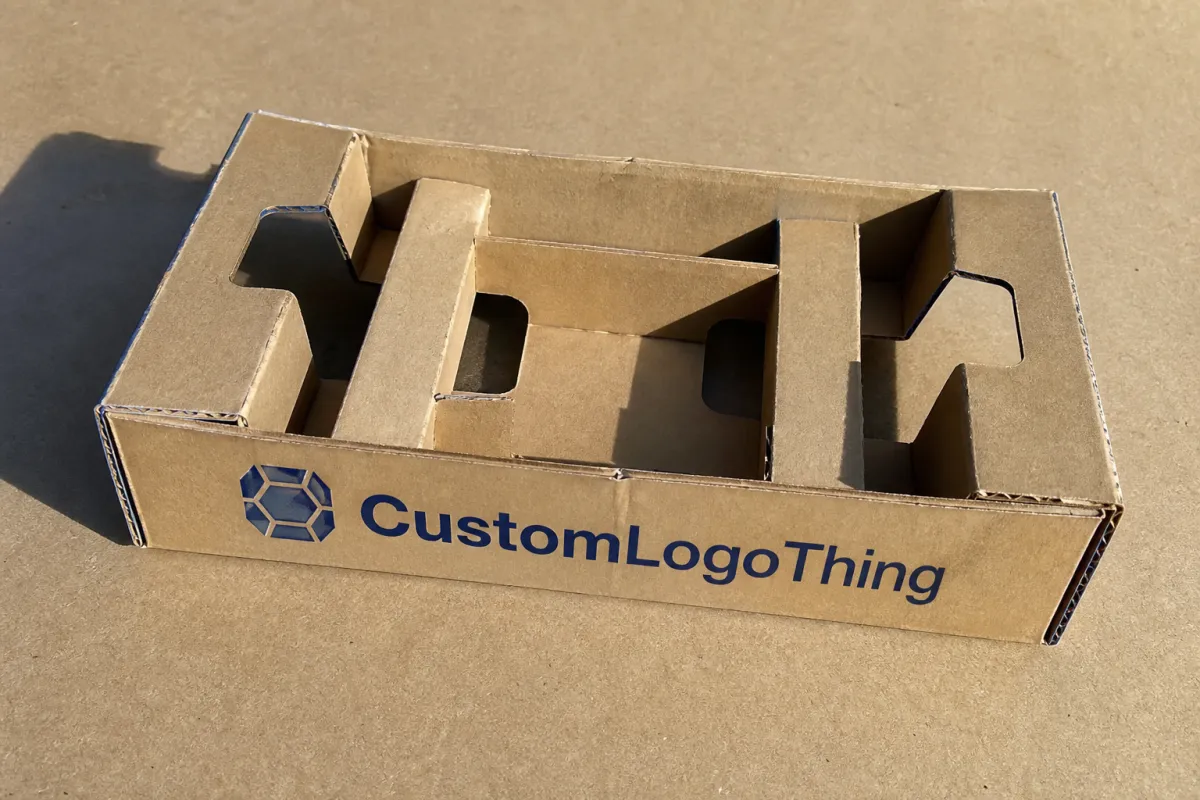
The expensive packaging problem is usually not the carton itself. It is the movement inside the carton: a bottle rubbing against a wall, a device sliding into an accessory, or a display item shifting just enough to chip a corner. A buyer may look at a box that closes cleanly and assume the job is done. Transit vibration, compression, and repeated handling tend to disagree.
That is where a corrugated insert changes the math. One well-designed insert can center the product, separate components from each other, and absorb part of the shock that would otherwise hit the item directly. It also helps the line move faster because packers do not have to improvise with loose fill, paper, or hand-cut dunnage. Across a full production run, that labor savings can matter as much as the material cost.
The cheap carton is not always the cheap shipper. If a lower-cost box damages product, then replacement inventory, customer service time, return freight, and repacking labor wipe out the savings quickly. From a packaging buyer's point of view, the real comparison is landed cost plus performance. That includes the board, the insert, the labor to build the shipper, and the loss rate after transit. For electronics, glass, cosmetics, food gift sets, and other branded packaging programs, the insert is often the piece that turns a carton into a controlled package instead of a hopeful one.
Practical rule: if the product can move, the package is still unfinished. The insert should control motion before the parcel reaches a truck, a sortation lane, or a retail receiving dock.
Better insert design also helps freight efficiency. Smaller void space usually means less overboxing and less wasted air, which can lower chargeable weight on parcel shipments and improve cube utilization on palletized freight. That is not always the deciding factor, but it is rarely irrelevant. A smart custom insert can protect the product while making the shipment tighter, cleaner, and easier to handle.
What Custom Corrugated Inserts Actually Include
Custom corrugated inserts are not one product. They are a family of structures built to do different jobs inside the shipper. Some are designed for cushioning, some for separation, some for presentation, and some for all three at once. The right choice depends on the product, the pack count, the carton style, and the handling environment.
Common insert formats include:
- Die-cut pads that cradle a product, close off voids, or create a flat support surface.
- Layered cushions that build stack height and help isolate fragile items from shock.
- Partitions and dividers that separate multiple units, such as bottles, jars, glassware, or accessories.
- Trays that hold a product in position and improve presentation in retail packaging or gift sets.
- End caps that protect the ends of a product or create a snug fit inside the outer box.
- Fold-in retainers that lock the item in place without a complex assembly sequence.
- Corner-lock structures that stabilize a product with protrusions, handles, or uneven surfaces.
These parts are often made from single-wall corrugated board, but the board choice can move up quickly if the product is heavy, stacked, or shipped through rough handling. Single-wall is common for lighter products and smaller box sizes. Double-wall and heavy-duty constructions are used when stacking pressure, compression, or puncture resistance matters more. Board grade matters as much as thickness in many jobs, so a good estimate should reference the required ECT or, in some cases, a broader BCT performance target for the full shipper.
There is also a big difference between an insert that is merely present and one that truly supports the product. A loose paperboard divider might separate items visually, but it will not necessarily stop vibration. A well-specified corrugated insert can hold tolerances tightly enough that the product arrives in the same position it had at pack-out. That matters in custom printed boxes, and it matters in plain shipper programs where the product is the focus and the packaging has to do the quiet work behind the scenes.
In retail packaging, inserts often carry a second role: presentation. A neat tray or die-cut support can make the product look deliberate, not improvised, which helps package branding feel more complete. In subscription kits and premium bundles, that presentation can be just as important as protection. The buyer still needs the insert to be economical, though, so the best structures usually balance fit, material usage, and assembly time.
If the operation is semi-automated or line-side packed, the insert should also be designed with speed in mind. A structure that folds in one motion or nests cleanly can save real labor across thousands of units. A design that takes five extra seconds per pack may not sound like much, but on a run of 10,000 units it turns into a meaningful labor line item. Accounting notices that kind of thing fast. Usually after the bill arrives.
Specifications That Shape Your Custom Corrugated Inserts Quote
A reliable quote starts with dimensions, but dimensions alone do not tell the whole story. The estimator needs to know the product size, the carton inside dimensions, the desired clearance, and how the product is supposed to sit in the box. A mug standing upright and a circuit board lying flat create two very different insert requirements, even if the carton volume looks similar on paper.
The most useful specifications usually include:
- Product dimensions: length, width, height, and any protrusions or irregular features.
- Product weight: the load the insert must support and how much compression it may see in transit.
- Carton inside dimensions: the true usable space after board thickness is accounted for.
- Pack count: one unit, multiple units, or mixed components with accessories.
- Required clearance: how snug the fit needs to be and where air gaps are acceptable.
- Shipping method: parcel, pallet, LTL, or mixed distribution.
Then come the material and performance details. Flute selection changes stiffness, crush resistance, and print surface quality. Caliper affects the exact fit. Board grade affects how the structure behaves under load, especially if the cartons will be stacked. If humidity, cold-chain exposure, or temperature swings are part of the route, say so early because corrugated performance changes when the environment changes. For some programs, clean handling or food-contact sensitivity is also relevant, and that can change the board and adhesive choices.
Product characteristics matter too. A glossy painted surface scratches more easily than an uncoated industrial part. A heavy metal item may need more compression support than a light cosmetic set. A product with attached accessories, cables, or irregular geometry may need a cutout, notch, or two-piece cradle instead of a simple rectangular pad. If the product has fragile corners or a polished face, the insert should be shaped to avoid point loading and abrasion.
For buyers seeking a stronger estimate on the first pass, sample units help a great deal. A physical sample, a current dieline, or even a few clear photos of the current pack-out can reveal fit issues that dimensions alone miss. The same is true for shipping damage photos. If a current pack-out is failing in one area, showing the failure point lets the packaging team quote the corrective structure instead of guessing at the cause. That usually shortens the revision cycle and keeps the quote closer to reality.
Testing expectations also belong in the spec conversation. Many teams reference ISTA procedures or ASTM-based transit tests to confirm that the package survives the distribution environment. If the program has a sustainability target, note that too. Paperboard sourcing may need to align with FSC expectations, recycled content goals, or internal procurement rules. Those details do not always change the structure, but they can change the approved material set.
Custom Corrugated Inserts Quote: Pricing, MOQ, and Unit Cost
A custom corrugated inserts quote should separate the things that drive price so the buyer can see where the money goes. Board grade is one driver. Cut complexity is another. The number of panels, folds, slots, and glue points adds labor and setup time. Tooling or die cost matters, especially for new designs. Print requirements can also affect price if the insert needs a logo, handling marks, or product identification. Finally, shipping from the converter to the buyer adds to the landed number, and that freight cost can shift if the insert ships flat, nested, or assembled.
MOQ, or minimum order quantity, usually reflects setup efficiency, not just material cost. If a job requires die cutting, sample approval, and make-ready time, the converter needs enough volume to spread those fixed costs across the run. That is why a low-volume order may still be possible, but the unit price is often noticeably higher. Buyers who need a pilot run can still get one, yet they should expect the economics to look different from a production order.
The most useful quotes show multiple breakpoints. A 500-unit price can help validate the structure. A 1,000-unit price can support a launch. A 5,000-unit price can show the real production economics. Comparing those tiers gives procurement a clearer picture of where savings begin. It also reveals whether a design is setup-heavy or material-heavy. If the unit price falls sharply at higher volume, the design may fit a scaled program well.
Here is a practical pricing view, using broad industry-style ranges rather than a promise on a specific project. Actual numbers depend on size, board, location, and finishing:
| Insert style | Typical use | Illustrative unit price at 1,000 units | What usually affects the number |
|---|---|---|---|
| Die-cut pad or simple retainer | Light cushioning, single-product fit, void fill control | $0.12-$0.30 | Board grade, die complexity, and sheet utilization |
| Partition or divider set | Multi-item separation, glass, bottles, accessories | $0.18-$0.45 | Number of slots, board thickness, assembly method |
| Tray or folded cradle | Presentation-focused retail packaging, premium kits | $0.30-$0.75 | Fold count, locking features, and fit tolerance |
| End cap or corner-lock structure | Shock protection for irregular or heavier products | $0.35-$0.90 | Board grade, puncture resistance, and product geometry |
| Double-wall or heavy-duty insert set | Stacked loads, transit stress, stronger compression demands | $0.55-$1.25 | Material weight, panel count, and production handling |
| Pre-assembled kit | Labor-saving pack-out, premium shipment, repeatable setup | $0.95-$2.50 | Assembly labor, kitting, and whether the parts ship nested |
Those numbers are best read as a planning tool. A small insert with a complex die can cost more than a larger simple pad. A double-wall structure can be more economical than a single-wall design if it prevents damage and reduces returns. Landed cost should always be the final comparison point, not the bare unit price alone.
A strong quote also helps the buyer compare pricing models. Some converters quote per insert, some quote per complete kit, and some quote per carton set with the outer shipper included. A full pack-out price can be easier to manage if the assembly is complex, while a separate insert price works better if the outer carton is being sourced elsewhere. Either way, the quote should clearly show what is included so the buyer can compare apples to apples.
Good quoting practice: ask for the unit price, the tooling charge if any, the MOQ, the sample cost, and the freight assumption. A single line item is rarely enough to make a clean purchasing decision.
For many programs, price breaks matter more than the first number on the page. If the insert is part of a recurring product packaging run, a slightly higher initial cost may still be justified if the structure cuts damage and shortens packing time. That is especially true for custom printed boxes and branded packaging where the unboxing experience is part of the product promise, not just a shipping requirement.
Quote Process, Lead Time, and Production Steps
The quote process should be straightforward, even if the design itself is not. Most teams start with an RFQ that includes the product dimensions, photos, quantity, carton size, and the shipping goal. From there, the estimator reviews the structure, flags any unclear assumptions, and returns preliminary pricing. If the project needs structural refinement, the packaging team may suggest board changes, a different insert style, or a revised fit to improve pack-out performance.
Sample lead time and production lead time are not the same thing. A prototype might turn quickly, especially if the structure is simple and the die is already available. Production, however, may require tooling approval, sample revision, and material scheduling before the run starts. For a new design, it is common for sampling to take several business days and for production to take another one to three weeks after final approval, depending on complexity, volume, and current plant load. Reorder jobs are often faster, but not always if the board spec changes.
The schedule slips when the details are incomplete. Dieline approval can take time if the carton inside dimensions are still being finalized. Tooling can create a delay if a new die must be made. Board availability may shift if the selected grade is in high demand. Plant capacity can affect any order, especially near seasonal launches or peak fulfillment periods. Buyers who need a launch date should say so early. That lets the converter work backward from the deadline before commitments are made.
Fulfillment choices also influence lead time and cost. Flat-packed inserts are usually easier to ship and store, and they can reduce freight charges. Nested sets may save cubic space but still require careful handling. Pre-assembled kits reduce labor at the buyer's end, but they typically add assembly cost before shipment. For semi-automated lines, a structure that feeds cleanly and stacks predictably can improve throughput more than a slightly cheaper but awkward design.
That is why a good quote does more than assign a number. It should also explain the path from approval to shipment. Buyers Need to Know whether they are looking at a simple cut-and-ship job, a new design with sample approval, or a full production program with assembly and kitting. If the outer pack needs to be developed too, the team may want to coordinate with the right carton style or review Custom Shipping Boxes at the same time. A controlled package is easier to manage than two separate pieces engineered in isolation.
For programs that depend on retail calendars, replenishment windows, or distributor appointments, timing matters as much as price. A delayed insert can hold up a launch even when the product itself is ready. The safest approach is to build in time for sample review, then keep a small safety stock once the design is approved. That reduces the risk of scrambling for an emergency run with a weakened specification.
Why Buyers Source Corrugated Inserts From a Packaging Partner
There is a real difference between a vendor who sends a number and a packaging partner who understands how corrugated behaves in the field. Corrugated is simple in appearance, but the details matter: flute direction, score lines, panel strength, compression, humidity response, and how the product sits under vibration. A partner who works with those details every day can often reduce board usage without weakening protection, which improves the balance between cost, product safety, and presentation.
Consistency is another reason buyers stay with a partner. Many brands manage several SKUs, seasonal launches, or line extensions, and they need inserts that repeat cleanly from one run to the next. A slight fit change can slow packers down or create a poor presentation in the box. A stable structural spec reduces those surprises, which is helpful whether the product goes into subscription packaging, direct shipping, or retail-ready bundles.
The value also shows up in communication. Clear answers around dimensions, tolerances, samples, and production limits lower rework. If the buyer knows the product has a high-gloss finish, a fragile corner, or an accessory that shifts weight to one side, that information should be in the quote request. It is much easier to solve a fit issue during estimating than after the first packed shipment has already gone out.
Many buyers also want a broader packaging view, not just an insert. They may be working on product packaging, branded packaging, or a refresh of custom printed boxes where the outer shipper and the insert need to carry the same visual standard. In those cases, the insert design becomes part of package branding. The product should open neatly, sit securely, and present cleanly without unnecessary bulk or wasted material.
For sourcing teams, the biggest benefit is practical. A better insert means fewer damages, smoother packing, cleaner unpacking, and a clearer purchasing decision. It also gives procurement a more complete picture of what the final landed package will cost. That is why experienced buyers do not ask only, "How much is the insert?" They ask how the insert performs, how much labor it saves, and how it affects the total system.
Industry references can help sharpen the conversation. Organizations such as packaging.org provide useful corrugated and packaging background, while transit-testing groups such as ISTA help define the rough conditions a shipper should survive. Those references do not replace product-specific testing, but they do keep the discussion grounded in recognized methods instead of guesswork.
How to Prepare a Quote Request That Gets Faster Answers
The fastest quote requests are the ones that answer the packaging team's questions before they have to ask them. Start with the essentials: product dimensions, quantity, carton inside dimensions, the shipping method, and the date you need production or delivery to begin. Those five items give the estimator a framework for fit, volume, and schedule.
Then add visual context. Photos of the product, the current package, or the damage issue can reveal details that dimensions do not show. A curved shoulder, a handle, a cable, a label area, or a fragile finish can all change the insert geometry. If the existing pack-out is failing, include a photo of that failure. It is often the fastest way to show why the current solution is not holding up.
It also helps to define the scope. Do you need inserts only? Do you need the outer carton as well? Do you want the packaging team to refine the carton size so the insert can be simpler? A quote that includes the full pack-out can be more efficient if the project is still in development. A quote for inserts only can be better if the carton is already locked and the inner fit is the only issue.
Ask for at least two volume breaks. A short-run price can help with a pilot, while a production price can support the full rollout. If sample timing matters, request that alongside the quote so the project plan stays realistic. Buyers often lose time by accepting a price without understanding the sample path. A useful estimate should include the expected next step, whether that is a prototype, a dieline revision, or direct production approval.
If the product is sensitive to appearance, say so. If the insert sits inside retail packaging, that needs a different level of finish than a plain transit shipper. If the structure will live inside a premium presentation box, the board edge, the fold quality, and the assembly sequence all matter. If the insert will be hidden but must survive long-distance distribution, protection becomes the priority. Both scenarios can be solved well, but they are not solved the same way.
A useful request to send should include:
- Product photos and dimensions
- Carton inside dimensions or a current dieline
- Quantity per order and forecast volume
- Shipping method and destination type
- Any fragility, finish, or compression concerns
- Sample timing and production target date
If you want the most useful estimate, be specific about the outcome. Say whether the goal is lower damage, faster packing, a tighter fit, a better presentation, or lower freight cube. That gives the estimator a clearer target and usually produces a better structural recommendation. A quote that reflects the real job is far more valuable than the lowest number on paper.
Before requesting pricing, collect the product specs, a few photos, the carton size, the quantity breaks, and the shipping target. That one step usually separates a vague estimate from a useful custom corrugated inserts quote that can actually be compared, approved, and built without a second round of guesswork.
What information do I need for a custom corrugated inserts quote?
Send the product dimensions, weight, quantity, carton inside dimensions, shipping method, and target ship date. Photos of the product and the current pack-out help a lot, especially if the item has irregular shapes, accessories, or damage concerns. A physical sample is even better if you have one. Guesswork is cheap until it becomes freight damage.
How do you determine MOQ for custom corrugated inserts?
MOQ usually reflects tooling, make-ready, and setup time as much as board usage. Lower quantities are possible, but the unit price often rises because the fixed production cost is spread across fewer pieces. A good quote should show price breaks so you can compare pilot and production volumes clearly, not just stare at one lonely number and hope for the best.
Can you estimate a corrugated insert quote before final box artwork is approved?
Yes, if the inside dimensions, product size, and pack configuration are already defined. Artwork can be finalized later, but the structural information drives most of the pricing and fit decisions. If the carton may still change, ask for a revision note or a quote range so the estimate stays useful.
How long is the lead time for custom corrugated inserts?
Lead time depends on whether you need a sample, a repeat order, or a new structure with tooling. Simple repeats can move quickly, while new designs usually need time for sample approval and production scheduling. Ask for separate sample and production timelines so your launch date, replenishment window, and safety stock are all planned on realistic dates.
What affects the price most in a corrugated insert quote?
Board grade, cut complexity, panel count, and tooling are usually the biggest drivers. Volume changes the unit cost quickly because setup expense is distributed across more finished pieces, and freight can also matter if the inserts ship flat, nested, or assembled. If you want an accurate number, give the quote team as much structural detail as you can, then let the numbers reflect the actual package rather than a rough guess. That is usually the best way to turn a request into a useful custom corrugated inserts quote.

