Buyer Fit Snapshot
| Best fit | Custom Corrugated Mailer Boxes Quote projects where brand print, material claims, artwork control, MOQ, and repeat-order consistency need to be specified before quoting. |
|---|---|
| Quote inputs | Share finished size, material target, print colors, finish, packing count, annual reorder estimate, ship-to region, and any compliance wording. |
| Proofing check | Approve dieline scale, logo placement, barcode or warning zones, color tolerance, closure strength, and carton packing before bulk production. |
| Main risk | Vague material claims, crowded artwork, missing packing details, or unclear freight terms can make a low unit price expensive after revisions. |
Fast answer: Custom Corrugated Mailer Boxes Quote: Pricing & Specs should be specified like a repeatable production item. The safest quote records material, print method, finish, artwork proof, packing count, and reorder notes in one written spec.
Production checks before approval
Compare the actual filled-product size with the drawing, then confirm tolerance on folds, seals, hang holes, label areas, and retail display edges. Reserve space for logos, QR codes, warning copy, and material claims before decorative graphics fill the panel.
Quote comparison points
Review material grade, print process, finish, sampling route, tooling charges, carton quantity, and freight assumptions side by side. A quote is only useful when the supplier can repeat the same color, closure quality, and packing count on the next order.
Why a Custom Corrugated Mailer Boxes Quote Starts With the Product
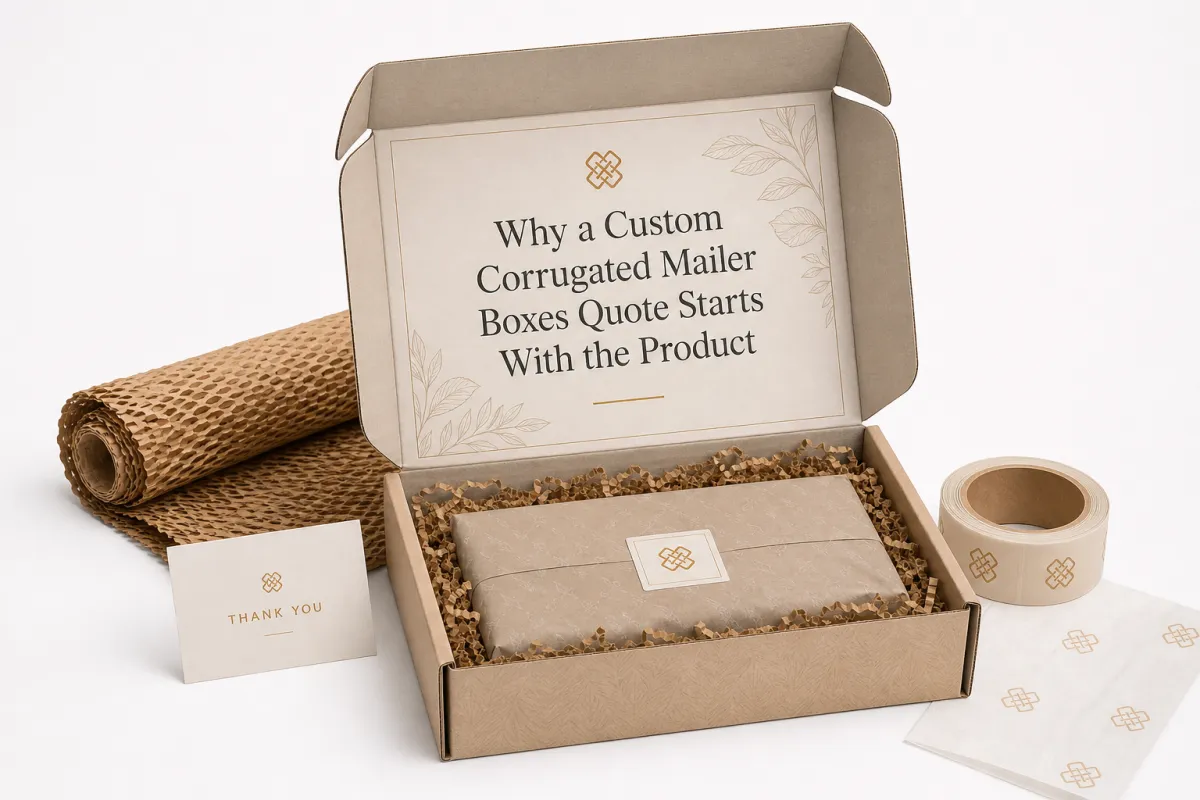
If you want a custom Corrugated Mailer Boxes quote, start with the product, not the packaging fantasy. Two boxes can look identical in a mockup and land at very different price points once board grade, dimensions, print coverage, and quantity are set. A mailer built for soft apparel does not price like one built for glass jars, candles, or a sample kit that has to survive parcel abuse. The quote should reflect what the carton actually has to do, not what it looks like on a screen.
Corrugated mailers keep showing up in ecommerce, subscription shipments, sample kits, and direct-to-consumer orders for a reason. They do three jobs at once: protect the product, present the brand, and pack efficiently on the line. That balance matters. Packaging is never just a shell. It touches labor, freight, returns, damage rates, and the first impression a customer gets when the box lands on the doorstep.
One common mistake is assuming a prettier box automatically costs more. Not true. A simple one-color kraft mailer can come in lower than a plain white box with an awkward structure. A compact full-color box can also price well if the run is large enough to spread setup costs across the order. The real price drivers are usually board thickness, footprint, print method, and any custom tooling needed for the style.
A useful Custom Corrugated Mailer Boxes quote answers a basic question: what does this box need to survive? If it only needs to protect lightweight goods on a short shipping route, the build can stay simple. If it has to carry heavier contents, resist parcel handling, and still open cleanly for the customer, the spec changes fast. Technical packaging design matters here. Fancy branding is great. A box that collapses in transit is not.
I've sat through enough packaging reviews to know the pattern: people fall in love with the render, then act surprised when the carton behaves like a real shipping item. That part is not glamorous. It is, however, where the money goes.
If your project is still broad, compare formats before you lock yourself into one build. Our Custom Packaging Products page is a good place to start, and if you are deciding between a mailer and a different shipping style, our Custom Shipping Boxes category helps frame the choice. The point is not to shove every job into a mailer. The point is to match structure, product, and budget without pretending those things are the same.
What a good quote should do:
- Show how size, board, and print affect price.
- Confirm whether the box is for shipping, retail presentation, or both.
- Call out missing details before production starts.
- Lay out the path from estimate to approval without mystery.
For teams planning branded packaging around a launch, the quote conversation also sets expectations. A strong custom Corrugated Mailer Boxes quote should tell you whether the box is a plain shipper, a presentation piece, or a tougher build for heavier contents. Clear up front, less annoying later. Funny how that works.
Custom Corrugated Mailer Boxes Quote: Product Details That Change the Price
The fastest way to get a useful custom corrugated mailer boxes quote is to describe the box in plain terms, not brand poetry. Corrugated mailers are structural products first. Once the structure is right, the branding becomes easier to price and easier to make.
Board grade and flute profile
Single-wall corrugated board is the usual starting point for mailers. From there, flute profile changes the feel and the performance. E-flute gives a smoother surface for print and a slimmer profile, which works well for custom printed boxes that need a cleaner presentation. B-flute is thicker and usually better for crush resistance. F-flute and other micro-flute styles can work for lighter products where presentation matters more than brute strength.
Board choice changes more than stiffness. It affects carton blank size, cut depth, folding behavior, and shipping weight. That is why a custom corrugated mailer boxes quote should never rely on outside dimensions alone. Inside size, fit allowance, and board thickness all matter. Leave one out and the number starts drifting into wishful thinking.
Mailer style and structural complexity
Different mailer styles carry different manufacturing demands. A basic tuck-top mailer is straightforward. A roll-end lock-front design or a more intricate die-cut shipping mailer may need extra tooling and slower finishing. Structural complexity can raise cost even when the board grade stays the same, because some styles run slower on the converting line and create more waste during setup.
That is also where buyers can get tripped up. A structure that looks elegant in a mockup may not be the smartest choice for high-volume packing. If the box needs to open and close repeatedly, or if inserts have to fit tightly, the dieline has to support that use case. A solid custom corrugated mailer boxes quote should account for those functional details instead of pretending every mailer is the same slab of cardboard with a logo on it.
Print method and coverage
Print coverage is one of the biggest cost variables. Simple one-color flexographic print is usually economical for shipping marks, logo placement, or restrained branding. Full-color digital print can be the right fit for shorter runs, complex artwork, or product packaging that needs stronger visual punch. Interior printing, flood coverage, and heavy ink laydown all push cost higher because they change setup time and may require different board finishes.
If the box is part of a larger brand system, the print spec should also say whether the same artwork has to work across multiple SKUs. Clean package branding usually comes from discipline, not from cramming every panel full of graphics. That keeps cost under control and makes the final set look like it belongs together instead of like three teams fought over the layout.
Finishes, inserts, and functional extras
Matte or gloss coatings, water-based coatings, tear strips, adhesive closures, partitions, and custom inserts all change the quote. Some are decorative. Some are practical. Some do both. An insert may add only a little to the raw box price, but it can improve presentation and keep the contents from rattling around. That matters if the product ships with fragile parts, samples, or retail-ready collateral.
Honestly, the best custom corrugated mailer boxes quote is not always the cheapest one. It is the one that fits the product weight, shipping method, and brand expectation without wasting board or creating a carton that feels overbuilt for no reason.
For a quick reference, here is how box choices often compare in actual quoting conversations:
| Box Type | Typical Use | Common Run Size | Indicative Unit Price | Quote Driver |
|---|---|---|---|---|
| Light E-flute mailer | Apparel, small accessories, sample kits | 500-2,000 | $0.95-$1.85 | Print coverage and box dimensions |
| Folding mailer with one-color flexo | Subscription boxes, ecommerce replenishment | 1,000-5,000 | $0.62-$1.20 | Setup amortization and board grade |
| Full-color digital mailer | Branded launches, retail packaging, gift sets | 250-1,500 | $1.10-$2.60 | Ink coverage and artwork complexity |
| Heavier B-flute custom mailer | Fragile goods, glassware, heavier kits | 1,000-10,000 | $0.78-$1.55 | Material thickness and die-cut complexity |
These numbers are directional, not fixed. A strong custom corrugated mailer boxes quote changes once artwork, insert count, and freight assumptions are known. That is normal. The goal is not perfection on the first pass. The goal is to narrow the design to something manufacturable, cost-aware, and strong enough for the shipping lane it will actually see.
For technical buyers, a little standards language helps keep the quote honest. Corrugated performance is often discussed in terms of edge crush, burst, and compression strength, and transit testing may reference methods used in ISTA standards. You do not need a lab report for every order, but you do need enough structure detail to avoid buying too little board or paying for more board than the product will ever need.
Specifications to Lock In Before You Request a Quote
A detailed spec sheet makes a custom corrugated mailer boxes quote faster, cleaner, and usually more accurate on the first round. Packaging vendors do not quote vibes. They quote material, labor, and process. Miss one piece of information and the estimate gets padded or delayed.
The core dimensions come first: inside length, width, and depth. Outside dimensions can help, but inside dimensions matter more because they show how much usable space the product actually gets. If the mailer has to hold a tray, tissue, literature, or a protective insert, note that upfront. A box that looks right for the product itself can end up too shallow once inserts or packaging sleeves enter the picture.
Weight matters just as much. A box that carries a single t-shirt can be built differently from one that carries a ceramic mug, even if the footprint is the same. Stacking pressure matters too. Boxes stored on pallets, loaded on trucks, or packed with other items need enough board performance to resist deformation. For plenty of projects, shipping method matters more than shelf appeal.
Artwork details shape the quote as well. Share the number of print colors, print placement, approximate ink coverage, and whether the inside of the box needs printing. If the design includes compliance marks, barcodes, recycled content claims, or FSC language, review those before production. They may look tiny on paper, but they change plate count, setup time, and proofing.
Order quantity and launch date matter just as much. A custom corrugated mailer boxes quote for 500 pieces will not look anything like a quote for 10,000 pieces. Small runs are often driven by setup costs. Larger runs spread those costs across more units and can improve unit pricing. If you need pilot quantities first, say so. If the order is meant to replenish every quarter, say that too. Repeating the same spec later gets much easier when the first quote is built with that future order in mind.
And yes, the boring stuff matters. If the spec is missing one line, somebody on the production side is gonna guess. Guessing is not a pricing strategy.
What to send with the quote request
- Inside length, width, and depth.
- Product weight and any fragile components.
- Print method, color count, and placement.
- Quantity, target date, and whether the run is one-time or recurring.
- Artwork files, logo files, or a reference sample if available.
- Photos of the current pack-out if the box replaces an existing format.
Those reference photos are more useful than most buyers expect. They show how product packaging is currently assembled, whether the fit is loose or tight, and whether a redesign needs to speed up the pack line. If you are comparing formats, a simple link to Custom Poly Mailers can also help separate a box project from a lighter shipping envelope. The point is not to force the answer. The point is to give the quote team enough evidence to recommend the right construction.
A good custom corrugated mailer boxes quote should also mention whether the boxes need to ship flat to your team, arrive palletized at a warehouse, or be kitted for a fulfillment center. Those logistics details matter because the wrong delivery format can slow receiving and pile on handling costs before the box is even used. Packaging design and operations should stay in the same conversation from the start. Anything else just makes cleanup someone else's problem.
For projects that care about fiber sourcing, ask whether the board can be supplied with FSC-certified content. If that matters to your brand, the FSC framework gives you a real reference point for responsible sourcing claims. Not every order needs it, but when it does, it belongs in the quote request instead of getting added after approval like an afterthought nobody wants to explain.
Pricing, MOQ, and What Affects Your Custom Corrugated Mailer Boxes Quote
Once the structure is set, price comes next. A custom corrugated mailer boxes quote usually breaks down into board cost, converting cost, print cost, setup or tooling, and freight. The mix shifts from order to order, but those are the pieces that matter.
Quantity is usually the biggest cost driver. Once setup gets absorbed, unit pricing drops as the run grows. That does not mean the biggest order is always the smartest order, but it does mean volume tiers can create real savings. If the box will reorder later, compare 1,000 pieces against 3,000 or 5,000 pieces and see where the unit price starts to level off. A little extra inventory can be cheaper than living in perpetual rush mode.
Board grade and material thickness come next. Heavier board costs more, but it can reduce damage claims and improve confidence in transit. For fragile product lines, that may be worth more than the small price difference on paper. Inserts follow the same logic. Die-cut partitions add material and labor, but they can protect the product better than loose fill while making pack-out faster and cleaner.
Print complexity also changes the number. A one-color logo and a short shipping message are easier to quote than a full-coverage interior and exterior print system. If the artwork uses multiple colors, fine gradients, or special brand elements, the print method needs to be chosen carefully. Digital print can make sense for short runs or variable artwork. Flexographic print often becomes more economical as quantity rises, especially for simpler designs.
Minimum order quantity is not the same for every structure. Simple custom printed boxes with digital printing may support lower MOQs, while more complex die-cut builds often need larger runs to justify tooling and make-ready time. Buyers sometimes ask for a low MOQ and then design the box like a premium retail launch pack. That tension is real. Fine. Just say it out loud and let the quote show where the economics land.
Below is a practical view of the cost pieces that usually show up in a custom corrugated mailer boxes quote:
| Cost Element | What It Covers | Typical Impact | Buyer Question to Ask |
|---|---|---|---|
| Board grade | Material thickness and flute profile | High | Is the board strong enough for shipping without being overbuilt? |
| Tooling / die | Cutting form for the box style | Medium to high | Is the tooling a one-time cost or reusable for reorders? |
| Print setup | Plates, prepress, or digital file prep | Medium | How many print colors and print locations are included? |
| Sampling and proofing | Prototype, sample, or press proof | Low to medium | Do I need a sample before full production? |
| Freight | Transit from plant to ship-to address | Varies | Are boxes shipping flat, palletized, or kitted? |
One of the most overlooked costs is poor fit. A box that is too large can increase board usage, freight volume, and filler material. A box that is too small can slow packing or damage the product. From a practical standpoint, the cheapest custom corrugated mailer boxes quote can turn expensive fast if the carton arrives with weak corners, sloppy closure, or print that misses the brand standard. Value beats a low number every time, even if that answer annoys people chasing a spreadsheet victory.
If your order sits inside a broader branded packaging plan, ask whether the same print language should carry across cartons, inserts, and retail packaging. Consistency usually reduces artwork confusion and gives the line a cleaner package branding system. That does not mean every package should look identical. It means the visual system should work across sizes and product families without forcing every SKU into a one-off design.
From Quote to Approval: Process and Timeline
A strong custom corrugated mailer boxes quote should come with a clear process, not just a number. The best projects move in a simple sequence: receive specs, review construction, confirm quantity and print, issue estimate, refine details if needed, then move into artwork approval and production.
The quote stage usually starts with a spec review. If the dimensions, print count, and quantity are clear, the estimate can be built quickly. If the box style is still undecided, the vendor may present a few options so the team can compare performance and price side by side. That helps with sample kits and launch boxes, where presentation and protection both need to hold up.
Dielines and artwork files are the next checkpoint. Designers often work in Illustrator or another vector format, and the die line has to match the exact box style before final approval. Bleeds, safe zones, and panel orientation all matter. A layout that looks fine on a flat concept sheet can fall apart once it wraps around folds and closures. The more custom the box, the more valuable proofing becomes.
Timelines vary, but a useful planning window is often 12-15 business days from proof approval for production on straightforward runs, with extra time for sampling, complex structures, or high-coverage print. Shipping time sits on top of that. If the launch date is fixed, the calendar should include proofing, manufacturing, and freight instead of pretending the plant schedule is the whole story.
Rush jobs can happen in some cases, but they usually narrow the available options. A fast turnaround can limit board choices, print methods, or finishing details. It also raises risk if the artwork is not final. A better move is to give the quote team the real deadline, not the wishful one. They can tell you what is realistic before the order gets locked in.
A good packaging quote is not the one that sounds fastest; it is the one that names the exact spec, the real lead time, and the point where approval is truly final.
The most common causes of delay are boring and avoidable: unclear dimensions, late logo changes, missing artwork files, and freight planning that starts after production is already rolling. Buyers who treat the quote as part of the production plan instead of a casual pricing check usually get better results. That matters even more for ecommerce programs where replenishment, seasonal launches, and sales forecasting all have to stay in sync.
For a company like Custom Logo Things, the process should feel practical rather than theatrical. You should know what was quoted, what the carton will be made from, and what needs approval before the order moves. That kind of communication is what keeps a custom corrugated mailer boxes quote useful all the way through delivery.
Why Choose Us for Your Corrugated Mailer Boxes
Most buyers do not want hype. They want a manufacturer that can turn a shipping need into a reliable spec and stand behind the result. That is the standard we aim for with every custom corrugated mailer boxes quote: clear sizing, sensible board selection, and packaging that can handle parcel handling, warehouse stacking, and customer unboxing without drama.
Technical steadiness matters more than flash. A good corrugated mailer has to fold cleanly, close consistently, and protect the contents without wasting material. If the board is too light, the box loses strength. If the board is too heavy, the package gets expensive and bulky for no real gain. Matching structure to use case is what separates a workable box from one that only looks good in a render.
Repeatability matters too. On reorders, the box should look and perform the same way as the first run. That means verifying dimensions, checking print consistency, and packing cartons in a way that protects corners and scores during transit. Small variations can turn into large headaches in a fulfillment operation, especially if the boxes are used for retail packaging or recurring ecommerce shipments.
Better guidance can also cut waste. The right fit reduces filler, speeds up pack-out, and improves the customer experience without making the box oversized. That helps with labor, freight, and damage prevention at the same time. For a lot of brands, the best packaging design solves the logistics problem first and the brand problem second, while still doing both well. Radical concept, I know.
If your project includes other package formats, we can help compare them without forcing a one-size-fits-all answer. Some brands need mailers. Some need shipping cartons. Some need lighter-duty packaging for accessories. Some need a mix, including a branded outer carton and a separate mailer for replenishment. That is where a broader view of product packaging starts paying off.
We also stay practical about sourcing and standards. If your board needs recycled content language, moisture resistance, or transit testing support, those requirements should be part of the quote conversation early. A good vendor will talk through those choices plainly instead of hiding behind vague claims. Buyers usually remember that honesty after the purchase order is signed.
For teams still building a launch plan, our Contact Us page is the best place to start a direct quote conversation. Bring the dimensions, artwork, and quantity target, and the estimate can move faster. If you are still shaping the packaging mix, the full range of Custom Packaging Products can help you compare box formats before you commit.
In short, the value of a custom corrugated mailer boxes quote is not just the price on the page. It is the combination of fit, speed, durability, and brand presentation that comes from a spec built correctly the first time. That is what keeps shipping boxes working instead of turning into a recurring problem.
Next Steps After Your Custom Corrugated Mailer Boxes Quote
Once you have a custom corrugated mailer boxes quote, the next move should be deliberate. Confirm the inside dimensions, choose the board grade, decide on print coverage, and send the artwork or logo file for review. Those four steps usually settle most of the remaining questions.
If the box will carry premium products, request a sample or proof before full production. Fit, closure performance, and print placement are much easier to check before the order is locked in. That matters even more for direct-to-consumer kits, subscription packaging, and gift sets where the first unboxing experience carries real weight.
Compare quotes only when the specs are actually the same. Two estimates are not comparable if one includes inserts, heavier board, or freight and the other does not. Ask for the same board, the same print method, the same quantity, and the same shipping assumptions before you judge value. That simple discipline saves a lot of confusion.
Also confirm where the boxes will ship, how they will be stored, and whether they must arrive flat, palletized, or kitted. Those details sound operational, but they affect receiving speed and warehouse space. A quote that ignores logistics can create a problem after production is done, which is the wrong time to discover it.
For many buyers, the best outcome is a quote that is clear enough to approve without endless revision loops. That means exact specs, realistic timing, and a construction that supports the product instead of fighting it. If you are ready to move forward, send the spec sheet, artwork, and target quantity to get a custom corrugated mailer boxes quote.
The cleanest takeaway is simple: send inside dimensions, product weight, print details, quantity, and a pack-out photo in the same request. That gives the quote team enough context to price the job honestly and keeps you from paying for guesswork later.
What information do I need to get a custom corrugated mailer boxes quote?
Provide inside dimensions, product weight, quantity, print details, and whether you need inserts or special closures. If branding is part of the order, share artwork files or at least a logo so print coverage can be priced correctly. A target ship date helps the manufacturer confirm a realistic lead time before the custom corrugated mailer boxes quote is finalized.
How does box size affect my custom corrugated mailer boxes quote?
Larger boxes use more board and usually cost more per unit, especially when the run size is small. A tighter product-specific fit can reduce material waste and lower damage risk in transit. Oversized boxes can also raise freight cost because they take up more space on pallets and in cartons, which shows up quickly in a custom corrugated mailer boxes quote.
What is a typical MOQ for custom corrugated mailer boxes?
MOQ depends on the box style, board choice, and print method, so there is no single standard number. Simple structures and digital print often support lower quantities than highly customized die-cut builds. If you expect repeat orders, ask about volume pricing so the first run can be planned around future replenishment and a better custom corrugated mailer boxes quote.
How long does it take to receive custom corrugated mailer boxes after the quote?
Timing depends on proof approval, tooling needs, production capacity, and shipping distance. Sampling and artwork revisions usually add the most time before production begins. Once approved, ask for a confirmed schedule that separates production days from transit days so the full order cycle is clear after your custom corrugated mailer boxes quote.
Can I get a custom corrugated mailer boxes quote with printed branding?
Yes, branded print is common on corrugated mailers and can be done with one-color or full-color artwork. Print coverage, color count, and interior printing all affect the final quote. If brand presentation matters, request a proof so you can verify layout and placement before production starts on the custom corrugated mailer boxes quote.

