Buyer Fit Snapshot
| Best fit | Custom Corrugated Mailer Box Pricing projects where brand print, material claims, artwork control, MOQ, and repeat-order consistency need to be specified before quoting. |
|---|---|
| Quote inputs | Share finished size, material target, print colors, finish, packing count, annual reorder estimate, ship-to region, and any compliance wording. |
| Proofing check | Approve dieline scale, logo placement, barcode or warning zones, color tolerance, closure strength, and carton packing before bulk production. |
| Main risk | Vague material claims, crowded artwork, missing packing details, or unclear freight terms can make a low unit price expensive after revisions. |
Fast answer: Custom Corrugated Mailer Box Pricing: What Drives Cost should be specified like a repeatable production item. The safest quote records material, print method, finish, artwork proof, packing count, and reorder notes in one written spec.
Production checks before approval
Compare the actual filled-product size with the drawing, then confirm tolerance on folds, seals, hang holes, label areas, and retail display edges. Reserve space for logos, QR codes, warning copy, and material claims before decorative graphics fill the panel.
Quote comparison points
Review material grade, print process, finish, sampling route, tooling charges, carton quantity, and freight assumptions side by side. A quote is only useful when the supplier can repeat the same color, closure quality, and packing count on the next order.
Most buyers assume Custom Corrugated Mailer box pricing is mostly a print question. It usually is not. The bigger swing comes from the structure itself: how much board the box uses, how it locks shut, how it ships, and how much abuse it has to survive after it leaves the warehouse.
A mailer box is not just a container. It is a small packaging system that has to handle fit, branding, and transit at the same time. That is why Custom Corrugated Mailer box pricing behaves more like a project quote than a shelf price. Change one spec and the number can move fast. Swap the board, tighten the insert, or change the print method, and the quote stops being polite.
I have seen teams spend three weeks debating a logo color and then get blindsided by the board upgrade buried in the spec. That part is pretty common. The visual side gets attention because it is easy to talk about. The structural side is where the money sneaks around.
Custom Corrugated Mailer Box Pricing: What It Covers
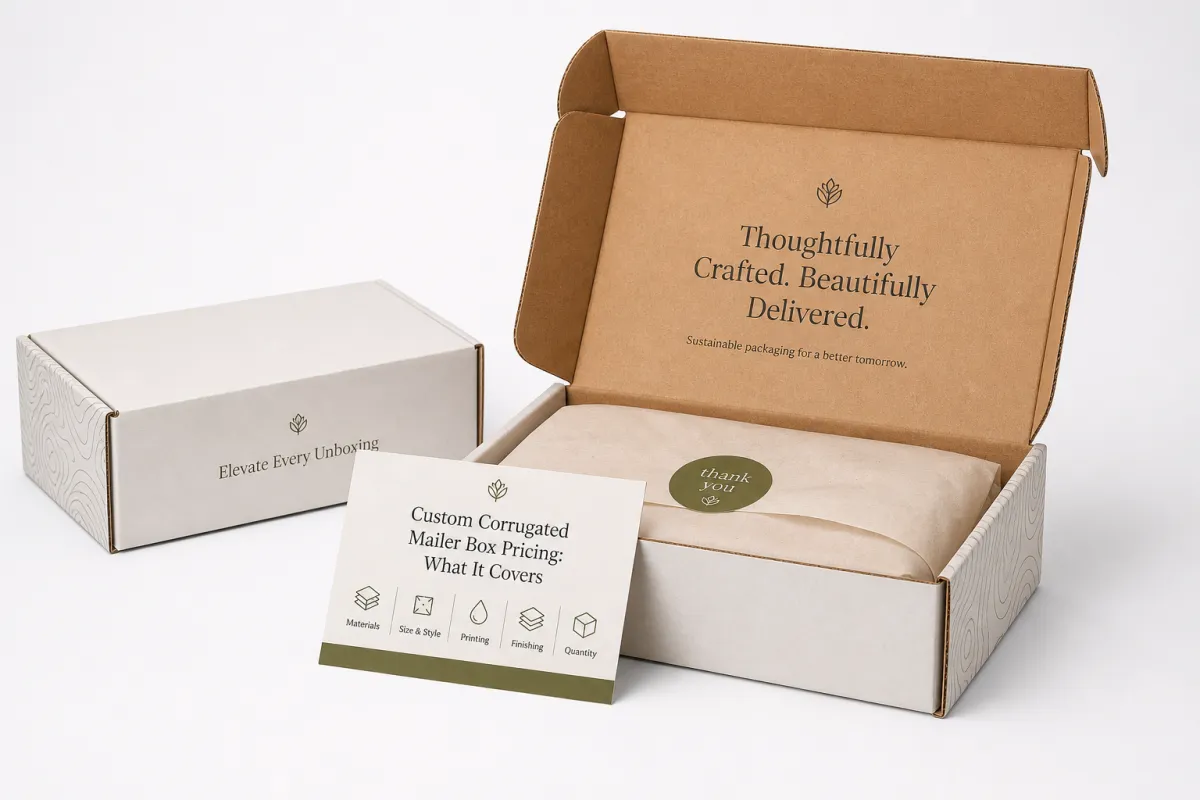
A mailer box usually means a die-cut corrugated carton with a self-locking style. Brands use them for ecommerce, subscription kits, retail packaging, and product shipments that need to look sharp without folding under pressure. Stock cartons fit a broad range of products. A custom mailer is built around one product, one fulfillment flow, and one unboxing experience. Different animal entirely.
That difference matters because custom corrugated mailer box pricing is not just a print quote wrapped around a plain carton. It covers design work, board selection, die-cutting, printing, folding style, insert integration, and often the freight profile of the finished box. A plain kraft mailer with a standard tuck sits in one cost tier. A full-coverage branded box with a tight insert lives somewhere else.
The weird part is how quickly the structure changes the number. A few millimeters of extra depth can increase board usage, hurt nesting efficiency, and raise shipping cost. A reinforced front panel or double-wall insert improves crush resistance, but it also adds board and labor. For that reason, custom corrugated mailer box pricing should be read as a blend of structure, manufacturing, and logistics decisions, not a single unit number pulled from thin air.
From a packaging buyer's point of view, the real question is not “What does a box cost?” It is “What is the cheapest spec that still protects the product and supports the brand?” That question gets better answers. It also prevents budget surprises later, which is where packaging plans usually get bruised.
There is one other wrinkle: corrugated is not a commodity in the way people wish it were. Two boxes can share a footprint and still price very differently because one nests efficiently on a die line and the other wastes board in the fold pattern. Small details, big bill. Annoying, yes. Surprising, not really.
How Custom Corrugated Mailer Box Pricing Is Calculated
The simplest way to think about custom corrugated mailer box pricing is fixed cost plus variable cost. Fixed cost includes setup, design review, dieline preparation, print setup, and any tooling or plate work. Variable cost covers board, converting, finishing, packing, and shipping. As quantity rises, the fixed portion gets spread over more units. That is why a small run can look expensive even when the box itself seems basic.
Size changes cost in more ways than most teams expect. A larger box uses more board per unit, sure, but it also increases freight weight, pallet space, storage burden, and the chance that inserts need to be adjusted. That is why custom corrugated mailer box pricing can change even when the artwork stays the same. The carton gets bigger, and the bill grows in several directions at once.
| Order Profile | Typical Structure | Indicative Unit Range | Why the Quote Lands There |
|---|---|---|---|
| Short run, 250-500 units | Single-wall mailer, 1-color print, no insert | $1.25-$2.75 | Setup cost is spread across few units, so fixed costs dominate |
| Mid run, 2,000-5,000 units | Single-wall mailer, 2-4 colors, light insert | $0.45-$1.10 | Material and converting are more efficient, and setup is diluted |
| Higher volume, 10,000+ units | Optimized dieline, limited print coverage, stacked shipment | $0.28-$0.70 | Better press efficiency, better nesting, and lower per-unit handling |
Those numbers are examples, not universal truth. A larger box, heavier ink coverage, specialty coating, or a stronger flute can move the quote quickly. Still, the pattern holds: custom corrugated mailer box pricing usually drops as volume rises, but only after the fixed setup cost gets absorbed.
There is also landed cost, which is the number that actually hits the budget. Landed cost includes production, freight, samples, inserts, warehousing, and any inbound or outbound handling tied to the project. A quote that looks cheap on paper can get ugly once freight and replacements show up. Procurement teams that track custom corrugated mailer box pricing properly ask for the delivered number, not just the factory number.
- Board grade: 32ECT single-wall, 44ECT single-wall, or double-wall where compression strength matters.
- Print coverage: one-color logo work is very different from full-coverage custom printed boxes.
- Finishing: matte varnish, aqueous coating, lamination, or no finish at all.
- Insert needs: molded pulp, corrugated partitions, paperboard cradles, or a simple fold-in spacer.
- Logistics: destination, pallet count, and freight class all influence total spend.
Two standards are worth keeping in view. For transit testing, the International Safe Transit Association offers useful packaging test frameworks at ISTA. For responsibly sourced fiber, the FSC certification system often comes into the buying conversation. Neither one sets a price by itself. Both shape the requirements that feed into custom corrugated mailer box pricing.
A quote only helps if the assumptions are visible. If one supplier is quoting a 32ECT mailer and another is quoting a reinforced double-wall build, the unit price comparison is junk.
A plain-language formula helps a lot. In practice, custom corrugated mailer box pricing usually looks like this:
Total quote = setup + board + converting + print + finishing + inserts + freight + margin
Once buyers see the cost built that way, the quote stops feeling mysterious. They can spot the spec change that actually matters. That beats guessing, which is a terrible budgeting strategy.
Key Cost Drivers Behind the Final Quote
Structural complexity is usually the first driver. A basic self-locking mailer with standard flaps is efficient to make. Add reinforced corners, a custom insert system, double walls, or a hybrid design that has to behave like both retail packaging and shipping packaging, and the cost changes fast. That is why custom corrugated mailer box pricing often jumps more from a structural revision than from a small artwork tweak.
Print choices come next. One-color flexographic printing on kraft board tends to be economical. Full-coverage graphics, tighter registration, heavier ink laydown, or multiple print passes increase machine time and usually need more careful quality control. If the box needs premium branding, the supplier may also add coatings, spot treatment, or specialty handling. None of that is free. In fact, the visual side of custom corrugated mailer box pricing can rise faster than buyers expect once the box stops being plain and starts acting like a branded statement.
Timeline pressure is another cost driver people underestimate. Rush work shrinks the pool of factories that can take the job, compresses proofing windows, and forces less efficient scheduling. A supplier might still take the order, but the premium can be real. Even a clean spec gets expensive when the ship date is tight and there is no room for sample approval. That is why custom corrugated mailer box pricing should always be discussed with the calendar in the room.
Customer-specific requirements shift the quote too. A subscription box needs a neat opening experience. A cosmetics kit may need a polished presentation and a snug insert. A heavier consumer good might need a stronger flute or a tougher crush target. A retailer might want the box to look good on shelf and survive parcel shipping, which is a demanding combo. Once those requirements are clear, custom corrugated mailer box pricing becomes less about guessing and more about reaching the shortest path to the right spec.
Here is a practical comparison of how structural choices tend to affect cost:
- Simple mailer: lowest setup burden, easiest to quote, best for compact products.
- Mailer with insert: higher board use and more labor, but better product control.
- Reinforced mailer: stronger transit performance, higher material and converting cost.
- Premium printed mailer: best for brand presentation, often higher print and finishing spend.
Too many buyers hear the word “box” and assume every corrugated format behaves the same. It does not. A box built for a subscription kit, a box built for retail presentation, and a box built for rough parcel lanes can all use corrugated board, yet the pricing logic changes underneath. That is the part of custom corrugated mailer box pricing that sales decks tend to gloss over.
One detail I always check early: whether the supplier is quoting board strength by ECT, basis weight, or just calling it “heavy duty” and hoping nobody asks. That kind of fuzzy language can hide a cheaper build. It can also hide a stronger one, which is why the exact spec matters more than the adjectives. Packaging people love their adjectives. Budget people do not.
Custom Corrugated Mailer Box Pricing and Production Timeline
The production calendar has a direct effect on custom corrugated mailer box pricing. A simple order with a known dieline, clean artwork files, and no insert can move through the system quickly. A project that needs structural review, sample testing, or late-stage artwork changes takes more hands and usually costs more to complete.
The path usually looks like this: brief, spec review, dieline confirmation, artwork proofing, sample or prototype approval, production, quality check, and shipment. Each step is small by itself. Together, they decide whether the order stays on budget. If measurements are vague or the artwork arrives in the wrong format, the supplier may need to pause, rework, or re-quote. That delay can push custom corrugated mailer box pricing upward because the job no longer fits the schedule cleanly.
- Brief and dimensions: Product size, quantity, destination, and use case are confirmed first.
- Structure review: The supplier checks fit, board grade, and folding style.
- Proofing: Artwork, colors, and print placement are checked before production.
- Sampling: A prototype confirms fit, closure, and presentation.
- Production: Cutting, printing, converting, and packing happen in sequence.
- Shipping: Finished cartons are palletized and sent to the agreed destination.
Lead time is not one-size-fits-all. A straightforward branded mailer might take roughly 10-15 business days after proof approval, depending on plant schedule and shipping distance. A more involved Custom Printed Box with inserts or upgraded board can stretch into the 3-5 week range. If prototypes need a second round, add more time. That reality matters because rushed work often forces less efficient manufacturing windows, and that can change custom corrugated mailer box pricing more than the artwork itself.
Testing can also shape the schedule and the quote. Teams that ship fragile goods often want more than visual approval. Transit testing aligned to ISTA methods, or internal compression and drop tests based on ASTM practices, can catch a weak structure before it reaches customers. That kind of diligence is not busywork. It protects margin. A box that fails in the field costs more than a slightly stronger design would have cost up front, and that is especially true in custom corrugated mailer box pricing conversations where the starting number looks deceptively low.
If the package is part of a wider sourcing program, the box timeline should also fit the rest of the lineup. Brands that buy multiple formats often need coordination between Custom Packaging Products, Custom Shipping Boxes, and Custom Poly Mailers. That planning step can cut split shipments, duplicate approvals, and rushed reorders, all of which tend to inflate custom corrugated mailer box pricing.
Step-by-Step Guide to Comparing Quotes
If two suppliers give different numbers, the first job is not to grab the cheaper one. The first job is to confirm they are quoting the same thing. That sounds obvious. It is also where packaging budgets go sideways. A quote for plain brown mailers is not the same as a quote for fully printed branded packaging with inserts and freight included. Fair comparison is the backbone of custom corrugated mailer box pricing.
Start with a standardized spec sheet. Put the exact product dimensions, quantity, board grade, flute preference, print colors, finish, insert requirement, ship-to address, and delivery window in writing. That blocks hidden assumptions. It also keeps one vendor from pricing a stronger build while another prices a lighter one. Without that control, custom corrugated mailer box pricing can look wildly different even when both suppliers are acting in good faith.
Then ask each supplier what is included in the number. Samples? Tooling? Plate charges? Prepress? Freight? Packaging approval revisions? Some vendors bundle a few of those items. Others itemize everything. A low unit price can be misleading if the quote quietly leaves out the costs that show up later. That is why a true apples-to-apples comparison matters more than the headline figure in custom corrugated mailer box pricing.
| Quote Element | What You Want To See | Red Flag |
|---|---|---|
| Board grade | Named spec such as 32ECT or 44ECT | “Corrugated” with no strength detail |
| Print method | Flexo, litho-lam, or digital stated clearly | Only says “printed” |
| Quantity | Exact run count and tolerance range | Rounded estimate with no MOQ |
| Freight | Delivered, FOB, or separate line item | Shipping missing from the quote |
| Samples | Prototype cost or included sample policy | Not mentioned at all |
The cheapest quote is not the cheapest outcome if it leaves out freight, samples, or the stronger board the product actually needs.
A better way to evaluate custom corrugated mailer box pricing is to calculate landed cost per sellable unit. If a supplier quotes a lower carton price but charges more for freight, inserts, or setup, the apparent savings can disappear. Add the cost of damage, replacements, and customer service time, and the real number can swing harder than most teams expect.
It also helps to ask for tiered pricing. A quote at 1,000 units, 3,000 units, and 10,000 units reveals the pricing curve. That curve tells you whether the project benefits from a larger buy or whether the savings flatten fast. Once you see the breakpoints, custom corrugated mailer box pricing becomes a planning tool instead of a mystery invoice.
If a supplier cannot explain why the price changes between tiers, that is a clue. Not always a bad one, but a clue. It may mean they are pricing to capacity, not to material efficiency. Or it may mean the quote is padded. Either way, you want to know before the first PO goes out.
Common Mistakes That Skew Pricing Decisions
The first mistake is comparing different specs as if they were the same. One supplier might quote a basic unprinted mailer, while another quotes a fully branded carton with a custom insert and stronger board. Those numbers should not sit side by side without context. A fair read on custom corrugated mailer box pricing requires the same structure, the same quantities, and the same delivery terms.
The second mistake is under-specifying the box to save money. On paper, a lighter board or a smaller insert might reduce cost. In practice, it can lead to crushed corners, scuffed graphics, product movement, or returns. Replacement shipments wipe out the early savings fast. A few cents saved on custom corrugated mailer box pricing can vanish if the box fails in transit or the product lands looking sloppy.
The third mistake is ignoring dimensional weight, pallet counts, and route distance. Corrugated products are not just made and sent; they take space. If a box nests badly, the freight bill can climb even when the per-unit quote looks attractive. That is especially true for larger mailers or projects with heavy board coverage. A clean production quote is only part of the story in custom corrugated mailer box pricing.
The fourth mistake is waiting too long to source packaging. Late sourcing cuts competition, compresses proofing windows, and limits the ability to compare options properly. Suppliers often charge more when they have to squeeze work into a crowded schedule. Planning earlier usually gives the buyer more room to shape the spec and lower risk. That is often the simplest path to better custom corrugated mailer box pricing.
Sometimes the right answer is a different format altogether. If the product is soft, flat, and low-bulk, Custom Poly Mailers may be the better choice. If the item needs a stronger ship-ready structure, Custom Shipping Boxes can make more sense. And for teams building a broader branded packaging program, Custom Packaging Products keeps sourcing options under one roof. That wider view keeps teams from forcing every product into the same packaging design and the same custom corrugated mailer box pricing model.
Another easy miss: assuming the quoted quantity is the quantity you will actually receive. Repack allowances, spoilage, and setup waste are real. Good suppliers are usually transparent about this. If they are not, ask. You do not want to discover a shortage after the cartons are already on a truck.
Expert Tips for Better Custom Corrugated Mailer Box Pricing
Simplify the dimensions first. That is the easiest place to find value. A box that removes dead air can cut board usage, reduce shipping volume, and improve storage efficiency. It can also improve the unboxing feel because the product stops sliding around inside the carton. From a packaging design standpoint, that is one of the few moves that helps both cost and presentation. Better fit often improves custom corrugated mailer box pricing and the customer experience at the same time.
Request tiered pricing at several quantities. A quote for 1,000 units tells you very little on its own. A quote for 1,000, 3,000, and 10,000 units shows where the curve bends. That matters for inventory planning and cash flow. If the unit cost drops sharply after a certain break, it may make sense to place a larger order and hold stock. That kind of decision can materially improve custom corrugated mailer box pricing over a full buying cycle.
Prototype before locking a large run. One or two sample versions can uncover fit issues, insert problems, or artwork concerns that would be expensive to fix later. Buyers skip this step because it feels slow. It is usually the cheaper path. A small spend on sampling can prevent a much larger correction after production. For complex product packaging, that trade is hard to ignore, and it often protects custom corrugated mailer box pricing from avoidable change orders.
Use a clear scorecard when reviewing suppliers. Price matters, but so do lead time, print consistency, communication quality, and whether the supplier understands your shipping environment. A good mailer that arrives late is still a problem. A cheap quote that misses the board spec is still a risk. The best buying teams weigh all of that before choosing a vendor. That is how custom corrugated mailer box pricing turns into a repeatable procurement process instead of a one-off scramble.
One last practical point: if your team sells across channels, align the packaging brief with the channel mix. Retail packaging wants shelf impact. Ecommerce wants shipment strength. Subscription brands want a controlled opening experience. Those goals overlap, but they are not identical. If the brief is written well, the supplier can quote the right box the first time, and custom corrugated mailer box pricing becomes easier to defend internally.
I also like to ask suppliers to show me one real production constraint before I approve a run. Could be pallet height, could be press sheet size, could be a board substitution risk. The answer tells you whether they actually know the job or are just filling out a form. That little check saves more headaches than people expect.
Bottom line: build a clean spec sheet, compare the same structure across every supplier, and treat custom corrugated mailer box pricing as a repeatable purchasing process rather than a one-time guess. The more precise the brief, the fewer surprises show up later. If you want the cheapest number, you can probably get one. If you want the best number for the actual job, the spec has to do the heavy lifting.
What does custom corrugated mailer box pricing usually include?
It usually includes board, converting, printing, and the basic setup tied to the exact box spec. Some quotes also include samples, inserts, and delivery, while others list those separately. Always confirm whether freight, tooling, and proofing are part of custom corrugated mailer box pricing before comparing numbers.
How can I lower custom corrugated mailer box pricing without hurting quality?
Start by trimming unused space in the box, because size affects material, freight, and storage. Then simplify the print layout if the brand can still hold up visually. Asking for tiered quantities can also improve custom corrugated mailer box pricing by showing where the per-unit cost drops most sharply.
Is custom corrugated mailer box pricing driven more by size or printing?
Size often has the bigger effect because it changes board usage, shipping efficiency, and warehouse footprint. Printing can become the larger factor when coverage is heavy, colors are numerous, or the finish is premium. The real answer depends on the spec, which is why side-by-side custom corrugated mailer box pricing breakdowns matter.
Why do two suppliers give very different custom corrugated mailer box pricing quotes?
They may be quoting different board grades, different print methods, or different assumptions about freight and setup. One vendor may include samples or design support while another excludes them. A low number can still cost more once hidden fees are added, so custom corrugated mailer box pricing should always be checked line by line.
How long should it take to get an accurate quote for custom corrugated mailer box pricing?
Simple jobs can be quoted quickly if measurements and artwork are ready. More complex projects take longer because the supplier may need dieline review, sample planning, or structural checks. Accurate quotes move faster when the buyer provides clear quantities, product dimensions, and delivery details up front, which helps stabilize custom corrugated mailer box pricing.
If you treat the quote as a packaging system decision instead of a carton price, the numbers make more sense. Structure, board grade, print coverage, and logistics all move together, and that is why custom corrugated mailer box pricing rewards careful planning. The buyers who get the best results are usually the ones who ask sharper questions before the first sample is even cut.
That is the real takeaway: nail the spec, verify the assumptions, and compare delivered cost instead of chasing the lowest line item. Do that, and the pricing conversation gets a lot less fuzzy. Honestly, it should have been that way from the start.

