Buyer Fit Snapshot
| Best fit | custom corrugated packaging factory for packaging buyers comparing material specs, print proof, MOQ, unit cost, freight, and repeat-order risk where brand print, material, artwork control, and repeat-order consistency matter. |
|---|---|
| Quote inputs | Share finished size, material target, print colors, finish, packing count, annual reorder estimate, and delivery region. |
| Proofing check | Approve dieline scale, logo placement, barcode or warning zones, color tolerance, and any recyclable or compostable wording before bulk production. |
| Main risk | Vague material claims, crowded artwork, or missing packing details can create delays even when the unit price looks attractive. |
Fast answer: Custom Corrugated Packaging Factory: How It Works Inside should be specified like a repeatable production item. The safest quote includes material, print method, finish, artwork proof, carton packing, and reorder notes in one written spec.
What to confirm before approving the packaging proof
Check the product dimensions against the actual filled item, not only the sales mockup. Ask for tolerance on folds, seals, hang holes, label areas, and retail display edges. If the package carries a logo, QR code, warning copy, or legal claim, reserve that space before decorative graphics fill the panel.
How to compare quotes without losing quality
Compare board or film grade, print process, finish, sampling route, tooling charges, carton quantity, and freight assumptions side by side. A lower quote is only useful if the supplier can repeat the same color, closure quality, and packing count on the next order.
Custom Corrugated Packaging Factory: How It Works Inside
The most expensive box is usually the one that looked perfect in a spreadsheet and then folded under real-world abuse. A custom corrugated packaging factory exists to keep that mess from happening. It takes product data, shipping risk, warehouse behavior, and branding goals, then turns them into cartons that survive transit and still look like somebody meant it.
Corrugated work is not just cardboard with a better haircut. A custom corrugated packaging factory sits where engineering, logistics, and branding collide. On one side: board grade, flute profile, stack strength, compression, and transit testing. On the other: freight cost, labor time, print quality, and how the box feels when it lands on a dock or a front porch. When those pieces line up, the packaging stops acting like overhead and starts doing a real job.
That matters more than most buyers want to admit. Better product packaging can cut damage claims, reduce repacks, speed up ecommerce fulfillment, and make the product look intentional instead of thrown into a brown box and hoped for. I have seen teams save more money by fixing the carton than by negotiating another penny off the unit price. That is not glamorous. It is just true.
What a custom corrugated packaging factory really does
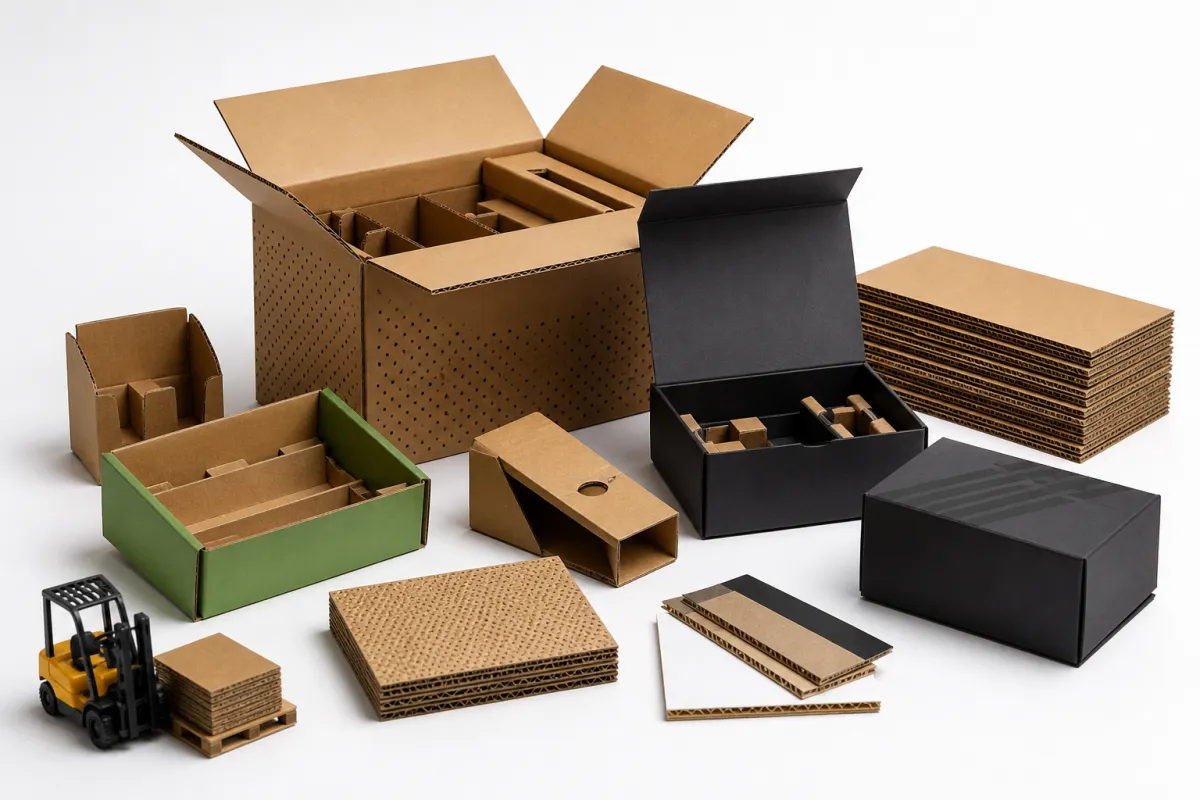
A custom corrugated packaging factory works like a translation layer. You bring product dimensions, shipping method, brand direction, and hard limits like pallet height or warehouse space. The factory turns those inputs into a package system that can actually be built and actually survive. That might be a plain shipping carton, a die-cut mailer, a retail-ready shipper, or a kit with inserts and printed outer panels.
The job looks simple until the details show up. A carton has to fit the product, but it also has to fit the way your team packs orders. It has to hold up if boxes are stacked six high in storage. It has to survive vibration, drops, humidity, and temperature swings on the road. So a custom corrugated packaging factory is not really selling paper. It is selling performance under pressure.
That performance has layers. Structural performance is one. Visual performance is another. Operational performance is the one buyers miss most often. Save two seconds per pack and it sounds tiny. Multiply that by 20,000 units and the labor savings stop being tiny real fast. A good custom corrugated packaging factory pays attention to that math because bad packaging creates work at the packing bench, not just damage in transit.
The factory also acts as a risk filter. Fragile, heavy, or awkward products may need a stronger flute, tighter fit, or internal partitions. Premium retail packaging pushes the conversation toward print method, coating, and board face. A solid custom corrugated packaging factory is where those tradeoffs get sorted before they become expensive problems. If the factory waits until after approval to flag the weak spots, you are already paying for the mistake.
The prettiest box is not always the best box. A high-coverage printed shell with weak board can collapse under load. A heavy carton that ignores dimensional weight can blow up freight costs. A good custom corrugated packaging factory asks uncomfortable questions early because those questions usually save money later. Nobody loves that meeting, but it beats explaining a pallet of crushed product to finance.
Practical rule: a box that looks fine in a rendering but has not been checked for fit, compression, and pack-out is still a risk, not a solution.
For broader industry context, the corrugated sector has decades of standards and test methods behind it. The International Safe Transit Association is a useful reference for transit testing, and the Forest Stewardship Council matters when buyers want verified fiber sourcing. A good custom corrugated packaging factory should be able to speak to both without hiding behind buzzwords.
How a custom corrugated packaging factory turns specs into boxes
The workflow inside a custom corrugated packaging factory is usually more disciplined than buyers expect. It starts with discovery. A rep or estimator collects product dimensions, weight, fragility, shipping method, print goals, quantity, and any constraints such as retail display requirements or machine-pack compatibility. Vague inputs produce vague quotes. Shocking, I know.
Structural design comes next. The team decides whether the job should be an RSC, a die-cut mailer, a folder, a tray, or something more specialized. This is where the factory checks pallet patterns, board compression, and whether the carton must hold up in storage before it ever ships. A serious custom corrugated packaging factory often uses CAD dielines and prototype tools to see how the product behaves inside the pack-out. That is the boring part that saves the exciting part from failing.
Then the factory builds a sample or prototype. That may be a white sample, a laser-cut sample, a digital print mockup, or a production proof depending on the job. If the customer is ordering custom printed boxes, artwork gets checked against the dieline so logos, barcodes, and copy do not land in the wrong place. Small errors here grow teeth later, so the best custom corrugated packaging factory teams slow down before the first run instead of pretending the file will magically behave.
Testing and revision follow. A carton that fits loosely may need tighter tolerance. A shipper that bows under load may need heavier board or a different flute. A retail shipper that prints beautifully but scratches during handling may need a different coating. Packaging design is iterative. A custom corrugated packaging factory that pretends otherwise is usually selling optimism, not boxes. And optimism does not survive a UPS conveyor.
Here is the usual sequence, stripped down:
- Discovery call and requirements review.
- Dimension capture, weight check, and pack-out review.
- Dieline or structural concept creation.
- Prototype or sample creation.
- Fit, drop, and compression review.
- Artwork adjustment and quote revision.
- Tooling approval and production scheduling.
- Quality checks during the run.
- Final shipment and reorder planning.
Delays usually show up in the approval chain, not in the machine room. Artwork revisions, dieline edits, late changes to insert dimensions, and slow sample sign-off can add days or weeks. A custom corrugated packaging factory can move fast once the spec is locked. It cannot outrun changing inputs. That holds for the simplest ecommerce carton and for a premium branded packaging project with tight visual standards.
Simple and complex jobs are not the same animal. A plain shipping carton for a stable product can often move from quote to production with few surprises. A printed retail-ready shipper with inserts, varnish, and a strict color target needs more checkpoints. The custom corrugated packaging factory has to coordinate prepress, die cutting, corrugating, gluing, and finishing so the final box matches the approved sample, not just the art file.
That is why buyers should think of the factory as a process partner, not a box vendor. If the factory is asked to design, sample, quote, and produce without clear inputs, the cost shows up somewhere else: extra proofs, missed deadlines, or a carton that underperforms. A sharp custom corrugated packaging factory makes the workflow visible early, before anybody is stuck explaining the mess to a warehouse manager.
Key factors that shape cost, durability, and print quality
Pricing in a custom corrugated packaging factory comes down to a handful of variables that interact more than buyers usually expect. Board grade matters. Flute profile matters. Box style, print coverage, and quantity matter too. Inserts, coatings, and special finishing can all move the number. Clean comparisons only happen when you compare like with like. That sounds obvious until the quotes start landing.
Board grade affects both performance and cost. A lighter single-wall board may work fine for a 2-pound ecommerce item, while a heavier shipper for a 30-pound product may need better compression resistance. Flute choice changes the picture too. B flute is tighter and often better for print; C flute is common for general shipping; E flute can work well for thinner profiles and finer graphics; BC double-wall adds protection and cost. A custom corrugated packaging factory should match the flute to the handling risk, not just the product weight.
Print method changes the look and the economics. Flexographic printing usually fits straightforward graphics and larger quantities. Litho-lam can deliver a more polished retail finish, but setup and unit costs climb. Digital print helps with smaller runs and faster turnarounds. A smart custom corrugated packaging factory knows that package branding is a production decision too, not just a design debate. Pretty artwork on the wrong substrate is just expensive disappointment.
To make the tradeoffs easier to see, here is a practical comparison. Exact pricing depends on size, region, freight, and spec details, but these ranges are directional and meant to frame the conversation with a custom corrugated packaging factory, not replace a quote.
| Option | Typical use | Indicative unit cost | Strength / appearance |
|---|---|---|---|
| Plain RSC, single-wall C flute, 1-color print | General shipping, warehouse cartons | $0.38-$0.72 at 5,000 units | Good strength, basic branding |
| Die-cut mailer, E flute, full-color print | Ecommerce, lighter retail presentation | $0.65-$1.25 at 5,000 units | Sharper graphics, moderate protection |
| Printed shipper with inserts, BC double-wall | Fragile or premium product packaging | $1.20-$2.80 at 5,000 units | Higher protection, stronger retail impact |
Those numbers move in real life. A small run can feel expensive because tooling, prepress, and setup costs do not vanish just because the quantity is low. That setup-versus-unit-cost tradeoff is one of the first things a custom corrugated packaging factory should explain plainly. If the first quote looks high, the better question is not “Can you lower it?” It is “Which part of the spec is driving the cost?” That question gets you somewhere.
In some cases, a stronger board lowers damage and rework enough to justify the extra cents per unit. In others, a lighter board paired with a better insert design protects the product just as well while trimming freight by cutting overall weight. A practical custom corrugated packaging factory talks about cost in the context of claims, packing speed, and shipping efficiency, not just carton price. That is the difference between buying boxes and buying a packaging system.
Comparing quotes correctly takes some discipline. One vendor may quote a different inside dimension, a heavier board, a higher print coverage, or a different quantity break and make the number look better or worse than it really is. Smart buyers ask each custom corrugated packaging factory to confirm the same assumptions in writing: dimensions, board grade, flute, print method, insert count, coating, freight terms, and acceptable revision limits.
Durability is not just about stacking. Distribution conditions matter too. Humid warehouses, automatic packing lines, long dwell times, and cross-country freight all change the stress on the box. That is why standards such as ASTM compression methods and ISTA transit testing matter. The paperwork feels dry. The damage claim does not. A custom corrugated packaging factory that understands testing methods is usually better at avoiding ugly surprises.
Step-by-step: from product sample to production run
The cleanest projects start with the right inputs. Before a custom corrugated packaging factory opens a dieline file, the buyer should gather product dimensions, product weight, fragility, shipping method, storage conditions, and packing style. If the carton is for ecommerce, the factory needs to know whether the box will be hand-packed, auto-packed, or shipped as part of a subscription kit. If the box is for retail packaging, shelf height and display orientation matter too.
Think in terms of pack-out, not just product size. A device may measure 8 by 6 by 2 inches, but once you add foam, dividers, literature, or a charger, the real pack-out can get bigger fast. That is one of the most common reasons a custom corrugated packaging factory has to revise the first concept. The product was measured correctly. The system around it was not. I have watched that happen more than once, and it is never as dramatic as people want it to be. Just messy.
After intake, the design sequence starts. The team chooses the carton style, generates or reviews the dieline, and checks how the contents sit inside the structure. A prototype then tests fit, compression, and handling. If the box has to look good for retail, the sample also checks logo placement, panel orientation, and copy legibility. This is where custom corrugated packaging factory work starts to feel like design consulting instead of commodity manufacturing.
Testing can be basic or formal. A simple fit check may be enough for a low-risk mailer. A fragile or high-value product may need a more deliberate plan: drop testing, vibration review, compression estimation, or pilot shipping. The goal is not to turn every project into a lab experiment. The goal is to match the test to the risk. A disciplined custom corrugated packaging factory will not push a large production run without enough confidence in the structure.
Once the sample is approved, artwork gets finalized. This step gets ignored more than it should. Logos need to sit correctly on the dieline, bleed must be right, and barcode areas need to stay readable after folding and gluing. For custom printed boxes, even small registration issues can throw off the whole presentation. A careful custom corrugated packaging factory usually asks for native artwork files and a clear brand standard before approving print. That is not nitpicking. That is how you avoid a stack of boxes with a logo floating halfway off the panel.
Here is a simple production logic that keeps the process sane:
- Lock the dimensions before discussing print.
- Approve the structure before approving the artwork.
- Approve the sample before the production slot is released.
- Document any special handling or storage needs.
- Agree on what counts as an acceptable variance.
After the pilot run is approved, the factory locks in materials and quantities, then scales the job with repeatable QC checks. The best custom corrugated packaging factory teams do not just run the order. They watch board consistency, print accuracy, gluing quality, and case counts so the first cartons and the last cartons behave the same way. If the customer needs a reorder later, those records make the next run faster and less risky.
That is also where reorder planning starts. A buyer with a stable carton spec can reduce future friction by keeping a short note on approved materials, pallet counts, and revision history. If your custom corrugated packaging factory keeps clean records, the next purchase is usually smoother than the first one. Small operational advantage. Big payoff over time.
For teams that buy packaging often, this is where the difference between a supplier and a partner shows up. The supplier ships boxes. The custom corrugated packaging factory helps preserve continuity across runs, which can matter just as much as the box itself.
Common mistakes when ordering custom corrugated packaging
The most common mistake is measuring only the product. A custom corrugated packaging factory needs the full pack-out: inserts, headspace, closures, pallet pattern, and the way the product behaves once it is packed. A box that fits the unit on paper can still be too tight for efficient packing or too loose for transit stability. That sounds obvious. It is still missed all the time.
Another mistake is comparing quotes that are not built on the same assumptions. One supplier may quote a heavier board, another may be using a lighter spec, and a third may have lower print coverage. Compare those numbers as if they were identical and the wrong quote usually wins. A disciplined custom corrugated packaging factory will help you compare apples to apples, but only if you ask for the details.
Skipping samples is a classic error, especially for new product launches. A design that looks reasonable on screen can still fail in a real warehouse, in humid storage, or during automated packing. That is not some rare edge case. It happens constantly. The safest move is to let the custom corrugated packaging factory produce a sample, test it with the actual product, and stress it before scale-up.
Branding gets shortchanged too often. Teams spend heavily on the product itself, then treat the package like a box with a pulse. The result protects the item but weakens the presentation. In ecommerce, that can hurt perceived value. In retail, it can hurt shelf appeal. A good custom corrugated packaging factory should help the team balance protection and brand presence instead of pretending one does not affect the other.
Here are the pitfalls that show up most often in real projects:
- Using product-only dimensions instead of packed dimensions.
- Approving artwork before the dieline is locked.
- Assuming all single-wall boards perform the same.
- Ignoring humidity, stacking, or long-term storage.
- Ordering too few units to absorb setup costs efficiently.
Freight economics deserves attention too. A thicker box can protect better, but if it pushes dimensional weight or pallet height too far, shipping cost rises. That is why a custom corrugated packaging factory has to think beyond the box. The carton is part of a bigger logistics system, and the wrong move in one place can create cost somewhere else.
Packaging buyers also underestimate the hidden cost of rework. If the first carton version is wrong, someone has to relabel, repack, or scrap units. Those costs can wipe out any savings from a cheaper paper spec. That is why a seasoned custom corrugated packaging factory pushes for proofing, even on jobs that look straightforward.
Plain truth: a carton that works in a clean office test may behave differently after 12 hours in a humid warehouse or after a courier route with multiple handoffs. The box is not the lab. The market is the lab. A custom corrugated packaging factory that remembers that usually ships better outcomes.
Expert tips for faster approvals and fewer shipping surprises
The fastest projects usually start with a one-page packaging brief. Keep it blunt and specific. Include dimensions, product weight, fragility, pack-out details, pallet count, branding needs, shipping method, and any retail or ecommerce constraints. A custom corrugated packaging factory can work with incomplete information, but it works faster when the brief is clean.
Ask for tiered material options. Good-better-best comparisons help a team decide whether to spend more on structure, more on appearance, or less on both. One tier might use a standard single-wall board with flexo print. Another might use a better face sheet or a different flute. A third might add an insert or premium finish. A responsive custom corrugated packaging factory understands that buyers often need a structured choice, not a blank page.
Use samples as decision tools, not ceremonial objects. The best sample review includes fit, closure behavior, stacking feel, print clarity, and how quickly a packer can assemble the carton. If the product is delicate, do a small pilot run or transit test before scaling. A thoughtful custom corrugated packaging factory will welcome that discipline because it protects both sides of the relationship. The goal is a better box, not a prettier meeting note.
Build a feedback loop from the first order. Damage reports, warehouse comments, and reorder data are gold. If a carton is too slow to pack, note it. If a corner crushes during long storage, note that too. The smartest packaging programs improve after the first production run, not before it. That is especially true with branded packaging, where visual goals and functional performance need constant balancing.
Standardize what you can. If several products can share the same size family, the packaging program gets simpler. Fewer box sizes can mean less confusion, less dead inventory, and better purchasing leverage. A custom corrugated packaging factory is easier to work with when the program is coherent rather than fragmented.
Keep revision control tight. If the dieline changes, the artwork should change with it. If the product weight changes, the board spec may need another look. If the shipping channel changes, the testing assumptions should change too. A careful custom corrugated packaging factory respects version control because packaging chaos is expensive in ways that do not show up until it is too late.
Packaging and recovery standards from groups like the Packaging Association can give internal teams a useful reference point, especially when they are trying to align on sustainability or material choices. Pair that with transit testing guidance and you get a stronger basis for the final spec. A custom corrugated packaging factory should be able to speak that language without sliding into sales fluff.
One more practical tip: if a supplier keeps answering cost questions with vague “it depends” language and no detail, that is not expertise. That is avoidance. A real custom corrugated packaging factory can explain the price drivers in plain English, even if the answer is a little annoying.
Next steps for working with a custom corrugated packaging factory
If you are ready to move, start with a packaging brief and request quotes on identical assumptions. Ask each custom corrugated packaging factory to confirm material, construction, lead time, and revision limits in writing. That one move cuts confusion more effectively than a dozen follow-up emails. It also makes the comparisons honest, which is rarer than it should be.
Approve a first article or pilot run before scaling. Compare the sample against damage risk, freight cost, and packing speed. If the result looks stronger than expected, you may be able to simplify the spec. If it looks weaker than expected, you have time to fix it before the full run. Either way, a custom corrugated packaging factory should be part of the decision, not just the quote.
From there, treat the first order as the start of a repeatable process. Set reorder triggers. Define storage limits. Keep the approved dieline, artwork, and spec sheet in one place. Review damage feedback after the first shipments. That is how a custom corrugated packaging factory becomes more valuable over time: not by making one flashy sale, but by helping the packaging program get cleaner, faster, and more predictable.
Honestly, that is the real payoff. A custom corrugated packaging factory gives you more than boxes. It gives you a structured way to control fit, protection, freight, and presentation in the same system. For any brand that depends on product packaging to arrive intact and look credible on arrival, that is not a small detail. It is the difference between an order that works and a box that quietly burns money every time it ships.
If you want the shortest possible version of the lesson, here it is: lock the pack-out, test the structure, compare quotes on the same spec, and do not approve artwork until the carton is real. Skip any one of those steps and you are basically gambling with freight damage and rework. No need to make it more dramatic than that.
What should I ask a custom corrugated packaging factory before requesting a quote?
Give them product dimensions, weight, shipping method, and whether the box must survive stacking, retail display, or ecommerce handling. Share branding needs, carton quantity, and any must-have constraints so the quote is built on the same assumptions from the start. A custom corrugated packaging factory can usually move faster when those basics are clear.
How long does a custom corrugated packaging factory take for a new box design?
Simple structural jobs move quickly when dimensions are locked and no artwork changes are expected. More complex jobs need extra time for sampling, tooling, print approval, and revisions, so the timeline is usually driven by decisions, not machine speed. A custom corrugated packaging factory tends to move fast once the approvals stop moving.
What affects custom corrugated packaging factory pricing the most?
Board grade, flute choice, box style, print coverage, inserts, coatings, and order volume are the biggest pricing levers. Freight and setup costs also matter, so a quote for a small run can look higher per unit even when the material spec is similar. A custom corrugated packaging factory should be able to show where the money is going.
How do I lower costs without weakening the carton?
Standardize sizes where possible, reduce unnecessary print coverage, and use the lightest board that still passes stacking and transit needs. If the product is fragile, put the budget into the structure and inserts first, then cut visual extras only after the protective spec is proven. A custom corrugated packaging factory can usually help test that balance before you commit.
What files and samples help a custom corrugated packaging factory work faster?
Send a dieline, product sample, photos, brand files, and a short spec sheet with dimensions, weight, and pack-out details. If you have pallet or shelf requirements, include those too, because they help the factory design for real shipping and storage conditions instead of guesswork. The right custom corrugated packaging factory can do much better work when the inputs are concrete.

