Buyer Fit Snapshot
| Best fit | Custom Corrugated Roll Boxes projects where brand print, material claims, artwork control, MOQ, and repeat-order consistency need to be specified before quoting. |
|---|---|
| Quote inputs | Share finished size, material target, print colors, finish, packing count, annual reorder estimate, ship-to region, and any compliance wording. |
| Proofing check | Approve dieline scale, logo placement, barcode or warning zones, color tolerance, closure strength, and carton packing before bulk production. |
| Main risk | Vague material claims, crowded artwork, missing packing details, or unclear freight terms can make a low unit price expensive after revisions. |
Fast answer: Custom Corrugated Roll Boxes: Board, Finish, Dieline, and Unit Cost should be specified like a repeatable production item. The safest quote records material, print method, finish, artwork proof, packing count, and reorder notes in one written spec.
Production checks before approval
Compare the actual filled-product size with the drawing, then confirm tolerance on folds, seals, hang holes, label areas, and retail display edges. Reserve space for logos, QR codes, warning copy, and material claims before decorative graphics fill the panel.
Quote comparison points
Review material grade, print process, finish, sampling route, tooling charges, carton quantity, and freight assumptions side by side. A quote is only useful when the supplier can repeat the same color, closure quality, and packing count on the next order.
Custom corrugated roll boxes: Shipping Smarter, Safer
Custom corrugated roll boxes look simple until a long product starts chewing through shipping budgets. The carton gives way before the product does, and the result is more filler, more repacking, and damage claims that never should have landed on the desk in the first place. Packaging buyers usually want one thing from this category: a box that fits the roll, protects it in transit, and keeps the line moving without turning every order into a small event.
That is the real value of custom corrugated roll boxes. They are built around length, crush resistance, pack-out speed, and the route the shipment is actually going to travel. A good spec cuts down on void fill, holds the product steady, and gives printed packaging a clean surface to work with. A poor spec creates a long tube of dead air, adds labor at the pack station, and sends the freight bill in the wrong direction.
Custom corrugated roll boxes: what problem they actually solve
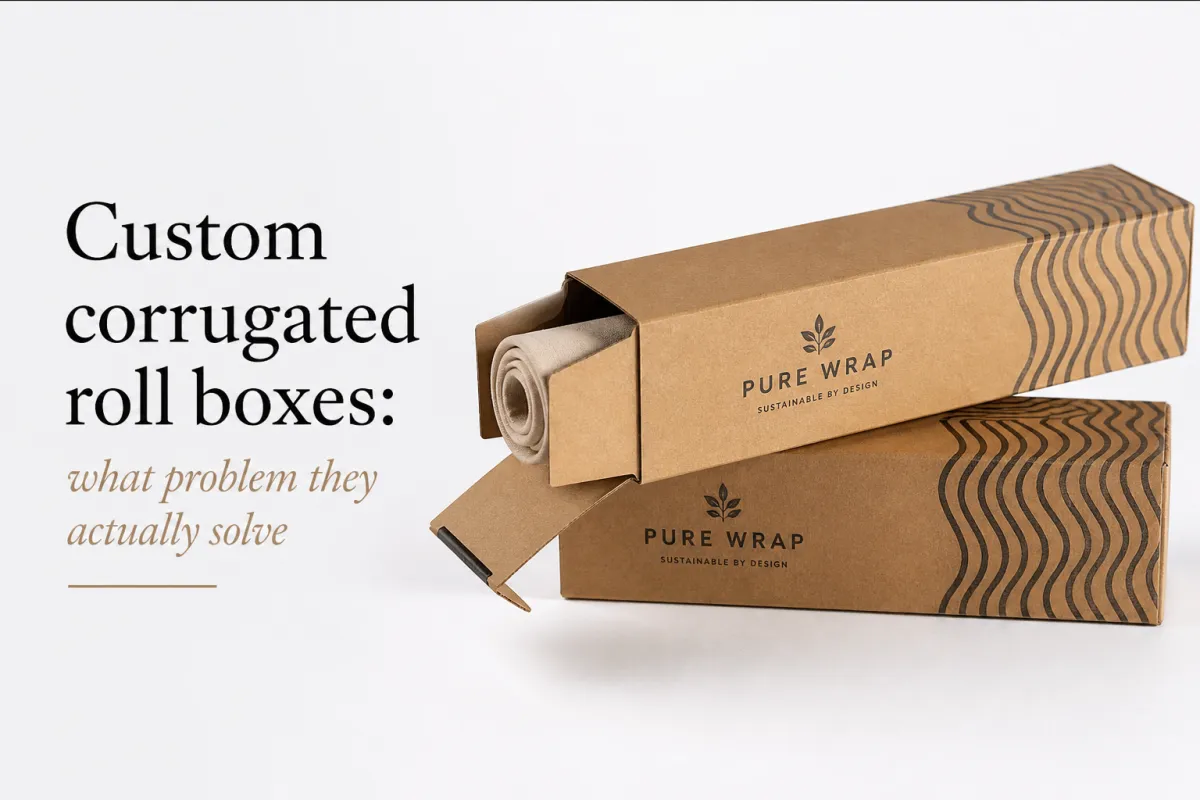
Custom corrugated roll boxes solve a geometry problem first and a protection problem right after that. Long, narrow products are awkward for standard cartons because empty space grows quickly as length increases. Posters, textile rolls, blueprints, wallpaper, labels, rods, and rolled goods all become harder to ship safely when the carton is oversized, weak at the corners, or built with no thought for the load path. A stock carton can look acceptable on paper and still fail the moment vibration, stacking, or rough handling enters the picture.
That failure usually shows up in familiar ways. Edges get crushed. Rolled items drift to one end. The shipper adds paper, bubble, or air pillows to stop movement, which slows packing and still does not fix the structure. I have seen that happen more than once in pack-out reviews: the carton was technically “close enough,” but close enough is kinda useless once a parcel hits a conveyor or gets stacked under a heavier load. A well-built set of custom corrugated roll boxes keeps the product centered, reduces dimensional weight waste, and gives the carton a shape that carriers can handle without turning the contents into a test sample.
In practice, custom corrugated roll boxes are less about appearance and more about control. They can be built as mailers, tuck-end shippers, telescoping formats, or die-cut cartons with internal stops. The right choice depends on product length, weight, surface sensitivity, and whether the shipment goes parcel or freight. That is why the structural design matters so much here. The box is not just a container. It is part of the shipping system, and it either reduces risk or adds to it.
A long product does not need a fancy carton. It needs a carton that stops movement, resists crush, and survives the trip without making the warehouse babysit it.
Most people get tripped up because they compare custom corrugated roll boxes to generic cartons on unit price alone. That misses the full cost. A carton that saves two minutes of pack time and cuts even a small number of claims usually beats a cheaper box that needs extra filler, more tape, and another inspection before every shipment. For many brands, the better spec also improves retail packaging consistency and package branding, which matters when the carton is visible at receiving or during a direct-to-consumer unboxing.
There is also a simple size advantage. The smallest viable structure usually ships better than a box that tries to leave extra room just to be safe. Too much slack means more fill, more rattling, and more chance the product moves under vibration. Too little slack means abrasion, bowing, or a seam that bulges before the shipment even leaves the dock. Custom corrugated roll boxes sit in that narrow middle ground where the fit is deliberate instead of accidental.
How custom corrugated roll boxes work in the pack-out process
Custom corrugated roll boxes make more sense when you watch the pack-out line from start to finish. The operator inserts the rolled product, adds any accessory kit or insert, closes the carton, seals it, applies the label, and sends it to palletizing or carrier pickup. Every extra motion costs time. Every extra decision slows the line. A carton designed around the product removes a surprising amount of friction from that sequence.
The structure changes depending on how the item is packed. A tightly rolled poster may need only a snug mailer with a tuck flap. A looser roll may need an internal sleeve or stop so it does not telescope inside the box. If accessories travel with the main item, a partition or pocket keeps them from scratching the surface. Custom corrugated roll boxes can also include locking tabs, dust flaps, score lines, or die-cut inserts that keep the pack-out consistent from one operator to the next.
That consistency matters more than many buyers expect. If warehouse staff has to decide every time whether the roll needs more paper, a second piece of tape, or one more tuck, the process slows and the packing quality drifts. A cleaner structure means fewer packing decisions, less tape use, faster line work, and fewer returns caused by products shifting in transit. It also makes custom printed boxes easier to standardize across multiple skus, which helps procurement and operations stay on the same page.
Here is the basic sequence I would expect for custom corrugated roll boxes in a solid pack-out setup:
- Measure the product in its real shipping state, not the neat version on the drawing.
- Choose the internal fit with enough room for wrap, labels, or inserts.
- Build the structure so the roll stops moving without crushing the ends.
- Seal the carton with a closure that survives handling, not just a desk test.
- Place the barcode and shipping label on a flat, readable panel.
- Stack or palletize with the orientation the carrier can handle best.
That list looks simple because the job is simple once the carton has been designed correctly. The trick is keeping each step repeatable. Custom corrugated roll boxes help because the carton itself guides the process. The line does less guessing, and the product spends less time being handled like a loose object. If you need a broader carton lineup around that setup, Custom Packaging Products can cover inserts, sleeves, and support pieces without forcing everything into one oversized format.
Key sizing, strength, and print factors to compare
Custom corrugated roll boxes start with internal dimensions, not the outside look of the carton. That sounds obvious, yet plenty of bad orders begin with someone measuring the product once and forgetting about wrap, tolerances, or the way the item settles after packing. Measure the widest practical shipping point, not just the tightest rolled diameter. Then add room for the protection layer you actually use. If the box is too tight, it will scuff or bow. If it is too loose, it will rattle and push you into ugly void fill.
Strength is the next decision. A lighter board lowers shipping weight, while stronger board improves crush resistance. For many roll products, single-wall board in the 32 ECT to 44 ECT range is enough if the item is light and the route is short. Once the shipment gets longer, heavier, or more vulnerable to stacking, double-wall construction starts to make sense. Flute choice matters too. E-flute gives a cleaner print surface and slimmer profile. B-flute adds better cushioning. C-flute sits in the middle. Custom corrugated roll boxes should be matched to the actual abuse path, not the wishful one.
Print is not just decoration. It affects scuffing, readability, and whether the carton still looks clean after a carrier sorts it through a few machines. If the box is part of product packaging or retail packaging, the print surface needs to hold up enough for the brand to look intentional. You may want room for handling marks, arrows, a barcode, and a flat panel for package branding. Overprinting every side is tempting, but extra coverage can raise cost and show wear faster when the carton rides rough routes.
Buyers usually get the best result by balancing function first and finish second. A one-color logo on a clean panel often does more than a full-wrap art treatment on a box that gets scuffed by the first conveyor belt. If the carton is part of a broader packaging design system, keep the structural spec simple enough that operations can live with it. That is where the best custom corrugated roll boxes stay useful: they protect the item, look decent, and do not create a new headache for the pack team.
For shipping validation, many teams use ISTA test methods because they give a repeatable way to check drop, vibration, and compression performance. That is not a magic stamp of approval, but it is a much better starting point than guessing. If the carton is part of a recycled-content or paper sourcing claim, FSC is the right place to verify chain-of-custody details.
Custom corrugated roll boxes process, timeline, and production steps
The production path for custom corrugated roll boxes is usually straightforward, but only if the buyer sends clean information. Start with the product size, weight, shipping method, and the failure points you are trying to eliminate. Then move into dieline creation, material selection, structural approval, sampling, production, and delivery. Skip one of those steps and the project slows down later, usually right when everyone wants to blame the timeline instead of the missing data.
A realistic timeline depends on complexity. Simple custom corrugated roll boxes with an existing structure and plain print can often move from approval to production in roughly 10 to 15 business days. New die-cut structures, heavy print coverage, or insert programs can push the schedule into the 15 to 25 business day range, sometimes more if revisions drag on. Freight adds its own time on top. Nothing exotic there. It is just manufacturing behaving like manufacturing.
The slowdowns are predictable. Missing product measurements cause bad fits. Late artwork stalls proofing. Unclear load requirements leave the supplier guessing on board grade. Sample revisions can add several days if the first prototype is too loose, too tight, or too weak. If you want custom corrugated roll boxes to launch without chaos, ask for proofing, ask for compression guidance if the shipper stacks, and request a preproduction sample when the item is fragile or expensive. The sample is cheap compared with a pallet of returns.
Here is the workflow I would expect from a disciplined supplier:
- Confirm internal dimensions, product weight, and shipping mode.
- Create the dieline and structural drawing.
- Select board grade, flute, and closure method.
- Review artwork with label, barcode, and handling placement.
- Run a sample or prototype for fit and pack-out testing.
- Approve production and schedule manufacturing.
- Inspect the first run for print, cutting, and glue accuracy.
That process sounds slow only if the buyer is used to ordering stock cartons and hoping for the best. For custom corrugated roll boxes, the extra steps save more time later because the pack line does not have to improvise. If the shipment needs an outer shipper and a separate presentation layer, Custom Shipping Boxes can handle the outer carton while the roll box focuses on the product itself.
Custom corrugated roll boxes pricing, MOQ, and quote drivers
Custom corrugated roll boxes pricing is driven by a few repeat offenders: size, board grade, print complexity, finishing, inserts, tooling, and order quantity. Bigger boxes use more board and more freight space. Stronger board raises material cost. More colors mean more plates or more printing setup. Die-cuts and inserts add tooling. Lower quantities push the unit price up because setup costs get spread across fewer cartons. There is no mystery here. Packaging math is merciless, which is one of the few honest things in procurement.
MOQ matters because it changes how painful the setup costs feel. A 500-piece run can be perfectly valid for a launch, but the unit cost will look nothing like a 5,000-piece order. That is not the supplier being dramatic. It is simply how converting works. If product volume is stable, larger runs usually lower unit cost, but they also lock you into inventory. You do not want to overbuy a carton that will sit in the corner for eleven months while the product spec changes twice.
| Option | Best for | Typical spec | Indicative unit cost at 5,000 units | Tradeoff |
|---|---|---|---|---|
| Single-wall roll mailer | Posters, apparel rolls, light art prints | 32 ECT, E-flute or light B-flute | $0.35-$0.85 | Low weight, lower crush resistance |
| Die-cut branded roll box | Direct-to-consumer shipments, retail packaging | 32-44 ECT, E-flute/B-flute, one-color print | $0.55-$1.25 | Better presentation, moderate tooling cost |
| Double-wall freight shipper | Heavier rolls, long routes, pallet stacks | BC or EB flute, 44 ECT+ | $1.20-$2.80 | Stronger protection, higher freight and material cost |
Those numbers are directional, not a promise carved into stone. Tooling can run about $150-$450 for a die, and print plates can add another $75-$200 per color depending on the method and supplier. Samples may be free on repeat work or charged on new structures. Freight can swing hard if the cartons are bulky. When comparing quotes, ask what is included: tooling, samples, freight, setup, and any plate changes. Otherwise the cheaper quote often becomes the expensive one after the second email.
If you are building a broader carton program, start with Custom Packaging Products and map the job to the product’s real failure points. Then compare the cost of damage, labor, and freight rather than obsessing over the carton line alone. For a broader shipment program, Custom Shipping Boxes can cover the outer mailer or shipper while the roll carton does the product-specific work. That is usually how sensible packaging buying works: one box does the product job, the other does the transit job.
One useful rule holds up well across categories: pay more for strength if damage is expensive, but do not overbuild a carton for a lightweight item that ships cleanly in a simpler structure. A lot of custom corrugated roll boxes are over-specified because nobody wants to be blamed for a return. That fear is understandable. It is also expensive. The better move is to size and spec the box around actual shipping risk, then refine the print and finish only after the structure has proven itself.
Common mistakes that make custom corrugated roll boxes fail
The biggest mistake with custom corrugated roll boxes is measuring the product wrong and then blaming the carton when it bows, squeezes, or rattles. You need the shipping-state measurement, not the optimistic one. Measure with wrap, tape, caps, or inserts in place. If the roll expands after it is packed, build for that. If the ends are fragile, account for them. A box that is perfect around the core and terrible around the actual shipment is still a bad box.
Another common miss is under-spec board strength. This happens a lot when the shipment is light in the hand but hard on the road. Long routes, humid climates, stacking in a distribution center, and repeated conveyor handling all punish weak cartons. A roll box that feels sturdy on a desk can still fail in transport if the board grade is too light or the flute choice is wrong. Custom corrugated roll boxes should be chosen for the worst normal condition, not the best case.
Overprinting can also backfire. Excess ink coverage, dark solids, or heavy coatings can look sharp at first and then scuff badly after a few touchpoints. If the carton has to survive warehouse handling, retail receiving, or repeated carrier scans, keep the design readable and practical. A cleaner print with strong information hierarchy often works better than a loud design that looks tired before the package reaches the customer. That is a packaging design lesson people keep relearning the hard way.
The last common mistake is making the carton annoying to assemble. If the structure takes too long to fold, needs too much tape, or confuses new staff, warehouse teams will simplify it. They always do, and usually not in the way you wanted. The result is a beautiful box that gets built wrong. That is not a packaging win. It is a training problem wearing packaging clothing.
A tidy spec sheet saves more money than aggressive negotiation ever will. Wrong length, weak board, or awkward assembly burns labor and freight savings in one shot.
- Wrong fit adds void fill and movement.
- Weak board raises crush damage and claims.
- Overdesign slows pack-out and frustrates the line.
- Poor label placement slows scanning and routing.
There is also a broader systems issue. If the box needs extra tape, extra padding, and a custom instruction sheet just to survive, the design is doing too much work in too many directions. Custom corrugated roll boxes should remove complexity, not create a mini project every time an order hits the dock.
Expert tips and next steps for custom corrugated roll boxes
The easiest way to get better results from custom corrugated roll boxes is to build a simple spec sheet before asking for quotes. Include product dimensions in shipping condition, weight, whether the item is fragile or slippery, how it ships, expected stack height, and the two or three ways the current pack-out fails. That one page does more for quote quality than a long email thread full of “we want it to feel premium” ever will.
Next, test the carton in the real path. Not on a clean table. In the actual pack-out flow, with the real materials, the real label placement, and the real carrier service. If the product rides parcel, run a few samples through the same drop, vibration, and compression assumptions that matter in shipping. If it rides freight, check stackability and edge crush. If the item is sensitive, send a prototype through a trial batch before you commit volume. Custom corrugated roll boxes are supposed to reduce risk, not hand it off to the first customer who opens the carton.
After that, compare total landed cost, not just the carton line. A cheaper box that causes two extra minutes of labor per unit, or even a small bump in damage claims, is not cheap. It is just underbilled. Good packaging buyers look at the full picture: material, print, setup, freight, labor, claims, and inventory. That is the clearest way to judge whether the spec is actually working.
Honestly, the best custom corrugated roll boxes are the ones nobody talks about later. They fit the product, survive the route, and stay out of the way. That usually means choosing the smallest viable structure, keeping the print disciplined, and adding only the inserts or reinforcement the shipment truly needs. If you want a cleaner system around those decisions, the right mix of Custom Packaging Products and purpose-built roll boxes can cover the support pieces without bloating the carton.
One more practical point: if recycled content, FSC sourcing, or customer-facing sustainability claims matter, verify them Before You Print the art. If transit performance matters, validate with a simple test plan before launch. That is how custom corrugated roll boxes stop being a guess and start being a reliable part of the shipping operation. Build for the route you actually have, not the one you wish you had, and the carton will usually pay for itself in fewer claims, cleaner packing, and less wasted fill.
What are custom corrugated roll boxes used for?
They protect long or rolled products like posters, textiles, tubing, prints, and specialty parts during shipping. The fit reduces movement, which cuts edge crush, scuffing, and damage claims. They also speed packing when the box is built around a specific product size instead of a generic carton.
How do I size custom corrugated roll boxes correctly?
Measure the product at its widest practical shipping point, not just the narrowest rolled diameter. Leave enough clearance for inserts, wrap, and sealing without creating a loose, rattling fit. If the item is sensitive, test a sample with real packing materials before placing a full order.
What affects the price of custom corrugated roll boxes most?
Box size and board strength usually have the biggest impact on unit cost. Print coverage, special dies, inserts, and lower order quantities can push the price up fast. Ask whether tooling, samples, freight, and setup are included so the quote is apples to apples.
What is the typical turnaround for custom corrugated roll boxes?
Simple designs with existing materials can move quickly after artwork and dimensions are approved. Custom structures, samples, and heavy print usually add time before production starts. The fastest projects are the ones where the buyer supplies clear specs and responds to proofs quickly.
Do custom corrugated roll boxes need inserts or extra protection?
Not always, but inserts help when the product is fragile, slippery, or easily dented. Extra protection is useful when the box must survive long shipping lanes or repeated stacking. If the product shifts inside the carton, the structure needs a fix before the order scales up.
What should I test before I approve custom corrugated roll boxes?
Check fit, closure strength, label placement, and how the carton behaves after a real packing cycle. If the shipment has any meaningful risk, run a sample through handling, drop, or compression assumptions that match the route. A five-minute test can save a lot of claims later.

