Buyer Fit Snapshot
| Best fit | Custom Counter Display Cartons projects where brand print, material claims, artwork control, MOQ, and repeat-order consistency need to be specified before quoting. |
|---|---|
| Quote inputs | Share finished size, material target, print colors, finish, packing count, annual reorder estimate, ship-to region, and any compliance wording. |
| Proofing check | Approve dieline scale, logo placement, barcode or warning zones, color tolerance, closure strength, and carton packing before bulk production. |
| Main risk | Vague material claims, crowded artwork, missing packing details, or unclear freight terms can make a low unit price expensive after revisions. |
Fast answer: Custom Counter Display Cartons: How They Work & Cost should be specified like a repeatable production item. The safest quote records material, print method, finish, artwork proof, packing count, and reorder notes in one written spec.
Production checks before approval
Compare the actual filled-product size with the drawing, then confirm tolerance on folds, seals, hang holes, label areas, and retail display edges. Reserve space for logos, QR codes, warning copy, and material claims before decorative graphics fill the panel.
Quote comparison points
Review material grade, print process, finish, sampling route, tooling charges, carton quantity, and freight assumptions side by side. A quote is only useful when the supplier can repeat the same color, closure quality, and packing count on the next order.
Custom Counter Display Cartons: How They Work & Cost
Custom counter display cartons can tip a sale in the final few seconds at the register. That is not marketing fluff, just retail reality: a shopper either notices the item, understands it fast, and reaches for it, or the moment passes. For small products, custom counter display cartons are often the cleanest way to turn packaging into a selling surface instead of a passive container sitting there doing not much at all.
Well-made custom counter display cartons are not flashy by default. They are compact, practical, and built for the places where people pause without really planning to buy: checkout counters, pharmacy stations, service desks, specialty registers, and impulse zones. Their job is simple to explain and tricky to execute, which is why the structure, graphics, fill count, and board choice all need to work together in a tight footprint.
If you are comparing branded packaging options, this is the part many buyers overlook. The carton is not there only to shield the product. It is there to support package branding, make the offer easy to read, and improve sell-through without wasting board, ink, labor, or counter space. I have seen beautiful artwork get approved and then fail on the floor because the structure was a little off or the product sat too low to be seen. That kind of miss is avoidable, and thankfully it is usually pretty fixable once the brief gets tightened up.
What Custom Counter Display Cartons Are, and Why They Sell
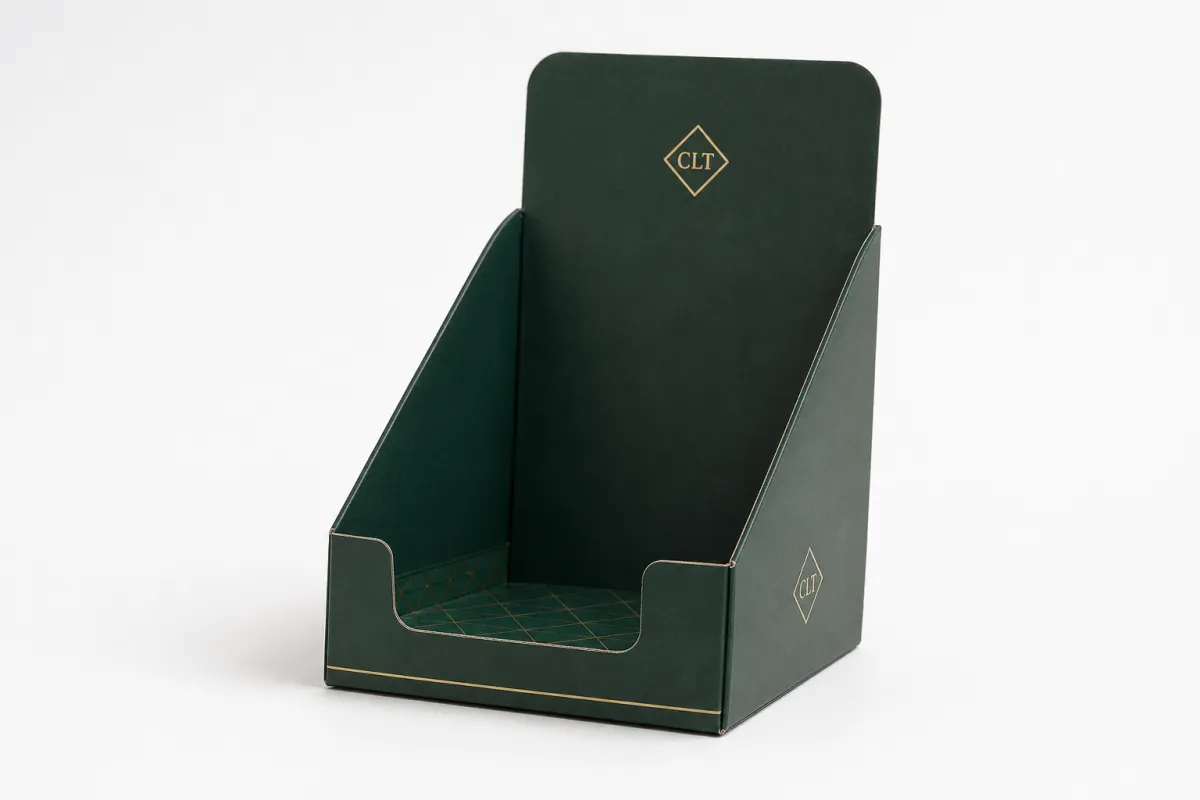
Custom counter display cartons are compact retail cartons designed to hold products upright and visible in a small selling area. They show up often with cosmetics, snacks, supplements, accessories, travel-size items, and sample packs. In practical terms, they make a small product look intentional on the counter instead of abandoned among receipts, promo tags, and whatever else is competing for attention that day.
These cartons are not the same as standard folding cartons, because the display function matters just as much as the protective function. A regular folding carton usually encloses one item and stops there. A shipper box moves goods from one place to another. Shelf-ready packaging helps with stocking. Custom counter display cartons need a different mindset entirely, since they are asked to protect, present, and sell at the same time in a very limited space.
The selling power comes from how little patience shoppers have at the counter. They are already committed to the store visit, but not necessarily to the impulse buy. A clear, upright display shifts that decision quickly, which is why custom counter display cartons can outperform loose trays or generic packaging. The shape points the shopper toward the product. Read this. Pick this up. Buy this. No extra explanation required, and honestly, that directness is a big part of the appeal.
From a packaging buyer's perspective, the best use case is straightforward. A small product needs a neat presentation, a message that can be understood at a glance, and a carton that does not take over the entire counter. That is why these cartons appear so often in product packaging programs for low-unit retail formats where the average selling price is modest but the impulse margin still matters.
A few common examples make the role easier to picture:
- Cosmetics: lip balms, travel skincare, sample kits, and boxed accessories.
- Snacks: gum, mints, protein bites, candy bars, and trial packs.
- Supplements: sachets, stick packs, and short-run wellness items.
- Accessories: cables, earbuds, phone add-ons, and small tools.
- Promo items: event giveaways, launch samples, and seasonal bundles.
In each of those categories, custom counter display cartons act as both retail packaging and branded packaging. The shopper sees a clear promise, the staff gets a compact format, and the brand gets a tiny billboard sitting right next to the purchase decision. There is nothing theatrical about that. It just works when the execution is sound.
How Custom Counter Display Cartons Work on a Retail Shelf
Custom counter display cartons work because they combine structure with a clean selling face. Most versions include an outer shell, a front-facing panel, a product cavity, locking tabs, and sometimes an insert or tear-away section. The carton arrives flat, gets packed at the plant or by the brand, and is then placed at retail where it behaves like a small stand-up display.
The structure itself is not complicated, but the details carry the load. The outer walls hold the form. The display face carries the artwork. The cavity keeps the product in a repeatable position. Inserts cut down on wobble. Tear-away fronts make one-at-a-time removal easier without wrecking the full carton. Locking tabs stop the box from opening when a clerk slides it across a counter for the tenth time before lunch.
That sounds simple because the best carton solutions usually are. A box that takes too long to assemble or falls apart after a few product pulls is not helping anyone. Custom counter display cartons need to balance visibility, access, and stability all at once. Improve one at the expense of the others and the whole setup loses value on the shelf. That tradeoff is easy to miss when you are looking at a clean mockup on a screen; it gets obvious fast once the box is handled in a real store.
Shopper flow is the real test. The carton needs to communicate in one glance, invite a hand reach, and hold its shape after repeated handling. The graphics should not bury the product name under a wall of copy, and the cavity should not let the units slump forward like they have already given up. Strong packaging design is not about impressing a design review. It is about helping a shopper make a quick decision without hesitation.
Common retail formats
Not every display carton should be built the same way. The format should fit the product, the environment, and the level of handling it will see on the counter.
- Countertop tray cartons: open-front trays that hold multiple units and keep the top edge low for easy grabbing.
- Dispenser-style cartons: front-open cartons that let staff or shoppers pull one item at a time.
- Front-open promotional units: compact displays with a stronger brand face and a limited quantity of stock.
- Multi-pack retail cartons: small grouped formats that keep a few SKUs together for a tidy presentation.
Most custom counter display cartons are built from folding carton board, though heavier products sometimes need corrugated reinforcement to stay upright. For heavier loads or long-haul shipment, ask about transit testing under ISTA guidance or relevant ASTM methods. That is not extra caution for its own sake. It is how you avoid receiving a pallet of cartons that already look tired before they ever reach the shelf.
Retail staff also care about replenishment. If the format allows quick loading and neat facing, the carton stays attractive longer. If the structure is awkward, the display starts looking ragged after a few pulls, and the brand loses the clean presentation it paid for. That is why custom counter display cartons should be judged as merchandising tools, not just as box shapes.
Key Factors That Shape Custom Counter Display Cartons
The most common mistake with custom counter display cartons is starting with artwork before the product spec is locked. That order is backward. Size, weight, fill count, opening style, and the way the product is removed all shape the carton structure. A carton can look right on screen and still fail on the counter.
Size and product fit
Product dimensions are the first non-negotiable. Measure the unit, the bundle, and the clearance needed for easy insertion and removal. A carton should not squeeze the product so tightly that the board bows. It should also not be so loose that the contents rattle around and turn the display into a noisy little mess.
For custom counter display cartons, fill count matters as much as footprint. A 6-count display and a 12-count display may share the same general size, but they will not need the same cavity depth, front opening, or panel strength. Skip that step and the carton can end up overbuilt, underbuilt, or oddly oversized for the counter it is meant to sit on.
Board choice and durability
Lightweight paperboard works well for low-weight items and shorter retail cycles. A 14 pt to 24 pt SBS or C1S board is common for smaller custom printed boxes and display cartons that do not carry much weight. For sturdier retail packaging, E-flute corrugated or reinforced paperboard offers better crush resistance and better shape retention. If the product is fragile, a simple insert can prevent returns, scuffed edges, and a messy shelf profile.
A useful rule for buyers is simple: the lighter the product and the shorter the shelf life, the more standard paperboard can do the job. As the product gets heavier, reinforcement, locking geometry, and testing become more valuable. That adds cost, of course. So does replacing damaged stock after a carton fails in transit or on the counter.
Branding and shelf visibility
Print choices change sell-through more than many teams expect. Strong color contrast helps the carton stand out from several feet away. Large type makes the offer readable at counter height. A clear hierarchy tells the shopper what the product is, why it matters, and whether it deserves a pickup. That is classic package branding, but it has to work inside a very small visual window.
Window placement can help too, though only if the product inside looks good enough to justify the cutout. A window on a messy or generic product is not a shortcut to better presentation. It is just a hole. Custom counter display cartons need the display face to do the selling, not the contents to carry the entire burden by themselves. If the inside product is strong enough to support a window, great; if not, a solid front panel is usually the cleaner move.
Retail environment changes the spec
Pharmacy counters, convenience stores, specialty boutiques, and grocery service desks all treat counter space differently. Some locations need tighter footprints. Others need tougher materials because staff will move the carton more often. Some channels are strict about messaging and pricing callouts. Others care more about quick stocking and easy removal. The same carton spec rarely fits all of them.
That is also where product packaging strategy matters. A carton aimed at a pharmacy counter may need quieter graphics and a more clinical structure. A snack display may need bolder color and faster readability. A beauty launch might need a more premium finish. The point is not to make every carton look expensive. The point is to make it look right for the shelf it actually occupies.
If you are comparing options, it helps to review a few structural directions before you commit. Our Custom Packaging Products page is a useful place to narrow the field, and the right retail packaging choice usually becomes clear once the product dimensions and use case are defined.
Custom Counter Display Cartons Cost, Pricing, and MOQ
Custom counter display cartons do not carry one clean price, and anyone saying otherwise is selling a tidy story rather than a real quote. Cost depends on board grade, size, print coverage, finish, inserts, die complexity, and whether the carton needs hand assembly or a structure better suited to automation. Quantity changes everything too, because setup costs get spread across the run.
For planning purposes, simple custom counter display cartons at 5,000 units often land around $0.18-$0.28 per unit for a plain structure with standard print. Add a window, insert, or a more complicated die and the range can move to $0.25-$0.42 per unit. Premium finishes, heavier board, or a reinforced build can land around $0.55-$1.20 per unit, depending on quantity and labor. Those numbers are not promises. They are planning bands, useful for early budgeting but not a substitute for an actual quote.
| Option | Typical build | Best for | Approx. unit cost at 5,000 pcs | Tradeoff |
|---|---|---|---|---|
| Standard paperboard display carton | 16-18 pt SBS, 4-color print, simple die cut | Light products, sample packs, short promos | $0.18-$0.28 | Lowest cost, but limited strength |
| Windowed carton with insert | 18-24 pt board, PET window, internal support | Beauty, accessories, visible retail packaging | $0.25-$0.42 | Better visibility, more assembly steps |
| Reinforced dispenser carton | Paperboard plus corrugated support or heavier board | Heavier products, busy counters, repeated pulls | $0.38-$0.75 | Stronger and neater, but higher material cost |
| Premium branded display unit | Specialty finish, complex die, possible foil or soft-touch | Launches, giftable SKUs, premium retail packaging | $0.55-$1.20 | Best presentation, highest setup and unit cost |
The MOQ logic is easy to understand, even if the invoice is not. Smaller runs usually cost more per unit because setup, cutting, and finishing are spread across fewer cartons. Larger runs lower the unit price, but they also tie up cash and warehouse space. That is why custom counter display cartons should be quoted in tiers rather than in a single quantity only. Ask for 1,000, 3,000, 5,000, and 10,000 pieces if the supplier can quote them clearly. The gap between tiers tells you where the real savings sit.
Hidden costs show up more often than the print quote itself. Freight can be painful if the cartons ship flat but in bulky cartons. Sampling takes time and sometimes money. Structural revisions can trigger new tooling or fresh die plates. Last-minute artwork changes remain one of the easiest ways to burn a budget. Custom counter display cartons do not get expensive only because of the carton. They get expensive when the process gets sloppy.
If the order is tied to a launch, the smartest move is to compare tiered quotes and decide how much inventory you can actually carry. A unit price that is 3 cents lower on 20,000 cartons may not help if half of them sit in storage for six months. That is why the best branded packaging decision balances unit price, cash flow, and real sell-through.
Ask for three things on every quote:
- Unit price at multiple quantities.
- Sampling and revision costs, if any.
- Estimated freight and packing method.
That simple checklist saves more budget than most buyers expect. It also makes custom counter display cartons easier to compare against other retail packaging options, including standard folding cartons or more specialized shelf-ready units. If a vendor cannot show the cost steps clearly, the quote probably hides something.
For buyers who need certified fiber sourcing, ask about FSC certification and whether the board supplier can provide chain-of-custody documentation. Some retailers care a great deal, others barely mention it, but it is far easier to confirm early than to discover the requirement after artwork approval.
Custom Counter Display Cartons Process and Lead Time
The process for custom counter display cartons usually moves in the same order: brief the supplier, confirm dimensions, build a structural concept, review artwork, approve a sample, then move into production. When one of those steps is fuzzy, the schedule slips. That is the whole story. Time rarely disappears because a carton is difficult in theory; it disappears because specs arrive late or change halfway through.
Step 1: Lock the brief
Start with the product specs: dimensions, weight, fill count, and how the carton will be loaded and opened. Add the quantity target, retail channel, finish preferences, and launch date. If inserts or windows are part of the plan, say so now. A supplier cannot design a stable carton around "something about this size" without creating waste later.
Step 2: Review the structure
A basic structural concept may come back quickly, often within a few business days if the supplier has clear information. More complex custom counter display cartons can take longer because the lock style, panel geometry, and front opening all affect stability. If the carton needs to stand up under repeated handling, one or two structural revisions are normal. That is not delay for its own sake. It is how you avoid a weak production run.
Step 3: Approve the artwork
Once the structure is right, the print file should be checked for type size, barcode space, product copy, legal copy, and color build. A carton that is 95% correct is still wrong if the barcode scans poorly or the main message falls into a fold line. Custom counter display cartons need the artwork to respect the die line rather than fight it.
Proofing discipline matters here. Ask for a digital mockup or structural proof first. Then, if the project justifies it, request a physical sample or pre-production sample. A flat proof checks dimensions and artwork. An assembled sample checks reality. Both are worth having, and skipping either one is the sort of shortcut that usually comes back to bite you later.
Step 4: Production and transit
For simple runs, lead time can be about 12-15 business days after proof approval. For more complex custom counter display cartons with specialty finishes, windows, inserts, or new tooling, 18-25 business days is a more honest planning range. Freight sits on top of that. International shipping, customs, and last-mile delivery can easily add another week or two.
Lead time slips in a few predictable places: missing specs, late artwork approval, repeated structural tweaks, and finish changes after sampling. None of that is mysterious. It is just expensive. If the retail launch date is fixed, plan backward from the shelf date rather than the purchase order date. Leave room for proofing, one correction round, and freight. That buffer costs less than air shipping a correction run because the carton missed the shelf window.
Custom counter display cartons also benefit from testing before production. If the carton will face rough transit or heavy retail handling, ask about standards such as ISTA methods or relevant ASTM packaging tests. A carton should not fail just because it looked excellent in a PDF.
Common Mistakes With Custom Counter Display Cartons
Most bad outcomes with custom counter display cartons come from one of four mistakes: wrong fit, too much design noise, weak structure, or no real testing. None of those are rare. They are common, which is exactly why they keep showing up on production floors and store counters.
The biggest one is designing for the artwork first and the product second. I understand why teams do it. The mockup looks exciting. The colors pop. The logo sits in the right corner. Then the actual item arrives and the carton is too tight, too wide, or too deep. That is how buyers end up paying for custom printed boxes that match the concept but not the SKU. A few millimeters can be the difference between a display that loads quickly and one that turns into a headache for the warehouse team.
Overdesign is another familiar problem. Too many colors, too much copy, too many icons, too many claims. The result is a carton that tries to say everything and ends up saying nothing quickly. A shopper at a counter does not need a lecture. They need the product name, the benefit, and maybe one short supporting point. If the carton asks for more attention than the product can justify, it loses the sale.
Structural mistakes are even more expensive because they become visible damage. Weak bases lean. Poor tear lines fray. Thin board crushes. A carton with a beautiful front panel but no spine is basically a billboard with anxiety. Custom counter display cartons need structure that survives repeated grabs, resets, and the occasional overenthusiastic staff member who yanks a product out sideways. That happens more often than people think.
"If a carton looks good in a render but tips after the fifth product pull, the design is wrong. The store is not the problem."
Testing is the last line of defense. Check assembly time, shelf footprint, product removal, and how the carton looks after handling by store staff. If the unit needs a 20-minute setup to look right, that is too slow for most retail counters. If the front panel tears the first time someone removes a product, the structure needs revision. If the carton still looks neat after a few pulls, you are getting close.
For buyers who want the packaging to support sell-through instead of merely holding inventory, the test list should include:
- Footprint on a standard counter depth.
- Ease of loading by a warehouse or store associate.
- Visibility of the main message from 3 to 5 feet away.
- Resistance to leaning after repeated product removal.
- Compatibility with the real SKU, not a guessed placeholder.
That level of discipline keeps custom counter display cartons from becoming expensive shelf clutter. It also protects the retail packaging budget, because a good design is usually cheaper than a reprint.
Expert Tips and Next Steps for Custom Counter Display Cartons
If you want better results from custom counter display cartons, design for the shopper's eye level first. The main message should be readable in one glance from the counter, not after a long stare at close range. That means large type, short copy, strong contrast, and a front panel that does not bury the offer under decorative noise.
Ask for two samples, not one
Request both a flat sample and an assembled sample. The flat sample tells you whether the die line, scores, and print registration are correct. The assembled sample tells you how the carton behaves in real life. Does it sit square? Does it bow? Does the product feel crowded? Does the opening make sense? Those are practical questions, not design-theory questions.
Gather the spec before quoting
Before you ask for pricing on custom counter display cartons, line up the basics: product dimensions, target quantity, fill count, artwork files, finish preferences, budget range, and launch date. If the retail environment matters, say that too. A pharmacy counter and a convenience store checkout do not need the same construction. Good suppliers can only quote accurately when the brief is honest.
That is also the moment to compare options side by side. One carton may save 4 cents per unit but require extra labor. Another may cost a little more and arrive ready to pack. One may look premium but be too fragile for a busy counter. The best choice is not always the cheapest quote. It is the one that supports retail packaging, labor speed, and sell-through at the same time.
Compare two or three structures
Do not stop at the first concept. Ask for a simple version, a reinforced version, and a premium version if the budget allows. That gives you real tradeoffs instead of a single number dressed up as strategy. It also helps you decide whether the project needs standard folding carton logic or a more specialized display structure.
If your brand is still deciding how far to push the visual side, the safer move is to keep the packaging design clean and the structure strong. A carton with one clear message and a stable base usually beats a busy display unit with a fragile spine. That is true for sample packs, accessory kits, and most impulse products. Fancy is optional. Clear is mandatory.
If you need a broader starting point, review the Custom Packaging Products lineup and compare the structure against the product's actual weight and selling environment. That cross-check usually saves a round of revisions. It also helps keep custom counter display cartons aligned with the rest of your custom packaging program instead of turning into a one-off mistake.
My short version: lock the product spec, choose the lightest structure that still survives the counter, and compare pricing in tiers before you place the order. Custom counter display cartons work best when the brief is specific, the artwork is restrained, and the supplier has enough time to build something that does not collapse under normal use. Get those pieces right, and custom counter display cartons stop acting like an expense and start behaving like a small, very persistent salesperson. If you are stuck on where to begin, start with the product dimensions and fill count; that one step usually clears up the rest of the decision tree.
FAQ
What are custom counter display cartons used for?
They hold small retail products in a compact display format that sits on counters, service desks, or other high-traffic areas. Custom counter display cartons are built to make products easy to grab while also carrying branding, pricing cues, and promotional messaging. They are especially useful for impulse buys, sample sizes, and items that need a tidy presentation without taking up much space.
How much do custom counter display cartons usually cost?
Price depends on size, board grade, print coverage, finishing, inserts, and order quantity. Lower quantities cost more per unit because setup and cutting fees are spread across fewer cartons, while higher runs bring the unit cost down. A simple run may sit around $0.18-$0.28 per unit at 5,000 pieces, while more complex custom counter display cartons can run higher. The smart move is to compare tiered quotes so you can see the real savings before you overbuy.
What is the typical turnaround for custom counter display cartons?
Straightforward jobs can move quickly once artwork and dimensions are approved. More complex cartons, new structures, or special finishes usually need extra time for sampling and production. For planning, simple custom counter display cartons may land around 12-15 business days after proof approval, while more involved builds can need 18-25 business days before freight. Build in buffer time for proofing, transit, and one round of corrections.
What information do I need for a custom counter display cartons quote?
Provide product dimensions, weight, fill count, and how the carton will be opened or stocked. Share your quantity target, artwork files, finish preferences, and whether you need inserts or windows. Add the launch date and retail environment so the supplier can recommend the right construction. The more exact the brief, the less likely you are to get a quote that looks fine on paper and useless in production.
Are custom counter display cartons suitable for heavy products?
Yes, but only if the structure is reinforced with stronger board, inserts, or a more stable base. Heavy items need testing for crush resistance, shelf stability, and safe product removal. If the item is very heavy, ask for a structural review before you approve the artwork. Custom counter display cartons can handle more weight than people expect, but only when the build is matched to the load instead of guessed from a mockup.
If you are comparing options right now, keep the brief specific, ask for two or three structure choices, and make sure the retail packaging spec fits the product instead of the other way around. That is the cleanest path to a carton that holds up, looks right, and actually helps the product sell.

