Buyer Fit Snapshot
| Best fit | Custom Crash Lock Bottom Boxes projects where brand print, material claims, artwork control, MOQ, and repeat-order consistency need to be specified before quoting. |
|---|---|
| Quote inputs | Share finished size, material target, print colors, finish, packing count, annual reorder estimate, ship-to region, and any compliance wording. |
| Proofing check | Approve dieline scale, logo placement, barcode or warning zones, color tolerance, closure strength, and carton packing before bulk production. |
| Main risk | Vague material claims, crowded artwork, missing packing details, or unclear freight terms can make a low unit price expensive after revisions. |
Fast answer: Custom Crash Lock Bottom Boxes: How They Work and Why should be specified like a repeatable production item. The safest quote records material, print method, finish, artwork proof, packing count, and reorder notes in one written spec.
Production checks before approval
Compare the actual filled-product size with the drawing, then confirm tolerance on folds, seals, hang holes, label areas, and retail display edges. Reserve space for logos, QR codes, warning copy, and material claims before decorative graphics fill the panel.
Quote comparison points
Review material grade, print process, finish, sampling route, tooling charges, carton quantity, and freight assumptions side by side. A quote is only useful when the supplier can repeat the same color, closure quality, and packing count on the next order.
On a busy packing line, the gap between a carton that requires a little manual fighting and Custom Crash Lock Bottom boxes that snap into position with one quick press is huge. I have stood on packing floors where that difference decides whether labor hits the shift target or ends up chasing a backlog all afternoon. The difference is operational, not cosmetic. It is speed, consistency, and confidence under the hands that touch the box every day.
From a packaging buyer’s perspective, the value is straightforward. You get a flat-packed format that ships cleanly, then opens into a stable base without a long sequence of hand folds. In real production, custom crash lock bottom boxes are less about novelty and more about control: cleaner assembly, fewer mis-folds, better repeatability, and steadier support before the box even leaves the bench. For teams in Custom Packaging Products sourcing, that control often beats anything that looks fancy on a spec sheet.
If you are comparing structures, this one matters for moderate-weight SKUs, subscription kits, and cases where packout rate affects labor planning. I can confirm this from live runs: the same workforce that can hit high output with a standard design will usually stay calmer with a bottom that locks reliably. The rest of this article explains how custom crash lock bottom boxes behave, what affects pricing, and how to specify them without getting trapped by assumptions that only appear after production starts.
Why do custom crash lock bottom boxes stand out on the line?
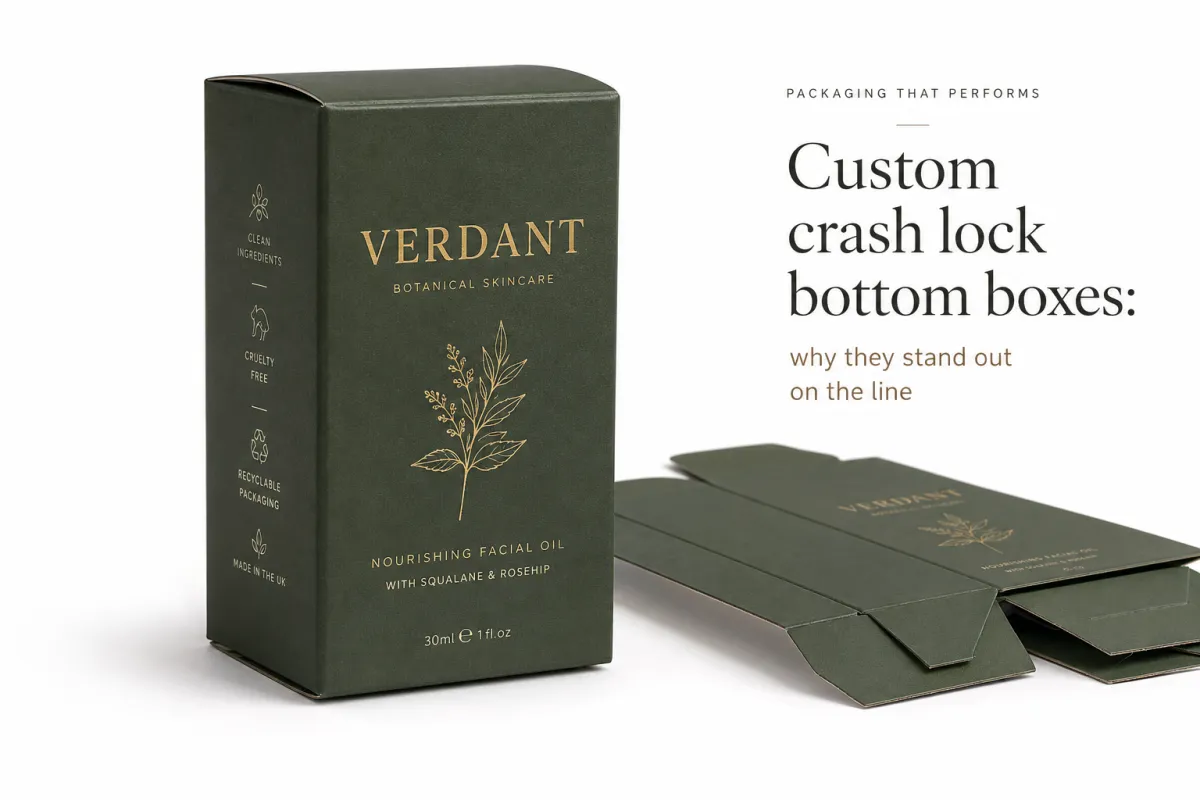
The big advantage is not shelf drama. It is behavior under packout pressure. A regular tuck carton asks an operator to fold, tuck, and re-check a few critical moves. That adds seconds, and it adds variation. A crash-lock style arrives flat, but the base geometry and glue placement are designed so the bottom locks with one deliberate press, which shortens the work cycle by design.
That time gain sounds minor until you stack it against real numbers. On a line moving 1,200 units, shaving 6 to 10 seconds per carton can recover a meaningful amount of labor. Over a day, that is often the difference between one extra changeover window and another. For custom crash lock bottom boxes, the win is not just speed. The base gives packers a steadier load path, which is especially useful once the product gets heavier than a tiny sample jar.
They are also better for repeatability, and that is why teams keep coming back to them. Whether you pack beauty, nutrition, personal care, small housewares, specialty food, or e-commerce secondary packs, your team benefits when the structure opens exactly the same way each time. With custom crash lock bottom boxes, the bottom is pre-glued during conversion, so the operator is not forced to “rebuild” the base by hand on the floor. It sounds basic, and that is exactly why it works.
Presentation gets better, too. A properly built crash-lock carton supports a straight profile, reduces bottom sag, and helps the print stay aligned after filling. In retail packaging, this is not just aesthetics; it is brand trust, because a warped carton makes a product look careless. A controlled bottom gives you a cleaner visual edge and less variation from carton to carton.
A box that adds a few cents and saves a few seconds can still be the lower-cost choice once you include labor, rework, and bottom failures in the real cost math. On a packing floor, hidden costs are where most budgets quietly disappear.
There is a quiet structural benefit, too. A well-designed custom crash lock bottom boxes distributes load through several fold lines instead of concentrating stress on one seam. That helps keep the carton stable in handling and shipping. If you are comparing Custom Printed Boxes or simpler fold formats, this load distribution often becomes the deciding factor when return damage appears in QA reports.
Another reason they stand out is flexibility in appearance. You can do a plain kraft aesthetic for natural branding, or build a higher-visibility retail version with stronger print and coatings. The locking principle stays the same; the differences are in board selection, artwork, and finish. That separation makes it easier to standardize structure while letting branding vary.
For reference quality standards, it helps to review external methods from ISTA and broader industry packaging guidance from packaging.org. Those standards won’t choose your carton for you, but they keep teams honest about what “survive transport” should mean.
How custom crash lock bottom boxes work
Think of the bottom as a pre-linked set of panels. During conversion, selected glue points are applied, fold geometry is set, and the carton is shipped flat. At packout, opening the carton and applying pressure causes the bottom panels to crash into a locked configuration. It is mechanism plus material working together, not magic.
That “crash” moment is the core of the design. Instead of folding multiple flaps manually, custom crash lock bottom boxes use panel angle, joint sequence, and glue placement to lock the base in one action. The operator’s motion becomes consistent, which is critical on medium-to-high throughput lines and across mixed shifts.
The strength comes from more than the glue. Fold angles, panel dimensions, adhesive selection, and board stiffness all have to be aligned with the product load profile. If one is off, corners can misalign, the bottom can pop, or the seam can fatigue quickly. That is why these cartons are always a structural spec problem first, not just a graphics problem.
In practice, packout is straightforward. The carton ships flat, storage footprint stays predictable, and the opening motion can be managed in manual or semi-automated processes. Once open, custom crash lock bottom boxes create a base that spreads force better than many simple tuck systems. That helps with dense products, taller cartons, and contents that settle during filling.
The physics is simple and worth repeating: force spreads across the whole bottom footprint instead of hanging on a single fold line. If the geometry is right, you get better bottom stiffness, less bowing, and fewer seam pull-outs under repetitive stress. That is often enough to keep you out of the “maybe we should move to rigid” debate when all you need is stronger folding carton performance.
But the system will fail when underspecified. A too-light board can soften the lock. Weak adhesive can create progressive fatigue. Bad dimensions force bulging, and bulging creates stress concentrations. custom crash lock bottom boxes stay efficient only if designed around the actual product dimensions and weight profile, not around a generic template.
Testing is simple to run if you keep it practical. Check opening speed, corner squareness, base compression feel, and edge behavior at the glue line. If distribution stress is expected, add compression and vibration checks at least on pilot units. For structural benchmarking, teams commonly combine internal tests with guidelines from ASTM and ISTA references; in practice, ASTM D642-style compression logic and ISTA transit-style scenarios are often discussed in parallel.
The point is to test before scale, not after shipment. A few fully packed prototypes under real load can expose lock weakness, product shift, and bottom deformation early. It is a lot cheaper to adjust a die at sample stage than to explain why a full pallet arrived with a soft base.
Key factors that affect performance and fit
Board choice is usually step one. custom crash lock bottom boxes rely on board caliper, fiber type, and finish compatibility, especially once weight rises. SBS can be a good option for lighter goods. A kraft-faced or heavier board may be better for denser goods, premium touch, or natural branding with more visual texture. The wrong board gives you a soft bottom and, eventually, a weak operation.
Size is the next trap. Too much internal volume creates movement, and movement is enemy number one for a stable base. Too little internal space can force the lock to bind and distort during closing. You are balancing load, product geometry, and folding mechanics simultaneously. For custom crash lock bottom boxes, fit is never a single dimension problem; it is an interlocking system problem.
Product attributes matter even more. A bottle stack behaves differently than a tube set, which behaves differently than glass jars. Center of gravity, shape asymmetry, fill density, and insert design all change how the bottom should be engineered. A short-screen review rarely catches this. A sample in hand will, and a sample in hand does not lie.
Finish choice affects both look and durability. Gloss can make graphics pop, while aqueous, matte, or soft-touch options can improve handling tolerance, depending on touchpoints. Window cuts increase transparency and sales visibility, but window location and reinforcement must be planned so the seam remains stable. An insert can improve centering, and can also block weak zones if it is not aligned with the load path.
Artwork and structure must coordinate. Print placement cannot ignore glue zone, seams, and fold direction. If barcode, legal copy, or ingredient panels sit on a fold, scanners and compliance checks suffer. I have seen attractive artwork end up unusable because people moved an ingredient line across a dynamic fold line. With custom crash lock bottom boxes, design review is structural review first, graphic approval second.
Sustainability is increasingly a real specification, not a side note. FSC-certified fiber can support sourcing goals, and right-sizing reduces material waste in shipping and storage. Recycle-aware coatings and lower-plastic packaging options are more feasible when the structure is tested early. If sustainability is part of your purchase criteria, include it before tool approval, not after print sign-off. FSC is one common external benchmark teams consult.
When people compare custom crash lock bottom boxes against other Custom Printed Boxes, the best fit usually comes down to product weight and line tolerance for manual correction. A simple tuck can be fine for very light SKUs. Once weight and speed rise, the mechanical stability of custom crash lock bottom boxes begins to matter a lot more than expected.
Custom crash lock bottom boxes pricing: what drives cost
Cost is not just “more complex = more expensive.” It is usually a collection of known drivers: substrate, coating, print, structural complexity, and quantity. A simple monochrome kraft style can be materially cheaper than heavy print with spot effects, but that only shows half the story. Every custom bottom has conversion cost attached, whether you feel it in unit price or in labor.
Volume still matters. At small quantities, die preparation, proofing, and setup create a higher base cost per carton. At higher quantities, those fixed costs spread out and unit economics improve. For custom crash lock bottom boxes, you might see a light retail-style run around $0.35-$0.65 per unit and higher-volume simpler specs closer to $0.18-$0.30 per unit. These are directional figures, not guarantees. Your exact job can drift from these ranges based on dimensions, finish, and board.
Tooling is often where buyers get surprised. Dieline creation, structural proofing, and prepress iteration can take extra rounds when first-pass specs are vague. Window additions, inserts, unusual folds, and additional locking features increase risk of rework if not locked early. In my experience, the cleanest cost structure always comes from clear structure sign-off before artwork lock.
Also count the operating value. Faster packout, lower misassembly, and fewer damaged bottoms reduce effective cost per unit over time. A box with a higher printed unit price can still be cheaper to run if it saves labor and avoids damage claims. That is why I always price on total cost, not on invoice line alone.
| Option | Typical use | Approximate unit cost | Notes |
|---|---|---|---|
| Light SBS crash-lock carton | Cosmetics, small retail items | $0.18-$0.30 | Best for light products with moderate print and straightforward handling. |
| Kraft-faced crash-lock carton | Natural branding, e-commerce, specialty food | $0.22-$0.38 | Often chosen for natural visual language and practical structural performance. |
| Heavier print-and-finish carton | Premium retail packaging | $0.35-$0.65 | Higher unit cost reflects stronger board, coatings, and tighter quality review. |
Use the table as a decision aid, not a promise. The lowest line-item quote is often not the best operating choice. The better framing question is, “How much labor, damage, and rework does this carton save me over the life of the run?”
Many packaging programs group custom crash lock bottom boxes with other Custom Packaging Products to balance board sourcing, artwork control, and lead-time planning across SKUs. That usually reduces complexity and makes it easier to compare cost and performance at the program level.
Production process and timeline for custom crash lock bottom boxes
For custom crash lock bottom boxes, the sequence should start with structure, not decoration. If the dieline is not right, no amount of excellent artwork fixes a weak fit. A reliable workflow starts with dimensions, carton role, and volume targets, then confirms board and fold mechanics before finalizing design files.
Prepress follows with layout validation: bleed, fold lines, seam areas, barcode zones, warnings, and legal text all get checked against the physical structure. If you plan a window, insert, or special coating, that detail must be on the approved artwork before print. In these cartons, mechanics and graphics are married. If one moves without the other, you get issues downstream.
From there, production usually passes through proofing, printing, die cutting, gluing, and finishing. A straightforward order can move quickly, especially when materials are available and the design is stable. A typical run of custom crash lock bottom boxes can land around 12-15 business days from proof approval for many suppliers, but that timeline can move if sample revisions, coating choices, or material sourcing are required.
Most delays trace back to revisions. Artwork edits are common. So is structural tuning when the first physical sample does not pack the way expected. Coating choices can add cycle time too, especially if special effects require additional passes. The only way to stay out of this pain is to reserve schedule for at least one true physical sample before ramping production.
Quality checks belong at multiple points. In conversion, verify glue line consistency. During folding, confirm the lock action is repeatable. After conversion, validate squareness, print placement, and weighted bottom performance. If shipment is part of the path, add transit-style tests for vibration, compression, and handling orientation.
Reference frameworks from ISTA are helpful here because they describe common handling stresses. They do not replace your internal requirements, but they give teams a shared language when discussing failure modes.
Integration planning makes or breaks performance. If your pack line requires an opening orientation, or if cartons must fit a specific master shipper, decide that before finalizing structure. Custom crash lock bottom boxes are strongest when the entire chain is coordinated: product dimensions, carton geometry, filling method, and shipping path.
For multi-SKU programs, standardize key parameters where it helps and leave room for brand flexibility where it matters. That is how many operations keep complexity manageable without flattening differentiation. It is boring work, but the boring decisions are the ones that stop costly surprises.
Step-by-step guide to specifying the right box
Begin with the real object, not the mockup. Measure length, width, height, and weight. Add allowance for caps, pumps, rounded corners, labels, and any accessory that can change inside geometry. A custom crash lock bottom boxes pack is not about the paper shell alone; it is about loaded geometry and how the contents settle over time.
Next, define the carton’s job. Is it a shelf-ready retail carton, an e-commerce secondary pack, a display-facing container, or a transport shell inside another packaging system? That decision changes board choice, print complexity, and finish selection. I usually see teams over-design retail finishes on a mailing-only box and pay for it later.
Then select structure and finish for use conditions, not style preference. SBS with aqueous coating is common for many retail jobs. Kraft-faced board suits brands that want a natural look and can stay within moisture and handling limits. Denser products or long stack patterns in transit often require stiffer board and stronger bottom performance. For custom crash lock bottom boxes, spec the final load condition, not only the empty carton look.
- Measure the item and include all growth points: caps, pumps, seals, inserts, and corners that stick out.
- Define the carton role before starting artwork so structure and visuals stay aligned.
- Choose board and finish from real handling conditions: gravity, stacking, and touchpoints.
- Request and evaluate prototypes physically, not only on screen.
- Lock legal and scan zones away from glue seams, folds, and distortion-prone panels.
Requesting a prototype is one of the most practical decisions you can make. A screen file cannot tell you if the pack rattles, if the lock action feels awkward for operators, or if the bottom has just enough “give” to be annoying by hour three of a shift. A small height or width adjustment in prototypes can save a production team from daily frustration.
Close the file with operational details, not just aesthetics. Confirm barcode direction, scanner clarity, tamper feature clearance, and fold direction for the specific operators on the line. Those details are not glamorous, but they are exactly what stop cartons from becoming warehouse conversation pieces.
Then stress-test in realistic scenarios. If the package sits in a warehouse, stack it. If it rides with totes, apply vibration and handling motion. If climate varies, test humidity and temperature drift for a short period. custom crash lock bottom boxes perform as intended only when the environment in the spec matches actual use.
Common mistakes and expert next steps
The biggest mistake is underestimating board strength. A carton can look okay before filling and still fail after load. If weight is underestimated, custom crash lock bottom boxes can bow, lose shape, and start to look soft around seams. That is usually not a graphic issue. It is a structure issue, and it should be corrected in the material spec before print commitment.
Second most common: skipping hands-on packing trials. A carton may pass dimensional QA and still be painfully awkward for operators. If opening feels inconsistent, if the lock action varies by angle, or if the product hangs up on side panels, your line will feel it instantly. I have watched this eat hours per shift. A ten-minute pack test avoids that.
Third: ignoring seam-aware design. Artwork may look balanced in software and still be wrong in production if it interferes with folding and glue zones. Barcode location, legal copy, and critical brand elements should stay clear of stressed folds. Since custom crash lock bottom boxes are movement-dependent, the print layer has to follow the mechanism, not override it.
Fourth: forgetting distribution stress. Humidity can alter board behavior. Compression can distort long-run stacks. Vibration can loosen fragile loads if the internal support is weak. For cartons headed into ecommerce channels or mixed freight, this is where specs get proven, not debated.
Fifth: treating sustainability as a sticker instead of a design decision. If that matters to your brand, ask for sourcing details, coated-paper behavior in your climate, and recycling guidance from the supplier. I see better outcomes when sustainability is added to the structural spec early and reviewed with the same seriousness as cost and print.
Here is the practical next-step checklist I use with buyers considering custom crash lock bottom boxes:
- Capture exact dimensions, weight, and fragile features.
- Assign a clear carton function: retail, ecommerce, secondary distribution, or display.
- Set quantity and print level before quoting so timelines and cost stay realistic.
- Approve a sample with real product before signing off the full run.
- Verify artwork against folds, seams, glue lines, and barcode/scanner clearance.
- Run loaded handling tests for fit, speed, and durability in actual conditions.
For many operations, the outcome is plain. Custom crash lock bottom boxes are not a gimmick. They are a pack design discipline that improves throughput and consistency when specified properly. That is why they keep getting selected for operations where speed, repeatability, and stable support are non-negotiable.
Frequently Asked Questions
What products work best in custom crash lock bottom boxes?
Custom crash lock bottom boxes work well for products that need a faster pack flow and a bottom with more load stability than a basic tuck carton. They are often a strong fit for cosmetics, supplements, personal care, specialty foods, and moderate-weight retail goods. The best match is any product that benefits from quick, repeatable setup and clean geometry during filling and shipping.
Are custom crash lock bottom boxes more expensive than standard cartons?
Unit pricing can be higher than a basic folding carton because of structure and conversion complexity. In many cases, the extra cost gets offset by labor savings and fewer handling errors. Your total value depends on quantities, board grade, print complexity, and how the carton changes packing and transport outcomes.
Do custom crash lock bottom boxes need glue during assembly?
Most designs are pre-glued in conversion so the base can lock when opened. That is what allows the quick action at packout. The quality of the adhesive application and the conversion process still matters. If gluing is weak or board strength is too low, the lock can fail regardless of design intent.
How long does production usually take for custom crash lock bottom boxes?
Timing depends on artwork readiness, structural approval, board availability, and finishing requirements. Simple structures move faster, while sample changes, coatings, or special printing add lead time. The safest schedule starts with stable dimensions and approved structure before production launch.
Can custom crash lock bottom boxes include inserts or windows?
Yes. Inserts can improve product centering and protect fragile components, and windows can improve visibility. Both are useful when used correctly. Keep the structural zones in mind so neither inserts nor window cuts weaken the base or alter the fold sequence.
If your next packaging run needs a carton that opens quickly, holds weight cleanly, and holds brand quality on shelf, custom crash lock bottom boxes should be your first serious option. Keep it practical: match board, dimensions, and print to the actual product profile, then validate with a real sample before full production. That simple sequence is the difference between a carton that merely exists and custom crash lock bottom boxes that actually keep your line running better.