A custom cufflink box does more than hold a pair of accessories. It is the first physical proof of quality a buyer touches, and that first touch can lift a modest set into gift-ready territory or expose weak packaging design immediately if the lid wobbles, the insert shifts, or the print lands out of register.
For jewelry brands, corporate gifting teams, and wedding retailers, the box is part of the product, not an afterthought. A well-built presentation box supports branded packaging, protects the cufflinks in transit, and makes the set feel deliberate the moment it is opened. A bad one does the opposite with surprising speed.
What a Custom Cufflink Box Changes at First Touch
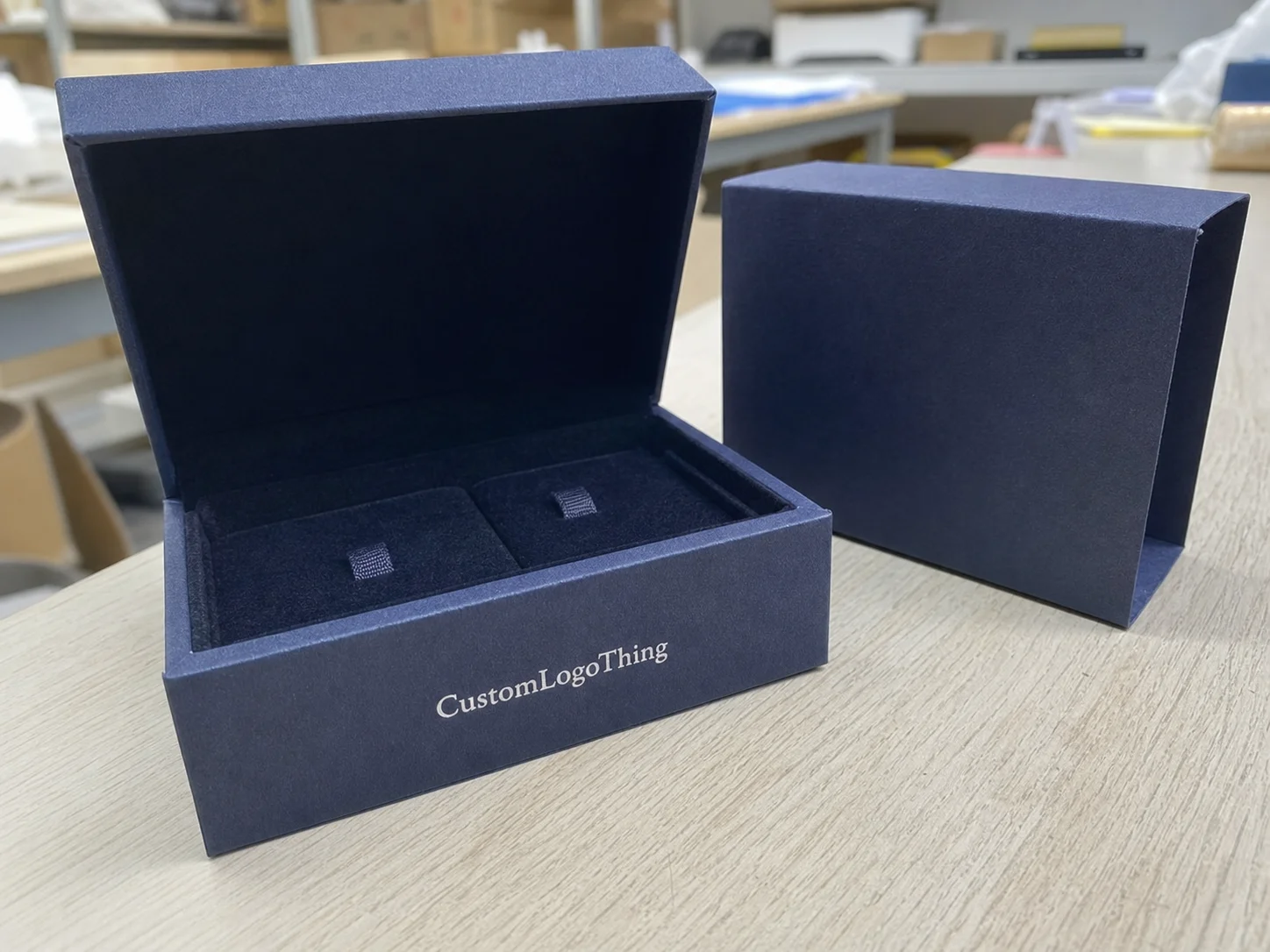
People usually judge cufflinks before they ever wear them. That is a simple retail truth. The same pair can feel ordinary in a thin stock carton and feel premium in a carefully made custom cufflink box with a clean reveal, a snug insert, and a lid that closes with confidence.
The product itself is straightforward: a purpose-built presentation package sized to hold, protect, and display cufflinks during retail sale, gifting, or shipping. In direct-to-consumer orders, the box may travel through a mailer, then sit on a dresser or vanity. In luxury retail packaging, it has to look composed on the shelf and feel consistent with the rest of the line. For wedding favors and corporate awards, the box often becomes part of the memory, which raises the standards in a way most buyers underestimate at the quoting stage.
The box affects perceived value in a few concrete ways. A tight lid line says the structure was built carefully. A centered logo says the brand pays attention to detail. A loose insert, by contrast, makes the set feel unfinished even if the cufflinks themselves are well made. That is why jewelry packaging has to be judged as a system, not just as a printed shell.
A buyer may forgive a simple structure if it feels intentional. They are much less forgiving when the box looks cheap because of poor fit, sloppy alignment, or a finish that scuffs on contact.
Most often, this packaging shows up in wedding gifting, corporate recognition, luxury retail, and direct-to-consumer mailers. Each use case has a different priority. Wedding orders usually care about presentation and timing. Corporate gifts need consistency across batches. Retail programs need repeatable replenishment. And mail-order packages need enough compression and abrasion resistance to survive handling without looking tired before the customer even opens them.
That split matters because a box that works beautifully for a boutique shelf display can fail in fulfillment. The structure may be attractive, but if the surface marks easily or the closure opens under vibration, it has the wrong balance for the job.
How the Insert, Lid, and Closure Work Together
A cufflink package is only as good as the parts working together. The outer structure gives you the form, the insert holds the product steady, and the closure determines how the opening feels. If one of those pieces is out of balance, the whole presentation drops.
For inserts, the common choices are foam, EVA, velvet-lined board, and die-cut paperboard. Foam is economical and forgiving, which makes it useful for lighter runs and basic protection. EVA is denser, more precise, and usually better for holding shape without compression marks. Velvet-lined board adds a more traditional jewelry feel, though it can raise cost and require more careful handling during assembly. Die-cut paperboard inserts work well when you want a cleaner, more recyclable presentation with less soft-touch feel. The right choice depends on whether the box is meant for display, shipping, or both.
Closure style changes perception fast. A rigid lift-off lid gives a classic luxury feel. A magnetic closure feels modern and controlled, but the magnet strength has to be right; too weak and the lid drifts open, too strong and the opening feels awkward. Tuck-end structures are useful for lighter retail setups and lower-cost runs, though they do not create the same premium impression as a rigid presentation box. Hinge style matters too, especially if the box is opened frequently in store or used for repeat gifting.
Fit is non-negotiable. If the cufflinks shift in transit, the box arrives looking unfinished even if the print is perfect. If the cavity is too tight, the user has to force the product in and may scratch plated surfaces or crush a backing card. That is why a custom cufflink box should be designed around the actual cufflink profile, including any card, pad, or branded insert that ships with it.
One practical way to think about structure is this: the outer shell sells the brand, the insert protects the product, and the closure finishes the unboxing sequence. If any one of them feels flimsy, the customer notices immediately.
Quality control in this category usually comes down to simple checks that catch expensive mistakes early. Look at corner squareness, lid alignment, glue squeeze-out, magnet pull, insert depth, and whether the cufflinks can move when the box is shaken gently. Those checks sound basic because they are basic, but they catch most of the failures that turn a polished design into a return or a rework.
Materials, Finish, and Fit: The Specs That Matter
Buyers often start with color or print, but the real decisions are structural. For rigid presentation packaging, a common build is 1200gsm to 1500gsm greyboard wrapped with 157gsm coated art paper, specialty paper, or textured stock. For folding carton styles, 300gsm to 400gsm paperboard is more common, especially if the box will be shipped flat and assembled later. Those ranges are not universal, but they are practical starting points for custom printed boxes in jewelry packaging.
Finish changes both the look and the handling behavior. Soft-touch lamination gives the surface a muted, premium feel, though it can show fingerprints if the job is handled a lot. Matte lamination is usually a safer balance for retail packaging because it resists visible scuffing better than high gloss. Foil stamping adds a strong brand cue with relatively small coverage, while embossing and debossing create tactile detail that can make package branding feel more intentional. Spot UV can work well on logos, but only if the rest of the artwork supports it rather than fighting it.
Sizing needs to account for more than just the cufflink body. If the set ships with a backing card, protective sleeve, or printed message card, that extra thickness changes the cavity. Internal dimensions should leave enough clearance for easy placement but not so much room that the cufflinks rattle. In many projects, a few millimeters make the difference between a clean fit and a frustrating one.
Decoration also affects cost and durability. Full-surface print coverage gives you more freedom for graphics, but it can expose alignment issues if the wrap is not controlled carefully. Foil, embossing, and specialty coatings add labor steps. If the box is meant for repeated handling, favor finishes that resist abrasion rather than chasing a look that only works in a static mockup. Good product packaging should survive storage, distribution, and the occasional rough delivery route.
Paper sourcing is part of the spec conversation too. If the brand wants a sustainability claim, confirm whether the board and paper are FSC-certified and whether the finish still supports that claim. FSC certification is one of the clearer signals for responsible paper sourcing, and it is worth confirming before artwork is locked: FSC.
One material caveat is gloss and dark color. Deep black, navy, and charcoal finishes can look sharp in photography but show lint, dust, and press marks faster than lighter tones. If the boxes will be handled heavily in fulfillment or retail replenishment, that matters more than many buying teams expect.
Process, Timeline, and Production Steps
Most delays happen because the order starts with missing details. A clean process usually runs from concept brief to dieline confirmation, artwork setup, sample approval, full production, and final packing for shipment. If a buyer gives accurate dimensions, logo files, Pantone references, insert requirements, and quantity by SKU up front, the project moves faster and with fewer revisions.
The sampling stage is where a lot of risk gets removed. A digital proof can confirm layout, but it cannot tell you how the magnetic closure feels or whether the insert compresses the cufflinks too tightly. A physical sample can. That is especially true for a custom cufflink box, because jewelry packaging is judged by touch as much as by sight.
Lead time depends on material sourcing, structure complexity, and finishing steps. A simpler box with standard materials and one decoration method can move faster than a rigid box with specialty paper, foil, and a custom insert. In many production runs, 12 to 15 business days after proof approval is a realistic window for straightforward jobs, while more complex projects may need more time. Seasonal pressure matters too; wedding and gift programs often stack into the same production calendar.
Before production, a good supplier will confirm the dieline, production method, packing method, and carton quantity. That is also the point to check whether the order is going into retail cartons, inner sleeves, or shipping mailers. If the box is going into a mail fulfillment flow, the pack-out method matters almost as much as the box itself.
For buyers comparing packaging vendors, it helps to review available Custom Packaging Products alongside the quote so the chosen structure matches the actual use case rather than a generic jewelry box. If you are ordering as part of a wider packaging refresh, consistency across the line matters as much as the single item cost.
For shipping-sensitive programs, many buyers ask for testing aligned with ISTA methods or at least an internal drop and vibration check. That is not overkill. A decorative box that cracks or scuffs during transit is a packaging failure, even if the product inside survives.
Practical production review should also include tolerance checks on inserts, especially when cufflinks vary by batch or style. A project built around a fixed sample can drift if later units have thicker posts, larger faces, or an added backing card. That is where a Box Design That seemed generous at sample stage becomes too tight in live production.
Cost, Pricing, MOQ, and Quote Drivers
Price should never be treated as a single number. It moves with quantity, structure, insert type, decoration method, and finishing complexity. A custom cufflink box with a simple printed wrap and paperboard insert will price differently from a rigid presentation box with magnet closure, velvet lining, and foil stamping. That is normal.
MOQ matters because setup costs get spread across the run. A small pilot order usually costs more per piece, but it can still make sense for a test launch, a limited edition, or a wedding or corporate event with a fixed guest count. Larger runs lower the unit cost, though they only help if the design is already locked and the inventory risk is acceptable.
These are the drivers most likely to change the quote:
- Board grade and wall thickness
- Insert material, including foam, EVA, or velvet-lined board
- Print coverage and color count
- Foil stamping, embossing, debossing, or spot UV
- Magnetic closure, lift-off lid, or tuck-end style
- Custom sleeves, bands, or printed inner cards
- Overall dimensions and whether the box is standard or fully custom
For reference, a simple folding carton style may land in a lower cost band than a rigid presentation box, while a fully custom rigid set with specialty finish can climb quickly. For many buyers, pricing in tiers is the most useful way to compare options. Ask for 100, 500, and 1,000 unit scenarios so you can see where the real break point sits.
| Option | Typical MOQ | Typical Unit Cost | Best For |
|---|---|---|---|
| Folding carton with paperboard insert | 500 to 1,000 | $0.60 to $1.20 | Entry retail packaging and lower-risk launches |
| Rigid box with printed wrap | 300 to 500 | $1.40 to $3.20 | Gift sets, premium retail, and brand presentation |
| Rigid box with foam or EVA insert and foil | 300 to 500 | $2.10 to $4.50 | Luxury gifting and stronger package branding |
Those numbers are not a quote, and they move with paper stock, labor, and decoration complexity, but they are realistic enough to guide a buyer conversation. A custom cufflink box should be evaluated against the value it adds, not just the line item cost.
Price also shifts with packing format. Flat-packed folding cartons are usually easier to ship and store, while assembled rigid boxes take up more freight volume and may require better secondary packaging. If a procurement team compares only unit price, it can miss the freight and handling difference that changes total landed cost.
Common Mistakes That Cause Rework or Damage
The most common mistake is poor fit. If the insert cavity is undersized, the cufflinks get pinched or scratched. If it is oversized, they move during transit and arrive with a messy presentation. Both problems are avoidable with a sample and accurate measurements, yet they still show up often because the team approves the outer size and forgets the internal cavity.
Another frequent issue is approving artwork before confirming the dieline. A logo may look balanced on screen, then sit too close to a fold, edge, or closure point once the structure is made. That kind of error is especially frustrating in custom printed boxes because it is visible, expensive, and completely preventable with a proper prepress check.
Skipping physical samples is risky, especially if the project depends on color matching, surface feel, or magnet strength. A screen proof cannot tell you whether a soft-touch coat attracts fingerprints too easily or whether a matte finish feels too dry in the hand. A sample does. For premium retail packaging, that distinction is not small.
There is also a tradeoff between finish and function. A fragile coating may look elegant in a photo but scuff in fulfillment. A decorative wrap may have great shelf appeal but poor abrasion resistance in a mail program. In those cases, a more durable surface with controlled decoration usually performs better over the life of the order.
One more practical mistake: not confirming how the box will be packed for shipment. If the outer carton is weak, the presentation box gets crushed before it reaches the customer. If the inner pack-out is loose, the box opens in transit. A nice design cannot rescue weak handling decisions.
People also under-specify the insert. “Foam insert” is not enough if the product has a plated finish, a curved face, or an irregular post. The insert density, cut depth, and cavity edge finish all matter. That is the sort of detail that separates a clean presentation from a box that looks fine only in a mockup.
Expert Tips for Premium Presentation and Repeat Orders
Design for the opening sequence, not just the closed box. The best cufflink packages reveal the product in a controlled way, with one clear action leading to another. That can be a lift-off lid, a magnetic close, or a sleeve that slides away cleanly. The point is to make the reveal feel intentional. Busy graphics or too many structural tricks usually dilute the experience rather than improve it.
Keep the brand language consistent across the full jewelry line. If the cufflink packaging uses a matte wrap and gold foil, the tie bar box or ring box should not feel like it came from another brand family unless that difference is deliberate. Package branding works best when color systems, logo placement, and finish choices feel aligned across the collection.
Standard internal dimensions can save time on repeat orders. If you know a few core cufflink styles will return season after season, build the box around a stable cavity size rather than redesigning every SKU. That makes future replenishment faster and easier to quote, and it reduces the chance of small fit errors creeping in.
For brands that reorder regularly, simplicity is a strength. One or two structural formats, one or two finish systems, and a controlled set of insert options are easier to manage than a new build every time. If you need broader packaging support, it is often smarter to keep the box format stable and vary the outer graphics or sleeve rather than rebuilding the whole package.
If you are building a line from scratch, start with the actual product dimensions and then work outward. That keeps the decisions grounded in the real object instead of an imagined ideal. It also makes the final custom cufflink box more likely to hold up in retail, gifting, and shipping without compromise.
Repeat-order programs benefit from a short specification sheet that travels with the artwork. Include finished dimensions, insert type, coating, foil position, acceptable color tolerance, and pack-out instructions. Without that record, a reorder often drifts just enough to cause a visible mismatch six months later.
Next Steps for a Production-Ready Order
Start by writing down the cufflink dimensions, target quantity, desired finish, insert material, and the main use case. A box for retail display does not need the same handling profile as a box meant to ride inside a shipping carton. If the project needs to do both, say so early.
Ask for tiered pricing so you can compare the real cost at different quantities. That makes the MOQ discussion concrete instead of theoretical. In many cases, the best choice is not the smallest run or the largest run, but the quantity that balances launch speed, unit cost, and stock risk.
If color accuracy, presentation quality, or precise fit matters, request a sample or proof and inspect it in hand. Check the closure feel, the cavity fit, the print placement, and the surface finish before you approve full production. That one step prevents a lot of avoidable rework.
Before release, confirm the artwork, internal dimensions, closure style, pack-out method, and delivery date. Those five items sound basic, but they are the points where many orders go sideways. A clear sign-off protects the schedule and the final result.
For jewelry brands that treat packaging as part of the product itself, the box should earn its place. Done well, a custom cufflink box supports the cufflinks, the brand, and the buyer’s first impression in one move. That is the standard worth aiming for.
How do I choose the right size for a cufflink presentation box?
Measure the cufflinks with any backing card or insert card they will ship with, then add just enough clearance for easy placement without rattling. Check the internal cavity first, not only the outer dimensions, because wall thickness and insert material reduce usable space quickly. If the fit is uncertain, ask for a sample or a dieline before you approve production.
What finish works best for a custom cufflink box?
Soft-touch, matte paper wrap, and foil accents are common when the goal is a premium gift feel without making the design look crowded. Choose a finish that matches handling conditions, since some high-gloss coatings show fingerprints and scuffs more easily. For repeat retail use, a finish that balances elegance with abrasion resistance usually performs best.
How long does custom cufflink box production usually take?
Timing depends on sampling, approvals, material availability, and the complexity of print or decoration. Simple structures with standard materials usually move faster than rigid boxes with specialty inserts or multiple finish steps. Build in extra time if the boxes need to arrive before a launch, wedding deadline, or trade show.
What affects custom cufflink box pricing the most?
Quantity, structure type, insert material, and decoration method are the biggest cost drivers. Smaller runs often cost more per piece because setup and tooling are spread across fewer units. Adding foil, embossing, custom inserts, or special wraps increases the quote, but it can also raise perceived value.
Can I order a low MOQ for a limited cufflink packaging run?
Yes, but the tradeoff is usually a higher unit cost than a larger production run. Low MOQ orders make sense for event gifting, test launches, or niche collections where speed matters more than scale. Ask for tiered pricing so you can compare a small pilot run against the next pricing break.