Buyer Fit Snapshot
| Best fit | Custom Die Cutting Boxes projects where brand print, material claims, artwork control, MOQ, and repeat-order consistency need to be specified before quoting. |
|---|---|
| Quote inputs | Share finished size, material target, print colors, finish, packing count, annual reorder estimate, ship-to region, and any compliance wording. |
| Proofing check | Approve dieline scale, logo placement, barcode or warning zones, color tolerance, closure strength, and carton packing before bulk production. |
| Main risk | Vague material claims, crowded artwork, missing packing details, or unclear freight terms can make a low unit price expensive after revisions. |
Fast answer: Custom Die Cutting Boxes: Design, Costs, and Timing should be specified like a repeatable production item. The safest quote records material, print method, finish, artwork proof, packing count, and reorder notes in one written spec.
Production checks before approval
Compare the actual filled-product size with the drawing, then confirm tolerance on folds, seals, hang holes, label areas, and retail display edges. Reserve space for logos, QR codes, warning copy, and material claims before decorative graphics fill the panel.
Quote comparison points
Review material grade, print process, finish, sampling route, tooling charges, carton quantity, and freight assumptions side by side. A quote is only useful when the supplier can repeat the same color, closure quality, and packing count on the next order.
Custom Die Cutting Boxes: Design, Costs, and Timing
Learn how custom die cutting boxes are made, what drives pricing, and how to Choose the Right structure, finish, and timeline for smarter packaging decisions.
A plain carton and custom die cutting boxes can hold the same item, but they do not send the same signal. One says, "We had a box." The other says, "We planned this." That difference shows up everywhere: on a retail shelf, in a shipping lane, on a packing table, and in a customer's hand. For brands that care about packaging as part of the product, custom die cutting boxes are rarely a vanity move. They are a structural decision.
From the buyer side, custom die cutting boxes are about more than looking polished. They control fit, reduce void fill, improve protection, and make the opening sequence feel deliberate instead of improvised. A tight, well-built carton can cut rattling, speed up packout, and keep the graphics exactly where the eye expects them. A sloppy one does the opposite. It wastes material, slows the line, and turns a simple shipment into a little daily annoyance. Nobody needs more of those.
That is why custom die cutting boxes deserve a real spec review before anyone asks for pricing. Yes, the upfront work is higher than grabbing stock cartons off a shelf. The payoff is usually better brand consistency, fewer packing mistakes, and a package that does actual work instead of just occupying space. If you are comparing branded packaging options, the smarter question is not "Can we make the box fit?" It is "What should the box do, and what is it allowed to cost?"
Why Custom Die Cutting Boxes Change the Shelf Game
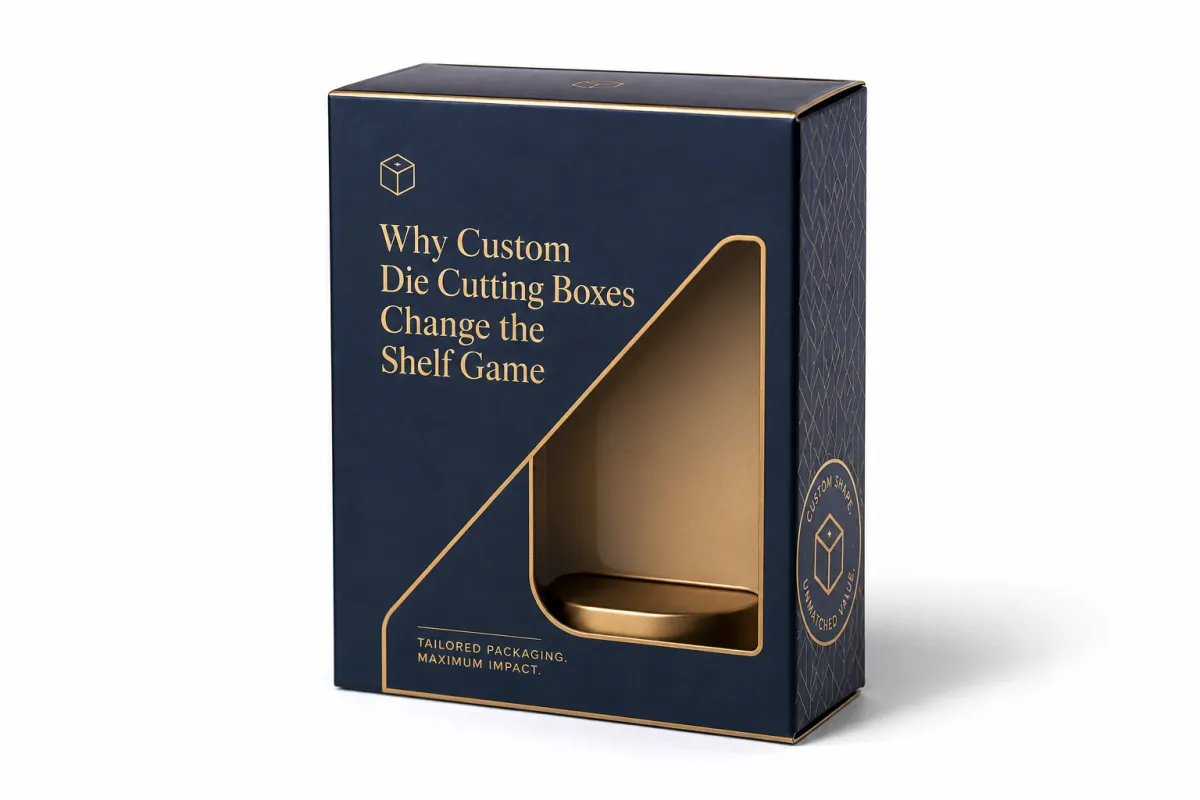
Walk down a retail aisle and watch how fast people sort products without even thinking about it. Some boxes look generic even when the contents are premium. Others look engineered before the shopper reads a single word. Custom die cutting boxes create that second reaction because the structure itself signals intent. The shape, folds, closure style, and insert locations are built around the product instead of forcing the product to behave like a stock-size compromise.
That matters because the box has more than one job. It has to protect the product, communicate the brand, and survive handling. A box with a purposeful fit often needs less filler, which improves presentation and can lower shipping waste. It also tends to unbox more cleanly. The lid opens where it should. The insert holds the item where it belongs. The graphic panel lands where the customer can actually see it. Nothing flashy. Just competent packaging, which is weirdly hard to find.
Custom die cutting boxes also help when the product is awkward. Think about a cosmetic kit with several parts, a specialty food item that needs separation, or an electronics accessory with cords and small components. A stock carton can hold those items, sure, but it usually needs extra pads, bags, or loose dunnage to stop them from rattling around. A custom structure can solve that at the design stage. That is why custom printed boxes built with die cutting often feel more finished even when the print coverage is simple.
There is another reason brands move this direction: repeatability. Once the structure is dialed in, the next production run behaves the same way. The packing team knows where the product sits. The warehouse knows how the carton stacks. The customer gets the same opening sequence every time. In practice, custom die cutting boxes are less about decoration and more about removing uncertainty from a process that already has enough of it.
A box should earn its footprint: protect the product, speed the line, and communicate enough to make the buyer trust what is inside.
That is why custom die cutting boxes often outperform stock packaging even when the graphics are modest. A plain kraft mailer with the right geometry can look more premium than a heavily printed box that feels loose or overstuffed. The structure tells the truth. Buyers notice. They might not say it out loud, but they notice.
How Custom Die Cutting Boxes Are Designed and Made
The process starts with measurement, but not the casual kind. Good custom die cutting boxes are built from product dimensions, tolerances, packing method, and the shipping environment. A bottle that sits on a retail shelf has different needs than the same bottle riding through parcel networks. That sounds obvious. Still, packaging issues usually start when one measurement gets treated like the whole story.
First comes the brief. The product's length, width, height, weight, and fragility get recorded. Then the packaging team defines the use case: retail display, e-commerce shipment, secondary packaging, or some hybrid of those. From there, a dieline gets drafted. The dieline is the flat blueprint that shows where the board will be cut, scored, folded, glued, and locked. For custom die cutting boxes, this is the stage where the engineering starts to show up in the final carton.
Next comes the cutting method. A steel rule die is common for repeat runs and larger quantities because it creates consistent cuts and scores at speed. Digital cutting can be a better fit for sampling, short runs, or projects with frequent artwork revisions. Either way, the machine follows the dieline, and the board gets trimmed into the exact shape needed. Creases are added so the folds behave predictably. That detail matters more than many buyers expect. I have seen boxes with beautiful art fail because one score line was off by a hair. The carton still folded, technically. It just folded badly.
After that, the prototype or sample enters review. Designers, packaging engineers, and printers usually check fit, closure strength, artwork placement, and assembly behavior before full production. For custom die cutting boxes, this approval loop is not a nice extra. It is the step that catches a flap that is too short, an insert that fights the product, or a logo that lands too close to a crease. Fixing those issues on a sample is far cheaper than fixing them after 10,000 units are printed. A sample that looks boring can save a very expensive mess later.
Depending on the structure, inserts, windows, locking tabs, and glued panels can be built into the design. Each choice changes the mechanics of the box. A tuck-end carton assembles differently from a mailer. A tray-and-sleeve setup gives a different feel from a two-piece rigid box. The more custom the geometry, the more important the dieline becomes. That is why custom die cutting boxes are part design exercise, part manufacturing exercise, and part logistics decision. You are not just drawing a box. You are setting rules for how the box behaves.
If you want to see how those choices fit into a broader packaging program, take a look at Custom Packaging Products and the team's Manufacturing Capabilities. Those details matter because the box is only one layer of the system; materials, finishing, and production method all affect the outcome. Ignore that, and the package ends up looking fine in a file but kinda awkward in the real world.
Key Factors That Affect Fit, Strength, and Appearance
Most packaging decisions start with the board. That is the right instinct. Custom die cutting boxes can be made from paperboard, corrugated board, or specialty substrates, and each behaves differently. Paperboard gives strong print quality and is common for retail packaging such as cosmetics, supplements, and smaller consumer goods. Corrugated board adds crush resistance and is better for shipping. Rigid board creates a premium feel, but it adds cost and bulk.
For folding cartons, a common spec is 14pt to 18pt paperboard, often with C1S or C2S print surfaces. For mailer styles, E-flute corrugated at roughly 1/16 inch is often used when print quality and structure both matter. B-flute at roughly 1/8 inch offers more protection but takes up more space. For premium presentation, 2 mm to 3 mm rigid board is common. The right choice depends on the product weight, the route it travels, and how much presentation is expected from the box. There is no magic thickness that fits every job, no matter how nicely a supplier says otherwise.
Box style matters just as much as board. A sleeve gives a different opening moment than a tuck box. A tray can display the product well, but it may need extra support in transit. A two-piece rigid setup can feel elevated, yet it usually costs more to produce and ship. Custom die cutting boxes are not one category in practice. They are a family of structures, each with tradeoffs.
Finishes change both appearance and economics. Matte lamination softens glare and usually reads as more refined. Gloss can make color pop. Soft-touch adds a velvety feel, though it can raise cost and sometimes stretch lead time. Embossing and foil stamping add tactile depth and high contrast, which can be strong for package branding. Spot UV can highlight a logo or pattern. Every finish adds another production step, and every step affects budget, timing, and minimum order assumptions. In other words, custom die cutting boxes can stay simple or move into premium territory, but the spec should be intentional either way.
Product weight and shipping distance should guide the spec more than visual preference alone. A box that looks elegant on a shelf may not be suitable for parcel transit. Teams selling through e-commerce need to think about compression, drop risk, and abrasion. That is where testing standards help. For shipping validation, many brands reference ISTA test protocols, especially when the package will face drops, vibration, or compression in distribution. For fiber sourcing, FSC-certified materials can support responsible sourcing claims, while source-reduction thinking keeps material use in check. Custom die cutting boxes do best when structure, finish, and transit conditions are treated as one design problem instead of three separate conversations.
Here is the part buyers sometimes miss: the prettiest spec is not always the smartest one. A heavy emboss, multiple spot UV layers, and a rigid insert may look impressive, but if the product is low-margin and ships in volume, the economics can fall apart quickly. The best custom die cutting boxes are the ones that balance appearance with how the product actually moves through the business.
Custom Die Cutting Boxes Cost and Pricing Factors
Pricing for custom die cutting boxes is not mysterious, but it is easy to misread. Two boxes can look almost identical and still carry very different costs because the expense sits in the structure, setup, and finishing, not just the visible size. Tooling, material grade, print setup, inserts, sampling, freight, and storage all shape the final number.
One of the biggest cost drivers is order quantity. The die and setup work have to be spread across the run, so smaller orders almost always cost more per unit. That does not mean small runs are bad; it just means the economics change. A short run of 500 units may have a much higher unit price than a run of 5,000 or 10,000, even if the structure stays the same. With custom die cutting boxes, scale rewards planning.
Complexity also raises cost. More folds, more cutouts, more glue points, more artwork coverage, and more specialty coatings all increase labor and waste. Inserts can be inexpensive if they are simple, or they can move the project into a different cost bracket if they must be die cut, laminated, or assembled by hand. A plain kraft mailer with one-color print is a very different job from a custom die cutting boxes project with foil, embossing, and a custom insert tray. That is not marketing fluff. It is how the quote sheet gets built.
Below is a practical comparison that many packaging buyers find useful when they are choosing between options:
| Packaging option | Typical unit cost | Best use | Tradeoff |
|---|---|---|---|
| Stock carton | $0.10-$0.30 | Fast, low-complexity needs | Limited fit and branding control |
| Simple custom folding carton | $0.18-$0.45 | Retail packaging and light products | Less protection for heavy or fragile items |
| Custom mailer style with print | $0.40-$0.95 | E-commerce and subscription boxes | More material, more assembly steps |
| Rigid two-piece setup | $1.20-$3.50 | Premium presentation and gifting | Higher material and freight cost |
Those figures are directional, not universal. For custom die cutting boxes, a modest folding carton with simple print might land toward the low end, while a heavy board setup with a premium finish could move well above it. Freight, regional labor, and current paper market conditions also matter. I would not promise any exact number without a sample and a real quote. Paper prices swing, and shipping charges do their own little dance.
There are also hidden savings. Simplifying the structure can lower the price without making the box look cheap. Standardizing dimensions across a product family can reduce tooling complexity. Choosing the correct board grade can prevent overbuilding. Those decisions are especially helpful for custom die cutting boxes, because a cleaner spec often prints and converts more reliably. In practice, the lowest-cost solution is usually the one that does the job with the fewest extras.
For businesses trying to balance branded packaging and budget discipline, the best question is not "How cheap can this box be?" It is "What value does each added feature create?" If foil is only there because the catalog always used foil, that is weak justification. If the customer base expects premium finish and the product margin can support it, then the investment may make sense. Custom die cutting boxes should earn their price by solving more than one problem at once.
Step-by-Step Process and Timeline for Approval
Speed starts with clarity. The fastest custom die cutting boxes projects are the ones where product dimensions, weight, packing method, and artwork files are ready before the quote request goes out. If the supplier has to chase basic information, the schedule stretches before production even begins. Nobody needs that kind of drag.
The first step is the brief. Define what the box has to do. Is it for retail display, shipping, subscription fulfillment, or a mix of those? Is the product fragile, oily, sharp-edged, or temperature-sensitive? Does it need inserts, a window, or a locking feature? That kind of detail helps the packaging partner recommend the right structure and prevents a long revision loop later.
Then comes the dieline and sample review. A structural drawing or physical mockup lets the team check fit, closure, stacking, and panel placement. This is where many custom die cutting boxes save money in the long run. A small change to a score line can stop a flap from buckling. A 2 mm shift in insert position can keep a product from rocking. Those are tiny edits with a big impact.
After that, artwork proofing and prepress happen. The printer checks bleed, safe zones, color intent, and alignment with the die line. The biggest time loss usually comes from late changes. If artwork is still moving when the structure is already near production, the schedule can slip fast. That is why teams should lock the structural spec before asking for final graphics wherever possible. Custom die cutting boxes reward teams that separate "designing" from "revising."
Typical timing varies by complexity, but a useful planning range looks like this:
- Simple folding cartons: often 10-15 business days from proof approval.
- Boxes with inserts or specialty finishes: often 15-25 business days from proof approval.
- Highly customized structures: can take longer if sampling or hand assembly is involved.
- Freight: add several days for domestic shipping and longer for international transit.
That does not include the time needed for sampling, which can add a few days to a couple of weeks depending on revisions. The fastest custom die cutting boxes runs usually happen when the product spec is stable and the decision maker is available to approve quickly. If approvals bounce between departments, even a clean project can slow down.
Assembly method matters too. Some boxes arrive flat and are assembled on the line. Others need gluing, taping, or manual insert placement. That changes labor on the back end. If a box saves two seconds in packing but costs more to produce, the math may still work if the volume is high enough. If the line is slow and labor is tight, a simpler carton may win. This is why custom die cutting boxes should be reviewed with operations in the room, not just design.
One practical way to stay organized is to create a packaging spec sheet that includes product dimensions, tolerances, board choice, finish, artwork version, and reorder notes. That document becomes the memory of the project. Without it, the same custom die cutting boxes can drift from one run to the next, and consistency disappears quietly.
Common Mistakes with Custom Die Cutting Boxes
The most common mistake is measuring too tightly. A product may measure exactly 120 mm by 80 mm by 40 mm, but the final box should not be cut to those numbers with no tolerance. Board thickness, fold behavior, and insert placement all affect real-world fit. If custom die cutting boxes are drawn too snugly, the result can be crushed corners, split seams, or a packout team that has to fight the carton every shift.
Another mistake is designing for the mockup instead of the shipment. A box can look excellent in a render and still fail under pressure. If it crushes in transit, slows the packing line, or makes the product hard to remove, the "pretty" spec becomes expensive fast. That is especially true for retail packaging that also has to travel by parcel. Custom die cutting boxes need to be judged by how they behave, not only by how they photograph.
Quote comparisons cause trouble as well. One supplier may quote the die, print, finish, and freight together. Another may separate those lines or leave one out entirely. A lower headline number can disguise a higher landed cost. Ask exactly what is included. Tooling? Sampling? Inserts? Packaging? Palletization? Freight to one location or multiple drops? For custom die cutting boxes, that level of specificity prevents bad surprises.
Skipping prototypes is another expensive habit. Without a sample, brands discover weak closures, artwork shifts, or awkward opening behavior after the run is already moving. A prototype may feel like a delay, but it is actually cheap insurance. In a typical production scenario, one sample can prevent hundreds or thousands of flawed cartons. Custom die cutting boxes are built on repeatability, and repeatability starts with proofing.
Here is a simple rule I use when reviewing a spec: if the box only succeeds in one environment, the design is incomplete. A carton that is perfect on a shelf but fragile in a shipper is only half a solution. So is a mailer that survives transit but looks off-brand when opened. The best custom die cutting boxes solve the whole journey, not just the best-looking part of it.
It also helps to watch for overdesign. Teams sometimes add a window, foil, embossing, a custom insert, and a special closure because each idea sounds good in isolation. Put together, the spec becomes slow and expensive. A better question is which feature truly helps the customer or the operation. If the answer is unclear, simplify. Custom die cutting boxes do not need every feature to feel premium. They need the right ones.
The box that works best is usually the one with fewer moving parts, clearer tolerances, and a reason for every added feature.
Expert Tips and Next Steps for Custom Die Cutting Boxes
Start by choosing one primary job for the package. Does it need better protection, stronger shelf impact, faster packing, or a more memorable unboxing experience? A lot of custom die cutting boxes projects go off track because they try to do all four equally well from day one. Pick the lead objective and let it shape the structure.
Request a prototype early, even if the design seems straightforward. A 3D render is useful, but a flat sample or physical mockup tells the truth faster. It shows whether the closure is intuitive, whether the board feels right in the hand, and whether the artwork lands cleanly on the panels. For custom die cutting boxes, one sample can answer more questions than a dozen emails.
Build a reusable spec sheet. Include product dimensions, tolerances, insert notes, finish choices, artwork version, supplier contact, and reorder instructions. That sheet turns a one-time project into a repeatable packaging asset. Teams that do this well avoid a common pattern: the first run is solid, the second run drifts, and nobody remembers why. Custom die cutting boxes stay consistent when the specification is documented clearly.
It also helps to compare total landed cost, not just unit price. Count tooling, sampling, freight, storage, damage risk, and packing labor. A slightly more expensive carton can win if it reduces filler, improves pack speed, or lowers breakage. That is especially true in e-commerce, where a damaged box often becomes a replacement order, and the replacement order costs more than the packaging ever did. Custom die cutting boxes can be cost-smart when they reduce hidden losses.
If you are building a packaging roadmap, this checklist is a practical place to begin:
- Measure the product and note tolerances.
- Define whether the box is for shipping, retail display, or both.
- Choose the board grade and finish based on weight and brand goals.
- Request a structural quote and a sample or dieline review.
- Check total landed cost before approving the run.
- Document the final spec for the next reorder.
One more thing: keep the first run modest if the design is new. A smaller pilot can reveal assembly issues, shelf behavior, and customer reactions before the full program scales. That is often the smartest route for custom die cutting boxes, especially when the product is new or the brand is testing a fresh retail concept.
For brands that want to move carefully but still move forward, that discipline pays off. The box becomes part of the product experience, not a separate problem to manage. And once custom die cutting boxes are specified well, they tend to stay useful for a long time because the structure, branding, and process all line up.
Custom Logo Things can use that same approach across custom die cutting boxes, custom printed boxes, and other product packaging formats. The strongest results come from treating the package as a working part of the business, not a decoration added at the end.
What are custom die cutting boxes used for?
They are used when a product needs a precise fit, better protection, or a more polished presentation than a standard stock carton can provide. Custom die cutting boxes work especially well for retail, subscription, cosmetics, electronics, and any item that benefits from inserts or a branded unboxing experience.
How much do custom die cutting boxes usually cost?
Pricing depends on tooling, material grade, print complexity, finishing, and order quantity, so two similar-looking boxes can land at very different price points. Smaller runs usually cost more per box because setup is spread across fewer units, while larger orders usually lower the unit price. For custom die cutting boxes, the structure and finish choices often matter as much as the print.
How long does it take to make custom die cutting boxes?
Simple projects can move quickly once the dieline and artwork are approved, but sampling, revisions, and specialty finishes can extend the schedule. The fastest jobs are the ones with final measurements, stable artwork, and a clear approval process before production begins. Custom die cutting boxes usually move faster when the brief is complete from the start.
What information do I need before ordering custom die cutting boxes?
Bring product dimensions, weight, fragility, packing method, quantity, and branding files so the supplier can recommend the right structure and materials. It also helps to know whether the box is for shipping, retail display, or both, since that changes the strength and finish requirements. Strong custom die cutting boxes start with a clear spec sheet.
Are custom die cut boxes better than stock boxes?
They are better when fit, branding, and performance matter more than speed alone because they can reduce filler, improve protection, and create a cleaner presentation. Stock boxes can still be useful for very fast, low-complexity needs, but custom options usually win when the packaging has to do more than simply hold a product. For many brands, custom die cutting boxes are the better long-term packaging choice.
The practical takeaway is simple: before you approve custom die cutting boxes, lock the product measurements, board grade, finish, and approval owner in writing, then sample the structure once before the full run. That one habit prevents most of the expensive surprises and keeps the box doing its job instead of creating new ones.


