Buyer Fit Snapshot
| Best fit | custom display carton printing branding for packaging buyers comparing material specs, print proof, MOQ, unit cost, freight, and repeat-order risk where brand print, material, artwork control, and repeat-order consistency matter. |
|---|---|
| Quote inputs | Share finished size, material target, print colors, finish, packing count, annual reorder estimate, and delivery region. |
| Proofing check | Approve dieline scale, logo placement, barcode or warning zones, color tolerance, and any recyclable or compostable wording before bulk production. |
| Main risk | Vague material claims, crowded artwork, or missing packing details can create delays even when the unit price looks attractive. |
Fast answer: Custom Display Carton Printing Branding: Dieline, Finish, Proof, and Buyer Review should be specified like a repeatable production item. The safest quote includes material, print method, finish, artwork proof, carton packing, and reorder notes in one written spec.
What to confirm before approving the packaging proof
Check the product dimensions against the actual filled item, not only the sales mockup. Ask for tolerance on folds, seals, hang holes, label areas, and retail display edges. If the package carries a logo, QR code, warning copy, or legal claim, reserve that space before decorative graphics fill the panel.
How to compare quotes without losing quality
Compare board or film grade, print process, finish, sampling route, tooling charges, carton quantity, and freight assumptions side by side. A lower quote is only useful if the supplier can repeat the same color, closure quality, and packing count on the next order.
A carton at checkout has a weirdly hard job. It has to block attention, sell the offer, and still protect the product while it gets handled, stacked, opened, shoved around, and shipped. That is the real value of Custom Display Carton printing: one package doing the work of packaging, merchandising, and brand theater without falling apart halfway through the trip.
Brands selling accessories, cosmetics, snacks, gift sets, and counter-ready promotions rely on custom display carton printing because it sits right between structure and marketing. The graphics matter. The board matters. The assembly method matters. Ignore one of those pieces and the carton ends up looking cheap, awkward, or like somebody made the whole thing at 4:55 p.m. and hoped nobody would notice.
Buyers keep comparing board stock, coatings, assembly styles, and lead times for a reason. A display carton has to survive the real world first, then look good doing it. If it crushes in transit or buries the selling point under messy layout choices, the package is dead weight. I have sat through enough sample reviews to know this: the design that looks “fine” on screen can turn into a very expensive problem in cardboard.
Custom Display Carton Printing: What It Is and Why It Matters
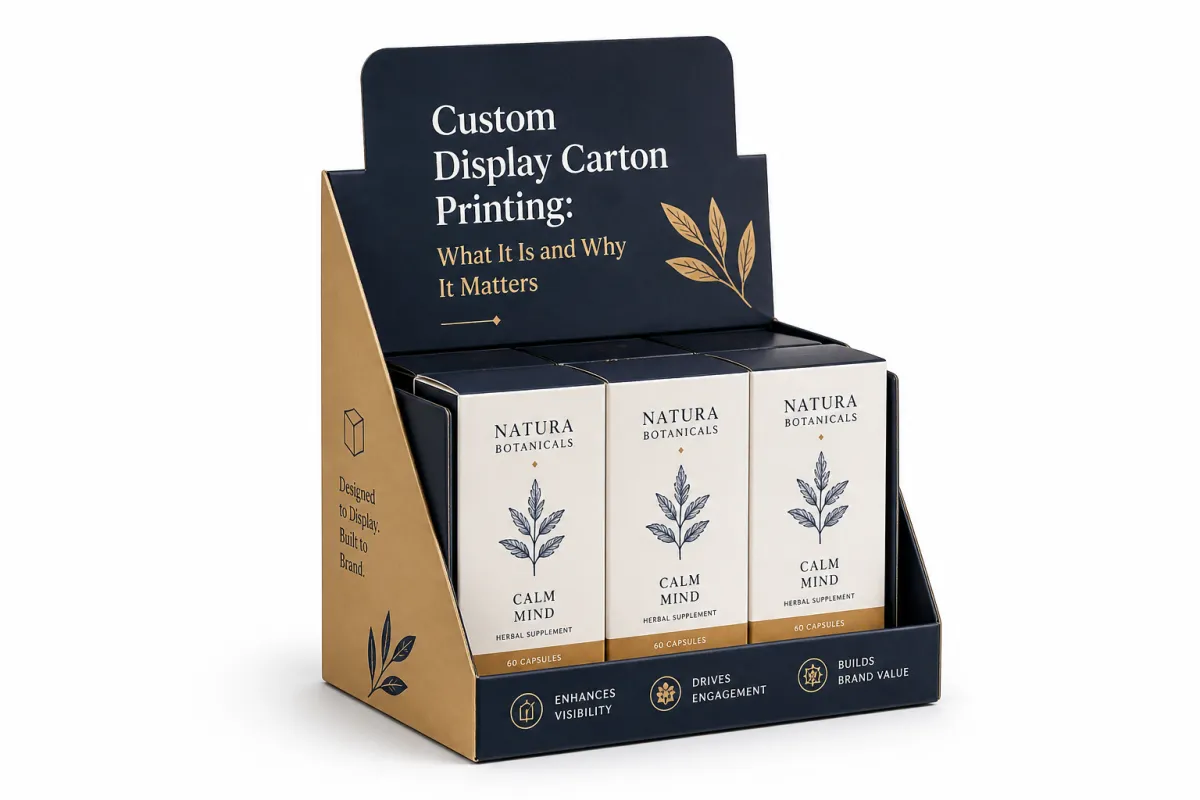
Custom display carton printing is the process of making cartons that hold a product and present it in retail at the same time. Sounds simple. It is not. A shipping carton only needs to get from point A to point B. A display carton needs to get there, open correctly, stand up, and still sell the product once it lands on a shelf or counter.
In practical terms, custom display carton printing blends product packaging with shelf communication. The front panel may carry the brand mark, product name, flavor, size, benefit statement, barcode, compliance copy, and a sales message. That front panel becomes a tiny ad unit. On a counter, it works like a sales rep. Not a chatty one. A better one. The kind that gets the point across without chewing up time.
The strongest display cartons handle three jobs at once. They protect the item. They explain the offer. They make the brand look deliberate instead of accidental. Those jobs do not always carry equal weight, so the project has to start with priorities. A lightweight cosmetic set may care more about polish than compression strength. A snack carton may need grease resistance and fast-scanning claims. An accessory line may care most about cost and volume. The structure should follow the business goal, not the other way around.
Where does custom display carton printing work best? Usually in places where shoppers are close to the product and make decisions fast:
- Launches that need immediate visibility
- Seasonal promotions with a short selling window
- Giftable items where presentation matters
- Cosmetics, skincare, and personal care kits
- Food and beverage counter displays
- Accessories, chargers, tools, and impulse buys
For a packaging buyer, the appeal is pretty clear. One structure can replace extra signage, loose merch cards, and random secondary packaging that nobody asked for. It also gives the brand more control over how the product shows up next to competing items. In crowded retail, control is not a luxury. It is the whole point.
There is also a branding side that gets ignored until the shelf looks messy. Strong package branding is not just a recognizable logo. It is a carton that fits the product, the category, and the price point without trying too hard. A mismatch makes shoppers pause. A clean match makes the product feel considered. That is why custom display carton printing can shift both perceived value and conversion.
For brands building out branded packaging, display cartons help keep the line visually connected. If the same design language carries across folding cartons, retail-ready packs, and counter displays, the whole range looks organized. If you want to see how those pieces fit into a larger packaging program, review the Custom Packaging Products offered alongside display work and the broader Manufacturing Capabilities behind them.
Practical rule: if a shopper can see it, it is not just packaging. It is merchandising space. That is why custom display carton printing matters.
How Custom Display Carton Printing Works From File to Shelf
The production path for custom display carton printing usually starts with a brief and ends with flat-packed cartons, pre-glued units, or ready-to-fill displays. The important part sits in the middle. Good results depend on making the structure and artwork agree before production starts. Otherwise the carton looks fine in a PDF and odd in your hands, which is a classic packaging disappointment.
The first step is the dieline. That is the structural map. It defines panels, folds, glue areas, lock tabs, cutouts, and the printable surface. Without a correct dieline, custom display carton printing turns into guessing with expensive consequences. Artwork can look clean on screen and still fail once it crosses a fold line or disappears into a seam. Structural planning removes that headache before it starts.
Once the dieline is approved, artwork prep begins. This is where bleed, safe zones, barcode placement, and copy hierarchy matter. A typical bleed allowance is 0.125 inch, though some printers use different tolerances. Barcodes need to sit where scanners can read them without distortion, and critical copy should stay away from folds and tuck areas. If the design uses small type, the fold pattern needs a careful check. In custom display carton printing, the carton can hide a decision that looked harmless on a monitor.
Proofing comes next. A digital proof catches obvious layout problems, but it will not show how the carton behaves physically. That is why sample builds matter. A folded sample can reveal panel fit problems, tear lines, weak corners, product retention issues, or a design that looks balanced on screen and unstable in cardboard. In many projects, this is the stage where a brand learns that a 50 mm change makes everything work better. Packaging loves small adjustments right up until the wrong small adjustment ruins the run.
Printing depends on quantity, color count, finish requirements, and timing. For short runs, digital printing is attractive because setup time is lower and version changes are easier. For larger quantities, offset printing often delivers better unit economics and more consistent color across long runs. Neither one is automatically superior. The right choice depends on the job. Custom display carton printing usually lands right on that decision line.
After printing, the board may go through coating, lamination, spot UV, foil stamping, embossing, or window cutting. Then it gets die-cut, creased, folded, glued, and packed for shipment. Some buyers want cartons shipped flat to keep freight down. Others want pre-glued units ready for filling. Some need display structures that can be set up in store with minimal handling. Each format changes labor, shipping, and retail setup time.
Assembly logic matters more than people expect. If a carton takes too long to fill or needs too much manual adjustment, the retail benefit drops fast. That is one reason the best custom display carton printing projects involve operations teams, not just designers staring at mood boards and hoping for the best. I have seen a neat-looking carton add ten seconds of labor per unit. Ten seconds sounds harmless. It is not harmless when you multiply it by a full shipment.
Key Factors That Change Quality, Durability, and Shelf Impact
Board stock is the first big variable. A carton made from 14 pt SBS feels different from one built on 18 pt or 24 pt board. Recycled kraft feels different too. So does CCNB with a coated liner. The right material depends on product weight, shelf life, shipping stress, and the visual tone of the brand. In custom display carton printing, material choice is not some back-end footnote. It changes how the package behaves in hand and how it reads from the aisle.
For lightweight retail items, a clean white SBS or coated board may be enough. For heavier products, stronger board with higher caliper can improve rigidity and reduce sagging at the front panel. If sustainability matters, recycled fiber content and FSC-certified stock can support that goal, but only if the board still performs for the actual product. You can verify chain-of-custody and certification standards through FSC, which is useful when a buyer wants traceability instead of vague green language.
Print method affects the result just as much. Offset printing usually handles solid color consistency and richer coverage well at higher quantities. Digital printing is often better for short runs, multiple versions, or faster proof-to-production timelines. If the project has multiple SKUs, seasonal variants, or retailer-specific changes, digital can cut waste. If the run is large and the artwork stays fixed, offset often lowers the cost per unit. That tension sits at the center of most custom display carton printing decisions.
Finishes change shelf impact fast. Matte coating gives a quieter, more premium look. Gloss pushes brightness and contrast. Soft-touch adds a tactile feel that can support a luxury signal, though it costs more and can show scuffs during transit. Spot UV draws attention to a logo or product name. Foil can support premium positioning, though too much of it starts to look like the carton wandered into a discount jewelry kiosk. In custom display carton printing, the best finish usually supports the message instead of fighting it.
Structure matters too. Tuck ends are simple and economical. Locking tabs add holding power. Window cutouts show the product and can help buyers trust what they are buying, especially for cosmetics or accessories. Reinforced corners and bottom panels help when the carton gets handled repeatedly. If the display lives near checkout, front opening and top stability are not decorative details. They determine whether the package stays upright through a busy sales day.
Sustainability should be treated as a quality factor, not a side note. Right-sized cartons reduce empty space and material waste. Lower ink coverage can reduce production load. Recyclable substrates can make disposal easier. Some brands ask for water-based coatings or soy-based inks depending on the project. EPA guidance on sustainable materials management is a useful reference if the team wants to think beyond unit price and look at waste, efficiency, and recovery: EPA Sustainable Materials Management.
One more reality check: shelf impact is not the same as screen impact. A design that looks polished on a laptop can vanish under fluorescent lights and louder competitors. That is why custom display carton printing benefits from a shelf-distance test. Print a sample, stand back three to five feet, and ask the blunt question: what does the shopper notice first?
Custom Display Carton Printing Costs and Pricing Factors
Pricing for custom display carton printing can move around a lot, and that is normal. A simple low-volume carton with limited color coverage lives in a very different world from a premium unit with foil, window cutting, and pre-glued assembly. The biggest drivers are quantity, board grade, print coverage, finishing, die complexity, and labor.
For budgeting, it helps to think in ranges instead of pretending there is one magic number that applies to every project. A small run often costs more per unit because setup expenses get spread across fewer cartons. A larger run usually lowers unit price, but only if storage, obsolescence, and SKU changes are under control. For many brands, the real question is not whether custom display carton printing can be made cheaper. It is whether the extra units still make sense after the promo ends.
Here is a useful way to compare common routes. These are broad patterns, not universal quotes. Packaging pricing hates being simplified too much, but buyers still need a starting point.
| Option | Typical Use | Relative Unit Cost | Strength | Best For |
|---|---|---|---|---|
| Simple digital carton | Short runs, test launches, multiple versions | Higher at low volume | Good for light to medium products | Fast-moving campaigns and pilot sales |
| Offset-printed carton | Stable artwork, larger quantities | Lower as volume rises | Consistent color and strong shelf finish | Core retail lines and repeat orders |
| Premium finished carton | Foil, spot UV, soft-touch, window cutouts | Highest | Strong visual presence | Gift sets, cosmetics, and premium branding |
That table leaves out something important: visible price is only part of the bill. Hidden costs matter. Artwork revisions, dieline changes, sample production, freight, inserts, and assembly labor all shape the final budget. A carton that looks inexpensive at the unit level can turn pricey once a custom insert or specialty finish needs extra tooling. Anyone comparing custom display carton printing quotes should ask for the complete landed cost.
Order quantity changes the math too. A quote for 1,000 pieces does not scale neatly to 5,000 or 10,000. Setup charges, plate costs, and finishing setup get spread over more units, which can drop the per-unit price quickly. For a brand that tests new SKUs often, the smartest move may be a simple structure with flexible graphics. For a stable flagship product, a more detailed presentation can make sense because the sales life is long enough to justify it.
It helps to separate must-have branding elements from nice-to-have features. Does the carton need a window? Maybe. Does it need foil? Only if the shelf competition actually calls for it. Does it need a soft-touch laminate? That depends on how much tactile premium signal the brand really needs. In many custom display carton printing projects, a strong board choice and a clean layout deliver more value than another decorative flourish nobody remembers.
From a buyer’s point of view, the best quote is not always the cheapest. The best quote balances unit price, minimum order quantity, setup burden, and the risk of buying packaging that ages out before it gets used. That matters even more in seasonal or promotional retail, where timing can matter more than shaving a few cents off a line item.
The Custom Display Carton Printing Process and Timeline
Most custom display carton printing projects move through the same basic sequence: discovery, structural development, artwork prep, proof approval, production, finishing, and shipping. The timeline shifts with complexity, but the order rarely does. If you understand the workflow, schedule risk gets easier to spot before it wrecks the launch calendar.
Discovery starts with the basics: what product is going inside, how heavy it is, where the carton will sit, and what the retail goal is. A counter display for a beauty sample kit has a very different brief from a carton holding hardware accessories. One needs elegance. The other needs readability and durability. Treating every carton like it belongs to the same category is how projects drift into mediocrity.
Structural development comes next. This stage may move quickly for a simple tuck carton, or take several rounds if the display needs custom locking, windows, or multiple compartments. The first timeline mistake often happens here. Teams approve artwork before the structure is settled. Then the layout changes and the copy breaks. That is avoidable. Stabilize the structure before finalizing the design.
Artwork prep moves faster when the brand has its files organized. Missing vector logos, low-resolution product photography, and legal copy that is still being argued over will slow everything down. A printer can work more efficiently when files are clean and specifications are clear. That holds true for custom display carton printing and for broader custom printed boxes programs. Good file discipline saves time. Shocking, I know.
Sampling deserves a buffer in the schedule. A sample can reveal fit issues, color shifts, folding problems, or a conflict between the carton and the product label. In some categories, especially cosmetics and food, the sample is the safest place to catch problems before mass production. A week spent on proofing can save thousands of units from becoming expensive mistakes. That is a trade most experienced buyers take without blinking.
Production time depends on the route. A simple digital job with minimal finishing may move quickly. An offset run with foil, embossing, and a custom die takes longer because each step has its own setup and inspection. Add pre-gluing or special insert construction and the calendar stretches again. For many buyers, the honest expectation is that custom display carton printing is not a same-week task once the project gets any real complexity.
Shipping and retailer approvals can extend the timeline even after production is done. If a retailer wants pack-out verification, if freight crosses borders, or if the shipment has to land before a promo reset, buffer time matters. The safest rule is simple: finish the packaging plan before the launch plan gets locked.
Typical timeline ranges often look something like this:
- Simple carton with digital print: often 8-12 business days after proof approval
- Offset carton with standard finish: often 12-18 business days after proof approval
- Premium carton with specialty finishes or inserts: often 15-25 business days or more
Those ranges depend on artwork readiness, sample approval, and production queue. They are still useful because they move the conversation away from vague promises and into actual planning. In custom display carton printing, realistic scheduling beats optimism every time.
Common Mistakes That Undercut Custom Display Carton Printing
The most common mistake is designing for a screen instead of a shelf. A package viewed at 100 percent on a monitor is not the same thing as a carton sitting in a bright aisle with competing colors, price tags, and hanging signage around it. Small text vanishes. Thin lines disappear. Low-contrast logos fade into the background. In custom display carton printing, shelf distance is the real test.
Another frequent error is choosing carton size before confirming product weight, shipping method, and handling conditions. A display carton that looks perfect in a flat mockup may tip once it is filled. Or it may fit too tightly and crush delicate parts during insertion. The smarter path is to define product dimensions, fill method, and retail handling before finalizing the structure. That sounds basic because it is. Still, rushed projects skip it all the time.
Too much design can hurt performance too. When every panel competes for attention, the customer has nowhere to land. A busy carton can feel less premium than a simpler one because the eye cannot settle. Good custom display carton printing usually follows a hierarchy: product name first, benefit second, brand third, technical details fourth. If everything shouts, nothing sells.
Skipping mockups or samples is another expensive habit. A flat PDF cannot tell you whether a panel bows, whether the lock tab holds, or whether the color temperature shifts once the finish is applied. A sample reveals the physical truth. It also gives the team a chance to catch barcode placement issues, legal copy errors, or retailer-specific labeling problems before the run starts. That matters even more if the packaging has to meet specific retail partner requirements or category rules.
Compliance mistakes can be painful. Barcodes need the right quiet zone. Ingredient or warning text has to stay legible. Country-of-origin statements may need to sit in a specific location depending on the market. If the carton supports a product category with stricter handling or shipping rules, testing standards may matter too. For transport and distribution durability, some teams refer to ISTA protocols to understand how packages are expected to perform under vibration, drop, and compression conditions.
The final mistake is underestimating assembly in retail. A carton that is hard to open, fill, or reset creates labor costs that never appear in the first quote. If store staff spend two extra minutes per unit, the packaging is no longer efficient. That is why the best custom display carton printing projects are designed with both brand and operations in mind.
Expert Tips and Next Steps for Smarter Orders
Start with a shelf-distance test. Print a prototype, stand back three feet, then five. Check whether the product name is still readable, whether the brand mark is obvious, and whether the carton communicates the offer without extra explanation. The test sounds simple because it is. It also catches more problems than a lot of teams want to admit. In custom display carton printing, clarity usually wins over complexity.
Gather the right inputs before asking for quotes. Product dimensions, carton quantity, target budget, shipping conditions, preferred finish, and any compliance copy should all be ready. If the product is fragile or oddly shaped, send that information too. The more complete the brief, the more useful the pricing. Vague requests produce vague quotes. That is not a mystery. It is just avoidable chaos.
Ask the printer for structural suggestions, not only prices. A good packaging supplier can often point out a better board grade, a more efficient fold pattern, or a lighter finish that still looks premium. That is one of the quiet advantages of working with people who understand custom display carton printing at both the graphic and mechanical levels. The project becomes more than artwork wrapped around cardboard.
Compare two or three production routes if the project matters. One version might use digital printing with a matte finish. Another might use offset printing with a spot UV logo. A third might remove an insert or simplify a window to reduce cost. A modest structural change can free up enough budget to improve board stock or clean up the finish. That is the kind of trade-off smart buyers should be hunting for.
Think in terms of retail role too. Is the carton a launch piece, a core line item, or a seasonal unit that disappears after the promo ends? The answer changes the decision. For a short-lived promotion, speed and clarity may matter more than a luxury finish. For an ongoing product line, consistency and shelf identity matter more. Custom display carton printing should support the business model, not just decorate it.
Here is a practical action list if you are planning the next order:
- Finalize the dieline and confirm product fit.
- Check artwork for bleed, safe zones, and barcode placement.
- Request a sample or physical proof.
- Compare board, finish, and print options with total landed cost in mind.
- Build buffer time for approval, freight, and retail setup.
- Move into production once the structure and content are locked.
For brands that want stronger retail packaging, custom display carton printing is usually the point where design theory turns into sales reality. It can make a product easier to notice, easier to trust, and easier to buy. That is a lot of work for one carton, but that is exactly why the details matter. If the structure, printing method, and finish are chosen well, custom display carton printing becomes one of the most efficient tools in the packaging mix.
FAQ
What is custom display carton printing used for?
It is used to present products on shelves, counters, or promotional displays while also protecting the item. Brands use custom display carton printing for launches, giftable products, impulse items, and retail promotions where visibility matters. The carton becomes a marketing surface, not just a storage container.
How much does custom display carton printing usually cost?
Pricing depends on quantity, board stock, print coverage, finishing, and whether the carton needs custom cutting or assembly. Small runs usually cost more per unit because setup expenses are spread across fewer cartons. The best quote comparison looks at total landed cost, not just the lowest unit price.
How long does custom display carton printing take?
Timing depends on artwork readiness, proof approval, structural complexity, and finish requirements. Simple jobs can move quickly; cartons with samples, special finishes, or multi-step assembly take longer. Build in buffer time for retailer approvals, launch dates, and shipping delays.
What files do printers need for custom display carton printing?
Most printers want the correct dieline, print-ready artwork, fonts outlined or embedded, and high-resolution images. They also need bleed, safe zones, and barcode placement checked before proofing begins. Supplying product dimensions and folding notes helps prevent structural mistakes in custom display carton printing.
How do I choose the best material for custom display carton printing?
Start with product weight, shelf life, shipping method, and the level of protection the carton must provide. Then compare board strength, print quality, recyclability, and how the material supports your brand look. Ask for samples when possible so you can compare feel, stiffness, and finish before approving custom display carton printing.
The clean takeaway is simple: lock the structure first, then make the graphics do their job, and do not skip the physical sample. That order keeps custom display carton printing grounded in how the carton will actually be used, not how pretty it looks in a file. If the brief is clear, the fit is checked, and the finish matches the retail goal, the carton does more than hold product. It helps sell it.

