Buyer Fit Snapshot
| Best fit | Custom Display Carton Printing projects where brand print, material claims, artwork control, MOQ, and repeat-order consistency need to be specified before quoting. |
|---|---|
| Quote inputs | Share finished size, material target, print colors, finish, packing count, annual reorder estimate, ship-to region, and any compliance wording. |
| Proofing check | Approve dieline scale, logo placement, barcode or warning zones, color tolerance, closure strength, and carton packing before bulk production. |
| Main risk | Vague material claims, crowded artwork, missing packing details, or unclear freight terms can make a low unit price expensive after revisions. |
Fast answer: Custom Display Carton Printing: Board, Finish, Dieline, and Unit Cost should be specified like a repeatable production item. The safest quote records material, print method, finish, artwork proof, packing count, and reorder notes in one written spec.
Production checks before approval
Compare the actual filled-product size with the drawing, then confirm tolerance on folds, seals, hang holes, label areas, and retail display edges. Reserve space for logos, QR codes, warning copy, and material claims before decorative graphics fill the panel.
Quote comparison points
Review material grade, print process, finish, sampling route, tooling charges, carton quantity, and freight assumptions side by side. A quote is only useful when the supplier can repeat the same color, closure quality, and packing count on the next order.
A shopper often makes the call in a few seconds, and Custom Display Carton Printing has to do real work before the product name is even fully registered. That is the pressure point in retail packaging: the carton needs to protect the product, present the brand, and hold its own on a crowded shelf with only a small amount of surface area to do it. Well-planned custom display carton printing can make a small item feel more credible, more polished, and easier to notice from the aisle.
From a packaging buyer's perspective, the question is never just whether the carton looks good on a monitor. The real test is whether it performs in a store, ships without damage, keeps its shape, and helps the brand register quickly at a glance. If your project also touches broader branded packaging decisions, our Manufacturing Capabilities page shows the production methods behind different formats, and our Custom Packaging Products page helps connect the carton to the rest of the product packaging system.
Brands sometimes underestimate how much package branding happens in those first moments of shelf contact. A carton can act like a tiny billboard, a protective shell, and a retail cue card all at once. That is why custom display carton printing is more than a print purchase. It is a merchandising decision with logistics attached, and the best results come from treating both sides of that equation with equal care.
For a brand team, the strongest projects are the ones where packaging design, structural engineering, and supply chain planning sit in the same conversation from the start. Without that alignment, the carton may look refined in mockups and still fail the only test that truly matters: life on the store floor. I have seen nice-looking concepts get approved in a meeting room and then fall apart the moment a real product, real freight, and a tired store associate get involved.
What Is Custom Display Carton Printing?
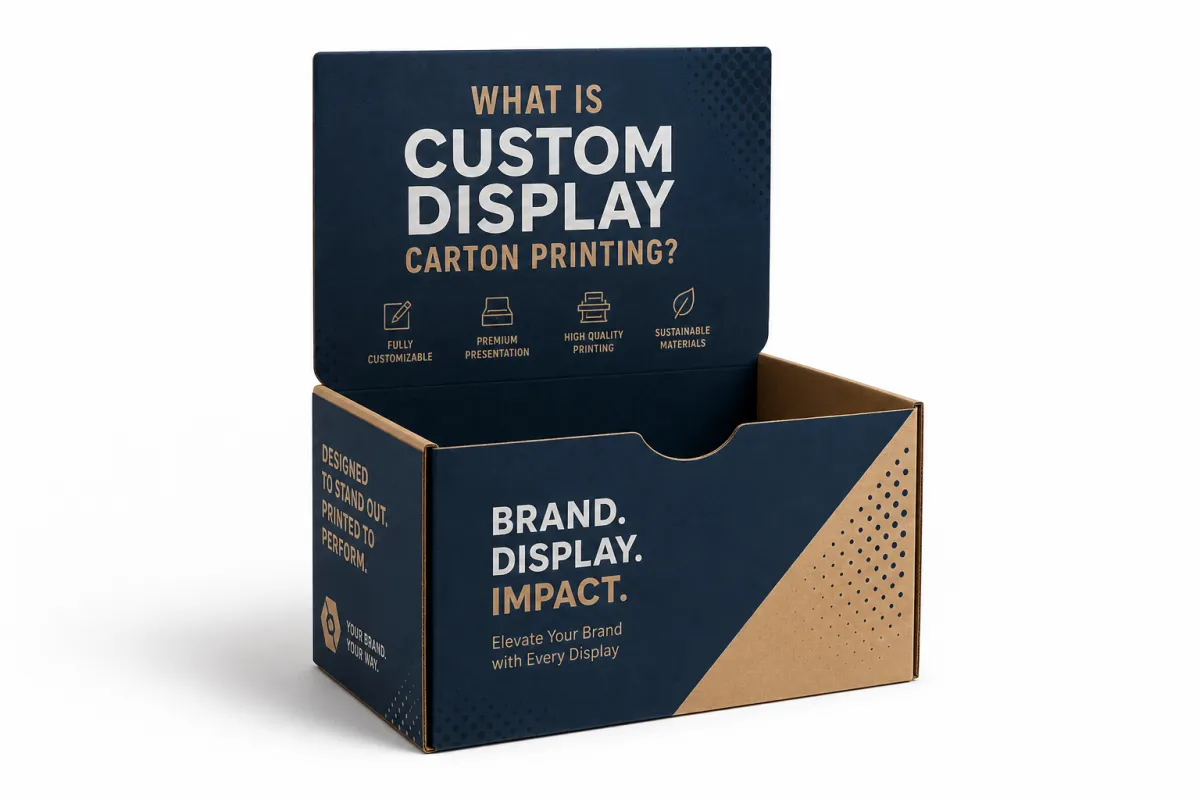
Custom display carton printing is the process of producing cartons that protect a product while also presenting it as a visible retail unit. In practical terms, the carton does more than hold the item. It faces the shopper, carries the brand story, and helps the product stand out in a shelf, counter, or point-of-purchase setting. Standard cartons usually focus on containment and transport. Display-ready cartons add shelf presence and merchandising value to that basic job.
The distinction matters. A plain shipping carton can be structurally sound and still be invisible to the customer. A display carton uses shape, opening style, graphics, and finishing to create retail impact. Some are counter-top trays with tear-away fronts. Others are open-faced cartons with windows or cutouts. Some are designed to sit beside cash wraps and impulse-buy zones, where one clear visual cue can move a shopper from pass to purchase. That is why custom display carton printing sits at the intersection of retail packaging and brand communication.
Common product categories include cosmetics, supplements, snacks, specialty retail, seasonal promotions, and launch bundles. These are products that benefit from quick recognition and tidy presentation. A supplement bottle may already have its own label, but the carton can carry legal copy, product hierarchy, and a more polished first impression. A snack brand may use a display carton to group multiple units and create a stronger block of color on shelf. In both cases, custom display carton printing supports visibility and structure at the same time.
The business case is easy to understand if you think like a buyer. A cleaner presentation can lift conversion, reduce the need for extra POS materials, and make a modest product feel more valuable. It can also support planogram compliance because the carton itself guides placement and facings. That is one reason many brands move away from generic outer packaging once they begin scaling beyond a trial run and need more from every retail touchpoint.
Display cartons are not only about appearance. They also affect handling. A well-designed carton can make stocking faster, reduce mess at the shelf, and give store staff a clearer unit to place. That matters in busy retail environments where speed often outweighs brand decks, mood boards, and design language that never survives contact with a receiving dock. Retail buyers notice that kind of practical help pretty quickly, even if they do not say it out loud.
"If the carton does not help the product sell in the store, the print job is only half finished."
For teams that want a wider baseline on packaging materials and sustainability language, the Sustainable Packaging Coalition at packaging.org is a useful reference point. It does not replace supplier guidance, but it gives useful context around material choices, recyclability claims, and retail expectations that shape real packaging decisions.
How Custom Display Carton Printing Works
Custom display carton printing starts with the product, not the artwork. The first step is to measure the item carefully: width, depth, height, weight, closure type, and any accessories that need to fit inside. Once those dimensions are clear, a dieline is created. The dieline is the flat template that shows folds, cut lines, glue areas, and panels. Without an accurate dieline, even the strongest design can misfit, collapse, or waste material.
After the structure is defined, the artwork is mapped to the dieline. That is where packaging design becomes practical. Branding has to sit in the right place. Product name and variant information need a clear hierarchy. Barcodes need a quiet zone. Legal copy, claims, symbols, and usage instructions all have to fit without crowding the shelf-facing panel. In custom display carton printing, graphics are only one part of the job; placement and readability carry equal weight.
The print method comes next. Offset printing is usually preferred for larger runs because it offers strong color control, sharp detail, and efficient unit cost once setup is absorbed. Digital printing makes more sense for shorter runs, test launches, or multi-SKU programs where artwork changes often. Flexographic printing can be a good fit for certain packaging runs, especially where speed and repeat production matter. The right option depends on order volume, artwork complexity, and the level of color consistency you need across the line.
A practical comparison often helps buyers think through the options:
| Method | Best Fit | Typical Strength | Typical Tradeoff |
|---|---|---|---|
| Offset printing | Mid to high volumes, brand-sensitive retail packaging | Strong color control and crisp detail | Higher setup cost than digital |
| Digital printing | Short runs, launches, frequent artwork updates | Low setup and faster approval cycles | Higher unit price at scale |
| Flexographic printing | Longer runs, simpler graphics, efficient repeat production | Good production speed and repeatability | Less ideal for highly detailed artwork |
Structure matters as much as print. Tuck styles, lock bottoms, display cutouts, windows, and tear-away panels all change how the carton behaves in the store. A carton that opens well for the shopper but folds awkwardly for the filler line is not a good carton. The strongest custom display carton printing projects move cleanly from filling to shipping to retail presentation without forcing workarounds that slow down operations.
Proofing is another step that gets rushed too often. A digital proof checks artwork placement, copy, and layout. A physical sample checks structure, board behavior, and fit. A press check can catch color drift, especially on brand-critical hues. If transit durability matters, testing against ISTA methods is worth discussing with your supplier, and the standards published by ista.org are a solid reference point for shipment-focused planning. A carton does not live on a design board. It lives on a line, in a truck, and on a shelf.
Custom display carton printing is not a single action. It is a sequence: measure, build the dieline, place the artwork, choose the print method, approve samples, convert, pack, and ship. Miss one step, and the final result can look expensive while behaving badly.
Key Factors That Shape Custom Display Carton Printing Results
Custom display carton printing depends heavily on substrate choice. SBS, CCNB, corrugated board, and recycled options each bring different levels of stiffness, print clarity, and retail credibility. SBS often gives a clean print surface and a premium feel. CCNB can be cost-effective and practical for many retail uses. Corrugated structures add strength, which is useful if the carton has to survive shipping and hold product weight at the same time. Recycled content can be part of the spec, but it should be chosen for performance first, not just for messaging.
Artwork hierarchy is the next major variable. The brand name has to win the first read. The product name needs to be second. Variant, flavor, format, or claim language should support the main message rather than compete with it. Too many brands stack benefits, icons, badges, and legal notes across every face of the carton, then wonder why the package feels noisy. Custom display carton printing works best when the shopper can identify the product in under two seconds, even from a slight distance.
Finishing choices also affect perception. Matte varnish can soften glare and make a carton feel more restrained. Gloss can help saturated color pop on shelf. Lamination adds protection, but it changes tactile feel and can affect recyclability claims depending on the structure. Foil stamping, embossing, and spot UV are useful when a brand wants to create one or two focal points instead of decorating every inch. A little restraint usually goes further than a crowded finish list, especially in custom display carton printing, where the carton competes with other packages in the same retail bay.
Order quantity drives nearly every cost decision. Larger volumes spread setup cost more efficiently, which usually lowers unit price. The tradeoff is storage and forecast risk. If the cartons move slowly, a bulk buy can tie up cash and floor space. If they move quickly, the lower unit cost can materially improve margin. Buyers often ask for the cheapest unit price, but the better question is which run size fits the sell-through pattern. That is a supply chain question as much as a print question.
Retail conditions matter more than many brand teams expect. Humidity can affect board behavior. Stack weight can crush weaker structures. Abrasion in transit can dull high-gloss finishes. Store staff may open cartons in a hurry, which means tear lines and perforations need to behave predictably. Custom display carton printing has to survive all of that while still looking intentional.
Product weight also changes the spec. A lightweight cosmetics carton can use a thinner board than a supplement display carton packed with glass bottles. A snack carton designed for countertop presentation may need a different gusset or locking method than a carton that rides through distribution before landing on shelf. The print spec and the structural spec are linked. Treat them as separate, and the job gets fragile very quickly.
For brands comparing material options, ask for a spec sheet that includes board caliper, basis weight, finish type, and any FSC certification claims if they matter to your brand story. FSC-certified stocks can help support responsible sourcing language, but the certification has to be documented properly. If your team wants to cross-check that language, fsc.org explains the standard and the chain-of-custody framework in a clear, practical way.
The most useful mindset is simple: custom display carton printing should be judged by shelf impact, production behavior, and fulfillment performance. If a carton excels in only one of those categories, it is incomplete.
Custom Display Carton Printing Process and Timeline
The workflow for custom display carton printing is more predictable than many launch teams assume, but only when the brief is complete. The process usually starts with a product brief that includes dimensions, product weight, quantity, retail channel, deadline, budget range, and any claims or regulatory text that must appear on pack. Missing information slows everything that follows, and the delays tend to compound fast.
From there, the packaging supplier creates or confirms the dieline, then the artwork team fits design elements into that structure. Proofing follows. A digital proof verifies placement and content. A physical prototype validates board behavior, fold lines, fit, and display stability. After approval, the print run begins, the sheets are converted, cartons are packed, and the finished order moves to delivery. Custom display carton printing runs more smoothly when each step stays in that order instead of being compressed into one rushed approval chain.
Timing depends on complexity, but a useful planning window is often 12 to 15 business days from proof approval for simpler jobs, with longer lead times for custom structures, premium finishes, or multi-step approvals. If the job requires special board sourcing, complex die creation, or multiple rounds of artwork revisions, the timeline can stretch further. I would not promise a fixed schedule until the dieline, copy, and finish list are stable. That kind of caution prevents a lot of avoidable friction later.
Some jobs move faster. Digital print runs with limited finishes and standard carton shapes can be completed sooner because they avoid heavy setup. Speed still has limits. A fast carton that opens poorly in retail is not actually fast; it just gets corrected later. In custom display carton printing, the real schedule is the one that includes approvals, not just production hours.
The biggest bottlenecks are usually easy to predict:
- Late copy changes after layout approval
- Barcode corrections found too late
- Slow sign-off from marketing or legal
- Color revisions after a screen proof looked different from expectation
- Missing product measurements that force dieline changes
Those delays are rarely dramatic on their own. Together, they can push a launch past the retailer window. That is why a buffer matters. If the cartons are for a first-time release, add more time than you think you need. First runs of custom display carton printing often uncover small structural or artwork issues that never show up in concept decks.
Production timing also needs to line up with freight and warehouse planning. A carton that is approved on time but delivered to the wrong dock date can still derail a launch. Retail packaging is a chain, and the weakest link tends to be the handoff between teams. The cleanest projects are the ones where print, procurement, logistics, and sales all work from the same calendar.
One practical habit helps more than most teams expect: define one sign-off owner. Not a committee. One person. That decision can save days, especially when brand teams, regulatory teams, and sales teams all have opinions about the final carton. Custom display carton printing gets easier with clear ownership, not more voices.
Custom Display Carton Printing Costs: What Drives Pricing?
Pricing for custom display carton printing is shaped by a handful of variables, and most of them are visible if you know where to look. Carton size is one of the biggest factors because larger cartons use more board and often require more complex converting. Board grade matters too. A premium board with better stiffness or printability can cost more, but it may reduce failures and improve shelf presentation. Print coverage, color count, and finishing all add up as well.
Setup cost is the hidden lever that makes short runs feel expensive. Die creation, plates, prepress time, and press setup have to be paid once before the unit price starts to make sense. That is why 1,000 cartons can look surprisingly costly per unit, while 10,000 cartons often show much better economies of scale. The important part is not just the sticker price. It is the total landed cost, including freight, sampling, warehousing, and any rush fees. Custom display carton printing is rarely expensive for only one reason.
A simple cost comparison often helps buyers see the tradeoffs:
| Decision | Lower-Cost Option | Higher-Cost Option | What Changes |
|---|---|---|---|
| Print volume | Short run | Long run | Short runs raise unit cost; long runs spread setup cost |
| Finish | Basic varnish | Foil, emboss, spot UV | Premium finishes improve shelf impact but add tooling and labor |
| Board | Standard board | Higher-stiffness or specialty board | Better structure and feel usually cost more |
| Artwork | Simple graphics | Heavy ink coverage and multiple revisions | More complex artwork can increase prepress time and print control needs |
Some of the best savings come from simplifying the structure. A carton with fewer folds, fewer specialty cuts, and a standard dieline is usually cheaper to produce than a highly customized display format. Standardizing sizes across SKUs can also reduce tool changes and create better buying power. If the product family is likely to expand, planning a shared carton footprint can help the business more than shaving a few cents from one design.
Premium finishes deserve a careful cost test. A soft-touch coating or a foil accent can add real value if the carton sits near a premium beauty or wellness shelf. It can also be wasted if the product is sold in a price-led channel where shoppers focus on value first. The right answer depends on the channel, the margin profile, and the competitive set. That is why custom display carton printing should be priced with context, not in isolation.
One of the best cost-control tactics is to ask for alternatives before approving the final spec. What happens if the board changes by a few points? What if the finish is simplified? What if the ink coverage is reduced on the hidden panels? Those questions can uncover savings without sacrificing shelf impact. Good buyers do not ask only for the cheapest carton. They ask for the smartest carton.
One useful rule of thumb: if the carton is part of a launch that may be repeated, spend more time on the structure and less on the novelty. Repeating a proven carton design across product cycles usually lowers risk and keeps custom display carton printing aligned with commercial reality.
If you need a benchmark for transit durability and supply chain testing, the standards and guidance at ISTA are worth reviewing before you finalize the budget. A carton that survives tests on paper but fails in distribution becomes a far more expensive line item after the fact.
Common Mistakes in Custom Display Carton Printing
The most expensive mistake in custom display carton printing is designing before confirming the fit. It sounds basic, but it happens constantly. Teams fall in love with a concept, then discover the carton is too tight, too loose, or too unstable once the actual product is inserted. That means rework on structure, rework on artwork, and often a delay in sampling. A carton should be engineered around the product, not forced to fit after the fact.
Another common problem is treating a screen proof like a final color match. Screens lie. Lighting lies. Even different paper stocks can shift the same color in visibly different ways. Brand colors that matter on shelf need a more disciplined approval process. If the carton must sit next to multiple SKUs, consistency matters even more. Custom display carton printing is unforgiving when the brand palette drifts from one batch to another.
Overloaded design is also a quiet failure point. Brands want to say everything: benefits, claims, certifications, usage notes, ingredients, and promotional language. The result is often a carton that reads like a wall of type. Shoppers do not reward that effort. They skim it or ignore it. The cleanest cartons usually win because they give the eye one clear route: brand first, product second, proof points third.
Handling is another blind spot. A carton that looks good flat on a table may show scuffing, corner crush, or weak panel behavior once it passes through distribution. Shipping abrasion can dull finishes. Pallet pressure can flatten weak folds. Store staff can tear open display panels faster than expected. If the carton will carry real product weight, test it with that weight before approving the full custom display carton printing run.
These are the mistakes I see most often in retail packaging projects:
- Leaving measurements loose until the last minute
- Approving color only from a monitor
- Ignoring barcode placement and quiet zones
- Using too many finishes at once
- Skipping physical samples because the schedule feels tight
That last one is especially costly. A physical prototype often reveals what design files cannot: how the carton feels in the hand, how it folds, whether the display cutout holds, and whether the print area looks balanced under normal light. The sample is not a formality. It is the part of custom display carton printing where theory meets the shelf.
There is also a regulatory mistake worth mentioning. If your carton carries claims, recycling language, or certification marks, those elements need to be reviewed carefully. Not every symbol belongs on every carton. Not every claim is supported by the same evidence. That is where legal and prepress have to work together instead of handing off responsibility. A polished carton with weak compliance is not a successful carton.
My blunt advice is simple: do not let the artwork calendar outrun the structural calendar. In custom display carton printing, structure problems are harder to fix later than typography problems, and typography problems are harder to fix later than copy approval problems. Sequence matters.
Expert Tips and Next Steps for Custom Display Carton Printing
If you want a smoother custom display carton printing project, start with a production-ready brief. That brief should include product dimensions, product weight, target quantity, retail channel, budget range, deadline, and the exact copy that must appear on pack. It should also say whether the carton is meant for counter display, shelf display, or a hybrid format. That level of clarity saves time and cuts down on the assumptions that create revisions later.
Ask for substrate and finish samples before choosing the final spec. A board that looks fine in a PDF may feel too flimsy in the hand. A matte finish may mute the brand more than expected. A gloss finish may feel too loud for a premium wellness line. Real samples answer questions that mockups cannot. In custom display carton printing, tactile judgment matters almost as much as color judgment.
Prioritize shelf readability over decoration, then add one or two premium touches where they matter most. That might be a foil logo, an embossed panel, or a spot UV highlight on the brand name. The goal is visual hierarchy, not ornament for its own sake. Retail packaging works best when the shopper can identify the item quickly and still feel that the package was designed with care.
A practical checklist keeps projects moving:
- Confirm the dieline against the actual product dimensions
- Approve copy, claims, and barcode placement
- Request a physical sample or prototype
- Choose one sign-off owner
- Set delivery timing against launch and warehouse dates
That checklist looks simple, but it prevents a long list of expensive errors. I would add one more step: ask your supplier what they need from you before prepress begins. The answer usually reveals whether the job is truly ready or just nearly ready. Custom display carton printing is easiest when both sides know exactly which files, measurements, and approvals are still missing.
For brands that care about broader packaging strategy, this is also the point to compare the carton against your other product packaging and custom printed boxes. Sometimes the carton should mirror the primary shipper. Sometimes it should differentiate the retail line completely. That decision depends on channel, margin, and how much of the brand story the carton needs to carry on its own.
One overlooked tactic is to build a small margin of tolerance into the structure. If the product fill varies slightly from batch to batch, a rigid carton with no allowance can become a production headache. A thoughtful structure gives you a little breathing room without looking oversized. That kind of judgment separates routine custom display carton printing from packaging that actually supports operations.
My final recommendation is straightforward: treat the carton as part of the selling system, not a decorative afterthought. The strongest custom display carton printing projects usually combine practical sizing, disciplined artwork, appropriate material choice, and a realistic timeline. When those pieces line up, the carton does more than hold the product. It helps the product earn attention, move through the supply chain, and show up on shelf with confidence. If you are building the next run, start by locking the structure first, then the copy, then the finish. That order keeps the work honest and usually saves a headache or two.
Frequently Asked Questions
How much does custom display carton printing usually cost?
Pricing depends on carton size, board grade, color count, finishing, and order volume. Short runs usually cost more per unit, while larger runs spread setup costs across more cartons. For a meaningful quote, ask for a line-item breakdown that separates printing, tooling, samples, freight, and any rush charges. That makes custom display carton printing easier to compare across suppliers.
How long does custom display carton printing take from approval to delivery?
Simple jobs can move in a few weeks, but custom structures and premium finishes take longer. Most delays come from late artwork changes, proof revisions, and sample approval. If the launch date is fixed, build in extra time so custom display carton printing does not collide with shipping or warehouse schedules.
What files do I need for custom display carton printing?
Provide a final dieline, print-ready artwork, outlined fonts, and linked images in the requested format. Use the correct bleed, safe zone, and barcode placement so nothing gets trimmed or distorted. A prepress checklist helps avoid file issues that slow down custom display carton printing and create unnecessary revision loops.
Which materials work best for custom display carton printing?
The best material depends on product weight, retail environment, and whether the carton must hold display value and shipping strength. Common choices include SBS, CCNB, and corrugated options, with recycled content available in many cases. Request samples so you can compare stiffness, print clarity, and finish before approving the stock for custom display carton printing.
What are the most common mistakes in custom display carton printing?
The biggest mistakes are poor sizing, weak shelf readability, and approving color from a screen only. Many brands also forget to test real product weight and stacking pressure before production. A physical prototype can prevent costly reprints and launch delays, which is why it belongs near the start of every custom display carton printing project.
Custom display carton printing rewards teams that think like manufacturers and merchandisers at the same time. If the structure is right, the artwork is disciplined, and the timeline is realistic, the carton can do more than package a product. It can help that product sell. That is the real value of custom display carton printing: better shelf behavior, clearer branding, and fewer surprises between proof approval and retail placement.

