Buyer Fit Snapshot
| Best fit | Custom Drawer Boxes Bulk Pricing projects where brand print, material claims, artwork control, MOQ, and repeat-order consistency need to be specified before quoting. |
|---|---|
| Quote inputs | Share finished size, material target, print colors, finish, packing count, annual reorder estimate, ship-to region, and any compliance wording. |
| Proofing check | Approve dieline scale, logo placement, barcode or warning zones, color tolerance, closure strength, and carton packing before bulk production. |
| Main risk | Vague material claims, crowded artwork, missing packing details, or unclear freight terms can make a low unit price expensive after revisions. |
Fast answer: Custom Drawer Boxes Bulk Pricing: Costs, MOQ, and Value should be specified like a repeatable production item. The safest quote records material, print method, finish, artwork proof, packing count, and reorder notes in one written spec.
Production checks before approval
Compare the actual filled-product size with the drawing, then confirm tolerance on folds, seals, hang holes, label areas, and retail display edges. Reserve space for logos, QR codes, warning copy, and material claims before decorative graphics fill the panel.
Quote comparison points
Review material grade, print process, finish, sampling route, tooling charges, carton quantity, and freight assumptions side by side. A quote is only useful when the supplier can repeat the same color, closure quality, and packing count on the next order.
Custom Drawer Boxes bulk pricing looks harmless until the quote starts telling the truth. The first number gets all the attention. Then the insert shows up. Then the ribbon pull. Then the finish. Then freight. By the time all of that is in the same email thread, the bargain is usually gone. That is why packaging buyers keep circling back to custom drawer boxes bulk pricing in the first place. The unit price is only one part of the bill. The landed cost is the part that actually matters.
Drawer boxes have a real job to do. They present the product, protect it, and make the brand look intentional instead of improvised. That matters for cosmetics, candles, jewelry, gifts, supplements, and premium retail packaging. A drawer box can replace extra outer packaging in some programs, which helps. It can also become a money pit if the spec is vague and the buyer is guessing while the supplier is pricing. I have seen that movie more than once, and it is not a good sequel.
Two drawer box quotes can look almost identical and still land in very different places. One supplier may have left out the insert. Another may have priced a lighter board. A third may have assumed freight you were never going to love. Custom drawer boxes bulk pricing only makes sense when the whole order is compared, not a neat little unit price sitting there like it has no consequences.
Practical rule: judge the full landed cost, not the headline unit price. If the quote skips freight, tooling, or inserts, it is not a deal. It is an incomplete spreadsheet with a confident tone.
Why custom drawer boxes bulk pricing looks cheap at first
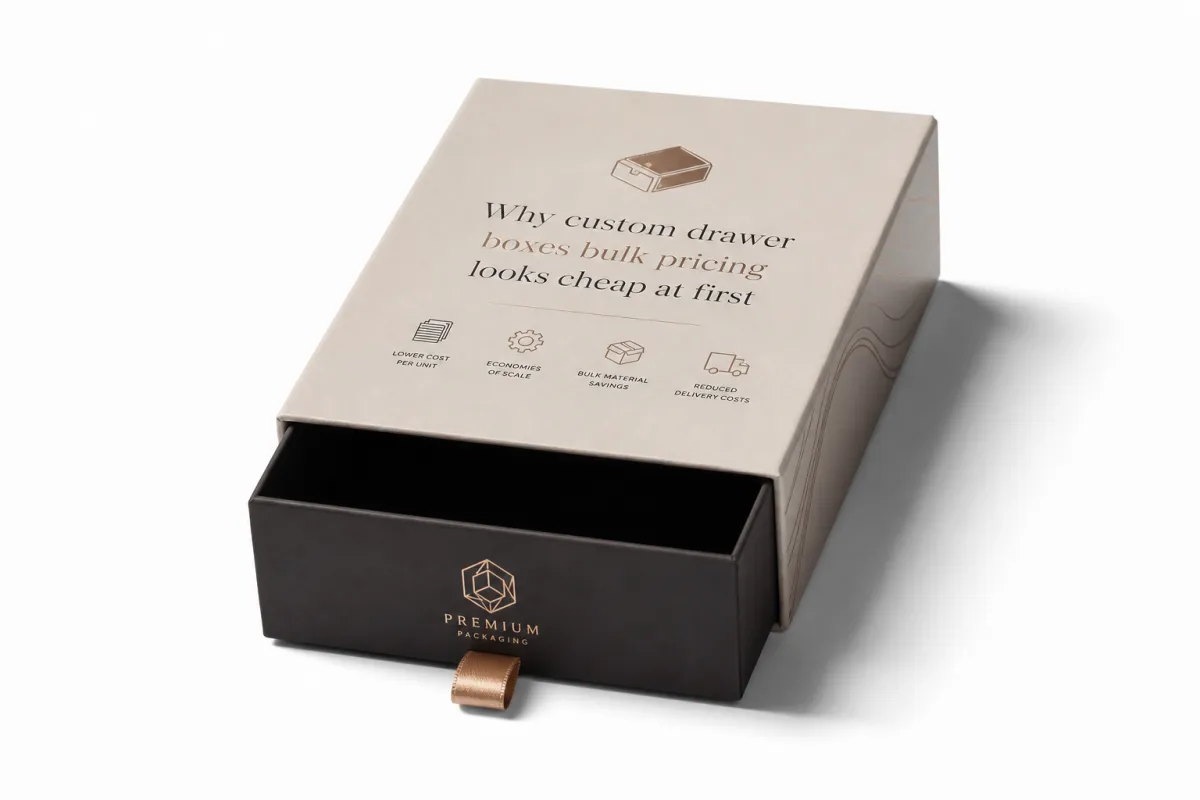
The first number usually looks friendly. Then the real spec shows up. Insert. Paper wrap. Foil. Delivery. Suddenly custom drawer boxes bulk pricing is no longer a single figure. It is a stack of smaller charges that decide whether the order works or turns into a headache.
That happens because drawer boxes are systems, not one-piece cartons. There is an outer sleeve, an inner tray, and sometimes a ribbon pull, foam insert, paperboard insert, or printed interior. Each part adds material, labor, and setup time. A plain structure can stay efficient. A layered build with specialty finishes and multiple components will not pretend to be cheap, no matter how politely the quote is written.
Buyers often compare only the per-unit number. That helps, but it is not enough. A quote that is fifteen cents lower can still cost more if freight is higher, the minimum order is bigger, or the structure wastes space in transit. Damaged goods make the math worse. Replacement boxes cost money. Delay costs money. Staff time spent fixing the mess costs money too. Packaging never fails quietly.
Another reason custom drawer boxes bulk pricing looks lower on paper is that early estimates usually assume smooth production. Real life is less cooperative. Artwork shifts. Pantones need correction. The fit is tighter than the mockup suggested. Pallet counts change because the finished boxes take more room than expected. Small issues do not stay small once they hit procurement.
- Hidden cost: insert materials missing from the first quote.
- Hidden cost: tooling, cutting, or plate setup charges.
- Hidden cost: freight, palletization, and warehouse delivery fees.
- Hidden cost: waste from a loose fit or oversized structure.
- Hidden cost: rework after a finish or print mismatch.
Bulk drawer boxes can still be a smart buy. They protect premium products, create shelf impact, and support brand presentation without forcing every SKU into a fully bespoke rigid box program. That balance matters. The goal is not the fanciest package on the floor. The goal is the one that fits the product, the channel, and the budget. Custom drawer boxes bulk pricing only becomes useful when those three things line up.
If you are comparing formats, browse our Custom Packaging Products to see how drawer boxes fit alongside other structures. For repeat programs, our Wholesale Programs are built for buyers who need steadier pricing and fewer surprises. Not glamorous, sure. Still cheaper than redoing the whole spec because someone guessed on the tray size.
Custom drawer boxes bulk pricing and product details that change the quote
Custom drawer boxes bulk pricing starts with the structure. Not the sales pitch. Not the mockup. The structure. A drawer box is a set of parts, and each part can have a different material, different print coverage, and different assembly steps. Add parts and the quote rises. Add more finishing and the price climbs again. It is not mysterious. It is just math with paperwork attached.
The outer sleeve is usually the visible branded surface. The inner tray does the holding. Then there may be a ribbon pull, a foam or paperboard insert, and sometimes an interior print panel. Each addition changes the cost. A simple one-color design stays efficient. A build with foil, embossing, and a custom insert will not match that number, no matter how much someone wants the proposal to feel friendly.
Board choice matters a lot. Paperboard works for lighter retail packaging and promotional kits. Chipboard is common for economy rigid structures and midweight products. Thicker rigid stock gives a more premium feel and more protection, but it also adds material cost and often shipping weight. For cosmetics, gifts, and small electronics, the material should match the product value, not the mood board.
Finish choices carry real weight too. Matte lamination looks clean and modern. Gloss helps color pop. Soft-touch adds a velvet-like feel, but it also adds cost and can slow production. Foil stamping, embossing, debossing, and spot UV all improve presentation, but they increase labor and the chance of reject issues. If the design already has a lot going on, adding more finishes pushes custom drawer boxes bulk pricing upward without improving sales. That is a pretty easy place to overspend if nobody pushes back.
Branding options can shift the quote just as fast. Full-wrap printing across the sleeve uses more ink and more press time. Single-color branding is cheaper and can still look sharp if the type is handled well. Inside printing creates a stronger unboxing moment, but it adds another process step. Custom die-cut windows help in some product packaging programs, but they also require tighter engineering and more inspection. The easiest way to hold custom drawer boxes bulk pricing in check is to reduce the number of unique production steps.
For brands that care about sourcing standards, paper choice can matter as much as decoration. FSC certification is often requested by retail buyers who want documented forestry sourcing; the requirements are laid out at fsc.org. That does not automatically make the box cheaper or more expensive, but it can affect material selection and paperwork. Ask early if you need chain-of-custody documentation. Waiting until later is a bad habit, and it turns simple sourcing into a scramble.
Structure details that move the price
Drawer boxes are not all built the same. A shallow sleeve with a light tray moves faster through production than a thick reinforced box with tight tolerances. If the tray needs to glide without rubbing, the fit has to be more exact. That means more setup attention and usually a bit more waste. A base reinforced for a heavier item raises the material count again. Those details look minor on a sample and then show up clearly in custom drawer boxes bulk pricing once the quantity gets serious.
Simple designs save more money than hunting tiny savings on paper grade. One board type. One finish. Clean graphics. That combination usually beats a more elaborate version on both unit cost and consistency. Fancy is fine. Complicated is where the budget goes to die.
Specifications buyers should lock before requesting pricing
If you want a quote that actually means something, lock the spec first. Custom drawer boxes bulk pricing only works when the supplier knows the dimensions, board thickness, print coverage, finish, insert, and quantity. Leave those open and the estimate turns into a guess wearing a suit.
Dimensions are more than box size. They control material use, cutting layout, shipping volume, and fit. Too loose and the product moves around while the packaging looks sloppy. Too tight and the product gets crushed or the assembly slows down. Either way, you pay for it. Oversizing is especially annoying because you end up paying for air. That is not clever planning. That is freight with an attitude.
Measure the finished product, not a rough sketch or the size someone remembers from the prototype table. Include height, width, and depth after lids, caps, or display parts are attached. If the product will sit inside a protective sleeve or bag, include that too. A supplier quoting custom drawer boxes bulk pricing can only build the right dieline if the fit target is real.
Lock these details before requesting a quote:
- Exact size: finished internal and external dimensions.
- Board thickness: such as 1.5 mm, 2.0 mm, or a thicker rigid stock where needed.
- Print coverage: one-color, full-color, outer wrap only, or inside printing.
- Finish: matte, gloss, soft-touch, foil, embossing, spot UV, or a combination.
- Insert type: none, paperboard, foam, molded pulp, or custom die-cut paperboard.
- Quantity: clear tier targets for the first run and any reorder expectation.
- Assembly level: flat-packed, pre-assembled, or partially assembled packaging.
Sloppy dimensions create hidden costs that rarely show up as a clean line item. They create tool adjustments, more inspection time, and ugly sampling cycles. If the product changes size every few weeks, the packaging spec will stop being cheap almost immediately. Standardization is boring. Boring usually wins in custom drawer boxes bulk pricing.
Fit should be intentional. A lightweight cosmetic jar may only need a paperboard insert to stop movement. A glass bottle may need foam or molded pulp for better protection. A premium gift set may need a tray with multiple cavities so the presentation feels deliberate. If the item is fragile or travels rough routes, ask whether the pack-out should align with ISTA test methods or an ASTM distribution profile. That is not overkill. That is what keeps the box from becoming a complaint later.
Retail rules matter too. Leave space for barcodes, warning text, and shelf-facing graphics. If the box has to fit a master carton limit or sit in a display tray, that needs to be baked into the quote. A supplier cannot price the job properly if the compliance requirements show up after approval. Custom drawer boxes bulk pricing gets worse when the rules arrive late.
Custom drawer boxes bulk pricing: what drives the quote
Custom drawer boxes bulk pricing comes down to a few predictable inputs: quantity, size, material grade, print complexity, finish complexity, insert type, and assembly labor. That is the whole game. Once buyers understand those levers, they stop guessing and start making actual tradeoffs.
Quantity is usually the biggest lever. Small runs spread setup and tooling across fewer units, so the per-unit cost stays high. Larger runs dilute the setup impact. That is why a 1,000-piece order often feels painful while a 5,000-piece order starts to look normal. Nobody loves carrying more inventory than needed, but the price curve does not care about feelings.
Material grade comes next. Heavier board, better wrap paper, and specialty liners all raise the price. The same goes for exact color matching. A black sleeve with a clean logo is easier to run than a full-color gradient that has to stay tight across the whole batch. If you want a premium look without pushing custom drawer boxes bulk pricing too far, let the structure do some of the work and keep the decoration controlled.
Labor is a bigger driver than many buyers expect. Drawer boxes may need wrapping, gluing, alignment checks, insert placement, and final packing. Anything that slows the line appears in the quote. If the design requires hand finishing or manual ribbon placement, the cost goes up again. The best value designs usually look simple and still feel premium in the hand. That is harder than it sounds, which is why so many boxes miss the mark.
Typical pricing ranges buyers can expect
These are broad ranges, not promises, because specs can change everything. For simple drawer boxes with moderate print coverage, buyers often see ballpark pricing around $0.70-$1.50 per unit at higher quantities. For rigid drawer boxes with better board, one or two finishes, and a basic insert, the range often moves into $1.20-$2.80 per unit. Add premium finishing, multi-part inserts, or complex structures, and custom drawer boxes bulk pricing can reach $3.00-$5.50 per unit or more. Smaller quantities usually sit above those numbers.
If a quote lands far below those ranges, check what disappeared from the spec. If it lands far above them, ask whether the supplier is building in hand assembly, premium paper, special coating, or heavy freight assumptions. A useful quote explains itself. A sloppy one just tosses out a number and hopes nobody reads it too closely.
Freight and packing count too
Unit price is only part of the picture. Shipping can move the budget more than buyers expect, especially when the boxes are rigid, bulky, or include inserts. Drawer boxes may ship flat or pre-assembled depending on construction. Flat-packed options lower volume and freight. Pre-assembled boxes are easier for the receiving team, but they can raise shipping and handling costs. That tradeoff needs to be discussed early, because custom drawer boxes bulk pricing should be judged on arrival cost, not factory price alone.
Ask how many finished units fit per carton and per pallet. If the pallet count is high, freight can jump even when the box price looks attractive. That is the sort of detail that separates a real purchase from an optimistic spreadsheet.
Pricing, MOQ, and how to lower your per-unit cost
Custom drawer boxes bulk pricing always ties back to MOQ, or minimum order quantity. That is not a penalty. It is production math. Setup, proofing, cutting, wrapping, and inspection all have to be spread across enough units to make sense. If the run is too small, the price per box climbs fast.
For standard drawer box projects, many suppliers are comfortable starting around 500 to 1,000 units. For more complex rigid builds, 1,000 to 3,000 units is more common before the pricing starts to settle down. Very high-volume programs can unlock better rates, especially when the spec stays stable over time. If you need a one-off boutique run, expect custom drawer boxes bulk pricing to be noticeably higher.
There are practical ways to reduce cost without making the box feel cheap. Keep the structure consistent across multiple SKUs. Use one insert style where possible. Cut the number of print passes. Choose one finish instead of stacking three. Standardize size families so the supplier can run longer sheets and waste less material. That is how experienced packaging teams save money without turning the box into a sad brown rectangle nobody wants to touch. The trick is restraint, not wizardry.
- Use one dieline: adapt artwork instead of rebuilding the structure for every SKU.
- Limit finishes: one premium effect often looks better than three competing effects.
- Keep inserts simple: paperboard or molded pulp can be cheaper than custom foam.
- Consolidate orders: larger combined runs usually improve custom drawer boxes bulk pricing.
- Choose practical sizing: avoid oversized packaging that burns material and freight.
- Plan reorders: repeat specs reduce proofing time and help stabilize pricing.
If your brand sells seasonal products, reuse the same base structure with new outer graphics or labels. That keeps the premium drawer format while limiting new tooling. It also makes reorder planning easier. The less you change, the less you pay for change. Not poetic. Just true.
Buyers should also ask about artwork revisions. Some suppliers include a basic proof cycle. Others charge for repeated changes. If the creative team is still experimenting, do not pretend the packaging quote will stay fixed. It will not. Every new finish, color tweak, or size adjustment tends to show up in custom drawer boxes bulk pricing.
Process and timeline from quote to delivery
The process should be simple if the supplier is organized. You send the product dimensions, quantity, artwork, finish preference, and insert requirements. The supplier builds a quote. The dieline gets reviewed. A proof gets approved. Sampling starts if needed. Then production, inspection, packing, and shipment follow. That sounds ordinary because it should be ordinary.
For many drawer box orders, a reasonable timeline looks like this: 1 to 3 business days for initial quoting once the details are clear, 1 to 3 more days for dieline confirmation, 3 to 7 days for sampling or preproduction proofing, and roughly 12 to 20 business days for production after approval. Complex finishes, large volumes, or special materials can extend that. Custom drawer boxes bulk pricing can look good, but if the timeline wrecks your launch date, it is still the wrong order.
Communication matters more than people like to admit. If the supplier is waiting on artwork, fit confirmation, or a test decision, the schedule slips. Buyers who want tight timelines should send complete files the first time and keep approvals moving. One day lost during proofing can turn into a week once everyone disappears into their inboxes again. That is not drama. That is production.
Good suppliers should also explain inspection. Ask how the box will be checked for color consistency, edge wrap quality, insert alignment, and tray glide. Ask whether the order is packed flat or assembled. Ask how overages and shortages are handled. If the order is tied to a retail launch, ask for photos of the approved sample before production moves forward. Small checks like that keep custom drawer boxes bulk pricing from turning into expensive rework later.
What a clean approval cycle looks like
A clean approval cycle starts with a precise brief. The product fits the packaging. The dieline matches the product. Artwork lands on the right surfaces. The finish is confirmed before production. Then the supplier prints, assembles, and inspects. Buyers who rush this process usually pay for it in missed details, not in magical speed. There is no prize for saving three days if the box arrives wrong.
If the packaging will face rough handling, request a sample drop test or at least a practical fit check. That matters for glass, ceramics, and heavier cosmetic jars. A box that passes visual review but fails transit is still a bad box. ISTA methods exist for a reason. So do chargebacks.
Why choose us for bulk drawer box orders
For bulk drawer box programs, buyers usually want three things: clear specs, predictable pricing, and a supplier that does not vanish after the deposit clears. That is not a high bar. It is the minimum. We focus on practical builds that make custom drawer boxes bulk pricing easier to understand and easier to control.
We help buyers match structure to product instead of overspending on packaging that looks impressive and does not fit the use case. A cosmetic line may need a clean rigid drawer box with a paperboard insert. A candle brand may need a sturdier tray and a more durable outer wrap. A gift set may need a presentation-first build with a controlled opening experience. The best packaging usually supports the product without wasting material or budget.
We keep the quote tied to the actual spec. Size, board, print coverage, finish, insert style, and quantity are all visible before pricing is finalized. No vague promise. No mystery surcharge hiding behind a cheerful email. If a job needs a special requirement, it should be named early. That is how custom drawer boxes bulk pricing stays useful for procurement instead of turning into a guessing game.
Consistency is another reason buyers stay with us. Reorders should not feel like starting from scratch every time. Once the packaging spec is approved, the goal is to keep the process stable so future runs are easier to quote and easier to receive. That matters a lot when a brand is scaling. If the packaging changes every round, the budget starts drifting without asking permission.
We also think about the unglamorous side of wholesale packaging. Pallet counts, packing density, carton size, and warehouse handling are part of the cost. A neat design that ships efficiently is better than a flashy box that eats freight and damages margins. Experienced buyers know that. They keep circling back to custom drawer boxes bulk pricing because they want the real number, not the brochure number.
Next steps to get an accurate quote
If you want a quote that can actually be compared, send the basics in one message. Product dimensions. Target quantity. Artwork files. Finish preference. Insert need. Delivery location. If the product is fragile, include a photo or a spec sheet. The faster the supplier understands the full job, the more accurate custom drawer boxes bulk pricing will be.
Here is the shortest useful checklist:
- Final product dimensions and weight
- Target quantity for the first order and likely reorder volume
- Board preference and finish preference
- Need for inserts, ribbons, or inside printing
- Any retail compliance or barcoding requirements
- Delivery address and target schedule
If you are still choosing between two structures, ask for both quotes using the same size and print assumptions. That makes the comparison cleaner. If you are unsure about the insert, ask whether a simpler paperboard cavity will hold the product safely before jumping straight to foam. Too many brands spend too much because nobody pushed back on the first fancy idea.
For larger launches, build in a small buffer for sample changes and freight movement. That is not pessimism. It is planning. Custom drawer boxes bulk pricing gets easier to manage once the brief is stable and the order is written around actual production needs instead of hopeful assumptions.
Questions buyers ask
How much do custom drawer boxes cost in bulk?
It depends on structure and finish, but simple drawer boxes can start in the $0.70-$1.50 range at higher quantities, while premium rigid drawer boxes often land around $1.20-$2.80 or more. Add specialty finishes or custom inserts and custom drawer boxes bulk pricing can move higher quickly.
What MOQ should I expect?
Many suppliers will quote from 500 to 1,000 units for simpler builds, while more detailed rigid orders often become cost-efficient at 1,000 to 3,000 units. If the quantity is much smaller, setup costs have less room to spread.
What is the cheapest way to build a drawer box?
Keep the structure simple, use one finish, avoid multi-layer decoration, and choose a basic insert only if the product truly needs it. In other words, make the box serve the product instead of trying to win a design trophy. That is usually the best path for custom drawer boxes bulk pricing.
Can you print inside the box?
Yes, and it can improve the unboxing moment. Just know that inside printing adds cost and another production step, so it should support the brand story rather than decorate empty space for no reason.
How long does production take?
Typical timelines are often 12 to 20 business days after approval, but complex finishes, large orders, or extra proof cycles can extend that. Freight time is separate, so do not forget to account for shipping when planning a launch.
Do drawer boxes need testing?
For fragile products or long shipping routes, yes. Basic fit testing is smart, and ISTA-style distribution testing may be worth it for heavier or breakable items. Packaging that looks good but fails in transit is just expensive waste.
What should I send for the fastest quote?
Send final dimensions, target quantity, artwork, finish choices, insert details, and the delivery location. The cleaner the brief, the cleaner the quote. That is how custom drawer boxes bulk pricing gets accurate instead of optimistic.
Bottom line: custom drawer boxes bulk pricing is easy to misunderstand if you only stare at the first unit price. Lock the specs, compare the landed cost, and make sure the box design matches the product. Do that, and the order turns into a controlled packaging purchase instead of a surprise expense. That is the move, and it is kinda boring. Good. Boring saves money.
Custom Drawer Boxes Bulk Pricing: decision table
| Decision area | Best fit | What to verify | Risk if skipped |
|---|---|---|---|
| Board or flute choice | Product protection, stacking strength, and shipping distance | Caliper/flute, crush resistance, and sample fit | Weak structure or oversized cartons increase damage and freight cost |
| Print and finish | Retail presentation, unboxing, and shelf recognition | Color proof, coating, scuff resistance, and logo placement | A good dieline can still look cheap if finish and color drift |
| Packing method | Hand packing, ecommerce fulfillment, or retail-ready cartons | Inner count, master carton, label position, and warehouse handling | Good packaging slows operations if pack-out is ignored |
FAQ
What should I verify before ordering Custom Drawer Boxes Bulk Pricing?
Confirm the product size, material, print method, quantity, sample route, packing count, and delivery date. A clear packaging spec is easier to quote, easier to approve, and easier to reorder.
How many samples should I review before bulk production?
At minimum, review one production-grade sample or proof that shows scale, color, logo placement, finish, and packing fit. For high-volume orders, keep the approved sample as the reference standard.
What usually changes the final cost?
Material grade, printing method, finish, tooling, quantity, packing method, revision count, and freight assumptions can all move the final price.

