Buyer Fit Snapshot
| Best fit | Custom E-Commerce Box Pricing projects where brand print, material claims, artwork control, MOQ, and repeat-order consistency need to be specified before quoting. |
|---|---|
| Quote inputs | Share finished size, material target, print colors, finish, packing count, annual reorder estimate, ship-to region, and any compliance wording. |
| Proofing check | Approve dieline scale, logo placement, barcode or warning zones, color tolerance, closure strength, and carton packing before bulk production. |
| Main risk | Vague material claims, crowded artwork, missing packing details, or unclear freight terms can make a low unit price expensive after revisions. |
Fast answer: Custom E-Commerce Box Pricing: What Drives the Cost should be specified like a repeatable production item. The safest quote records material, print method, finish, artwork proof, packing count, and reorder notes in one written spec.
Production checks before approval
Compare the actual filled-product size with the drawing, then confirm tolerance on folds, seals, hang holes, label areas, and retail display edges. Reserve space for logos, QR codes, warning copy, and material claims before decorative graphics fill the panel.
Quote comparison points
Review material grade, print process, finish, sampling route, tooling charges, carton quantity, and freight assumptions side by side. A quote is only useful when the supplier can repeat the same color, closure quality, and packing count on the next order.
Custom E-Commerce Box Pricing: What Drives the Cost
Two stores can ship the same candle, notebook, or skincare kit and still end up with wildly different custom e-commerce box pricing. One pays for a right-sized carton that survives parcel handling and packs fast. The other pays for oversized board, extra void fill, and damage claims that quietly chew through the margin.
That is why custom e-commerce box pricing should never be treated like a lonely number in a spreadsheet. It is a stack of decisions: structure, board grade, print method, finishing, freight, setup, and sometimes storage or assembly. For a packaging buyer, the useful question is not, "What does a box cost?" It is, "What does the full system cost once the product leaves the warehouse?"
For brands building branded packaging and product packaging at scale, the quote only matters if it reflects real shipping conditions. A clean-looking carton that arrives crushed, slows down kitting, or triggers dimensional weight charges is not cheap. It is expensive with better lighting. If you are comparing structural options, it helps to review a product range like Custom Packaging Products before you ask for quotes, because the style you choose changes everything downstream.
What Custom E-Commerce Box Pricing Really Means
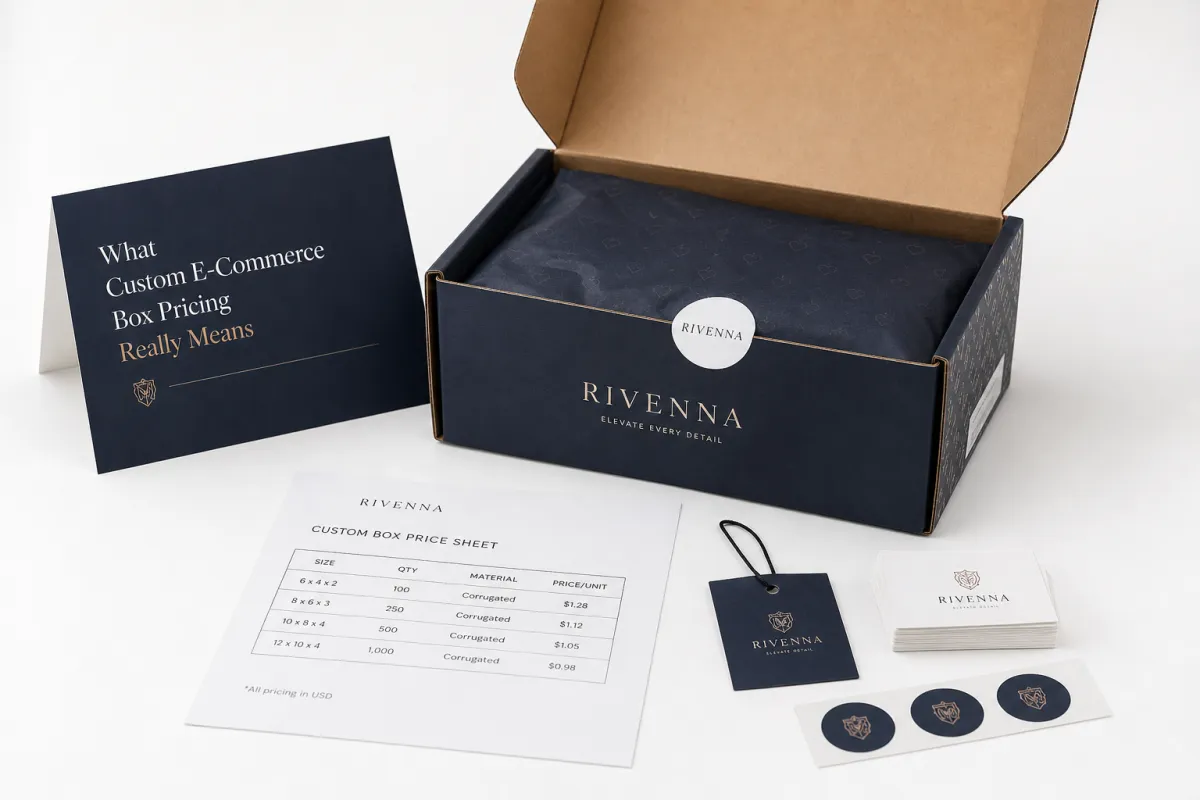
At its simplest, custom e-commerce box pricing is the full cost of designing, producing, and delivering packaging that fits a product, protects it in transit, and supports the brand. Simple enough on paper. Messy in practice. Once you break it apart, the invoice gets real fast: material, cutting tools, printing, coatings, freight, storage, sampling. Each one can move the total more than a buyer expects.
Here is the practical split most teams miss: the box itself is only part of the picture. A supplier may quote the carton shell, but the final custom e-commerce box pricing can also include die charges, insert tooling, ink setup, proofing, and inbound freight. In some programs, there is a separate charge for hand assembly or kitting because the box is being delivered as a finished mail-ready pack, not as loose packaging components.
The cheapest box can become the most expensive choice if it increases returns, packing labor, or parcel damage. A one-size-fits-all mailer may look attractive on paper, but if the product rattles inside, the customer receives scuffed goods or broken corners. That means replacement cost, extra shipping, and wasted time. From a packaging buyer’s point of view, custom e-commerce box pricing has to be judged against the total cost of ownership, not just the unit quote.
There is also a branding angle. In modern package branding, the box does more than hold the item. It signals care, consistency, and quality before the customer even opens it. That is why many brands invest in custom printed boxes instead of plain stock cartons. A plain box may save pennies, but if the unboxing experience feels generic, the brand loses a chance to build repeat purchase behavior.
I keep coming back to the same point because it holds up: a good box pays for itself by preventing problems. It should reduce damage, simplify packing, and make shipping costs easier to predict. That matters for subscription kits, beauty items, gifts, and fragile consumer goods where retail packaging has to survive a rough trip and still look presentable on arrival.
There is one more thing that gets missed a lot: a box is also a labor tool. If it folds cleanly, nests well, and arrives flat without warping, it saves seconds on every pack-out. That sounds small until you multiply it by 20,000 orders. Then it stops being small.
If you want a quick rule of thumb, the price can rise for reasons shoppers never see but operations teams feel immediately: a wider footprint that increases dimensional weight, a heavier board grade that uses more fiber, or a structure that needs more hand steps to assemble. The box may seem minor. The economics are not.
How Custom E-Commerce Box Pricing Is Calculated
Custom e-commerce box pricing usually starts with a spec sheet, not a guess. Suppliers need the product dimensions, product weight, shipping method, brand artwork, quantity, and any insert or finish requirements before they can quote with confidence. If the product is fragile, oddly shaped, or shipped with accessories, those details matter just as much as the logo.
The quote process usually moves through four stages. First comes the discovery call or brief. Then the supplier builds a dieline or confirms a structural template. Next is sampling or proofing, which checks fit and print placement. Finally, production pricing is locked once the structure, artwork, and quantity are approved. That is why custom e-commerce box pricing often changes between the first estimate and the final order: the first number is educated, the second is specific.
Volume changes the math in a big way. Short runs carry heavier setup costs per unit because press setup, die cutting, and proofing are spread across fewer boxes. Larger runs spread those fixed costs more efficiently, so the unit price usually drops as quantity rises. A run of 1,000 boxes and a run of 5,000 boxes may use the same die, but the per-unit share of tooling can be very different. That is one reason custom e-commerce box pricing looks sharp at higher quantities and stubborn at lower ones.
There is also a difference between estimate pricing and production pricing. An estimate is a planning tool. Production pricing is the number tied to the final approved artwork and structure. If the artwork changes from one-color to full-coverage print, if the insert layout changes, or if the box size grows by even a fraction of an inch, the supplier may need to revise the quote. That is not padding. It is manufacturing.
"If the dimensions are not locked, the price is not locked."
That line comes up often in packaging conversations because it captures the basic risk. Custom e-commerce box pricing is sensitive to structural detail. A small change in width can alter board usage, nesting efficiency, pallet count, and dimensional shipping charges. The more custom the pack, the less useful vague assumptions become.
Some quotes are based on box count only, while others include assembly and packing labor. Others may cover the printed carton but exclude inserts, dividers, or protective wrap. A buyer comparing bids needs to confirm whether the supplier is pricing a carton, a component, or a finished pack. Without that clarity, custom e-commerce box pricing comparisons can be misleading even when the numbers look close.
For transit-sensitive projects, ask whether the design has been tested against a recognized method such as ISTA protocols. If the supplier has no testing data, then the cheapest quote is only a theory. In packaging design, theory is cheap right up until the first damage claim lands.
The Biggest Cost Factors Behind the Quote
Custom e-commerce box pricing starts with material choice, and material choice shapes almost everything else. Corrugated board can be single-wall or double-wall, with flute profiles such as E flute, B flute, or combinations used for heavier loads. A thinner flute can reduce material use and improve print sharpness, while a heavier board can improve crush resistance. The right answer depends on the product, the route, and the damage risk.
Board grade matters too. A 32 ECT carton and a 44 ECT carton are not interchangeable. Neither are recycled-content boards and virgin-fiber boards if the application demands a specific finish or compression level. If you are managing a sustainability brief, FSC-certified fiber may be required, and that shapes the sourcing conversation. For brands that want a credible environmental claim, FSC certification is one of the cleaner signals to look for.
Size is another major driver. Every extra inch can affect board usage, shipping class, storage density, and the number of Boxes That Fit per pallet. That matters because custom e-commerce box pricing is not only about manufacturing cost. It is also about freight efficiency. A box that ships well in a factory may perform badly in parcel networks if the outside dimensions push the package into a higher dimensional weight tier.
Printing adds another layer. A one-color logo on kraft board is usually simpler than full-coverage graphics with multiple inks, bleed, and tight registration. Specialty finishes such as aqueous coating, varnish, soft-touch lamination, matte lamination, or foil stamping also change the number. Those touches can strengthen package branding, but they are never free. They add setup time, material cost, and often more quality-control steps.
Operational complexity matters just as much as print. If the box needs a die-cut insert, a paperboard divider, a molded pulp tray, or a custom fold sequence, assembly time goes up. If the package needs to be kitted with tissue, stickers, or another component, labor can exceed the cost of the carton itself. That is why custom e-commerce box pricing often looks modest for the shell and far less modest once the finished pack is priced honestly.
Minimum order quantities can surprise first-time buyers. Some suppliers price aggressively at the breakpoint they want to hit, then add a premium below it because machine setup and waste are harder to absorb. Order 500 units instead of 5,000, and the unit cost may swing sharply. That does not automatically mean the supplier is expensive. It means fixed costs are being spread over fewer pieces.
There is a practical line between a box that looks good and a box that works hard. In custom e-commerce box pricing, the most expensive features are often the ones added late in the process. A structural change after artwork approval, a new insert shape, or a last-minute coating upgrade can trigger reproofing and delay the schedule. The smartest packaging design decisions happen before those costs stack up.
From a shipping-performance standpoint, brands should think about protection testing early. If the product is fragile, ask whether the pack is aligned with the expected lane, whether by parcel, courier, or palletized shipment. For general packaging and shipping context, the Packaging Association provides useful industry background at packaging.org. That kind of reference helps teams compare claims against a broader industry baseline instead of trusting a sales pitch alone.
One more subtle driver is warehouse handling. A box that arrives flat, stacks well, and folds cleanly can reduce packing time by seconds per unit. That sounds minor until you multiply it by tens of thousands of orders. In a busy operation, those seconds are real money. Custom e-commerce box pricing should reflect the actual labor path, not just the printed carton.
And yes, a supplier can be technically right and strategically wrong. If the box saves two cents but creates five cents of labor or damage, the quote is trash in disguise. Pretty common, honestly.
Step-by-Step: Estimating Your Custom E-Commerce Box Pricing Budget
The cleanest way to estimate custom e-commerce box pricing is to start with the product, not the box. Measure the item as it ships, not as it sits on a desk. Include accessories, protective wraps, inserts, and any space needed so the product does not move around inside the carton. If the shipping method is parcel, build around the carrier’s dimensional rules from day one.
Next, separate the budget into four buckets: per-unit packaging cost, setup costs, freight, and failure cost. Failure cost includes returns, damage replacements, and labor tied to rework. That bucket is the one most teams forget. A slightly higher quote can still be the smarter move if it cuts claims by a meaningful percentage. I have seen custom e-commerce box pricing decisions flip after a simple damage review because the cheapest option was causing the most expensive problems.
A useful method is to request three quote tiers. Ask for a budget option, a balanced option, and a premium option. Then normalize them on the same assumptions: same quantity, same dimensions, same board grade, same print coverage, same freight term. Once the quotes line up, the differences in custom e-commerce box pricing become easier to read.
| Quote Tier | Typical Spec | Illustrative Unit Range | Best Fit | Main Trade-Off |
|---|---|---|---|---|
| Budget | Standard corrugated mailer, simple one-color print, minimal finishing | $0.55-$0.95 at 5,000 units | Commodity items, light products, low brand complexity | Less visual impact and tighter limits on fit or protection |
| Balanced | Right-sized custom printed box, simple insert, clean branded exterior | $0.95-$1.65 at 5,000 units | Most DTC programs, subscription kits, consumer goods | Moderate setup work, but usually the best cost-to-performance balance |
| Premium | Full-coverage graphics, specialty finish, custom insert, tighter presentation | $1.60-$3.25 at 5,000 units | Gifting, beauty, premium retail packaging, high-touch launches | Higher tooling, longer lead time, more print and finishing complexity |
The table above is only a budgeting tool, not a promise. Custom e-commerce box pricing can move outside those ranges if the run is short, the structure is unusually complex, or freight is expensive. Still, it is a useful way to see how material, print coverage, and finish quality change the total.
Another practical step is to calculate landed cost instead of unit price alone. Landed cost includes freight to your dock or fulfillment center, plus any assembly or kitting. A box that costs less per unit but arrives as a flat stack requiring manual build can lose badly to a slightly higher-priced pack that folds fast and packs cleanly. That is where custom e-commerce box pricing becomes an operations question, not just a procurement question.
Here is a simple comparison that many buyers use internally:
- Capture the product dimensions and weight as shipped.
- Define the parcel method, retail presentation, and branding requirements.
- Ask for three aligned quotes with identical assumptions.
- Review freight, assembly, and setup before comparing unit price.
- Check whether damage risk or labor time changes the real cost.
If you are still early in the process, a structured brief can save days. Pair the brief with examples from your Custom Packaging Products search or internal packaging library so every supplier is quoting from the same playbook. That makes custom e-commerce box pricing much easier to compare without guessing what was included.
Process and Timeline: From Dieline to Delivery
Custom e-commerce box pricing is tied to timing as much as material. A project with a ready-made structure, finished artwork, and clear specs moves faster than one that needs new engineering. The usual sequence starts with discovery, moves into dieline review, then samples, then production, then finishing, then inbound freight. Every step has a different failure mode, and every failure mode can add cost.
The longest delays usually show up in structural changes, sample revisions, print approval, and production slot availability. If the box is new, the die must be made. If the insert is custom, that insert needs its own design approval. If the artwork is seasonal, any delay can push the order into a higher-cost rush window. In practice, custom e-commerce box pricing often climbs because the schedule gets compressed, not because the carton suddenly became harder to make.
Lead time also changes with complexity. A standard mailer on an existing tool can move quickly. A new die-cut box with a multi-part insert, special coating, or exact-fit interior may need more sample rounds before production starts. That is normal. It is the price of doing custom work well. The more custom the pack, the earlier the specs should be locked to avoid rush fees and missed launch dates.
For parcel programs, transit testing should be part of the timeline discussion. Ask for evidence aligned with the shipping route and product fragility. Not every program needs an extensive lab plan, but fragile goods and premium consumer items deserve more than a visual check. That is one of the cleanest ways to protect custom e-commerce box pricing from hidden losses later in the program.
Timeline rule of thumb: if a box is simple and uses an existing structure, plan for a shorter cycle; if it needs new tooling, inserts, or artwork approval, build extra time into the schedule. That extra time is not waste. It is insurance against avoidable expedites.
Well-run teams also keep the packaging and fulfillment teams in the same conversation. If the carton is beautiful but slow to pack, the launch will feel more expensive than the quote suggested. If the carton is efficient but the presentation is too bare, the brand may save money but lose perceived value. Custom e-commerce box pricing sits right in the middle of that trade-off.
I have watched launches go sideways because packaging got treated like a last-mile decision. It is not. By the time the boxes are on a dock, the expensive choices were already made.
Common Mistakes That Skew Custom Box Pricing
The first mistake is comparing quotes that are not actually comparable. One supplier may include inserts, another may not. One may quote freight, another may leave it out. One may use a heavier board grade or a different flute profile. Without a line-by-line check, custom e-commerce box pricing can look cheaper on paper while being more expensive in reality.
The second mistake is designing for shelf appeal before shipping performance. That is a common trap in retail packaging and product packaging. Buyers want the box to look polished, which is fair, but a rigid visual brief can produce a carton that wastes space or fails in parcel transit. Damage, filler, and replacement shipments erase any cosmetic win pretty quickly.
The third mistake is underestimating order volume. Many suppliers price around quantity bands because setup costs are not linear. If your forecast is too conservative, your quote can look inflated simply because the run is too small. A better approach is to map a likely volume range and ask for pricing at several breakpoints. That gives a clearer view of how custom e-commerce box pricing moves as scale improves.
The fourth mistake is approving artwork before the structure is final. If the dieline changes after art is locked, the file may need to be rebuilt, proofed again, or reprinted. That adds cost and extends the schedule. In custom packaging work, the structure and the artwork are not separate problems. They are one system.
There is also a subtle error that shows up in growing DTC brands: teams chase premium finishes before they have measured packing speed. A foil accent, soft-touch film, or high-coverage ink can make a box feel premium, but if it increases assembly time by even a few seconds, the labor bill may outweigh the visual lift. Custom e-commerce box pricing should always reflect both presentation and throughput.
Another one: teams forget reorder discipline. The first run is usually the most carefully managed. The second run is where someone "just changes a little thing," and then suddenly the project needs new proofs, new inventory counts, and a new quote. That kind of drift is how margins get sneaky.
If you are reviewing options on Custom Packaging Products, keep one principle in mind: the smartest quote is the one that matches the real shipment, not the idealized mock-up. That is where the gap between packaging design and operations usually shows up.
Expert Tips and Next Steps for Smarter Quotes
Custom e-commerce box pricing gets easier to manage once you standardize the brief. I recommend building a one-page package spec that includes product dimensions, product weight, shipping method, target quantity, branding needs, insert requirements, finish preferences, and target unit cost. When suppliers receive the same brief, the quotes are easier to compare and the risk of surprise charges falls.
Ask for landed cost, not just box price. That means freight, setup, and any assembly work should be visible in the comparison. A quote that ignores inbound logistics can look attractive until the pallet lands. If the boxes are shipping to a fulfillment center, ask whether they stack cleanly, whether there is a pallet count target, and whether the supplier can meet it without special handling. Those details change custom e-commerce box pricing more than many buyers expect.
Test a pilot run before scaling if the product, route, or labor process is new. A live pilot often reveals fit issues, damage risk, or assembly bottlenecks that samples do not show. A sample can look perfect on a desk and still fail in a busy warehouse. For that reason, a small pilot is often the cheapest insurance a brand can buy. It protects both the budget and the customer experience.
Here is a simple procurement checklist that pays off:
- Compare at least three aligned quotes with the same specs.
- Confirm board grade, flute profile, print coverage, and finish.
- Verify whether inserts, assembly, and freight are included.
- Ask about transit testing, especially for fragile or premium goods.
- Document every assumption so reorders stay consistent.
That last point matters more than people think. If you do not document the assumptions, the next reorder becomes a fresh negotiation. With a clean spec sheet, custom e-commerce box pricing becomes repeatable, and repeatability is what keeps margin stable over time.
For brands that are still refining their branded packaging approach, the real goal is not to find the cheapest carton. It is to build a pack that supports the product, reinforces the brand, and stays within a defendable cost range. Sometimes that means simplifying the print. Sometimes it means upgrading the board. Sometimes it means changing the structure so packing labor drops by 20% or more. The right answer depends on the product, but the method stays the same.
Smart teams treat custom e-commerce box pricing like a controlled experiment. Change one variable at a time, measure the result, and keep the version that protects margin without damaging the customer experience. That is the path to better quotes, fewer surprises, and packaging that earns its keep every time it ships.
The most useful next move is simple: lock the ship-ready dimensions, decide which features actually earn their cost, and ask every supplier to quote freight, setup, and assembly on the same line. Do that before you fall in love with artwork or coatings, and the pricing conversation gets a lot cleaner. Otherwise, you're kinda just paying extra to find out later.
What affects custom e-commerce box pricing the most?
Box size, board grade, print coverage, quantity, and whether inserts or specialty coatings are included usually have the biggest impact. Freight and assembly can matter just as much, especially on larger or heavier orders. If the package needs transit testing, that can also affect custom e-commerce box pricing because the structure may need extra reinforcement.
How can I lower custom e-commerce box pricing without sacrificing quality?
Right-size the box, simplify the print, and choose a standard structure when possible. Ask for quote options at multiple quantities so you can see where scale lowers the unit cost the most. You can often improve custom e-commerce box pricing by removing unnecessary finish layers before you upgrade board quality.
Why do two suppliers quote different custom e-commerce box prices?
They may be using different board grades, tooling assumptions, freight terms, or minimum order quantities. One quote may include samples, inserts, or assembly while the other only covers the printed carton. That is why apples-to-apples comparison is essential for custom e-commerce box pricing.
How long does the custom e-commerce box process usually take?
Simple reorders can move quickly, but new structural designs and artwork approvals add time before production starts. Sampling, revisions, die creation, and freight scheduling are usually the steps that stretch the timeline most. If a project has custom inserts, expect custom e-commerce box pricing discussions to run alongside longer lead times.
What should I send to get an accurate custom e-commerce box quote?
Send product dimensions, weight, shipping method, quantity, artwork files, and any insert or finishing requirements. The more complete the brief, the easier it is to compare custom e-commerce box pricing on an apples-to-apples basis and avoid rework later. That final detail is the one most buyers regret skipping.

