Buyer Fit Snapshot
| Best fit | custom e commerce mailers for packaging buyers comparing material specs, print proof, MOQ, unit cost, freight, and repeat-order risk where brand print, material, artwork control, and repeat-order consistency matter. |
|---|---|
| Quote inputs | Share finished size, material target, print colors, finish, packing count, annual reorder estimate, and delivery region. |
| Proofing check | Approve dieline scale, logo placement, barcode or warning zones, color tolerance, and any recyclable or compostable wording before bulk production. |
| Main risk | Vague material claims, crowded artwork, or missing packing details can create delays even when the unit price looks attractive. |
Fast answer: Custom E Commerce Mailers: Design, Cost, Fit, and More should be specified like a repeatable production item. The safest quote includes material, print method, finish, artwork proof, carton packing, and reorder notes in one written spec.
What to confirm before approving the packaging proof
Check the product dimensions against the actual filled item, not only the sales mockup. Ask for tolerance on folds, seals, hang holes, label areas, and retail display edges. If the package carries a logo, QR code, warning copy, or legal claim, reserve that space before decorative graphics fill the panel.
How to compare quotes without losing quality
Compare board or film grade, print process, finish, sampling route, tooling charges, carton quantity, and freight assumptions side by side. A lower quote is only useful if the supplier can repeat the same color, closure quality, and packing count on the next order.
A package can look tidy on a packing bench and still drain money once it enters the carrier network. One extra inch of air on each side, multiplied across thousands of shipments, is not small change. That is why custom e commerce mailers matter: they tighten the fit, cut wasted space, reduce preventable damage, and set the tone for the first physical interaction a customer has with an order.
For a lot of brands, custom e commerce mailers sit between plain stock packaging and fully custom printed boxes. They are not just holders. They affect freight, line speed, unboxing quality, and how well a product survives the trip from warehouse to porch. The best versions do several jobs at once without asking the operation to slow down for them.
Used well, custom e commerce mailers can make a small item feel considered, a fragile item feel safer, and a shipping program feel more disciplined. Used badly, they create dead air, higher dimensional weight, scuffed surfaces, and returns that never should have happened. The margin between those outcomes can be narrow. A quarter-inch in the wrong place is enough to matter.
In practice, the difference between a mailer that merely contains a product and one that supports the whole shipment comes down to fit, material choice, print strategy, and how much thought went into the journey itself. The strongest custom e commerce mailers are built around the product first and the branding second, then refined until both demands are handled cleanly.
I have seen teams spend weeks perfecting artwork while ignoring a five-millimeter fit issue. That kind of mismatch is gonna show up in the carrier network, not in the mockup room.
What Are Custom E Commerce Mailers?
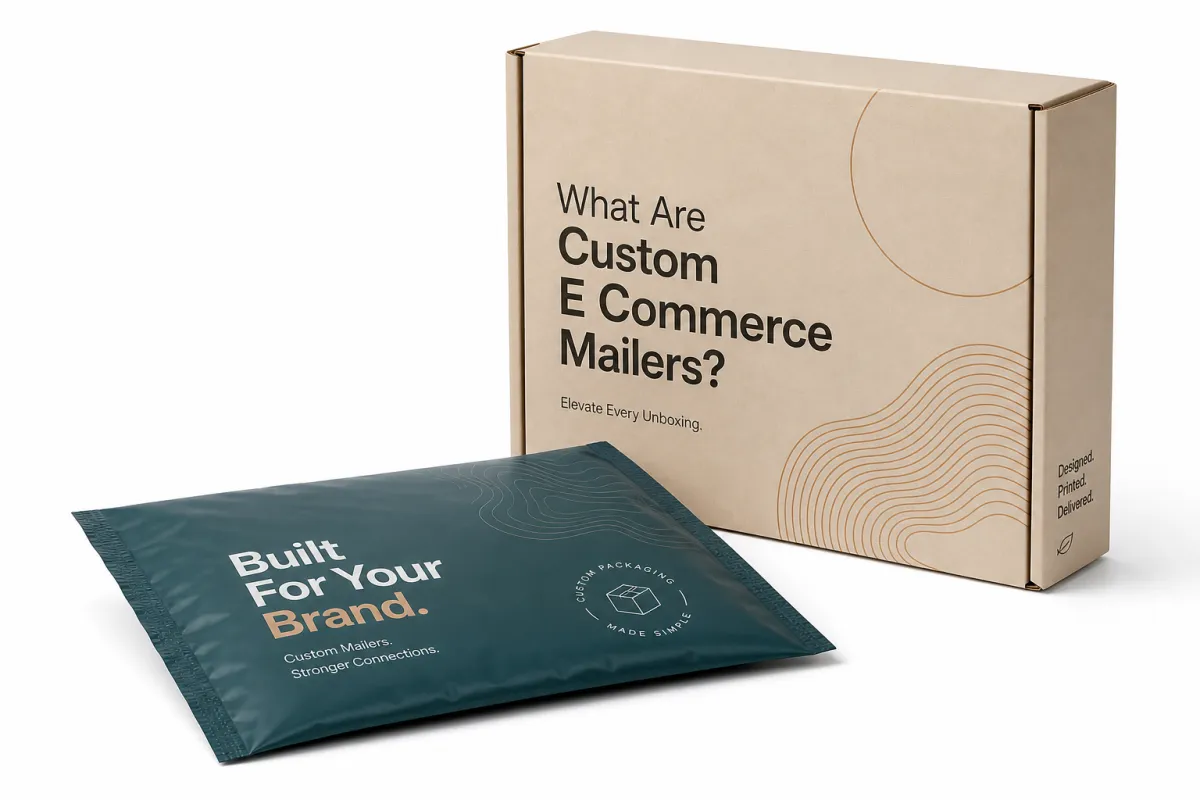
Custom e commerce mailers are branded shipping packs designed around specific products, fulfillment methods, and customer expectations. They are made to carry, protect, and present an item in a way that stock mailers usually cannot, especially when the product size, shape, or presentation needs are unusual enough to cause trouble later.
The plain version is simple: a custom mailer is sized and built for the item you actually ship, not for a generic average. That could mean a flat folding carton for an accessory, a corrugated sleeve for cosmetics, a rigid structure for a subscription kit, or a flexible poly format for soft goods. The right build is the one that fits the item, moves efficiently through your line, and gives the brand the visual tone it wants.
Stock mailers make sense when the product is standard, the shipment is simple, and price is the main constraint. Custom e commerce mailers become more attractive when the product needs a tighter fit, better crush resistance, less filler, or a more specific look. Structure, print area, closure style, and protection level all have to line up. If one piece is off, the whole pack feels off.
That is what makes custom e commerce mailers such an interesting part of product packaging. They do not need to behave like retail packaging on a shelf, yet they still need to feel intentional. They do not need the heft of rigid presentation boxes, yet they still have to survive the trip with enough reliability to keep damage and returns under control.
"A mailer is not a wrapper with a logo on it. It is part shipping container, part brand signal, and part cost equation."
From a packaging buyer's point of view, that is the real value. Custom e commerce mailers are not purchased for decoration alone. They are chosen because a better package can reduce freight waste, cut pack-out mistakes, and improve the unboxing experience without turning the operation into something slow or fussy.
Package branding plays into that too. The branded surface may be the first thing a customer notices, but fit and structure decide whether the parcel arrives looking the way the proof suggested it would. A mailer that photographs well in a mockup room can behave very differently once it gets tossed through a hub-and-spoke system.
In one cosmetics rollout I reviewed, the brand chose a mailer that looked gorgeous but left too much play around the bottle cartons. The first 500 units came back with scuffed corners. The packaging was pretty. The system was not.
How Do Custom E Commerce Mailers Work in Transit?
Custom e commerce mailers work by joining structure, closure, and surface finish into one transit-ready package. The anatomy is not complicated, but each element does different work. Board grade or film choice gives the mailer its base strength. Folds, seams, or welded edges hold shape. The closure keeps the pack shut. Internal features, whether that means a tuck tab, insert, or snug interior dimension, keep the product from sliding around.
For paper-based custom e commerce mailers, the most common material families are corrugated board, folding carton stock, and rigid board. Corrugated styles often use E-flute or B-flute because those profiles strike different balances between print quality and protection. E-flute gives a cleaner print face and a slimmer feel. B-flute usually delivers more puncture resistance. Folding carton stock works well for lighter goods, especially when the goal is a sharp presentation. Rigid board is better when the package needs a premium hand feel and a structure that resists collapse.
For lighter, less fragile shipments, film-based options can be practical. That is where Custom Poly Mailers often enter the discussion, especially for apparel, returns, and other soft goods that do not need a board structure to stay safe. The correct choice depends on what the product needs to survive, not what happens to look nice in a sample photo.
Transit is harder on packaging than most people assume. A mailer gets touched during fulfillment, stacked on a line, sorted by carrier equipment, loaded into vehicles, shifted during transit, and then dropped, slid, or compressed once more on the last mile. Custom e commerce mailers have to absorb those touches without opening, crushing, tearing, or scuffing in a way that creates a bad customer experience.
Crush resistance, edge strength, scuff resistance, and moisture protection matter for that reason. A matte aqueous coat may hide handling marks better than a high-gloss finish on some graphics. A soft-touch film can feel premium, but it may show rubs in a different way depending on the ink and board underneath. A tear strip can make opening easier, but only if it does not weaken closure strength. None of that is universal, yet it comes up often enough that a packaging team should ask about real shipping conditions before choosing a surface treatment.
Branded packaging also has to hold up visually. Print registration, white ink underlays on kraft, varnish choice, and color consistency all affect how the customer reads the package before it is opened. A mailer that looks clean in a sample room can read very differently after a trip through carrier handling. Custom e commerce mailers should be judged as shipping tools first and branding tools second, even though they clearly do both jobs.
For teams that want a benchmark on transit testing, the International Safe Transit Association is a solid reference point: ISTA distribution testing protocols. A handful of practical drop, vibration, and compression trials will tell you more about a mailer than a stack of renderings ever will.
If the pack is built well, custom e commerce mailers can keep the product centered, protect edges, resist rubbing, and still look polished when the customer opens it. If it is built poorly, the failure shows immediately. That is the difference between a shipping expense and a packaging asset.
Key Factors That Shape the Right Mailer
The right custom e commerce mailers start with the product, not the artwork. Measure the ship-ready item, not just the catalog version, because sleeves, inserts, labels, tissue, and protective wrap all change the final pack-out size. A mailer that seems generous on paper can still be too tight once the real shipping build is inside it.
Weight and fragility usually come first. A heavier item needs stronger board or a more rigid structure, while a brittle or scratch-sensitive item may need a tighter fit, a smoother interior, or a protective insert. A ceramic jar, a boxed accessory, a stack of apparel, and a glossy cosmetics kit do not ask the same thing from packaging design, even if the outside measurements look close.
Material choice has to match those demands. Corrugated board is the workhorse because it offers a useful balance of cost and stiffness. Folding carton stock works well for lighter items that still need a neat, branded surface. Padded formats can make sense for low-risk products where a little cushioning does the job. Flexible poly styles can be right for durable soft goods, and that is where custom e commerce mailers shift from being a structural problem to a volume and branding decision.
Branding goals matter just as much. If the brand wants a premium feel, the mailer may need full-coverage print, tighter color control, and a finish that supports the visual language. If the brand is aiming for a more minimal or rugged look, a kraft surface with a single-color mark may be the better answer. Package design and retail packaging thinking overlap here: the parcel ships through a different environment, but the tone still needs to feel deliberate.
I would put these on a packaging brief before talking to a manufacturer:
- Fit: the item should have enough room for safe pack-out without rattling.
- Protection: board caliper, inserts, or padding should match the product's risk level.
- Print coverage: large solids, fine detail, white underprint, and spot colors all affect cost and appearance.
- Closure style: adhesive strip, tuck flap, tab-lock, or tear-open feature can change both labor and tamper evidence.
- Surface finish: matte, gloss, aqueous, soft-touch, or uncoated kraft will change rub resistance and perceived quality.
Sustainability belongs in the conversation, but it needs discipline. The smallest mailer that truly protects the product is usually the best direction because source reduction cuts material use and shipping waste. A larger pack made from a nicer-looking substrate is not automatically the greener choice. If recyclability is a goal, the finished construction should be checked against real collection and recycling conditions rather than assumptions or marketing language. Recycling rules vary by municipality, and mixed-material builds can be trickier than the sales sheet suggests.
That is one reason many brands compare custom printed boxes and custom e commerce mailers together. The goals can overlap, but the execution usually differs. A box family may handle shelf-ready kits and special bundles, while mailers cover the higher-volume shipped orders. Used together, they can create a cleaner product packaging system instead of a pile of one-off solutions.
Once those decisions are aligned, custom e commerce mailers become a controlled part of the supply chain. They reduce guesswork, improve consistency, and give the brand a package that feels like it belongs in the operation rather than something the operation has to work around.
Custom E Commerce Mailers: Cost and Pricing Basics
Pricing for custom e commerce mailers is shaped by material, print complexity, structure, order quantity, and any added finish or insert. The same concept can be cheap in one build and expensive in another if the board grade changes, the artwork adds more colors, or the structure needs extra tooling. Unit price alone does not tell the full story.
As a rough planning frame, custom poly mailers at around 5,000 units may land in the $0.12-$0.30 range depending on size, print count, and film spec. Folding carton-style mailers often sit around $0.45-$0.90. Custom Corrugated Mailers may run about $0.75-$1.50. Premium rigid formats can move into the $1.25-$2.75 range or higher if the run is short, the print is rich, or the finishing is elaborate. Those numbers are not promises, but they are useful when a team needs a realistic budget discussion.
| Mailer Type | Best Use | Typical Unit Cost at 5,000 | Protection / Brand Feel | Watch-Outs |
|---|---|---|---|---|
| Custom corrugated mailers | Apparel kits, accessories, fragile cosmetics, medium-weight products | $0.75-$1.50 | Strong crush resistance and a solid branded surface | Can add weight if overbuilt |
| Folding carton mailers | Light goods, subscription inserts, small retail packaging | $0.45-$0.90 | Clean presentation with moderate protection | Needs tight fit to avoid movement |
| Padded paper mailers | Low-risk items, flat accessories, simple shipments | $0.25-$0.70 | Basic cushioning and easy fulfillment | Not ideal for sharp or fragile products |
| Custom poly mailers | Soft goods, apparel, returns, lightweight programs | $0.12-$0.30 | Low weight, fast pack-out, strong brand surface | Very little structural protection |
| Premium rigid mailers | Gifts, high-touch product packaging, premium sets | $1.25-$2.75+ | Excellent presentation and strong hand feel | Heavier freight and higher material cost |
Setup costs matter more at low volume. A die, plate set, or tooling charge may add $250-$1,500 before the first unit ships, depending on the structure and print method. If the artwork needs multiple colors, a special coating, or a custom insert, the setup layer can grow quickly. That is one reason custom e commerce mailers can feel expensive at the quote stage even when the shipping result is perfectly practical.
There are also hidden costs that are easy to miss. Freight can be significant, especially if the mailer is bulky but light. Storage matters when a packaging program uses more than one SKU. Sample rounds cost time and sometimes money. Waste from a poor size choice can quietly eat into the savings you thought you were getting. A mailer that is too loose may demand extra filler, while a mailer that is too heavy can raise postage. Neither outcome helps.
From a packaging buyer's point of view, the smart comparison is not just unit price. It is cost per ship, reduction in damage, labor at pack-out, and how well the package reinforces the brand. A lower-cost option that increases returns is usually the more expensive option in disguise. A slightly higher-cost mailer that fits better and protects better can be the cheaper path overall.
The surprise is how often custom e commerce mailers change the math. The savings do not always show up in the box line. They show up in fewer complaints, fewer replacements, smoother packing, and fewer awkward moments where a customer opens a crushed parcel and immediately questions the brand.
Process and Timeline: From Spec to Shipment
Good custom e commerce mailers do not start with artwork. They start with a clear specification. Product dimensions, ship weight, surface sensitivity, closure preference, target ship method, and monthly volume should all be on the table before a sample is cut. The more precise the brief, the faster the project moves.
A practical workflow usually looks like this:
- Measure the ship-ready product, including inserts, sleeves, labels, and any protective wrap.
- Define the protection target, such as crush resistance, scuff control, or tamper evidence.
- Choose the substrate and structure that match the product and the budget.
- Request a structural sample or prototype so fit can be checked in the real world.
- Review printed proofs and confirm color, copy, and finishing details.
- Approve production and schedule freight so the goods arrive before the launch window.
Most of the time goes into sampling, revisions, and proofing. A straightforward project may move from spec to production in two to three weeks after approval, but a custom structure with several revisions can stretch to four to six weeks or more. If the package is tied to a launch date, seasonal shipment, or marketing calendar, the safest move is to build a buffer and work backward from the delivery deadline.
Lead times also depend on how clean the handoff is. If the manufacturer has to chase missing dimensions, search for the wrong art file, or guess at the pack-out, the schedule will slip. Good custom e commerce mailers usually come from a strong packaging brief, not from a rushed approval chain. Send the die line, the final art, Pantone references if needed, and notes about inserts or fill materials in one organized packet. That alone can save days.
It helps to have one person own the packaging decision. Too many voices can make a simple build act like a moving target. The team does not need a committee for every fold line. It needs clear inputs, a sensible approval path, and a manufacturer that can translate the brief into a repeatable shipping pack.
For brands that also ship custom printed boxes, keeping a shared spec library can be useful. The same product may need one set of dimensions for the box and another for the mailer, but the artwork, fit rules, and protection goals often overlap enough that a shared system reduces errors.
One practical trick from the field: keep a photo log of approved samples, not just a PDF spec. When a reorder happens six months later, that visual record is often faster and more reliable than digging through email threads.
Common Mistakes When Ordering Mailers
The most common mistake is choosing a mailer that fits on paper but not in transit. If the product rattles, shifts, or needs more filler than expected, the custom e commerce mailers spec is not really right yet. A box that is technically large enough can still be too loose, too heavy, or too inefficient to ship well.
Here are the mistakes I see most often:
- Oversizing: too much empty space increases movement, raises dimensional weight, and wastes material.
- Overbuilding: choosing a heavier structure than the product actually needs can drive up freight without adding real protection.
- Ignoring graphics until late: print, coatings, and panel layout should be planned with the structure, not layered on afterward.
- Skipping testing: fragile items, sharp edges, and sensitive finishes should be checked with actual samples before launch.
Another mistake is treating print as an afterthought. Artwork can look fine on a screen and still fall apart once it meets a die line, flap fold, or closure strip. The brand mark may land too close to a fold. A color block may rub against a seam. A matte finish may behave differently on a dark flood than it did on the white proof. That is true for custom e commerce mailers and for custom printed boxes, and it is one of the easiest ways to create a packaging headache for no reason.
Testing matters because carrier handling is not gentle. Drop, vibration, and compression checks reveal failure points that a CAD mockup cannot show. If you want a starting point, the ISTA testing framework is worth studying. It helps teams think about distribution the way carriers actually move parcels, which is far more useful than guessing from a shelf sample alone.
There is also a tendency to underestimate the opening experience. A mailer that tears too early, opens awkwardly, or leaves messy fibers can make a product feel cheaper than it is. A package does not need theater, but it does need to feel deliberate. That is one place where custom e commerce mailers can outperform generic stock packs if the design is handled carefully.
One last issue is assuming the cheapest quote is the best quote. A low price can hide a higher damage rate, a slower pack-out, or a weaker brand impression. If the package is part of the customer experience, the real cost is bigger than the quote line.
Expert Tips and Next Steps for Better Orders
If you want better results from custom e commerce mailers, start with a short packaging brief that includes product dimensions, actual ship weight, fragility concerns, surface sensitivity, target ship method, and expected monthly volume. That one document can prevent a lot of guessing, especially when a brand is comparing formats, finishes, and insert options.
My strongest recommendation is to prototype more than one direction. One concept may win on cost, another may win on presentation, and a third may be the best balance of both. The brands that get the best results treat packaging design as something to refine, not something to freeze on the first try. That mindset usually produces better product packaging and better service downstream.
Measure the ship-ready product, not the bare product. Add the accessory bag, the tissue wrap, the charging cable, the care card, the insert, or whatever else rides inside the pack. Those details matter more than most people expect. In branded packaging, even a small change in pack-out can alter closure tension or create a bulge that ruins the clean line you were trying to preserve.
It also helps to compare your current mailer against one improved spec using real numbers. Look at unit cost, damage rate, postage impact, and customer complaints. Then ask a simple question: is the current mailer doing its job, or is it just familiar? That is usually how custom e commerce mailers improve over time. Not through a flashy redesign, but through a few smart corrections that add up.
If your team is building a larger packaging system, think about how the mailer fits alongside custom printed boxes, inserts, and secondary packaging. A good program should feel like one family of decisions, not a pile of unrelated parts. That is where the right structure, the right print treatment, and the right fulfillment process start working together.
The most practical next step is a side-by-side sample review using the real ship-ready product, not a simplified mockup. One afternoon of testing can reveal more than a month of discussion, and it usually makes the final choice obvious.
How do I choose the right custom e commerce mailers size?
Measure the packed product, not just the bare item, so you account for sleeves, inserts, labels, and any protective wrap. Leave only the clearance needed for safe packing, because extra empty space can raise shipping cost and increase movement in transit. For most brands, the right custom e commerce mailers size is the smallest one that still protects the product and keeps pack-out smooth.
Are custom e commerce mailers worth it for small brands?
Yes, when product protection, repeat branding, or lower damage rates matter more than using a generic stock pack. Small brands often see the biggest benefit when a better-fitting mailer cuts returns, improves unboxing, and supports a consistent look. Even a modest order of custom e commerce mailers can pay back through fewer complaints and a cleaner customer experience.
What materials work best for custom e commerce mailers?
Use corrugated or rigid board when the product needs structure, crush resistance, or a sharper presentation. Use lighter formats when the product is durable and the main goals are efficient shipping and branded presentation rather than heavy-duty protection. The best material for custom e commerce mailers depends on the product, the shipping lane, and the look the brand wants to project.
How long does it take to produce custom e commerce mailers?
Lead time depends on sampling, art approval, print method, and order size, so simple projects move faster than highly customized ones. Build in extra time for proofs and revisions if the packaging is tied to a product launch or seasonal shipment. In many programs, custom e commerce mailers are fastest when the brief is clear and the approval chain is short.
How do custom e commerce mailers affect shipping costs?
A better fit can reduce dimensional weight, wasted space, and the need for extra filler, which often improves shipping efficiency. Heavier or oversized designs can increase postage, so cost should be evaluated alongside protection and brand value. The right custom e commerce mailers can lower total shipping expense even when the unit price is a little higher.
Handled well, custom e commerce mailers can cut wasted space, reduce damage, and give the shipment a cleaner first impression without making production harder than it needs to be. The clearest takeaway is simple: start with the product, test the actual pack-out, and choose the smallest structure that protects it in transit. That is the point where custom e commerce mailers stop being a guess and start being a dependable part of the shipping system.

