Buyer Fit Snapshot
| Best fit | Custom Poly Mailers for Socks projects where brand print, material claims, artwork control, MOQ, and repeat-order consistency need to be specified before quoting. |
|---|---|
| Quote inputs | Share finished size, material target, print colors, finish, packing count, annual reorder estimate, ship-to region, and any compliance wording. |
| Proofing check | Approve dieline scale, logo placement, barcode or warning zones, color tolerance, closure strength, and carton packing before bulk production. |
| Main risk | Vague material claims, crowded artwork, missing packing details, or unclear freight terms can make a low unit price expensive after revisions. |
Fast answer: Custom Poly Mailers for Socks: Fit, Cost, and Process should be specified like a repeatable production item. The safest quote records material, print method, finish, artwork proof, packing count, and reorder notes in one written spec.
Production checks before approval
Compare the actual filled-product size with the drawing, then confirm tolerance on folds, seals, hang holes, label areas, and retail display edges. Reserve space for logos, QR codes, warning copy, and material claims before decorative graphics fill the panel.
Quote comparison points
Review material grade, print process, finish, sampling route, tooling charges, carton quantity, and freight assumptions side by side. A quote is only useful when the supplier can repeat the same color, closure quality, and packing count on the next order.
Custom Poly Mailers for socks can look like a small decision on a spreadsheet, but they often determine whether a shipment feels efficient or oddly wasteful. Socks are light, compressible, and easy to ship flat. That sounds simple. It is simple, until the wrong mailer adds dead air, slows packing, or makes a strong product look like it was sent in a rush. Get the size right, the seal right, and the print right, and custom poly mailers for socks can trim shipping waste while making the first touch feel deliberate.
From a packaging buyer's perspective, the outer mailer is never just a bag. It is protection, branding, and warehouse efficiency rolled into one choice. I have watched brands spend months refining product photography and then ship the finished goods in a plain pouch that barely registers on arrival. That kind of mismatch is expensive in a subtler way than freight. A good mailer does more work than its material cost suggests, which is exactly why custom poly mailers for socks keep showing up in serious fulfillment conversations.
The real question is not whether custom poly mailers for socks look good in a mockup. It is whether they protect soft goods, keep pace with the packing line, and avoid paying freight on empty space. That tradeoff drives the decision. Everything else is decoration.
If the mailer is oversized, the parcel looks sloppy. If the film is too weak, the parcel fails in transit. If the print is muddy, the brand takes the hit. Packaging rarely gets the benefit of the doubt.
Why Are Custom Poly Mailers for Socks a Smart Fit?
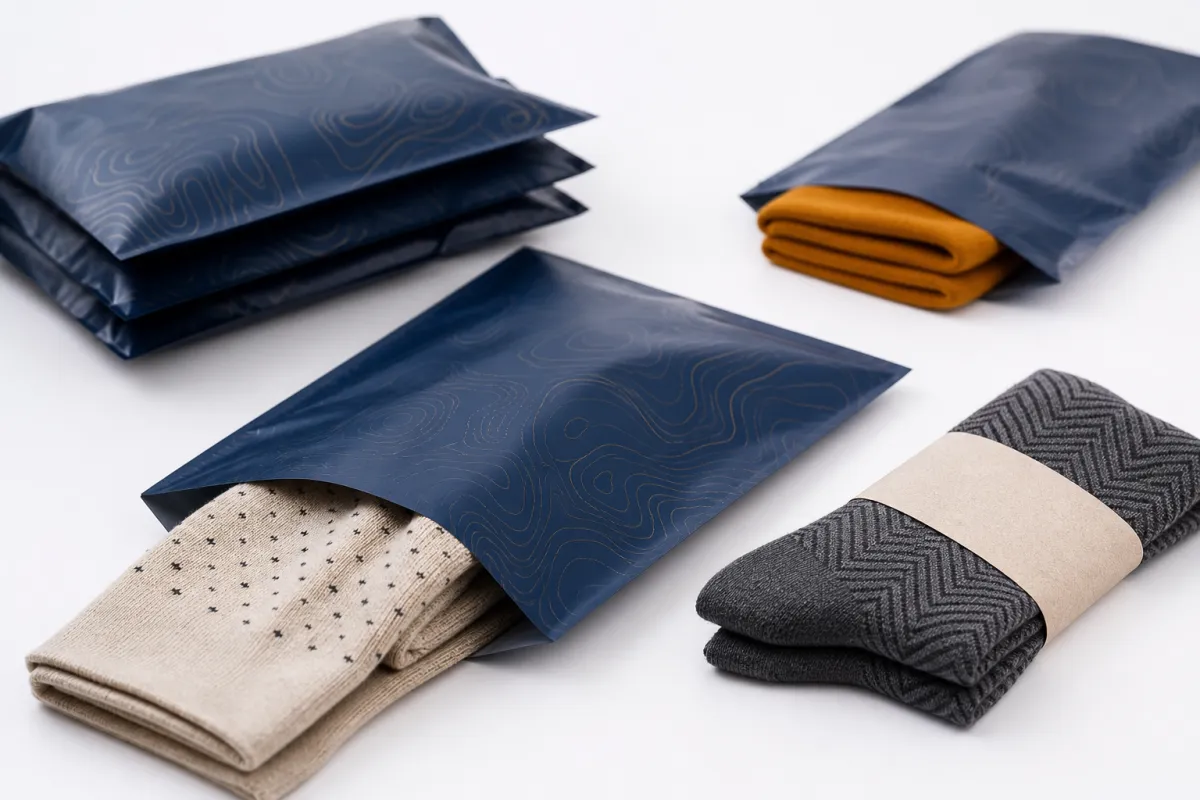
Socks are light, compressible, and stack cleanly. That sounds ideal for shipping, and it is, as long as the packaging does not undo the advantage. Custom poly mailers for socks fit the product well because they use less material than boxes, weigh less than padded envelopes, and match the shape of soft goods instead of forcing them into rigid packaging they do not need.
Shipping cost does not care about brand mood or visual taste. It cares about dimensions, weight, and how much air gets moved through the carrier network. A pair of crew socks in a loose 10 x 13 mailer can cost more to ship than the product deserves. A tighter mailer reduces dead space, looks cleaner on arrival, and keeps the packing line moving without extra motion. That is the kind of efficiency that shows up quietly, then keeps paying you back.
The first touch matters too. For many direct-to-consumer orders, the mailer is the first physical object the customer sees. That gives custom poly mailers for socks a second job: protect the item and carry the brand. Print quality, opacity, and color control matter even when the product inside is low bulk. Packaging has a memory. Customers remember when it feels careless, and they remember when it feels like someone actually paid attention.
Brands still get lazy here. They refine the sock design, then ship it in a plain gray pouch and call that efficiency. That is efficient only in the narrowest sense, the same way a labeled box with no tape is technically a package. The point is not minimum effort. The point is controlled effort.
Custom poly mailers for socks work best for single-pair orders, two-pair bundles, lightweight gift sets, and subscription shipments. Limited drops also fit the format well because the outside of the pack can echo the collection without moving into the higher cost and rigidity of custom printed boxes.
Used well, they sharpen package branding without complicating fulfillment. Used poorly, they become oversized, noisy, and forgettable. The win is not the mailer by itself. It is the fit between product, warehouse, and brand promise.
How Custom Poly Mailers for Socks Work in Fulfillment
A poly mailer is a film pouch with a seal. Most use polyethylene film, a pressure-sensitive adhesive strip, and a printable outer surface. Some include a tear notch, a second adhesive strip for returns, or a dual-seal design that lets customers reuse the bag for exchanges. Custom poly mailers for socks may look simple, but the construction details shape the whole packing experience.
The workflow is direct. Socks are folded or banded, paired with any insert or thank-you card, then placed into the mailer and sealed. Compared with cartons, there is less folding, less void fill, and fewer hand movements. In a busy operation, that saves seconds on every order. Multiply that across hundreds or thousands of shipments and the impact becomes easy to see. Not glamorous. Very real.
Custom poly mailers for socks protect against dust, scuffing, light moisture, and the rough handling that happens in parcel sortation. They are not armor. That would be a strange claim for a soft-goods mailer. For socks, the film is usually enough. If there are no fragile components inside, the bag often does the job without the weight penalty of a box.
Packaging teams often look at test methods from organizations like ISTA and recycling guidance from EPA recycling guidance when they think through material choices and end-of-life expectations. Those sources do not choose a supplier. They do help define what acceptable performance should look like, and that distinction matters.
Where custom poly mailers for socks perform best is flat or lightly compressed shipments. Single-pair orders are easy. Multi-pair bundles still work if the size is correct. Lightweight apparel kits, event giveaways, and promotional drops also fit the format well. The parcel stays compact, which keeps carrier pricing saner and warehouse staff less irritated. That is a useful combination.
Some products do not belong in a poly mailer, and it helps to say that plainly. Hard goods, breakables, and premium presentation programs that depend on structure usually need another format. That might mean Custom Poly Mailers with stronger film and more print control, or it might mean moving into other Custom Packaging Products for a more rigid retail feel. Forcing the wrong format onto the wrong item only creates expensive optimism.
Choosing the Right Size, Material, and Print for Socks
Size starts with the folded sock bundle, not the flat listing photo. Measure the packed thickness after folding, banding, or adding a card. Then leave just enough room for easy insertion and a clean seal. Too little space and the packer fights the bag. Too much and the parcel turns into a balloon, which is a strange way to advertise freight waste. Custom poly mailers for socks should fit like clothing, not like a tent.
Many sock brands land around 6 x 9, 7.5 x 10.5, or 9 x 12 inches, depending on whether they ship one pair, a bundled set, or a retail-ready presentation. That is not a rule. It is a starting point with some useful gravity behind it. The right size depends on fold thickness, inserts, and how much room the fulfillment team needs to move quickly. I have seen a half-inch of extra width look harmless on paper and then add up across a full season of shipments. It really does.
Material choice matters more than many buyers expect. Standard polyethylene is common because it is light and economical. Co-extruded film can improve puncture resistance and gives the bag a cleaner hand feel. Recycled-content options make sense when the brand wants a sustainability message that sounds specific rather than vague. For custom poly mailers for socks, thicker film often feels more premium and resists tearing better, though it raises cost.
Print choice changes the whole impression. A one-color logo on a white or kraft-toned mailer can feel clean and premium. Full-coverage graphics suit streetwear labels, athletic drops, and giftable collections that need more energy on the outside of the pack. Matte finishes hide handling marks better. Glossy finishes pop harder under light, but they show scuffs more easily. Pick the finish that matches the brand, not the sample photo that looks loud on a screen.
Custom poly mailers for socks also need to be readable at a glance. If the artwork gets too busy, the logo disappears. If the background and ink contrast are weak, the package looks tired before it leaves the dock. Good packaging design usually makes a decision quickly. Clarity tends to beat clutter, and that is true more often than designers like to admit.
Check the practical details too: opacity, thickness, adhesive strength, and whether the mailer needs a packing slip pocket or return seal. Those details do not sound glamorous. They reduce headaches. Custom poly mailers for socks that are opaque enough to hide the product, strong enough to survive handling, and simple enough to pack quickly are usually the smartest buy.
Custom Poly Mailers for Socks: Pricing, MOQ, and Hidden Costs
Price is not just the unit quote. It is size, thickness, print coverage, finish, adhesive style, freight, and setup all tangled together. A basic single-color run for custom poly mailers for socks can look cheap per piece, then turn expensive if the order is tiny. A fully printed mailer with thicker film and a return seal can look pricier up front, yet it may be the better long-term buy because it cuts waste and improves pack speed.
MOQ matters because smaller quantities almost always push unit cost upward. That is packaging arithmetic, and it still surprises people. Short runs work for launches and seasonal drops, but unit economics usually improve as quantity rises. A 3,000-piece order may feel manageable. A 10,000-piece order often drops the unit cost enough to justify the inventory space if the design is stable.
Here is a useful planning table for custom poly mailers for socks:
| Option | Typical MOQ | Typical Unit Range | Best For | Tradeoff |
|---|---|---|---|---|
| Stock-size, one-color print | 1,000-3,000 | $0.12-$0.22 | Launches, simple branding, lean budgets | Less sizing flexibility |
| Semi-custom size, two-color print | 3,000-5,000 | $0.18-$0.32 | Most DTC sock brands | Higher setup than stock options |
| Fully custom size, full-coverage print | 5,000-10,000+ | $0.28-$0.55 | Premium branding, subscription programs, seasonal drops | More lead time, higher freight risk |
Those figures are ballpark ranges, not guarantees. Print coverage, thickness, and whether the supplier is quoting ex-factory or landed pricing all move the number around. Custom poly mailers for socks also pick up hidden costs from freight, proof revisions, and overbuying a size that is just a little too large. A mailer that is 10% bigger than needed can cost you every day in shipping. That is the sort of expense nobody celebrates in a spreadsheet, but it still shows up month after month.
Do not ignore landed cost. A low unit price with expensive freight can be a worse deal than a slightly higher unit price with local or consolidated shipping. Packing labor counts too. If the mailer is awkward to load or seals poorly, the warehouse pays for it with time. From a packaging buyer's standpoint, the cheapest quote is often the one that has not been opened all the way yet.
For brands comparing custom poly mailers for socks against boxes or other formats, the question is whether the packaging supports the order mix. Boxes make sense for rigid kits, heavier bundles, or a premium structural feel. If the job is to ship soft goods efficiently, poly usually wins on cost and handling. That is not a trend. It is simple math with a shipping label on it.
Step-by-Step Process and Timeline for Ordering
The ordering process should feel orderly, or it becomes a mess with better typography. For custom poly mailers for socks, the usual path is concept, sizing, artwork, proofing, production, and freight. Each step sounds obvious. Trouble starts when one of them is vague. Vague specs are where reprints are born.
Start by defining the use case. Is the mailer for single pairs, multi-pair bundles, or subscription shipments? Are inserts part of the pack? Do you want a matte finish, a glossy finish, or a recycled-content look? Once that is clear, confirm size against a packed sample. Measure the real socks, not the product page. Socks stretch the truth more than most products, and they do it without blinking.
Next comes artwork. Supply vector files, brand colors, and any print-safe zones. If the logo uses fine lines, make sure the supplier can reproduce them at the chosen film and print method. This is where custom poly mailers for socks save time later: one clean proof now is cheaper than three rushed revisions later. That is especially true if multiple teams are weighing in and everybody has a slightly different idea of what “close enough” means.
The timeline depends on quantity and transit. Sampling or digital proofing can happen quickly. Production for a modest custom run often lands in the 12-15 business day range after proof approval, though larger runs or complex print setups can take longer. Freight adds its own clock. Domestic shipping may take a few days. International transit can stretch to one or several weeks depending on lane and season. If launch timing matters, build in a buffer. Shipping delays are common enough to qualify as a habit.
Here is a simple internal checklist before you approve custom poly mailers for socks:
- Confirm folded sock dimensions with the actual product.
- Decide whether the pack needs a return seal or tear strip.
- Approve the print side, ink colors, and finish.
- Check whether the logo reads clearly at arm's length.
- Verify freight terms and delivery address accuracy.
- Test one packed sample in your normal workflow.
That workflow keeps the brand, fulfillment team, and supplier aligned. Which sounds easy until the wrong size shows up and everyone starts searching the email thread for a clue. Custom poly mailers for socks reward discipline. The more exact the front-end spec, the smoother the production run.
One more practical note: if you are coordinating custom poly mailers for socks with a broader launch, align them with your other Custom Packaging Products so your labels, inserts, and outer packaging feel like one system. Consistency matters. Package branding reads faster when it is not arguing with itself.
Common Mistakes When Using Custom Poly Mailers for Socks
The first mistake is oversizing. A mailer that is too large makes the parcel look sloppy, increases the chance of shifting inside the bag, and can trigger dimensional shipping costs that erase the savings you thought you had. Custom poly mailers for socks should fit the order, not float around it.
The second mistake is picking film that is too thin for the handling path. If orders move through multiple sortation points or include heavier inserts, weak film and weak seals will show up quickly. A bag that fails at the seam becomes a brand problem, not a packaging problem. That is simply where the customer feels it.
Third, too much artwork can backfire. Busy layouts may print poorly, look noisy at small scale, or bury the logo when the bag wrinkles. Minimal graphics often age better. Bold graphics can work too, but they need restraint. Good packaging design is not more ink. It is the right ink in the right place.
A fourth mistake is ignoring the pack line. Some mailers look fine in a mockup but are awkward to grab, hard to open, or inconsistent in thickness. That slows the team down. If the warehouse staff hates the bag, the bag is wrong. Plain and simple. Custom poly mailers for socks should support the operation, not fight it.
Fifth, people shop only on unit price. That is where the bad deals hide. A cheaper mailer that adds two seconds of packing time, a higher failure rate, or more freight waste is not cheaper. It is merely cheaper-looking. The better comparison is total landed cost plus labor plus customer experience. Not exciting. Correct.
There is also a brand mistake that shows up in subscription and gift programs. Some brands choose a mailer that performs fine physically but does nothing for presentation. If the outer package is the first physical touchpoint, then the look matters. Custom poly mailers for socks can be understated, but they should not be forgettable unless that is the actual strategy. That can be a strategy. It just is not a loud one.
Finally, do not skip testing. Put a real pair of socks inside the bag, seal it, label it, and ship one to a test address. Then inspect the result. Custom poly mailers for socks either survive that test or they do not. Guessing is not testing.
Expert Tips and Next Steps for Custom Poly Mailers for Socks
If this decision needs one practical move, start with a sample pack or a short proof run before committing to a large order. Custom poly mailers for socks are easy to evaluate in the real world. Load them with actual socks, seal them, stack them, and see how they behave under your normal fulfillment rhythm.
Check three things first: size, seal strength, and print clarity. Size tells you whether the order feels tight or sloppy. Seal strength tells you whether the adhesive can handle transit. Print clarity tells you whether the brand survives contact with reality. Those are the things that matter. Fancy supplier language does not pack a parcel.
It also helps to compare two or three quotes with the same spec sheet. Use the same dimensions, film thickness, artwork, and finish so you are comparing real options instead of sales fluff. A difference of a few cents per unit may not matter if one supplier offers better freight terms or fewer defects. Custom poly mailers for socks should be bought as part of a process, not as a random commodity.
Here is the spec sheet I would want on file before production starts:
- Finished mailer dimensions and acceptable tolerance
- Film thickness and material type
- Print colors, finish, and approved artwork file
- Seal type, tear strip, and return adhesive details
- Packaging target: one pair, bundle, or subscription order
- Packing slip, label, or insert requirements
That document saves time for everybody. It also makes reorders easier, which is where a lot of brands quietly win. A clean spec for custom poly mailers for socks means less back-and-forth, less chance of sizing drift, and fewer embarrassing moments when the reorder arrives “close enough” and then turns out not to be.
One useful rule: test with the bulkiest sock style you ship, not the thinnest one. A lightweight no-show sock can make a bag look generous. A thicker athletic sock can expose the weak spot immediately. If the mailer works with the bulkiest SKU, it usually works with the rest. If it only works with the easiest SKU, that is not a win. That is denial wearing a label.
For brands building a full packaging system, pair your mailer spec with your broader Custom Poly Mailers strategy and the rest of your Custom Packaging Products. The point is not to collect packaging formats. The point is to make product packaging and retail packaging feel intentional from the first touch to the last.
My last practical tip: verify freight terms, inspect the proof carefully, and lock the final spec only after the custom poly mailers for socks pass a real pack-out test. That is the cleanest path. It is also the cheapest way to avoid a reprint that nobody wants to explain.
FAQ
What size custom poly mailers work best for socks?
Choose the size from the folded sock bundle, not the product label. Leave just enough room for easy insertion and a clean seal. If you use a thank-you card, barcode label, or insert, test one packed sample with all of that in place so the final size is based on reality, not guesswork.
Are custom poly mailers for socks cheaper than boxes?
Usually yes. Poly mailers use less material and weigh less, so they often reduce both packaging cost and shipping cost. Boxes only make sense if you need rigid protection, a premium structural feel, or multi-item kits that cannot stay flat.
How long does it take to order custom poly mailers for socks?
Timing depends on proof approval, production queue, and freight method. Simple orders can move faster than fully custom sizes with multiple print colors or special finishes. If a launch date matters, leave room for artwork changes and transit delays.
What material should I pick for branded sock mailers?
Standard polyethylene works for many lightweight sock shipments and keeps costs down. Co-extruded or thicker films improve puncture resistance and tend to feel more premium. Recycled-content options can help if your brand wants a more sustainability-focused message.
Do custom poly mailers for socks need a return seal?
Not always. A second adhesive strip is useful for brands with frequent exchanges, because it gives customers a cleaner return experience. If your return rate is low, a single strong seal is often enough.
Bottom line: custom poly mailers for socks work best when the size fits the product, the print matches the brand, and the packing process is tested Before You Buy at scale. The practical next step is simple: spec the bag around your bulkiest sock style, request a packed sample, and approve production only after it passes a real pack-out. That is the difference between a mailer that merely ships and custom poly mailers for socks that actually support margin, speed, and package branding.

