Buyer Fit Snapshot
| Best fit | Custom Eco Mailer Boxes Pricing projects where brand print, material claims, artwork control, MOQ, and repeat-order consistency need to be specified before quoting. |
|---|---|
| Quote inputs | Share finished size, material target, print colors, finish, packing count, annual reorder estimate, ship-to region, and any compliance wording. |
| Proofing check | Approve dieline scale, logo placement, barcode or warning zones, color tolerance, closure strength, and carton packing before bulk production. |
| Main risk | Vague material claims, crowded artwork, missing packing details, or unclear freight terms can make a low unit price expensive after revisions. |
Fast answer: Custom Eco Mailer Boxes Pricing: Film, Print, MOQ, and Carton Packing should be specified like a repeatable production item. The safest quote records material, print method, finish, artwork proof, packing count, and reorder notes in one written spec.
Production checks before approval
Compare the actual filled-product size with the drawing, then confirm tolerance on folds, seals, hang holes, label areas, and retail display edges. Reserve space for logos, QR codes, warning copy, and material claims before decorative graphics fill the panel.
Quote comparison points
Review material grade, print process, finish, sampling route, tooling charges, carton quantity, and freight assumptions side by side. A quote is only useful when the supplier can repeat the same color, closure quality, and packing count on the next order.
Custom eco mailer boxes pricing looks simple right up until the first quote lands and the numbers start moving around like they have their own agenda. One supplier gives you a clean unit price, another hides freight in a separate line, a third adds tooling after the fact, and the “budget” option suddenly feels kinda expensive. That pattern is common. Custom eco mailer boxes pricing is rarely one number, because the box is only one piece of the spend; material, print, setup, freight, and waste can matter just as much as the board itself.
Buyers usually mean four things by custom eco mailer boxes pricing: the material, the structure, the print method, and the costs nobody mentioned on the first call. Eco does not automatically mean premium, either. It changes the cost mix. Recycled content, FSC-certified sourcing, and lower-impact inks move money around in the quote, but they do not turn a simple mailer into a luxury item. If you want the real numbers, not the polished sales version, you have to start there.
I have sat through enough packaging reviews to see the same mistake repeat: people compare the loudest headline number and ignore the assumptions underneath it. That is how a quote that looks cheap on Monday becomes awkward on Thursday. The box is the product, yes, but it is also part of shipping, storage, and labor. Miss one of those, and custom eco mailer boxes pricing stops making sense.
What Does Custom Eco Mailer Boxes Pricing Really Include?
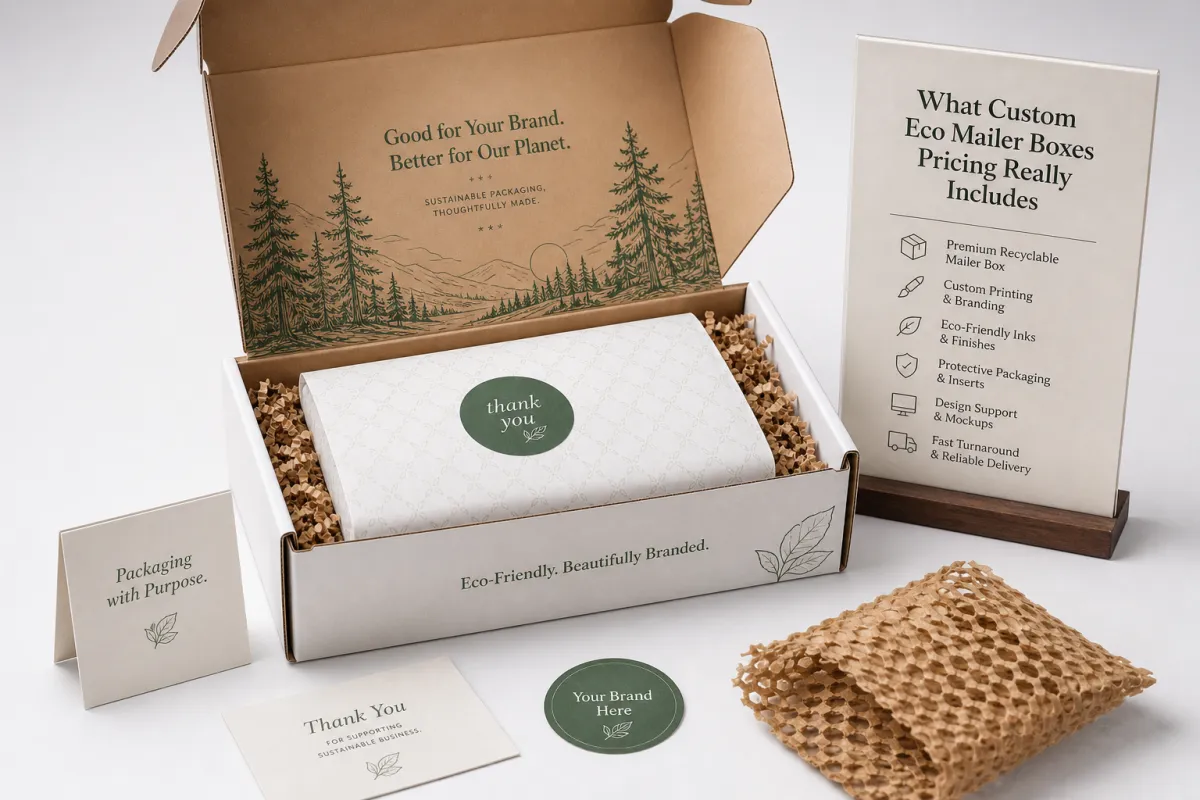
Custom eco mailer boxes pricing is broader than the per-box figure most people latch onto. That number usually covers board stock, die-cutting, printing, and some form of packing or bundling. It often leaves out freight, sample revisions, artwork cleanup, rush charges, and the cost of a weak spec that burns labor on your side. Packaging procurement has a habit of hiding expenses in plain sight. The box itself may be only one slice of the total bill.
From a packaging buyer’s point of view, the real task is not finding the lowest sticker price. It is finding the lowest landed cost for a box that protects the product and still looks like your brand approved it. That means custom eco mailer boxes pricing has to be read against the actual use case: shipping method, product weight, unboxing experience, storage footprint, and how much manual packing time each unit consumes.
Eco materials change the cost structure, but not always in the way people expect. Recycled corrugate may cost a little more than commodity board on some runs, yet a tighter size spec can cut freight and reduce product damage. FSC-certified board can add a premium, but it also makes documentation easier if your brand needs proof of chain-of-custody. Water-based inks and soy-based inks may cost more than the cheapest options, but they often fit branded packaging better when the goal is responsible presentation without the dull, washed-out look cheap ink can create.
Custom eco mailer boxes pricing is not a number you memorize. It is a formula. Once you know what belongs in the formula, the fluff falls away and the spending starts to make sense: fit, strength, print quality, and freight efficiency. That is the part people miss when they compare quotes too quickly.
“The cheapest quote is only cheap if the box shows up on time, fits the product, and survives the first shipping lane.”
That standard is plain, but it is the one that matters. No theater. No brochure language. Just a working definition of value.
How Custom Eco Mailer Boxes Pricing Is Calculated
Custom eco mailer boxes pricing usually breaks into two buckets: fixed setup costs and variable unit costs. Fixed costs are the stubborn ones. They stay in place whether you order 500 units or 50,000. Die-cut tooling, printing plates for some methods, press setup, proofing, and prepress work sit there waiting to be paid. Variable costs are easier to picture: board usage, ink coverage, folding or gluing labor, and the amount of space each finished carton occupies in freight.
Small runs feel expensive for a reason. A setup cost of $180 spread across 500 boxes adds $0.36 per unit before board or ink enters the picture. Spread that same setup across 10,000 units and it drops to under two cents per box. That is why custom eco mailer boxes pricing can look irrational to a buyer ordering a first run and perfectly logical to a supplier watching the spread across volume.
Printing method changes the math fast. Digital printing usually has the lowest setup burden for short runs and artwork changes, but the unit cost can climb on larger quantities. Flexographic printing often performs better on repeat work and longer runs, especially when the design is simple. Offset can deliver excellent image quality, though it usually makes sense only when the artwork and volume justify the extra prep. If a quote does not name the method, ask directly. Custom eco mailer boxes pricing can swing on that single detail.
| Print method | Best for | Typical pricing behavior | Tradeoff |
|---|---|---|---|
| Digital | Short runs, frequent artwork changes, fast sampling | Lower setup, higher unit cost on larger volumes | Flexible, but less efficient at scale |
| Flexographic | Longer runs, simple logos, repeat orders | Moderate setup, lower unit cost as quantity rises | Artwork limits are tighter than digital |
| Offset | High-detail graphics, premium retail-style presentation | Higher setup, better economics on larger quantities | Not ideal for small, quick orders |
Quote structure creates another layer of confusion. One factory bundles tooling, prepress, and freight into one line. Another breaks out every item so the unit price looks lower, which is neat until the extras arrive later. A third may quote a nominal size while using a different board grade behind the scenes. That is enough to distort custom eco mailer boxes pricing by more than most buyers realize.
The cleanest way to read a quote is to split it into components:
- Board stock: kraft, recycled corrugate, virgin fiber, or a heavier specialty grade.
- Die-cut tooling: a one-time cost for the cut pattern.
- Print setup: plates, digital setup, or prepress work.
- Finishing: coating, lamination, spot effects, or specialty inks.
- Packing: flat-packed bundles, palletizing, or inner protection.
- Freight: the part people forget until the shipment is already on the road.
That list is the anatomy of custom eco mailer boxes pricing. Miss one part and the quote stops telling the truth.
Cost Factors That Move Custom Eco Mailer Boxes Pricing
Size is the first lever. A box that looks only 10 percent larger on paper can consume a surprising amount more board and freight space. Corrugated and folding carton layouts are built from flat blanks, not from thin air. Once the dieline grows, the sheet usage grows with it. More board means more raw material, more shipping volume, and often more production waste. Custom eco mailer boxes pricing reacts quickly to that kind of change.
Material choice comes next. Kraft board, recycled corrugate, virgin fiber board, and heavier GSM or E-flute builds sit in different price bands. A basic kraft mailer is usually the least fussy option. Recycled-content board can cost a little more, though the premium may be worth it if the packaging is supposed to support sustainability claims. Virgin fiber can improve print appearance and consistency, but it is not always the smartest choice for a shipping box that will be taped, stacked, and crushed in transit. Custom eco mailer boxes pricing should follow the job, not the fantasy.
Print coverage is another lever buyers often underestimate. A one-color logo on the lid costs far less than a full-wrap art treatment, especially if the design uses heavy ink coverage or tight registration. Flood coats, metallics, and complex gradients increase production complexity. If the brand needs a retail-style presentation, the extra spend may be justified. If the box is heading straight into a shipping lane, a simpler treatment usually makes more sense. There is no prize for the most expensive logo.
Finishes and add-ons can quietly blow up a budget. Coatings, embossing, debossing, tear strips, inserts, custom closures, and specialty adhesives all add steps. Every extra step adds labor or materials, and labor never shows up as free just because the line item sounds elegant. A plain mailer with smart print choices will usually beat a heavily dressed-up box on custom eco mailer boxes pricing, especially for early-stage brands.
Keep these planning ranges in mind:
- Small runs of 250 to 1,000 units usually carry the highest per-box cost because setup is spread thin.
- Mid-volume runs of 2,500 to 5,000 units often hit the sweet spot for balanced unit cost and manageable inventory.
- Larger runs of 10,000 units and up often lower unit pricing, but storage and cash flow start to matter more.
Material, size, and print are the obvious levers, but freight is the silent one. A lightweight box can still cost real money to move because carriers punish cubic volume. If custom eco mailer boxes pricing looks suspiciously low, check whether freight was left out or quoted on a weak assumption. One overlooked detail can erase the savings in a single lane.
Board efficiency matters too. A dieline that nests cleanly on a sheet can reduce waste and improve yield. A sloppy dieline with awkward dimensions costs more even if the box looks smaller at first glance. That is why Custom Printed Boxes are never just surface art. Packaging structure and packaging design affect what you pay before the first carton is folded.
There is also a practical point that rarely gets enough attention: warehouse handling. If the cartons arrive in awkward bundle counts or cannot stack cleanly, labor costs creep up. I have seen fulfillment teams lose more time wrestling with a bad spec than they ever saved on the unit price. That is the sort of thing a quote will not tell you unless you ask.
Step-by-Step: How to Compare Quotes and Timeline
Before asking for custom eco mailer boxes pricing, lock down the spec. A vague request like “eco Mailers for Skincare” will not get you far. Give the supplier product dimensions, approximate weight, shipping method, closure preference, print colors, and target quantity. If you can tolerate a little extra room or a slightly tighter fit, say that too. If the product needs tissue, inserts, or a pouch, include that. Vague specs produce vague quotes, and vague quotes are how budgets get mangled.
The cleanest comparison starts with the dieline. Ask for one before you commit. A dieline tells you whether the product fits, whether the closure works, and whether the interior has dead space you do not need. Dead space costs money because it adds board, increases freight, and makes the package feel less considered. Custom eco mailer boxes pricing should reward good structure, not just attractive artwork.
Ask for samples or prototypes. A flat sample is enough to test fit and fold behavior, while a printed sample helps verify color, logo placement, and readability. If the product is fragile, test the sample with the real contents and the real packing method. It is cheaper to find a problem during sampling than after 5,000 boxes are already in the warehouse. The odd part is how often that step gets skipped anyway.
Compare quotes line by line. Not “this one is lower.” Line by line. The quote should show board grade, thickness, print method, tooling, quantity break, and freight assumption. If one supplier includes plates and another does not, the headline number means almost nothing. Custom eco mailer boxes pricing only becomes useful when every quote is built on the same spec.
Here is the timeline buyers should ask about:
- Sampling: 3 to 10 business days for a basic dieline sample, longer if revisions are needed.
- Proofing: 1 to 3 days for artwork signoff, more if there are color corrections.
- Production: often 10 to 20 business days after approval, depending on quantity and print method.
- Transit: add domestic or international freight time, which can be a few days or several weeks.
That schedule matters because a late box can cost more than an expensive box. Rush production, expedited freight, and last-minute artwork fixes are the hidden taxes of poor planning. The cheapest custom eco mailer boxes pricing can become the most expensive order in the room if it misses the launch date.
“Compare the quote you got, not the quote you wish you got.”
That means matching dimensions, board, print, finish, pallet count, and delivery terms. If one supplier quotes 2,000 units and another quotes 2,500, the comparison is already broken. If one includes inserts and the other does not, the comparison is broken again. Custom eco mailer boxes pricing only works when the comparison is clean.
If you are still shaping the packaging program, it can help to review broader options in Custom Packaging Products before you lock in one structure. In some shipping programs, a box is the wrong tool altogether, and a lighter format may make more sense for the product and the carrier mix. For some mail-order items, Custom Poly Mailers may be a smarter fit than a heavy mailer box if protection, weight, and shipping cost all point that way.
Eco Tradeoffs That Change Price Without Hurting Performance
People like the word eco until the quote lands. Then the conversation gets sharper. Recycled content is not automatically the better economic choice, and virgin fiber is not automatically the villain. The right material depends on product weight, print needs, and how much abuse the box will take in transit. Custom eco mailer boxes pricing should be judged against performance, not against a label. That is where sustainable packaging turns from branding language into a procurement decision.
Recycled board makes sense when the brand story needs a clearer sustainability signal and the product does not require the smoothest possible print surface. Standard kraft is often the smarter buy when the product is light, the art is simple, and the priority is keeping the box affordable and durable. For direct-to-consumer shipping, the question is blunt: will it arrive intact? A box that fails in transit is not sustainable. It is waste with better language.
Certification affects cost too. FSC claims require traceable sourcing, and traceability adds administrative and procurement work. If your packaging needs certification language on pack, ask upfront whether the supplier can support it and whether the job will need chain-of-custody paperwork. For brands working with formal sustainability reporting, the extra diligence may be worth the premium. The FSC site is a useful reference for certified forest management and chain-of-custody basics.
Right-sizing deserves more attention than it usually gets. Trim empty space and the job usually uses less board, ships more efficiently, and suffers fewer damage claims. That is one reason custom eco mailer boxes pricing often improves when the structure is designed around the product instead of around a rough guess. In practice, a cleaner fit can save more than a fancy finish ever will.
Shipping-heavy programs need design choices that support transport performance as much as appearance. If the box will face vibration, stacking, drop impact, or pressure in a fulfillment center, the structure should be checked against real shipping expectations. Organizations like ISTA publish testing frameworks that help brands think about transit abuse before it shows up as returns. That is not excess caution. That is avoiding expensive surprises.
Custom eco mailer boxes pricing gets easier to control once these tradeoffs are clear:
- Use recycled content where it supports the brand and the box does not need special print tricks.
- Use standard kraft or a familiar board grade if strength and cost matter more than premium presentation.
- Use FSC-certified materials only when the claim matters to your customer or retailer.
- Use right-sized dimensions to cut both material waste and shipping bloat.
That is the part many teams miss. The cheapest eco choice is not the thinnest board or the lowest quote. It is the one that balances product protection, shipping efficiency, and honest branding. That balance is where custom eco mailer boxes pricing starts making sense.
If your packaging team is also building a stronger package branding system, the mailer box should support the product story instead of fighting it. Clean typography, restrained ink coverage, and a solid structure often do more for perception than a pile of decorative extras ever will.
Common Mistakes That Inflate Pricing Fast
The first mistake is ordering blind. A buyer sees a low custom eco mailer boxes pricing number and skips sampling because the box “looks fine on paper.” Then the product rattles around, the closure fails, or the lid bows under stack pressure. That one decision can erase the savings from the lower quote and leave you paying twice: once for the box, once for the replacement run.
The second mistake is insisting on a custom size when a standard dieline would do the job. Custom works when it solves a real problem. Custom is wasteful when it only feeds vanity. Every unusual dimension can raise tooling complexity, reduce sheet efficiency, and make inventory harder to store. If your product fits inside an existing structural format, custom eco mailer boxes pricing usually improves, sometimes sharply.
The third mistake is ignoring freight and storage. A box may look inexpensive until the carton count and pallet count reveal how much room it takes. Bulky packaging can chew up warehouse space, and warehouse space is never free. Shipping behaves the same way. Low weight helps, but dimensional volume still matters. In many programs, freight becomes the quiet villain in custom eco mailer boxes pricing.
The fourth mistake is forgetting lead time. A rushed production schedule forces expensive choices: faster setup, premium freight, less room for proofing, and more risk on the artwork side. If a launch date is fixed, the quote will reflect that pressure. The better move is to plan early, approve samples quickly, and leave some slack in the schedule. Slack is cheaper than a panic fee.
There is a fifth mistake, and it comes up often: buyers treat the mailer box in isolation. The box sits inside a broader product packaging and fulfillment system. If the outer carton is too large, if the inner fit is sloppy, or if the brand wants a more retail-style presentation, the mailer has to work with those choices. A box that looks good in a mockup but slows packing labor is not cheap.
If the run is small, do not chase every special effect. That is how custom eco mailer boxes pricing gets silly. A good structure, a clear logo, and a sensible board grade usually beat an overdesigned box with too many moving parts. Packaging should protect the product and present the brand. It does not need to audition for a sculpture exhibit.
Another one I see often: teams let enthusiasm for sustainability outrun the actual shipping environment. A thinner board with a nice story can fail if the parcel route is rough, and then the environmental win disappears into returns and re-ships. The greener choice is the one that survives the trip the first time.
What To Do Next Before You Request Quotes
Before you ask for custom eco mailer boxes pricing, build a one-page spec sheet. Keep it simple and factual. Include product size, desired outer dimensions, approximate weight, order quantity, print colors, finish preference, shipping destination, and whether the box needs to carry inserts or extra protection. If you already know the product’s failure points, write those down too. That saves time and keeps the conversation honest.
Then separate your must-haves from your nice-to-haves. Must-haves are the things that protect the product, support the brand, or keep freight under control. Nice-to-haves are the parts that would be useful in a perfect world, but can disappear if the budget gets tight. This is the easiest way to lower custom eco mailer boxes pricing without stripping out something critical.
Ask at least three suppliers to quote the same spec. Same board. Same dimensions. Same print method. Same finish. Same delivery terms. Once the quotes come back, compare unit cost, setup cost, freight, and lead time together. If one quote is lower because it excludes tooling or uses a different board grade, that is not a better quote. That is a misleading one.
Use the first order as a benchmark. The first run teaches you things a spreadsheet cannot: how the box stacks, how easy it is to pack, whether the closure feels secure, and whether the product shifts in transit. Then adjust the structure if needed. Maybe the lid needs a tighter tuck. Maybe the height can drop by a few millimeters. Maybe the print can be simplified. That is how custom eco mailer boxes pricing gets better over time, not by guessing harder.
One more practical move helps. If the supplier offers multiple board or print options, ask for side-by-side pricing on the spec changes that matter most. Sometimes the jump from one-color to two-color print is modest. Sometimes a small dimensional adjustment unlocks a much better sheet layout. The only way to know is to ask for the numbers clearly.
If you want cleaner purchasing decisions, think like a packaging buyer, not a mood board. A box that ships well, stacks well, and looks controlled on arrival is doing its job. Everything else is decoration. Good decoration is fine. Expensive decoration without purpose is how custom eco mailer boxes pricing gets bloated for no useful reason.
Start with the product, the route, and the packaging goals. Then ask for custom eco mailer boxes pricing that reflects the actual job. That is how you avoid paying for fluff and get a mailer that feels right in the hand, holds up in transit, and makes sense on the invoice.
FAQ
What affects custom eco mailer boxes pricing the most?
Size, board grade, print coverage, and order quantity usually move custom eco mailer boxes pricing the most. Finishes, inserts, and specialty inks can add cost quickly. Freight matters too, especially for bulky but lightweight packaging that fills space on a pallet or in a truck.
Are custom eco mailer boxes always more expensive?
No. Small runs can cost more per unit, but efficient sizing and simpler print can keep pricing competitive. Recycled materials may add a small premium in some cases, but they can also reduce waste and improve the overall packaging system. The total cost depends on the full spec, not the eco label alone.
How long does custom eco mailer boxes production usually take?
Sampling and proofing can take several days to two weeks depending on revisions. Production often takes a few weeks after approval, then freight adds more time. Rush orders are possible, but they usually raise custom eco mailer boxes pricing.
What is the cheapest way to lower custom eco mailer boxes pricing?
Use a standard size whenever possible. Keep print to one or two colors and skip unnecessary coatings. Order enough volume to spread setup costs across more units. Those three moves usually deliver the best savings without damaging the package.
How do I compare custom eco mailer boxes pricing from different suppliers?
Make sure every supplier quotes the same dimensions, board, print method, and finish. Compare setup fees, unit price, freight, and lead time together. Ask whether samples, plates, and tooling are included or billed separately. If those pieces do not match, the numbers do not mean much.
If you are building a packaging line that has to balance brand presentation, shipping performance, and budget control, custom eco mailer boxes pricing deserves the same discipline you would give any other production decision. Read the quote, check the spec, and test the box before you scale. That is how you get a cleaner result and fewer expensive surprises. Custom eco mailer boxes pricing stops looking mysterious once the box is treated like part of the shipping system, not the whole story.

