Buyer Fit Snapshot
| Best fit | Custom Embossed Labels with Logo projects where brand print, material claims, artwork control, MOQ, and repeat-order consistency need to be specified before quoting. |
|---|---|
| Quote inputs | Share finished size, material target, print colors, finish, packing count, annual reorder estimate, ship-to region, and any compliance wording. |
| Proofing check | Approve dieline scale, logo placement, barcode or warning zones, color tolerance, closure strength, and carton packing before bulk production. |
| Main risk | Vague material claims, crowded artwork, missing packing details, or unclear freight terms can make a low unit price expensive after revisions. |
Fast answer: Custom Embossed Labels with Logo: Material, Adhesive, Artwork, and MOQ should be specified like a repeatable production item. The safest quote records material, print method, finish, artwork proof, packing count, and reorder notes in one written spec.
Production checks before approval
Compare the actual filled-product size with the drawing, then confirm tolerance on folds, seals, hang holes, label areas, and retail display edges. Reserve space for logos, QR codes, warning copy, and material claims before decorative graphics fill the panel.
Quote comparison points
Review material grade, print process, finish, sampling route, tooling charges, carton quantity, and freight assumptions side by side. A quote is only useful when the supplier can repeat the same color, closure quality, and packing count on the next order.
Custom Embossed Labels With Logo: Practical Buying Notes for Better Packaging
Flat labels can do a lot with color, but custom embossed labels with logo add a physical cue that the hand notices almost before the eye has finished reading. That little rise in the surface changes the whole conversation around the package. It feels quieter, more deliberate, and often more expensive in the best possible way, because the finish is asking the shopper to slow down for half a second.
Embossing is straightforward in concept and pretty exact in production: the label stock is pressed so the logo lifts above the surrounding field, creating depth, shadow, and a more tactile brand mark. When the layout is clean, custom embossed labels with logo make packaging feel intentional instead of crowded. When the layout is doing too much, the emboss just becomes another expensive detail trying to rescue a weak design. That never ends well.
That effect is especially useful on wine, spirits, cosmetics, specialty food jars, gift boxes, and other retail packaging that needs refinement rather than noise. If your line includes Custom Packaging Products or matching Custom Labels & Tags, embossing can help the whole system feel connected instead of like a bunch of unrelated parts tossed together.
A good emboss does not fix weak branding. It makes the strong parts easier to feel.
It also helps to keep the finishes straight. Embossing raises the logo, debossing presses it inward, and foil stamping adds shine through metal or pigment transfer. These effects can be combined, and sometimes should be, but each one changes cost, setup, and visual weight. Custom embossed labels with logo usually work best with disciplined artwork, clean line work, and a substrate that can hold the shape instead of collapsing under pressure.
Custom embossed labels with logo: why they feel expensive
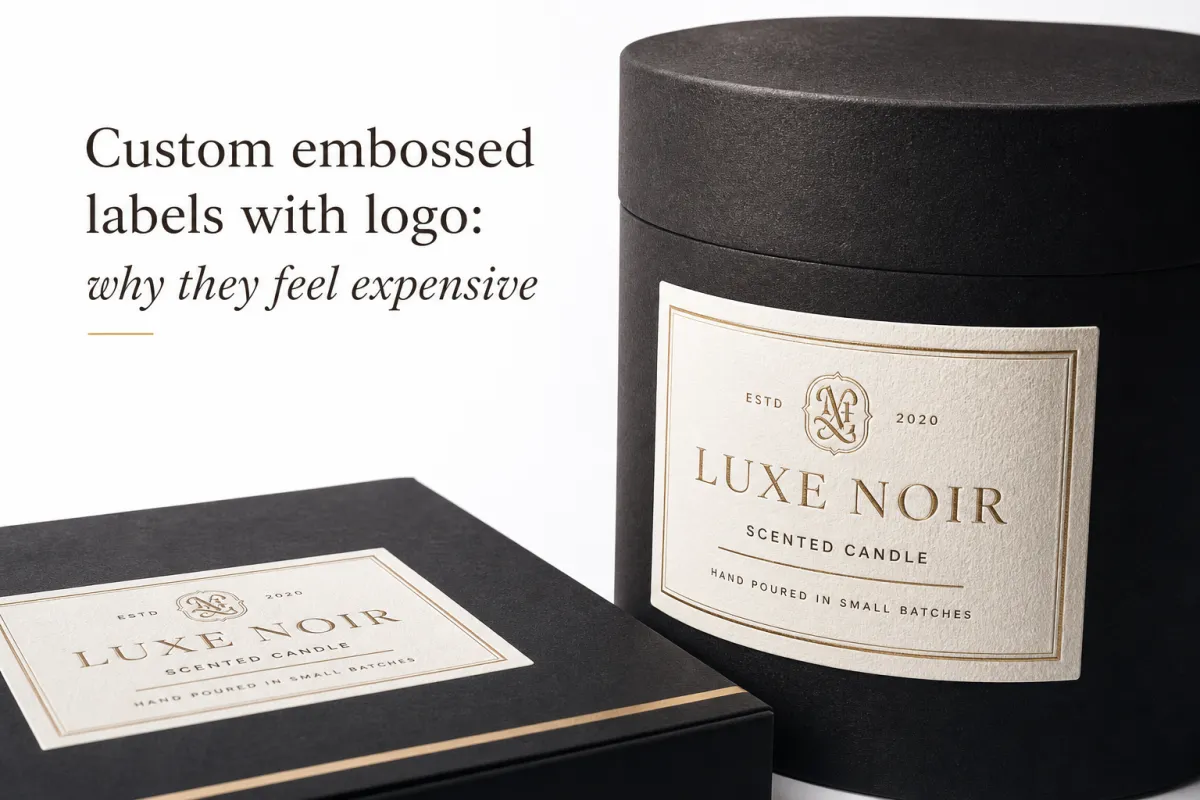
The reason custom embossed labels with logo feel expensive is not complicated. The surface gives both the eye and the hand something to pause on. A lot of brands spend heavily on print coverage and still end up with packaging that looks busy but forgettable. A crowded label can look like effort. A raised logo often looks like confidence.
Light does some of the work too. Even a shallow emboss catches a fine shadow around the logo edge, and that tiny shift makes the mark visible from angles that flat ink never really reaches. In a retail setting, that matters. A person scanning a shelf may not read every line of copy, but their fingers will notice a crisp raised detail almost immediately once they pick up the package.
Custom embossed labels with logo fit naturally on premium food jars, perfumes, candles, craft spirits, subscription gifts, and limited-run product packaging where the goal is to feel deliberate without shouting for attention. They also work well on custom printed boxes that need a little more texture but not another round of foil and graphic density just to signal quality.
For buyers who like direct production language, embossing is a mechanical forming process. The label stock is shaped between matched tooling so the logo sits above the surrounding field. Debossing does the opposite. Foil stamping adds a separate layer of reflectivity. The strongest version of custom embossed labels with logo usually keeps the design simple enough that the tactile element carries the premium feel.
That is where many projects drift off course. Teams assume premium means more decoration, when the better answer is often fewer elements, cleaner spacing, and tighter control of texture. A restrained raised symbol on a matte stock can outshine a full-color layout that is trying to speak too loudly.
Raised detail also gives a brand cue that is hard to fake with a bargain print run. The texture suggests an intentional production step, and buyers register that difference even if they cannot describe it in technical terms. That is one reason custom embossed labels with logo keep showing up in categories where shelf presence needs to feel calm, not flashy.
How custom embossed labels with logo are made, step by step
The production path for custom embossed labels with logo is not complex, but it rewards suppliers who actually pay attention to detail. Artwork review comes first. The supplier checks line weight, type size, spacing, and whether the logo can survive a raised impression without turning soft or muddy. After that, a die or embossing tool is made to match the approved shape.
Once the tooling is ready, the label stock goes to press and the logo is formed into the material. Depending on the build, that may happen before printing, after printing, or on a separate finishing pass. The order matters because inks, coatings, and laminations respond differently under pressure. A plain raised paper label and a film label with a surface coating are not treated the same way.
For custom embossed labels with logo, the material choice drives a large part of the outcome. Paper stocks can hold a clean edge and deliver a classic premium look, especially on dry goods. Film and coated stocks are better for moisture, handling, or curved containers. Fine detail behaves differently on each substrate, so the tool depth and pressure need to match the stock, not just the mockup.
Good suppliers should proof the logo for sharpness, edge definition, and consistency across the design. They should also flag thin strokes, tiny counters, and small text that may fill in during embossing. If that warning never comes up, the team is either inexperienced or overly optimistic, and neither one helps once production starts.
Typical production checks include:
- Logo edge crispness under raking light
- Raised depth consistency across the run
- Adhesive performance after pressure and handling
- Registration between print, foil, and emboss areas
- Whether fine lines still read cleanly at arm's length
That last point is where many custom embossed labels with logo projects lose clarity. Artwork that looks perfect on a screen can break down once the press adds force. Thin script fonts, crowded icons, and tiny outlines often look clever in a proof and weak in production. In packaging, clarity usually wins more often than cleverness.
If the product will travel through rough distribution, ask for a transport test or at least a distribution-style review aligned with ISTA methods. A label that survives the press but scuffs on the way to market is not a win. It is just future rework, and nobody wants that kind of surprise.
Custom embossed labels with logo also need a clean inspection step at the end. The supplier should verify that the raised areas stay sharp after trimming, that adhesive edges remain down, and that the finished labels match the approved proof. Shortcuts here usually show up later as curled corners, crushed detail, or cartons that vary from one case to the next.
Key factors that change texture, depth, and durability
The look of custom embossed labels with logo depends on much more than the emboss die. Material thickness, stock coating, emboss depth, adhesive strength, and the shape of the surface all affect whether the final piece feels crisp or sloppy. I have seen plenty of buyers blame the press for a result that really started with the wrong stock.
Start with the substrate. Paper is usually the easiest path to sharp detail and a classic luxury feel, especially on dry products or gift packaging. Coated paper often holds cleaner edges than uncoated sheets because the surface resists fiber crush a little better. Film is the safer choice when the label has to handle condensation, light abrasion, or repeated handling. For custom embossed labels with logo, the wrong stock can flatten good artwork fast.
Then look at emboss depth. More depth is not automatically better. A heavy press can distort fine letters, weaken adhesive contact around the raised area, and create a look that feels overworked instead of premium. The strongest raised effect is often subtle enough that people notice it when light hits the label, then feel it when they pick up the pack.
Finish changes the read as well. Matte stock usually makes embossing feel more refined because the shadow contrast shows clearly. Gloss can look sharp in some categories, though it may hide the raised detail unless the design is strong. Soft-touch adds a velvety feel, though it can mute fine texture if the emboss is too shallow. Foil and spot varnish can pair well with custom embossed labels with logo, but each extra finish increases alignment risk.
Adhesive choice matters more than many people expect. Cold bottles, chilled jars, coated cartons, and textured boxes all demand a bond that matches the actual surface and storage environment. A label that lifts at the edge makes the embossed logo feel cheap, even if the die work was excellent.
Surface shape is another real constraint. Flat boards are simple. Curved bottles are not. Small radii, shoulder transitions, and textured glass can all change how pressure sits on the label. That is why a polished mockup is not enough. Custom embossed labels with logo should be tested on the actual container, not just approved as a nice PDF.
Storage and handling matter too. If the product sits in a humid warehouse, gets wiped during retail setup, or stacks tightly in shipper cartons, the emboss can soften or scuff. For paper stocks, ask whether the source is FSC-certified if that claim matters to your brand; you can verify chain-of-custody expectations through FSC and then confirm the specific stock with the supplier.
One more practical point: if the logo is very small, adding more depth will not solve the legibility problem. It will only make a small bad shape into a deeper small bad shape. Better artwork, not more pressure, is usually the answer for custom embossed labels with logo.
Custom embossed labels with logo pricing, MOQ, and quote basics
Pricing for custom embossed labels with logo usually comes down to five things: tooling, material, quantity, finishing, and inspection. Artwork itself is rarely the biggest cost driver unless the design is unusually complex. If a quote sounds unusually low and the setup details are vague, the expensive part is probably hiding somewhere else.
Tooling is the first major variable. A custom emboss die or matched tool can be modest on a simple job and much higher when the design is detailed or multi-level. Material is next. Standard paper usually costs less than film or specialty stocks. Foil, spot varnish, and extra proof rounds all add to the total.
For practical planning, small runs carry a heavier setup burden. A 1,000-piece order can cost much more per label than a 10,000-piece order, even when the print spec looks similar. The unit price falls as tooling gets spread over more pieces. That is not a trick. It is the math behind production.
Here is a useful range buyers can use as a starting point, assuming a standard label size and no unusual supply-chain disruptions:
| Build | Typical MOQ | Setup / tooling | Typical unit cost | Best fit |
|---|---|---|---|---|
| Paper label with simple emboss | 1,000-2,500 pcs | $75-$250 | $0.12-$0.24 | Dry goods, gift packaging, clean premium look |
| Coated paper or film with emboss | 2,500-5,000 pcs | $120-$350 | $0.18-$0.38 | Curved bottles, handling, light moisture exposure |
| Foil + emboss premium build | 2,500-10,000 pcs | $150-$500+ | $0.25-$0.60 | Spirits, cosmetics, luxury retail packaging |
| Complex custom shape or multi-level detail | 5,000+ pcs | $250-$700+ | $0.30-$0.80 | High-impact launches, hero SKUs, collector runs |
Those numbers are a working range, not a promise. A narrow logo with limited coverage may land below the middle of the range. A heavy foil field, specialty stock, or extra inspection can push things up quickly. For custom embossed labels with logo, the quote should always separate tooling, sample fees, production, and freight so the cost structure stays visible.
MOQ is another point buyers often misunderstand. Some vendors quote low quantities because they run digital or short-run equipment. Others insist on higher minimums because emboss setup is not worth it on a tiny order. Both models can be valid. The better question is whether the vendor's MOQ fits your launch risk.
If the product is still experimental, I would rather pay a slightly higher unit cost on a small test run than lock into a large quantity before the shelf read is proven. If the SKU is already selling, a larger run usually makes more sense because it lowers the unit cost and improves consistency across the line. That matters even more for custom embossed labels with logo used across several product packaging sizes.
Custom embossed labels with logo process, timeline, and turnaround
A realistic timeline for custom embossed labels with logo starts with the brief, not the press. The supplier needs final artwork, size, container details, finish choices, and target quantity before they can make a proof that actually helps. If those details keep changing, everything else slips.
For a first order, the normal flow looks like this:
- Artwork review and print check
- Proof and revision round
- Tooling or die creation
- Sample production and approval
- Full production run
- Inspection, packing, and shipment
On a clean job, the first round often takes about 12-20 business days after proof approval, depending on tooling complexity, substrate availability, and whether foil or extra finishing is involved. Repeat orders are usually faster, sometimes 5-10 business days, because the die already exists and the artwork is locked. With custom embossed labels with logo, the first order is naturally slower than the reorder. That is normal, not a warning sign.
The biggest delay is usually not machine time. It is approval time. Buyers send revised copy late, marketing changes the logo size, compliance text gets missed, and a simple job needs another proof. None of that is unusual. It just means the schedule was too tight from the start.
Rush orders can happen, but they are not free. Faster turnaround often means higher cost, fewer revision rounds, and less room for sample testing. I would only use a rush spec if the artwork is locked and the container is already approved. If not, you are paying to create problems faster.
For launch planning, leave room for at least one sample round and one correction round if the package is new. Custom embossed labels with logo look strongest when the supplier has time to check edge quality, pressure depth, and adhesive behavior on the actual container. That extra week or two is cheaper than reprinting a bad batch.
Common mistakes that ruin embossed label results
The most common failure with custom embossed labels with logo is simple: the artwork is too detailed to emboss cleanly. Thin lines, tiny type, and crowded icons look fine on a monitor and then fall apart once pressure and material texture enter the picture. The more fragile the design, the more likely it is to lose definition.
Picking the wrong adhesive is another classic mistake. Chilled bottles, textured boxes, glass, and coated cartons all behave differently. A label that holds on one surface may fail on another. If your product spends time in cold storage or humid transport, the adhesive spec matters as much as the emboss itself.
Overdoing the depth is another easy way to make a premium label look clumsy. A heavy emboss on thin stock can crush the surface, distort the logo, and create an uneven feel under the fingers. Custom embossed labels with logo should feel controlled. If the effect is shouting, it is probably too much.
Skipping samples is risky. A digital mockup cannot show pressure, fiber crush, adhesive behavior, or how lighting changes the final read. What looks elegant on screen can turn awkward in hand. Buyers who skip physical samples often end up paying for the privilege of being surprised.
Application errors can ruin good labels too. Misaligned placement, dust on the surface, worn application equipment, and poor carton storage all make the final pack look cheaper than it is. Even well-made custom embossed labels with logo can appear inconsistent if the field application process is sloppy.
Here are the mistakes I would watch first:
- Logo lines thinner than the press can hold
- Too many small text blocks near the emboss area
- Stock choice that cannot support the desired depth
- Adhesive chosen without testing the real container surface
- Approval based only on screen proofs
- Poor storage before application
Packaging teams do better when they check the whole chain instead of only the artwork. The label, bottle, box, and shipping method all affect the result. A clean emboss on a bad carton is still a bad customer experience, and that is the part brand teams can miss when launch pressure starts climbing.
Expert tips and next steps before you order
If you are buying custom embossed labels with logo for the first time, start with one hero SKU. Not the whole line. Not six variations. One product, one logo lockup, one material choice, one finish. That gives you a real read on texture, color, and handling without spreading the budget thin across too many experiments.
Ask for a sample that shows the label under actual lighting, not just under a camera flash. Raised detail behaves differently under bright retail light, soft warehouse light, and daylight. A label that looks rich on a monitor may disappear on shelf if the shadow contrast is too weak.
Choose artwork with strong outlines and enough negative space. Custom embossed labels with logo need room to breathe. When the logo has clean edges and a simple shape, the raised effect stays sharper and reads better from a short distance. That matters more than complicated decoration that most shoppers will never study.
Get the quote broken out. Ask for tooling, sample fees, production cost, shipping, and any reprint policy as separate lines. That gives you a fair comparison across vendors instead of chasing the lowest unit price like a bargain hunter in a warehouse aisle. Cheap quotes often hide expensive surprises.
It also helps to connect the label choice to the rest of the package. If your brand is building a full set of branded packaging, compare the label plan against the carton structure, carton print, and outer shipper. A raised logo on the label may need a quieter box, or the box may need to carry more of the visual load. Balance matters in package branding.
That is why I usually tell buyers to think beyond the label itself. If the product already sits in custom printed boxes, the label should reinforce the same visual language instead of competing with it. If the container is simple, custom embossed labels with logo can carry more of the premium load on their own. Either way, the spec should be deliberate, tested, and tied to the job the packaging actually has to do.
For more packaging structure ideas and supporting components, review Custom Packaging Products and compare them with Custom Labels & Tags before you lock the final brief. The strongest buying decisions usually come from seeing the full package, not one shiny feature in isolation.
If you want a practical rule, use this: pay for custom embossed labels with logo when touch, shelf presence, and premium perception matter enough to influence conversion. Skip them when the design is already crowded, the container is unstable, or the budget cannot support a clean sample-and-approval cycle. Good packaging is not about doing everything. It is about doing the right few things well.
FAQ
What materials work best for custom embossed labels with logo?
Paper works well for dry products and shorter production runs where crisp detail matters more than heavy abuse. Film or coated stocks are better for moisture, refrigeration, handling, or curved surfaces that need more durability. The right choice depends on the container finish, storage conditions, and how much raised detail the logo needs to hold. For many buyers, custom embossed labels with logo start with paper, then move to coated or film once the application needs more toughness.
Are embossed logo labels durable on bottles and boxes?
Yes, if the substrate and adhesive match the surface and the emboss depth stays within sensible production limits. For bottles, test for moisture, condensation, and rubbing. For boxes, test for scuffing, stacking pressure, and corner wear. Durability is usually more about material choice and adhesive performance than the emboss itself. In other words, custom embossed labels with logo can be very durable, but only when the spec is matched to the actual job.
What affects the price of custom embossed labels with logo most?
Tooling, material choice, quantity, and finishing details usually move the price more than the artwork itself. Small orders tend to cost more per label because setup fees are spread across fewer units. Adding foil, specialty stock, or extra proof rounds can raise the quote quickly. If you want a tighter number, ask suppliers to separate tooling from production on custom embossed labels with logo so you can see the real cost drivers.
How long does it take to produce custom embossed labels with logo?
First orders usually take longer because they need artwork review, tooling, sampling, and approval before production starts. Repeat orders are faster if the die already exists and the artwork does not need changes. Fast turnaround is possible, but only when the spec is locked and approvals are immediate. For launch planning, I would still leave room for one sample round on custom embossed labels with logo so the finished piece is not a surprise.
Can custom embossed labels with logo include foil or color?
Yes, embossing can be combined with foil stamping, printed color, or spot varnish for a layered premium look. The tradeoff is complexity: every added finish can increase cost, lead time, and the chance of alignment issues. If the logo is already strong in raised form, keep color and foil deliberate instead of piling on effects for no reason. The cleanest custom embossed labels with logo often use one tactile idea and one supporting finish, not four competing ones.

