Buyer Fit Snapshot
| Best fit | Custom Food Labels With Logo projects where brand print, material claims, artwork control, MOQ, and repeat-order consistency need to be specified before quoting. |
|---|---|
| Quote inputs | Share finished size, material target, print colors, finish, packing count, annual reorder estimate, ship-to region, and any compliance wording. |
| Proofing check | Approve dieline scale, logo placement, barcode or warning zones, color tolerance, closure strength, and carton packing before bulk production. |
| Main risk | Vague material claims, crowded artwork, missing packing details, or unclear freight terms can make a low unit price expensive after revisions. |
Fast answer: Custom Food Labels With Logo: Design, Cost, and Process should be specified like a repeatable production item. The safest quote records material, print method, finish, artwork proof, packing count, and reorder notes in one written spec.
Production checks before approval
Compare the actual filled-product size with the drawing, then confirm tolerance on folds, seals, hang holes, label areas, and retail display edges. Reserve space for logos, QR codes, warning copy, and material claims before decorative graphics fill the panel.
Quote comparison points
Review material grade, print process, finish, sampling route, tooling charges, carton quantity, and freight assumptions side by side. A quote is only useful when the supplier can repeat the same color, closure quality, and packing count on the next order.
Custom Food Labels With Logo: Design, Cost, and Process
Two jars can hold nearly the same recipe and still move very differently off the shelf, and custom food labels with logo often decide that outcome before a shopper reads a single ingredient. On a crowded aisle, in a refrigerated case, or beside a stack of pouches at a market table, the label is the first piece of branding a buyer actually sees up close. That is why custom food labels with logo deserve real planning instead of a quick artwork upload.
A label is not just decoration. It carries product identification, supports package branding, and often becomes the difference between a launch that feels finished and a package that looks improvised. A good custom food labels with logo setup needs to look clean, but it also has to survive moisture, refrigeration, oils, handling, shipping friction, and the ordinary wear of people opening, closing, and stacking food containers. That balance between appearance and performance is where smart packaging design starts paying for itself.
If you are building a new SKU, refreshing a private label line, or updating retail packaging for a seasonal product, the real question is not whether the logo belongs on the label. The real question is which material, adhesive, finish, and workflow will keep the label looking right from production through purchase. That is the difference between a label that simply exists and custom food labels with logo that actually support the sale.
Why Custom Food Labels With Logo Can Change Shelf Appeal Fast
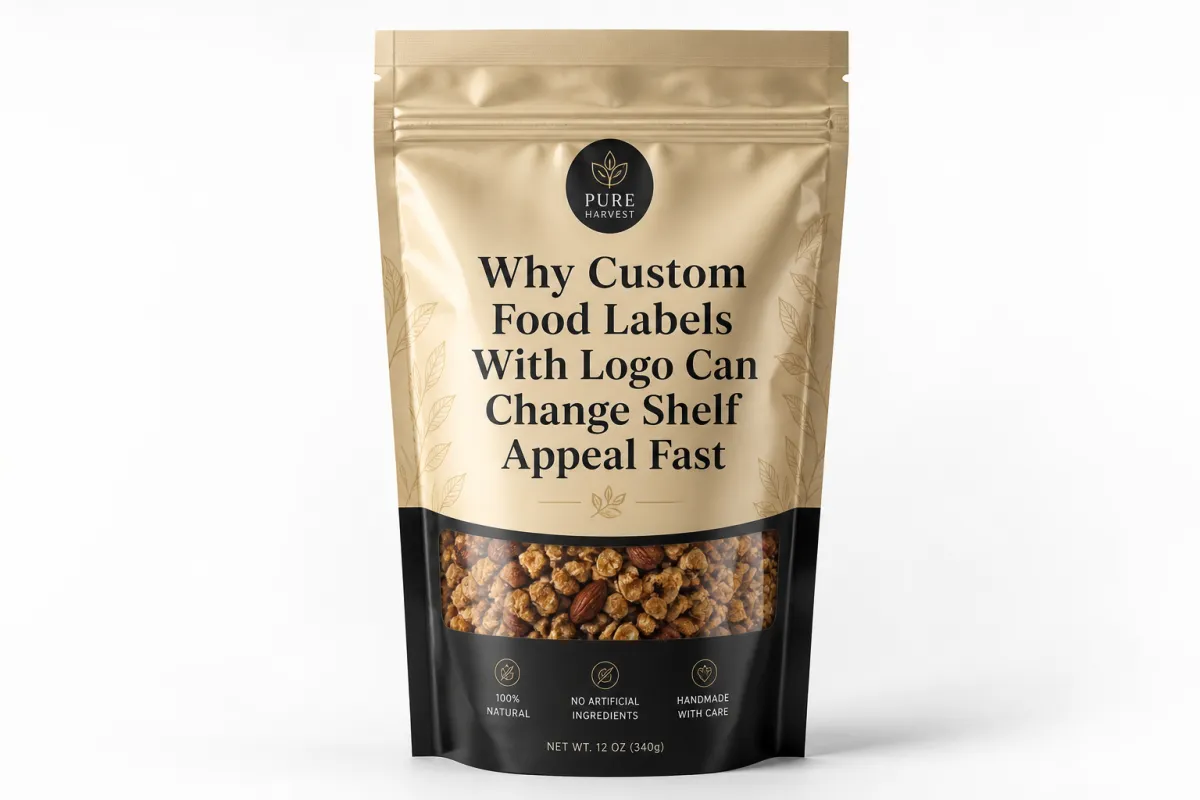
Walk down almost any grocery aisle and the pattern shows up right away: products with similar ingredients, similar sizes, and often similar prices, yet one package feels more trustworthy, more premium, or more organized than the rest. Custom food labels with logo are usually doing that work. A shopper gives a package a second or two, sometimes less, and the label has to answer the obvious questions quickly: What is it? Who made it? Does it feel safe, polished, and worth the price?
That pressure gets stronger in refrigerated displays, where condensation, cold glass, and tightly packed SKUs create visual noise. A well-planned custom food labels with logo layout creates instant recognition, while a weak one disappears into the background. I’ve seen brands spend heavily on the recipe and the container, then underinvest in the label, only to find that the package still reads as generic because the visual hierarchy never got a clear structure.
From a buyer’s point of view, the logo does not need to shout, but it does need to anchor the design. Good custom food labels with logo use the logo to build memory: the shopper sees it once, then recognizes it again in the store, online, or on a delivery shelf. That matters across product packaging categories, whether the product is a sauce, granola, dry good, frozen item, or deli-style tub.
There is also a practical advantage that gets missed. A clear label structure helps staff, distributors, and customers identify flavors and variants quickly. In a busy kitchen, on a pallet, or in a refrigerator door, that speed cuts down on mistakes. For brands selling through multiple channels, custom food labels with logo can also create a steady bridge between retail packaging, e-commerce images, and supporting materials like Custom Labels & Tags or broader Custom Packaging Products.
A label has two jobs: sell the product in a split second, then keep working after the product gets cold, wet, handled, and moved around.
The strongest custom food labels with logo do not need flash to be effective. In many cases, a clean hierarchy, readable type, strong color contrast, and enough white space will outperform a crowded design with too many effects. That is one reason premium food brands tend to use disciplined branding packaging systems instead of trying to squeeze every message onto the front panel.
For brands that also use custom printed boxes, the label should feel like part of the same family, not a detached afterthought. When the box, label, and container speak the same visual language, the whole product line feels more intentional. That is how custom food labels with logo become part of a broader package system rather than a one-off purchase.
Custom Food Labels With Logo: Process, Timeline, and Lead Time
The production path for custom food labels with logo usually follows a predictable pattern, even if the details vary from supplier to supplier. It starts with a packaging brief, moves through artwork setup and proofing, then into printing, finishing, packing, and shipping. The smoothest jobs are the ones where the customer already knows the container size, the storage environment, and the required copy before the first quote request goes out.
In real terms, the biggest time drain is rarely the press run itself. It is the review process. That includes die-line setup, copy checks, color correction, barcode placement, and approval of the digital proof or sample. If the label is new, or if the package has a tricky shape, the proof stage for custom food labels with logo can stretch longer than expected because the team needs to be sure the artwork wraps cleanly and the logo lands where the eye naturally goes.
Most straightforward digital jobs can move fairly quickly once the proof is approved. A simple roll label order may take about 7-10 business days after approval, while a more involved custom food labels with logo order with lamination, special adhesives, or multi-version artwork may need 12-18 business days or more. If the order needs cold-chain testing, sample rolls, or repeated revisions, extra cushion is wise. The calendar should include review time, not just press time.
There is a meaningful difference between production time and total lead time. Production time is what happens on the press. Lead time includes the back-and-forth before the press ever starts. That difference matters because many packaging delays are self-inflicted: missing logo files, unclear ingredient copy, a barcode that was never checked, or a size mismatch that shows up only after the proof. Good custom food labels with logo orders account for those steps early.
It also helps to think about the label in the context of the full packaging system. If the same launch also needs branded cartons, display packs, or a short run of custom printed boxes, planning those orders together can cut down on handoff delays. A label supplier can coordinate better when the custom food labels with logo brief clearly states launch date, storage conditions, application method, and any downstream packaging milestones.
One of the best habits is to treat the proof like a production document, not a casual preview. Check spelling, check unit measure, check net weight placement, check barcode quiet zones, check allergen language, and check that the logo sits at the right visual weight. That level of review is tedious, but it saves money. A reprint on custom food labels with logo is almost always more expensive than a careful proof pass.
If distribution testing is part of the job, standards from organizations such as ISTA can be useful because labels sometimes fail in transit for reasons that have nothing to do with print quality. If the package will move through recyclable paper-based systems or you are evaluating sustainability claims, the FSC certification framework is worth understanding too. Those references do not replace supplier testing, but they give the conversation more structure.
Custom Food Labels With Logo Cost, Pricing, MOQ, and Quote Factors
Price is one of the first questions buyers ask about custom food labels with logo, and it should be. The tricky part is that label pricing is never only about size. A small label with a complex finish can cost more than a larger plain one, especially if the job calls for specialty ink, white ink underprint, a unique die cut, or a material that behaves well in cold storage. The smart way to compare quotes is to understand the cost drivers before focusing on the final number.
The main variables are easy to name, but they interact in real ways. Size affects material usage. Quantity affects setup spread. Finish affects both appearance and durability. Quantity breaks matter because a lower run often carries a higher per-unit cost, while a larger run improves unit economics by spreading fixed setup costs across more pieces. That is true for custom food labels with logo just as it is for other branded packaging work.
Minimum order quantity, or MOQ, is another practical issue. Some digital programs can start as low as 250 to 500 labels, but many roll-label jobs are priced more efficiently at 1,000, 2,500, or 5,000 pieces. For a startup testing a new flavor, that can feel like a lot. For a private label program with stable demand, it is often manageable. The right MOQ for custom food labels with logo depends on how quickly the product moves and how often the artwork changes.
Freight and packaging can also be overlooked. A label roll may look cheap on paper, then end up more expensive after shipping, protective packing, or expedited delivery are added. If the labels are going into a launch window, ask whether the quoted number includes setup, proofing, finishing, and delivery conditions. Comparing apples to apples is the only fair way to compare custom food labels with logo quotes.
| Label Type | Typical Use | Indicative Unit Range | Notes |
|---|---|---|---|
| Paper roll labels | Dry goods, short-run jars, bakery packaging | $0.10-$0.22 at 5,000 units | Cost-effective, but less resistant to moisture and abrasion |
| BOPP film labels | Refrigerated items, sauces, tubs, pouches | $0.16-$0.30 at 5,000 units | Better moisture resistance and shelf durability |
| Clear film labels | Premium visibility on glass or plastic containers | $0.18-$0.34 at 5,000 units | Clean look, but needs strong artwork contrast |
| Laminated specialty labels | Freezer items, premium retail packaging, high handling | $0.22-$0.40+ at 5,000 units | Higher durability, often worth it for cold-chain use |
Those numbers are broad working ranges, not promises, because actual pricing depends on coverage, finish, and press method. Still, they help buyers see why a quote for custom food labels with logo can vary so much even when the artwork looks simple. A one-color logo on a paper stock with a standard adhesive may sit near the low end, while a full-color refrigerated label with matte lamination and specialty adhesive moves higher.
Another hidden cost is revision time. If a design arrives with low-resolution art, a missing barcode file, or copy that has to be reworked, the supplier spends time fixing the file instead of printing it. That may not always appear as a line item, but it still affects lead time and sometimes affects the quote. A clean artwork package makes custom food labels with logo more economical from the start.
For brands watching cash flow, it can help to simplify the label system. A standard shape, a consistent layout, and shared components across flavors can reduce die costs and keep production simpler. That is also why many companies coordinate label buying with broader retail packaging decisions instead of treating every SKU like a separate design exercise. The more consistent the system, the easier it is to expand later without losing control of cost.
Here is the practical rule I use: if two quotes for custom food labels with logo differ by a lot, ask what is missing. Often the lower number excludes proofing, finishing, or the adhesive needed for actual use conditions. That is how some buyers end up paying twice, once for the label and again for the reprint.
Materials, Adhesives, and Finishes That Matter on Food Packaging
The material is where custom food labels with logo either prove themselves or fall apart. Paper can work very well on dry goods and short-life items, but once moisture, refrigeration, or oily contact enters the picture, film-based materials often make more sense. Common choices include paper, polypropylene, and other durable films, with each one selected for a reason tied to the package environment rather than just the look of the print.
For a dry pantry item, a coated paper label may be perfectly appropriate and cost-efficient. For chilled jars, sauce bottles, or yogurt-style tubs, a BOPP or similar film face stock usually handles condensation better. For freezer storage, the label needs both a substrate and an adhesive that can hold in colder conditions without curling or lifting. That is why custom food labels with logo should always be matched to storage conditions, not just artwork style.
The adhesive matters just as much as the face stock. A permanent acrylic adhesive may work for many standard uses, but freezer-grade or moisture-tolerant adhesives are often a better fit for cold-chain packaging. Textured kraft pouches, ribbed containers, and lightly oily surfaces can change bond performance too. A label that looks fine in a mockup may fail on the actual package if the surface energy, temperature, or texture is wrong.
Finishes are the last layer of control. Gloss can sharpen color and make a label feel lively. Matte can soften the look and make type easier to read under bright lighting. Soft-touch adds a premium tactile feel, although it is not always the right choice for food packages that get handled often or exposed to condensation. Lamination, whether gloss or matte, adds another protective layer and helps custom food labels with logo survive abrasion, wiping, and cooler doors better than unprotected stock.
There is also a branding question hidden in the material choice. A beautiful logo printed on the wrong surface can lose its effect the moment the package sweats or the corner starts lifting. That is especially true in branded packaging programs, where the label is expected to carry the premium signal for the whole product. If the surface fails, the brand signal fails with it.
Below is a simple way to think about material selection for custom food labels with logo:
- Paper stock: Best for dry, low-moisture products and shorter handling cycles.
- BOPP or similar film: Best for chilled, wet, or frequently handled products.
- Clear film: Best when the package itself should show through and the logo can carry the design.
- Lamination: Best when you want added protection against scuffing and moisture.
- Special adhesive: Best when the container is cold, curved, textured, or exposed to oil.
From a package branding standpoint, the finish should support readability, not fight it. I have seen glossy labels look impressive under studio lighting but become hard to read under store LEDs because the reflectivity was too high. I have also seen matte labels win on the shelf because the type stayed crisp and the logo held its shape from a few feet away. That is why a real-world sample matters more than a screen render for custom food labels with logo.
Step-by-Step Guide to Ordering Custom Food Labels With Logo
The easiest way to order custom food labels with logo is to treat it like a packaging brief, not just a graphics task. Start by measuring the container carefully, because a label that is 1/8 inch too wide can wrap into a seam, overlap a curve, or wrinkle on application. Confirm whether the label is going on a jar, pouch, carton, clamshell, or bottle, because every substrate behaves differently.
Next, define the environment. Is the product shelf-stable, refrigerated, or frozen? Will it be wiped down? Will the label be applied by hand or by machine? These answers shape the label recommendation more than the logo does. For custom food labels with logo, the package format and use case decide whether the right path is paper stock, film, lamination, or a special adhesive.
After that, prepare artwork properly. Use vector files for the logo if possible, because they keep edges sharp at any size and make future revisions easier. Include final copy for product name, ingredients, allergens, net weight, barcode, and any other required text. A bad file slows the job, and a good file speeds up custom food labels with logo production because fewer corrections are needed.
Review the proof with a production mindset. Look at the artwork from the distance a shopper would actually use, not only at 100 percent zoom. Make sure the barcode scans cleanly, the type is readable, and the logo is positioned where the eye lands first. If the label has multiple flavors or variants, confirm the color naming system now so you do not confuse your own inventory later. That discipline helps both product packaging and retail packaging stay organized.
If your label program is tied to launch timing, work backward from the shelf date. Give yourself time for proof corrections, supplier queue time, and freight. A label order that arrives technically on time but two days after your filling run is still a miss. For custom food labels with logo, shipping and application planning are part of the order, not an afterthought.
A simple ordering checklist looks like this:
- Measure the package and confirm label placement.
- Document storage and handling conditions.
- Gather logo files, copy, barcode, and compliance text.
- Choose the label format: roll, sheet, front, side, or wrap.
- Request a quote with quantity and finish options.
- Review the proof line by line.
- Approve only after the label matches the container and the brand.
That checklist sounds basic, but it prevents the most common mistakes. It also makes communication with the supplier clearer, which helps them recommend the right custom food labels with logo solution the first time rather than after a round of revisions.
One more point matters here: keep a master brand file. If the logo exists only as a low-resolution image inside a brochure PDF, future packaging changes will be painful. A clean vector master file supports not only custom food labels with logo, but also future custom printed boxes, insert cards, and broader package branding updates.
Common Mistakes With Custom Food Labels With Logo
The most common mistake with custom food labels with logo is choosing the material for looks alone. A label can look elegant on a screen and still fail in a refrigerated display. Paper may be fine for some applications, but if the product faces condensation, freezer storage, or constant handling, the label needs a material and adhesive combination that matches the real environment.
Another mistake is letting the logo dominate so much that the rest of the label becomes hard to read. Strong branding matters, but food packaging still has to communicate clearly. If the product name, net weight, ingredients, or barcode gets squeezed into a cramped layout, the label may look busy and perform poorly as custom food labels with logo and as compliant packaging. Good design balances brand impact with information hierarchy.
Dimension errors are common too. A mockup can hide the fact that the label will wrinkle around a curve, overlap a seam, or land too close to a cap or closure. This happens a lot with jars, ribbed tubs, and flexible pouches. The fix is simple but easy to skip: measure the real package, not the brochure dimensions. For custom food labels with logo, fit is just as important as color.
Skipping proof review is another expensive habit. A misspelled ingredient, a low-contrast barcode, or a logo cropped too tightly can force a reprint. That is frustrating on any packaging project, but especially painful on a launch with inventory already scheduled. A careful proof pass on custom food labels with logo costs far less than redoing an entire order.
There is also an application mistake that gets overlooked. Labels applied to wet bottles, cold jars, or textured containers need more thought than labels applied to a dry carton. Surface prep, temperature, and pressure all matter. If a label starts lifting at the corner, the customer does not blame the adhesive chemistry. They blame the brand. That is why the application environment is part of the custom food labels with logo decision.
The label should survive the shelf, the cooler, the warehouse, and the customer’s hands before it tries to impress anyone.
Brands also underestimate how much consistency matters across a line. If each flavor uses a different type family, a different layout, and a different color logic, the system starts to feel fragmented. That weakens package branding and makes inventory harder to manage. A more disciplined approach to custom food labels with logo usually looks better and scales better.
Expert Tips and Next Steps for Launching Custom Food Labels With Logo
If you want a smoother launch, start with one strong packaging brief and use it for every quote request. Include size, material preference, finish, quantity, storage condition, and launch date in a single document. That gives the supplier a clean view of the job and makes custom food labels with logo pricing more accurate from the start. It also reduces the back-and-forth that slows artwork approvals.
Another practical move is to request a sample roll or small proof run if the package is new. That matters most when the label is going on a curved jar, a chilled bottle, a slick laminated pouch, or any other surface that may challenge adhesion. A sample can reveal problems that a digital proof never will. For custom food labels with logo, the sample stage is where many avoidable surprises get caught.
Keep your logo master file in vector format and store the correct brand colors in one place. That sounds simple, but it saves time every time a new flavor or season appears. It also protects consistency across custom food labels with logo, custom printed boxes, sell sheets, and other branded materials. A stable visual system makes future product packaging faster to launch and easier to control.
It is also smart to standardize the label architecture. If the front panel always follows the same hierarchy, if the side panel always carries the same compliance structure, and if the same stock and finish are used across the line, production becomes more predictable. That kind of standardization is not flashy, but it is what helps growing brands keep costs under control without weakening the design.
For brands that sell across multiple channels, consistent custom food labels with logo can support both shelf presence and online photography. That matters more than people think. A package that photographs well often looks clearer in person too, because the color balance, contrast, and type sizing were chosen carefully. That is a real advantage in retail packaging, especially when the same product also appears in email campaigns or marketplace listings.
Before you place the order, compare the quote against the actual use case. Ask yourself: will this label face cold storage, moisture, oil, friction, or long dwell time on shelf? Does the adhesive suit the container? Does the finish support readability? Does the run quantity justify a more durable material? Answering those questions makes custom food labels with logo a better business decision, not just a nicer-looking one.
If your brand is expanding into a wider packaging system, coordinate the label program with other pieces of product packaging and branding packaging so the look stays coherent. A smart system can make future launch work easier, whether that means private label extensions, seasonal varieties, or a new set of Custom Labels & Tags for a different container style.
Final Takeaway on Custom Food Labels With Logo
Custom food labels with logo are one of the most practical places to invest in packaging because they influence shelf appeal, information clarity, and product confidence all at once. They are not a finishing touch. They are part of the packaging structure itself, and the best results happen when design, material, adhesive, and production planning are all aligned from the beginning.
If you remember only one thing, make it this: the cheapest label is not always the least expensive label, and the prettiest label is not always the best performing one. A good custom food labels with logo choice protects the brand, supports the package, and holds up in the real conditions the product will face. That is the standard worth aiming for, and it is usually the difference between a label that just looks nice and one that actually earns its keep.
So the practical next step is simple: start with the container, define the storage environment, then choose the material and adhesive from there. That order keeps the decision grounded in how the product will really be used, which is how you avoid the usual guesswork and get a label that works from day one.
FAQ
What do I need to order custom food labels with logo for a new product?
Have the container size, label dimensions, logo file, product name, ingredient copy, net weight, barcode, and any required compliance text ready before requesting a quote. If possible, include storage conditions such as refrigerated, frozen, or room temperature, because those details affect material and adhesive recommendations. A clear packaging brief helps reduce proof revisions and makes pricing more accurate from the start for custom food labels with logo.
Which label material works best for custom food labels with logo on refrigerated items?
Refrigerated items usually need a moisture-resistant face stock and an adhesive that can bond well to cool, sometimes slightly damp surfaces. Film materials and protective finishes are often preferred when condensation, abrasion, or ice exposure could damage a paper label. The best choice depends on the container surface, the amount of handling, and how long the product will sit in cold storage, so custom food labels with logo should always be matched to the real use environment.
How long does it usually take to produce custom food labels with logo?
Timeline depends on proof approval, quantity, material availability, finishing, and whether the design needs special testing or revisions. Fast orders move quickly only when artwork is print-ready and all details are confirmed early in the process. If the label is new or requires custom adhesives, build in extra time for review and sampling, since custom food labels with logo often slow down at the proof stage rather than on press.
Do custom food labels with logo have a minimum order quantity?
Many label programs have an MOQ because setup, proofing, and press preparation create fixed costs that must be spread across the run. Smaller orders are often possible, but the unit price may be higher than larger production quantities. If you are launching a test batch or seasonal item, ask for options that balance flexibility with cost efficiency for custom food labels with logo.
How can I lower the cost of custom food labels with logo without hurting quality?
Keep the size efficient, simplify finishing, and avoid unnecessary specialty effects unless they support the product's positioning. Use a consistent label layout across multiple flavors or SKUs so setup stays streamlined and production can run more predictably. Ask for a quote comparison across materials and quantities, then choose the option that meets both performance and branding needs. That approach usually lowers the true cost of custom food labels with logo without weakening shelf appeal.

