Buyer Fit Snapshot
| Best fit | Custom Embossed Packaging Boxes projects where brand print, material claims, artwork control, MOQ, and repeat-order consistency need to be specified before quoting. |
|---|---|
| Quote inputs | Share finished size, material target, print colors, finish, packing count, annual reorder estimate, ship-to region, and any compliance wording. |
| Proofing check | Approve dieline scale, logo placement, barcode or warning zones, color tolerance, closure strength, and carton packing before bulk production. |
| Main risk | Vague material claims, crowded artwork, missing packing details, or unclear freight terms can make a low unit price expensive after revisions. |
Fast answer: Custom Embossed Packaging Boxes: Design, Cost, and Use should be specified like a repeatable production item. The safest quote records material, print method, finish, artwork proof, packing count, and reorder notes in one written spec.
Production checks before approval
Compare the actual filled-product size with the drawing, then confirm tolerance on folds, seals, hang holes, label areas, and retail display edges. Reserve space for logos, QR codes, warning copy, and material claims before decorative graphics fill the panel.
Quote comparison points
Review material grade, print process, finish, sampling route, tooling charges, carton quantity, and freight assumptions side by side. A quote is only useful when the supplier can repeat the same color, closure quality, and packing count on the next order.
Custom Embossed Packaging Boxes: Design, Cost, and Use
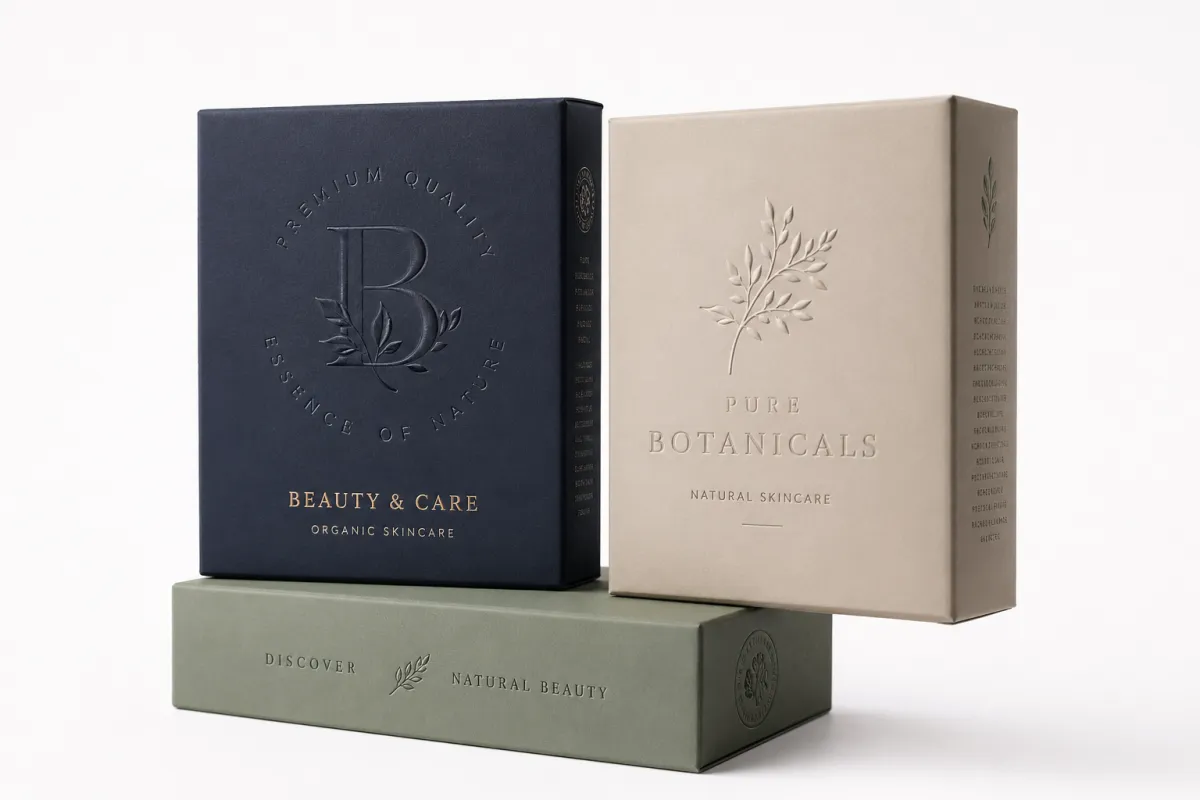
Custom Embossed Packaging boxes do one thing flat print cannot. They slow the hand down. The raised detail catches light, then catches fingertips, and that tiny interruption changes how the box gets read. Sometimes that pause is the whole point. People do not always remember the color. They remember how the carton felt before they opened it.
That is why custom embossed packaging boxes are not just a vanity upgrade for brands with extra budget and too much time. They shape first impressions, signal price position, and give the product a tactile cue that sticks around longer than another glossy mockup. If the packaging feels considered, buyers usually assume the product inside was considered too. That assumption carries a lot of weight.
This page breaks down what custom embossed packaging boxes are, how they get made, what changes the price, where projects go sideways, and how to keep the result sharp without burning money on avoidable revisions. You will get practical numbers, production steps, and a few hard-earned rules that save time. No fluff. Nobody needs more fluff.
If your work sits in product packaging for luxury retail, beauty, gifting, specialty food, or premium apparel, these decisions map directly to real buying behavior. Smaller technical projects still benefit from the same logic. Tooling, board behavior, finish compatibility, and production discipline all shape the final outcome. If you need tactile packaging that feels controlled instead of chaotic, this is the lane.
What do custom embossed packaging boxes do for a brand?
People like to pretend texture is a minor detail. It is not. Texture changes how a box is read before anyone notices the copy. Raised elements create status without shouting. They make the surface feel more expensive, even before the product has proven anything.
Here is the plain version. Embossing is a physical process where a die presses into paperboard and lifts part of the design above the surface. The result can be soft and restrained, or more dramatic with deeper shadow lines and sharper edges. The design looks elevated because it literally is. That is the point. No digital effect can fake the hand feel.
Custom embossed packaging boxes matter most in categories where the package carries part of the sales message. Luxury retail uses them to suggest craft. Beauty brands use them to create a premium context. Gift boxes gain ceremony from them. Specialty food packaging can look more credible on a crowded shelf. Premium apparel often uses a tactile crest or seal to separate itself from ordinary mailer boxes. In every case, the raised surface reinforces what your branded packaging is already saying.
They also help with shelf presence. A flat carton can disappear. Custom embossed packaging boxes create a small physical event, which is exactly what a premium unboxing moment needs. The box gives people a reason to touch it, and touch is where confidence starts.
Not decoration alone: an intentional communication layer
Good design teams do not treat embossing as frosting. They treat it like a second voice in the brand system. A logo, nameplate, or icon can become the focal point because the raised texture gives it authority. Stack too many elements around it and the effect gets muddy fast. The box starts talking too much. Nobody needs that.
Simple package branding systems usually work better with embossing than busy ones. A single emblem on a quiet field tends to read more premium than a crowded sleeve covered in borders, foil, gradients, and microscopic type. If a hand lands on your carton, what should it feel first? Usually the answer should be obvious. That is where custom embossed packaging boxes do their best work.
How buyers perceive the same design differently
Texture changes the buying path from the buyer's side too. A matte label can look premium from a distance. Add embossing and the box becomes discoverable in hand. That matters in retail, trade shows, and any setting where light shifts constantly. The eye notices movement. The fingers notice depth.
For ecommerce and mail-order fulfillment, embossed detail also helps during inspection. Quality teams can feel whether the box matches the approved sample. That reduces the risk of the package arriving with the wrong tone, which is a real problem and not a theoretical one.
Here is the working rule: if your goal is trust and a serious gifting feel, use restrained embossing and keep the copy disciplined. If your goal is energy and surprise, go bolder on depth and keep the palette simpler. That tension is where custom embossed packaging boxes earn their keep. And yes, sometimes the simplest box is the one that looks most expensive. Annoying, but true.
“A high-end box is not about stacking every effect you can afford. It is about choosing the one effect people remember after they throw the tissue paper away.”
For teams building Custom Printed Boxes, the memory hook is often the logo panel, the flap edge, or a signature emblem. Those are usually the best places for custom embossed packaging boxes too. The same logic applies to premium packaging and other high-touch formats. If the raised detail lives where the hand naturally lands, it will earn its keep faster.
How Custom Embossed Packaging Boxes Are Made
Embossing is not one neat step. It is a chain. Miss one link and the rest starts wobbling. I see this happen when teams push proofing late and hope the press will rescue the project. It will not. A press is not a magician. It is a machine with opinions, and those opinions are shaped by the tooling and the board.
When custom embossed packaging boxes are built well, the sequence is boring in the best way. Files are clean, tooling is accurate, and the press does not have to guess. That is the difference between a nice sample and a production run that behaves.
1) Artwork prep
Everything starts with the files. Good artwork prep separates structure, print, and emboss intent so nobody has to guess later. In practice:
- Vector files are best for precision, usually in PDF/X-4 or native AI/EPS workflows.
- Line weights should stay clean, with minimum strokes often above 0.3 to 0.5 mm depending on stock and depth.
- Spacing around folds and glue tabs needs tolerance, often 2 to 4 mm away from active emboss zones.
If live text, symbols, or fine detail sit too close to edges, the die can clip them at corners or crush them near folds. That is not a mystery. It is just poor planning between design and structure. A pretty file does not matter if it cannot survive a press bed.
2) Die creation
The emboss tool is usually laser-engraved or chemically etched into steel. That is one of the biggest fixed-cost pieces in the job. A simple logo with broad shapes is cheaper to tool than a detailed pattern with tiny repeating elements. More depth and more detail mean more time in engraving and more risk in registration.
Precision matters here. A small offset in the die can shift the design by fractions of a millimeter. That sounds tiny until the shadow line lands wrong on the finished box. Then everyone sees it. Especially the person approving the order. Funny how that works.
3) Board selection
Material choice controls how the raised detail behaves. Paperboard for embossed packaging commonly falls around 250 to 450 gsm, depending on the box style and how hard the package has to work. For medium-duty premium cartons, 300 to 400 gsm is often the sweet spot.
Heavier stock usually gives cleaner shoulders and better fold performance. Thinner board can lower cost, but it also risks flattening the impression or producing a shallow look after scoring and creasing. Recycled and softer lots can vary from batch to batch, so ask for a material spec with caliper and compression values if the finish matters.
4) Press setup and registration
Press setup covers heating, pressure calibration, alignment, and registration against the printed and die-cut positions. Packaging embossing presses usually run with serious pressure. If the setup drifts even a little over a long run, edge bleed, flattening, or ghosting can show up fast.
For custom embossed packaging boxes near text or borders, operators usually run 2 to 3 dry trials before the real job starts. That is normal. It costs some board, yes. It also keeps the run from turning into a pile of expensive mistakes. Sample time is cheaper than scrapping a full order, and nobody likes explaining that mess to accounting.
5) Pressing, drying, and finishing
Once the emboss impression is stable, the box moves into the rest of the finish stack. Common pairings are:
- Embossing + foil: strong premium signal when metallic contrast matters.
- Embossing + soft-touch coating: calm tactility with a muted surface.
- Embossing + matte lamination: good for scratch resistance and controlled shine.
- Embossing + spot UV: layered contrast for logos that need both depth and reflectivity.
Some combinations work against each other. Heavy matte can hide shallow embossing. Thick UV on tiny marks can blur detail. Sequence matters too. If UV happens before embossing, pressure can disturb the gloss. If it happens after, drying windows need to be respected or the surface gets ugly in a hurry.
Embossing versus debossing
Here is the practical difference. Embossing raises the design above the surface. Debossing presses it down into the material. Raised forms catch light and fingertips. Debossed forms feel quieter and more restrained. Both belong in packaging design.
Use custom embossed packaging boxes when the box needs visible depth, a clear focal point, or a stronger premium cue. Use debossing when the look should stay editorial, minimal, or severe in a good way. Either one can look cheap if the execution is sloppy. In a lot of luxury packaging programs, the raised version wins because the shadow line carries more presence.
Key Factors That Change the Look and Feel
The most expensive mistake in a custom embossed packaging boxes project is usually not the material. It is the gap between what the team imagined and what the board can actually hold. Four variables control that gap, and they do not care how nice the presentation deck looks.
1) Material thickness and rigidity
The wrong stock will sabotage the result faster than bad mood boards ever could. A dramatic logo can look crisp in a mockup and still fail if the board springs back after pressing. I have seen teams approve on heavier test stock and then switch to thinner production board to save money. The final box ends up looking soft, not premium.
If the package has to survive shipping and still look good in retail, the board has to do both jobs. A 250 gsm artboard may look great in hand and then collapse near the folds during assembly. A 350 gsm C1S with controlled lamination usually behaves more predictably under repeat handling.
2) Artwork complexity
Fine lines and micro-patterns are where embossing starts to punish optimism. Thin icons below 1 mm stroke can blur once pressure and fiber direction get involved. Dense textures can close up near perforations or fold lines. The fix is not mystery work. It is simplification.
For custom embossed packaging boxes, ask for two artwork versions: a full-detail concept and a production-safe version. The safe version is not less creative. It is just more likely to survive the press and still look intentional. It also keeps paperboard boxes from looking overworked. Kind of a mercy move, really.
3) Emboss depth and placement
Depth controls tone. At 0.15 to 0.2 mm, embossing reads as refined texture. Around 0.5 mm, it starts to feel architectural. Push beyond 0.8 mm on thin stock and the risk climbs fast, especially along fold edges where cracking can show up if scoring is not tuned properly.
Placement matters just as much. Front panels, lids, and sleeve faces are strong zones because hands land there first. Opening flaps also work well if you want the detail to register during unboxing. Put heavy embossing directly on a fold line and the result will look warped. No surprise there.
4) Finish compatibility
Some finishes make embossing stronger. Some flatten it. Pick badly and the fancy detail turns into a sad little bump no one notices.
- Matte lamination: smooth and quiet, but can hide fine texture if it is too thick.
- Soft-touch: velvety and good for cosmetics or gift packaging.
- High-gloss UV: creates contrast, though it can feel loud if used over large embossed fields.
- Foil stamping plus emboss: high-end feel, but registration has to be dead on.
Retail lighting changes the result too. Cool LED light brings out deeper shadows. Warm spotlights can flatten the same box. A proof under simulated retail lighting often saves you from a disappointing rollout.
5) Brand context
The same emboss style can feel elegant on one brand and cartoonish on another. A minimalist perfume box may need a tiny emblem and nothing else. A bright craft-food line might use a broader nameplate or border. The same rule applies in both cases: restraint can still be bold when the shape is strong.
From a package branding angle, embossing should match the tempo of the identity. Calm brands need cleaner raised planes. Loud brands can handle deeper, broader treatment. When the brand and the production line agree, custom embossed packaging boxes become useful marketing instead of just expensive cardboard.
If the board already carries several special effects, pick one hero element. Make the logo the hero and keep the rest plain. Pick a pattern and let the logo stay flat. That way the thing can actually be read from across the room. That discipline is why the best Custom Printed Boxes look expensive without trying too hard.
Custom Embossed Packaging Boxes: Cost, Pricing, and MOQ
Pricing in this category is driven by a handful of variables, and missing even one of them is how a budget drifts off by 20 to 40 percent. The stack usually includes:
- Tooling and die costs: engraving and setup.
- Board grade: gsm, fiber mix, and tolerance.
- Print complexity: full color, spot color, coating, special inks.
- Finish stack: foil, UV, lamination, varnish.
- Assembly: gluing, inserts, closures, and inspection.
- Freight and handling: especially for custom sizes and long lanes.
For a buyer comparing suppliers, the same size box can go from $0.55 to $2.50 per unit depending on those variables. That is not dramatic theater. It is how production works. It is also why custom embossed packaging boxes need a real quote, not a guess.
The die cost matters because most of the fixed spend lands before the first finished unit ships. If you run 500 pieces, tooling gets spread across a small batch. If you run 5,000, the per-unit hit drops. Tooling may feel like a sunk cost, but in a short run it is one of the main cost drivers.
| Order Size | Typical Setup Profile | Indicative Unit Cost Range (USD) | What Usually Changes |
|---|---|---|---|
| 500-1,000 pcs | High tooling weight per unit | $1.60 - $2.90 | Tooling, sampling, and approval overhead dominate |
| 2,000-5,000 pcs | Moderate | $0.95 - $1.75 | Board, depth, and finish drive the spread |
| 10,000+ pcs | Low tooling impact per unit | $0.55 - $1.20 | Material and finishing efficiency dominate |
*Ranges vary by print process, region, and supply conditions; they are directional for planning, not final quotes.
What makes a quote useful
Some vendors send numbers fast, which feels helpful until you realize they quoted three different products in one email. A useful quote starts with strict inputs. Keep the following identical when comparing:
- Finished size, for example 160 x 120 x 60 mm.
- Board type, for example 350gsm C1S with soft-touch varnish.
- Emboss depth, for example 0.3 mm.
- Ink colors and finish stack.
- MOQ and delivery region.
Otherwise you are not comparing quotes. You are comparing assumptions and pretending they are pricing. That is how budgets get weird.
MOQ realities
MOQ is one of the least glamorous parts of the conversation, which is probably why people avoid it until too late. A supplier may say the minimum is 300 units. The actual production floor may only start behaving efficiently from 500 to 1,000, depending on the format. That is not policy theater. It is setup reality.
Low-quantity options do exist, but the cost rises quickly. Some vendors lower the first run minimum by using shared tooling blocks or standard blanks, but that can affect consistency. For launch editions or collector packaging, that tradeoff might be worth it. For a core line, probably not.
Hidden costs buyers miss
Most teams budget for print setup. Fewer budget for the slow little extras that pile up.
- Revisions after first sample review.
- Extra proofs because the depth or color was off.
- Shipping samples back and forth for approval.
- Rush lanes tied to promo windows.
- Rework if scoring and emboss registration miss on the first pass.
Those costs add up fast. In many projects they tack on 10 to 20 percent to the planned total because the team treated embossing like a single upgrade instead of a production system.
Cost planning example
Say your baseline is 2,000 boxes in 350gsm board, one-color print, deep logo emboss at 0.4 mm, matte lamination, no metallic extras. If a supplier quotes $1.25 per unit with a $320 setup and a 3-day proof cycle, your total lands around $2,820 before freight and art changes. Add a second finish pass and the unit price may jump to $1.45, pushing the total to about $3,350. If artwork becomes more complex and you need one redo, plan for another 1 to 2 proof days and another 10 to 15 percent in handling.
A cleaner way to manage this is to build two budgets: Plan A at target spec and Plan B at premium spec. That keeps custom embossed packaging boxes from becoming a surprise line item that swallows the launch margin. It also gives procurement a sane comparison point instead of a moving target.
Custom Embossed Packaging Boxes: Process and Timeline
Production of custom embossed packaging boxes looks linear on a spreadsheet. Real life is more of a loop. The loop starts with your brief and ends when freight clears and the cartons are ready to ship. Somewhere in the middle, somebody always asks for one more tiny change. Of course they do.
The usual sequence goes like this:
- Creative direction and structural brief.
- Dieline validation and fit check.
- Artwork preflight and pre-press review.
- Sample run and physical approval.
- Production approval and serial monitoring.
- Finish inspection and fold and pack integrity test.
- Freight coordination and release.
If legal, marketing, and brand teams all want a say, the loop gets longer unless the timeline is locked before the files go out. Everyone says they need time. Sure. Time is useful. Deadlines are more useful.
Where delays happen, usually
Three places create most of the pain:
- Artwork changes after die-ready approval. Moving a logo or thinning a line after the die is made means extra work and more delay.
- Tooling revisions after the physical proof. A small correction can turn into a full retooling event.
- Material substitutions after press start, often requested for sustainability or cost reasons.
Material swaps are not innocent. Switching from virgin board to recycled paper can change compressive strength and emboss clarity, especially on narrow forms. That is why custom embossed packaging boxes need locked inputs before the machine starts.
Lead-time expectations
For polished production, realistic lead times often look like this:
- Standard runs, minimal revisions: 12 to 15 business days from approved proof.
- Moderately complex die and finish stack: 18 to 22 business days.
- High complexity with multiple finish passes: up to 30+ business days.
Those ranges assume stable supply and no freight drama. If your launch is tied to a seasonal drop or a retail calendar, add a buffer of at least 25 percent. That is not pessimism. That is experience.
ASTM D4169 packaging distribution testing and ISTA transport test methods are not boxes to tick for show. If the product ships under pressure or can take a drop, ask how the structure is validated. A sample that looks perfect in the studio can still fail after corner impact if the board stiffness was wrong. I have seen that more than once, and it is never cute.
Sampling is not a formality
Digital mockups are useful for layout, not for how the press behaves. Sampling is where you verify depth, shadow, panel stiffness, and seam feel. For custom embossed packaging boxes, one physical sample round should be the minimum unless the design is very simple and the supplier has already run the exact setup before.
“If the sample looks too shallow, that usually means the board or pressure is off. It is rarely a matter of taste.”
For a single correction cycle, leave 1 to 2 extra business days before you green-light production. Teams that skip this step tend to meet the mistake later, usually during pack-out. Not ideal. Not even a little bit.
Delivery planning and freight
Do not leave shipping until the end like it is some separate problem. Freight mode can shift the schedule. Full cartons need pallet planning, and oversized boxes often have nesting constraints that change with emboss depth.
If your team is using FSC claims, confirm that freight and inserts do not create a documentation mismatch. Sustainability language should line up with the actual material chain, not just the website copy.
For custom embossed packaging boxes with complex dies, sample freight can get ignored in planning. Budget for sample airfreight separately from production freight. International sample delays can wipe out a week before anyone notices the clock moved.
One useful comparison method: ask for a delivery timeline by phase, broken into design, tooling, proof, production, finishing, and ship. A single flat number is too vague to manage. A phase-gated schedule is annoyingly specific, which is exactly why it works.
Common Mistakes When Ordering Embossed Boxes
Even experienced teams repeat the same errors when they want premium output fast. The mistakes are logical. That is what makes them annoying. Nobody wakes up planning to create a production headache. It just happens when the details get rushed.
1) Too-fine artwork
Delicate flourishes look elegant on screen and collapse under pressure. Text below 8-point in embossed mode, thin lines, and tiny pattern work can disappear into the board. If the type weight is too light, build a fallback version before approval.
Simple test: if the line is already shaky at 200 percent zoom on a screen, it will probably fail in production too. That is why many teams simplify logos into stronger geometry for custom embossed packaging boxes.
2) Skipping physical sample review
Some teams rely on renderings and call it enough. It is not enough. A screen cannot show the real shadow direction, board texture, or finish interaction. Physical proofing reveals whether edge bleed appears when the fold pressure hits. That alone is worth the extra round.
Trying to save one sample is a classic false economy. The saved money disappears fast once rework lands. I wish that lesson were more glamorous, but it is just arithmetic.
3) Ignoring product fit
A beautiful outer shell is not a successful package if the product rattles inside it. Internal inserts, cavity support, closure quality, and corner locks all matter. If the product moves during shipping, the box has already failed its job.
For retail packaging, fit affects returns and complaints. For food and cosmetics, it affects breakage and leak risk. For apparel, it affects wrinkles and presentation. That is not secondary. That is the whole thing.
4) Overloading decoration layers
Embossing, foil, heavy color, gloss, and texture all speak loudly. Stack them together and the hierarchy collapses. The box stops feeling premium and starts looking undecided. A restrained box usually reads more expensive because it looks deliberate.
One hero effect plus one support finish almost always beats a pile of competing effects. That holds for launch kits, refreshes, and the awkward middle ground where teams want luxury on a budget. It is a boring rule, which is why it keeps working.
5) Underestimating lead time and budget
This is the big one. Teams budget for print only: “art in, ship in 10 days.” Then tooling, prepress, sample changes, and compliance checks add two or three weeks. The fix is basic. Build internal approvals and proof windows before you schedule production.
Ask vendors for a phase-gated schedule. If the schedule has no sampling or inspection phase, the schedule is fantasy.
If your product has a fixed campaign date, work backward from pack-in and include custom embossed packaging boxes lead-time buffers. That is how you avoid sprinting into a wall.
Expert Tips and Next Steps Before You Order
Time to move from theory to doing. Before you place the order, run these checks and do not skip them because someone is busy.
Place embossing where hands naturally land
If there is one placement rule that pays off, it is this: prioritize lid tops, logo zones, sleeve fronts, and opening edges. Those are the areas people touch first. A logo on the bottom panel is technically there. It is also mostly useless.
For custom embossed packaging boxes used as custom printed boxes, this placement rule increases perceived quality without adding extra complexity. It is a small choice with a large payoff.
Use one hero detail
Do not scatter embossed accents everywhere and hope the result looks coherent. Pick one focal point and let the rest stay quiet. A single strong crest can carry the whole box if the shape is right.
Keep text readable. In many cases, embossed typography should be larger than printed-only type because the edges soften around folds and pressure points.
Pair embossing with restraint
If your palette already has multiple inks, reduce them before adding more tactile effects. Controlled color plus one secondary finish usually performs better than layered complexity. A matte black box with one foil mark and one raised panel can feel more expensive than a full-color box full of random micro-embossing.
That is how the eye works. Contrast needs direction, not clutter.
Ask for evidence before approval
Before final approval, ask for comparative sample guidance. Many suppliers can provide:
- One low and one medium emboss depth sample.
- Soft-touch and harder-touch finish behavior.
- Two board options with the same design.
That test set helps both procurement and merchandising. If your review team is not in one room, ask for a physical kit and a short approval window. It keeps custom embossed packaging boxes from slipping on timing.
Lock commercial basics before art freezes
This is the step people treat like paperwork and then regret later. Before ordering custom embossed packaging boxes, lock:
- Target quantity and final MOQ.
- Exact stock profile and thickness.
- Emboss depth and finish sequence.
- Proof schedule with sign-off owner.
- Delivery window and penalty policy.
That prevents last-minute little changes that turn into expensive revisions.
For teams running branded packaging campaigns, compare vendors using the same input set. One supplier may be cheaper on color but slower on setup. Another may charge a similar unit price and give better support with fewer defects. A clean comparison sheet is not optional. It is basic hygiene.
If you want examples and current catalog references, check Custom Packaging Products. For a direct planning conversation and timeline alignment, use the order planning contact route.
Honest disclaimer: small runs, complex finishes, and eco-certification limits can move costs more than expected. Not always. Often enough to ask for explicit assumptions before you sign anything.
Conclusion: Decision Framework for Custom Embossed Packaging Boxes
In practice, custom embossed packaging boxes are not a magic style move. They are a precision decision that blends packaging design intent, manufacturing capability, and timing discipline. When the board, depth, and finish line up, the box upgrades first-touch perception quickly. When the project is rushed, it creates rework, delay, and budget leakage.
If your goal is premium retail differentiation, start with one hero effect and validate it with a real sample. If your goal is production efficiency, keep the scope tight and define the phase gates clearly. Use the same logic across options and build the financial case on actual assumptions, not hope. That is how teams stay nimble without acting reckless.
Use a comparison sheet before purchase, test the right dimensions, and treat every layer - die, board, finish, and timeline - as part of the cost structure. That mindset turns custom embossed packaging boxes from a decorative expense into a managed asset, and it helps buyers, stores, and customers see the value your brand is trying to communicate. It also keeps paperboard cartons and other premium structures honest about what they can actually deliver.
For the next order, build your approval around three things: a production-safe design, a physical sample, and a phase-based schedule with locked inputs. If those three are in place, you are already ahead of most teams. If they are not, fix that before anyone starts talking about foil colors.
For deeper packaging standards context, the industry body resources at Packaging Technologies and sustainability guidance at FSC can be useful references when aligning internal quality and material claims.
FAQ
What is the difference between custom embossed packaging boxes and debossed boxes?
Embossed boxes raise the design above the surface, while debossed boxes press the design inward into the material. In practical terms, custom embossed packaging boxes usually cast stronger shadow and read more clearly in retail lighting. Debossed options can feel quieter and more restrained, which works well for minimal layouts and text-led packaging.
How much do custom embossed packaging boxes usually cost?
Cost depends on tooling, board thickness, print coverage, run size, and any added finish such as foil or lamination. Small runs tend to cost more per unit because setup is spread across fewer pieces. The clean way to compare is to request matched quotes with the same size, board, depth, and finish so you are actually comparing the same product. That is the only way custom embossed packaging boxes pricing makes sense.
What artwork works best for custom embossed packaging boxes?
Bold logos, clean icons, and short text hold definition best. Fine linework and tiny iconography can flatten under pressure, especially on softer paperboard. If your design is detailed, get a pre-press review and a production-safe version early, before the die is committed.
How long does it take to produce embossed packaging boxes?
Lead time depends on artwork, die creation, sampling, production, and shipping, so it is usually longer than flat-print packaging. Typical production windows often run from 12 to 22 business days after proof lock, depending on finish complexity and revision count. Adding buffer time reduces schedule risk for launches and promotions.
Can small brands order custom embossed packaging boxes in low quantities?
Yes, but the per-box price is usually higher because tooling and setup are spread across fewer units. Low quantities still make sense for limited editions or premium launches, especially when the unit margin supports the setup cost. Confirm MOQ, sample pricing, and any alternate finish options with your vendor before you place the order.

