Buyer Fit Snapshot
| Best fit | Custom Five Panel Hangar Boxes projects where brand print, material claims, artwork control, MOQ, and repeat-order consistency need to be specified before quoting. |
|---|---|
| Quote inputs | Share finished size, material target, print colors, finish, packing count, annual reorder estimate, ship-to region, and any compliance wording. |
| Proofing check | Approve dieline scale, logo placement, barcode or warning zones, color tolerance, closure strength, and carton packing before bulk production. |
| Main risk | Vague material claims, crowded artwork, missing packing details, or unclear freight terms can make a low unit price expensive after revisions. |
Fast answer: Custom Five Panel Hangar Boxes: A Practical Breakdown should be specified like a repeatable production item. The safest quote records material, print method, finish, artwork proof, packing count, and reorder notes in one written spec.
Production checks before approval
Compare the actual filled-product size with the drawing, then confirm tolerance on folds, seals, hang holes, label areas, and retail display edges. Reserve space for logos, QR codes, warning copy, and material claims before decorative graphics fill the panel.
Quote comparison points
Review material grade, print process, finish, sampling route, tooling charges, carton quantity, and freight assumptions side by side. A quote is only useful when the supplier can repeat the same color, closure quality, and packing count on the next order.
Custom five panel hangar boxes look plain on a dieline. That is part of the appeal. They get underestimated until somebody needs better protection, a cleaner retail presentation, and faster packing in one format. Plenty of packaging looks sharp in a mockup and turns annoying on a real bench. Custom five panel hangar boxes usually do the opposite when they are built with discipline instead of wishful thinking.
From a packaging buyer’s point of view, the format earns its keep when a carton has to do more than hold a product. It needs to hang, stand, survive handling, and still make the brand look organized instead of improvised. That is a lot to ask from a folding carton, but custom five panel hangar boxes can handle it when structure, board, and print are chosen carefully. Pretty graphics help. Structure comes first.
That is also why this style shows up across apparel accessories, cosmetics, small electronics, gift sets, and promo kits. In those categories, packaging design has to support both the shelf and the shipping box. If you are comparing formats, it helps to scan broader Custom Packaging Products before locking into one structure. Sometimes the right answer is not a more decorated carton. Sometimes it is a better carton.
I have seen buyers spend weeks arguing about foil and spot UV while the box itself was two millimeters too tight. That is backwards. Custom five panel hangar boxes are working packaging. If the closure is weak, the measurements are loose, or the insert is sloppy, the whole package feels cheap no matter how good the print looks.
What Custom Five Panel Hangar Boxes Are and Why They Stand Out
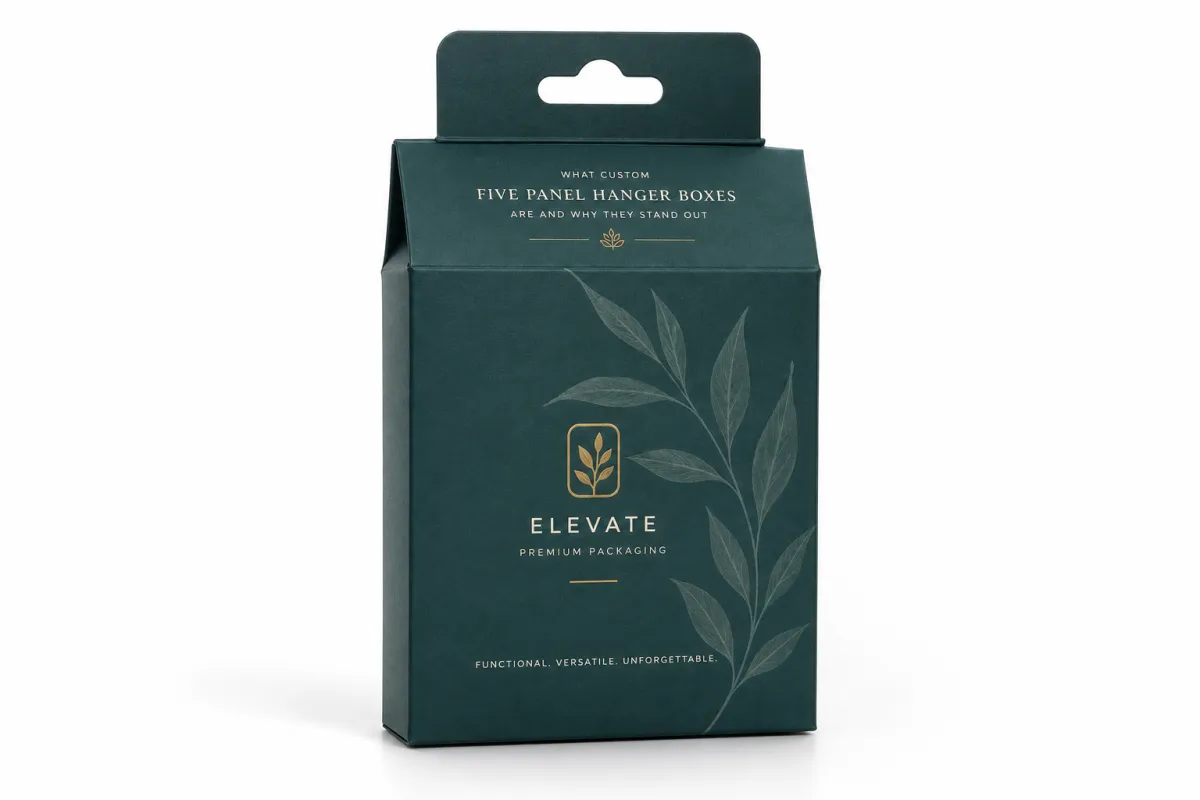
Custom five panel hangar boxes are folding cartons built with five structural panels instead of the more common four-panel shape. That extra panel does more than most people expect. It can strengthen the closure, create a better hang-tab area, and give package branding a little more room to breathe. On paper, the change looks small. In production, it often changes how the carton behaves when folded, filled, stacked, and displayed.
The useful way to think about it is simple. Standard tuck-end cartons are usually designed to close and ship. Custom five panel hangar boxes are often designed to close, ship, and present. That extra structural element can help the box resist popping open, keep the front panel cleaner, and support a more retail-ready silhouette. If your product lives on a peg hook, sits under bright store lighting, or gets handled by shoppers before purchase, the extra panel can matter.
Some suppliers call this family of packaging hanger boxes or hang-tab cartons, and the exact dieline varies by plant. The name matters less than the result. Custom five panel hangar boxes are useful when you need the carton to do one job well instead of trying to become a luxury object nobody can pack efficiently. That is where a lot of Custom Printed Boxes miss the mark. They look polished, then they waste labor.
Compared with mailers, they are lighter and more retail-friendly. Compared with rigid boxes, they are cheaper and faster to ship flat. Compared with standard folding cartons, they can offer a little more strength and display flexibility. That combination is why custom five panel hangar boxes make sense for apparel items, mini tech accessories, cosmetics, candles, sample sets, and gift kits.
If you are building branded packaging for a product line, think about what the carton has to do before you think about foil. I know, that sounds boring. It also saves money. A solid structure paired with simple, well-placed graphics usually beats a flimsy box covered in overworked artwork. That is especially true for custom five panel hangar boxes, because the structural shape already gives the package some personality.
"A carton that looks premium in a PDF but folds poorly on a packing line is not premium. It is just an expensive problem."
How Custom Five Panel Hangar Boxes Work in Real Fulfillment
Custom five panel hangar boxes usually arrive flat, which is the first reason operations teams like them. Flat stock is easier to store, cheaper to ship, and less annoying to count. The carton is opened by folding the scored panels into shape, locking the base or top depending on the dieline, then closing the remaining flap or tab. Good production feels crisp. The folds land where they should, the locking points stay consistent, and the box does not fight the packer every time a unit is loaded.
The extra panel matters most at the closure and the front face. It can act like reinforcement, make the top hang feature more stable, and improve the way the carton holds its shape after repeated handling. That is not magic. It is just more board working in a smarter way. Custom five panel hangar boxes often perform better than standard folding cartons when the product needs a little extra support around the opening edge or a cleaner display profile.
Hang tabs, die-cuts, windows, and inserts can all be added, but they need to be planned together. A hang tab cut too close to a fold line can tear. A clear window placed too aggressively can weaken the face panel. An insert that is too thick can make pack-out slow and create bulging. Custom five panel hangar boxes work best when the structural add-ons solve one real problem, not three imaginary ones. Every add-on costs time and money. Funny how that keeps happening.
In fulfillment, this format can speed up packing if the product is already well sized for the cavity. A packer can open, load, and close the carton quickly when the board thickness is sensible and the insert is doing its job. If the fit is wrong, though, the carton becomes fiddly. Then every unit takes longer and the labor savings disappear. That is the honest tradeoff with custom five panel hangar boxes: good setup saves time, bad setup burns it.
For shipping, the real question is not whether the box looks neat. It is whether the pack survives compression, vibration, and drop handling. If the carton is going into parcel networks, ask whether the structure should be tested against an ISTA distribution standard. The ISTA site is a useful place to start if you want to understand package testing language instead of guessing. Custom five panel hangar boxes do not need to be overbuilt, but they do need to be honest about the journey they will take.
Key Material, Size, and Print Factors to Decide First
If you are ordering custom five panel hangar boxes, start with product size, not artwork. Measure the product at its widest, tallest, and deepest points, then add clearance for easy loading and any insert material. For tight retail packaging, that clearance may be only 1-2 mm per side. For awkward items or manual packing, it can be 3-5 mm. A lot depends on whether the product is rigid, flexible, or already packed in another inner component.
Board choice usually falls into a few practical buckets. For lightweight products, 14pt C1S or similar paperboard can work. For cleaner print and a more premium retail feel, 18pt SBS or a comparable artboard is common. For heavier items or more protection, 24pt paperboard or a corrugated option may make more sense. Custom five panel hangar boxes are not automatically stronger than standard cartons; the board spec still has to match the product weight and handling conditions.
Board options that usually make sense
The simple truth is that board selection affects both cost and performance. If you choose too light a stock, the box can bow, crack, or telegraph the product shape. If you choose too heavy a stock, folding becomes harder and print cost often climbs for no functional gain. I usually tell buyers to match board thickness to the product first, then adjust the coating and finishing choices after that. Custom five panel hangar boxes should feel balanced, not armored.
Surface finishes are where buyers overspend. Matte or aqueous coating is usually enough for a clean retail look. Gloss can help with vivid color and shelf pop. Soft-touch gives a more tactile premium feel, but it also adds cost and can show fingerprints in some conditions. Foil and spot UV can work well on custom five panel hangar boxes, but only if they are used to highlight a logo, icon, or product name. Covering every panel with effects is how budgets disappear while the carton stays mediocre.
Print method matters too. Offset printing is the standard choice for larger runs because color consistency and fine detail are usually better. Digital printing can be useful for short runs, fast samples, or versioned artwork, but per-unit cost is often higher. For custom five panel hangar boxes, the right process depends on quantity, color control, and how much artwork coverage you need. If your brand color is picky, ask for a press proof or a color target, not a hopeful shrug.
Brand and compliance details deserve their own attention. Barcode placement needs a quiet zone. Legal copy needs readable contrast. Recycling marks should be accurate, not decorative. If you want an FSC claim, use certified stock and confirm chain-of-custody paperwork. The FSC site is the right reference point if you need to understand what that label actually means. Custom five panel hangar boxes can look polished and still fail at the basic information layer if the panel layout is sloppy.
One more small thing: color matching expectations need to be realistic. Coated paperboard, uncoated board, and different presses will not behave identically. That is normal. Ask for a target Pantone, a CMYK build, or a previous sample to compare against. Otherwise, the buyer thinks the printer is off and the printer thinks the buyer never explained the target. Everyone gets grumpy. Nobody wins. I am not gonna pretend that part is glamorous.
Custom Five Panel Hangar Boxes: Cost, Pricing, and MOQ Factors
Pricing for custom five panel hangar boxes is driven by a handful of boring variables that add up fast: size, board grade, print coverage, coating, special finishes, inserts, and how much die-cutting the structure requires. If a quote looks dramatically lower than the others, it usually means something is missing. Sometimes it is freight. Sometimes it is setup. Sometimes it is the kind of finishing that mysteriously appears as an add-on later. Buyers have been getting surprised by that trick for decades. It still works because people do not read line items carefully enough.
For realistic planning, simple short-run custom five panel hangar boxes can land around $0.75-$1.75 per unit at 500 pieces, depending on board and print. At 1,000 units, a cleaner offset job with basic coating may land around $0.45-$1.05 each. At 5,000 pieces, simple builds often fall into the $0.18-$0.45 range, while more involved cartons with coating, inserts, or premium finish work can sit closer to $0.35-$0.85. At 10,000+ units, cost per unit usually drops further, but not evenly. The price curve flattens when special finishes or complex structures are involved.
Those numbers are ballpark, not a promise. Every factory has different labor rates, board access, waste allowances, and finishing equipment. I have seen two quotes for the same-looking carton differ by a lot because one plant was charging for a true custom die and the other was quietly using an existing tool. That sort of thing happens more than vendors like to admit.
| Option | Best Use | Typical Cost Impact | Practical Tradeoff |
|---|---|---|---|
| 14pt C1S | Light accessories, promo items, low-weight retail packaging | Lowest starting point | Cheaper, but less crush resistance and less premium feel |
| 18pt SBS / artboard | Cosmetics, apparel accessories, small electronics | Moderate | Good print quality and solid shelf presence without overbuilding |
| 24pt paperboard | Heavier products, sturdier product packaging, better hand-feel | Higher | Stronger structure, but folding and scoring need more care |
| Corrugated build | Shipping-heavy SKUs or fragile contents | Highest of the common options | Protection improves, but retail finish can feel bulkier |
MOQ matters because setup costs do not disappear just because the order is small. Die creation, plate setup, proofing, cutting, and finishing all carry overhead. A 250-piece order of custom five panel hangar boxes might be technically possible, but it often costs more per unit than people expect. In practice, many suppliers are more comfortable at 500, 1,000, or 2,500 units because the economics make sense there. Below that, the quote can get lumpy.
Tooling and proofing are another place where budgets drift. Ask whether the quote includes the dieline, mockup, sample, and revision rounds. Ask whether freight is included. Ask whether plates or cutting dies are one-time charges. If a supplier leaves those out, the initial number is not really a price. It is a teaser. Custom five panel hangar boxes should be compared as landed cost, not fantasy cost.
If you are comparing suppliers, compare the spec sheet line by line. One quote may include matte lamination, insert assembly, and printed outer cartons for shipping. Another may include only the box itself. That is not apples to apples. That is a fruit salad with a sales pitch. For buyers who also need wider packaging support, it helps to review the full range of Custom Packaging Products before locking one line item into the budget.
Ordering Custom Five Panel Hangar Boxes: Step-by-Step Timeline
The cleanest way to order custom five panel hangar boxes is to move in a sequence, not a panic spiral. Start with the product dimensions, target quantity, destination, and structural needs. Then move to material and finish preferences. Then artwork. Then proofing. Then production. Then freight. That sounds obvious. Somehow it still gets skipped all the time.
What the timeline usually looks like
For a straightforward job, dieline setup and specification review may take 1-3 business days. Artwork prep depends on the buyer. If files are clean, print-ready PDFs can move quickly. If the artwork is being built from scratch, allow more room. A digital or flat sample may take another few days. Production often runs 10-15 business days after final proof approval for simpler custom five panel hangar boxes, and more time if the structure is complex or special finishing is involved. Freight can add 3-7 business days domestically and much more for offshore production. If your launch date is fixed, count backward with margin, not hope.
The biggest delays usually come from missing measurements, vague artwork files, and last-minute changes to the board or coating. A buyer sends a rough sketch, then asks the supplier to “make it premium.” That is not a spec. That is a mood. Custom five panel hangar boxes need exact depth, width, height, fold direction, hang feature placement, and any insert or window detail. If those are not defined, the project will drift.
Proof approval is another choke point. Review the dieline with the product in mind, not just the graphics. Check the barcode area, fold panels, bleed, safe zones, and the exact location of any window or hang tab. A clean proof on screen does not guarantee a clean carton in hand. For custom five panel hangar boxes, a good buyer wants both the flat proof and, ideally, a physical sample before committing to bulk production.
A simple planning framework helps a lot. If the launch date is fixed, add buffer for revisions, buffer for sampling, and buffer for freight. Then add a little more buffer because something always changes. That is not pessimism. That is packaging reality. Custom five panel hangar boxes are easier to get right when the timeline is built like a real production schedule instead of a wish list.
One practical move: ask for the supplier’s file checklist before artwork starts. Good vendors will specify PDF format, bleed, color mode, image resolution, and dieline usage. If they are vague there, they may be vague everywhere else. For buyers who want more than one packaging format, an internal Custom Packaging Products page can help the team compare structures before the artwork is locked.
Common Mistakes Buyers Make With Custom Five Panel Hangar Boxes
The first mistake is undersizing the carton. People measure the product and forget the insert, the wrap, the manual, or the fact that real packing lines need tolerance. Then custom five panel hangar boxes get built too tight, and the product scuffs, jams, or bulges the panels. A 1-2 mm error sounds harmless until it happens across 8,000 units.
The second mistake is overdesigning the box. Buyers stack up foil, spot UV, windows, rigid inserts, custom locks, and extra finishes because every feature sounds premium in isolation. The quote arrives, and suddenly the budget is gone. Worse, the box may still not function any better. Custom five panel hangar boxes do not need every possible enhancement. They need the right ones.
There is also the print-file problem. Low-resolution art, missing fonts, wrong dieline layers, and undocumented color expectations create delays that nobody enjoys. If the supplier asks for 300 dpi, give them 300 dpi. If they ask for CMYK or Pantone numbers, do not send a JPEG and hope for the best. Custom five panel hangar boxes are still print products. They obey print rules even when the marketing team is in a hurry.
"If the dieline is ignored, the carton will remind you later. Usually during approval, sometimes during packing, and occasionally after freight has already left the building."
Another mistake is assuming every factory builds the same way. They do not. Lock styles, board grades, coating options, and tolerances vary more than people expect. A sample from one supplier can look close to a sample from another supplier and still perform very differently in the hand. That is why sample checks matter for custom five panel hangar boxes. The flat proof is not the whole story.
Finally, buyers sometimes skip real-world testing. If the carton is meant for retail display only, you may not need heavy transit testing. If it is going through parcel networks or warehouse handling, then test the structure in a way that resembles the actual journey. That is where a standard like ISTA helps the conversation. Good packaging design is not just about looking finished. It is about surviving the route.
Expert Tips and Next Steps for Better Custom Five Panel Hangar Boxes
My strongest advice is simple: start with the product, not the decoration. Custom five panel hangar boxes work best when the structure is solved first and the branding supports that structure second. If the carton is sized right and the closure behaves well, the whole package feels more intentional. If the structure is weak, no amount of special ink will save it.
Build a buyer checklist before you request quotes. Include product dimensions, product weight, target quantity, shipping destination, board preference, finish preference, need for inserts, need for windows, and whether the box must hang, stack, or both. Add a realistic budget range too. Custom five panel hangar boxes are easier to quote accurately when the supplier gets the whole picture, not a half-finished idea and a deadline.
Ask for three things in every quote: the dieline or structural option, the sample timing, and the production lead time. If you are comparing suppliers, ask them to state what is included and what is not. That means sampling, plates, dies, freight, and any revision charges. A useful quote for custom five panel hangar boxes should let you compare the actual landed cost, not just the headline number.
There is also a practical branding angle. The best package branding does not shout from every panel. It frames the product clearly, uses color with restraint, and keeps the logo where the eye expects it. That is especially true for retail packaging where the carton has only a few seconds to earn attention. Custom five panel hangar boxes can do that job very well if the design team respects the structure instead of fighting it.
If you want a clean next step, compare two or three suppliers, request a prototype, review the quote line by line, and lock the spec before production starts. That sequence saves more money than most premium finish choices ever will. If you are still deciding between formats, look at the broader Custom Packaging Products lineup before committing to a structure that is only familiar.
Custom five panel hangar boxes are not the flashiest packaging format on the shelf, and that is part of their value. They are practical, adaptable, and often more cost-effective than they look at first glance. Get the size right, keep the finish choices disciplined, and compare quotes honestly. Do that, and custom five panel hangar boxes can become one of the more reliable pieces of your product packaging strategy.
The actionable takeaway is straightforward: define the product dimensions, board weight, hang requirement, and finish limits before you ask for pricing. Once those four things are fixed, the rest of the project gets a lot easier, and the final box usually looks better too.
What products work best in custom five panel hangar boxes?
Custom five panel hangar boxes work best for products that need a neat retail presentation plus real structure, such as apparel accessories, cosmetics, small electronics, sample sets, and gift kits. They are especially useful when the package needs to hang, stand, or handle repeated shopper interaction without collapsing easily.
How much do custom five panel hangar boxes usually cost?
Cost depends on size, material, print coverage, finish, and order quantity, so small runs usually cost much more per unit than larger orders. A simple order of custom five panel hangar boxes might start around the high cents range at low volume and move down sharply once you reach 5,000 units or more. Add sample, setup, and freight costs before comparing quotes, or the “cheap” quote will stop looking cheap.
How long does production usually take for custom five panel hangar boxes?
Simple orders can move quickly if artwork is ready and no revisions are needed, but sampling and approvals can add meaningful time. For custom five panel hangar boxes, it is common to allow 10-15 business days for production after final approval on a straightforward run, plus extra time for sampling and shipping. Complex structures, premium finishes, or overseas freight extend the schedule.
What information should I prepare before requesting a quote?
Have product dimensions, target quantity, material preference, print requirements, finish ideas, and your delivery location ready. If you already know whether custom five panel hangar boxes need inserts, windows, or a hang feature, include that too. The more specific the brief, the more useful the quote.
Are custom five panel hangar boxes better than standard folding cartons?
They can be better when you need stronger closure behavior, more display flexibility, or a more distinctive structural shape. Standard folding cartons may be cheaper and simpler, so the better choice depends on function, not just the mockup. For some SKUs, custom five panel hangar boxes are the right answer; for others, a plain tuck-end carton is smarter and less expensive.

