Buyer Fit Snapshot
| Best fit | Custom Flat Bottom Pouches Bulk projects where brand print, material claims, artwork control, MOQ, and repeat-order consistency need to be specified before quoting. |
|---|---|
| Quote inputs | Share finished size, material target, print colors, finish, packing count, annual reorder estimate, ship-to region, and any compliance wording. |
| Proofing check | Approve dieline scale, logo placement, barcode or warning zones, color tolerance, closure strength, and carton packing before bulk production. |
| Main risk | Vague material claims, crowded artwork, missing packing details, or unclear freight terms can make a low unit price expensive after revisions. |
Fast answer: Custom Flat Bottom Pouches Bulk: Specs, Pricing, Timeline should be specified like a repeatable production item. The safest quote records material, print method, finish, artwork proof, packing count, and reorder notes in one written spec.
Production checks before approval
Compare the actual filled-product size with the drawing, then confirm tolerance on folds, seals, hang holes, label areas, and retail display edges. Reserve space for logos, QR codes, warning copy, and material claims before decorative graphics fill the panel.
Quote comparison points
Review material grade, print process, finish, sampling route, tooling charges, carton quantity, and freight assumptions side by side. A quote is only useful when the supplier can repeat the same color, closure quality, and packing count on the next order.
Custom flat bottom pouches Bulk: Specs, Pricing, timeline. That is usually the real question tucked inside a packaging brief, because custom flat bottom pouches bulk orders are rarely just about appearance. They touch freight, pallet density, warehouse handling, fill speed, and the number of facings a brand can win on shelf. For a surprising number of SKUs, that is where the math finally starts to work.
People tend to notice the visible benefit first: the pouch stands upright with less drama than a lot of other flexible formats. The less visible advantage sits in the operation behind it. A well-built pouch can lower shipping waste, reduce storage friction, and still look premium without the weight penalty of a rigid container. That is why custom flat bottom pouches bulk often outperform jars, tubs, and tins on total landed cost, especially for coffee, snacks, protein powders, pet treats, and dry goods.
If you are comparing branded packaging options, the sharper question is not “Does it look good?” It is whether custom flat bottom pouches bulk purchasing improves unit economics enough to justify the run. That means looking at structure, quantity, fill speed, shelf life, and production lead time together, not as separate boxes to tick.
Buyers comparing Custom Packaging Products or planning a broader rollout through Wholesale Programs often land on flat bottom pouches because they split the difference between premium presentation and practical operations. They sit between flexible bags and Custom Printed Boxes: lighter to ship than rigid packaging, more polished than a plain stock pouch. In package branding, that middle ground can matter more than the loudest design choice.
Why custom flat bottom pouches bulk orders save shelf space
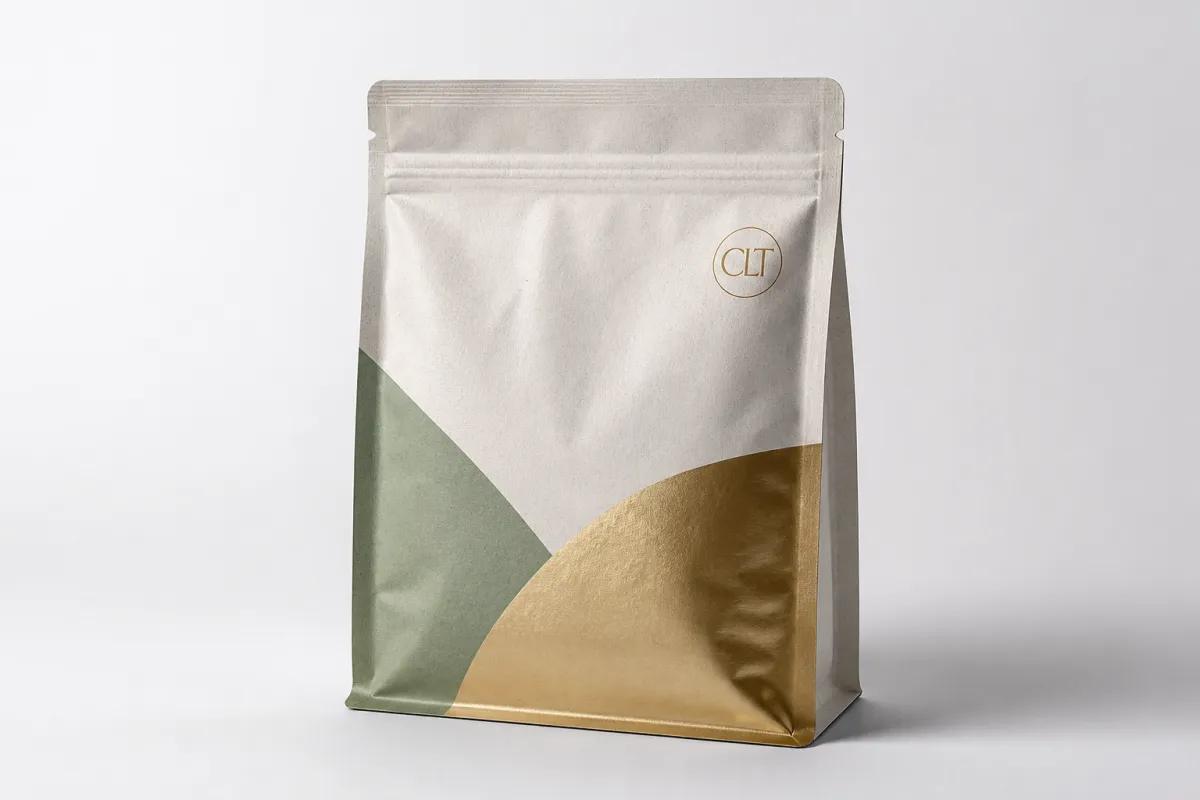
A brand moving from rigid tubs to custom flat bottom pouches bulk usually sees the same first gain: better shelf facings. The square base and broad front panel create a tidy display profile, which helps retail packaging look organized instead of crowded. In categories where a one-inch shift in front-of-shelf presence can change whether a customer notices the product, that difference carries real weight.
The freight case is just as straightforward. A flat bottom pouch stays lightweight packaging, and the lower tare weight can reduce transportation cost compared with tubs, jars, or cartons. Nothing mystical is happening here. Still, when a pallet carries hundreds or thousands of units, shaving material weight adds up quickly. In practice, custom flat bottom pouches bulk buyers often save twice: once in shipping and again in warehouse storage.
Stacking efficiency is the third advantage, and buyers often underestimate it. Rigid packaging creates dead space between units and inside cartons. Flat bottom pouches compress more efficiently before filling and can be packed into shipping cases with less wasted void. That improves cube utilization, one of those unglamorous metrics that quietly shapes margin. The best-looking format is not always the best performer, but this one usually handles both jobs well enough to matter.
Coffee makes the advantage easy to see. A 12 oz or 1 lb pouch with the right bottom structure and barrier film can stand, seal, and display without the cost of a metal tin or thick jar. Snacks and dry goods gain a different benefit: SKU planning gets simpler. Brands can consolidate inventory around one pouch family and still support different fill weights without rebuilding the entire packaging line.
The buyer’s math is not complicated. Lower freight, less storage friction, and better display efficiency can offset packaging spend before brand impact is even counted. That is why custom flat bottom pouches bulk programs belong to supply chain planning, not only creative direction. If the product must move through a warehouse, a distributor, and then a retail shelf, the format has to work at every step.
"The cheapest pouch on paper can become the most expensive pouch on a pallet. Freight, repacking, and damage have a way of exposing weak assumptions."
That is the detail many first-time buyers miss. They look at the front panel and forget the pallet. I have seen brands save a few cents a unit and lose the gain the minute damaged product, repacking, or a messy shelf reset enters the picture. In a crowded category, the package that protects margin is usually the one that respects logistics as much as it respects design.
What to specify in custom flat bottom pouches bulk orders
The strongest custom flat bottom pouches bulk quote starts with a clear spec sheet. Product type comes first, because a pouch for roasted coffee is not the same as a pouch for protein powder or freeze-dried fruit. Define the fill weight, target dimensions, whether the pouch must stand upright after filling, and whether the product is dense, dusty, oily, sharp, or moisture-sensitive.
Size comes next. Buyers often ask for a “standard” size, but standard changes with the fill. A 100 g snack pouch and a 5 lb pet treat pouch both use the flat bottom format, yet their gusset depth, panel height, and seal dimensions can be very different. For custom flat bottom pouches bulk orders, the wrong size can slow fill speed and make the bag look underfilled on shelf. That last part sounds small until a buyer walks the aisle and sees a product that looks half-empty next to a competitor packed tighter.
Closure and function follow close behind. A zipper makes sense for many retail products, but not every product needs one. Degassing valves matter for coffee. Tear notches matter for first-open convenience. Hang holes matter for peg display. Matte or gloss finish changes how the graphics read under store lighting. The best spec choices are not decorative; they support the product, the channel, and the opening experience.
Material selection deserves careful attention. For oxygen-sensitive foods, high-barrier structures such as PET/AL/PE or PET/MPET/PE are common. For lighter dry goods, a PET/PE or BOPP-based structure may be enough. If visibility matters, a window can help, but that trade-off reduces barrier and takes away some print area. In custom flat bottom pouches bulk buying, every feature carries both a cost and a reason.
It helps to build the spec in this order:
- Product requirements: shelf life, moisture control, puncture resistance, reseal needs
- Fill requirements: weight, density, headspace, filling equipment
- Display requirements: shelf presence, standing stability, print coverage
- Commercial requirements: budget, MOQ, launch timing, reorder plan
That order keeps the conversation practical. Packaging design should support production, not slow it down. A disciplined buyer treats custom flat bottom pouches bulk as product packaging first and branding second, because the pouch has to function before it can sell.
Specifications that affect performance and shelf appeal
After the basic spec is set, the next layer is performance. In custom flat bottom pouches bulk production, film structure drives shelf life, seal reliability, and print quality. A stronger barrier can protect aromas and slow oxygen ingress, though it can also increase cost and sometimes complicate sealing if the structure is not matched correctly to the fill equipment.
Thickness matters more than many buyers expect. A 4.0 mil pouch and a 6.0 mil pouch are not just different on a spec sheet; they feel different in hand, stand differently once filled, and resist puncture differently in transit. For heavier products, more structure can reduce leaks and seal failures. For lighter items, overbuilding the bag adds cost without much return. That is why custom flat bottom pouches bulk quotes should always be judged against the product, not against the ink alone.
Finish changes shelf appeal quickly. Matte finishes often signal premium positioning and soften reflections, which helps typography read more cleanly. Gloss finishes can deepen color and make images pop under bright retail lighting. Soft-touch lamination adds a tactile layer, though it usually belongs in higher-end launches where package branding is part of the value story. In retail packaging, the finish is not a minor detail; it changes the first impression.
Panel count and print coverage also influence complexity. Flat bottom pouches offer broad faces, but large ink coverage, white underprints, metallic effects, and window placement all change how the artwork is manufactured. The more precise the panel alignment must be, the more important the proof review becomes. For custom flat bottom pouches bulk jobs, the front panel may look simple on screen and still require careful setup on press.
Here is a practical sample checklist before you approve a run:
- Seal integrity: no pinholes, weak seams, or wrinkles in the seal zone
- Zipper function: opens cleanly, closes fully, and aligns across the width
- Stand-up stability: pouch sits flat after filling and handling
- Print accuracy: colors, text, registration, and barcode placement match proof
- Filled appearance: the bag looks full enough for retail packaging standards
When a sample fails, it usually fails in one of those five places. That is why experienced buyers do not judge a pouch by a flat proof alone. They inspect it as a finished object, because custom flat bottom pouches bulk performance depends on the completed bag, not the blank film.
Regulated and sustainability-focused programs add another layer. Structural claims, transit durability, and recycled-content discussions often intersect with testing and documentation. Referencing groups such as the ISTA can help buyers think more clearly about transit testing, while certification bodies like the FSC matter when paper components or fiber sourcing are part of the brief. The spec is not just a design document; it is a risk-control document.
Custom flat bottom pouches bulk: cost, pricing, and MOQ
Pricing for custom flat bottom pouches bulk usually comes down to six variables: size, structure, print colors, finish, feature set, and total quantity. A small pouch with simple one-color print costs less than a large, high-barrier pouch with a zipper, valve, matte finish, and full-coverage graphics. That sounds obvious, but it is still where buyers lose sight of the real comparison when they line up quotes.
MOQ, or minimum order quantity, is the other term to understand early. It is the smallest production run a supplier will accept at a given spec. Some manufacturers will quote a lower MOQ for simpler constructions and a higher MOQ for complex or custom printed packaging. For custom flat bottom pouches bulk programs, MOQ often shapes the first launch. It determines whether you can test a SKU, support a seasonal item, or fill one distribution cycle without piling up inventory.
Below is a practical pricing frame. These are planning ranges, not fixed quotes, because artwork coverage, barrier level, and freight all influence the number. Film markets move too, so any quote that looks unusually cheap deserves a careful second look.
| Order volume | Typical unit price | Best fit | Notes |
|---|---|---|---|
| 1,000-2,500 pieces | $0.42-$0.85 each | Launch tests, specialty SKUs | Higher setup impact, useful for proof of concept |
| 5,000 pieces | $0.20-$0.38 each | Early growth, repeatable SKUs | Often a better balance of cost and flexibility |
| 10,000-20,000 pieces | $0.14-$0.30 each | Core retail programs | Better unit economics, more efficient freight planning |
| 50,000+ pieces | $0.09-$0.22 each | Stable high-volume items | Best for consistent reorders and strict spec control |
That table helps, but it still leaves out hidden costs. Plate charges, sampling, freight, import duties, and proof corrections can alter landed cost more than buyers expect. A quote that looks cheaper up front may lose on the back end if it excludes packaging design work, digital proofs, or shipping. For custom flat bottom pouches bulk comparisons, ask for an itemized quote every time.
The better comparison frame is not simply price per pouch. It is price per filled unit, plus damage rate, plus waste reduction, plus shelf value. If one pouch costs two cents more but reduces leaks, speeds filling, and improves retail packaging appeal, the real savings may be larger than the headline difference. That is especially true in product packaging categories where shrink, damage, or repacking eat into margin.
Custom flat bottom pouches bulk buyers should also watch the gap between base pricing and the full commercial scope. If a supplier quotes only the pouch shell, then zipper type, valve, and freight may appear later. A clear spec sheet and a clear quote format are worth more than a low number with vague assumptions. Transparency is not decorative. It is the only fair way to compare suppliers.
Custom flat bottom pouches bulk: process, timeline, and lead time
The production path for custom flat bottom pouches bulk orders usually follows the same sequence: inquiry, quote, artwork review, proof approval, production, inspection, and shipping. The time consumed by each step is not equal. In many projects, the artwork and approval stage takes longer than the press run itself, especially when the buyer is still refining brand copy, barcode placement, or warning statements.
Unclear artwork causes delays. Late spec changes do too. A customer may approve the size and then decide on a different zipper or finish, and the timeline starts over. If faster turnaround matters, send print-ready files, final dimensions, and a clear quantity target before the quote is finalized. For custom flat bottom pouches bulk projects, preparation is often the quickest way to save time.
A realistic schedule depends on the process, but many programs fit into a pattern like this:
- Sampling and proofing: a few business days to two weeks, depending on revisions
- Production: often 12-20 business days after final approval, depending on complexity
- Freight: a few days domestically, or longer for ocean transit and customs
That separation matters. Too many buyers hear “three weeks” and assume the order will land in three weeks. It rarely works that way. For custom flat bottom pouches bulk buying, the calendar should include a buffer for proof correction, production queue time, and transit variance. If the launch date is fixed, back-plan from store arrival rather than order placement.
A practical launch plan should also account for internal approvals. Marketing may need one review cycle. Operations may need another. Regulatory or legal teams may request copy changes. The more people involved, the more likely the order will stall on a small detail. Good packaging design looks simple at the end because someone kept the complexity contained at the beginning.
Inspection is the last step that often gets overlooked. A reliable supplier should check sealing, print, count accuracy, carton packing, and visual defects before shipment. In well-run custom flat bottom pouches bulk programs, inspection prevents expensive surprises on arrival. That is where a supplier earns trust: not by promising speed alone, but by controlling the handoff.
Brands planning larger packaging rollouts often tie pouch timing to other product packaging decisions, such as label changes or custom printed boxes for bundled SKUs. That coordination can prevent mismatched launch dates and reduce pressure across the supply chain. If the pouch and the outer shipper do not land together, the last mile gets messy quickly.
Why choose us for custom flat bottom pouches bulk programs
For buyers comparing suppliers, reliability usually decides the deal. Custom flat bottom pouches bulk programs need consistent specs from one run to the next, or the packaging line starts absorbing the difference. A pouch that fills differently, seals differently, or stands differently can trigger extra labor, rework, or rejected inventory. That cost never appears in a simple unit quote, which is why it catches teams off guard.
What should a strong supplier do? Check the pouch structure against the product before production begins. Verify closure choices. Confirm dimensions. Review the artwork for panel fit and barcode placement. Those steps are not bureaucracy; they are risk reduction. When a supplier works this way, the buyer gets fewer surprises and better predictability across reorders. That matters most for custom flat bottom pouches bulk accounts that expect repeat business.
Transparency matters just as much. A clean quote should show what is included, what is optional, and what can change the final price. If the supplier is vague about freight, sampling, or printing setup, the buyer ends up managing hidden costs after approval. That is the fastest route to damaged trust in branded packaging projects. Clear communication is a commercial advantage.
Cross-category packaging knowledge also has real value. Coffee needs degassing considerations. Pet treats need puncture resistance and odor control. Protein powders need fill-friendly geometry and enough headspace for sealing. Dry foods may need a barrier against moisture and oxygen, but not necessarily the most expensive film in the catalog. Product-specific thinking keeps custom flat bottom pouches bulk orders aligned with the product instead of with a generic template.
For buyers comparing flexible formats with other retail packaging options, the practical difference is straightforward: flat bottom pouches often deliver stronger shelf presence than standard pouches and lower freight burden than rigid containers. They also work well inside broader package branding systems, whether the brand uses labels, cartons, or a mix of flexible and rigid formats. That versatility helps during phased launches and wholesale replenishment.
If your team is weighing custom flat bottom pouches bulk against another format, the right supplier should help compare unit economics, not just sell a bag. That includes knowing when a matte finish improves premium perception, when a valve is necessary, and when a simpler structure would protect margin just as well. Good supply partnerships are built on restraint as much as capability.
Next steps for custom flat bottom pouches bulk orders
If you are preparing a quote request for custom flat bottom pouches bulk, send a short but complete brief. Include product type, fill weight, target dimensions, artwork files, quantity range, required features, and any shelf-life or barrier concerns. A supplier can only quote cleanly when the brief is specific. Vague requests usually produce vague pricing.
It helps to ask for two or three sample configurations instead of one. Compare a basic PET/PE structure, a higher-barrier version, and a premium finish with zipper or valve added. That kind of comparison shows where the money goes. It also makes it easier to choose the spec that fits the product instead of the one that merely sounds impressive. For custom flat bottom pouches bulk programs, controlled comparison beats guesswork every time.
Before approval, confirm the final details in writing:
- Material structure and film thickness
- Finish such as matte, gloss, or soft-touch
- Closure including zipper type, tear notch, or valve
- Carton pack count and pallet count
- Lead time from proof approval to ship date
That checklist sounds basic, and basic is exactly where mistakes hide. One wrong assumption about carton counts can disrupt receiving. One missing approval can push a launch back a week. One unclear note on finish can alter how artwork reads under store lighting. For that reason, custom flat bottom pouches bulk buyers should ask for a sample or digital proof whenever branding, shelf presentation, or barrier performance matters to the launch.
If you are comparing landed quotes, compare like for like. Use the same dimensions, the same print coverage, the same closure, and the same freight assumptions. Then decide which spec supports the product and the margin. That is the practical way to buy custom packaging without turning the process into a guessing contest. When the numbers are clear, custom flat bottom pouches bulk orders become easier to scale, easier to reorder, and easier to justify internally.
For brands that want a packaging partner rather than a one-time vendor, the smartest move is to lock the spec, lock the schedule, and line up inventory before demand turns urgent. Custom flat bottom pouches bulk works best when it is planned as part of the broader packaging system, not treated as a last-minute purchase.
Then, once the product is live, measure what changed: freight weight, fill speed, damage rate, shelf performance, and reorder stability. That data will tell you whether the format is earning its keep. In many cases, that is the clearest proof that custom flat bottom pouches bulk is more than a packaging choice. It is a margin decision.
The practical takeaway is simple: define the product first, compare landed cost second, and approve the pouch only after you have checked how it behaves in filling, shipping, and shelf display. If those three parts line up, custom flat bottom pouches bulk stops being a design purchase and starts acting like a real operational advantage.
What is the minimum order for custom flat bottom pouches bulk?
MOQ depends on size, print method, and feature set, so ask for the smallest production run that still gives accurate pricing. If you are launching a new product, compare the MOQ against forecasted sell-through and storage capacity before committing. For many buyers, custom flat bottom pouches bulk starts at a few thousand pieces, but the right number depends on the actual commercial plan.
How long does custom flat bottom pouches bulk production usually take?
Lead time usually includes proof approval, production, inspection, and shipping, so the full schedule is longer than factory time alone. Fast approvals, final artwork, and stable specs reduce delays more than any single rush request. If timing is tight, build buffer into the plan for custom flat bottom pouches bulk transit and revision cycles.
Which materials are best for custom flat bottom pouches bulk food packaging?
Choose the structure based on the product: high-barrier films for oxygen-sensitive goods, tougher films for heavier items, and clear windows only when visibility matters. The best material balances shelf life, seal strength, and print quality instead of chasing the highest barrier on paper. For custom flat bottom pouches bulk food packaging, product behavior should drive the structure.
Can custom flat bottom pouches bulk orders include zippers, valves, or tear notches?
Yes, those features are common, but each one changes tooling, production complexity, and price. Match features to how the product will be opened, resealed, and displayed so you are paying for useful functions only. In custom flat bottom pouches bulk programs, the best feature set is the one the customer will actually use.
How do I compare quotes for custom flat bottom pouches bulk without hidden costs?
Ask every supplier for the same spec sheet, then compare unit price, setup fees, freight, and any testing or proof charges. The best quote is usually the one with the clearest scope, not just the lowest headline price. That approach keeps custom flat bottom pouches bulk buying grounded in landed cost rather than guesswork.

