Buyer Fit Snapshot
| Best fit | Custom Flat Pouches MOQ projects where brand print, material claims, artwork control, MOQ, and repeat-order consistency need to be specified before quoting. |
|---|---|
| Quote inputs | Share finished size, material target, print colors, finish, packing count, annual reorder estimate, ship-to region, and any compliance wording. |
| Proofing check | Approve dieline scale, logo placement, barcode or warning zones, color tolerance, closure strength, and carton packing before bulk production. |
| Main risk | Vague material claims, crowded artwork, missing packing details, or unclear freight terms can make a low unit price expensive after revisions. |
Fast answer: Custom Flat Pouches MOQ: Pricing, Specs, and Lead Times should be specified like a repeatable production item. The safest quote records material, print method, finish, artwork proof, packing count, and reorder notes in one written spec.
Production checks before approval
Compare the actual filled-product size with the drawing, then confirm tolerance on folds, seals, hang holes, label areas, and retail display edges. Reserve space for logos, QR codes, warning copy, and material claims before decorative graphics fill the panel.
Quote comparison points
Review material grade, print process, finish, sampling route, tooling charges, carton quantity, and freight assumptions side by side. A quote is only useful when the supplier can repeat the same color, closure quality, and packing count on the next order.
Custom Flat Pouches MOQ: Pricing, Specs, and Lead Times
Buyers often start with the lowest number on the page and only later discover it was the wrong number to focus on. custom flat pouches MOQ only makes sense once the size, material structure, and print method are defined, because those choices determine most of the cost. A pouch quote is not pulled from thin air. It is built from barrier requirements, finish selection, artwork coverage, setup time, and how efficiently the plant can run the job.
That matters whether you are launching a snack line, testing a subscription refill pack, or ordering sample pouches for a sales meeting. A clean-looking pouch can become expensive once you add oxygen barrier, a matte surface, a tear notch, or a window cutout. Factories do not price the idea of packaging. They price film, machine time, waste, and labor. Anyone asking for a useful quote needs to know what is being measured.
From a buyer’s point of view, flat pouches win for practical reasons. They keep product packaging light, they take up less room than rigid containers, and they create a sharp shelf profile without extra bulk. That is why they show up in coffee, nutraceuticals, sample kits, snack SKUs, and beauty refills. Good branding packaging starts with fit. Decoration comes after fit.
This breakdown focuses on the parts that move price and lead time: MOQ, structure, sizing, artwork, and the information you should gather before requesting a quote. If you are comparing options across Custom Packaging Products, this is the kind of spec thinking that prevents revision loops later.
Most buyers miss the real cost of custom flat pouches
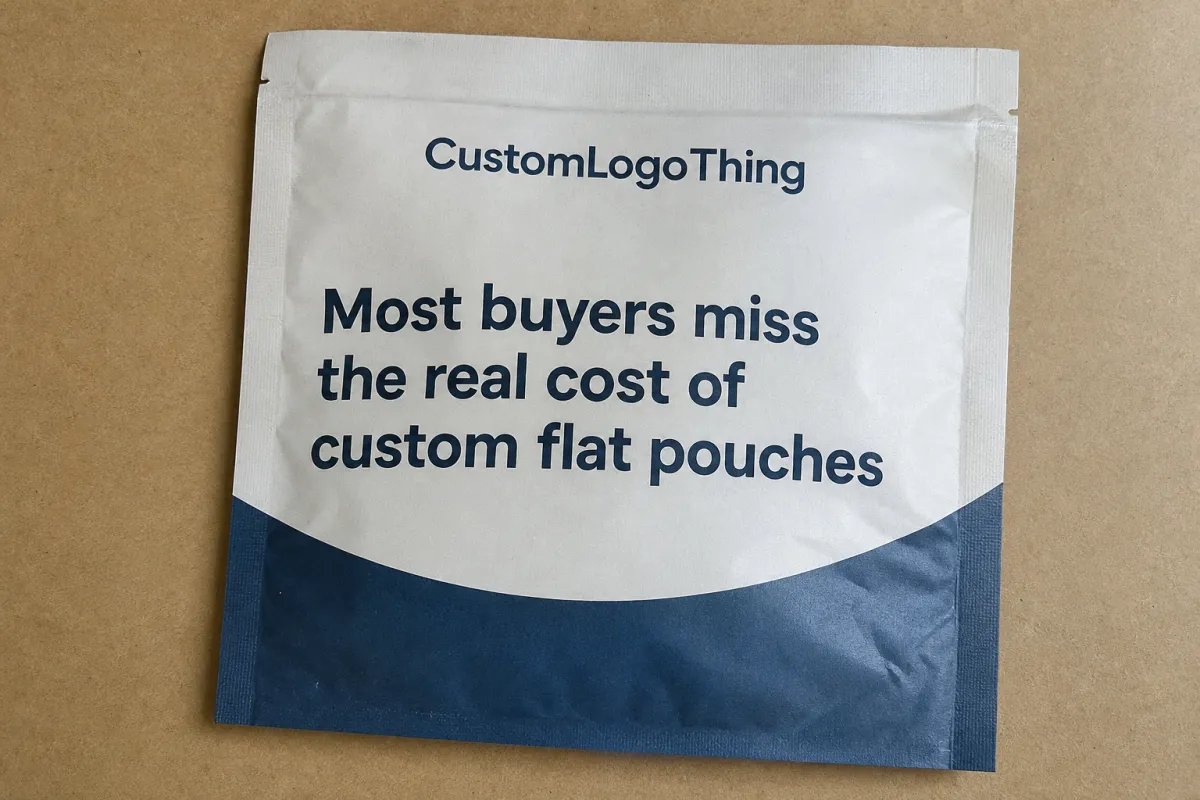
The first mistake is treating price like one fixed number instead of a range with tradeoffs. A flat pouch quote usually depends on several variables, and the mix matters more than any single feature. A small snack brand may want 5,000 pouches with a matte finish and a high-barrier liner. A month later, the same brand adds a zipper and a metallic accent, and the unit cost jumps. Same format. Different economics.
Custom flat pouches make sense because they are efficient. The profile is slim, the shelf presentation is clean, and the material use is lower than many rigid formats. For dry goods, samples, powders, wipes, and refill packs, that difference matters. The pouch protects the product without making the carton heavier than the product itself. In retail packaging, that is a poor trade, and buyers notice.
Here is the part that gets missed: MOQ usually reflects setup efficiency, not supplier mood. If a line needs new plates, a fresh cylinder, a custom film spec, or a dedicated converting run, the factory has to spread those fixed costs across enough pieces to keep the job viable. That is why a lower MOQ often carries a higher unit cost. The math is plain, even when the quote is not.
A simple example helps. A supplement brand wants to test a powder product in a flat pouch. The artwork looks straightforward. The order sounds small. Then the team learns the product needs moisture protection, the print area is close to full coverage, and the fill weight requires a larger bag than expected. The quote stops being about pouch shape and starts being about barrier film, material yield, and production waste.
A buyer-focused request produces a better answer. Ask for pricing based on the real fill weight, the intended quantity, and the print method you want. If the direction is still unclear, request two or three versions. A useful vendor should be able to show the difference between a test run and a production run without making you decode the plant floor.
Flat pouch formats, materials, and print options
A flat pouch is the simplest flexible pack in the lineup: slim, low-profile, and usually without a gusset, or with only a minimal one depending on the style. It fits sample inserts, single-serve portions, refills, dry goods, and items that do not need a rigid wall. You see them used in package branding because the front panel offers enough space for graphics without adding useless volume.
Material choice is where the tradeoffs show up. Paper-based structures can create a natural look, but they are not always the right fit for moisture-sensitive products. PET and PE combinations are common because they balance strength and seal performance. Foil laminates and high-barrier films are better when oxygen, light, or aroma control matters. If the brief calls for recycled content or FSC-linked paper sourcing, ask for documentation rather than accepting a marketing claim at face value.
Here is a practical way to think about common structures:
- Paper/PE - suited to a softer, natural presentation; barrier is limited unless upgraded.
- PET/PE - a dependable general-purpose choice for print quality and seal strength.
- Metalized film laminates - useful for shelf impact and improved barrier without the cost of full foil.
- Foil laminates - high barrier for coffee, fragrance, supplements, and moisture-sensitive goods.
- Clear-window structures - helpful when product visibility supports sales, though they can add complexity and reduce barrier.
Print method changes the economics too. A stock-style look might use labels or limited graphics on a plain pouch. Fully custom printed pouches give more control over color, branding, and shelf presence, but they also raise setup demands. More ink coverage can mean more plate work, more quality checks, and more risk of color drift if the files are poorly prepared. Packaging design is not only about visual appeal. It also has to run cleanly through production.
Finish selection affects both feel and cost. Matte gives a softer, more premium appearance. Gloss tends to stand out under retail lighting and often stays cheaper than specialty finishes. Soft-touch adds a distinct tactile feel, but it can increase cost and sometimes complicate scuff resistance. Windows can support sell-through, yet they also make the spec more complicated. A buyer should ask whether the window helps conversion or simply looks clever in a mockup.
Functional features are worth deciding early. Tear notches improve opening consistency. Hang holes matter for hook displays. Zippers support recloseability, especially for refill packs or products that are used over time. Heat seals remain standard for many flat pouch formats because they are simple, inexpensive, and reliable. Every bag does not need every feature. The right features are the ones that match the product and the sales channel.
If your product is being evaluated against packaging industry guidance, remember that the correct structure depends on barrier, distribution, and end use. A pouch that looks fine on a sample table may fail in humid transit or warehouse handling. That is not a branding issue. It is a spec issue.
Send fill weight, barrier need, and print sides in the first message. That one habit removes most of the unnecessary back-and-forth.
Custom flat pouches MOQ: pricing, setup, and unit cost
Here is the direct version. custom flat pouches MOQ is driven by setup cost, material yield, and print method. It is not random. If the job needs plates, cylinders, custom film sourcing, or dedicated press time, the factory has to protect itself from losing money on a tiny run. Minimums exist because the work has a fixed cost before the first pouch is even finished.
The good news is that MOQ is not locked to one number for every process. Different print methods support different run sizes. Digital printing usually allows lower quantities, but the per-piece cost stays higher. Flexographic or gravure printing often makes more sense for larger runs because the setup cost can be spread across more pouches. Smaller order, higher unit cost. Larger order, lower unit cost. Manufacturing still runs on arithmetic.
Typical pricing ranges shift with the structure, but these ballpark numbers give buyers a useful starting point:
| Quantity tier | Typical unit cost | Setup impact | Best fit |
|---|---|---|---|
| 1,000-3,000 units | $0.40-$0.95 each | High, because setup is spread over fewer pieces | Test launches, samples, early market validation |
| 5,000-10,000 units | $0.18-$0.45 each | Moderate, with a better balance of cost and flexibility | Small brands with steady reorder potential |
| 20,000+ units | $0.10-$0.28 each | Lower per unit, strongest efficiency | Established SKUs, retail rollouts, repeated production |
Those ranges move with size, material, print coverage, and add-ons. A plain smaller pouch can sit near the low end. A foil laminate with full-bleed graphics and a specialty finish can climb quickly. That is why asking for multiple tiers matters. Five thousand units may look steep beside one thousand, but the per-unit drop can be large enough to change the launch plan.
There are also hidden cost drivers buyers forget to ask about. Metallic inks, Custom Die Cuts, special lamination, oversized windows, and reseal zippers all add complexity. If the pouch is very narrow and the product is high-fill, material waste can rise too. Waste does not look dramatic on paper. It still moves the quote.
For commercial planning, I would ask for at least three tiers every time:
- Trial tier - enough to test the market without overcommitting.
- Working tier - enough to support a sales cycle or short promotion.
- Volume tier - enough to reveal the real price break.
That gives you a clearer view of the economics. It also gives finance a clean answer to the usual question of why a lower quantity order costs more per piece. Because setup is still there, even if the quantity is not.
If you are weighing flexible packs against Custom Packaging Products like custom printed boxes, flat pouches often win on shipping weight and material use for lightweight goods. Boxes still make sense for structural protection or premium presentation, but they should not be the default if the product does not need that much packaging.
Artwork, sizing, and specs that affect your quote
Most quote delays begin with missing specs. A useful price needs pouch width, height, any gusset detail, fill weight, product type, material preference, and the number of print sides. If the final size is not set yet, send product volume and the shelf look you want. A vendor can work with that. A guess with no dimensions usually turns the quote into a puzzle nobody wanted.
Product density matters more than many buyers expect. A flat pouch sized for 50 grams of coffee may not be right for 50 grams of dried fruit. Powders, granules, and snacks behave differently in the bag. A pouch that fits one product can look overstuffed or underfilled with another. In retail packaging, that affects shelf presence, seal margin, and how well the pack sits in a tray or carton.
Artwork files are another common bottleneck. A clean quote usually needs a dieline, bleed setup, safe areas, and the correct color mode. Low-resolution files, missing fonts, and unapproved brand colors slow the process down. If the printer has to rebuild the layout, delays are likely. If the art includes tiny legal copy or compliance marks, review time increases. That is normal, not exceptional.
For food, supplements, or cosmetics, the spec list can change again once claims and labeling enter the picture. Ingredients, net weight, lot coding, barcode space, and warning language all need room. If the product claims moisture or oxygen protection, the film structure has to support that claim. ASTM seal-strength testing and barrier testing often enter the discussion on serious runs, especially when shelf life matters. If shipping validation is needed for e-commerce or distribution, ask whether the pack should be tested against ISTA distribution test standards.
The short version is simple: better inputs produce better quotes. Clear specs reduce revision cycles. They also lower the chance of ending up with a pouch that looks fine on screen and fails in use. That is wasted time and wasted money, and neither one is cheap.
Checklist for a clean quote:
- Finished pouch dimensions
- Fill weight or fill volume
- Product type and sensitivity to moisture, light, or oxygen
- Material preference, if you have one
- Print coverage and number of colors
- Closure or feature needs such as zipper, tear notch, or hang hole
- Target quantity and any backup tier you want priced
Send all of that in one message and the quote gets faster and more useful. That is the point.
Production process, timeline, and lead time expectations
The production path is usually straightforward: inquiry, quote, spec confirmation, artwork review, proofing, production, finishing, and shipping. The slowest part of most orders is not the press run. It is the back-and-forth before the run. A sloppy file can cost more time than the pouch conversion itself.
For a custom pouch project, realistic lead time depends on order size and print method. Simple jobs with clean art can move quickly once the proof is approved. More complex jobs take longer, especially if they need custom film sourcing, specialty coatings, or new tooling. A sample order can often move faster than a full production run, but the two are not the same thing. A sample proves the concept. It does not always match the same throughput, case count, or freight plan as a repeat run.
Here is a practical timeline view:
- Quote and spec review - often 1-3 business days if the information is complete.
- Artwork and proof approval - usually 2-5 business days, longer if revisions are needed.
- Production - commonly 10-20 business days for standard custom runs, depending on complexity and quantity.
- Shipping - varies by destination, freight method, and whether you choose economy or expedited service.
That range is practical, not guaranteed. Specialty finishes, tight color matching, foil structures, and custom inserts can push timing out. Poor file prep can do the same. The quote should tell you whether proofing, production, and freight are included in the same schedule or tracked separately. If timing matters, ask for the production start date, not just the delivery estimate. Those are different milestones.
Shipping method also changes the timeline and the risk profile. Air freight moves faster but costs more. Ocean freight saves money but adds time and more planning. If a launch date is fixed, build in room for revisions, quality checks, and transit. Packaging like a pro means respecting the calendar instead of hoping it behaves.
From a buyer’s point of view, the best quote names the milestone dates clearly. If a supplier cannot tell you when proof approval is due, when production begins, and what happens if artwork changes, the process is weak. It may still work out. You are still buying uncertainty, and that is a poor fit for launch planning.
A quote without a clear proofing step is not a quote. It is a guess with a price attached.
Why buyers choose our custom flat pouches over generic stock
Buyers usually move from generic stock to custom once fit starts to matter. Generic pouches can work for an early test, but they rarely match the product, the shelf strategy, or the brand story as well as a tailored pack. With custom flat pouches, you control the material, the barrier level, the print coverage, and the finish. That gives you better alignment between the product and the packaging design.
That matters most when presentation drives conversion. In some categories, the pouch is the brand. Coffee, supplements, beauty samples, and specialty foods rely on package branding to signal trust quickly. If the pack looks off, the product gets judged before anyone tastes it, uses it, or opens it. That is where branded packaging earns its keep.
Direct manufacturing matters because it keeps the conversation tied to the real spec. A middle layer can inflate MOQ and add margin or vague service charges to the quote. Direct specs usually give more control over final price, print result, and reorder path. That does not mean every factory is a better factory. It means the chain is shorter and easier to manage.
Compared with stock formats, custom printed pouches also improve consistency. The color set is matched to the artwork, the pouch size is built around the fill, and the final pack is less likely to look like a compromise. That matters in crowded retail categories where packaging has to do real work. It also matters when one brand family needs several SKUs to look related without becoming identical.
There is a practical side as well. A custom run often gives clearer pricing tiers, cleaner communication, and fewer surprises after artwork approval. If you know a reorder is likely, that stability matters. If the launch is one-time testing, a lower MOQ option can be the smarter move. I would rather see a buyer start at the right quantity than treat a large run like a badge of honor.
In plain terms, custom flat pouches are not about vanity. They are about matching the pack to the product, the channel, and the margin. That is the real equation, and it is usually the one that determines whether a launch holds up after the first reorder.
Next steps: get a quote that actually matches your order
If you want a quote that helps, send the details that matter: pouch dimensions, fill weight, product type, material preference, print coverage, and target quantity. If artwork already exists, include it. If the concept is still rough, send that too. A good packaging team can work from a sketch, but the number improves when there is something concrete to price.
Ask for pricing at multiple tiers. That gives you a clean view of MOQ, unit cost, and the point where volume starts to improve the economics. Also ask whether the quote includes setup, proofing, and shipping, or whether those are separate. A low number that leaves half the job out is not a better deal. It is a delayed surprise.
If the launch is sensitive or the artwork is complex, request a proof or sample before full production. That is especially smart for product packaging with strict color targets, regulated copy, or high shelf visibility. Small mistakes become expensive once they are printed on thousands of pouches. Catching them early is the cheaper path.
At Custom Logo Things, that level of detail is what we want before pricing a run. It keeps the conversation honest and the quote aligned with the actual job. If you are ready to move, send the spec sheet, the target order size, and any constraints on barrier, finish, or lead time. For general ordering questions, our FAQ page covers the basics before you request a formal quote.
custom flat pouches MOQ is not just a number on a spreadsheet. It is the point where spec, setup, and production efficiency meet. Give the supplier the right inputs, and the quote gets sharper, the lead time gets clearer, and the final pouch has a far better chance of doing its job. Start with the product’s real needs, not the cheapest opening price, and the rest of the ordering process becomes much easier to trust.
What is the MOQ for custom flat pouches?
MOQ depends on size, material structure, and the print method used. Short runs are possible, but the unit cost is usually higher because setup is spread across fewer pouches. If you are comparing options, ask for tiered pricing so you can see where the break point sits between a test order and a more efficient production run.
Can I order custom flat pouches with a low minimum order quantity?
Yes, though low MOQ orders work best when the spec is simple. Expect fewer finish choices or a higher per-piece price if the quantity is very small. If you are testing a product, start with the smallest viable quantity and confirm what a reorder would cost once sales begin.
What affects the unit cost on custom flat pouch MOQ orders?
Size, material structure, and print coverage have the biggest impact. Add-ons like zippers, tear notches, windows, metallic effects, and barrier upgrades can raise cost quickly. The fewer units you order, the more setup cost shows up in each pouch.
How long does production take for custom flat pouches?
Lead time depends on artwork approval, material availability, and order size. Simple orders move faster than pouches with specialty coatings or complex print effects. Ask for separate timing on proofing, production, and shipping so the schedule is clear before you commit.
What do I need to send for an accurate quote on custom flat pouches?
Send pouch dimensions, fill weight, product type, material preference, and target quantity. Include artwork files or a rough layout if you have one. The more exact the spec, the less likely you are to get quote revisions later, and the faster the project can move.

