Custom beanies low MOQ gives buyers a way to test demand without committing to a large inventory run. A 24-, 48-, or 100-piece order can confirm the fit, decoration quality, and color accuracy before a bigger seasonal buy. That matters when the product is being used for merch, uniforms, campus programs, or a small retail drop.
Beanies look simple, but production choices change the result fast. Knit structure, cuff depth, decoration method, labeling, and packaging all affect cost and finish. A small order helps buyers see what the product actually looks and feels like before they scale.
For many teams, the first order is less about volume and more about control. A smaller run reduces dead stock risk, preserves budget for the rest of the launch, and gives a clearer read on whether the style will reorder well. The tradeoff is usually a higher unit price, but that is often worth it when the design is still being validated.
"A small order is only risky if it teaches you nothing."
Why custom beanies low MOQ can test demand without overbuying
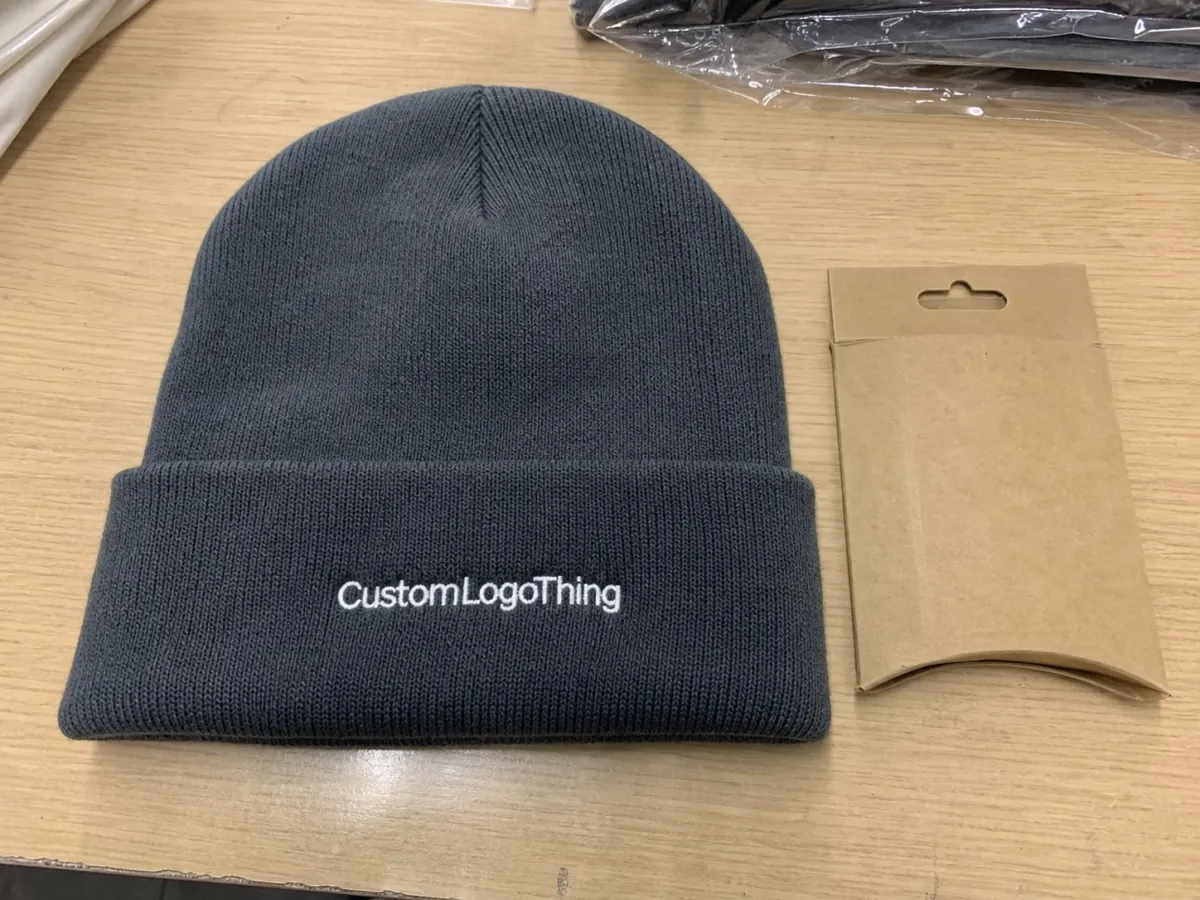
Low MOQ is useful when demand is real but hard to size. That includes winter merch drops, employee kits, sports clubs, holiday gifts, and retail experiments. In those cases, a smaller run is not a compromise; it is a controlled test.
The difference between a sample and a production run is important. A sample shows whether the logo is acceptable. A batch shows whether the beanie holds shape, whether the cuff sits correctly, and whether the logo still reads well once the item is worn. Production answers the questions that renderings cannot.
That is especially true for accessories that get repeated use. Beanies are worn outside, indoors, and on camera, so the brand gets more exposure than on a one-time promo item. If the fit and decoration work, the reorder decision gets easier. If they do not, the buyer learns fast and keeps the risk contained.
There is also a budget angle. Smaller runs keep cash available for packaging, inserts, hang tags, or Custom Packaging Products if the product needs a retail-ready presentation. Buyers do not need to overbuy just to prove the concept.
Low MOQ is most valuable when the order has to answer several questions at once: will the color match the brand palette, will embroidery read cleanly on knit, is the crown deep enough, and does the hat feel premium enough for the line? Those answers come from production, not mockups.
Beanie styles and decoration methods that change the final look
Beanie style affects both appearance and usability. A cuffed beanie gives the most reliable decoration area and the most predictable logo placement. A slouch beanie feels more casual, but the branding zone can shift when worn. Pom styles are more playful and work well for team or event merch. Fleece-lined beanies add warmth and help the product feel more premium.
The knit itself matters too. A tighter rib knit usually supports cleaner embroidery and a sharper overall look. A chunkier knit can feel more seasonal and tactile, but small text and fine detail become harder to read. That is not a design flaw; it is a material limit.
Decoration method is where the final look changes the most. Embroidery is the most common option because it is durable, cost-effective, and suitable for simple logos. Woven patches handle finer detail than stitches can capture. Leather or PVC patches create a more retail-focused feel. Jacquard knit branding integrates the design into the fabric, but it needs more planning and usually a higher setup cost.
| Decoration method | Best use case | Typical visual result | Common add-on cost per unit |
|---|---|---|---|
| Embroidery | Simple logos, staff wear, event merch | Durable, clean, slightly raised stitching | $0.80-$2.20 |
| Woven patch | Small detail, brand marks, retail lines | Fine detail, flat and neat | $1.10-$2.75 |
| Leather or PVC patch | Premium feel, outdoor brands, lifestyle merch | Sharper contrast, more dimensional | $1.30-$3.50 |
| Jacquard knit | All-over branding, repeat patterns, team identity | Integrated into the fabric | Higher setup cost; often $3.50-$6.50 above a blank knit |
The right choice depends on the logo, budget, and use case. A campus giveaway can usually work with simple embroidery. A retail line may need a patch or jacquard treatment because the hat has to sit beside other branded goods without looking cheap. If the beanie is meant to sell, the decoration should match the price point.
Specs to confirm before you quote: yarn, fit, labels, and packaging
Clear specs lead to better quotes. Yarn type is the first decision. Acrylic is the most common option because it is cost-effective, consistent, and easy to scale. Wool blends add warmth and a more natural hand feel. Recycled yarn can work too, but Buyers Should Ask for documentation rather than accepting vague sustainability claims.
Knit weight and gauge matter as much as the yarn. A denser beanie usually looks cleaner and holds its shape better. A looser knit may feel softer, but it can reveal decoration issues sooner. If the hats are for outdoor crews, cycling teams, or cold-weather uniforms, say so up front. Standard one-size-fits-most works for many programs, but not all. Helmet-compatible fit, deeper crown depth, or youth sizing should be specified before quoting.
Labels and packaging affect both price and presentation. Woven labels, side tabs, care labels, and hang tags can all change the quote. If the order needs a retail finish, those pieces should be planned with the decoration, not added later. Packaging choices matter too. A folded polybag is one thing; a beanie that has to fit in a gift box or custom insert setup is a different job.
- Yarn: acrylic, wool blend, recycled blend, or fleece-lined construction
- Fit: standard stretch, youth sizing, deeper crown, or helmet-friendly profile
- Decoration: embroidery, patch, jacquard knit, or mixed methods
- Branding: woven label, side tag, care label, hang tag, or inside print
- Packaging: polybag, belly band, carton labeling, retail insert, or gift-ready fold
For recycled content or fiber-source claims, ask specifically and early. It is easier to qualify materials before quoting than to revise the order after approval. The same is true for packaging stock, finish, and count. If the insert card or carton art matters, define it before production starts.
Cost, pricing, and MOQ: how smaller runs are priced
Price is driven by more than the beanie itself. Decoration method, yarn type, stitch density, color count, and packaging all affect the quote. A cuffed hat with embroidery and a simple hang tag will cost less than a fully packaged retail piece with a patch and custom insert.
For low-MOQ work, minimums often fall around 24, 48, 50, or 100 pieces depending on construction. Fully custom knit styles usually need higher minimums because the setup is heavier and the art is built into the fabric. Embroidered stock beanies can usually run lower because the base product already exists and the branding is added later.
Smaller orders usually carry a higher per-unit price. A 50-piece run may cost more per hat than a 300-piece run of the same style. That is normal. The benefit is lower exposure if the design does not move. When the style is unproven, that tradeoff often makes sense.
Typical quote components usually look like this:
- Blank beanie cost: roughly $2.20-$5.80 depending on yarn and knit weight
- Decoration setup: embroidery digitizing or patch tooling, often $35-$120 one time
- Per-unit decoration: usually $0.80-$3.50 depending on method and detail
- Packaging: polybag, insert card, hang tag, or gift wrap, often $0.10-$0.75 per unit
- Freight: varies by carton count, shipping speed, and destination
These ranges are broad because construction changes the cost quickly. A thick rib knit with a leather patch sits in a different range than a light acrylic cuff beanie with simple thread embroidery. Seasonal timing also matters. Peak winter demand tightens capacity, which can affect lead time and sometimes pricing.
Process and timeline: from artwork approval to delivery
The production flow is straightforward: inquiry, spec confirmation, quote, artwork review, proof approval, production, inspection, and shipment. The process slows down when the buyer sends incomplete information. A logo file, quantity range, delivery target, and short spec list will produce a far better response than a screenshot and a guess.
Lead time depends on decoration and stock availability. A simple embroidered order on stocked beanies can sometimes move in about 12-20 business days after proof approval. Add patches, extra labels, or special packaging and the window extends. A fully custom knit order takes longer because yarn matching, knitting setup, finishing, and packing add steps.
Shipping affects the schedule too. Air freight shortens the timeline but increases cost. Ocean freight improves unit economics on larger orders but requires more planning. If the beanies are going into retail kits or fulfillment cartons, packaging should survive transit, not just look tidy in the warehouse.
Fast approvals compress the schedule. Slow approvals stretch it. That sounds obvious because it is. Still, many orders lose time to logo revisions, color changes, or late label requests. If there is a launch date, share it early and work backward from it.
For buyers comparing custom beanies low MOQ with other branded products, the process is familiar: lock the spec, approve the proof, confirm the timeline, and release the job. Once those steps stop moving, the order becomes much easier to manage.
Proofing mistakes that create delays or extra charges
Most delays start at proofing, not on the factory floor. Low-resolution logos are the obvious problem. Tiny text is another. Knit fabric stretches, so delicate detail often looks worse on the finished hat than it does on screen. If the design depends on thin strokes or small lettering, ask for a larger mark or a simpler version.
Color is another common issue. Yarn dyes, thread shades, and knit structure all affect the final appearance. If the brand has strict color standards, define acceptable tolerance instead of assuming every material will match exactly. A good supplier will explain where a close match is realistic and where it is not.
Placement needs to be approved clearly. Front center, left cuff, side panel, back, and offset patch placements all create different results. Thread color, patch size, label position, and carton count should all be confirmed in writing before production starts. Small changes can trigger rework.
"If the proof is vague, production guesses. Guessing costs money."
Late changes after digitizing or tooling often create extra charges. A small revision may require a new setup or a reset of the workflow. Careful proofing is the cheapest form of quality control, and it matters even more when the beanies are part of a larger brand system.
What buyers should expect from a supplier on repeat orders
Repeatability is where a supplier proves value. The second order should look and feel like the first, within normal knit-goods variation. The color should land in the same zone, the cuff height should stay consistent, and the decoration should not drift.
That only happens when the supplier keeps good records. Saved artwork files, spec sheets, color references, label dimensions, decoration notes, and packaging counts make reorders much easier. Buyers should not have to rebuild the job every time.
Good suppliers also flag changes early. Yarn shades can be discontinued, packaging materials can shift, and patch tooling can change. The important part is hearing about it before production, not after delivery.
Quality control should stay in place on repeat orders. Stitching should be clean, thread tension should be even, labels should sit square, and package counts should match the packing list. Stretch recovery matters too. If the hat loses shape too quickly, the product feels cheap even when the logo is right.
For multi-season programs, the key question is simple: can the supplier make the same thing twice without turning the reorder into a new project? If yes, low MOQ becomes a launch tool, not just a one-off purchase.
Next steps to request a quote and lock in production
To get a usable quote, send the basics in one message: logo file, preferred beanie style, color direction, decoration method, quantity range, packaging needs, and required delivery date. A vague request usually gets a vague estimate.
It helps to compare two versions of the same job. One can be the lower-cost embroidery option. The other can be a more premium patch or jacquard route. Side by side, the tradeoff is easier to judge. Lower Unit Cost is not always the right answer if the item has to sell in retail or sit alongside a premium product line.
- Approve the spec sheet before production begins.
- Confirm artwork, thread, or patch colors in writing.
- Lock the unit cost, minimum quantity, and packaging details.
- Sign off on timing before the run enters production.
That sequence protects both margin and schedule. It also keeps the order aligned with the rest of the brand presentation, whether the hats ship in cartons, gift sets, or retail packs.
What is the usual MOQ for custom beanies low MOQ orders?
Minimums vary by style and decoration method, but low-MOQ programs are usually set up for smaller test runs rather than full wholesale buys. Embroidery and patch decoration often allow lower quantities than fully custom knit constructions.
Can I order custom beanies with low MOQ in multiple colors?
Yes, but color splits can affect pricing because each colorway may need separate production handling. Ask whether the minimum applies per color or across the full order before you approve the quote.
How long do low-MOQ custom beanie orders usually take?
Timing depends on artwork approval, stock availability, decoration method, and shipping speed. Simple embroidered orders on stocked beanies are usually faster than fully custom knit styles or orders with extra labels and packaging.
What decoration method is best for custom beanies?
Embroidery is the most durable and common choice for clean logos with limited color complexity. Patches work better for detailed artwork or a more premium retail look. Jacquard knit works when the design is planned as part of the fabric.
Can I reorder the same custom beanies later?
Yes. If the artwork, specs, and color references are saved properly, reorders are usually faster and more consistent. Ask the supplier to keep a spec record so future runs can match the first order as closely as possible.

