Buyer Fit Snapshot
| Best fit | Custom Foil Pouches Supplier projects where brand print, material claims, artwork control, MOQ, and repeat-order consistency need to be specified before quoting. |
|---|---|
| Quote inputs | Share finished size, material target, print colors, finish, packing count, annual reorder estimate, ship-to region, and any compliance wording. |
| Proofing check | Approve dieline scale, logo placement, barcode or warning zones, color tolerance, closure strength, and carton packing before bulk production. |
| Main risk | Vague material claims, crowded artwork, missing packing details, or unclear freight terms can make a low unit price expensive after revisions. |
Fast answer: Custom Foil Pouches Supplier: Film, Print, MOQ, and Carton Packing should be specified like a repeatable production item. The safest quote records material, print method, finish, artwork proof, packing count, and reorder notes in one written spec.
Production checks before approval
Compare the actual filled-product size with the drawing, then confirm tolerance on folds, seals, hang holes, label areas, and retail display edges. Reserve space for logos, QR codes, warning copy, and material claims before decorative graphics fill the panel.
Quote comparison points
Review material grade, print process, finish, sampling route, tooling charges, carton quantity, and freight assumptions side by side. A quote is only useful when the supplier can repeat the same color, closure quality, and packing count on the next order.
Custom Foil Pouches Supplier: What Buyers Need to Know
A custom foil pouches supplier can give a product real shelf presence, but the visual finish only matters if the pouch also protects what is inside. A pack with the wrong barrier stack can let oxygen, moisture, or light do damage long before the date code says it should. That is why the right custom foil pouches supplier matters as much as the artwork, especially for brands that rely on tight seals, steady filling, and consistent presentation across retail packaging and e-commerce orders.
From a packaging buyer's point of view, the job is bigger than printing a nice pouch. The real work is matching the product to the right film structure, closure, size, and finish so the package holds up in storage, shipping, and on shelf. If you are comparing other formats too, the Custom Packaging Products page is a helpful place to see how pouches sit alongside custom printed boxes and other branded packaging options.
That is where many teams lose time. A pouch can look perfect in a mockup and still fall apart on the line, in the warehouse, or after a few weeks in distribution. Strong sourcing starts with the product itself: what it is, how sensitive it is, how it will be filled, and how long it needs to stay fresh.
A pouch that looks premium but seals poorly is not premium packaging. It is costly waste, and the failure usually shows up as rework, returns, or a shelf-life complaint that could have been avoided with better spec work.
What a custom foil pouches supplier actually does
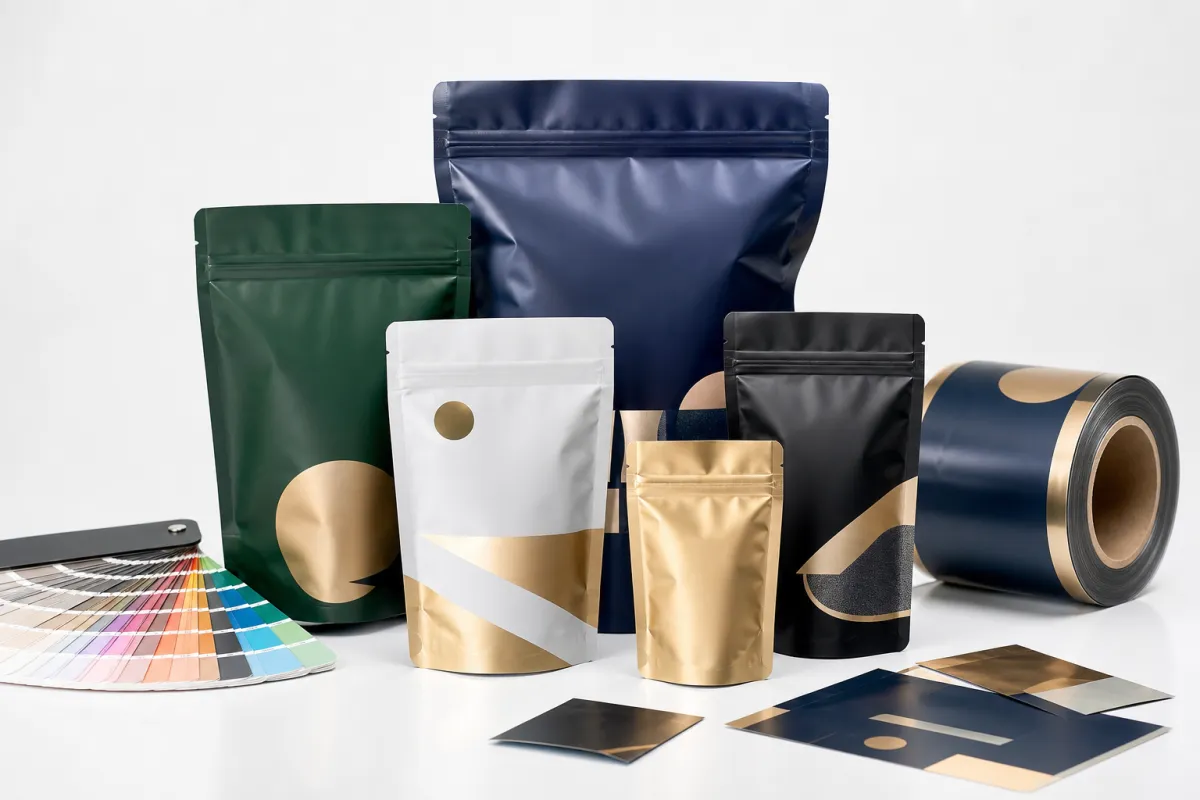
A custom foil pouches supplier does more than print graphics on a catalog pouch. The better partners turn product needs into a real package spec, then help you work through film structure, seal strength, closures, print method, and food-contact compliant construction without blowing up the budget or slowing the line. A good supplier acts like a spec guide, a production coordinator, and a practical second set of eyes.
That matters because every product carries a different set of risks. Coffee roasters usually need strong oxygen barriers and dependable one-way degassing valves. Snack brands may care more about grease resistance, puncture resistance, and a crisp retail display. Supplement companies often want light protection, tamper evidence, and a polished shelf look. Specialty food makers may need aroma retention, moisture control, and seals that stay intact through long shipping routes. A custom foil pouches supplier should be able to explain those tradeoffs clearly, without hiding behind vague claims.
There is a real difference between a stock pouch reseller and a true custom foil pouches supplier. A reseller may only offer a narrow set of sizes and constructions that already exist in the market, which can work for simple orders. A true supplier handles the custom side of the job: sizing, laminations, finishing, closures, print coordination, and the production details that keep the pack consistent from the first run to the reorder.
That difference matters in branded packaging because the package is not only a container. It is part of the product story. In retail packaging, the pouch has to carry color, copy, compliance, and shelf impact at once. From a packaging design standpoint, the best pouch is the one that gives the brand a strong face while still protecting the product inside.
Buyers sometimes focus too early on visual style and too late on performance. The first question should not be, "Can you print my artwork?" It should be, "What structure will hold this product safely, and what does the line need to run it well?" That is the kind of question a strong custom foil pouches supplier is built to answer. I have seen teams save weeks just by starting with that question instead of the mockup.
How custom foil pouches are made and approved
The process usually starts with an inquiry, but the best inquiries are specific. A custom foil pouches supplier will usually want product type, fill weight, dimensions, storage conditions, shelf-life target, closure preference, and artwork status before the first useful quote is built. If a buyer only says "we need a pouch," the supplier is kinda forced to guess, and guessing is where bad pricing and weak structures begin.
From there, the supplier narrows the film recommendation. That choice depends on how the product behaves. Is it sensitive to oxygen? Does it absorb moisture? Will it sit in a warm warehouse, or move through a supply chain with temperature swings? Will it be hand-filled, semi-automated, or run on a vertical or horizontal packing line? A custom foil pouches supplier uses those details to decide whether the build needs true foil, metallized film, a stronger sealant layer, or a finish that works with the fill environment.
- Discovery and quote: the supplier collects product, size, quantity, and compliance details.
- Structure recommendation: film layers, closure, and pouch style are matched to product needs.
- Artwork setup: the design team confirms the dieline, bleed, safe areas, barcodes, and copy.
- Proof review: color, positioning, and text are checked before anything is committed.
- Sample approval: the buyer reviews a mockup, prototype, or production-like sample.
- Production: the approved build moves into manufacturing and quality checks.
- Shipment: freight timing is coordinated with launch, inventory, or filling schedules.
That approval chain looks simple on paper, but it often moves in more than one direction. Artwork may need revision after the first proof because a barcode shifts, a nutrition panel needs more space, or a compliance statement lands too close to a seal area. A custom foil pouches supplier that understands production reality will catch those issues before they turn into expensive mistakes.
Sample types matter too. A flat digital mockup is useful for layout, color flow, and overall placement, but it does not tell you much about structure or feel. A printed prototype is better for showing artwork on a real pouch shape. A production-comparable sample is the strongest option when you need to check stiffness, seal behavior, zipper feel, or how the pouch stands on shelf. The more sensitive your product or line, the more useful that sample stage becomes.
| Sample type | Best use | What it tells you | Limitations |
|---|---|---|---|
| Digital mockup | Early artwork review | Layout, text placement, color direction | No real feel, no barrier validation |
| Printed prototype | Design approval | Artwork on an actual pouch shape | May not match final materials exactly |
| Production-comparable sample | Final validation | Seal feel, structure, zipper, and handling | Takes longer and may cost more |
A custom foil pouches supplier also helps bridge the gap between package branding and real production. That means checking whether the front panel has enough visual impact, whether the back panel has room for required copy, and whether the final pouch still works alongside other branded packaging or custom printed boxes in the same line. When buyers treat design and manufacturing as separate worlds, the result is often a pack that looks complete but runs awkwardly.
For products sold through retail packaging channels, the best approvals are rarely rushed. One or two review rounds is normal, and a careful buyer should expect that. A good custom foil pouches supplier does not just stamp "approved" on the first draft; it helps the team reach a version that is attractive, manufacturable, and suited to the product.
Key factors that affect pouch performance and shelf life
The biggest decision is barrier. A custom foil pouches supplier has to match the barrier level to the product's needs, because the wrong film structure can lead to staleness, flavor loss, clumping, oxidation, or visible package fatigue. Oxygen barrier matters for coffee, supplements, and dried foods. Moisture vapor barrier matters for snacks, powders, and hygroscopic products. Grease resistance matters for oily foods. Light barrier matters for products that break down when exposed to light.
Typical pouch structures use a combination of layers, and each layer has a job. Foil offers very high barrier performance and is often used when shelf-life protection is the priority. Metallized film gives strong barrier at a lower cost than full foil in some applications. PET adds print surface stability and stiffness. Nylon can improve puncture resistance. The sealant layer is what actually closes the pouch and gives it heat-seal performance. A custom foil pouches supplier should be able to explain why each layer is there instead of just saying the build is "food safe."
Closures and format choices matter just as much. Zip locks help with reclosure and consumer convenience. Tear notches support clean opening. Hang holes help in retail packaging displays. Gussets add volume and shelf presence. Spouts support liquids or semi-liquids, though they add complexity and cost. If your filling line is fast, the closure has to behave well under heat and pressure, not just feel good in hand. That is another point where a custom foil pouches supplier earns trust by thinking beyond the mockup.
Finish choices also shape how the pack behaves in the market. Matte films can look refined and modern. Gloss can intensify color and give a bright shelf effect. Soft-touch finishes add a tactile premium feel, but they are not the right fit for every product because they can affect scuff resistance and brightness. Metallic accents can help package branding stand out, yet the finish should never distract from the basic job of protecting the product. In practice, the best-looking pouch is the one that still closes cleanly, ships well, and preserves product quality.
For food buyers, compliance needs should be discussed early. FDA food-contact considerations, tamper-evident features, child-resistant features, and any state or category requirements can change the build. If your product needs validation, ask for test references that make sense for the use case: ASTM F88 for seal strength, ASTM D3985 for oxygen transmission rate, and ASTM F1249 for water vapor transmission rate. A thoughtful custom foil pouches supplier will know those terms and will not act surprised when you ask for them.
Transit testing is another practical layer. If the pouch is going into rough distribution, ask whether the package should be evaluated against ISTA-style transit expectations. The International Safe Transit Association keeps useful resources at ista.org. For paper-based components or fiber sourcing discussions, fsc.org is a common reference point. A custom foil pouches supplier does not replace testing, but it can help you decide where testing is worth the spend.
Custom foil pouches supplier process, timeline, and lead time
Buyers often ask for a lead time number before the pack is fully defined. That is understandable, but a custom foil pouches supplier can only give a meaningful timeline once the artwork, construction, and order size are clear. A simple repeat job may move quickly, while a new structure with specialty closures and multiple SKUs can take more planning than a team expects.
A practical timeline usually follows a familiar path: discovery and quote, artwork prep, proof approval, sample review, production, inspection, and freight planning. For a straightforward order, production might take roughly 12 to 15 business days after proof approval, though the calendar can stretch if the order includes complex print coverage, special finishes, or multiple pouch sizes. A custom foil pouches supplier that communicates early will tell you where the timeline has room and where it does not.
Several factors affect lead time. Print method matters because some methods require more setup or more approval steps. SKU count matters because every size and artwork version adds coordination. Seasonal demand matters because busy periods can fill production schedules fast. Tooling or special components, such as custom zippers or hang features, can add more time. Freight planning can move the schedule too if international transit or warehouse booking is involved. That is why a custom foil pouches supplier should give you a timeline that includes manufacturing and shipping, not just the factory date.
Repeat orders usually move faster. Once the specs are locked and the art is stable, the supplier does not need to revisit the structure or chase missing details. That is one reason experienced buyers keep clean records of approved dimensions, closure styles, panel copy, and print files. Good documentation shortens the next order, and a strong custom foil pouches supplier will usually appreciate that more than a loose "same as last time" instruction.
There is a real planning benefit here for filling and inventory. If your product launch date is fixed, build in time for sample review and corrections, then leave a cushion for freight delays. If the pouch is going into a contract fill, align the packaging calendar with the line schedule so product does not sit idle. The better custom foil pouches supplier relationships are usually built on honest calendars, not optimistic ones.
One more detail buyers forget: packaging testing takes time too. If the pouch will travel through regional distribution, ask whether the package should be checked against transit expectations before you commit to a full production order. That small step can prevent a lot of pain later, especially if the fill line is fast and the product is delicate.
Custom foil pouches supplier cost, MOQ, and pricing drivers
Pricing depends on more than pouch size. A custom foil pouches supplier prices around film structure, print complexity, finishing, closures, special performance requirements, and order volume. A larger pouch uses more material. A tighter barrier stack costs more. A zipper adds cost. A matte or soft-touch finish may add cost. High-coverage print can add cost. If a supplier is quoting a price without asking about those details, the number is probably too rough to trust.
MOQ, or minimum order quantity, is another point buyers need to understand in practical terms. Smaller runs usually carry a higher unit cost because setup, proofing, and conversion expenses are spread across fewer pieces. A custom foil pouches supplier may be able to support a lower starting quantity, but the unit economics usually improve as quantity rises. That is not a trick; it is how manufacturing works.
To compare quotes fairly, look at the full cost stack. Plates or cylinders may be part of the quote depending on print method. Shipping can swing landed cost more than people expect. Warehousing or split shipments may add handling. Test samples may be charged separately. Rush fees can appear if the schedule is compressed. A careful custom foil pouches supplier will make those pieces visible so you do not compare one all-in quote against another quote that hides several extras.
| Pouch build | Typical use | Approx. unit range at 5,000 pcs | Notes |
|---|---|---|---|
| Standard laminated pouch | Dry goods, lighter barrier needs | $0.18 to $0.28 | Good for simpler product packaging, but not ideal for sensitive aroma or moisture control |
| Metallized high-barrier pouch | Snacks, powders, supplements | $0.24 to $0.42 | Often the middle ground for cost and protection |
| Foil-laminate pouch with zipper | Coffee, specialty food, premium retail packaging | $0.30 to $0.55 | Higher barrier and stronger shelf presence, usually the best fit for premium branded packaging |
Those numbers are only a working range, not a quote. A custom foil pouches supplier may come in lower or higher depending on size, print coverage, special features, and how much customization is involved. The cheapest quote is rarely the best quote if it creates leakage, poor seals, or slower fill line performance. In the real world, a weak pouch costs more because it creates waste, delays, and avoidable reorders.
Value is larger than unit price. A slightly higher-priced pouch may save money if it reduces scrap, improves machine efficiency, or holds up better in shipping. That logic applies across branded packaging programs, not just pouches. The same thinking can help with custom printed boxes and other packaging formats because setup costs, print quality, and structural reliability all affect what you actually spend over the life of the product line. A smart custom foil pouches supplier should help you see that full picture.
Common mistakes when choosing a supplier
The first mistake is asking for a quote without enough product detail. A custom foil pouches supplier cannot recommend the right structure if the team does not share fill weight, product type, storage conditions, or shelf-life expectations. Vague specs lead to vague quotes, and vague quotes are how brands end up comparing the wrong things.
The second mistake is treating different builds as if they were identical. A pouch with stronger barrier layers is not the same as a lighter construction, even if both look similar in a mockup. A custom foil pouches supplier can only be compared fairly if size, film stack, finish, zipper, shipping assumptions, and print method are all aligned. Otherwise, the lowest number is often just the least complete quote.
The third mistake is making visual appeal the only priority. Good packaging design matters, and package branding absolutely matters, but the pouch also has to seal properly, resist puncture, and support the product's real shelf-life target. I see this mistake often: a team approves a beautiful layout and later discovers the zipper feels weak or the film is too soft for the fill line. That is not a design problem alone; it is a supplier selection problem.
The fourth mistake is skipping sample testing. Even if the artwork looks right, the finished pack can behave differently once it is filled. A custom foil pouches supplier should encourage testing on the actual product where possible. If the pouch needs to run on a machine, test it on a machine. If it will be handled repeatedly by consumers, simulate that. If the shipping path is rough, check the transit assumptions. Small tests save large costs later.
The fifth mistake is waiting too long to finalize size, closure, or copy. Late changes can affect plate work, print registration, and lead time. They can also shift fill weight or shelf presence in ways that create new problems. A disciplined custom foil pouches supplier relationship works best when the buyer locks the big decisions early and treats the approval stage as a real production gate, not a soft suggestion.
For teams building a larger branded packaging system, the same discipline should carry across every format. A pouch program, a carton program, and any related custom printed boxes should feel like they belong to the same product family. That consistency makes the line look more credible on shelf and helps the customer trust the brand faster.
Expert tips and next steps for better quotes
If you want better numbers from a custom foil pouches supplier, start with a clean spec sheet. Include product type, fill weight, storage conditions, target shelf life, dimensions, quantity, closure preference, artwork status, and any compliance needs. The clearer the brief, the less guesswork in the quote. That also gives you a more honest comparison across suppliers.
Ask for apples-to-apples quotes. Every supplier should be pricing the same pouch size, the same film structure, the same print method, the same closure, and the same shipping assumptions. If one quote includes a zipper and another does not, or one quote assumes a heavier barrier and another does not, the unit price means very little. A good custom foil pouches supplier should welcome that kind of comparison because it shows the real tradeoffs.
For new products, a pilot run or sample order can be worth the spend. A small validation step helps you catch seal issues, graphics problems, or line-fit concerns before the full order lands. That is especially useful if your product will be sold through retail packaging channels where shelf presentation and durability matter at the same time. A custom foil pouches supplier that supports pilot work is usually more useful than one that only talks about volume pricing.
Also ask how the supplier communicates after the quote. Do they respond quickly to proofs? Do they explain why a structure is being recommended? Do they help solve issues before production starts? Those soft details often matter more than a small difference in price. A custom foil pouches supplier that stays clear and steady during proofing is usually the one that will protect you when deadlines get tight.
Here is the simple checklist I would use before sending a request:
- Product type and sensitivity: moisture, oxygen, aroma, grease, or light.
- Target fill weight and pouch size.
- Closure choice: zipper, tear notch, hang hole, spout, or none.
- Quantity, launch date, and repeat-run expectations.
- Artwork status, required copy, and compliance notes.
- Expected storage and shipping conditions.
That checklist turns a vague inquiry into a useful production conversation. It also makes it easier for a custom foil pouches supplier to recommend the right structure instead of the easiest one. Keep that discipline from the start, and you are far more likely to land a pouch that protects the product, supports package branding, and runs the way your operation needs it to.
For brands building out their next run of Custom Packaging Products, the best results usually come from treating the pouch as part of the full product packaging system, not as a last-minute accessory. A skilled custom foil pouches supplier helps turn product needs into a workable package, and that is what keeps a launch looking polished after the first shipment, the second reorder, and the long stretch in between.
If you remember one thing, make it this: give the supplier the product facts first, the artwork second, and the price target third. That order keeps the conversation grounded in performance, and it is the fastest way to separate a true custom foil pouches supplier from someone just selling a pretty bag.
FAQ
What does a custom foil pouches supplier need from me to quote accurately?
A custom foil pouches supplier needs product type, fill weight, storage conditions, size, quantity, closure preference, and artwork status to build a realistic quote. If you already know your filling method or shelf-life target, include that too because it can change the pouch construction and the material recommendation.
How do I compare custom foil pouch suppliers without overpaying?
Compare like for like: same size, same film structure, same print method, same closure, and same freight assumptions. Look beyond unit price and check barrier quality, sample consistency, communication speed, and how well each custom foil pouches supplier explains tradeoffs. A slightly higher quote can be the better deal if it reduces waste, seal failures, or reorders.
What is a typical MOQ for custom foil pouches?
MOQ varies by pouch size, print method, and structure, so there is no single standard number across the industry. Smaller runs usually cost more per pouch because setup costs are spread across fewer units. If you need a low starting quantity, ask whether the supplier can offer a pilot run or staged production.
How long does custom foil pouch production usually take?
Lead time depends on artwork approval, sample review, production complexity, and shipping method. Simple repeat orders move faster than first-time custom jobs because the specs and tooling are already in place. A custom foil pouches supplier should be able to give you a timeline that includes both manufacturing and freight so your launch date is realistic.
Which materials work best for food-grade custom foil pouches?
The best structure depends on the product, but foil and high-barrier laminations are common for moisture, oxygen, and light protection. Coffee, snacks, spices, and supplements often need different barrier balances, so the product should drive the material choice. Ask the supplier to explain why a specific structure is recommended instead of accepting a generic food-safe claim.

