Buyer Fit Snapshot
| Best fit | Custom Foil Pouches with Logo projects where brand print, material claims, artwork control, MOQ, and repeat-order consistency need to be specified before quoting. |
|---|---|
| Quote inputs | Share finished size, material target, print colors, finish, packing count, annual reorder estimate, ship-to region, and any compliance wording. |
| Proofing check | Approve dieline scale, logo placement, barcode or warning zones, color tolerance, closure strength, and carton packing before bulk production. |
| Main risk | Vague material claims, crowded artwork, missing packing details, or unclear freight terms can make a low unit price expensive after revisions. |
Fast answer: Custom Foil Pouches with Logo: Film, Print, MOQ, and Carton Packing should be specified like a repeatable production item. The safest quote records material, print method, finish, artwork proof, packing count, and reorder notes in one written spec.
Production checks before approval
Compare the actual filled-product size with the drawing, then confirm tolerance on folds, seals, hang holes, label areas, and retail display edges. Reserve space for logos, QR codes, warning copy, and material claims before decorative graphics fill the panel.
Quote comparison points
Review material grade, print process, finish, sampling route, tooling charges, carton quantity, and freight assumptions side by side. A quote is only useful when the supplier can repeat the same color, closure quality, and packing count on the next order.
Custom foil Pouches With Logo are not shelf candy. The useful part is quieter: they block oxygen, moisture, light, and odor so the product still feels worth buying when the customer finally opens it. That matters for coffee, powders, snacks, supplements, pet treats, and a long list of products that go stale, clump, or lose punch the second packaging gets sloppy. A good pouch protects the product and carries the brand. No drama. Just fewer problems.
People who buy packaging usually learn this fast. A pouch only performs when the structure, seal, closure, and artwork all pull in the same direction. A pretty logo on a weak build is just expensive regret in a shiny wrapper. Custom Foil Pouches with logo are a packaging decision, not a design exercise. Treat them like one and the budget stops bleeding later.
Brands comparing flexible packaging against custom printed boxes or rigid containers usually see the same pattern. Foil pouches are lighter than jars, easier to store than cartons, and cheaper to ship than anything with real bulk. For sensitive products, custom foil pouches with logo can be a smart upgrade. For less sensitive products, they still earn their keep through retail packaging and package branding alone. Either way, they do a lot without dragging freight costs through the floor.
What Custom Foil Pouches With Logo Actually Are
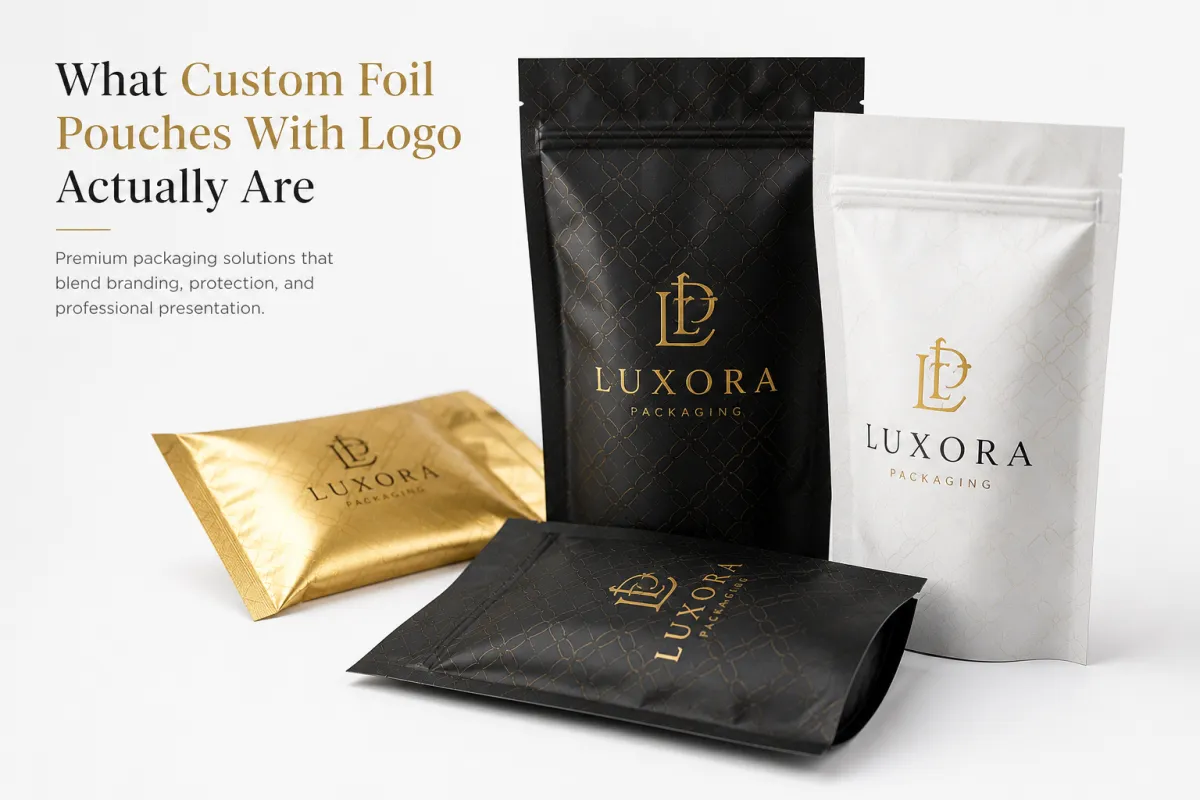
Most people hear “foil” and think shine. Sure, that can be part of it. The bigger point is protection. Custom foil pouches with logo are flexible laminated packages made to guard the product while displaying printed branding on the outside. They can be stand-up pouches, flat pouches, side-gusset pouches, or bottom-gusset formats depending on the product and the shelf goal. The outer layer carries the print, the barrier layer helps resist transmission, and the inner layer seals during filling and packing.
That structure explains why custom foil pouches with logo show up in coffee, nutraceuticals, pet food, snacks, and specialty dry goods. The pouch is light, stackable, and usually easier to move around than rigid packaging. It also lets a brand look premium without buying a thick carton, a molded insert, or a bottle cap doing all the visual heavy lifting. Nice trick, if the product actually needs that level of protection.
In practical terms, custom foil pouches with logo can extend shelf life when the structure matches the product. A snack that stales from oxygen needs different protection than a dry seasoning that mainly needs moisture resistance. Coffee needs stronger odor control and often a one-way valve. A supplement pouch may need light protection plus a seal that survives repeated opening. Same category. Different build. That is where buyers get burned: they choose the format first and the performance second.
Here is the part people love to skip. The logo is only one piece of the package. Custom foil pouches with logo still have to seal properly, run on the filling line, survive transit, and stay readable after handling. If the seal area is too narrow, if the pouch overfills, or if the artwork ignores safe zones, the mockup looks great and the real package looks tired. Packaging design is not just color and typography. It is structure, function, and compliance behaving themselves at the same time.
“A pouch that looks premium but fails at the seal is not premium. It is a refund waiting to happen.”
For brands building a broader product packaging system, custom foil pouches with logo also keep the line visually consistent across flavors, sizes, or formulas. Customers notice repetition more than they admit. Logo placement, finish, and panel layout become part of brand memory, which is why package branding works so well when it is controlled instead of random.
If you are comparing flexible pouches with other formats, look at them the same way you would look at Custom Packaging Products overall: by product behavior, shelf life, and total landed cost, not just the unit price on a quote sheet.
How Custom Foil Pouches With Logo Work
Custom foil pouches with logo usually rely on a layered construction. The outer layer is the print surface and often carries the branding, logo, product details, and design effects. The middle layer is the barrier, which may be true foil or a metallized film depending on the performance target. The inner layer is the sealant, the part that heat-seals shut during production. Each layer has a job. Skip one and the pouch gets less useful fast.
The barrier layer matters because it slows oxygen and moisture transfer. That is the whole point. Oxygen can stale snacks, dull coffee flavor, and damage sensitive ingredients. Moisture can clump powders, soften crackers, and shorten shelf stability. Light can degrade color, aroma, or potency. Odor transfer is another problem people ignore until a strong-smelling product ruins the rest of the pallet. Custom foil pouches with logo are built to cut those risks when the film structure is chosen correctly.
Print methods matter too. Logos can be reverse-printed under the laminate, surface-printed, or finished with matte, gloss, soft-touch, or metallic accents. Each choice changes the look and the cost. Matte usually reads as more restrained and premium. Gloss is louder and catches shelf light better. Metallic accents help the logo stand out, though a design with too many tricks can start looking desperate. Loud is not the same as clear.
Custom foil pouches with logo can also include practical features that affect day-to-day use much more than many design teams expect:
- Zippers for repeat opening and resealing.
- Tear notches for clean first-open access.
- Hang holes for display or peg merchandising.
- One-way degassing valves for coffee and other gas-releasing products.
- Clear windows when visibility matters more than maximum barrier.
Those add-ons do not just change the mockup. They change the way the pouch behaves in a warehouse, on a shelf, and in a customer’s kitchen. A zipper helps repeated use but adds cost and can change sealing behavior. A valve helps fresh coffee release gas but adds another point where sloppy work shows up. A window gives product visibility but usually weakens barrier performance in that area. Tradeoffs. Always tradeoffs.
There is also a production reality buyers should not ignore. Custom foil pouches with logo have to run at the right speed, seal at the right temperature, and avoid pinholes or delamination during transit. I have seen teams fall in love with a gorgeous proof, only to discover the film was a pain on the filler and the seal window was too tight. Pretty art does not fix a finicky machine. A pouch is worthless if it jams the filler or pops a seal after a short drop. Packaging Association resources like packaging.org are useful if you want a broader industry view on material and design decisions. For shipping and distribution testing, standards from ISTA are worth a look because they deal with the boring stuff that actually protects product.
Key Factors That Change Performance and Appearance
The first thing I ask about custom foil pouches with logo is the product itself. Dry goods, oily foods, powders, supplements, coffee, and pet treats all have different needs. A pouch for granola can be very different from a pouch for protein powder, and both differ again from a pouch for roasted coffee. If the barrier is too weak, the product fails early. If the structure is overbuilt, you pay for protection you do not need. Neither outcome is smart.
Size and fill weight matter more than many people expect. A pouch that looks balanced in an empty mockup can look bloated, wrinkled, or awkward once it is filled. Too much headspace can make the pack feel cheap. Too little can stress the seal or distort the logo panel. Custom foil pouches with logo should be sized around the actual fill weight and the physical behavior of the product, not around what looks pretty in a PDF.
Finish changes perception fast. Matte tends to feel more restrained and upscale. Gloss has more shelf punch and can make colors appear deeper. Soft-touch gives a tactile premium feel, though it can add cost and sometimes shows scuffs more visibly. Metallic accents can help package branding, but the design needs breathing room. If every element is shouting, none of it sticks. That is not bold. That is noise.
Closure options deserve real attention too. A resealable zipper is a good choice for products opened more than once, especially snacks, supplements, coffee, and powders. A tear-only pouch can work for samples or single-serve items, where simplicity and low cost matter more than repeat closure. For custom foil pouches with logo, the closure should match how the customer actually uses the product, not what the design team thinks looks nice on a slide.
Compliance is the other big one. Ingredient panels, barcode placement, recycle instructions, lot codes, and any required legal copy need to be planned before final approval. If the artwork gets forced to fit after the dieline is locked, the layout gets cramped fast. That is where packaging design starts to wobble. Good product packaging starts with a clear hierarchy, then fits the legal content around it without making the pouch look like a tax form.
There is also the material question. Traditional foil laminates are not the only route, and they are not always the right route. In some cases, metallized films or alternative structures can meet the need at a lower cost or with different recyclability characteristics. If sustainability matters, compare the structure carefully. The EPA has useful background on packaging waste and material recovery concepts at epa.gov/recycle, but general sustainability language should never replace a hard look at the actual barrier requirement.
What usually changes the outcome most
From a packaging buyer’s point of view, the three biggest drivers are usually product sensitivity, closure choice, and print finish. Those are the places where custom foil pouches with logo can swing from cost-effective to overpriced very quickly. A change in zipper style or barrier grade can matter more than a logo refresh. That is why experienced suppliers ask annoying questions before quoting. They are not being difficult. They are trying to avoid quoting the wrong pouch.
- Product sensitivity determines barrier requirements.
- Fill behavior determines pouch size and seal zone design.
- Brand goals determine print method and finish.
- Distribution conditions determine whether extra protection is worth paying for.
If you are also developing custom printed boxes or a full branded packaging line, consistency across formats matters. The pouch should feel like it belongs to the same brand family, even if the materials are different. That does not mean every package needs the same graphic treatment. It means the tone, typography, and logo handling should be deliberate. Package branding works best when the system holds together.
Custom Foil Pouches With Logo: Cost and Pricing
Pricing for custom foil pouches with logo depends on more than the size on the quote sheet. Pouch dimensions, film structure, barrier grade, print colors, finish, zipper type, valve inclusion, window cutout, and order quantity all affect unit cost. That is why two quotes can look wildly different and still be technically correct. The real issue is usually that they are not quoting the same pouch.
Setup costs are real. Samples, plates, proofing, dielines, and color checks can add upfront expense, especially on new projects. Small runs feel expensive because those setup costs get spread across fewer units. Larger orders usually lower the per-piece price, but they also raise cash commitment and storage burden. There is no magic here. The math is boring, which is exactly why it works.
For many buyers, a useful way to think about custom foil pouches with logo is in terms of typical ranges rather than a fake “one price fits all” answer. A simple mid-size pouch with a standard zipper and moderate print coverage will land somewhere very different from a high-barrier pouch with a matte finish and custom valve. The more premium the finish and the more complex the structure, the more the price moves. Not subtle. Very obvious.
| Option | Typical Use | What Affects Cost Most | Practical Tradeoff |
|---|---|---|---|
| Basic laminated pouch | Dry products, samples, low-risk retail | Size, print coverage, quantity | Lower unit cost, less premium feel |
| Custom foil pouch with zipper | Snacks, powders, supplements | Zipper type, finish, barrier grade | Better consumer convenience, higher cost |
| High-barrier pouch with valve | Coffee, aroma-sensitive products | Valve, multilayer structure, testing | Best product protection, more setup complexity |
| Windowed retail pouch | Display-focused product packaging | Window size, barrier loss, artwork balance | Better shelf visibility, weaker protection in the window area |
That table is the real decision tree. The cheapest option is not always the smartest, and the most elaborate option is often overkill. Better barrier and better finishing cost more, yes, but they can also reduce spoilage, returns, and weak shelf presentation. From a buying perspective, the right question is not “What is the lowest price?” It is “What structure gives me the least headache over the product’s actual life?”
To compare vendors properly, insist on apples-to-apples quotes. Ask them to quote the same size, same film build, same closure, same print method, and same shipping terms. If one supplier is quoting a 3.5 mil pouch with gloss lamination and another is quoting a 5 mil high-barrier structure with matte finish and zipper, the price difference tells you almost nothing. That kind of comparison is how people get fooled by low quotes.
If you need to lower cost, there are sane ways to do it. Simplify artwork. Remove nonessential features. Standardize pouch size across SKUs where possible. Reduce the number of print colors if the design allows it. Make sure the structure is only as strong as the product requires. Those are the levers. Everything else is usually decorative spending dressed up as strategy.
Where savings usually hide
The easiest savings in custom foil pouches with logo usually come from design simplification and size rationalization. A cleaner front panel, fewer special effects, and a more standard zipper can make a bigger difference than most people expect. If you are buying branded packaging across multiple product lines, standardizing pouch widths and heights can also improve forecasting and reduce waste. That matters even more if you are pairing pouches with other product packaging formats.
Honestly, this is where plenty of projects get sloppy. Teams spend money making the logo shine, then underinvest in the structure that protects the thing they are selling. A good pouch should earn its keep. Otherwise you are buying expensive decoration with a fancy seal.
Step-by-Step Process and Timeline
The best way to order custom foil pouches with logo is to treat the project like a controlled production process, not a one-email purchase. Start with the product requirements: what is being packed, how long it needs to stay stable, how often it will be opened, and where it will be sold. From there, ask for a structure recommendation before you polish the artwork. That order matters. Structure first, design second. Every time.
A clean process usually looks like this:
- Define the product, fill weight, and barrier needs.
- Request a structure recommendation and size range.
- Confirm pouch style, closure, and finish.
- Review the dieline and panel layout.
- Prepare artwork with bleed, safe zones, and barcode placement.
- Approve the proof and request samples if needed.
- Run fill tests and seal checks.
- Move into production and delivery.
Timeline depends on complexity. Straightforward repeat orders can move faster because the structure already exists and the artwork is already approved. New structures, special finishes, or custom functional features add proofing time. For many projects, a realistic schedule is often 12 to 15 business days from proof approval to production completion, with extra time for shipping. If the design is more complex, add more breathing room. Rushing packaging is a great way to buy a problem in bulk.
The proof stage is where most preventable errors get caught. Panel alignment, barcode placement, seal zones, and color expectations all need a careful look. A logo that looked perfect on a desktop monitor can shift once it sits on laminated film with limited print tolerance. If the brand depends on exact color matching, ask how the supplier handles spot colors, CMYK conversion, and ink control. Do not assume they all work the same way. They do not.
Sampling matters more than people admit. A flat PDF does not tell you how a pouch fills, where the seams sit, or whether the zipper feels right in hand. Fill tests, seal tests, drop tests, and shelf tests catch problems early. If the product is fragile or high-value, use transit testing too. ISTA guidelines are helpful for this kind of validation because they force the package to survive realistic handling, not just a polite desk inspection.
Delivery planning is the final piece, and it is often treated like an afterthought. It should not be. Production is only half the job. Transit time, customs delays, warehouse receiving, and launch dates all need to be mapped before approval. A perfect pouch arriving two weeks late is not a win. It is a scheduling failure with good print quality.
For brands coordinating custom foil pouches with logo alongside custom printed boxes or other branded packaging, align the calendar early. Packaging design should not be approved in separate silos if the launch depends on multiple components arriving together. That is how teams create expensive, avoidable bottlenecks.
Common Mistakes When Ordering Foil Pouches
The biggest mistake is starting with artwork before the size is locked. A logo can look perfect in a mockup and useless once the pouch dimensions change. That happens constantly. The panels move, the safe zones shift, and suddenly the front design feels cramped or off-center. Custom foil pouches with logo should be sized first, designed second, and approved last. That sequence keeps the project from wasting time.
Another common mistake is choosing appearance first and barrier second. People fall in love with the shine, the metallic effect, or the soft-touch finish and only later ask whether the product will stay fresh. That is backwards. The pouch exists to protect the contents. If custom foil pouches with logo cannot handle oxygen, moisture, light, or odor exposure properly, then the branding is just lipstick on a leaking bag.
Closure mistakes are especially annoying. If a product will be opened repeatedly, skipping a zipper because it saves a few cents is often a false economy. Customers notice. They may not know why the packaging feels bad, but they absolutely know that a pouch without a reseal option is inconvenient. For some products, that inconvenience turns into a complaint. For others, it turns into a missed repurchase.
File issues create delays too. Low-resolution logos, tiny legal text, and messy color builds are all preventable. Barcode placement errors and bleed problems are too. Ask for the dieline and follow it. Clean vector files make custom foil pouches with logo look sharp; sloppy files make everybody’s life harder. There is no mystery there.
Testing mistakes are the last big one. No one should approve a pouch without checking actual fill behavior, seal strength, and shipping durability. A package that looks fine on a monitor can fail under heat, pressure, or vibration. That is why samples exist. A buyer who skips validation is basically paying to discover the obvious the hard way.
If sustainability is part of your checklist, do not assume every flexible pouch is recyclable or that every “eco” label means much. Some multilayer structures are hard to recycle because they combine materials that do not separate cleanly. Check claims carefully. The FSC is useful for paper sourcing context, but paper credentials do not magically make a foil laminate curbside recyclable. Different material, different system, different rules.
“The cheapest pouch on paper is often the one that costs the most after returns, spoilage, and reprints.”
Expert Tips and Next Steps for Better Results
Here is the boring truth that saves money: barrier comes first, decoration comes second. Custom foil pouches with logo should protect the product and run cleanly on the line before anyone obsesses over metallic ink or special effects. That does not mean the branding should be dull. It means the structure has to earn the right to look good.
A smarter sampling approach is to ask for two or three structure options and test them with real product. Put actual fill weight in the pouch. Check the seal after filling. Store the samples under the conditions the product will face in the field. If you are packing coffee, let it outgas. If you are packing powders, check clumping. If you are packing snacks, monitor texture. Real product testing reveals what design decks cannot.
When comparing suppliers, look beyond price. Compare how well they explain tradeoffs, how clean their proofs are, how they handle artwork, and whether they understand product packaging beyond a single format. A supplier that only says “yes” is not necessarily helpful. Sometimes the best supplier is the one who says the pouch needs a different zipper, a thicker barrier, or a simpler design. That honesty is worth money.
Use a launch checklist before approval. It should include the final size, fill weight, artwork files, closure choice, compliance copy, test plan, and delivery window. Keep the checklist short enough that people actually use it. Long checklists turn into decorative bureaucracy. Short ones save real orders.
If you are building a product line instead of a one-off SKU, think about the family system. Custom foil pouches with logo can be the centerpiece, but they should sit comfortably beside other branded packaging such as custom printed boxes, shipping cartons, or retail display packs. Consistency across formats builds recognition faster than trying to make every package a separate design experiment.
One last practical point: ask your supplier to explain the minimum order quantity, plate costs, proof cycles, and lead times upfront. If they get vague, expect trouble later. If they give exact ranges and explain why those ranges exist, that is a better sign. Buyers do not need fairy tales. They need numbers that hold up.
Once the structure is right, the proof is clean, and the product has passed testing, custom foil pouches with logo stop being a gamble and start being a controlled purchase. That is the goal. Not flashy. Not fragile. Just a pouch that does the job and makes the brand look like it knows what it is doing.
For most brands, that is the sweet spot: custom foil pouches with logo that protect the product, support retail packaging goals, and fit the budget without making operations messy. If you get the structure, finish, and artwork aligned, custom foil pouches with logo can be one of the most useful packaging upgrades you make.
How much do custom foil pouches with logo usually cost?
Price depends on size, barrier film, print complexity, finish, zipper or valve options, and how many units you order. Small runs cost more per pouch because setup and proofing get spread across fewer units. Ask for quotes with the exact same specs so you can compare vendors without the usual pricing smoke and mirrors.
What products work best in custom foil pouches with logo?
They are a strong fit for coffee, tea, snacks, supplements, powders, pet treats, and anything sensitive to oxygen, moisture, light, or odor. They also work well when you need a premium shelf look and lighter shipping weight than rigid containers. If the product is greasy, fragrant, or fragile, barrier and seal quality matter even more.
How long does the custom foil pouch process take?
Straightforward repeat orders move faster than brand-new structures, custom finishes, or complex artwork approvals. Most of the schedule is spent on size confirmation, proofing, and sampling before production even starts. Build time around extra rounds if the pouch needs a zipper, special barrier, or line testing.
Are custom foil pouches with logo recyclable?
Many foil laminates are not curbside recyclable because they combine multiple materials into one structure. If recyclability matters, ask about mono-material or alternative barrier structures and compare the tradeoff in protection. Do not assume a pouch is recyclable just because it is flexible or uses less plastic than a rigid package.
What artwork files do I need for custom foil pouches with logo?
Send vector logo files when possible, along with exact colors, bleed, safe zones, barcode placement, and required legal copy. Use high-resolution assets and clean typography so the logo and compliance text stay sharp after printing. A proper dieline review prevents embarrassing placement mistakes and expensive reprints.

