Buyer Fit Snapshot
| Best fit | custom food cartons with logo branding fast for packaging buyers comparing material specs, print proof, MOQ, unit cost, freight, and repeat-order risk where brand print, material, artwork control, and repeat-order consistency matter. |
|---|---|
| Quote inputs | Share finished size, material target, print colors, finish, packing count, annual reorder estimate, and delivery region. |
| Proofing check | Approve dieline scale, logo placement, barcode or warning zones, color tolerance, and any recyclable or compostable wording before bulk production. |
| Main risk | Vague material claims, crowded artwork, or missing packing details can create delays even when the unit price looks attractive. |
Fast answer: Custom Food Cartons with Logo Branding Fast: Dieline, Finish, Proof, and Buyer Review should be specified like a repeatable production item. The safest quote includes material, print method, finish, artwork proof, carton packing, and reorder notes in one written spec.
What to confirm before approving the packaging proof
Check the product dimensions against the actual filled item, not only the sales mockup. Ask for tolerance on folds, seals, hang holes, label areas, and retail display edges. If the package carries a logo, QR code, warning copy, or legal claim, reserve that space before decorative graphics fill the panel.
How to compare quotes without losing quality
Compare board or film grade, print process, finish, sampling route, tooling charges, carton quantity, and freight assumptions side by side. A lower quote is only useful if the supplier can repeat the same color, closure quality, and packing count on the next order.
Custom Food Cartons with Logo: Branding That Sells Fast
People decide what food is worth buying faster than they usually admit. A carton sits on a counter for a few seconds, maybe rides in a delivery bag for ten more minutes, and that tiny window does a lot of work. Custom food cartons with logo do more than hold fries, pastries, noodle bowls, or desserts. They shape the first impression, protect the product, and make the brand memorable after the meal is gone.
In packaging audits, I keep seeing the same thing: the box is treated like a last step, then everybody acts surprised when the package underperforms. That is usually where the trouble starts. Custom food cartons with logo sit at the intersection of practical handling, product protection, and brand presentation, and the best versions handle all three without drama. If a carton looks sharp but collapses in a courier bag, that is not branding. That is a problem with printing on it.
If you are comparing formats for a new run, the structure should drive the decision before the artwork gets too far ahead of it. Browse Custom Packaging Products if you want to see how carton styles change for bakery items, fried foods, and meal packaging. The box has to suit the food. Not the other way around.
That sounds obvious, but packaging teams still make the same mistake: a pretty mockup, a rushed approval, and then a carton that bends, leaks, or crowds the logo into a corner. Custom food cartons with logo work best when the carton spec, the food profile, and the brand system are built together. That is the practical difference between a package that does real work and a generic container with ink on the side.
What Are Custom Food Cartons with Logo?
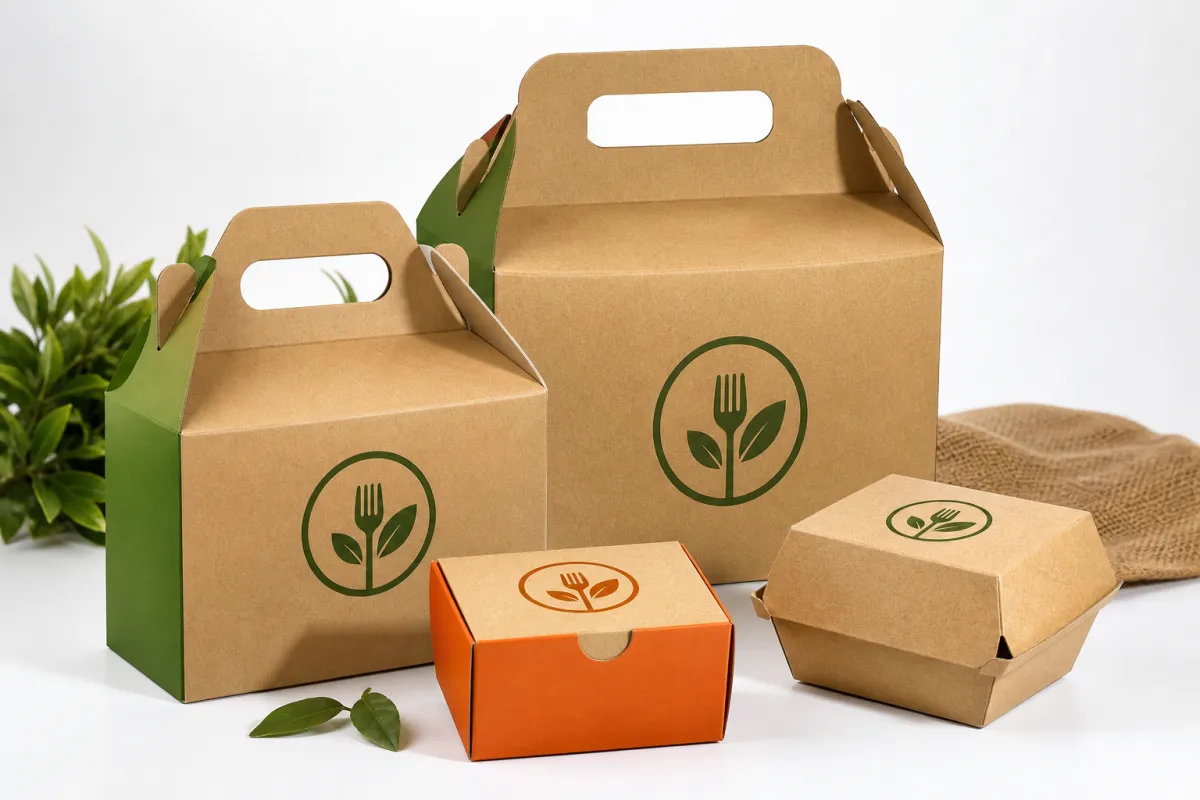
Custom food cartons with logo are food-safe containers printed with a brand mark, product message, or visual system that helps the package do marketing work while it carries the food. The carton is not just a shell. It is a surface that stays in the customer’s line of sight at the exact moment the purchase gets judged. In restaurants, bakeries, and fast-casual counters, that matters more than many brands want to admit.
These cartons show up wherever speed, structure, and presentation overlap: takeout counters, bakery cases, dessert sleeves, deli trays, fried-food boxes, meal-kit components, and grab-and-go displays. Use case changes everything. A dry pastry carton does not need the same barrier performance as a box holding saucy rice or hot wings. I have seen more than one bakery order a nice-looking stock carton, only to find that a warm tart steamed the base soft within minutes. Pretty is nice. Functional is what keeps the day moving.
The strongest cartons pull three jobs together. They protect the product, they help the kitchen move quickly, and they reinforce the brand. Miss one of those, and the other two lose strength. A carton that stacks well during prep, travels well in transit, and gives the logo room to breathe feels deliberate. That is what useful branding looks like. Not decoration. Not noise. A package that earns attention because it works.
Packaging also changes memory. A clean carton helps customers recognize the business on a shelf, in a social post, or in a delivery photo. That kind of recognition compounds fast for smaller brands, where one package may do the work a billboard would normally handle. For that reason, custom food cartons with logo often become one of the smartest forms of food packaging for operators trying to build visibility without buying a huge media budget.
Trust rides along with that too. A carton built around the food suggests the business pays attention to details. A flimsy box with a tiny mark suggests the opposite. People notice even when they do not say it out loud. Their hands and eyes make the call first.
A carton should make the food easier to choose, not harder to justify.
That is why custom food cartons with logo keep showing up in launch plans, rebrand decks, and store refreshes. They are visible, practical, and measurable. Better shelf presence. Fewer leaks. Faster packing. Less damage in transit. Those are concrete gains, not decorative ones.
How Do Custom Food Cartons with Logo Work?
The production path for custom food cartons with logo is straightforward when the brief is specific. Structure comes first. Dimensions follow. Artwork is then placed on a dieline, a proof is reviewed, and production begins after approval. That is the clean version. The messy version starts when nobody can name the fill weight, the closure type, or whether steam relief is needed.
Dielines matter because they control where the logo lands. A dieline is the flat map of folds, glue zones, cut lines, and panel positions. Ignore it and the mark may sit too close to a crease or disappear into a flap. Safe zones prevent that. Bleed handles trim tolerance. A print-ready file needs both, or the final carton can look slightly off even if the color match is fine.
Printing method changes the economics and the finish. Digital printing suits shorter runs, fast revisions, and multiple artwork versions. Offset printing fits larger quantities where color consistency and image detail matter more. Flexographic printing often makes sense for simpler packaging at scale. None of these is a universal winner. The right choice depends on quantity, complexity, and the visual result the brand actually needs.
Coatings, windows, and finishes change how custom food cartons with logo behave outside the mockup. An aqueous coating can add modest protection and leave a cleaner surface. A varnish can improve handling and sharpen the printed look. A window can reveal the product, which works especially well for bakery and retail packaging where visual appetite sells before the first bite. Every add-on should earn its place. If it does not improve selling, protection, or usability, it is just extra cost wearing a glossy jacket.
The customer experience stretches far beyond the counter. The carton sits on a shelf, goes into a delivery bag, rides in a car, gets opened at a desk or table, and often ends up in a photo before it gets tossed. That is a long journey for one small box. Custom food cartons with logo work because they turn that journey into a brand impression instead of a generic handoff.
Operations matter just as much as appearance. If staff must fold 400 cartons during lunch rush, the shape should assemble fast and repeatably. If the package carries hot food, the board should resist softening and steam distortion. If it needs to stack for display, the top panel should stay rigid instead of bowing under light pressure. Packaging teams think about cartons as systems because the system is what gets used.
For brands moving past a plain stock box, custom food cartons with logo often become the bridge between a basic container and a branded package that feels intentional. That is especially useful when the carton also has to carry menu labels, promotions, or seasonal artwork without forcing a new format every time the menu changes.
Materials, Coatings, and Structural Choices
Material selection is where many good ideas lose momentum. Custom food cartons with logo can look polished in a render and still fail if the board stock is too light for the food inside. Common choices include SBS, C1S, C2S, and kraft-based boards, usually in the 250gsm to 400gsm range depending on structure and load. Heavier board improves crush resistance. Lighter stock lowers cost, though not always safely. Matching the material to heat, grease, moisture, and handling is what keeps the carton honest.
Grease resistance often matters more than the print treatment. A carton for fries, wings, or saucy noodles needs a surface that resists migration long enough to avoid obvious staining. Moisture control matters for hot foods that release steam. Crush strength matters in delivery and during stacking. A box that sags in a courier bag undermines whatever the logo was trying to say.
Structure choices carry equal weight. Folding cartons, tuck-end cartons, auto-lock bottoms, sleeve boxes, and clamshell-style food cartons solve different problems. Inserts can help with separation or portion control. Lock tabs can reduce the need for adhesive. Some shapes speed filling, while others improve display. For custom food cartons with logo, the structure should fit the service flow rather than complicate it.
Coatings affect both performance and perception. An aqueous coating is often a practical default because it adds a light barrier and improves scuff resistance. A varnish helps when the printed surface needs a cleaner appearance or a bit more protection. Food-safe barrier coatings matter when grease or moisture exposure is predictable. If the carton will touch oily food directly, ask about migration resistance and whether the board is intended for that use. A polished sample can hide a weak spec.
Material sourcing adds another layer. FSC-certified paperboard can support responsible sourcing claims, and customers increasingly understand that signal. If certification matters to your brand, verify the chain-of-custody details directly with FSC. A vague “eco-friendly” label does not fill the gap. It never really has.
The structure should also respect the logo. A narrow front panel can make the mark feel crowded. Too many folds can break the artwork into fragments. Packaging teams often develop the structure and branding together for that reason. A clean, uninterrupted panel gives custom food cartons with logo more presence and makes the design feel purposeful instead of squeezed in.
If the cartons will move through delivery or distribution, ask how they were tested against handling reality. For transit and vibration references, the ISTA site is a useful starting point. Not every food carton needs formal lab validation, but the thinking helps: simulate the actual abuse, not the ideal scenario in a presentation deck.
The visual layer can only stretch so far if the structure is weak. The best custom food cartons with logo usually come from a practical balance of board strength, barrier performance, and assembly speed. Attractive is fine. Fragile is expensive.
What Drives the Cost of Custom Food Cartons with Logo?
Pricing for custom food cartons with logo comes down to a few concrete variables: material grade, size, print coverage, number of colors, coating, structural complexity, and quantity. That is the real list. Anything else starts drifting into sales language. A small carton with one-color print and no special finish sits in a different cost band than a large carton with full coverage, a custom die, and a specialty coating.
Volume changes the math quickly. Lower quantities carry higher per-unit costs because setup, proofing, and production prep are spread across fewer cartons. At 1,000 units, setup weighs more heavily. At 10,000 or 20,000 units, the per-unit price often falls enough to change the buying decision. That is why tiered quotes are worth requesting. One number tells very little. Several volume breaks tell the story.
Here is the useful way to compare options for custom food cartons with logo:
| Option | Typical Quantity | Approx. Unit Price | Best For | Tradeoff |
|---|---|---|---|---|
| Stock-style carton with simple print | 1,000-3,000 | $0.28-$0.55 | Testing a new menu item or small launch | Higher per-unit cost, less customization |
| Mid-range custom carton with coating | 5,000-10,000 | $0.18-$0.34 | Regular takeout, bakery, or meal service | Needs more planning on artwork and specs |
| Higher-volume branded carton with special finish | 20,000+ | $0.11-$0.22 | Multi-location brands and steady repeat orders | More upfront commitment and storage space |
Those figures are not universal. A carton for greasy fried food can cost more than a dry bakery box at the same quantity. A window adds cost. A custom insert adds cost. Embossing, foil, matte lamination, soft-touch coating, and structural changes add cost too. Every choice stacks on top of the others.
Hidden costs are where buyers usually get surprised. Rush production can carry a premium. Freight can matter a lot if the carton is bulky. Heavier board raises shipping weight. A custom die may require tooling expense. Revisions after proof approval can trigger delays and redraw charges. Careful packaging design helps here because clean specs reduce waste.
Comparing custom food cartons with logo across several quantity levels makes the tradeoffs obvious. Ask the supplier to separate the base price from the extras. That way you can see whether the jump from 5,000 units to 10,000 units is worth the storage space. Sometimes it is. Sometimes it is not. A lower unit price means little if the inventory sits too long or the menu changes before the cartons are used.
Artwork complexity also has a real effect on the final bill. Dense ink coverage, full-panel graphics, tight registration, and multiple spot colors can all increase production difficulty. Tight budgets usually benefit from simpler art and better materials. A clean logo on a sturdy carton often outperforms a crowded print job that looks busy and feels flimsy.
Process and Timeline: From Dieline to Delivery
The production timeline for custom food cartons with logo usually follows the same sequence: brief, sizing, artwork, proofing, sampling, production, finishing, and shipment. The order hardly changes. The jobs that move fastest are the ones where the client already knows the food dimensions, print needs, and packaging goals before the first file opens.
Briefing is where many delays begin. The supplier needs the carton dimensions, food type, quantity, print method, coating preference, and any compliance requirements. If the box must handle hot food, say that. If it will ship flat to a fulfillment center, say that. If the logo should appear on only one panel, say that. Vague briefs create slower revisions. Slower revisions push launch dates out.
Standard structures can move quickly when files are ready. A straightforward run might go from final artwork to production in roughly 10-15 business days, depending on factory capacity and print method. Custom structures, specialty coatings, or new tooling can stretch the schedule well beyond that. First runs usually need extra time because the team is still resolving practical details like fold behavior, lock strength, and panel fit.
Changes after proof approval are a classic schedule killer. Someone notices the logo sits too close to a crease. Someone else wants a claims line added late in the process. The carton goes back into revision. Approval discipline matters because the cartons are not the hard part. Indecision is.
Sampling is worth the time. A flat PDF cannot tell you how the board feels, how the closure behaves, or whether the carton stays rigid after a hot fill. If the food is greasy or saucy, test the sample with the real product and a realistic hold time. If the carton will be used in delivery, shake it, stack it, and place it in a bag. Weak points show up fast once the box leaves the screen and enters the kitchen.
For custom food cartons with logo, a clear approval process protects both print quality and launch timing. A simple checklist helps: dimensions confirmed, dieline approved, bleed set, colors matched, coating selected, sample tested, and final sign-off captured. That may sound formal, but it saves money. Packaging failures are rarely dramatic. They are usually the result of small mistakes left untouched.
One practical move pays off every time: build in extra time for the first order. Even with a strong brief, the first production run tends to uncover one more question. That is normal. The mistake is pretending the timeline will behave like a spreadsheet.
How Do You Choose Custom Food Cartons with Logo?
Start with the food. Temperature, moisture, grease level, portion size, and hold time should drive the decision. A carton for warm pastries has different needs from a box holding saucy noodles or fried snacks. If the product gives off steam, the package needs a plan for it. If the food sits for 20 minutes before pickup, the carton needs more structure than a quick-service tray.
Carton style should then follow the way it is used. Dine-in packaging can be lighter because it travels less. Delivery packaging needs stronger closure and better board performance. Display cartons need clearer visual impact and often better stackability. Shelf takeaway needs a front panel that reads quickly because the carton has to sell before anyone opens it. That is why custom food cartons with logo are never truly one-size-fits-all.
Artwork should obey the same logic. The logo needs to be large enough to read at arm’s length. Typography should stay clear. The front panel should not try to carry every message the brand has ever written. One strong message usually beats four weak ones. If the carton has a window, the printed areas should frame the food rather than fight it. Good branding usually comes from restraint and clarity, not volume.
The operating environment matters too. If staff assemble the carton during a rush, it should fold fast and consistently. If the product sits in a retail display, the carton should look good from multiple angles. If it travels in a paper bag, the printed surface should resist scuffing. Those details decide whether the packaging feels premium or merely printed.
Ordering a sample or prototype is the safest move, especially when the carton must carry heavy, greasy, or saucy food. A good prototype tells you more than a dozen opinions in a meeting. You can check closure, stack height, print placement, and handling. If the sample feels wrong in your hand, a full production run will not magically correct it.
Use a simple approval checklist before final sign-off. Design should confirm the artwork. Operations should confirm assembly and fill behavior. Production should confirm print specs, coating, and tolerances. If each group signs off in isolation, the carton may look fine on paper and still fail on the line. The safest custom food cartons with logo are approved by people who understand how the box will actually be used.
If you already have stock packaging, compare it directly with the spec you want. Measure the current box, note the food issues, and list the changes that need to happen. Then decide whether the new carton solves a real problem or simply adds print. That sounds blunt because it is. Printing alone does not improve a carton. Better specifications do.
Common Mistakes, Expert Tips, and Next Steps
The most common mistake with custom food cartons with logo is choosing the wrong board weight. Buyers get pulled in by a polished mockup, then discover the carton softens under heat or dents during transit. Grease performance comes next. A crowded design follows close behind, with the logo disappearing into a wall of copy, icons, and claims.
Approving artwork without testing is another frequent miss. A screen mockup cannot show how the carton behaves under real food conditions. Steam, condensation, oil, and handling pressure can expose weak specs in minutes. If packaging only works in a clean render, it does not really work. I have seen teams discover that the hard way after launch, and nobody enjoys reprinting a whole run because the lid curls in a warm kitchen.
These practical moves save money and frustration:
- Keep the logo large enough to read from 3-6 feet away.
- Use one clear brand message on the main panel.
- Choose a coating for food performance, not only for appearance.
- Test the carton with real product, not paper towels and optimism.
- Ask for proof, sample, and production specs in writing.
There is a brand lesson buried inside all of this. A carton that is easy to assemble, easy to stack, and easy to recognize feels more premium than a complicated package that looks impressive on a screen and awkward in the kitchen. That is why custom food cartons with logo should be built around operations as much as design. Packaging that slows a team down costs real money, even if it photographs well.
From a packaging buyer’s point of view, the next move is straightforward. Audit the current cartons. Measure the actual product. List the temperature, grease, and transport challenges. Gather artwork files. Request samples. Then compare quote tiers at multiple quantities so the breakpoints are visible instead of guessed. If you need a wider view of packaging options, reviewing Custom Packaging Products can help you compare carton formats against other branded packaging choices.
The smartest launch plan usually starts small: a pilot run, a real-world test, and then a larger production order once the details settle. That keeps risk down and gives you room to fix weak points before they become inventory problems. It is not glamorous. It is how good packaging decisions are made.
Done well, custom food cartons with logo protect the food, speed the handoff, and make the brand memorable without wasting space or budget. The real takeaway is simple: choose the carton by the food first, test it with the actual service route, and only then lock the artwork and quantity. That order saves money, and it saves a lot of avoidable hassle too.
FAQs
How much do custom food cartons with logo usually cost?
Pricing depends on size, board type, print colors, coating, and total quantity. For many runs, the unit price may land around $0.28-$0.55 at low volumes and drop closer to $0.11-$0.22 at larger quantities, though the exact number shifts with the structure and finish. The clearest way to judge cost is to compare quotes at 1,000, 5,000, and 10,000 units so the breakpoints stand out.
What is the best material for custom food cartons with logo?
The best material is the one that fits the food and handling conditions. Greasy or hot foods usually need a sturdier board with a stronger barrier or coating. Dry bakery items can often use lighter stock. For custom food cartons with logo, the product should lead the material choice, then the branding can follow.
How long does it take to produce custom food cartons with logo?
First runs usually take longer because artwork, proofing, and sampling need approval. Standard jobs can move in roughly 10-15 business days after final sign-off, while custom tooling or specialty finishes can add more time. If the launch date is fixed, add extra cushion for revisions and sample testing.
Can custom food cartons with logo handle greasy or saucy food?
Yes, if the board and coating are chosen for that use case. The carton should be tested with actual food, not just a visual mockup. Ask about grease resistance, moisture performance, and how long the carton holds under heat. Custom food cartons with logo can work very well for messy foods, but only when the material spec fits the job.
What should I send my supplier for custom food cartons with logo?
Send dimensions, food type, target quantity, branding files, coating preferences, and any compliance requirements. Photos or samples of current packaging help too because they make the comparison clearer. The more precise the brief, the fewer revisions and the faster the proofing process for custom food cartons with logo.

