Buyer Fit Snapshot
| Best fit | foil stamped gift boxes wholesale branding for packaging buyers comparing material specs, print proof, MOQ, unit cost, freight, and repeat-order risk where brand print, material, artwork control, and repeat-order consistency matter. |
|---|---|
| Quote inputs | Share finished size, material target, print colors, finish, packing count, annual reorder estimate, and delivery region. |
| Proofing check | Approve dieline scale, logo placement, barcode or warning zones, color tolerance, and any recyclable or compostable wording before bulk production. |
| Main risk | Vague material claims, crowded artwork, or missing packing details can create delays even when the unit price looks attractive. |
Fast answer: Foil Stamped Gift Boxes Wholesale Branding: MOQ, Samples, Lead Time, and Quote Checks should be specified like a repeatable production item. The safest quote includes material, print method, finish, artwork proof, carton packing, and reorder notes in one written spec.
What to confirm before approving the packaging proof
Check the product dimensions against the actual filled item, not only the sales mockup. Ask for tolerance on folds, seals, hang holes, label areas, and retail display edges. If the package carries a logo, QR code, warning copy, or legal claim, reserve that space before decorative graphics fill the panel.
How to compare quotes without losing quality
Compare board or film grade, print process, finish, sampling route, tooling charges, carton quantity, and freight assumptions side by side. A lower quote is only useful if the supplier can repeat the same color, closure quality, and packing count on the next order.
A single foil mark can change the way a box feels before a customer lifts the lid. Light catches the edge, the surface shifts, and the package starts speaking the language of value. That is why foil stamped Gift Boxes Wholesale keeps showing up in luxury gifting, retail displays, and subscription launches: the finish does not need a crowded layout to make an impression.
The buying logic is just as direct. foil stamped Gift Boxes Wholesale helps brands hold a consistent look across product lines, brings unit cost down as volume rises, and cuts the risk of small visual mismatches between launches. Premium categories live and die on consistency, and packaging is usually the first place that consistency gets tested.
Strong projects treat foil as a sharp accent rather than a blanket effect. A logo, seal, or border line often looks more refined than a box covered in shine from edge to edge. That is one reason this packaging format is often paired with rigid structures, restrained artwork, and limited color palettes in luxury packaging programs.
"Premium packaging rarely shouts. It places one strong detail in the right spot and lets the material do the work."
Why Do Foil Stamped Gift Boxes Wholesale Orders Feel More Premium?
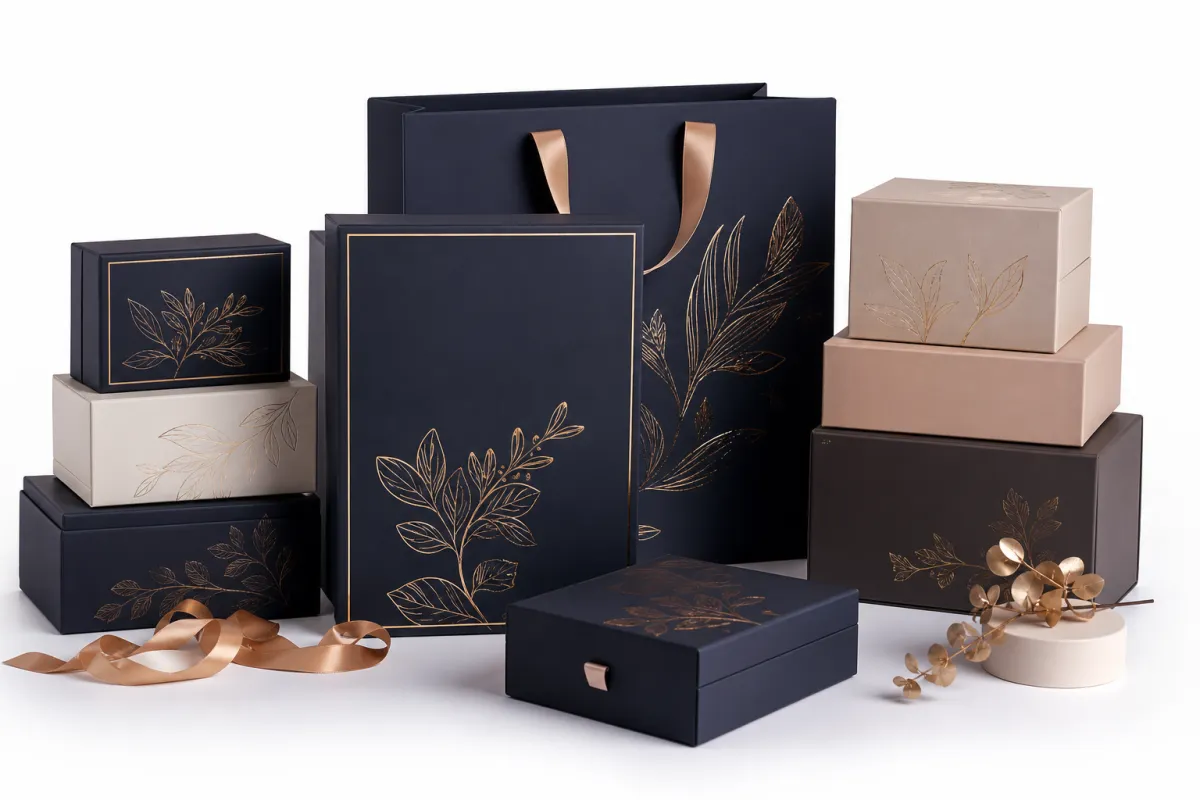
The box is often the first thing people remember. Not the product description, not the pricing grid, not the shelf talker. A small foil logo on a matte surface creates contrast, and contrast pulls the eye almost instantly. That is the real advantage of foil stamped gift boxes wholesale: it signals premium positioning fast, even when the rest of the design stays quiet.
Digital print can be fast and flexible, especially for complicated art. It still does not deliver the same sensory signal. Embossing adds depth, yet under bright retail lighting it can disappear faster than buyers expect. Lamination can improve protection and hand feel, but it does not create that metallic flash. Used well, foil-stamped packaging sits in the narrow band between restraint and memorability.
That is exactly why this format works in categories where perceived value shapes the sale: jewelry, cosmetics, candles, confectionery, watches, corporate gifts, and seasonal sets. A candle in a plain carton is functional. The same candle in a premium rigid box with a foil logo looks like a present, which changes how buyers justify the purchase and how recipients read the brand.
The wholesale side matters more than many teams admit. Buying in volume makes it easier to standardize dimensions, artwork placement, and finish rules across launches. Instead of building a new package every time a SKU changes, a brand can keep the same structure and update only the foil detail or a short line of copy. That keeps reorders cleaner and reduces the kind of mismatch that can make a product line look improvised.
Restraint usually wins in production. Full-panel foil can turn flat if the shape is too large or the artwork too dense. A logo, monogram, seal, or border line often produces more impact per dollar. In practice, foil stamped gift boxes wholesale is strongest when the foil becomes the visual anchor and the rest of the box supports it rather than competing with it.
Foil also does a job beyond decoration. It can direct attention toward an opening point, a feature name, or a limited-edition message. In retail display, that matters because the box gets only a brief moment to explain itself. For launch packs and seasonal campaigns, many buyers choose foil stamped gift boxes wholesale because it does two things at once: it elevates the package and it makes the message easier to find.
For repeat collections, the return becomes visible in more than one place. A consistent premium box can reduce the need for extra point-of-sale explanation, improve giftability, and make product photography look more polished with fewer props. The packaging stops acting like a shell and starts acting like part of the price story.
I have watched buyers spend weeks fixing a product page while the real problem sat in the box. One matte carton with a crisp foil seal often does more for conversion than a long copy refresh, especially for giftable categories. That is not marketing fluff; it is the way shoppers process value when they have the item in their hands.
Box Styles and Finish Options for Foil Stamped Packaging
The structure comes first. A rigid setup box creates a different buying experience from a folding carton, and the wrong format can make even strong artwork feel out of place. That is why wholesale decisions should start with the box style and move to the finish after the shape is settled.
Rigid setup boxes are the classic premium choice. They use thicker board, usually around 1.5 mm to 3 mm greyboard, wrapped in printed or specialty paper. They feel substantial, stay square, and create a strong unboxing moment. Magnetic Closure Boxes add a more deliberate reveal, which suits luxury gifting and presentation sets. Both are common in premium packaging programs for cosmetics, jewelry, and corporate gifting.
Folding cartons make more sense when shipping weight, shelf efficiency, or turnaround speed matter more than a rigid feel. They are often built from 300gsm to 400gsm SBS or C1S artboard and can still look premium when the foil is placed with care, especially on a matte or soft-touch surface. Mailer boxes work well for ecommerce and subscription programs, particularly when the package has to survive handling and still open cleanly. A mailer usually keeps foil on the lid or outer flap rather than wrapping the entire body.
Sleeve-and-tray formats give a clean reveal and let the foil sit on a short logo line or mark without crowding the design. Drawer styles create a slower opening rhythm and suit jewelry, watches, and compact luxury items. Each structure serves a different purpose. That is why the right wholesale build should match the sales channel, not just the sample that looked good on a desk.
| Box style | Best use | Typical MOQ | Indicative unit range | Production pace |
|---|---|---|---|---|
| Folding carton with foil logo | Retail, cosmetics, confectionery | 1,000-3,000 | $0.25-$0.55 | Fastest |
| Sleeve-and-tray | Gift sets, seasonal launches | 1,000-2,000 | $0.45-$0.90 | Fast to moderate |
| Rigid setup box | Jewelry, candles, premium gifts | 500-1,000 | $1.10-$2.80 | Moderate |
| Magnetic closure rigid box | Luxury presentation, corporate gifting | 500-1,000 | $1.60-$3.50 | Moderate to longer |
| Drawer box with insert | Jewelry, watches, small accessories | 800-1,500 | $1.30-$3.10 | Moderate |
Those numbers are only a guide, and they shift with board quality, foil coverage, inserts, and shipping method. Still, they show where buyers usually spend the money: structure first, decoration second. In most foil stamped gift boxes wholesale projects, gold and silver remain the most requested foil finishes, but rose gold, black foil, matte foil, and holographic effects can work well when the brand palette supports them.
Foil looks stronger when another finish gives it support. Embossing raises a mark so the foil catches along the edges. Debossing sinks the shape into the board and can look especially crisp on a matte surface. Spot UV can bring a secondary element forward, though it needs discipline or the gloss starts fighting the foil. Soft-touch lamination adds a velvet-like hand feel and makes the metallic detail stand out more clearly. In a well-planned foil stamped gift boxes wholesale build, the finishes should work together rather than compete for attention.
Add-ons change the final impression too. Custom inserts keep the product centered and protect fragile contents. Ribbon pulls help drawer boxes feel more complete. Paper wraps hide board seams and make the edges cleaner. Die-cut windows only make sense when the product gains something from a partial reveal. Used with restraint, these details make premium packaging feel more expensive without turning the design loud.
Shipping deserves its own thought. Rigid boxes excel in presentation, but folding cartons and mailer formats usually travel better over long routes or in ecommerce programs. If the package will be tested for distribution strength, many packaging teams refer to ISTA test methods to define the level of handling abuse the box should survive. That is a useful reminder that the purchase is not only about appearance; it is also about performance after the box leaves the warehouse.
One practical note from the production side: a design that looks elegant on a render can get tricky fast if the foil sits too close to a fold or the artwork includes hairline details. We have had to nudge logos a few millimeters more than once because the first proof looked great on screen and wrong in hand. That kind of adjustment is normal, and honestly, it saves money later.
Foil Stamped Gift Boxes Wholesale Specifications: Sizes, Stocks, and Artwork
Good packaging starts with dimensions, not decoration. The size should come from the product, the insert depth, and any outer shipping need. A candle jar with a lid insert needs different clearance than a cosmetic set or a necklace tray. In wholesale work, the safest approach is to measure the product precisely, then add room for loading, wrapping, and closure pressure.
Common board choices include rigid greyboard, paper-wrapped chipboard, SBS, C1S, and specialty wrapping papers. Rigid boxes often use 1.5 mm, 2 mm, or 3 mm board depending on product weight and the feel the buyer wants to create. Folding cartons often use 300gsm to 400gsm board with a coated or uncoated print face. The wrap paper matters too. Smooth art paper gives a sharper print surface, while textured paper can make foil feel softer and more artisanal. A solid specification sheet should name the board thickness, wrap paper, and finish in plain language so everyone is working from the same plan.
Foil coverage should be defined just as carefully. Logo-only stamping is usually the most economical and often the most elegant. Border accents can frame the top panel or lid edge without making the design feel busy. Full-panel foil can work for special collections, but it increases cost, raises the chance of visible registration variance, and can look heavy if the artwork was not built for it. Minimum line thickness matters too. Thin scripts, tiny serif details, and hairline borders may not reproduce cleanly at production scale. That is one of the most common mistakes in production files.
Artwork prep is another point where a project either moves smoothly or stalls. Production teams usually want vector files such as AI, EPS, or print-ready PDF with outlined fonts. Foil areas should be separated on their own layer or labeled clearly so the die and the foil stamp can be prepared correctly. If color matching matters, Pantone references should be listed in the brief, even if the final foil is metallic rather than ink-based. A clean handoff removes a lot of guessing from the proof stage.
Structural tolerances matter more than many buyers expect. A box that is too tight can scuff the product or crush the wrap, while one that is too loose makes the insert feel cheap. The practical target is usually a few millimeters of controlled clearance, but the exact tolerance depends on board choice, closure style, and pack-out sequence. Adhesive points should be planned so they do not show through a smooth exterior. If sustainability is part of the brief, paper-based builds with fewer mixed materials are easier to recycle than heavily layered constructions. FSC-certified paper is a common request for brands that want a more transparent sourcing story; see FSC for the certification framework.
Buyers should ask for a dieline before artwork begins. That single step often saves a revision round later. The dieline shows panel sizes, bleed zones, hinge placement, and fold direction. For foil stamped gift boxes wholesale, that means the logo lands where the eye expects it to land instead of drifting too close to a fold or lid edge.
Interior printing is optional, but it can be powerful when used with control. A short brand line, care note, or pattern on the inside of the lid can turn the opening experience into a branded moment. It adds cost, of course. For higher-margin products, the uplift often justifies it, especially when the exterior stays clean and the foil detail carries most of the visual weight.
I would also push buyers to ask a blunt question before approving artwork: does the foil placement help the package, or is it there because someone wanted more shine? That sounds simple, but it filters out a lot of waste. The best foil work is usually the piece that feels almost obvious once it is done.
Pricing and MOQ Breakdown for Wholesale Gift Boxes
Price is where packaging conversations often get fuzzy. Buyers see one unit number and think they understand the offer. They usually do not. The real cost of foil stamped gift boxes wholesale depends on structure, size, board, finish steps, insert complexity, and order volume. A box with a simple foil logo and no insert is a very different purchase from a magnetic rigid box with full wrap, embossing, and a custom tray.
The first cost driver is box style. Folding cartons are usually the lowest entry point because the setup is lighter and the material usage is lower. Rigid boxes cost more because they need thicker board, more hand assembly, and more time in wrapping and finishing. Magnetic closures add magnets, alignment work, and sometimes extra QC checks. In most wholesale programs, every added layer of structure increases labor before it increases material cost.
Foil coverage matters just as much. A single foil logo in one position is far less expensive than a full-panel foil pattern or multiple foil hits across several panels. Embossing and debossing add tooling. Spot UV adds another pass. Soft-touch lamination adds both material and finishing time. The simple way to think about it is this: every extra finish is another production event inside the same order.
MOQ usually rises with complexity. Simple folding cartons may start at 1,000 or 3,000 pieces, while rigid presentation boxes often start at 500 or 1,000 because the setup effort is greater even though the count is lower. That catches new buyers off guard. A smaller MOQ does not always mean a smaller cost burden. In fact, foil stamped gift boxes wholesale orders with low quantities can carry a higher per-unit price because tooling, proofing, and setup are spread over fewer boxes.
The better way to compare quotes is to look at landed cost, not only unit cost. Landed cost includes the box itself, sampling, tooling, freight, customs if applicable, and any rework risk. A quote that looks cheaper per box may turn out more expensive once shipping and sample charges are added. That is especially true for orders that need a prototype or a physical pre-production sample before mass run approval.
Sample fees should be discussed early. Some suppliers credit the sample fee back on the production order; others treat it as a separate development cost. Both models are common. The important thing is knowing which model applies so the project budget does not drift. For premium launches, a physical sample is often worth the money because foil reflection, lamination feel, and closure tension are hard to judge on a screen.
Standardization is where savings usually appear. If a brand keeps the same insert dimensions across a family of products, orders the same board spec repeatedly, and limits foil to the lid or top panel, the project becomes easier to price and easier to reorder. That is one reason mature buyers treat wholesale packaging as a system rather than a one-off purchase.
Material and finish choices also affect waste. If a program is built around one repeatable structure, setup waste falls over time. If each SKU uses a different shape, different insert, and different foil placement, the production floor has to reset more often. That does more than increase cost; it increases the chance of variation. For wholesale buyers, consistency is an economic advantage as much as a visual one.
One last pricing rule helps a lot: ask for the quote in the same units every time. If one supplier quotes ex-factory, another quotes delivered, and a third includes sample freight, the numbers cannot be compared cleanly. A solid foil stamped gift boxes wholesale conversation should define the same quantity, same dimensions, same finish set, and same delivery expectations before anyone judges the price.
In practice, the lowest bid is not always the safest bid. I have seen projects lose more money to reprints, late freight, and mismatched inserts than they saved on the first quote. That is why experienced buyers build in a little cushion, then spend it on the parts that protect the launch.
Process and Timeline for Foil Stamped Gift Boxes Wholesale
The production path is predictable once the brief is clean. A typical foil stamped gift boxes wholesale workflow begins with inquiry, then moves to quote review, dieline confirmation, artwork preparation, proof approval, sampling, production, quality inspection, and shipping. Each step looks simple on paper. Delays usually come from missing measurements, late feedback, or artwork that was not prepared for print production.
The biggest schedule risk is often the brief itself. If the product size is still changing, the insert has not been finalized, or the brand has not decided where the foil should land, the project can stall before it really starts. A tight timeline depends on final dimensions, one named approver, and one clean file set instead of several competing versions.
Proofing is usually fast, but only when the artwork is ready. Expect time for dieline review, foil layer checks, and structural notes. A simple order with no insert may move from proof to production quickly, while a complex rigid box can require more back-and-forth. For most buyers, the realistic move is to separate proofing time, production time, and transit time instead of treating them as one block. That difference matters when a launch date is fixed.
Sampling should be treated as a decision point. A digital mockup can confirm placement, but it cannot fully show foil shine, paper feel, or how the closure behaves under pressure. A physical sample is the better safeguard when the order has multiple finishes, premium pricing, or a retail-critical release date. In foil stamped gift boxes wholesale, the sample often prevents a more expensive mistake later.
Simple reorders usually move faster than fully custom builds. If the same structure, same foil die, and same insert are being repeated, production can focus on replenishment rather than development. A new structural shape, by contrast, needs more setup and sometimes a revised tool path. That is why repeatability is so valuable in wholesale packaging programs.
Rush orders are possible, but they come with tradeoffs. Faster work usually means tighter specs, fewer revisions, earlier payment milestones, and less room for experimentation. A buyer who wants a rush job should not also ask for three alternate foil layouts, two insert revisions, and a new box style. The schedule will punish that combination. If speed matters, the smartest move is to simplify the build and approve it quickly.
Quality control should not be treated as a final-stage formality. Registration accuracy, foil coverage, board consistency, adhesive performance, corner squareness, and insert fit all deserve inspection. A package that looks good in one photo can still fail in a warehouse if the lid opens too loosely or the wrap lifts at a corner. Good wholesale execution means checking the visual finish and the mechanical behavior.
Transit time deserves a separate line in the project plan. Production may finish on schedule and still miss the launch if freight is underestimated. That is especially true for overseas orders, where vessel timing, customs clearance, and last-mile delivery can shift the final date. Buyers who plan launch calendars around real transit windows usually avoid the most painful surprises.
On one recent run, a client wanted to save a week by skipping the sample. The foil color looked perfect on the render, but the chosen paper absorbed light in a way nobody expected, and the logo read too dark in person. We caught it before mass production because the proof was physical. That is the kind of save people forget to budget for, and it is exactly why the timeline should include a real sample whenever the finish is doing heavy visual work.
Why Choose Us for Wholesale Orders
The advantage of working with a packaging specialist is not only that the box looks better. It is that structure, decoration, and order management are handled together. For foil stamped gift boxes wholesale, that matters because the foil has to match the box geometry, the board has to hold the finish, and the final run has to match the approved sample. A supplier who understands all three reduces the chance of expensive disconnects.
Quality control is where the difference shows up fastest. Foil registration should be checked against the dieline, board consistency should be monitored across the run, and adhesive performance should be confirmed before shipment. If a corner slips or a stamp shifts even a little, the package can lose the premium feel buyers expect. For that reason, a careful wholesale program does not rely on artwork alone; it relies on controlled production steps.
Consultative support helps too. Buyers often bring artwork that looks strong on screen but is structurally awkward in production. The logo may be too small for foil clarity. The contrast may be too weak for a matte surface. The finish may look polished in a mockup and muddy in a real run because the paper choice was wrong. Good packaging guidance turns those problems into specific corrections before money is spent. That is especially useful for brands building out Custom Packaging Products across multiple categories.
Direct oversight also helps with repeat orders. Once the spec is locked, reorder production becomes simpler, and repeatability becomes a real asset. A brand can relaunch the same structure with a new sleeve, a revised foil mark, or a seasonal colorway while keeping the core box consistent. That is where foil stamped gift boxes wholesale pays back over time: the structure stays dependable while the branding evolves.
Companies that need a practical wholesale partner also benefit from clear communication. Notes on quantity, deadlines, foil placement, insert requirements, and approval timing keep the project moving. A detailed specification record means future campaigns do not need to start from scratch. Buyers can update the brand elements, confirm the changes, and move forward faster.
That fits the way purchasing teams actually work. They want a package that photographs well, ships safely, and repeats without drama. They also want a supplier who can explain tradeoffs in plain language. For that reason, foil stamped gift boxes wholesale works best when the supplier acts like a packaging partner, not just a quoting desk.
At Custom Logo Things, that mindset is the point. A good wholesale program should feel orderly: clean specs, clear proofs, controlled production, and a repeatable path for the next reorder. If the first run is done properly, the next launch gets easier instead of harder.
And yes, sometimes the most valuable thing a supplier can do is say no to a design choice that will not print cleanly. That is not being difficult. It is being honest.
What Should You Prepare Before Requesting Foil Stamped Gift Boxes Wholesale Pricing?
The fastest way to get a clean quote is to send fewer guesses and more facts. Confirm the product dimensions, choose the box style, define the foil placement, and estimate the order quantity before you request pricing. For foil stamped gift boxes wholesale, those four inputs remove most of the back-and-forth that slows a new project.
Then gather the files production actually needs. That usually means artwork in vector format, brand colors, any Pantone references that matter, insert requirements, and the target delivery date. If the launch has a fixed retail window, state it early. A quote built around a vague deadline is rarely useful. A quote built around a real schedule is much easier to trust. That matters most for wholesale orders that need proofing before a hard campaign launch.
Compare offers using landed cost, lead time, and revision support. The lowest headline price can become the highest real cost if freight is expensive, samples are not credited, or revisions are limited. A better comparison asks a more practical question: which quote gives the safest route to on-time delivery with the least risk of rework? That is the right test for foil stamped gift boxes wholesale, because the box only succeeds if it arrives on time and looks correct in person.
If the project has multiple finishes, a tight tolerance, or a high retail value, order a sample or digital proof before production. That extra step is usually cheap insurance. It helps the team verify foil shine, closure fit, board thickness, and print clarity before the full run begins. For more complex builds, use the sample as the decision gate and do not skip it.
For buyers who want to move quickly, the action list is simple:
- Confirm final product dimensions and insert depth.
- Choose the box style that fits the channel.
- Decide where the foil should appear.
- Gather artwork files and brand color references.
- State quantity, budget range, and delivery target.
Once those details are ready, the next step is straightforward: send specs, request proof, and approve production. That is the cleanest path for foil stamped gift boxes wholesale when the goal is premium presentation without unnecessary spend. If the project also needs a broader buying framework, the Wholesale Programs page is the right place to start, because it helps align reorder planning, specification control, and packaging assortment from the beginning.
Strong packaging does not happen by accident. It comes from choosing the right structure, the right foil placement, and the right production plan. If you are ready to move forward with foil stamped gift boxes wholesale, the most useful move is to lock the dimensions, keep the foil focus tight, and approve a physical sample before the full run begins.
Frequently Asked Questions
What is the minimum order for foil stamped gift boxes wholesale?
MOQ depends on the box structure, foil coverage, and setup complexity. Rigid styles usually start higher than simple folding boxes because they need more assembly and wrapping labor. Larger quantities lower the per-unit cost because tooling and setup are spread across more boxes. If you need a lower MOQ, expect fewer customization options or a higher unit price for foil stamped gift boxes wholesale.
How long do foil stamped gift boxes wholesale orders usually take?
Timeline usually includes quote approval, proofing, sampling, production, quality control, and shipping. Simple reorders move faster than fully custom structures with new artwork or inserts. Fast feedback from the buyer is often the biggest factor in keeping the schedule on track, especially when the project is a time-sensitive foil stamped gift boxes wholesale launch.
Can foil stamped gift boxes wholesale include embossing or magnetic closures?
Yes, foil can be paired with embossing, debossing, and magnetic closures for a more premium finish. Each extra feature adds tooling, cost, and sometimes lead time. The best results come from combining finishes that support the same visual hierarchy instead of competing with each other in a packaging design.
What artwork files do I need for foil stamped gift boxes wholesale?
Vector files are best, usually AI, EPS, or print-ready PDF files with fonts outlined. Foil areas should be separated clearly from the main print artwork so production knows exactly what gets stamped. Include box dimensions, logo placement, and any Pantone references that matter for the final look of the foil stamped gift boxes wholesale project.
Are foil stamped gift boxes wholesale options recyclable or eco-friendly?
Paper-based box structures can be recyclable when they avoid hard-to-separate mixed materials. FSC paper, water-based inks, and minimal lamination improve sustainability profiles. Magnets, heavy coatings, and multi-layer construction can reduce recyclability, so material choice matters if sustainability is part of the wholesale brief.


