Buyer Fit Snapshot
| Best fit | Custom Food Jar Labels Price projects where brand print, material claims, artwork control, MOQ, and repeat-order consistency need to be specified before quoting. |
|---|---|
| Quote inputs | Share finished size, material target, print colors, finish, packing count, annual reorder estimate, ship-to region, and any compliance wording. |
| Proofing check | Approve dieline scale, logo placement, barcode or warning zones, color tolerance, closure strength, and carton packing before bulk production. |
| Main risk | Vague material claims, crowded artwork, missing packing details, or unclear freight terms can make a low unit price expensive after revisions. |
Fast answer: Custom Food Jar Labels Price: Costs, MOQ, Lead Times should be specified like a repeatable production item. The safest quote records material, print method, finish, artwork proof, packing count, and reorder notes in one written spec.
Production checks before approval
Compare the actual filled-product size with the drawing, then confirm tolerance on folds, seals, hang holes, label areas, and retail display edges. Reserve space for logos, QR codes, warning copy, and material claims before decorative graphics fill the panel.
Quote comparison points
Review material grade, print process, finish, sampling route, tooling charges, carton quantity, and freight assumptions side by side. A quote is only useful when the supplier can repeat the same color, closure quality, and packing count on the next order.
Custom Food Jar Labels Price: Costs, MOQ, Lead Times is usually the first thing buyers ask once they decide the jars need to do more than just hold food. Salsa, jam, honey, sauces. Same basic story. The label has to look sharp, survive moisture, and keep doing its job after a few hands, a cold case, and one too many warehouse knocks. The label itself is rarely the expensive part. The wrong stock, weak adhesive, or a finish you do not actually need is what pushes the quote up.
Custom Food Jar Labels Price: Why Small Details Change the Bill
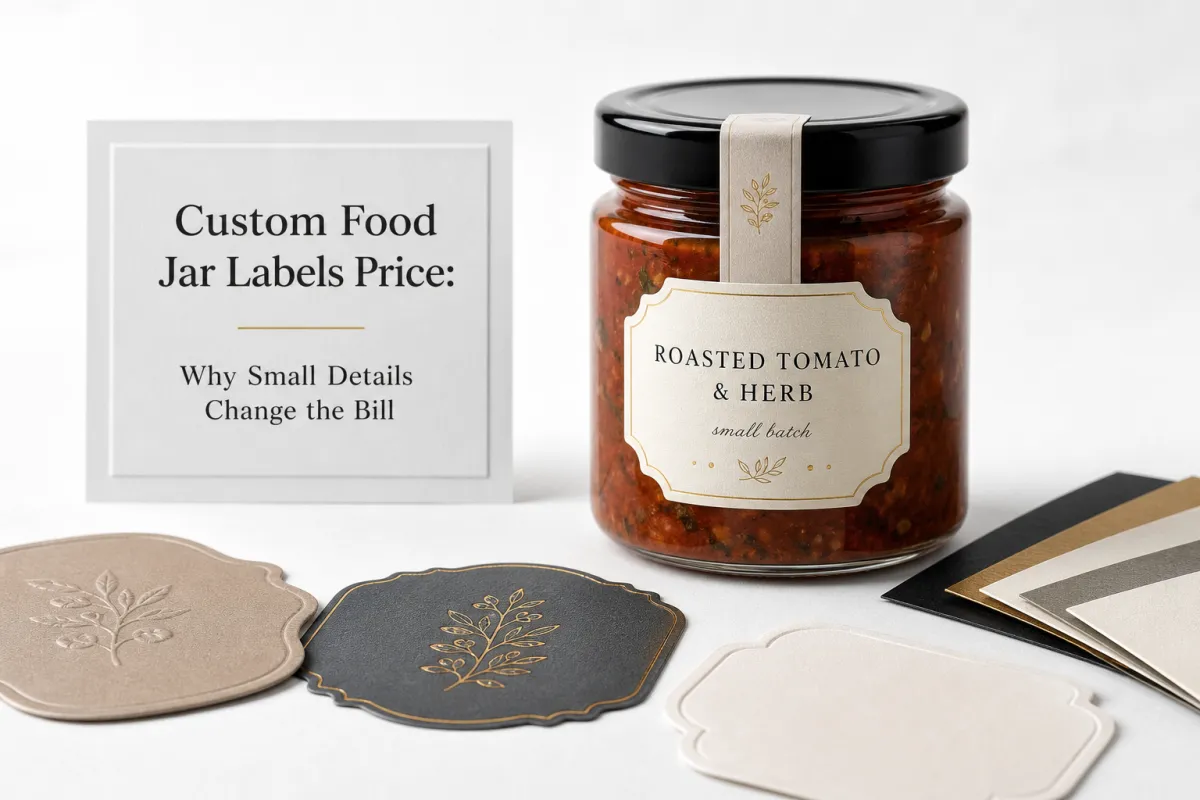
Custom food jar labels price depends on more than print size. The label has to stay put on glass, hold color in a cold case, and still look decent after refrigeration, handling, and shipping. If the jar is for honey, salsa, jam, marinades, or pickled goods, the label is dealing with moisture, oils, condensation, stacking pressure, and whatever else a real supply chain throws at it. That is the part most buyers underestimate. It looks simple from the outside. It never is.
From a packaging buyer’s point of view, custom food jar labels price should be compared on total landed cost, not just the neat little unit number that fits nicely on a quote sheet. A cheap sticker can create expensive problems later: reprints, customer complaints, and product that looks tired before it even reaches the shelf. Nobody wants to explain why a label slid off after one cold shipment. Or why a jar shelf-facing brand suddenly looks like it was printed in a hurry, because it was.
Here is the practical reality: a label that survives distribution is part of the product packaging. It supports retail packaging, package branding, and the first impression on shelf. If the finish is wrong, the adhesive is weak, or the artwork is unreadable at arm’s length, the label is failing even if the printer did exactly what was ordered. That kind of mismatch happens more than people like to admit.
Good packaging design is not about the lowest quote. It is about getting the label to survive the environment it actually lives in. Cold storage, oily surfaces, and rough handling do not care what the invoice said.
That is why custom food jar labels price should always be measured alongside setup fees, proofing, freight, and how the labels will be applied. Hand application on a 300-unit test batch is one thing. A machine-applied production run for 10,000 jars is another. Different use cases, different economics. Pretty obvious once you have watched both go sideways.
Custom Food Jar Labels Price: Materials, Adhesives, and Finishes
The fastest way to blow up custom food jar labels price is to pick a material that looks nice on paper but performs badly in the real world. For dry pantry items, coated paper can be perfectly fine. For refrigerated jars, anything that sees condensation or wipe-downs usually needs a film stock such as BOPP or a similar moisture-resistant face material. Paper can work, but it is not the hero in a cold, wet environment. It just is not.
Adhesive choice matters just as much as the face stock. Custom food jar labels price can rise a little if you need permanent adhesive for cold glass, deep-freeze performance, or curved jars with a stubborn surface. A standard general-purpose adhesive can be enough for room-temperature shelf life. The right question is not “what is cheapest?” It is “what will still be stuck on after the delivery run?” That is the one that saves you from headache later.
Finishes change the bill too. Matte gives a handmade, softer look. Gloss brightens color and tends to make sauces and fruit labels pop a little more. Soft-touch and textured stocks push the brand into premium territory, but they also add cost and sometimes complicate scuff resistance. That tradeoff is real. A fancy finish can make a jar look elevated on day one and still fail after one warehouse cart bump. Then the premium vibe starts looking kinda questionable.
If you need chain-of-custody paper for sustainability claims, look at FSC options and ask whether the supplier can document the stock properly. For buyers comparing paper sourcing and certified fiber, the FSC framework is the right place to start. It will not magically lower custom food jar labels price, but it can support the brand story if that claim matters to your retail buyer. Just be honest about the product environment. Certified paper is not a substitute for the wrong adhesive.
| Material / Finish | Best Use | Typical Unit Price at 5,000 Labels | Main Advantage | Main Tradeoff |
|---|---|---|---|---|
| Coated paper, matte | Dry shelf products, short display cycles | $0.05-$0.10 | Lowest cost, clean print surface | Weak in moisture and condensation |
| White BOPP, gloss | Refrigerated jars, sauces, oily handling | $0.08-$0.16 | Better durability and wipe resistance | Slightly higher material cost |
| Clear BOPP | Modern branded packaging with a no-label look | $0.09-$0.18 | Strong visual impact on glass | Artwork must be planned around transparency |
| Specialty textured stock | Premium jams, honeys, gift sets | $0.12-$0.28 | Higher-end tactile feel | More expensive, less forgiving in wet conditions |
There is a simple rule here. If the jars are going straight into a cool room, a farmers market cooler, or a supermarket front case, put durability ahead of appearance. If the jars are dry, short-run, and low-touch, paper may be enough. That decision has more impact on custom food jar labels price than a lot of buyers expect.
For most food jar labels, I would rather spend a little more on the right adhesive than waste money on a decorative finish the customer never notices. A label that looks rich but curls at the edges is not premium. It is a problem. That is how custom food jar labels price should be judged: by performance, not fantasy.
Jar Label Specifications That Affect Fit and Performance
Jar shape changes custom food jar labels price more than people think. Round jars are straightforward, but square and hex jars often need tighter layout control because edges, corners, and panel transitions affect how the label sits. A label that is too wide can wrinkle. One that is too short can look cheap, even if the print quality is good. Packaging people notice that stuff immediately. So do customers, even if they cannot explain why.
Measure the actual label zone, not just the jar. That means diameter, straight wall height, shoulder curve, and any recessed area where the label is supposed to live. For a wrap label, the overlap matters. For a front-and-back layout, the gap on the side matters. The printer should know whether the label needs to wrap partially or fully, because that changes die-cut size and therefore custom food jar labels price. One wrong measurement can snowball into a file fix, then a proof change, then a production delay. Fun times.
Custom shapes can add shelf impact, but they also add setup complexity. A simple rectangle with rounded corners is usually the cheapest path. A custom die-cut shape with a scalloped edge or cut-in corner can help a gourmet sauce or artisan jam stand out, yet it will usually cost more to set up. That is not a gimmick; it is tooling and production time. The printer is not inventing that cost. The die has to be made, and it has to be accurate.
Roll versus sheet format is another practical choice. Rolls are better for machine application and for hand labeling larger quantities because they are easier to store and dispense. Sheets can work for smaller runs or manual application, especially if the order is tiny. When buyers compare custom food jar labels price, format should be part of the quote because it affects labor and shipping efficiency. A label that saves a few cents on print but costs labor on application is not really cheaper.
File quality also matters. Ask for the dieline before you finalize artwork. Keep bleed around 0.125 inch, maintain a safe zone so text does not drift too close to the edge, and provide images at 300 dpi or better. Bad art creates avoidable delay, and delay makes custom food jar labels price feel higher because the schedule cost goes up even if the print cost does not. That is one of those annoying truths nobody likes, but there it is.
- Round jars: easiest to label, usually the lowest conversion risk.
- Square jars: better for front-panel branding but require tighter placement control.
- Hex jars: attractive on shelf, but corner spacing and label alignment matter.
- Curved shoulders: can force a shorter label height than the brand first wanted.
Most quote mistakes come from vague measurements. “It is about 3 inches wide” is not enough. Give jar diameter, wall height, panel shape, and whether the label is going on by hand or by machine. That is the kind of information that keeps custom food jar labels price honest instead of guesswork dressed up as a quote. It also helps the production team avoid the back-and-forth that burns a day for no good reason.
Custom Food Jar Labels Price: MOQ, Setup Fees, and Volume Breaks
MOQ is where custom food jar labels price becomes a math problem instead of a design problem. Smaller orders carry more setup cost per unit, so the unit price climbs. Larger orders spread setup across more labels, which lowers the per-label number, but increases your upfront spend. There is no free lunch here, despite what some quote sheets imply. The spreadsheet always gets its cut.
Ask every supplier about the full cost stack. That means setup or plate fees, die-cut tooling, proof charges, shipping, and any rush surcharge. A quote that looks cheap on the label line can become expensive once all the support charges appear. If you compare only unit price, you are comparing a slice of the bill, not the bill. That is how buyers get burned and then act surprised, which is a little rich, honestly.
Here are realistic planning ranges for custom food jar labels price, assuming standard print methods and normal artwork readiness:
- Sample or prototype run: 100-250 labels, often $0.20-$0.45 each plus setup.
- Small launch batch: 500-1,000 labels, often $0.12-$0.28 each depending on material and finish.
- Production batch: 5,000 labels, often $0.05-$0.18 each based on stock, coverage, and form factor.
- Repeat bulk order: 10,000+ labels, often $0.04-$0.12 each when artwork and setup are already approved.
These are not magic numbers. They move with print coverage, finish, shape, and vendor capability. Still, they are useful if you are trying to budget instead of pretending every print job should cost the same. In real buying, custom food jar labels price should be compared by total landed cost per usable label, not by a headline number that ignores freight or setup. The cheap option on paper can be the expensive one after everything lands.
Split shipments also matter. If you need part of the run now and part later, the freight and handling charges can rise. Multiple artwork versions can also inflate the bill because each version may need its own proof or setup. That is how custom food jar labels price gets quietly padded without anyone admitting it. Not dramatic. Just paperwork and extra time.
Common cost buckets to ask about
- Setup fee: the one-time charge for preparing the press or digital file workflow.
- Die-cut tool: needed if the shape is custom and not a standard rectangle.
- Proofing: digital or physical proof before production starts.
- Rush fee: added when the job has to move faster than standard scheduling.
- Freight: shipping cost based on box size, weight, and destination.
If you are buying labels for a new food line, do not chase the absolute lowest opening quote. A slightly higher custom food jar labels price can be cheaper in practice if it avoids a reprint, fewer hand application problems, or a label that fails in refrigeration. That is not theory. It is what happens when the wrong spec gets bought because the quote looked tidy.
Process and Timeline: From Quote to Delivery
Fast quotes start with good information. If you want accurate custom food jar labels price, send jar size, label dimensions, quantity, finish, material preference, and the shipping destination in the first message. When those details are missing, the supplier has to guess. Guessing is how quotes drift and timelines slip. It also leads to revisions nobody has time for.
The normal workflow is simple: inquiry, quote, proof, approval, production, shipping. The proof stage is where most delays happen. If artwork needs a dieline correction, font fix, bleed adjustment, or color tweak, the schedule moves. That is normal. It is also the moment where custom food jar labels price can rise if the buyer keeps changing the file after production planning has already started. I have seen that turn a reasonable schedule into a mess fast.
Standard turnaround for a straightforward label run is often 7-12 business days after proof approval, then shipping time on top. Rush orders can be faster, sometimes 3-6 business days for digital or simplified production, but custom shapes and specialty finishes can extend that. A satin laminate, textured stock, or shaped die-cut usually needs more handling than a basic rectangle on roll format. If the line is getting launched on a fixed date, that gap matters.
For shipping and transit testing, some buyers use shipment standards to protect the wider package system. If your jars are going into cartons, pallets, or subscription boxes, ISTA testing can help validate how the full pack survives movement, drop, and vibration. That matters because label performance is part of the retail packaging story, not a separate universe. A label that looks fine in the office and fails after transport is still a failure.
One practical note: delays usually come from missing specs, slow approvals, or messy artwork files. They do not come from a printer doing magic tricks. A clean brief keeps custom food jar labels price predictable and the schedule shorter.
- Confirm the jar dimensions before requesting a quote.
- Ask whether the labels are hand-applied or machine-applied.
- Approve the proof quickly so production can start.
- Check freight timing if the labels are needed for a launch date.
If you need the label program to fit a broader line, coordinate it with Custom Labels & Tags or keep the rest of the launch aligned through Custom Packaging Products. That keeps packaging design, product packaging, and package branding moving in the same direction instead of three different ones.
Typical buyers are not asking for perfection. They are asking for a label that lands on time, matches the jar, and does not peel the first time someone picks it up from a chilled shelf. That is the standard. Good custom food jar labels price planning should make that standard easy to hit.
Why Choose Us for Custom Food Jar Labels
We focus on practical quoting and clear specs. That sounds boring until you have already paid for a bad reprint. For brands comparing custom food jar labels price, the real value is not just the number on the quote. It is the amount of uncertainty removed before production starts. Fewer surprises. Fewer delays. Fewer awkward calls about why the label does not fit the jar people already bought.
We help check the artwork before it goes to press. That means looking at dielines, bleed, text safety, label placement, and whether the selected material matches the actual jar conditions. A lot of cheap mistakes start with a file that was never meant to survive production. Prepress support is where custom food jar labels price stays under control. It is also where the customer avoids that miserable moment of opening a box and realizing the margins were off by just enough to matter.
Food brands also need consistency. If your salsa line grows from 500 units to 5,000, the color should still look like the same brand. The same goes for a honey line that moves from a local market to retail packaging on a store shelf. Consistent repeat runs matter more than buyers admit, especially when the packaging design is carrying most of the brand perception. If the second run looks different from the first, people notice. Maybe not consciously. Still notice.
We work with materials that make sense for food jar use: moisture-resistant films, dependable adhesives for glass, and finishes that fit the brand instead of fighting it. That is the difference between branded packaging that looks polished and packaging that looks like someone gave up halfway through the spec sheet. If you need a premium look, we can support it. If you need a no-nonsense label that simply works, that is fine too. Both are valid. One just costs less in stress.
For buyers who want proof that the spec can handle real use, sample support is the smart move. Test the label on the actual jar, in the actual fridge, with the actual handling your product will see. That test tells you more than a sales pitch ever will. It also keeps custom food jar labels price tied to evidence instead of optimism. And optimism is not a production plan.
What buyers usually get right with us
- They send exact jar measurements instead of a rough guess.
- They pick the right material for the storage environment.
- They ask for a proof before they order a full run.
- They compare total landed cost, not just the lowest unit number.
Trust also comes from being honest about limits. If a paper label is being asked to survive condensation and repeated wipe-downs, I will say that is a bad fit. If a specialty finish adds cost without improving the shelf result, I will say that too. That is how custom food jar labels price stays useful instead of becoming a nice-looking mistake. Straight answers save money. Usually a lot of it.
For buyers building a larger launch, the label should sit comfortably beside Custom Printed Boxes, outer cartons, and the rest of the package branding system. Labels do not live alone. They sit inside a broader retail packaging program, and the cheapest part of that program is rarely the part that causes the most pain. Anyone who has managed a launch knows that already, even if they pretend otherwise in the meeting.
Next Steps for Custom Food Jar Labels Price Planning
The fastest way to get a usable custom food jar labels price is to send exact specs. Measure the jar, confirm the label panel, choose the material, choose the finish, and decide how many labels you want on the first run. If you are unsure, start with a sample or proof. That is the cheapest way to catch fit issues, adhesion problems, and color surprises before you place a larger order. Saves you from paying twice. Which, sadly, happens all the time.
Do not ask for a quote with “roughly this size” if you expect a serious number back. A vague request usually gets a vague price. A clean request gets a quote that is actually useful. That is true whether you are ordering jam labels, sauce jar labels, or a premium honey line that needs stronger visual pull on shelf. In other words, custom food jar labels price improves when the brief improves. It is not glamorous, but it works.
If your jars are refrigerated, oily, or handled a lot, test the label on the actual product before committing to the full quantity. The failure points show up fast: edges lifting, ink scuffing, poor adhesion on cold glass, or color that looks dull under store lighting. Those are the issues that turn a good-looking quote into a bad purchase. Better to find out on a sample than in the middle of a launch.
For sustainability claims or broader sourcing checks, ask about certified paper options, then match that against the product environment. Paper can be the right answer for dry shelf goods, but a film label is still the safer call for wet or cold conditions. There is no point forcing a sustainability story if the label falls off. That just wastes product and money, which is a strange thing to call brand building.
If you are ready to budget seriously, send the exact jar spec, artwork file, quantity target, and deadline. Review the proof quickly, approve the production details, and move forward without extra back-and-forth. That is how custom food jar labels price stays in range and the order gets out the door on time.
Custom food jar labels price is easiest to control when the spec is clear, the material matches the jar, and the quantity is planned around real demand instead of hope. Send the details, get a straight quote, and make the first run count. That is the part that actually matters.
What does custom food jar labels price usually include?
It usually covers the label material, printing, finish, and the base setup needed to run the job. Ask separately about proofing, die-cutting, shipping, and rush charges so the quote is easy to compare. If you do not ask, the quote can look cheaper than it really is. That trick gets used a lot.
How does MOQ affect custom food jar labels price?
Small orders carry a higher unit cost because setup gets spread across fewer labels. Larger orders lower the per-label figure, but they also require more upfront cash and storage space. That tradeoff is normal. It is not a flaw in the system; it is how production works.
Which label material is best for refrigerated food jars?
Film stocks like BOPP are usually safer than paper when condensation or wipe-downs are part of the job. Use an adhesive that stays put on cold glass and check the finish for scuff resistance. Paper can still work in some light-duty cases, but it is not the first choice for wet, cold, or oily conditions.
How long does production take after artwork approval?
Standard jobs usually move faster after approval; the real delay is almost always the proof stage. Custom shapes, specialty finishes, or file fixes can add time, so confirm the timeline before you commit. If the deadline is fixed, say so early. That helps the printer plan instead of scrambling later.
Can I get a sample before ordering custom food jar labels?
Yes, and you should ask for one if the jar is chilled, oily, or hard to label by hand. A sample helps you test fit, adhesion, color, and legibility before you spend on a full run. That is a cheap test compared with a reprint. Usually the cheapest test you will get.

