Buyer Fit Snapshot
| Best fit | printed stand up pouches with logo for packaging buyers comparing material specs, print proof, MOQ, unit cost, freight, and repeat-order risk where brand print, material, artwork control, and repeat-order consistency matter. |
|---|---|
| Quote inputs | Share finished size, material target, print colors, finish, packing count, annual reorder estimate, and delivery region. |
| Proofing check | Approve dieline scale, logo placement, barcode or warning zones, color tolerance, and any recyclable or compostable wording before bulk production. |
| Main risk | Vague material claims, crowded artwork, or missing packing details can create delays even when the unit price looks attractive. |
Fast answer: Printed Stand Up Pouches with Logo: Design, Cost, Timeline should be specified like a repeatable production item. The safest quote includes material, print method, finish, artwork proof, carton packing, and reorder notes in one written spec.
What to confirm before approving the packaging proof
Check the product dimensions against the actual filled item, not only the sales mockup. Ask for tolerance on folds, seals, hang holes, label areas, and retail display edges. If the package carries a logo, QR code, warning copy, or legal claim, reserve that space before decorative graphics fill the panel.
How to compare quotes without losing quality
Compare board or film grade, print process, finish, sampling route, tooling charges, carton quantity, and freight assumptions side by side. A lower quote is only useful if the supplier can repeat the same color, closure quality, and packing count on the next order.
Printed Stand Up Pouches with logo do something practical that a lot of other formats struggle to match: they turn the package into a shelf-facing sales tool before a shopper has time to read the fine print. In a crowded aisle, that first impression carries real weight. The pouch becomes the brand message, the product signpost, and the trust cue all at once, often within a few seconds of eye contact. That is why teams keep coming back to this format, even when they have other options on the table.
At the simplest level, printed Stand Up Pouches with logo are flexible pouches with a bottom gusset that lets them stand upright on a shelf or in a pantry. The difference between that and a stock pouch with a sticker is larger than visual polish. The branding is built into the package itself, which gives the whole presentation a more deliberate feel and makes it easier to keep a product line visually consistent across several SKUs.
For a packaging buyer, that consistency matters. printed Stand Up Pouches with logo can cut down on visual clutter, help a family of products stay aligned, and make a small fill volume appear more considered than a loose label on an off-the-shelf bag. Food, supplements, pet treats, coffee, and specialty dry goods all benefit from the same core advantage: the format protects the product while also organizing the shelf and carrying the brand story. It is a tidy solution, but not a simple one.
There is a commercial upside too, and it is easy to overlook until the line expands. printed Stand Up Pouches with logo make it easier to introduce new flavors, formulas, or sizes without forcing a complete redesign every time. A stable template can hold the structure, while color bands, icon systems, and panel copy do the differentiating. That gives distributors, retailers, and internal teams a cleaner way to read the range, and frankly, it keeps the brand from looking like it is making things up as it goes.
The real decision points stay the same from project to project: how are printed stand up Pouches with Logo made, what controls quality, what drives cost, and how long does the order take from proof to delivery? Those are the questions that separate a polished mockup from a package that performs in production.
Why printed stand up pouches with logo stand out
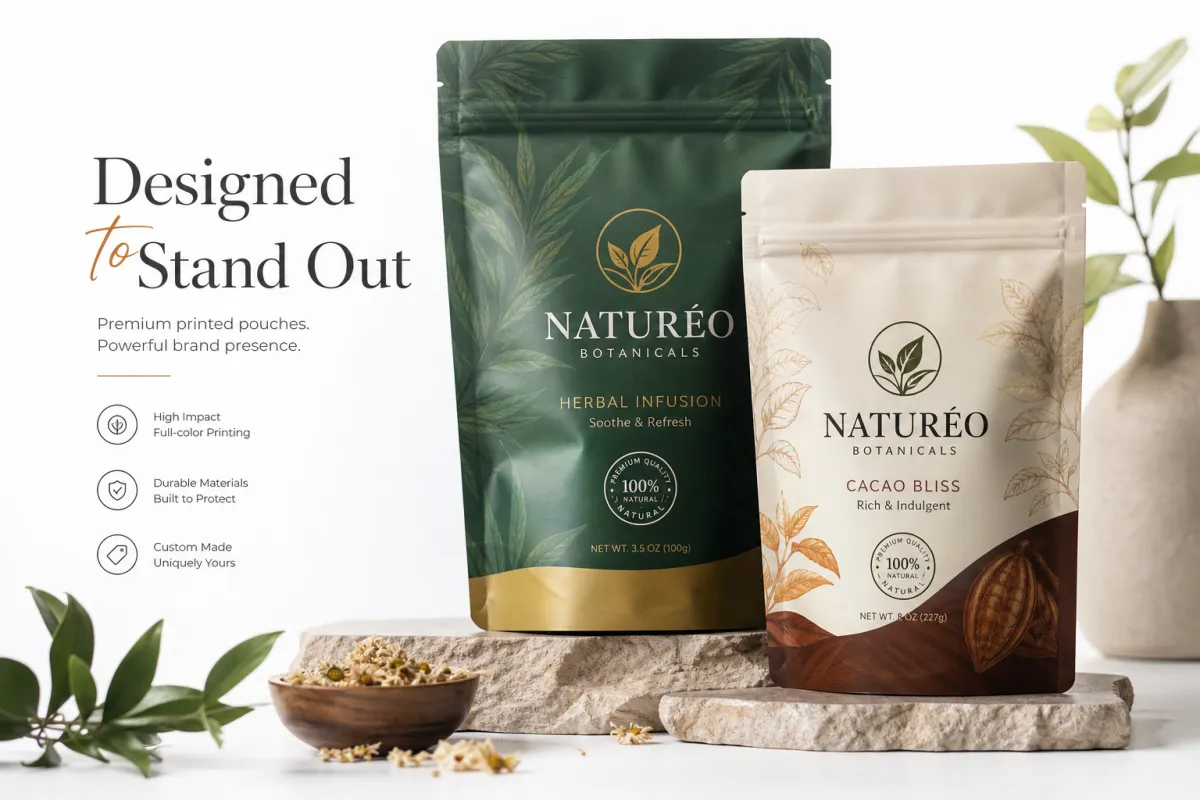
Printed stand up pouches with logo stand out because branding and function share the same surface area. That changes how a shopper reads the package. A flat carton gives you one face. A flexible pouch gives you front, back, side gussets, and often a top band or closure area to work with. More usable space means more room for benefit claims, usage directions, icons, and legal copy without making the package feel cramped.
There is a psychological effect at work as well. A printed package usually reads as more intentional than a blank pouch with a label, even when the fill product is identical. printed stand up pouches with logo can signal that the brand has invested in presentation, which often gets translated by shoppers into better quality, better consistency, and stronger control. That perception matters in categories where the product itself cannot be inspected before purchase.
In day-to-day use, the format works especially well for products that need a clear hierarchy of information. A coffee brand may want roast level, origin, grind type, and net weight to be visible immediately. A protein powder brand may need flavor, serving count, and benefit claims in a single glance. printed stand up pouches with logo make that possible without forcing the design team to cram everything into one tiny label.
Line management is another place where the format proves its worth. When a brand launches three flavors and two sizes, the challenge is usually not making each pouch attractive. The challenge is making them look related. printed stand up pouches with logo support that kind of system thinking because the structure stays fixed while the design language carries the variation. That is one reason they show up so often in private label and DTC packaging programs.
A pouch does not need to shout to sell. It needs to look clear, credible, and easy to choose.
In the jobs I have seen go smoothly, the winning pouch is usually the one that keeps the shopper oriented in a split second. Nobody is reading a package like a technical manual in aisle four. They are scanning. If the logo, product name, and primary benefit work together cleanly, the pouch earns attention without trying too hard.
Industry resources such as packaging.org help keep the discussion tied to package structure, materials, and supply realities instead of drifting into surface-level design talk. That matters when a brand is comparing decoration methods or deciding whether a pouch should be barrier-grade, windowed, kraft-faced, or fully opaque.
One more practical advantage shows up on the operations side: printed stand up pouches with logo can simplify the workflow. A pre-printed pouch may remove a separate labeling step, lower the risk of misplaced labels, and reduce handling in the warehouse. That does not guarantee a lower total spend, but it can make the whole process cleaner and easier to manage.
Process and timeline for printed stand up pouches with logo
The production path for printed stand up pouches with logo usually starts with a brief, not with artwork. Buyers who move fastest are the ones who can answer five basic questions early: what goes in the pouch, how much it weighs, how long it must stay fresh, what shelf it will sit on, and how many units the brand wants in the first run. If those inputs are vague, the quote stage slows down immediately.
Once the specs are clear, the supplier typically builds a dieline and reviews the artwork against that template. This is the stage where many delays start to stack up. The art may need barcode adjustments, copy edits, or seal-area corrections. For printed stand up pouches with logo, prepress checks matter because a seal line or zipper zone can cut off key text if the layout gets too ambitious. A beautiful composition is not much help if the zipper lands on the product name.
After proofing, the job moves into print preparation, which may include plate making for flexographic or gravure jobs, color separation, lamination if the structure needs extra barrier or stiffness, and converting the printed web into finished pouches. Final inspection, packing, and shipping follow. On paper, the sequence is straightforward. In real production, the approval cycle is usually the part that stretches the schedule.
A realistic schedule for printed stand up pouches with logo often looks like this: 1 to 3 days for quote development, 2 to 5 days for artwork and proof review, 1 to 2 weeks for production setup on simpler jobs, and another several days for shipping depending on distance and carrier mode. Custom materials, special finishes, or multiple SKUs will extend that window. A fast digital run can move far quicker than a large flexographic order, but only when the artwork is already clean and final.
Teams that want fewer surprises do better when they treat the process as a series of checkpoints instead of one big lead time. A practical framework is: request quote, submit specs, review proof, approve sample, schedule production, ship, and inspect on arrival. That sequence may feel obvious, yet it prevents the common assumption that printed stand up pouches with logo are simply "order in, boxes out."
Approval decisions can quietly add days too. If a brand needs a physical sample before the full run, that sample has to be produced, shipped, checked, and signed off. If the first proof shows contrast problems on a matte surface, the designer may need a second or third revision. For printed stand up pouches with logo, the fastest projects are almost always the ones where the copy, barcode, and legal claims were finished before the supplier quote even went out.
A reliable time estimate includes a cushion for risk. If the supplier says 10 business days after approval, a cautious planner still leaves room for feedback, sample transit, and freight delays. That is not pessimism; it is a reflection of how production behaves when multiple people need to approve the same package. I have sat through enough press checks to know that the cleanest schedule is the one with a little breathing room baked in.
Key factors that affect printed stand up pouches with logo performance
The performance of printed stand up pouches with logo begins with material selection. Kraft-faced pouches create a natural or artisanal look, clear structures show the product, matte films soften reflections, gloss films sharpen color, and metallized layers improve barrier properties. Each choice sends a different message and solves a different problem. A buyer who starts with design aesthetics alone can end up with a package that looks right but stores poorly.
Material and barrier
Barrier is the part many first-time buyers underprice. If a product is moisture-sensitive, aroma-sensitive, or oxidizes quickly, the film structure matters more than the printed surface. That is true for coffee, tea, dried fruit, powders, and many supplements. printed stand up pouches with logo may look nearly identical from the outside, but the inner laminate can change oxygen transmission, moisture resistance, and shelf life in a meaningful way.
For food and related categories, teams should ask about the actual barrier target rather than just the film name. A pouch described as "foil" or "high barrier" can still perform differently depending on thickness, sealant layer, and whether the structure uses PET, BOPP, nylon, EVOH, or a foil layer. If the product needs long shelf life, the supplier should be able to speak in concrete terms about oxygen and moisture protection, not just appearance.
It is kind of amazing how often a packaging discussion starts with color and ends with shelf life once someone finally asks the right question. The shiny version may look better in a mockup, but the better film is the one that keeps the product stable in the real supply chain.
Closure, convenience, and shelf behavior
Zippers, tear notches, spouts, hang holes, degassing valves, and gusset dimensions all change how printed stand up pouches with logo work in the hand and on the shelf. A strong zipper can improve resealability for snacks or powders. A tear notch helps first-use access. A hang hole may be useful in retail displays. A spout changes the filling and dispensing behavior for liquids or concentrates.
The right feature set has to match the actual use case. A premium appearance helps, but a package that tips over, leaks, or reseals badly can erase the branding benefit very quickly. That is why the best specifications usually balance shelf appeal with real user behavior. A pouch can look lovely and still be a pain to use, which is not a trade anyone wants to explain after launch.
For transport and distribution testing, many brands rely on ISTA guidance to check whether packaging can handle vibration, drop risk, compression, and handling stress before the full order ships. That kind of testing is not overkill when the product is expensive or fragile; it is insurance against damage that can be avoided with the right checks up front.
Color consistency is another performance issue, not just a design issue. printed stand up pouches with logo often live or die on whether the logo looks the same from the first proof to the tenth reorder. Matte finishes can mute saturation. Metallic layers can shift perceived color. Dark backgrounds can make small text disappear. A solid prepress review catches those problems before they become expensive inventory.
For food, supplements, and pet products, compliance also matters. Depending on the market, the package may need ingredient space, allergy statements, nutrition facts, barcode clarity, recycling instructions, or claims that meet local rules. If a brand is making sustainability statements, the structure should support them honestly. A paper face does not automatically make a pouch recyclable. The full material stack still has to be reviewed carefully.
When a buyer asks for "eco" without saying what kind of recovery stream the pouch is meant for, that is where trouble starts. The better path is to define the actual end-of-life target first, then match the structure to it. Honest claims are always easier to defend than polished ones that are not quite true.
Cost, pricing, MOQ, and quote variables
Printed stand up pouches with logo are priced by a mix of structure, print method, size, and order quantity. That is why two quotes can look wildly different even when the bags seem close at first glance. A buyer comparing only the unit price may miss setup charges, material grade, or finish quality hiding behind the number.
The biggest cost drivers are usually pouch size, film complexity, number of printed colors, barrier level, closure type, and special finishes such as matte lamination or soft-touch coatings. A small pouch with one-color print and a basic zipper is not the same job as a large pouch with a metallized barrier, clear window, foil accent, and tear notch. Printed stand up pouches with logo tend to scale better at higher volumes because setup costs spread across more units.
Minimum order quantity, or MOQ, is where many first-time buyers get stalled. Digital printing can support lower quantities, sometimes in the 500 to 2,000 unit range depending on the supplier and structure. Flexographic and gravure jobs usually need higher volumes to become economical, often 3,000 units or more and sometimes much higher. The right MOQ depends on the print method, not just the pouch size.
Here is a realistic way to compare common options for printed stand up pouches with logo. The numbers below are illustrative ranges only, because film cost, print coverage, and freight can shift the price materially.
| Print option | Typical MOQ | Illustrative unit range | Best fit | Main tradeoff |
|---|---|---|---|---|
| Digital print | 500-2,000 | $0.45-$1.20 | Short runs, launches, multiple SKUs | Higher unit cost at scale |
| Flexographic print | 3,000-10,000 | $0.18-$0.55 | Growing brands, repeat orders | Plate setup and proofing |
| Gravure print | 20,000+ | $0.10-$0.35 | Large-volume, stable programs | Highest upfront tooling cost |
That table shows why smaller orders can feel expensive. With printed stand up pouches with logo, the package itself is only part of the cost equation. Plates, cylinders, proofing, color management, freight, and revision rounds can all add to the total spend. If a buyer quotes a pouch without exact dimensions, exact closure type, and exact artwork status, the number often comes back with a wide range instead of a firm price.
The strongest quote request includes pouch dimensions, fill weight, product type, desired finish, closure preference, special features, quantity, artwork status, and target ship date. If possible, it should also state whether the brand wants samples before production. That lets the supplier quote printed stand up pouches with logo accurately instead of building in a cushion for uncertainty.
One more hidden cost deserves attention: revision time. If artwork needs multiple cleanup rounds, or if claims change after the proof is already underway, the schedule and price can both move. A careful buyer will ask whether the quote includes prepress corrections, whether there is a charge for new proofs, and whether freight is quoted separately. Those details often decide whether the "cheapest" offer is actually the lowest total spend.
There is a useful distinction between unit cost and operational cost. A slightly more expensive pouch can still win if it reduces labeling labor, cuts spoilage, or improves retail presentation. printed stand up pouches with logo should be judged on total packaging value, not just the invoice line.
Step-by-step buying checklist for printed stand up pouches with logo
The smartest way to buy printed stand up pouches with logo is to treat the order like a technical spec, not a design request. Start with the product brief. What is inside the pouch, how much does it weigh, what shelf life is required, and where will it be sold? A snack sold through retail has different needs than a powder sold through a warehouse club or a supplement shipped direct to consumer.
Before asking for samples, gather the technical basics. That includes width, height, gusset depth, fill weight, barrier requirement, closure style, finish preference, and any special handling needs. If the product is oily, fragile, highly aromatic, or moisture-sensitive, say so. printed stand up pouches with logo are not a one-size-fits-all format, and the supplier cannot recommend a structure without those details.
Artwork review deserves the same discipline. Confirm the dieline, verify the barcode quiet zone, check legal text, confirm that claims are supportable, and make sure no critical copy sits inside a seal or zipper zone. A line-by-line proof review sounds tedious, but it saves money. When a package is already printed, a misplaced logo is no longer a design issue; it is inventory.
A useful approval workflow for printed stand up pouches with logo looks like this:
- Write a one-page pouch brief with product specs and target quantity.
- Send artwork files in a print-ready format, ideally vector PDF, AI, or EPS.
- Review the dieline and mark safe zones for text, logos, and barcodes.
- Ask for a proof and compare it against the copy line by line.
- Request samples if seal performance, look, or fit needs confirmation.
- Approve production only after the sample passes actual filling and shelf checks.
Testing should happen on real equipment whenever possible. If the pouch will be filled on a specific machine, the sample should run through that machine. That is the only reliable way to know whether the seal behaves well, whether the zipper closes correctly, and whether the pouch stands upright under the actual fill weight. For printed stand up pouches with logo, a package that looks fine on a desk can still fail on the line if the tolerances are off.
After approval, plan the first order with the next reorder in mind. That means confirming stock expectations, shipping windows, and reorder thresholds. If the product sells faster than expected, the second run should not become a crisis. Brands that manage printed stand up pouches with logo well usually keep a simple record of supplier lead times, color references, and approved versions so the next batch stays consistent.
The buying process also benefits from a backup plan. Ask what happens if one material is unavailable, whether an alternate zipper is acceptable, and whether the supplier can quote a second film structure. That kind of flexibility can protect schedule without forcing a redesign.
Common mistakes that hurt printed stand up pouches with logo results
The most common mistake with printed stand up pouches with logo is designing for the shelf image and ignoring the product's real storage needs. A beautiful pouch that fails to protect moisture-sensitive powder or aroma-heavy coffee is not a success. The package must perform as a barrier first and a marketing surface second, even if the brand story is the part shoppers notice first.
Artwork errors are a close second. Low-resolution files, thin fonts, weak contrast, and busy layouts all create trouble. A logo that looks sharp on a laptop may blur in print if the source file is not strong enough. Small legal text can disappear on dark or metallic backgrounds. And if the design ignores the seal area, a beautiful layout can be damaged by the converting process. printed stand up pouches with logo need a proofing discipline that is much stricter than social media design.
Comparing quotes without matching specs is another expensive trap. One supplier may quote a thinner film, another may include a better zipper, and a third may be building in a different print method entirely. If the buyer does not line up pouch size, barrier, finish, and closure before comparing, the cheapest quote can be apples-to-oranges. With printed stand up pouches with logo, that error often shows up only after the shipment arrives and the quality gap becomes obvious.
Testing is the part many teams rush, especially under launch pressure. That is risky. If the pouch has never run on the filling line, the brand does not yet know whether it seals at speed, whether the fill weight changes the stand-up behavior, or whether the zipper makes the pouch too bulky for retail shelves. printed stand up pouches with logo should be checked for fill speed, seal strength, and display stability before volume ordering. A few sample runs can save hundreds or thousands of units from being scrapped.
Price alone should not make the decision. A cheaper package can carry hidden costs in spoilage, customer complaints, or freight damage. If the seal is weak, if the finish scuffs too easily, or if the supplier misses the ship date, the savings disappear fast. The better question is not "What is the cheapest pouch?" but "Which printed stand up pouches with logo solve the product, branding, and supply problem at the same time?"
Expert tips and next steps for printed stand up pouches with logo
One of the simplest ways to improve the buying process is to build a one-page spec sheet before reaching out to suppliers. Put the product name, fill weight, dimensions, closure type, finish, target quantity, and shipping target in one document. That way, every quote for printed stand up pouches with logo is based on the same assumptions, and price comparisons become meaningful instead of fuzzy.
Ask for physical samples, not just digital proofs, whenever the product is sensitive to seal performance or shelf life. It is common for a pouch to look perfect on screen and still behave differently once filled. A matte finish may hide fingerprints but mute the logo. A kraft face may fit the brand but reduce color pop. printed stand up pouches with logo deserve a side-by-side comparison across material choices, because the best choice is often a tradeoff between appearance, barrier, and cost.
Think in SKU systems, not single packages. That matters more than many brands expect. A family of printed stand up pouches with logo can use color coding, icon systems, size cues, and finish variation to help shoppers move through the range quickly. If the brand plans to launch more flavors or formats later, it is smarter to build a template that can expand than to redesign each pouch from zero.
Plan for reorders before the first shipment lands. Consistency is the real test. A package that prints beautifully once is useful, but a package that repeats cleanly across multiple runs is what keeps a brand stable. Keep reference samples, approved files, and supplier notes on hand. That small habit makes it easier to reorder printed stand up pouches with logo without color drift, copy changes, or confusion about the last approved version.
Before placing the order, compare at least two quotes, request samples if there is any doubt about fit or seal, and confirm the lead time with a buffer for proofing and freight. That sequence may feel cautious, but it is the difference between an attractive mockup and a package that performs in production. For brands planning a repeatable pouch program, the simplest path still wins: confirm the specs, test the sample, lock the artwork, and order the run only after the pouch has passed a real fill and shelf check.
How do printed stand up pouches with logo differ from stickered stock pouches?
Printed versions integrate the brand graphics into the pouch itself, while stickered stock pouches rely on a separate label layer. printed stand up pouches with logo usually look more polished, stay more consistent across larger orders, and reduce the risk of label placement errors. Stickered stock pouches can still work for very small test runs or quick market trials, but they often look less premium and can be harder to standardize.
What is the minimum order for printed stand up pouches with logo?
MOQ depends on the print method, pouch size, and film structure, so there is no single universal minimum. Digital runs may allow lower quantities, while flexographic and gravure jobs often need higher volumes to stay economical. The safest approach is to ask suppliers to quote several tiers so you can compare total spend, not just the unit rate for printed stand up pouches with logo.
How long does the process take for printed stand up pouches with logo?
Timeline depends on artwork readiness, proof approvals, production method, and shipping distance. Projects move faster when the dieline, copy, and barcode are already final before the quote stage. If you also need samples for seal or shelf testing, add extra time before production begins. For printed stand up pouches with logo, the best schedule is the one that includes approval time instead of assuming it will disappear.
Which materials work best for printed stand up pouches with logo for food products?
Barrier films are usually the best choice when freshness, aroma retention, or moisture protection matters. Kraft or matte finishes can support a natural or premium look, but the inner structure still has to protect the product. Match the material to the shelf life, filling method, and storage conditions instead of choosing only by appearance. That is especially true for printed stand up pouches with logo used for coffee, snacks, powders, and specialty dry goods.
What should I send to get an accurate quote for printed stand up pouches with logo?
Send pouch dimensions, fill weight, product type, quantity, closure preference, finish, and any special features. Include artwork files or at least a rough concept so the supplier can spot setup problems early. If possible, share your target ship date and whether you need samples before production starts. The more complete the brief, the more accurate the quote for printed stand up pouches with logo will be.
For brands that want a package to do more than hold product, printed stand up pouches with logo remain one of the clearest ways to blend protection, presentation, and operational control. The actionable takeaway is simple: define the product requirements first, request a proof next, test a filled sample on the real line, and only then approve volume production. That order of operations keeps the pouch honest, which is exactly what a good package should do.


