Buyer Fit Snapshot
| Best fit | Custom Food Pouches with Logo projects where brand print, material claims, artwork control, MOQ, and repeat-order consistency need to be specified before quoting. |
|---|---|
| Quote inputs | Share finished size, material target, print colors, finish, packing count, annual reorder estimate, ship-to region, and any compliance wording. |
| Proofing check | Approve dieline scale, logo placement, barcode or warning zones, color tolerance, closure strength, and carton packing before bulk production. |
| Main risk | Vague material claims, crowded artwork, missing packing details, or unclear freight terms can make a low unit price expensive after revisions. |
Fast answer: Custom Food Pouches with Logo: Film, Print, MOQ, and Carton Packing should be specified like a repeatable production item. The safest quote records material, print method, finish, artwork proof, packing count, and reorder notes in one written spec.
Production checks before approval
Compare the actual filled-product size with the drawing, then confirm tolerance on folds, seals, hang holes, label areas, and retail display edges. Reserve space for logos, QR codes, warning copy, and material claims before decorative graphics fill the panel.
Quote comparison points
Review material grade, print process, finish, sampling route, tooling charges, carton quantity, and freight assumptions side by side. A quote is only useful when the supplier can repeat the same color, closure quality, and packing count on the next order.
Custom food Pouches With Logo get a tiny window to do their job. A shopper glances at the shelf, clocks the branding, and decides fast. That part gets dressed up as “brand storytelling” a lot. Usually it’s just pressure, lighting, and a very short attention span.
For a buyer, the real test is not whether custom food pouches with logo look polished. The test is whether they protect the product, fit the filling line, stay inside budget, and still look like a brand someone would remember tomorrow. That mix is harder than it sounds, which is exactly why the details matter.
Here’s the practical version: what these pouches are, how they are made, what pushes the price up, and how to avoid the mistakes that turn a packaging order into an expensive headache. If you want to compare pouch formats with other options, you can also look at Custom Packaging Products.
What Are Custom Food Pouches With Logo?
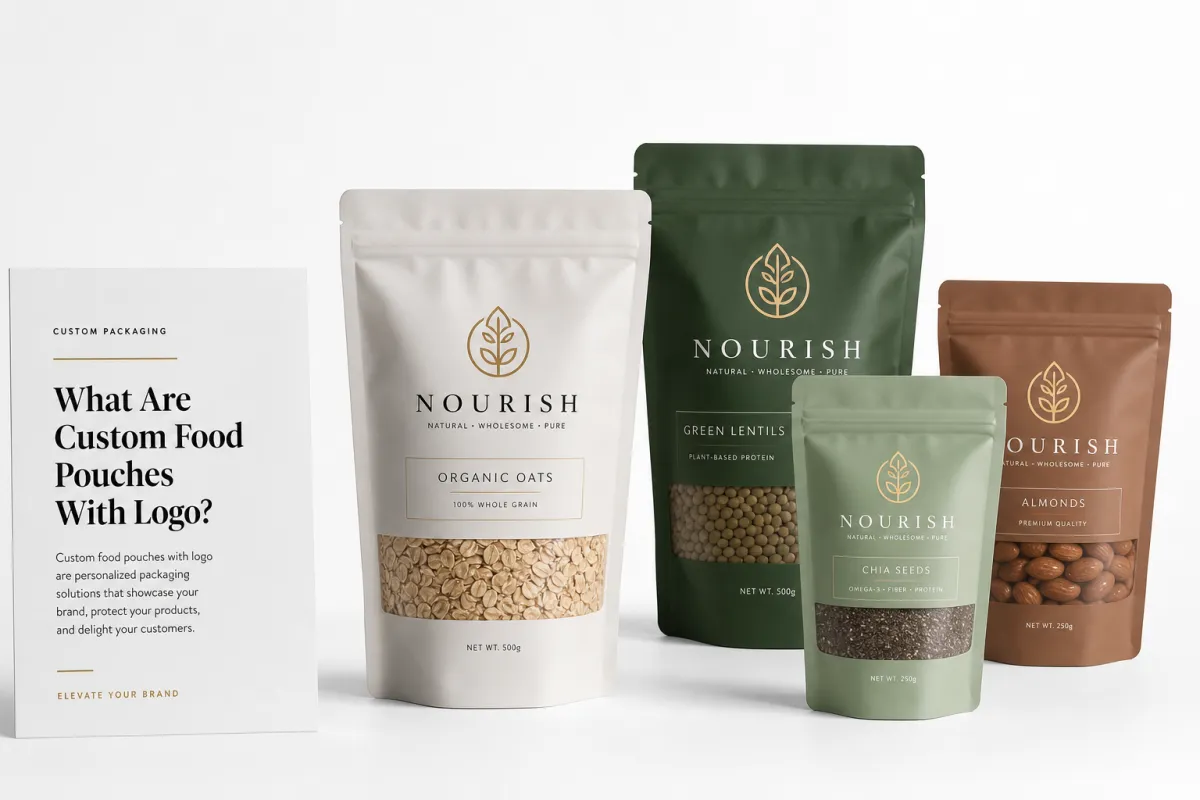
Custom food pouches with logo are flexible food packaging structures printed or finished to show a brand identity while protecting the product inside. They sit in a useful middle zone between plain commodity packaging and rigid containers that cost more to ship and store. For snacks, coffee, powders, dried fruit, pet treats, and shelf-stable foods, they do a lot of work for a small amount of material.
Most buyers choose custom food pouches with logo because they need more than a wrapper. They need retail packaging that stands up, makes flavor or variant clear at a glance, and survives shipping or display without collapsing into a sad heap. From a packaging buyer's point of view, that mix is exactly why pouches keep winning orders.
The common formats are simple enough:
- Stand-up pouches for snacks, granola, coffee, and dry mixes.
- Flat pouches for single-use portions, sample packs, or lightweight items.
- Gusseted bags for higher fill volumes or products that need more shape.
- Spouted pouches for sauces, purees, liquid concentrates, and similar items.
Custom food pouches with logo can be printed straight onto the film, or the logo can be added with labels or overprint methods when the order is smaller or the design is still changing. Direct print usually makes more sense for scale and consistency. Labels can work for lower volumes, test launches, or brands that need room to adjust while demand is still fuzzy.
Use case matters. A pouch built for e-commerce shipping does not need the same setup as one made for a grocery shelf. Sampling packs need lower cost and often shorter runs. Private-label packaging has to be clean, legible, and easy to scan. Food service pouches may need more durability and less decoration. Custom food pouches with logo are not one product. They are a packaging family with different jobs.
I’ve seen brands spend too much time obsessing over the front panel and not enough time checking whether the pouch will actually hold up. A sharp logo does not fix weak seals, poor barrier performance, or film that smells wrong next to a delicate product. Packaging design starts with the product, not the artwork. Kinda inconvenient, but true.
A pouch that looks premium but fails in transit is not premium. It is expensive garbage with better typography.
The best custom food pouches with logo follow a simple sequence: product needs first, structure second, artwork third, decoration last. Not glamorous. Very effective.
How Custom Food Pouches With Logo Are Produced
The production flow for custom food pouches with logo is more orderly than most buyers expect, as long as the brief is clear. It usually starts with the product itself: what it is, how much goes in each pouch, how long freshness needs to hold, and how the pouch will be filled. From there, the converter or printer recommends a structure, confirms dimensions, and sets up the artwork.
Artwork setup is more technical than people think. The logo is not just dropped into a file and sent to press. It has to match the dieline, respect bleed, stay inside safe zones, and hold up at the correct resolution. Color mode matters too. If a brand file lands in RGB and the printer expects CMYK, the finished pouch can come back with duller reds, flatter blues, or a logo that feels just a little off. A little off still looks off.
For custom food pouches with logo, the production steps usually look like this:
- Confirm product type, fill weight, shelf life target, and closure needs.
- Select pouch style, size, and material structure.
- Prepare artwork using the printer's dieline and technical specs.
- Review digital proof or printed sample.
- Approve print, lamination, and converting.
- Run production, inspect seals, and pack the finished pouches.
The printing method changes both the economics and the feel. Digital printing is often the smart choice for flexibility, lower setup cost, and faster changes. Flexographic printing usually makes more sense at higher quantities because the setup is heavier, but the unit price can drop fast. Gravure can work well on very large programs, though tooling costs and lead time move it into a different lane altogether.
That is why custom food pouches with logo should not be quoted on size alone. Two pouches with the same dimensions can price very differently if one uses metallic film, heavy graphics coverage, a zipper, a tear notch, and a matte finish while the other uses a simpler structure with basic print. Packaging is not magic. It is stacked cost.
Food safety and performance checks happen during production too. Seal strength, print adhesion, barrier performance, and line compatibility should all be reviewed before the order goes live. If the product is sensitive to oxygen, moisture, grease, or aroma loss, those checks matter more than a flashy mockup ever will.
For transit, many brands ask for testing aligned with standards like ISTA shipping test procedures. That is the right instinct. A pouch can look perfect on a desk and still fail after vibration, compression, or a drop in the real world.
Sample approval matters too. Skipping samples is how brands end up with a pallet of custom food pouches with logo that looked great in email and strangely off in hand. Sample approval is not decorative bureaucracy. It is the cheapest insurance in the process.
Materials, Barriers, And Features That Matter
Material choice is where custom food pouches with logo either earn their keep or quietly waste money. The outer look matters, sure, but the structure underneath is what protects the food. Buyers often focus on print finish first. I get why. Matte and soft-touch options look strong on a shelf. Barrier and seal performance still matter more, especially for products with a long shelf life.
Common material layers include PET, PE, CPP, foil, and paper-look laminates. PET is often used for strength and print quality. PE helps with sealing. Foil adds strong barrier against light, oxygen, and moisture. Paper-look laminates can create a more natural feel, though they still need careful checking for moisture and grease resistance. Recyclable structures exist too, but they are not a free pass. They often trade barrier performance or sealing behavior for recovery benefits, so the product has to fit the material, not the other way around.
Here is the plain truth: custom food pouches with logo need the right barrier for the food inside. Oxygen barrier matters for coffee, nuts, and many baked snacks. Moisture barrier matters for crispy or dry foods that lose texture quickly. Light barrier matters for ingredients that break down under exposure. Grease resistance matters for oily products that can stain or weaken the structure. Skip one of those, and the pouch may look fine while failing as packaging.
Useful features should be picked for the product, not because they sound good in a brochure.
- Resealable zippers help products that are opened and closed more than once.
- Tear notches make first-open access easier and cleaner.
- Hang holes support peg display in retail packaging.
- Clear windows help shoppers see product texture, color, or fill level.
- Degassing valves matter for coffee and some packed products that release gas.
- Matte or gloss finishes change the shelf look and how the logo reads under store lighting.
Custom food pouches with logo also need a balance between appearance and function. A matte pouch can feel more premium, but heavy matte coatings can reduce scratch resistance or mute print contrast a bit. A gloss finish pops more under bright retail lighting, though it can show fingerprints and scuffs. Neither is better by default. It depends on the shelf environment and the brand position.
For brands with more than one product line, this is where packaging gets strategic. A snack line may use one structure, while a coffee SKU and a protein powder SKU need different barrier targets. That is normal. Forcing one pouch across every formula usually backfires. Different products have different respiration, odor, moisture, and handling needs. Packaging should respect that.
If your business is expanding into other formats, it helps to compare pouches against Custom Packaging Products such as cartons, labels, or other flexible structures. Sometimes the better answer is not more decoration. Sometimes it is a different package.
Food-contact compliance matters too. Ask what standards or declarations support the material for the intended market. For sustainability claims, paper components may need chain-of-custody documentation from organizations such as FSC. That does not magically make a pouch recyclable or sustainable by itself, but it does help verify the paper source when paper is part of the structure.
Most bad pouch decisions come from choosing the prettiest sample and ignoring puncture resistance or seal integrity. That sounds obvious until you see how often it happens. Custom food pouches with logo should be judged as a package, not a graphic file with a zipper.
Cost And Pricing For Custom Food Pouches With Logo
Cost for custom food pouches with logo comes down to a few variables, and none of them are mysterious. The biggest ones are material build, print method, pouch size, finishing, special features, and quantity. Artwork can also nudge the price if it needs several revisions or a large number of spot colors. Buyers who understand that structure usually get cleaner quotes and fewer surprises.
Lower quantities always cost more per unit because setup gets spread across fewer pouches. That is math, not vendor attitude. At modest runs, digital printing often gives better entry pricing because there are fewer prepress costs. At higher volumes, flexographic or gravure options can bring unit cost down, though they usually need more setup and a firmer commitment.
For a practical frame of reference, many custom food pouches with logo land in these general patterns:
- Small runs: unit pricing is higher, but setup is lighter and inventory risk is lower.
- Mid-volume orders: the sweet spot for many brands, especially if the artwork is stable.
- High-volume programs: lower per-unit cost, but more cash tied up in stock and a bigger planning burden.
Special features move the total faster than many buyers expect. A zipper, clear window, matte finish, metalized layer, or custom die shape can add material and manufacturing cost. The same goes for wide-format pouches or very thick structures. If the quote seems high, it is often because the pouch is asking the factory to do extra work. Packaging always collects its bill somehow.
| Print Method | Best For | Typical Setup Burden | Unit Cost Trend | Practical Note |
|---|---|---|---|---|
| Digital | Short runs, multiple SKUs, fast artwork changes | Lower | Higher at scale, lower at small volume | Good for testing custom food pouches with logo before locking a bigger order. |
| Flexographic | Stable designs, repeat orders, medium to high volume | Moderate to higher | Usually lower as quantity rises | Often a strong value choice once artwork stops changing every week. |
| Gravure | Very large programs with consistent demand | Higher | Can be very competitive at scale | Tooling and lead time make sense only if the volumes justify them. |
Where can buyers save money without wrecking quality? Start with finish. Switching from a special-effect coating to a simpler matte or gloss can cut cost. Then look at feature count. A pouch with fewer add-ons usually costs less than one with multiple closures and windows. Standardizing sizes across SKUs can also help because it trims complexity in production and storage. If you can use one base structure for two or three products, that is often smarter than inventing a new pouch for every flavor.
Where should buyers avoid false savings? On barrier performance, seal quality, and print durability. A cheap quote that fails after filling, shipping, or storage is not cheap. It is a delayed loss. Custom food pouches with logo should be priced against real product life, not just the first invoice.
For broader product packaging planning, it helps to compare the pouch line with other Custom Packaging Products so the brand knows whether pouches are truly the best fit or just the easiest starting point.
One more practical point: ask what is included in the quoted price. Some quotes cover print and converting only. Others include sample work, plate costs, freight, or storage. If those pieces are hidden, the “best” quote may only be the shortest one, not the cheapest one.
Process And Timeline: From Artwork To Delivery
The easiest custom food pouches with logo orders are the ones with a clean process. The buyer knows the product, the printer knows the structure, and nobody is rewriting the label copy the night before approval. That sounds ideal because it is. It also saves time, which is usually the real budget killer.
A typical timeline starts with a spec request. The buyer should share product type, fill weight, shelf life target, dimensions, closure needs, and whether the pouches will run on a manual, semi-automatic, or fully automatic filling line. Once that is set, the supplier can recommend a structure and estimate the best print path.
Then comes artwork. Delays pile up here more than anywhere else. If the logo file is low resolution, if the dieline changes, if the legal copy is incomplete, or if the brand team cannot agree on the final back panel, the calendar moves. Not because anybody is being dramatic. Because production waits for approvals.
Typical pressure points include:
- Artwork revisions that trigger new proof rounds.
- Sample review delays when decision-makers are not available.
- Material sourcing if a special film or zipper has to be ordered.
- Seasonal demand that loads the factory schedule.
- Retail deadlines that leave no room for last-minute fixes.
For many custom food pouches with logo orders, simple ready-to-print files can move much faster than a project with custom die shapes and multiple finish changes. If the structure is standard and the artwork is stable, the process tends to stay smooth. If not, you are buying time as much as packaging.
The best way to avoid unnecessary delay is to treat the spec sheet like a decision document. Include the product type, fill weight, pouch dimensions, barrier requirement, reseal need, and final logo placement before the first quote goes out. The fewer assumptions in the brief, the fewer surprises later.
There is also a shipping reality here. If the pouches are destined for distribution rather than direct shelf placement, ask about pack-out style, carton count, pallet pattern, and transit testing. A package that survives filling but not shipment is still a failed package. That is why many brands use the same testing discipline they would apply to other food-safe package branding or shipping-sensitive product packaging.
For custom food pouches with logo, a typical well-managed project can move from approved artwork to delivery in a few weeks, while more complex structures or larger volume runs can take longer. The exact timing depends on print method, material availability, and whether samples are approved quickly. If the project includes a new filling-line test, add buffer. Always add buffer. The calendar never behaves as nicely as the spreadsheet.
My practical rule: if the launch date matters, lock the logo placement and final panel copy early, then leave the artwork alone. A lot of custom food pouches with logo delays are self-inflicted by design changes that looked small and turned into new proof cycles.
Common Mistakes When Ordering Food Pouches
The classic mistake is obvious once you say it out loud: designing for looks and forgetting how the pouch has to function. Custom food pouches with logo need to move through production, filling, transit, and shelf display. If any one of those stages is ignored, the order can go sideways.
Another common error is choosing the wrong size. Oversized pouches waste film, increase shipping bulk, and make the package look underfilled. Undersized pouches create poor fill behavior, awkward seals, and a compressed look that cheapens the product. Size should be tied to fill weight and headspace, not guesswork.
Artwork mistakes are just as common. Tiny text disappears fast. Low-contrast logos vanish on matte or metallic surfaces. Too many colors can make a design feel noisy. And if the logo has fine detail, it may not hold up well on textured or reflective finishes. Custom food pouches with logo reward clean, confident design. They do not reward clutter.
Here are the biggest problems buyers run into:
- Skipping barrier checks and assuming all pouches are the same.
- Ignoring machine compatibility until the filling line starts jamming.
- Not testing samples with the actual product.
- Mixing too many SKUs into one structure that does not fit all of them.
- Choosing finish before function and discovering the product ages badly.
Oily, aromatic, or moisture-sensitive products need extra care. Coffee can lose aroma. Spices can bleed scent. Crackers can go stale. Protein powders can clump. All of that means the pouch needs real barrier performance, not just a decent front panel. Custom food pouches with logo only work if the material supports the food's shelf-life needs.
Another hidden risk is assuming one pouch style can cover every SKU in the line. It rarely does. A blueberry granola may be fine in one structure, while a powdered drink mix or powdered supplement needs different seal behavior, different film thickness, or a different closure. That is packaging reality, not nitpicking.
People also underestimate how print finish behaves in the store. A very dark matte pouch may look beautiful in a mockup, then disappear under harsh retail lighting. A metallic accent can help a logo stand out, but too much shine can make the graphics harder to read from a distance. In packaging design, contrast sells faster than cleverness.
Sample review should not be treated like a box-checking exercise. Open the sample. Feel the seal. Check the zipper. Compare the logo tone. Ask whether the pouch stands properly when filled. If you are selling through retail packaging channels, it should also be checked against the rest of the shelf, because good branding is relative. A pouch competes with neighboring products, not with an empty vacuum.
Bottom line: custom food pouches with logo fail for boring reasons, not dramatic ones. Wrong size, weak material, rushed artwork, skipped testing. Nothing glamorous. Just expensive.
Expert Tips And Next Steps For Your First Order
If you are placing your first order for custom food pouches with logo, start with a one-page spec sheet. Keep it simple but complete: product type, fill weight, shelf life goal, pouch size, closure type, print finish, and whether the pouch needs to be resealable. That one page will save more time than another round of “just send us a quote” emails.
My strongest recommendation is to ask for samples in two directions if the brand is still deciding. Try two finishes or two material structures. Side-by-side samples tell the truth faster than any sales pitch. One may look better on screen, but the other may handle the product or the shelf environment better. That is the tradeoff buyers need to see early.
Test the pouch where it will actually live. Run it on the filling line. Ship it through the real lane. Put it under the actual store light if possible. Packaging That Works only in a clean office with a white table and no pressure is not finished. It is only approved in theory.
It also helps to lock logo placement and back-panel copy early. Rewriting the legal text or shifting the mark by a few millimeters sounds minor. It is not minor once the artwork is already built and everyone is waiting on a revised proof. Custom food pouches with logo move faster when the decision chain is short and the file set is complete.
For brands expanding beyond pouches, compare the pouch plan against other product packaging routes through Custom Packaging Products. Sometimes custom printed boxes make more sense for presentation. Sometimes pouches win because they protect the product better and cost less to ship. The right answer depends on the item, the channel, and the margin.
Before you place the order, confirm these five things:
- Structure matches the product shelf life and barrier need.
- Price includes the real extras, not just the base pouch.
- Lead time includes proofing and sample approval.
- Samples have been checked with the actual product.
- Final artwork is locked and ready for production.
That list is not fancy, but it works. It keeps custom food pouches with logo from turning into a scramble after the launch date is already on the calendar.
From a packaging buyer's point of view, the best order is the one that protects the product, supports the brand, and avoids unnecessary inventory risk. That is the real job here. Not just making something pretty. Making something that sells, ships, and survives.
Are custom food pouches with logo good for snacks and dry foods?
Yes. They work well for chips, granola, nuts, candy, powders, and many shelf-stable foods. The right barrier and seal strength matter more than the pouch shape. If the product is meant to be opened and closed more than once, add a resealable feature so the packaging does not fight the user.
How much do custom food pouches with logo usually cost?
Cost depends on size, material, printing method, finish, and order quantity. Small runs usually cost more per pouch because setup is spread across fewer bags. Special features like zippers, windows, foil layers, and custom finishes raise the price, sometimes more than the print itself.
What is the minimum order for custom food pouches with logo?
Minimums vary by printer and printing method. Digital runs can support lower quantities, while flexographic and gravure usually need larger volumes. Ask for the minimum by size and structure, because one pouch style may have a different threshold than another.
How long does it take to produce custom food pouches with logo?
Timing depends on artwork readiness, approval speed, material availability, and print method. Simple orders move faster when files are final and samples are approved quickly. New structures or special finishes usually add time, especially if the project needs extra testing before release.
What artwork files do I need for custom food pouches with logo?
Use editable vector files when possible, such as AI, EPS, or PDF with outlined fonts. Match the printer's dieline and bleed requirements before sending anything. High-resolution images and correct color setup help avoid blurry logos and color shifts that show up too late.
Custom food pouches with logo work best when the structure, print method, and timeline all match the product. Get those three pieces right, and the pouch does its job quietly in the background. Get them wrong, and you pay for it in shelf life, reprints, or inventory that should never have been made. The clean takeaway is simple: treat custom food pouches with logo like a packaging decision first and a design decision second.

