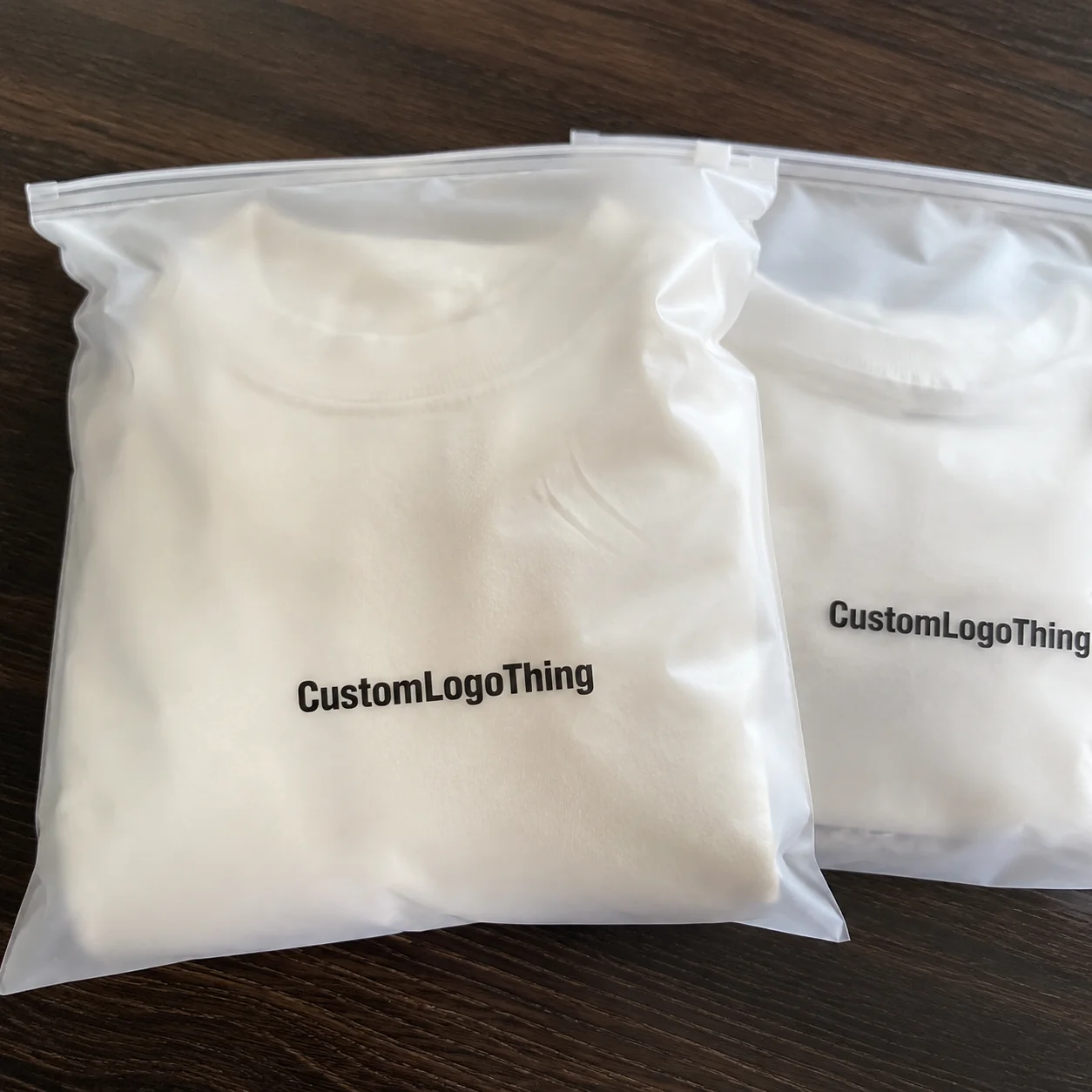
Custom frosted garment Bags Bulk Order buyers usually want the same three outcomes: cleaner presentation, fewer handling marks, and pricing that stays rational after sizing or artwork changes. Frosted film fits that brief well. It softens the look of the bag, hides dust and small wrinkles better than clear poly, and still keeps the package light enough for storage, transport, and retail prep.
The bag is doing more work than many teams assume. It is not just a cover. It affects how the garment reads on a rack, how inventory is sorted in the back room, and how the customer sees the item when it is delivered or handed over. For brands, dry cleaners, uniform programs, and apparel distributors, that makes product packaging part of the product experience rather than an afterthought.
Frosted film usually sits in a practical middle ground. It looks more considered than plain clear poly, but it avoids the higher cost and storage burden of rigid boxes or heavy reusable covers. For buyers balancing presentation and throughput, that middle ground is often the right answer.
Why frosted garment bags outperform clear poly in bulk storage
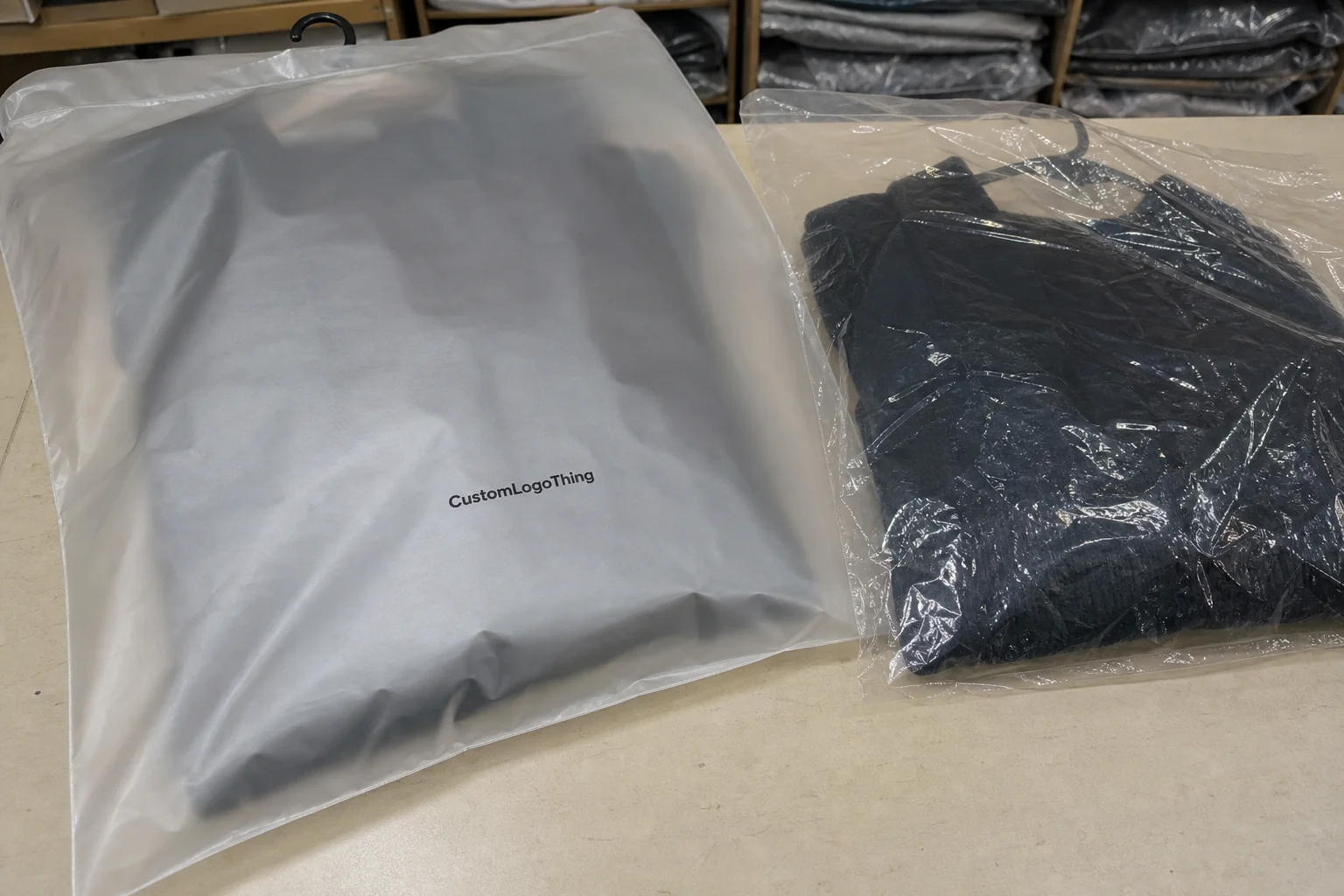
Clear poly is easy to inspect, but that visibility comes with a downside. Every scuff, lint mark, crease, and fingerprint becomes obvious under warehouse lighting or showroom spots. Once a rack is full, the visual noise adds up fast. Frosted film reduces that effect. It does not hide the garment, but it makes the overall presentation calmer and more consistent.
That matters in real operations. Frosted Garment Bags are common in showroom prep, seasonal storage, dry-cleaner handoff, e-commerce returns, and backroom sorting. They are especially useful where handling is frequent and the same pieces move between teams or locations. If the garment itself is clean and pressed, the bag should not distract from it.
There is also a cost angle that tends to be overlooked. A heavy reusable cover costs more, takes more space, and usually brings a different replacement cycle. Rigid packaging is not practical for hanging apparel. Frosted poly lands between those extremes. It gives a more polished read than clear stock poly without pushing the buyer into a premium structure that only makes sense for permanent storage or very high-value pieces.
| Option | Typical Use | Presentation | Approx. Unit Cost |
|---|---|---|---|
| Clear poly garment bag | Basic storage and quick identification | Highly visible, but shows handling marks | $0.08-$0.18 |
| Frosted garment bag | Retail prep, backroom sorting, returns | Cleaner, softer, more premium-looking | $0.12-$0.28 |
| Heavy reusable cover | Long-term wardrobe protection | Higher perceived value, higher cost | $0.60-$2.00+ |
That spread explains why many procurement teams choose frosted film for a custom frosted garment Bags Bulk Order. The bag looks better than plain clear, but the program still stays within a cost range that makes sense for apparel handling at volume.
Buyer takeaway: the right bag is the one that protects presentation without slowing the operation down.
Custom frosted garment bags bulk order specifications that matter
Most quoting problems begin with vague specs. “Standard size” is not enough. Neither is “a little thicker.” If you want a quote that holds up, define the core dimensions before you ask anyone to price the job. Width, length, gusset depth, film thickness, and closure style are the five variables that change the quote most often.
The garment should drive the size. Shirts and blazers do not need the same footprint as coats, suits, or long dresses. If the garment hangs on a bulky hanger or has padded shoulders, the bag needs more room at the top and along the side gussets. Otherwise the film pulls tight, seams stress, and the finish looks cramped rather than neat.
Film thickness matters more than many buyers expect. For apparel use, LDPE in the 1.5 mil to 3 mil range is common. Lighter gauges can work for short-term storage or low-touch programs, but they are easier to tear around hanger openings and more likely to wrinkle during packing. Heavier gauges feel sturdier and usually travel better through busy distribution channels, though they also increase cost and material use.
Closure style changes the user experience. A simple open-top hang bag is fast for dry-cleaning and warehouse work. Adhesive flaps reduce dust ingress and help keep the garment tucked in. Zipper closures and side-opening formats are more controlled, but they usually add cost and setup complexity. There is no single best option; the right choice depends on how the bag will be handled, stored, and opened.
Before requesting samples, buyers should confirm the following:
- Garment type and hanger style
- Flat width, length, and gusset depth
- Film thickness target
- Print area and number of ink colors
- Closure style and hanger hole format
- Pack count per carton and carton size target
That level of detail helps suppliers quote the same job instead of several different interpretations of it. It also prevents a common mistake: approving a price, then discovering the bag does not fit the actual garment line.
Printing, sizing, and finish options for retail-ready bags
Printing on frosted film works best when the artwork has clear contrast. Dark gray, black, and deep navy usually hold up better than pale tones. Fine lines and overly intricate logos can disappear against the matte haze, especially once the bag is folded or handled. That is not a production flaw. It is a design issue, and it should be solved before the order goes to press.
The frosted finish itself is part of the appeal. It diffuses reflections, so the bag photographs more cleanly and looks less greasy after handling. That helps in retail packaging, showroom presentation, product staging, and returns processing. A glossy film can look sharper in one light and messy in another. Frosted film is more forgiving.
Size strategy should follow the SKU mix, not the habit of using one bag for everything. A brand with mostly shirts and blazers may only need two or three standard sizes. A program that includes coats, uniforms, and long dresses needs at least one oversized spec. Forcing every garment into the same bag creates waste at the low end and shoulder stress at the high end.
Useful add-ons are practical, not decorative:
- Size labels or printed size markers
- Barcode windows for warehouse scanning
- Vent holes to reduce trapped air during packing
- Perforation for easy tear-off in distribution
- Reinforced hanger openings for repeated use
These features save time in the pack-out line and reduce avoidable handling errors. A small improvement in fit, scan speed, or line speed often matters more than a more complicated graphic. In a high-volume apparel workflow, seconds add up quickly.
For buyers already standardizing labels, tissue, and mailers, the same packaging logic applies here. Keep the logo legible at arm’s length, keep the sizing consistent, and avoid print details that only look good on a proof. Strong package branding is usually simpler than people expect.
Cost, pricing, and MOQ for bulk orders
Pricing for a custom frosted garment Bags Bulk Order is driven by a handful of predictable variables: film thickness, bag dimensions, print coverage, closure style, packing format, and total volume. There is no hidden formula. Bigger bags use more material. Thicker film uses more resin. More print colors take more setup and ink. A special closure adds conversion time. Each of those items shows up in the quote.
MOQ usually rises for the same reasons. Stock-adjacent dimensions with no print can often start lower. Once the order becomes custom sized, branded, or closure-specific, the setup burden grows. A supplier will usually need more units to justify the press setup, die work, or sealing change. That is normal, and it is one reason a quote that looks cheap at first may not hold once the real spec is entered.
Buyers should ask for pricing broken out by thickness, size, print color count, and packing method. A unit price without carton details or freight assumptions is incomplete. Bulk packing, retail-ready carton pack-out, and pallet configuration can change the landed cost more than a small difference in film price.
For procurement, the practical question is not simply “What is the unit cost?” It is “What cost structure makes sense across the full season?” A short run may carry a higher unit price, but it can still be the better buy if it prevents wasted inventory. A larger run may lower unit price, but only if the spec will stay stable long enough to consume it.
Here is a useful way to think about volume bands:
- Small runs cost more per unit, but they help when the spec is still being tested.
- Mid-volume runs often give the best balance between setup cost and inventory risk.
- Large runs bring the unit price down further, but they only make sense if the spec will not change soon.
As a rough planning range, a custom frosted bag program in the 5,000-piece range might land around $0.12-$0.28 per unit, depending on size, thickness, and print coverage. Heavier gauges, more artwork, or a reinforced closure will push that higher. Larger repeated runs can soften the price, especially if the design and size stay stable across seasons.
Compare quotes using a simple matrix.
| Quote Variable | Why It Matters | Buyer Question to Ask |
|---|---|---|
| Film thickness | Affects tear resistance and feel | What gauge is quoted, and is it actual or nominal? |
| Bag size | Changes material consumption | Are width and length measured flat or usable interior? |
| Print coverage | Drives setup and ink use | Is the price for one color or multiple colors? |
| Packaging format | Affects labor and freight | Are bags bulk packed or retail-ready in cartons? |
If a supplier cannot answer those questions clearly, the quote is not ready for procurement. It may be a placeholder, not a real landed cost.
Process, timeline, and production steps from quote to delivery
A clean production process saves more time than aggressive negotiation over price. The usual sequence is simple: spec review, artwork confirmation, sample approval, production, quality check, packing, and freight booking. Delays usually happen at the weakest link in that chain, not in the machine run itself.
Most issues are preventable. Missing dimensions force re-quoting. Low-resolution art files delay proofing. A vague delivery window creates freight mistakes. A buyer who sends one complete spec sheet early usually gets a faster and more accurate quote.
For stock-adjacent runs, lead times can be relatively short. Fully custom sizes, special closures, or print-heavy jobs need more scheduling room. A reasonable planning window for a straightforward Custom Apparel Packaging run is often 12 to 15 business days after proof approval, with extra time needed for sampling or large-volume production. Transit is separate from production, and that distinction matters when the order supports a seasonal launch or store reset.
Pre-production samples are worth the time when presentation matters. A sample catches issues that are expensive to fix in full production: off-center logos, weak seals, incorrect hanger openings, or a size that looks fine on paper but cramped on a rack. In retail packaging, small dimensional errors show quickly.
Shipping method changes the calendar too. Air freight moves faster, but it is rarely the right answer for heavy bulk quantities. Ocean freight and ground delivery usually make more sense for recurring replenishment, especially when the program has a predictable reorder pattern. Good inventory planning matters more than shaving a few days off a shipment that arrived before the warehouse was ready for it.
Quality control should include film gauge checks, seal strength checks, print registration checks, and carton count verification before dispatch. Those checks reflect standard packaging discipline and help reduce the risk of mixed lots or underfilled cartons reaching the buyer. If a supplier cannot explain how they verify consistency, that is a warning sign.
Why apparel buyers source frosted bags from a packaging partner
A low quote is not the same as a reliable supply program. Apparel buyers need repeatability. They need the same size, the same film feel, the same print placement, and a reorder path that does not require rebuilding the spec every season. That is why many teams prefer a packaging partner over one-time sourcing.
For recurring custom frosted garment Bags Bulk Order programs, the value is in retained specs, artwork files, carton standards, and reorder history. Once those records are organized, the next run moves faster. That matters for brands with multiple seasons, dry cleaners with steady turnover, and uniform programs that need the same presentation across locations.
There is also a quality-control advantage. Buyers should expect gauge verification, seal inspection, artwork match checks, and carton count confirmation. A supplier who speaks plainly about those checks usually understands the production risks well enough to support a repeat program. A supplier who skips them may still be able to source bags, but they are less likely to support a disciplined packaging system.
For mixed-material packaging programs, certification can matter on the paper side. FSC does not apply to the poly film itself, but it does matter when the broader packaging set includes inserts, labels, or printed paper components. If your packaging strategy includes both film and paper, it is worth aligning those pieces early.
The real question is operational: can one partner handle the bag, the print, the carton spec, and the reorder cycle without creating extra work for your team? If the answer is yes, the bag stops being a commodity and starts acting like part of the system that keeps presentation consistent.
For teams standardizing their vendor base, wholesale terms, reorder behavior, and packaging consistency should be reviewed together. A cheap quote with weak follow-through tends to create more work later. A stable supply partner tends to remove it.
Next steps for a fast, accurate bulk quote
If you want a usable quote for a custom frosted garment Bags Bulk Order, start with the minimum data set: garment type, target dimensions, thickness preference, print artwork, closure style, and estimated annual volume. That is enough for a supplier to return something grounded in production reality instead of a placeholder.
A photo helps more than many buyers expect. Send an image of the garment on its hanger, or an existing bag that is close to the target. That makes shoulder width, drape, and presentation goals easier to understand than a short email. If the bag must fit a specific rack, cart, or carton, say so early.
The three decisions that speed up quoting are straightforward:
- Will the bag be branded?
- Is the size fixed or flexible?
- Must the bags ship in retail-ready cartons or bulk packs?
Once those points are clear, ask for pricing at multiple volume bands. That shows where the unit cost drops enough to justify a larger buy, and where the extra inventory starts becoming a burden. For procurement, that is more useful than a single optimistic number.
If the project includes bags, tissue, printed cartons, or other branded components, it is easier to align the whole program early than to patch it later. Coordinated package branding keeps the garment presentation consistent from warehouse to shelf. That is the advantage of treating the bag as part of the packaging system rather than a separate emergency purchase.
Submit exact specs, and the quote will reflect actual production requirements instead of assumptions. Clear specs lead to sharper pricing, cleaner proofs, and fewer surprises in the run.
What sizes are most common for custom frosted garment bags bulk orders?
Most buyers start with shirt or jacket sizes, suit sizes, and long-garment sizes, then adjust for hanger style and fold depth. The right size depends on the garment silhouette, not just the label category, so a coat and a blazer rarely use the same spec. If multiple apparel types ship together, standardizing a few core sizes usually reduces inventory complexity and quoting time.
How does frosted film compare with clear plastic for garment bags?
Frosted film hides scuffs, dust, and mixed inventory better than clear film, which is useful for storage and retail prep. Clear film can show product details more visibly, but frosted film often looks more premium in presentation settings. The choice usually comes down to whether the buyer values visibility or a cleaner branded appearance.
What affects MOQ for custom frosted garment bags?
MOQ usually rises when the order includes custom dimensions, printed branding, special closures, or thicker film. Stock-adjacent sizes and simpler print setups tend to qualify for lower minimums. A supplier can usually quote multiple volume tiers so you can see where the best unit cost starts.
How long does production usually take for a bulk order?
Lead time depends on artwork approval, sample needs, order volume, and whether the bag is stock-sized or fully custom. The fastest path is a clean spec sheet with approved artwork and no last-minute proof changes. Shipping method also matters because production time and transit time are separate parts of the schedule.
What should I prepare before requesting a quote for frosted garment bags?
Prepare garment type, dimensions, thickness target, print details, closure style, and estimated quantity. Include a photo, existing sample, or packaging reference if fit or branding needs to match a current program. The more precise the spec sheet, the faster the supplier can return a usable quote and timeline.