Shoppers touch the tag before they trust the garment. That small moment carries more weight than many brands expect, which is why custom Garment Hang Tags are not decoration. They are part of the product. A weak tag can make a well-made hoodie feel bargain-bin. A strong one can make a basic tee look retail-ready.
In practical terms, the tag has a simple job: carry brand cues, pricing, product details, SKU data, and sometimes a QR code or care note. The real buying decision is less about “creative design” and more about size, stock, finish, attachment, and turnaround. Fancy language helps in a pitch deck; specs are what get the order produced correctly.
Why these tags change how a garment sells
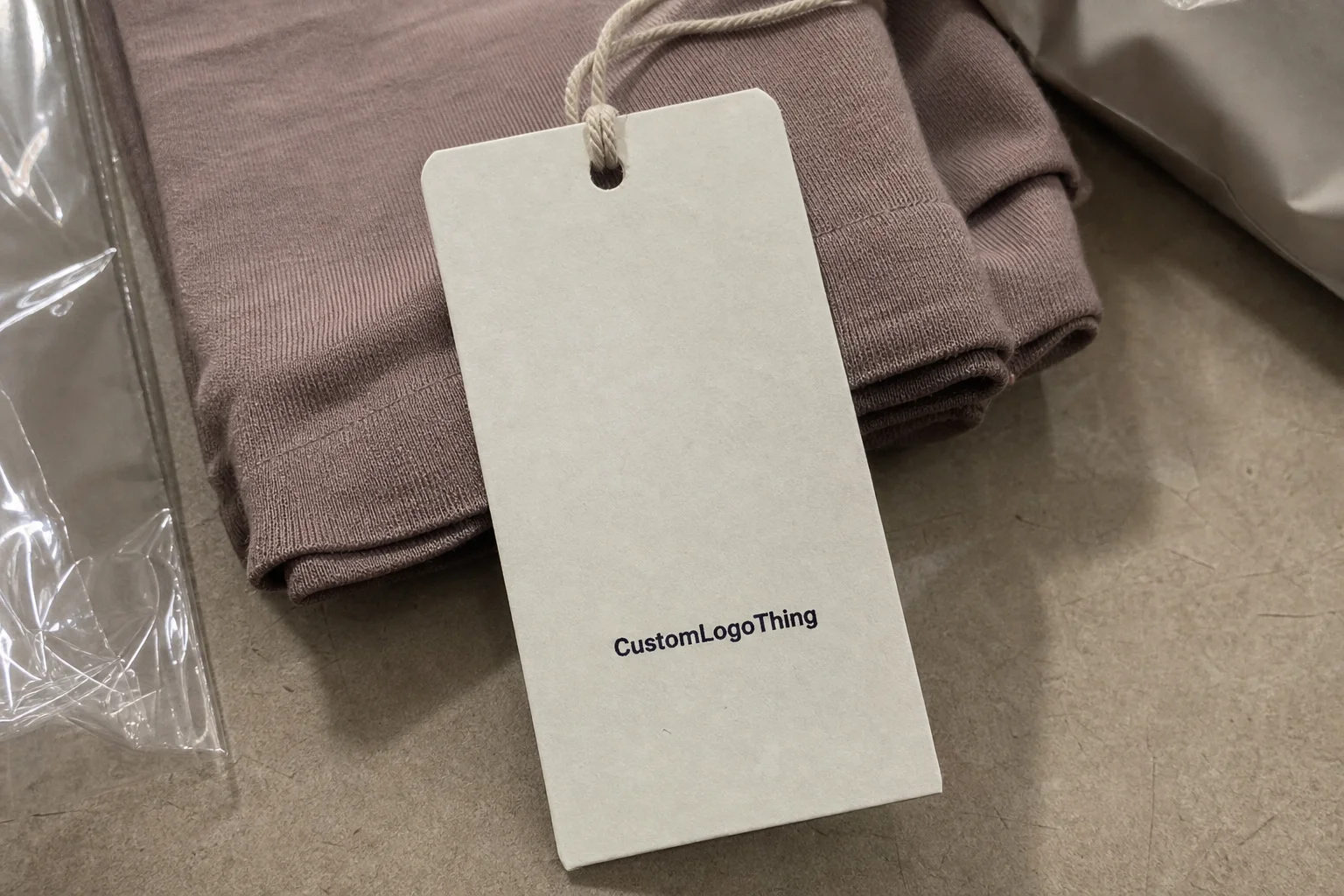
A garment tag does a lot in a small space. It introduces the brand, tells the customer what the item is, and signals whether the product belongs in a premium retail environment or a discount rack. People do not study it for long. They glance, feel the paper, and decide whether the item feels credible.
That is why custom garment hang tags affect perceived value so strongly. A heavyweight shirt on flimsy stock can feel cheap even when the stitching is excellent and the fabric performs well. The reverse happens too: a well-printed tag on sturdy board can make everyday apparel feel more intentional. Same logic as Custom Labels & Tags and broader packaging cues. The surface tells the customer what level of product they are holding.
Most brands use hang tags for a mix of practical and branding reasons. The usual details include:
- Brand name and logo
- Price or retail code
- Size and style number
- SKU or barcode
- Care note or material note
- QR code linking to product pages or content
That mix is why layout discipline matters. Too much copy and the tag starts reading like a receipt. Too little and it feels vague. The best apparel tags support the garment instead of competing with it. The right balance changes depending on whether the line is luxury, streetwear, basics, private label, or promotional retail.
One common mistake is treating the hang tag like a final add-on. It should be specified alongside label placement, pack-out, and carton count. When those details are aligned early, the order is easier to quote and less likely to miss a launch date.
How custom garment hang tags are built and attached
The production process is more structured than most buyers expect. A proper tag order usually starts with a dieline, which is the cut template. Then comes bleed, safe zone, proofing, print, cutting, punching, finishing, and final assembly. Miss one of those steps and the file starts arguing with the press.
Stock choice matters more than people think. A tag is handled, turned over, often folded or tugged, and sometimes clipped to a package for weeks before the garment is sold. The material has to survive that. Common options include:
- Uncoated board – matte, tactile, and often preferred for natural or eco-leaning branding.
- Coated paper – sharper print and stronger color pop, useful for photo-heavy or bold retail packaging.
- Recycled stock – a good fit for brands that want an earthy, lower-shine look.
- Textured paper – gives a premium feel, though small type can lose crispness.
- Heavier premium board – better for luxury pieces, jackets, and repeated handling.
Attachment choice changes the presentation. A simple string works for most apparel. A loop pin gives a cleaner retail look on some items. Plastic fasteners are fast and inexpensive, but not always elegant. Pre-tied assembly saves time on your end, although it adds labor cost on the vendor side.
| Attachment option | Best for | Typical tradeoff |
|---|---|---|
| String | General apparel, basics, fashion lines | Low cost, simple look, manual tying if not pre-assembled |
| Loop pin | Cleaner presentation, retail packaging, premium pieces | More assembly control needed |
| Plastic fastener | Fast attachment on high-volume runs | Practical, but less elevated visually |
| Pre-tied assembly | Brands short on labor time | Adds cost, but can save a lot of packing time |
Finishing is where the budget starts climbing. Matte coating keeps things restrained. Gloss gives more shine and better contrast on saturated colors. Soft-touch lamination feels expensive, though it adds cost and can slightly alter how certain inks read. Foil stamping, embossing, and spot UV each add a distinct effect, and each one adds setup time.
With custom garment hang tags, file handoff matters as much as the physical material. If the designer sends art without a proper dieline, the supplier has to guess where the fold, punch, trim, and safe zone should live. That is how text ends up too close to the edge and barcodes land in awkward places.
Garment hang tag pricing: what drives the quote
Unit price is mostly a quantity story. Short runs cost more per tag because setup, proofing, and press time get spread across fewer pieces. Larger apparel orders usually bring the per-unit cost down, which is why a 500-piece run often looks inefficient next to a 5,000-piece run.
For a basic single-sided tag on standard board, pricing may land around $0.12-$0.25 per unit at higher volumes. Smaller runs can sit closer to $0.30-$0.80 per unit, depending on the spec. Add foil, embossing, soft-touch, or custom die cutting and the range moves up quickly. If pre-assembly is required, budget more for labor.
The quote usually shifts based on these variables:
- Quantity
- Size and shape
- Board thickness
- Print sides
- Finishes such as foil, spot UV, or lamination
- Punch type and hole placement
- Attachment method
- Packing style and assembly needs
There are also setup fees and one-time charges. Die charges can apply for custom shapes. Foil and embossing often carry separate setup costs. If a quote looks unusually low, check what was left out. Sometimes the supplier priced only printing and did not include finishing, packing, or hardware.
Comparing quotes only works if the specs match. Ask each supplier the same questions: exact stock, exact size, print sides, finish, hole punch, attachment method, packing count, and whether the price includes proofing and shipping. If you are also ordering broader Custom Packaging Products, keep the same discipline across cartons, inserts, and labels.
Simple rule: if two quotes differ a lot and one looks too good to be true, something is missing. Usually it is stock weight, finishing, or assembly.
Production steps and timeline from proof to delivery
The path from art file to delivered tag is predictable. First, you Request a Quote. Then you send artwork. Then the supplier issues a proof. After approval, production starts. Then comes print, cutting, finishing, inspection, packing, and shipping. The delays usually come from file issues and approval changes, not the machine itself.
Proof revisions are the biggest time sink. Missing logos, blurry images, unconverted fonts, barcode problems, and incorrect dimensions all push the schedule. So does changing finishes after the proof is already in motion. If you know you want soft-touch and foil, decide that before you send the file.
Typical lead times for custom garment hang tags depend on complexity:
- Simple printed tags: often 5-8 business days after proof approval
- Custom die-cut or finished tags: often 8-12 business days
- Premium or assembled tags: often 10-15 business days
- Rush jobs: possible in some cases, but only if the vendor has open capacity
Shipping time is separate from production time. A tag order can finish on time and still miss a launch because freight was underestimated. If your garments are arriving in split shipments or you have content shoots before inventory reaches the warehouse, build in buffer stock.
For brands using hang tags as part of a broader product packaging rollout, it also helps to think about transit behavior. The ISTA testing framework is useful for understanding how packaging materials behave in shipment, and the EPA recycling guidance is worth reviewing if you are trying to choose paper stocks with lower waste impact or fewer mixed-material components.
Specs that keep tags durable, readable, and on-brand
Tag size should start with the garment, not with a random preference for “bigger looks better.” Tees and basics often work well with smaller formats, while jackets, premium dresses, and giftable items can support a larger tag that carries more information. If the tag is packed with brand story, product details, SKU, barcode, and a QR code, it needs enough surface area to breathe.
Typography matters more than people realize. A beautiful font is useless if it cannot be read under store lighting from arm’s length. Keep the contrast strong. Use bold enough weight for price, size, and SKU data. If the barcode is part of the layout, make sure it is sized and placed correctly so scanning is not a gamble.
Material choice should match brand position. A luxury label might want soft-touch coating, foil, and thick board. A rugged workwear brand might prefer uncoated stock with a sturdy punch. Eco-focused brands often lean toward recycled board and lower-shine finishes. Mass-market retail packaging generally needs sharp print, good efficiency, and a low per-unit cost.
These specs usually have the biggest impact on performance:
- Thickness for durability and hand feel
- Hole placement so the tag hangs straight
- Corner shape for style and tear resistance
- Coating or lamination for handling and moisture resistance
- Ink contrast for readability
Hole placement is one of those tiny details that can ruin a good design. If it sits too close to the edge, the tag tears. Too high, and the tag flips awkwardly. A clean punch plus the right attachment method keeps the tag aligned on the product.
For teams balancing product packaging, custom printed boxes, and package branding, consistency is the real win. The hang tag should speak the same visual language as the carton, label, and insert.
Common mistakes that trigger reprints and delays
The biggest file mistake is still the oldest one: sending artwork without a proper dieline, bleed, and safe zone. That usually leads to clipped text, off-center holes, or a layout that looks fine on screen and poor in print. A PDF is not proof of correctness. It is just a file.
Another common failure is over-designing the tag. Too many logos, too many finishes, too much copy. The tag turns into a miniature billboard with no hierarchy. The result is visual noise. If your audience needs a magnifying glass to find the size, the layout has already lost.
Flimsy stock is a credibility problem. Put a thin, bendy tag on premium apparel and customers feel the mismatch immediately. The same goes for a luxe finish on a low-cost garment that does not support the look. The tag and the product should agree on what they are worth.
Attachment mistakes can slow assembly or damage presentation. Wrong punch size, poor string choice, or a fastener that clashes with the brand style can make the whole piece feel off. If the tag needs to be attached by hand, that labor should be part of the buying decision, not an afterthought.
Under-ordering is the quiet mistake that shows up later. A few extra tags help with photo shoots, damaged pieces, returns, and replenishment. For launch work, a small buffer is usually more practical than a zero-margin count.
Brands ordering custom garment hang tags should also remember that consistency matters across every physical touchpoint. If the tag says premium but the pack-out says rushed, customers feel that gap. That is why Custom Labels & Tags and other branded packaging pieces should be planned together, not in silos.
Expert tips and next steps for a cleaner order
The fastest way to avoid back-and-forth is to start with a one-page spec sheet. Keep it boring and complete. Include size, stock, finish, hole placement, attachment method, quantity, packing method, and shipping destination. If you already know the brand direction, add a note about tone: minimal, luxury, rugged, eco-focused, or mass-market.
Ask for a paper sample or finish sample before approving anything important. This is especially smart for a launch, a premium collection, or anything that has to match existing product packaging. A sample lets you feel the thickness, see the coating, and judge whether the print tone matches the rest of the line.
Before payment, confirm these items:
- Turnaround time from proof approval
- Minimum order quantity
- Reprint policy for print errors or shipping damage
- Packing method and whether tags arrive pre-assembled
- Shipping method and estimated transit time
Order extra units. A small buffer is practical, not wasteful. You will use some on content shoots, samples, damaged items, and later replenishment. For a retail run, a 3-10% overage is often sensible, depending on how tight the launch schedule is and how many SKUs you are managing.
If you are building a broader branded packaging system, keep the tag aligned with other assets like Custom Packaging Products. The tag, the carton, the label, and the insert should feel like they came from the same brand. That is the point of package branding: make the product feel coherent before anyone even tries it on.
Final checklist: confirm size, paper stock, finish, punch, attachment, barcode placement, quantity, lead time, and shipping date. Do that, and ordering custom garment hang tags becomes straightforward instead of annoying.
What size should custom garment hang tags be for apparel?
Use the garment type as the starting point. Tees and basics usually need smaller tags, while jackets, premium fashion, and giftable pieces can support larger formats. Make sure the size leaves room for branding, price, SKU, and any barcode or QR code without crowding the layout. Match the size to the attachment point so the tag hangs cleanly and does not overpower the product.
How much do custom garment hang tags cost per unit?
The biggest cost drivers are quantity, stock thickness, size, print complexity, and finishing options. Short runs usually carry a higher unit cost because setup and production labor are spread across fewer tags. Special finishes like foil, embossing, spot UV, and custom die cuts raise the price quickly, so ask for a landed quote that includes any assembly and shipping charges.
How long does hang tag production usually take?
Standard production often takes a few business days after proof approval, but proof revisions can extend the schedule. Specialty finishes, assembly, and custom cutting usually add time compared with a simple flat print job. Shipping time is separate from production time, so confirm both before locking a launch date.
What stock works best for garment hang tags?
Uncoated stock works well for natural, matte, or eco-forward branding because it feels less polished and more tactile. Coated stock gives sharper color and cleaner photo reproduction, which helps bold branding stand out on shelf. A heavier board is better for premium apparel or tags that need to survive repeated handling.
Do custom garment hang tags need a hole punch and string?
Not always, but most apparel tags need a punch and some attachment method to hang properly on the garment. String, loop pins, and plastic fasteners all create different looks and different assembly costs. Choose the hardware based on brand style, speed of attachment, and how the tag needs to sit on the product.