Buyer Fit Snapshot
| Best fit | Custom Gift Bag Printing Wholesale for Retail Brands projects where brand print, material claims, artwork control, MOQ, and repeat-order consistency need to be specified before quoting. |
|---|---|
| Quote inputs | Share finished size, material target, print colors, finish, packing count, annual reorder estimate, ship-to region, and any compliance wording. |
| Proofing check | Approve dieline scale, logo placement, barcode or warning zones, color tolerance, closure strength, and carton packing before bulk production. |
| Main risk | Vague material claims, crowded artwork, missing packing details, or unclear freight terms can make a low unit price expensive after revisions. |
Fast answer: Custom Gift Bag Printing Wholesale for Retail Brands should be specified like a repeatable production item. The safest quote records material, print method, finish, artwork proof, packing count, and reorder notes in one written spec.
Production checks before approval
Compare the actual filled-product size with the drawing, then confirm tolerance on folds, seals, hang holes, label areas, and retail display edges. Reserve space for logos, QR codes, warning copy, and material claims before decorative graphics fill the panel.
Quote comparison points
Review material grade, print process, finish, sampling route, tooling charges, carton quantity, and freight assumptions side by side. A quote is only useful when the supplier can repeat the same color, closure quality, and packing count on the next order.
Custom Gift Bag Printing Wholesale for Retail Brands
I still remember standing beside a folding line in a Shenzhen plant in Longhua District while a boutique buyer from Orange County opened the first finished carton and said, “That bag feels more expensive than the sweater inside.” She was looking at a 210gsm C1S bag with a 350gsm bottom insert and 4 mm cotton rope handles, and the reaction was exactly the point: Custom Gift Bag printing wholesale changes what customers feel the moment they pick up a purchase, long before they read the swing tag or see the receipt.
For retailers, event teams, and corporate gifting programs, custom gift bag printing wholesale is not just decoration; it is a practical packaging decision with measurable effects on shelf presentation, handle strength, and landed cost. When I walk a production floor in Dongguan or Guangzhou and watch cartons being stacked, the difference between a plain carrier and a properly built branded bag shows up in the fold line, the gusset depth, and the way the handle sits under a 2 kg load. In other words, the bag often does more selling than the floor sign next to it, especially when the store uses it as part of the retail packaging experience.
Why custom gift bag printing wholesale pays off on the shelf
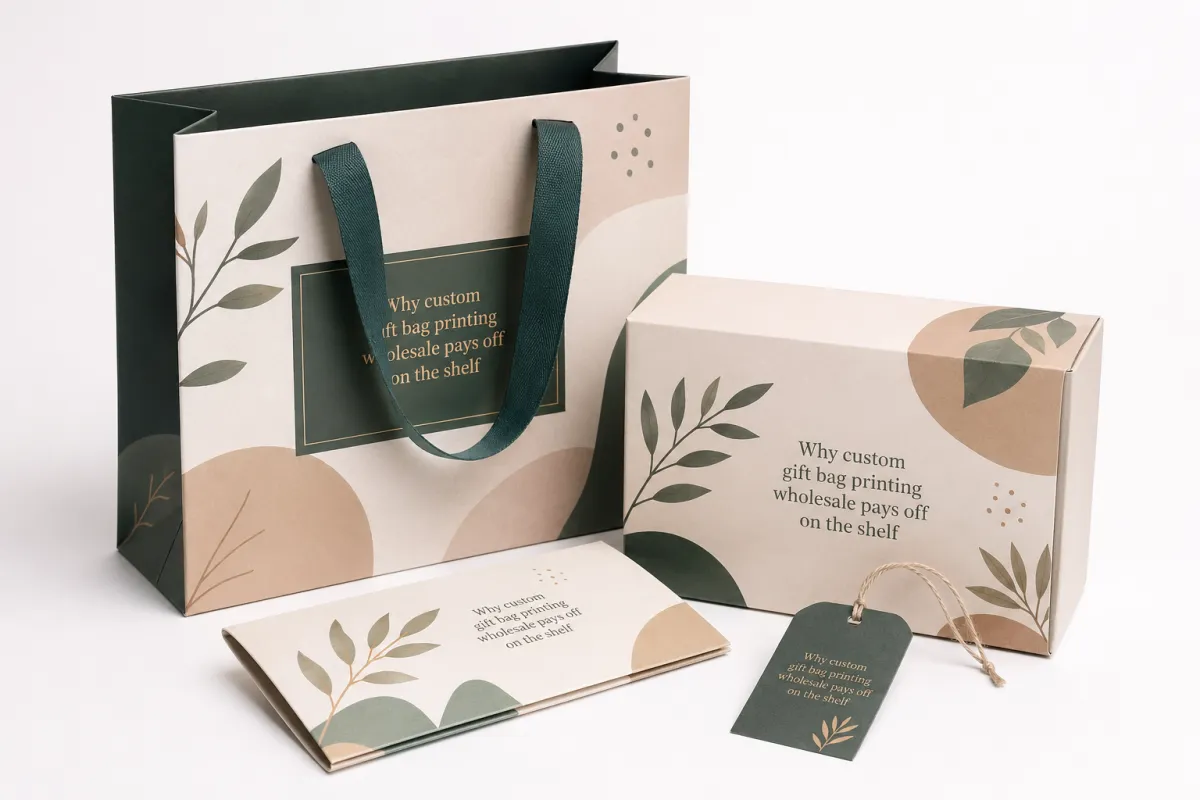
The first thing many shoppers notice is not the product itself but the package around it, especially in a boutique or pop-up where a branded carrier is part of the handoff. In a cosmetics shop I visited near Dallas Market Center, the buyer told me customers were posting bag photos on Instagram because the carrier looked intentional, with a soft matte laminate and centered foil logo that read clearly from three feet away. That is the quiet value of custom gift bag printing wholesale: it supports branding, retail packaging, and unboxing without requiring any change to the product SKU.
I have also seen the opposite, and it usually costs more than it saves. A jewelry store in Chicago switched from a 230gsm laminated stock to a thinner 180gsm kraft sheet to shave a few cents off each unit, and the handles began to tear at the top fold whenever a boxed necklace and a receipt envelope were carried together. The store reordered within six weeks, which wiped out the initial savings and added freight from a second shipment. The buyer looked at the failed bags on the counter and said, with the flat patience of someone doing the math in real time, “That was a very expensive twenty cents.” A better wholesale bag spec usually lowers long-term cost because you buy the right structure once and repeat it with the same artwork.
Wholesale ordering also matters because consistency is expensive when it is missing. If one location orders a 7 x 3 x 9 inch bag and another location orders an 8 x 4 x 10 inch version with a different handle width, the brand starts looking fragmented, even if the logo is identical. In practice, a disciplined run of branded gift bag production keeps PMS targets stable, artwork placement predictable, and carton counts easier to forecast at the warehouse in Shenzhen or the distribution center in Los Angeles. I have sat with buyers who wanted three bag styles, then discovered that two well-chosen sizes covered 92% of their product mix and cut proof revisions in half.
That is why I treat these bags as part of the product packaging system, right alongside Custom Printed Boxes, tissue, inserts, and sometimes a paper seal or ribbon tie. For boutiques, cosmetics, apparel, corporate gifting, holiday promotions, and event swag, the bag has to look right and hold up under a real load, usually between 1.5 kg and 4 kg depending on paper weight and handle build. The right bag should feel like it belongs in the same family as the product, not like it arrived from a different supplier in a different city.
“If the bag feels flimsy, the customer assumes the product inside is cheap.” A cosmetics buyer told me that during a line review in Atlanta while holding a sample made from 200gsm C1S stock, and she was right. When we upgraded her order to a 210gsm C1S bag with a 350gsm bottom board and 4 mm rope handles, complaints about crushed packaging dropped almost immediately, especially on bottle kits weighing just over 1.8 kg.
Honestly, a lot of packaging teams chase the print effect before they settle the structure, and that is the wrong order. The first questions should be about load, use case, and retail environment: is the bag sitting on a boutique counter in Miami, being handed out at a trade show in Las Vegas, or traveling home in a rideshare with glass bottles inside? Those details determine whether you need a natural kraft feel, a coated white board for sharper color, or a heavier art paper with matte lamination for better surface protection. If you ask the right questions first, you avoid the classic “why does this beautiful bag collapse the moment someone looks at it funny?” problem.
Custom Gift Bag Printing Wholesale: Sizes, Handles, and Finishes
The bag body starts with material choice, and that choice changes both the look and the print result on press. For a natural, eco-leaning presentation, kraft paper in the 150gsm to 200gsm range is common, especially for branded packaging in apparel stores, gift shops, and event programs in Portland or Austin. When the artwork needs sharp edges, stronger solids, and better photo reproduction, SBS or C1S paperboard in the 200gsm to 300gsm range is a better fit for custom printing. If the brand wants a premium hand feel, a heavier art paper with matte or gloss lamination usually behaves well in production and holds color more evenly. I have a soft spot for matte lamination, personally; it feels like the packaging spent a little extra time getting dressed.
Size is not a cosmetic detail, and the factory in Shenzhen or Ningbo will always tell you that first if you ask the right questions. A small 5 x 3 x 8 inch bag works for jewelry, cosmetics, and compact accessories, but it will buckle if you place a rigid gift box with sharp corners inside it. A mid-size 8 x 4 x 10 inch format is one of the most useful retail packaging sizes I see because it fits folded apparel, bottled gifts, and boxed sets without wasting paper. Large 12 x 5 x 15 inch bags are better for heavier product packaging, but they need stronger top folds, wider gussets, and often a board insert if the contents are dense. Good planning starts with that physical reality, not with whatever size looks prettiest in the mockup.
Handle style changes the experience more than most buyers expect. Twisted paper handles are usually the economy choice, and they are fine for lower-weight retail use if the glue bond is clean and the twist is consistent. Flat handles can work for simple shopping bags, while rope handles, ribbon handles, or die-cut handles move the presentation upward quickly. On one factory visit in Dongguan, I watched a 3 mm cotton rope handle fail a pull check because the reinforcement patch was too small by 8 mm on each side; the print looked excellent, but the structure was not ready. That is the sort of detail that separates acceptable custom gift bag printing wholesale from packaging that comes back in a complaint email three days later, which is always a cheerful message to open at 8:12 a.m.
Finish options should be chosen with both brand and factory in mind. CMYK process printing is useful for colorful art and gradients, while Pantone matching is the safer route when the brand color must stay fixed across stores from Seattle to Tampa. Hot foil stamping adds a crisp metallic edge on logos, embossing and debossing add tactile depth, and spot UV can highlight a mark without covering the entire bag in shine. Matte lamination gives a softer retail feel; gloss lamination makes colors pop more aggressively. A smart spec sheet usually spells out not just the decoration, but the bottom board, the top fold reinforcement, and whether the inside should remain plain kraft or carry a second print color.
Here is the practical breakdown I use when buyers ask which construction is right for their run, and I give these recommendations the same way whether the bags are being made in Guangdong or Zhejiang:
- Kraft paper bags: natural texture, 157gsm to 200gsm, strong for boutiques and event giveaways.
- C1S or SBS bags: smoother print surface, cleaner solids, better for crisp logos and product packaging.
- Art paper with lamination: stronger surface protection, richer color, better for premium retail packaging.
- Rope or ribbon handles: higher perceived value, stronger hand feel, better for gift-oriented programs.
What should you lock down before requesting custom gift bag printing wholesale?
If a buyer sends me a vague request with only a logo attached, I have to go back and ask three or four more questions before I can quote anything responsibly. The fastest way to keep the project moving is to prepare a clean spec list: finished width, height, and gusset; paper weight; handle style; print side count; lamination or foil; and whether the bag ships flat or assembled. A bag that is 8 x 4 x 10 inches is not the same as one that is 8 x 5 x 10 inches, because that extra inch of gusset changes board usage, carton packing, and freight volume. Packaging always finds the one inch you forgot.
Artwork readiness matters just as much as the bag dimensions. Vector logo files, embedded fonts, bleed on every edge, and a safe area around the handle patch reduce proof revisions and speed approval at the plant in Dongguan or Huizhou. When brand colors are critical, I ask for PMS references up front and I also ask what stock the artwork will print on, because the same ink can look darker on uncoated kraft and brighter on coated white paper. The proof is not just a picture; it is a production instruction sheet that should show exact logo placement, foil size, and the area where the handle reinforcement will sit.
Use case is another detail that gets overlooked. A bag for one scarf and a bag for two glass candle jars do not need the same build, even if they share the same logo and size. If the contents are heavy, the bottom board should be thicker, the handle bond should be wider, and the paper stock should be chosen with load in mind rather than appearance alone. I have seen buyers in corporate gifting choose a thin 180gsm stock for a bottle kit, then discover during packing that the base bowed inward by 6 mm. That is why the order should start from the product load, not from the artwork mockup.
Compliance and sourcing details can also matter, especially when bags are part of a larger retail rollout in California, the EU, or the United Kingdom. If you need recycled content, FSC-certified paper, or a specific destination label, say that early. For environmental paperwork and chain-of-custody language, the FSC resource at fsc.org is a solid reference, and for broader packaging education the Institute of Packaging Professionals site at packaging.org is useful. I also ask whether any bags are going near food-contact products or high-value kits that should be checked against ISTA-style packing and drop expectations, because not every retail environment is gentle. Those details keep the project grounded in the real world rather than in a pretty PDF that falls apart in the warehouse.
- Send dimensions: width, height, and gusset in inches or millimeters.
- Send files: AI, EPS, or PDF with outlined fonts and bleed.
- Send color targets: Pantone numbers or approved color references.
- Send use case: light gift, apparel, bottle, cosmetics, or event swag.
- Send delivery needs: ZIP code, in-hand date, and whether cartons must be palletized.
Custom gift bag printing wholesale pricing, MOQ, and what changes the number
Pricing in custom gift bag printing wholesale is driven by several real costs, not one vague market number. Quantity matters first, because setup and prepress costs get divided across the run. Then paper stock, print coverage, number of colors, handle type, lamination, foil, embossing, inserts, and carton packing all change the unit. A 1-color kraft bag with twisted handles is a different job from a full-color laminated bag with rope handles and foil on both sides, even if the finished size is identical. Anyone who has compared those two side by side knows the difference instantly; one is a workhorse, the other is trying to make an entrance.
Minimum order quantity usually begins in the low hundreds for simpler runs, but the best pricing often appears once the order reaches 1,000, 3,000, or 5,000 pieces. That is not arbitrary. Die cutting, plate making, press setup, and handle attachment all take labor before the first finished bag is packed. Small quantities are possible, but they often carry a higher unit cost because the setup time is spread over fewer bags. If a buyer wants several sizes, I usually recommend quoting each size separately so the cost structure stays clean. It saves a lot of confused spreadsheet archaeology later.
Special finishes add labor, and labor is where the quote changes fastest. Foil stamping needs another production step, embossing or debossing requires a matched die, and a laminated finish adds both material and handling time. Rope handles, ribbon handles, and custom inserts also push the cost upward, especially when the bag is larger and the glue area must be reinforced. In one supplier negotiation I handled with a factory team in Guangzhou, a ribbon handle upgrade increased the unit cost by $0.09, but the buyer accepted it because the bag was going into a luxury gift box program and the presentation mattered more than a few cents. That is a normal tradeoff in wholesale packaging.
Freight can surprise people as well. A flat-packed order is usually easier to ship than assembled bags, but carton count, palletization, destination zone, and season all affect the landed number. A quote from Guangdong to a West Coast warehouse is not the same as a quote to an East Coast event venue, and a holiday rush shipment will not price like a mid-season restock. When comparing quotes, ask for the same spec sheet on every line item so you are not comparing a basic kraft bag against a laminated premium bag and calling them equal. I have seen that mistake more times than I want to admit, and every time it turns into a “why is this quote so different?” email that could have been avoided with one extra minute of reading.
| Bag Type | Typical MOQ | Sample Unit Price | Best Use |
|---|---|---|---|
| 157gsm kraft, 1-color print, twisted handles | 1,000 pieces | $0.24/unit at 5,000 | Boutiques, event giveaways, simple retail packaging |
| 210gsm C1S, CMYK print, flat handles | 3,000 pieces | $0.41/unit at 5,000 | Cosmetics, apparel, branded packaging |
| 350gsm C1S artboard, foil, matte lamination, rope handles | 5,000 pieces | $0.78/unit at 5,000 | Premium retail programs with simplified artwork and high volume |
| 250gsm art paper, foil, matte lamination, rope handles | 5,000 pieces | $0.88/unit at 5,000 | Premium gift sets, corporate gifting, holiday promotions |
| 300gsm laminated board, embossing, ribbon handles | 5,000 pieces | $1.12/unit at 5,000 | Luxury launches, high-touch retail packaging |
Those figures are ballpark numbers from real production patterns I have seen in Guangdong and Zhejiang, not a promise on every spec. A deeper gusset, a heavier bottom board, a more difficult foil area, or a short-run rush schedule can move the number immediately. Still, they show the shape of the market: once the run gets larger and the build is simpler, the unit drops fast; once finishes and structure become more complex, the cost climbs in a way that can be justified only by the brand experience or the load requirement.
Production process and timeline for wholesale custom gift bags
The workflow for a wholesale bag order is usually straightforward, but only if the buyer answers the first questions clearly. It starts with spec review, then artwork check, then quote, then proofing, then prepress approval, then production, finishing, packing, and shipment. If the bag uses a standard die and one-color print, the path can move quickly. If it includes foil, embossing, or a new handle style, the job needs more time in setup and finishing. I have watched a seemingly simple order become a small project the moment somebody casually says, “Oh, and can we add inside printing too?” Sure. Of course you can. Right after I grow another pair of hands.
Simple stock-and-print jobs can move faster than buyers expect. I have seen a clean 1,000-piece order run from proof approval to shipment in 10 to 12 business days when the files were ready and the paper was in stock in the Shenzhen area. Once you add specialty finishes, a custom die line, or a heavier board upgrade, 12 to 15 business days from proof approval is a realistic target, and 15 to 20 business days is common for more elaborate builds. That is why I always tell customers to schedule backward from the delivery date, not forward from the quote date.
Most delays do not happen on the press; they happen in communication. Missing artwork links, a late color change, a handle patch revision, or unclear shipping instructions can slow a run more than the machine itself. On one plant floor in Dongguan, I watched a perfectly good order sit idle for a half day because the buyer wanted a last-minute change to the inside print color, and nobody had confirmed whether the bag would remain uncoated or receive lamination. The fastest projects are the ones where the proof is reviewed line by line: dimensions, color, logo placement, finish, handle alignment, carton count, and pack method.
Freight planning belongs in the schedule from the start, especially for seasonal retail programs. A holiday launch in November, a trade show in Las Vegas, or a corporate gifting campaign in New York leaves very little room for a missed truck booking. If the order must be delivered flat, palletized, or split between stores, that information should be locked early. I have seen strong production runs lose their advantage because nobody reserved enough time for domestic delivery. That is avoidable if the project is treated as a full supply chain job rather than a print job alone.
Why choose us for custom gift bag printing wholesale
What separates a good supplier from a merely attractive quote is factory judgment. I have spent enough time on folding lines and gluing stations in Shenzhen and Dongguan to know that a great bag is built in the details: die cutting that stays square, folds that do not crack at the crease, glue lines that hold in humidity, and handles that stay aligned after packing. That is the real value behind custom gift bag printing wholesale. The artwork matters, but the structure has to survive actual retail handling, carton stacking, and transport from the warehouse to the shelf.
Material familiarity matters too. A supplier who knows the difference between kraft, C1S, SBS, and laminated art paper can recommend the stock that prints cleanly and performs well under load. The same goes for finish selection. Some brands need rich offset printing with controlled PMS color; others can use digital printing for lower volume or variable artwork without paying for full plate setup. A good manufacturing partner will explain why one route saves money and where the tradeoff shows up. That is especially valuable in packaging projects, where a few cents on paper can either create savings or create a weak bag that costs more later.
Clear communication during quoting and proofing also saves time. Our Manufacturing Capabilities page shows the processes we work with, including die cutting, foil, gluing, and finishing, and our Wholesale Programs page explains how repeat orders and larger rollouts are handled. If you are building a broader system that includes cartons, inserts, and paper carriers, our Custom Packaging Products page helps connect the bag to the rest of the package branding mix. That kind of structure matters because the carrier usually sits inside a larger branded packaging plan.
Reliability is another reason buyers come back. Retail teams care about things that are easy to overlook in a mockup: consistent ink density, centered handles, squared bottoms, and cartons that arrive ready to place on the shelf. I have sat in meetings where a buyer had no interest in flashy claims, only in whether the next order would match the last order within a tight color window. That is a fair request. Repeatability is worth more than a dramatic sample if the bag has to be reordered across multiple locations or seasons.
Custom Gift Bag Printing Wholesale: Next steps and order checklist
If you are ready to move, the best next step is simple: gather the finished size, quantity, paper preference, handle choice, artwork files, and delivery location before you request a quote. With those five or six pieces in hand, custom gift bag printing wholesale becomes a clean specification exercise rather than a long back-and-forth email thread. I also recommend setting the target in-hand date first, because production and freight need to work backward from that number, not from the day you send the first message.
Ask for a dieline or template early. That single step prevents a lot of avoidable proof changes because the artwork team can place the logo, handle clearance, and finish area correctly the first time. If the bag needs a foil crest, a centered logo, or an inner print, the dieline should show it before the order is released. In my experience, these projects move faster when the buyer treats the dieline as part of the decision, not as a formality after the quote.
Before approval, confirm the stock, finish, color expectations, bag strength, and carton count. If the bag is for a bottle set, check the bottom board; if it is for apparel, check the gusset; if it is for a premium launch, check the handle material and laminate feel. This is where buyers often save themselves a reprint. A 5,000-piece order with the wrong gloss level or a handle that feels too light is not a small issue when the bags are already scheduled for a store rollout in Los Angeles or Miami. Good production is built on clear approval, not optimism.
My practical approval checklist looks like this:
- Verify finished dimensions and gusset.
- Confirm paper stock, weight, and finish.
- Approve logo placement and color targets.
- Check handle style, attachment, and load expectations.
- Review carton count, packing method, and delivery schedule.
Once those details are locked, the order path is much cleaner. The buyer knows what is coming, the factory knows what to build, and the brand gets a carrier that actually supports the product experience instead of distracting from it. That is the real value of a well-made bag: it is not a throwaway accessory, it is a functional piece of retail presentation that can support the sale, the gift moment, and the brand memory all at once. If you want a dependable result, start with the spec sheet, confirm the proof, and choose the build that fits the product instead of the cheapest line on the page.
What is the typical MOQ for custom gift bag printing wholesale?
MOQ usually starts around a few hundred pieces for a simple kraft bag, but the exact number depends on bag size, paper stock, handle style, and finishing complexity. A basic 157gsm kraft bag can often start lower, while foil, embossing, or oversized builds usually need a larger run because the setup costs are higher. If you need several sizes, ask for separate quotes so each line item stays easy to compare.
Which materials are best for custom printed gift bags wholesale?
Kraft paper works well for a natural look and is common for boutiques and events, while SBS or C1S stock is a strong choice when you need crisp graphics and solid color coverage. For higher perceived value, 350gsm C1S artboard with matte lamination prints cleanly and feels substantial in the hand, especially for premium retail programs. The right material depends on the load, the shelf presentation, and how much print accuracy matters to the brand.
How long does custom gift bag printing wholesale usually take?
Artwork proofing can take one to three business days when files are ready and the spec sheet is complete. Production typically takes 12-15 business days from proof approval for standard jobs in stock paper, while foil, embossing, or new die work can add time and push the schedule closer to 15-20 business days. Shipping is separate, so ask for a landed schedule rather than only a pressroom timeline when you plan the order.
Can you match brand colors on wholesale gift bag printing orders?
Yes, Pantone matching is commonly used when brand color control matters. Color accuracy still depends on the stock, ink system, and finish, so coated and uncoated papers will not always look identical. I always recommend approving the proof on the exact material whenever possible, because the final bag looks best when it matches the intended tone, not just the digital proof.
What should I send to get a quote for custom gift bag wholesale printing?
Send finished dimensions, quantity, paper preference, handle type, number of print colors, and any special finish requests. Include your logo files, delivery ZIP code, and target in-hand date so the quote reflects both production and freight, especially if the shipment is going to Texas, California, or New Jersey. If you have a dieline, send that too, because it speeds up layout and helps avoid specification errors.

