Buyer Fit Snapshot
| Best fit | Wholesale Custom Apparel Polygags projects where brand print, material claims, artwork control, MOQ, and repeat-order consistency need to be specified before quoting. |
|---|---|
| Quote inputs | Share finished size, material target, print colors, finish, packing count, annual reorder estimate, ship-to region, and any compliance wording. |
| Proofing check | Approve dieline scale, logo placement, barcode or warning zones, color tolerance, closure strength, and carton packing before bulk production. |
| Main risk | Vague material claims, crowded artwork, missing packing details, or unclear freight terms can make a low unit price expensive after revisions. |
Fast answer: Wholesale Custom Apparel Polygags: Pricing, Specs, Process should be specified like a repeatable production item. The safest quote records material, print method, finish, artwork proof, packing count, and reorder notes in one written spec.
Production checks before approval
Compare the actual filled-product size with the drawing, then confirm tolerance on folds, seals, hang holes, label areas, and retail display edges. Reserve space for logos, QR codes, warning copy, and material claims before decorative graphics fill the panel.
Quote comparison points
Review material grade, print process, finish, sampling route, tooling charges, carton quantity, and freight assumptions side by side. A quote is only useful when the supplier can repeat the same color, closure quality, and packing count on the next order.
Wholesale Custom Apparel Polybags: Pricing, Specs, Process
If you buy wholesale custom apparel polybags long enough, the bag stops feeling like a bag and starts acting like a quiet piece of factory insurance. It protects margin, keeps labor predictable, and saves a customer from opening a package that looks tired before the garment ever gets a chance to impress. I learned that the hard way on a premium tee program in Dongguan, Guangdong, where the shirts were folded beautifully, packed tightly, and still ended up with one scuffed hem inside the carton. That one small defect turned a clean order into a credit request on a $12.80 retail shirt. The bag cost less than the damage it prevented, which is usually how these things go once people stop treating packaging like an afterthought.
At Custom Logo Things, the right conversation around wholesale custom apparel polybags should be plain and practical: choose the bag that fits the garment, the packing line, and the landed cost. Not the fanciest bag on the quote sheet. Not the cheapest bag that looks fine only until it hits the warehouse floor. The right one. I have watched brands spend too much on oversized film because they wanted a premium feel, then pay for that decision again in freight, carton space, and slower packing. I have also seen smaller print shops in Los Angeles, California save real money by standardizing one bag across tees, hoodies, and retail kits instead of stocking three separate sizes and losing track of all of them.
Here is the plain version. Wholesale custom apparel polybags protect folded merchandise from dust, moisture, handling marks, and the little scuffs that show up between finishing and final shipment. They keep a tee looking retail-ready when it leaves the table and still respectable when it lands on a customer’s doorstep. They also cut down on rebagging labor, which sounds minor until you put a stopwatch on it. If a packing crew spends 15 seconds refolding and rebagging 10,000 units, that is 41.7 labor hours, not a rounding error. I have literally stood beside a line in Suzhou and watched people lose steam over a flimsy opening that kept sticking together like it had a personal grudge. Nobody needs that kind of drama before lunch.
I have worked with apparel brands, screen print shops, subscription kit teams, and fulfillment centers that ship folded garments by the pallet. Their goals are different, but the packaging logic stays the same. Wholesale custom apparel polybags need to fit the garment, hold up in the shipping lane, and present the product clearly. If you are building retail packaging, branded packaging, or a simple product packaging system that keeps inventory clean and easy to pack, the bag becomes part of the operation. If you also ship in Custom Poly Mailers or order through our Wholesale Programs, the same rule applies: every packaging decision should save time or reduce damage, ideally both.
Why Do Wholesale Custom Apparel Polybags Matter So Much?
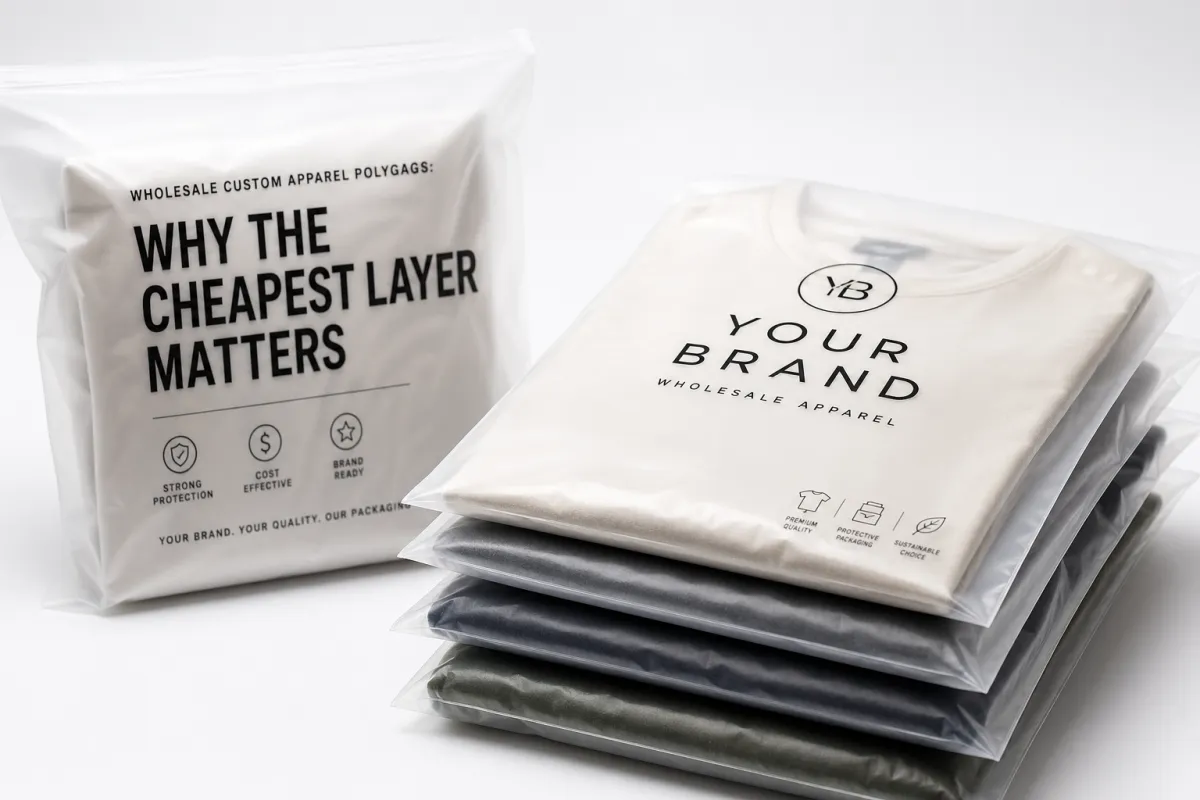
I still remember a factory floor in Shenzhen where a premium tee line was moving quickly, almost too quickly. The fold was neat, the carton count checked out, and the client was satisfied until we opened the top box and found one sleeve edge marked by a scuffed crease from loose handling. Nothing dramatic. Just enough to make the buyer ask for credits on a $14 retail shirt. That is the part most people miss about wholesale custom apparel polybags: they are not decoration. They are a damage-control layer that protects sellable units before the product ever reaches retail, a warehouse shelf, or a subscription box.
People like to focus on print design, and sure, package branding matters. A clean logo can improve the unboxing moment and make the whole order feel finished. If the bag does nothing to keep fabric clean, folded, and presentable, though, the branding is lipstick on a carton. A good bag reduces dust pickup during storage, keeps lint off black garments, and prevents folded edges from rubbing against the carton wall. On a busy fulfillment line in Ningbo, that also means fewer reworks. I have seen teams save 20 to 30 minutes per 1,000 units simply because the bag fit the fold correctly and the packer did not have to fight the opening every other piece. Honestly, I think that is the kind of boring win that keeps a warehouse sane.
The value shows up in very plain numbers. A bag that costs $0.03 more can still be the cheaper option if it prevents one return every few hundred orders, or if it trims rebagging labor by even 5 seconds per unit. On a 25,000-unit program, 5 seconds is 34.7 labor hours. And that does not include the cost of a damaged tee, a refunded order, or a complaint from a retailer who expected clean retail packaging. I have sat in those meetings in Orange County and heard the same sentence every time: the “cheap” bag added a hidden line item no one budgeted for. It is the kind of meeting that makes everyone stare at the table and suddenly become very interested in coffee.
Who benefits most from wholesale custom apparel polybags? Apparel brands shipping direct-to-consumer orders. Print shops packing customer orders after a heat-press run. Promo distributors bundling shirts, hats, and inserts into retail kits. Fulfillment teams managing folded garments at scale. Anyone shipping product that needs to arrive flat, clean, and consistent. If the item is folded, handled, stored, then shipped, the bag is part of the system. That is why I push buyers to think like operators, not dreamers. Good product packaging is boring in the best possible way, especially when you are moving 8,000 units out of a warehouse in Atlanta, Georgia.
My practical rule is simple: choose the bag that matches the garment and the packing environment, then confirm the landed cost. Not just the unit price. Landed cost. If you are sourcing alongside Custom Packaging Products, compare the bag spec against your carton size, your folding method, and your shipping weight. A better-fit bag often lets you pack more efficiently, and that is where the money starts to move. I have watched a quarter-inch of extra width turn into a mess of wasted carton space, and that is one of those tiny mistakes that somehow feels personal once you see it on a pallet. For many buyers, wholesale custom apparel polybags are the simplest place to recover time without touching the garment itself.
“We do not sell plastic. We sell a cleaner packing line, fewer complaints, and a better first impression.” That is what I tell buyers after I have seen three different factories in Guangdong repeat the same mistake with a different logo on the carton.
For buyers who want a technical reference point, packaging decisions should not be made by instinct alone. If a shipment is going through rough handling or long-distance e-commerce lanes, I look at transit testing guidance from groups like ISTA and the material standards commonly used in packaging work. A bag that looks good in a sample photo is not the same thing as a bag that survives actual handling through a hub in Dallas, Texas and a final mile route in Miami, Florida.
Wholesale Custom Apparel Polybags: Materials, Sizes, and Finish Options
Material choice drives almost everything about wholesale custom apparel polybags. The three most common film families are LDPE, HDPE, and recycled-content blends. LDPE is softer, clearer, and better when the goal is a smoother retail look. HDPE is stiffer, more crinkly, and usually cheaper, which is why it shows up in high-volume shipping operations that care more about utility than display. Recycled-content options can help meet sustainability targets, but the exact feel, clarity, and consistency depend on the resin mix. I have seen recycled film look excellent on one run and slightly hazy on the next because the supplier changed feedstock in a Ningbo compounding facility. That is why sample approval matters, even when everyone in the room would rather skip ahead and pretend the sample is close enough.
Thickness matters just as much. A light 1.0 to 1.25 mil film can work for simple tees and low-cost packing. A 1.5 to 2.0 mil spec is more common for standard garment shipping, especially when the bag gets handled multiple times before dispatch. For hoodies, joggers, and multi-piece sets, I usually recommend something heavier because the extra grams of fabric and the sharper corners create more stress on the seams. Wholesale custom apparel polybags should not split when a warehouse associate grabs a carton too hard. That sounds obvious until you visit a pack line in Dongguan and watch one flimsy bag tear every twenty minutes because somebody wanted to save fractions of a cent. It is astonishing how often “cheap” ends up being expensive in very specific ways.
Size should be based on the folded garment dimensions, not the flat shirt size. That is where buyers go wrong. A medium tee that folds to 10.5 by 13 inches is not the same as a medium tee that folds to 11.5 by 14.5 inches because of a heavy collar, a thick print, or a sleeve-over-body fold. Measure the actual packed unit. Then add a little clearance so the item slides in without fighting, but not so much room that the garment swims inside the bag. Oversized wholesale custom apparel polybags waste material and create sloppy presentation. Too-tight bags slow packing and wrinkle the fabric.
Finish options also matter. Clear bags are the default because buyers want visibility. Frosted or matte films look more elevated, especially for retail packaging. Vented bags are useful when you need airflow or want to reduce trapped air in thicker garments. Resealable strips make sense for brands that expect customer resealing or store repacking. Hang-hole styles work for rack display. Printed bags can carry a logo, size label, UPC, or suffocation warning. The cheapest smart option is usually one-color printing with the logo placed where it does not interfere with the fold, often on a 2-inch band near the top seal.
If you are choosing between appearance and function, start with function. Pretty bags are fine. Pretty bags that jam the line are not. The smartest wholesale custom apparel polybags I have seen combine a clean clear film, a simple print, and a fit that lets the packer move without thinking. That is how you build repeatable branded packaging instead of a one-off gimmick. And yes, I know that sounds less glamorous than a shiny mockup with dramatic lighting, but the warehouse in Fresno does not care about dramatic lighting.
| Bag Type | Typical Use | Common Thickness | Typical Unit Price | Notes |
|---|---|---|---|---|
| Clear stock bag | Tees, undershirts, light retail packs | 1.0-1.25 mil | $0.03-$0.07 at 10,000+ | Fastest and cheapest, limited branding |
| Printed stock bag | Basic logo or size identification | 1.25-1.5 mil | $0.06-$0.12 at 5,000+ | Good balance of cost and presentation |
| Custom size + print | Hoodies, kits, multi-item packs | 1.5-2.0 mil | $0.11-$0.24 at 5,000+ | Best fit, fewer returns and packing issues |
| Premium frosted bag | Retail packaging, premium apparel | 1.5-2.0 mil | $0.14-$0.30 at 5,000+ | Higher visual value, higher material cost |
For brands focused on sustainability messaging, I always tell them to verify what the film actually is before printing a claim on the bag. If you want to talk about recycling, use accurate language and check local rules. The U.S. EPA has straightforward guidance on plastics and recycling behavior at epa.gov/recycle. I have watched more than one buyer make a claim because it sounded nice in a meeting, then scramble when legal asked for proof. That is an expensive way to learn humility, and it tends to happen right after someone says, “We should be fine.”
There is no magic spec. There is only the right combination of resin, thickness, size, and finish for the use case. That is why wholesale custom apparel polybags are not a commodity decision when the garments are expensive or the packing line is tight. A few cents either way can change the whole operation, especially on a 50,000-piece run in Shenzhen where the savings or losses land hard.
Specifications That Actually Affect Fit and Presentation
If you ask me where bad orders start, I point to spec sheets. Not because spec sheets are evil. Because people fill them out wrong. The most important measurements for wholesale custom apparel polybags are width, length, gusset depth, seal type, and opening style. Those five details decide whether the garment slides in cleanly or fights like a bad zipper. I have seen buyers approve a bag that was “technically close,” then spend two weeks wondering why the packers were suddenly 12 percent slower. Close is not enough when you are handling thousands of units in a plant outside Guangzhou.
Width and length are obvious, but gusset depth is where a lot of sizing mistakes hide. A tee can sit flat in a narrow bag. Add a hoodie or a stacked bundle, and the same bag becomes cramped. That compression can wrinkle the garment, trap excess air, and make the pack look lumpy. If the bag is too large, the item slides around and the fold loses that crisp retail look. Wholesale custom apparel polybags should fit with enough room for insertion, not enough room to create chaos.
Seal type matters for packing speed. Bottom-seal bags are common and economical. Side-seal styles can work well for cleaner edges and presentation. Pre-opened bags with adhesive strips help on manual lines where labor consistency matters more than machine speed. If you are packing by hand in a warehouse in New Jersey, the opening needs to be easy to find. That sounds basic, but I have watched an entire room lose momentum because every packer was pinching at the bag edge like they were trying to open a stubborn envelope. It is a tiny annoyance that somehow behaves like a warehouse virus.
Think about the garment format too. Folded tees, hoodies, joggers, two-piece bundles, and retail sets all stress the bag differently. A slim tee can live in a 1.25 mil clear bag. A heavyweight hoodie with a front print needs more room and usually a sturdier film. A multi-item bundle might need a wider opening and a little gusset depth so the pack keeps its shape. In my experience, the best wholesale custom apparel polybags are designed from the pack-out, not from the product name alone.
Compliance and labeling deserve attention. Many buyers include suffocation warnings, barcode space, or a simple size callout. Warehouses also want fast visual identification, especially when multiple SKUs sit on the same rack. One client in Southern California asked for a clean logo-only bag, then complained later that pickers kept grabbing medium instead of large because the sizes were impossible to distinguish at a glance. We fixed it with a small printed size band in one corner, 0.5 inch high and 2 inches wide. Problem solved. Cheap fix. No drama. I wish every issue could be solved that easily, but frankly the packaging gods enjoy keeping us humble.
There is also a production reality nobody likes to mention. A bag that looks beautiful on paper can be irritating on the line if it jams sealing equipment, sticks together, or requires a packer to peel each opening by hand. I visited one site in Ho Chi Minh City where the operator lost nearly an hour per shift because the bag opening collapsed on humid days. The film was fine. The spec was not. Since then, I ask about humidity, hand packing, machine pack, and cartonization before I suggest a final size. Wholesale custom apparel polybags should fit the operation, not just the shirt.
If you want a simple testing rule, I use this: pack the largest folded size first, then the smallest, then the thickest version of the garment. If one bag spec covers those three without wrinkling or excess slack, you probably have a working size. If not, adjust. That is cheaper than learning the hard way after 8,000 units are already printed and waiting on a dock in Long Beach, California. It is also the easiest way to keep wholesale custom apparel polybags from becoming a bottleneck later.
Wholesale Custom Apparel Polybags Pricing and MOQ
Pricing for wholesale custom apparel polybags is driven by five things: material, thickness, size, print complexity, and quantity. That is the whole game. Every quote you receive is basically those five levers dressed up in different language. LDPE costs more than HDPE. Thicker film costs more than thinner film. Bigger bags use more resin. Two-color printing costs more than one-color. Small orders absorb more setup cost per unit. None of that is glamorous, but it is honest.
For realistic planning, a simple stock-style clear bag at higher volume may land around $0.03 to $0.07 per unit. Add a simple one-color logo, and you might be looking at $0.06 to $0.12 depending on size and run length. A custom size with one-color print often moves into the $0.11 to $0.24 range at 5,000-plus pieces. A premium frosted or thicker retail presentation bag can sit higher. Those are planning ranges, not guarantees; resin markets, print method, freight lane, and carton packing all shift the final number a bit. I have quoted programs where the difference between a standard clear bag and a custom printed retail bag was only $0.05 per unit, yet the client wanted to argue about the wrong thing: the bag cost. The real cost was the brand damage from using the wrong presentation for the product.
MOQ is where buyers get surprised. Stock-style polybags can start low, sometimes 500 to 1,000 pieces if inventory is already on hand. Light customization can stay in that range if the supplier has the bag and only adds a small print run. Fully custom sizing or special materials usually push MOQ to 3,000, 5,000, or 10,000 pieces depending on the construction and tooling. Wholesale custom apparel polybags are not expensive because someone wants to be difficult. They get expensive when the factory has to change film width, print plates, and production setup for your specific order.
Setup fees matter, especially on smaller quantities. Print plates, cylinders, artwork adjustments, and sample runs can add a few hundred dollars before the first bag ships. If someone quotes you only the unit price, keep asking until you see the full picture. I want to know the sample cost, the setup fee, and the freight estimate. That is landed cost. Anything less is a guessing game. And guessing is a fun hobby, not a buying strategy.
Here is how I usually reduce cost without destroying quality:
- Use one-color print instead of two-color print whenever the brand mark allows it.
- Standardize one size across tee and light hoodie programs if the fold allows it.
- Choose HDPE for shipping-only use and LDPE for retail-facing presentation.
- Consolidate annual quantities instead of placing three tiny orders.
- Keep suffocation text and barcodes in the same print pass.
That list sounds obvious because it is. Yet I still watch brands split one program into four SKUs, then pay four setup charges and wonder why the numbers look ugly. If your team is comparing Custom Printed Boxes, inserts, and wholesale custom apparel polybags at the same time, the smartest move is to align specs so the packaging family works together instead of fighting each other. I have seen packaging plans fail for no better reason than three departments refusing to speak to each other until the invoice arrived from a factory in Xiamen.
One negotiation stands out. A client wanted a premium-looking frosted bag with a two-color logo and a custom size for hoodies. The first quote came in at a level they hated. I asked the factory to hold the same size, drop to one color, and shift the logo placement by 1 inch to use a standard print screen. The revised quote fell by $0.04 per unit. On 20,000 pieces, that saved $800. Not life-changing, but real money. Real money pays freight. Real money pays for samples. Real money keeps the CFO calm.
So yes, wholesale custom apparel polybags are a price conversation. They are also a fit conversation, a labor conversation, and a presentation conversation. If a slightly better spec saves labor and reduces damage, the bag is cheaper even when the invoice is higher. That is the kind of math I prefer, especially when the order is running through a factory in Shenzhen at 7,500 units per shift.
Order Process and Timeline for Wholesale Custom Apparel Polybags
The order process for wholesale custom apparel polybags should be straightforward. If it turns into a scavenger hunt, somebody left out the right information. I like to move in six steps: inquiry, quote, artwork proof, sample or pre-production approval, mass production, shipment. That sequence keeps everyone honest and gives the buyer something concrete to review before committing to volume.
The fastest quotes come from buyers who send a few specific details up front: garment type, folded dimensions, thickness preference, print needs, quantity, destination, and any warning text or barcode requirement. If you can include a photo of the folded garment next to a ruler, even better. I once cut a quoting cycle from three days to four hours because the client in Chicago sent exact pack-out dimensions instead of “it’s probably tee size.” Probably is not a measurement. I am fond of people, but I am more fond of numbers.
Timeline depends on whether you are buying stock inventory or truly custom production. A stock bag with minor customization can move quickly, sometimes within a week if inventory is ready and artwork is approved. A custom size with printed artwork usually takes longer. In most cases, I would expect 12 to 18 business days from proof approval to production completion, then another 3 to 7 business days for freight depending on the lane. International transit can stretch that further. Wholesale custom apparel polybags are not hard to make, but they do require the factory to coordinate resin, printing, cutting, sealing, and packing. If one step slips, the schedule slips with it.
Sampling is not optional when the fit matters. A good sample can save a costly reprint. I learned that in a client meeting with a subscription box brand in Austin, Texas that packed tees plus a folded insert card. On paper, the bag looked fine. In the sample, the card corner poked the film and made the pack look fat. One test sample caught a problem that would have cost them thousands in rework. The extra day was worth it. Every time.
If you are asking for a rush, be realistic. Rush is feasible when the spec is simple, the artwork is minimal, and the supplier has stock material in hand. Rush gets messy when you want custom size, multiple print colors, special film, and a delivery deadline that was decided after lunch. I have seen factories in Foshan accept impossible dates just to win an order, then disappoint everyone. I would rather give you a conservative schedule than a fantasy with a tracking number attached.
Packaging teams sometimes ask whether the same order process applies to other categories like branded sleeves or mailers. The answer is yes, mostly. If you need support for broader packaging design, our team can discuss options across Custom Packaging Products and compare the bag spec against your actual packing workflow. I also like to test whether a bag spec aligns with your carton fill, because a tiny change in width can affect how many finished units fit per case, especially on 12-piece or 24-piece master cartons.
The cleanest project flow I have seen is simple: get an accurate sample, approve the artwork once, and lock the spec. That is what keeps wholesale custom apparel polybags on schedule and on budget. Every extra revision adds time. Every vague instruction adds risk. That is not drama. That is operations, and it is usually what separates a 15-day project from a 30-day one.
Why Buyers Choose Our Wholesale Custom Apparel Polybags
I do not pretend packaging is magic. It is not. It is a set of decisions that either support the product or make everyone work harder. Buyers come to us for wholesale custom apparel polybags because we treat them like a packaging decision, not a decoration decision. That matters. A bag that looks attractive but misses the fit, print, or handling requirement is just a more expensive mistake.
My background comes from sitting in factory conference rooms and standing on production floors where the floor tape is peeling, the humidity is miserable, and the only thing that matters is whether the line is actually moving. I have negotiated with film suppliers in Shanghai who wanted to charge a premium for a small resin change that barely improved performance. I have also walked a Shenzhen facility where the operator showed me, bag by bag, how a 0.2 inch change in opening width cut packing friction on a tee program by almost 10 percent. Those are the details that matter. Not the slogan on a sales page. The fit, the repeatability, the handling.
What do buyers actually get from working with us on wholesale custom apparel polybags? Consistent specs. Honest pricing. A recommendation that matches the garment, the packing speed, and the shipping method. If your brand needs simple branded packaging for DTC shirts, we keep it simple. If you need retail Packaging for Premium apparel, we push toward cleaner film, better print placement, and a tighter presentation. If your pack-out is complicated, we slow it down and measure it. That is the job.
I also care about avoiding waste. Oversized bags are a classic mistake. They inflate resin use, increase carton air, and make the whole package look less considered. Undersized bags create wrinkles and slow pack speed. The right wholesale custom apparel polybags reduce overbuying, reduce rework, and help the line feel stable. Stable lines are profitable lines. I have never seen a warehouse in Seattle celebrate chaos.
There is a trust piece too. If I think a spec needs testing, I say so. If I think a customer should compare two options side by side instead of accepting the first quote, I say that too. If a recycled-content film will change clarity or feel, I say it. That is how you build a useful packaging partner. Not with hype. With plain facts and enough experience to know where the problems usually hide.
For buyers who also manage broader package branding and product packaging programs, the same logic extends beyond bags. When we compare polybags against cartons, inserts, and shipping mailers, I want the full picture, not a single-item quote. If you are working through a launch, our Wholesale Programs page is a good starting point for planning volume and packaging mix without guessing your way through it.
Bottom line: the value is in the fit, the reliability, and the landed cost. That is why buyers choose our wholesale custom apparel polybags. Nothing mystical. Just cleaner packs, fewer headaches, and fewer surprises when the boxes hit the dock at 6 a.m. on receiving day.
Next Steps for Wholesale Custom Apparel Polybags
If you are ready to quote wholesale custom apparel polybags, stop staring at generic options and gather the numbers that matter. Measure the folded garment in its actual pack method. Decide whether you need logo print, size marks, warning text, or barcode space. Count the quantity you actually expect to consume, not the quantity that sounds convenient in a meeting. Then add shipping destination and turnaround needs. That is enough to build a real quote instead of a vague estimate.
What should you send first? Product type. Folded dimensions. Estimated annual usage. Desired quantity for the first run. Print colors. If you have a sample bag from another supplier, send that too. I can usually tell within one look whether the old spec was oversized, underbuilt, or simply wrong for the product. When a buyer gives me useful information on day one, the first estimate is close enough to make a decision. When they send “need bags for shirts, price please,” we all waste time. I have seen that email enough times to hear it in my sleep.
I recommend comparing at least two or three wholesale custom apparel polybags side by side. One should be your budget option. One should be your preferred retail-facing option. One should be the practical middle. That comparison usually reveals the truth. The cheapest option often costs more in labor. The nicest option often costs more than the margin can justify. The middle option is frequently the winner, which is annoying for people who like simple answers, but very useful for people who need to keep a business alive.
If the garment is premium, or if the pack-out is tight, order a sample or proof before full production. I know that feels like an extra step. It is. It is also a cheap one. A sample that costs a little time can save a reprint, a return wave, or a warehouse slowdown. I would rather annoy someone for one day than help them fix a six-figure mistake. That sounds blunt because it is. I have seen the six-figure mistakes, and they were all avoidable.
One last point. Do not turn wholesale custom apparel polybags into a design debate that drags on for months. Make the decision based on fit, price, and handling. Lock the spec. Move on. Packaging is supposed to support the product, not audition for attention. If you want a clean way to start, send us the garment measurements, your rough annual volume, and the print you need. We will help you narrow it down quickly and tell you what makes sense.
The smartest buyers use wholesale custom apparel polybags as a packaging decision they can lock in now, not a branding idea they keep postponing. That is how you keep the line moving, the product protected, and the cost under control.
What size wholesale custom apparel polybags do I need for folded tees?
Measure the folded shirt's width, height, and thickness after your actual folding method, not the flat garment size. For many tees, that lands around 10.5 by 13 inches folded, with a bag that adds roughly 0.5 to 1 inch of clearance on each side. If you pack multiple sizes, test the largest folded size first so one bag spec can cover the full range without wrinkles or a tight top seal. For wholesale custom apparel polybags, fit is always more useful than guessing from the size tag alone.
How much do wholesale custom apparel polybags usually cost?
Cost depends on material, thickness, size, print complexity, and quantity. Simple clear bags at 10,000 pieces might cost $0.03 to $0.07 per unit, while custom printed bags at 5,000 pieces often land around $0.06 to $0.12 or higher. Setup fees and sample charges can matter on small orders, so ask for landed cost, not just unit price. If you are comparing wholesale custom apparel polybags against mailers or boxes, use the total packing cost, not the headline number, to judge value.
What MOQ should I expect for wholesale custom apparel polybags?
Stock-style or lightly customized bags can start at 500 to 1,000 pieces if the supplier has inventory on hand. Fully custom print, custom sizing, and special materials usually push the MOQ to 3,000, 5,000, or 10,000 pieces. The best MOQ is the one that matches your packing volume without leaving dead inventory on the shelf. For wholesale custom apparel polybags, a slightly larger first run often lowers the per-unit cost enough to justify the extra volume.
Can I print my logo and warning text on wholesale custom apparel polybags?
Yes, most buyers add a logo, size note, barcode, or suffocation warning on the same bag. One-color printing is usually the simplest and most cost-efficient option, especially on runs of 5,000 pieces or more. Keep the layout clean so the bag still looks professional and stays easy to pack on a manual line. The best wholesale custom apparel polybags balance clear branding with a layout that does not slow the team down.
How long does production take after artwork approval?
Stock bags move faster than fully custom printed or custom-sized bags. A typical custom order takes 12 to 18 business days from proof approval to production completion, then 3 to 7 business days for freight depending on the lane. If timing is tight, confirm whether the spec can ship from existing inventory before you commit to custom production. For time-sensitive launches, wholesale custom apparel polybags should be sampled and approved early so the schedule stays predictable.
Actionable takeaway: measure the folded garment as it will actually ship, choose the lightest film that still survives your handling, and approve one sample against the real pack-out before you place the order. That three-step check is usually what separates a clean wholesale custom apparel polybags program from a messy one.

