Buyer Fit Snapshot
| Best fit | custom gift bags with handles for packaging buyers comparing material specs, print proof, MOQ, unit cost, freight, and repeat-order risk where brand print, material, artwork control, and repeat-order consistency matter. |
|---|---|
| Quote inputs | Share finished size, material target, print colors, finish, packing count, annual reorder estimate, and delivery region. |
| Proofing check | Approve dieline scale, logo placement, barcode or warning zones, color tolerance, and any recyclable or compostable wording before bulk production. |
| Main risk | Vague material claims, crowded artwork, or missing packing details can create delays even when the unit price looks attractive. |
Fast answer: Custom Gift Bags with Handles: Design, Costs & Uses should be specified like a repeatable production item. The safest quote includes material, print method, finish, artwork proof, carton packing, and reorder notes in one written spec.
What to confirm before approving the packaging proof
Check the product dimensions against the actual filled item, not only the sales mockup. Ask for tolerance on folds, seals, hang holes, label areas, and retail display edges. If the package carries a logo, QR code, warning copy, or legal claim, reserve that space before decorative graphics fill the panel.
How to compare quotes without losing quality
Compare board or film grade, print process, finish, sampling route, tooling charges, carton quantity, and freight assumptions side by side. A lower quote is only useful if the supplier can repeat the same color, closure quality, and packing count on the next order.
Custom Gift Bags with handles do more than hold a present. They set the tone before anyone even sees what is inside. That first impression matters more than most brands admit. A bag with the right structure, print, and handle can make a gift feel considered instead of improvised. A bad one does the opposite. It can make a nice product feel like it got packed in a hurry, which is never a great look.
The value is not only in the logo on the front. It lives in the whole construction: paper stock, board weight, handle style, glue pattern, finish, and size. Those details decide whether the bag feels polished or flimsy, sturdy or awkward, worth keeping or worth tossing immediately. I have seen a simple paper bag elevate a modest retail purchase just because it felt solid in the hand. I have also seen an expensive product lose some of its shine because the bag collapsed at the base. Pretty annoying, honestly.
Custom gift bags with handles deserve the same attention as custom printed boxes or any other customer-facing package. The contents should drive the spec. Start with what the bag needs to carry, how far it needs to travel, and how it will be handed off. Then build around that. It is a boring approach, but it saves money and avoids a lot of backtracking later.
"If the bag feels awkward to carry, the brand feels awkward too."
What custom gift bags with handles are and when to use them
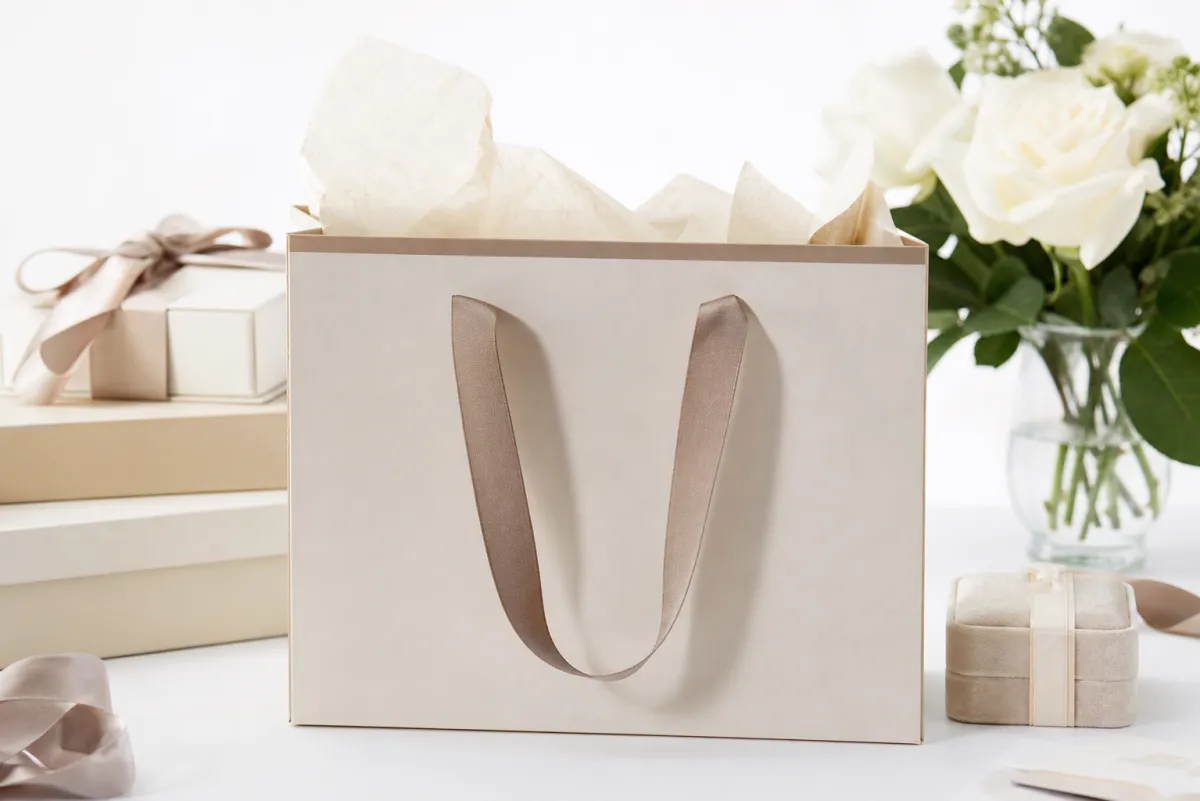
Custom gift bags with handles are paper or board carriers made for a specific brand, product, or event. They are not stock bags with a logo slapped on as an afterthought. The size, print area, stock, and handle style are chosen on purpose. That is what gives custom gift bags with handles a cleaner and more intentional look than off-the-shelf options that were never meant to represent a brand.
They show up in retail checkout, boutique gifting, corporate giveaways, tradeshow kits, wedding favors, holiday bundles, and launch events. They also work well for products that need to be handed over quickly without making the moment feel rushed. For apparel, candles, cosmetics, gift sets, and small accessories, custom gift bags with handles usually hit a sweet spot between presentation and convenience. They are easy to carry, easy to brand, and less fussy than rigid packaging.
The bag itself becomes part of the brand signal. People remember the look, the handle feel, and whether the print stayed crisp. They usually do not remember the spec sheet, which is fine. That is not the goal. The point is for the bag to do its job quietly while making the brand look like it has its act together.
There is also a practical side. A well-made bag takes pressure off staff, protects the contents during the handoff, and gives the customer something worth keeping for a second use. A weak one tears at the handle, caves in at the bottom, or looks too plain for what is inside. Start with the use case. Artwork comes second. Always.
One thing buyers still underestimate is how much a bag changes the feel of the moment. A bag reads as more gift-like than a carton, and it is faster to hand over at the counter. That matters in busy retail environments where staff are trying to move without making the line feel like a traffic jam.
How custom gift bags with handles are made
Everything starts with the material. Many custom gift bags with handles are made from SBS paperboard, art paper laminated to board, kraft paper, or coated stock selected for print quality and fold strength. Lighter retail bags often sit around 157 to 250 gsm, while more presentation-driven bags may use 210 to 300 gsm paper laminated over sturdier board. The right choice depends on the product. A folded scarf is one thing. A boxed candle set is another.
Printing comes next, and it sets the tone fast. That might be CMYK for full-color graphics, one- or two-color spot printing for a cleaner budget-friendly run, or Pantone matching if brand color accuracy matters. Custom gift bags with handles can also include foil stamping, embossing, debossing, spot UV, or soft-touch lamination. Those finishes are not just there to look fancy in a mockup. They change how the bag feels and how it reads under store lights or event photography.
The build sequence is pretty exact: print the paper, cut it to the dieline, fold it, glue it, reinforce the stress points, and attach the handle. Handle attachment is where quality shows up fast. Twisted paper handles are glued into internal patches. Flat paper handles give a cleaner retail look. Rope handles are knotted through eyelets or reinforced holes. Ribbon handles usually show up on more premium presentation bags. Die-cut handle bags can work too, but they need a strong top section or they start tearing where people grip them. Nobody wants a bag that gives up halfway across the parking lot.
The base matters just as much as the handle. A reinforced bottom, correct gusset folds, and clean glue lines help the bag stand up and carry weight without warping. When custom gift bags with handles are built well, the bottom opens square, the side panels stay controlled, and the handles align so the bag sits naturally in the hand. That is the difference between packaging and a carrier that barely survives the job.
For buyers comparing material and handle options, this is a practical starting point.
| Material or handle option | Typical feel | Best use | Relative cost impact | Practical note |
|---|---|---|---|---|
| Twisted paper handle | Simple, practical, familiar | Retail giveaways and everyday gift bags | Lowest | Good value when the bag needs to stay economical |
| Flat paper handle | Cleaner and slightly more refined | Boutiques, apparel, light gift sets | Low to moderate | Often a nice middle ground for custom gift bags with handles |
| Rope handle | Substantial and premium | Higher-end retail and corporate gifting | Moderate to higher | Comfortable for longer carrying distances |
| Ribbon handle | Soft and elegant | Luxury gifting and special occasions | Higher | Pairs well with foil, embossing, and specialty paper |
| Die-cut handle | Minimal and clean | Lightweight premium presentation | Low on parts, higher on structure | Needs a strong top area to avoid stress cracks |
Brands that care about sourcing or recycling claims should bring that up early. The FSC has useful guidance on certified forest materials, and the paper choice can shape how credible the sustainability story feels. If a recycled or certified claim matters to your packaging story, ask for the paperwork before the art gets locked. Do not wait until the sample is already in production and everyone is suddenly pretending the question is new.
Key factors that affect quality, look, and performance
Size is the first variable that really changes how custom gift bags with handles behave. A bag that is too tall can lean or fold at the top. One that is too narrow can squeeze the contents and warp the print. A bag that is too wide wastes material and can make a small gift look underdressed. Common sizes often land around 5 x 3 x 8 inches for small gifts, 8 x 4 x 10 inches for mid-size retail items, and 10 x 5 x 13 inches for apparel or gift bundles, but the right dimensions depend on the product, not a random category label.
Load capacity comes next. If the bag needs to carry a boxed candle, a glass item, or several pieces of apparel, the handle attachment and base reinforcement need to be stronger. That can mean heavier board, a stronger liner, wider handle patches, or a more secure glue pattern. I always tell buyers to spec custom gift bags with handles for actual carrying conditions, not for a nice render on a screen. If the bag has to survive a crowded event floor or a walk back to the car, build for that. Otherwise you are just making trouble for the customer.
Branding choices matter more than people expect. Full-coverage print creates a bold retail look, while a single logo on natural kraft can feel restrained and more organic. Repeating patterns make custom gift bags with handles feel lively on a shelf or table, and high-contrast color blocking improves visibility in busy spaces. If package branding is the goal, the design should be recognizable from a distance without turning the bag into visual noise. Subtle does not have to mean invisible.
Tactile details matter too. Paper hand feel, sound, and handle texture all shape perception. Soft-touch lamination gives a quieter, more premium finish. Gloss reflects light and can make colors pop harder. Uncoated kraft looks honest and natural, but it can scuff more easily and absorb ink differently. With custom gift bags with handles, those small sensory details often decide whether the bag feels like packaging or a throwaway carrier.
Sustainability claims need clear language. Recyclability depends on the paper, inks, adhesives, and coatings used. A laminated bag can still look good and do the job, but it is not the same as a plain uncoated paper bag in recycling terms. If your team needs a baseline on transit performance, the testing mindset used by ISTA is useful even for carrier packaging, because handle stress and drop behavior tell you a lot about how a bag behaves once it leaves the counter. For heavier product packaging programs, asking about ASTM-style pull or durability checks is a smart move. It is not glamorous, but it beats guessing.
I see buyers get distracted by the artwork and miss the structure. A sharp logo does not save a bag that folds badly or feels weak in the hand. Custom gift bags with handles work best when structure, branding, and use case are all doing their part.
Custom gift bags with handles pricing: what drives cost
Custom gift bags with handles pricing comes down to a few variables that stack up fast. Quantity is usually the biggest one because setup, die making, proofing, and press preparation get spread across the run. Size matters because bigger bags use more paper, more glue, and usually more reinforcement. Print coverage matters because a full-wrap design needs more ink and more press attention than a simple front logo. Handle type, finish, and special construction all add their own cost layers.
Low quantities almost always carry a higher per-unit price. The fixed work does not shrink just because the order is small. At 500 to 1,000 pieces, unit cost usually feels much higher than at 5,000 or 10,000. That is not a mystery. In packaging, setup effort stays close to the same no matter the run size, so custom gift bags with handles tend to get cheaper per piece as volume climbs. The same logic shows up in custom printed boxes, which is why small orders can sting.
Here is a practical budget view for planning purposes, assuming a standard paper bag format and ordinary production conditions. These are broad ranges, not a promise, and they shift with region, stock choice, freight, and timing.
| Spec level | Typical build | Planning range per unit | Where it fits |
|---|---|---|---|
| Entry-level | Kraft or SBS paper, one-color print, twisted paper handle | $0.20-$0.45 | Retail giveaways, simple promotions, basic gift packaging |
| Mid-range | Better paper weight, 1-2 color print, flat or rope handle, light lamination | $0.45-$1.20 | Boutiques, corporate gifting, seasonal retail use |
| Premium | Laminated stock, rope or ribbon handle, foil or embossing, stronger base | $1.20-$3.00+ | Luxury product packaging, special events, high-value gifts |
Handle style can move the quote more than people expect. Twisted paper handles are usually the cheapest. Rope and ribbon handles add more. Foil stamping, spot UV, and embossing also raise the price, but not all in the same way. A small foil logo often makes sense. Full-surface specialty finishing usually does not. Most buyers get better results by using premium effects where they matter and keeping the rest of the bag quiet. That keeps custom gift bags with handles from costing more than the products they are meant to frame.
Freight should never be an afterthought. A quote that looks attractive can change fast once shipping, cartons, palletization, and rush charges get added. I always push for landed cost, not just unit cost. A slightly pricier spec with cleaner packing or a shorter lead time can be the better business choice if the bags have to land before a launch, event, or holiday rush. That matters for custom gift bags with handles because timing is usually part of the value.
One simple trick is to reserve premium finishes for the logo area and keep the rest of the bag clean. That keeps the bag feeling elevated without spending on every square inch. It is package branding with restraint, which usually looks better than trying to decorate the whole surface just because you can.
Step-by-step process and timeline for ordering
The ordering process moves faster when the brief is specific from the start. First define the use case: retail carryout, a gift set, a corporate event, or a seasonal promotion. Then confirm product dimensions, expected weight, and the level of presentation you want. Once that is clear, custom gift bags with handles can be designed around the job instead of around guesswork. That one move saves a lot of pointless back-and-forth later, especially when the bag has to fit a product already chosen by another team.
After the use case, choose the material and handle. That is where the look and feel become concrete. Decide whether the bag should feel natural, glossy, elegant, or premium. Specify print method, Pantone or CMYK targets, finish preferences, and any structural needs like reinforced bottoms or thicker handles. If the artwork will go onto a specific dieline, get that file early. Nobody enjoys building design files around assumptions that should have been answered on day one.
A realistic timeline usually runs like this: quote and layout review first, then artwork prep, proofing, revisions, sample approval if needed, production, inspection, and shipping. For a standard order, production often falls in the 12 to 15 business day range after proof approval. More complex jobs can stretch to 18 to 25 business days. Specialty finishes, custom inserts, or multiple versions can push the schedule further. Custom gift bags with handles are not hard to order, but they do reward organized planning.
Sampling is not a delay. It is a checkpoint. If the bag will carry heavier items, represent a luxury brand, or sit in front of customers at a major event, a physical sample is usually worth it. You can check handle feel, print clarity, color tone, and how the bag stands when loaded. A sample will show a weak bottom panel or a handle that feels too thin long before full production is underway. That is a cheap mistake to catch once, not 5,000 times.
Buffer time is the easiest protection you have. Seasonal campaigns, retail launches, and conference kits get thrown off by late proofs, revised dielines, or freight delays all the time. Build in extra days wherever you can, especially when the bag is tied to a public event. If the bag has to coordinate with other branded items, it helps to review Custom Packaging Products alongside the bag spec so the full presentation stays aligned.
The cleaner the brief, the smoother the process. Dimensions, quantity, product weight, print area, finish, handle style, and delivery date should all live on the same sheet before the quote gets approved. That is the simplest way to keep custom gift bags with handles moving through design and production without extra rounds of clarification.
Common mistakes when specifying custom gift bags with handles
The biggest mistake is choosing the bag for appearance alone. A bag can look great on screen and still be wrong for the product. If the contents are heavy, the bottom may bow, the gussets may twist, or the handles may pull loose too soon. Custom gift bags with handles should always be checked against the actual load, not just the mood board. The product inside decides the structure. Not the other way around.
Weak artwork prep is another problem that shows up fast. Missing dielines, low-resolution logos, and fuzzy color references create avoidable delays. If the bag needs to match an existing brand color, give the supplier the closest Pantone reference you have instead of a screenshot from a laptop. Coated paper, kraft paper, and laminated stock all behave differently under ink. Good packaging design depends on clean inputs, and custom gift bags with handles are no exception.
Handle comfort gets ignored more than it should. A handle that looks elegant on a flat mockup may feel narrow or sharp once the bag is filled. That becomes more obvious with heavier gifts or during events where people carry the bag for a long time. Rope handles usually feel more substantial. Flat paper handles can be a decent middle ground if the load is moderate. The right choice is the one that works in the hand, not just in the render.
Finishes can create another mismatch. A buyer may want a natural recycled look and then add heavy gloss lamination, foil, and a bright metallic handle. That changes both the visual story and the recycling profile. None of that is automatically wrong. It just needs to be chosen on purpose. Custom gift bags with handles work best when the surface treatment supports the brand story instead of fighting it.
Lead time mistakes are usually the expensive ones. A lot of projects are not actually late because production dragged. They are late because the brief was incomplete, the sample needed revisions, or freight got booked too late. The fix is boring but effective: confirm the spec, approve the proof, and lock the shipping window before relying on the bags. That is standard practice for product packaging, though people love forgetting it when a bag feels simple.
Some buyers also forget that the bag is a visible brand object, not packaging filler. If the print is off-center, the glue line is visible, or the base sags when filled, customers notice. Even when the contents are excellent, the bag becomes part of the memory. That is why custom gift bags with handles deserve the same care you would give any other branded packaging element.
Expert tips and next steps for choosing the right bag
Start with the product itself. Measure it, place it in a sample bag or mockup, and see how much room is left above the top edge. That small exercise tells you whether the bag needs extra headroom, a wider gusset, or a stronger base. For custom gift bags with handles, product fit is usually the first technical filter. Everything else follows from there. A bag that fits cleanly will almost always look better than one that has to be forced.
Compare at least two material and handle combinations before you lock the spec. One option may be more economical. The other may feel better or carry better. A kraft bag with twisted paper handles might be perfect for a promotion, while laminated stock with rope handles may be the better answer for premium retail packaging. Buyers who test two versions side by side usually make better decisions because they can compare cost, comfort, and appearance at the same time. Guessing from photos is a great way to waste a budget.
Use a simple specification sheet. List dimensions, quantity, print method, finish, handle style, product weight, delivery date, and any special notes about inserts or reinforcement. That one page keeps internal teams and suppliers on the same track. It also cuts down on clarification emails, which is one of the easiest ways to keep custom gift bags with handles on schedule. If multiple departments are involved, that sheet becomes the shared source of truth.
If the bag is for a high-value moment, request a physical sample or prototype. There is no substitute for feeling the handle, checking the base, and seeing how the print reads under normal light. A photo can hide problems that show up instantly in person. For custom gift bags with handles carrying expensive products, a sample is a small cost compared with a weak presentation.
I also recommend matching the bag spec to the broader packaging plan. If the brand already uses custom printed boxes for shipping or retail, the bag should echo the same visual language where it makes sense. That does not mean every piece has to match exactly. It means the materials, colors, and finishing should feel like they belong in the same system. Good package branding works that way. The pieces support each other instead of competing for attention.
Before You Order, make sure the artwork, budget, and timeline all agree. If one of those is off, the project usually needs a reset. Once they line up, custom gift bags with handles become a straightforward way to raise the presentation, support the product, and make the handoff feel finished. That is usually the point where a buyer can move forward without second-guessing every decision.
Frequently asked questions
What are custom gift bags with handles used for?
They are used for retail purchases, event giveaways, luxury gifts, promotional kits, and any package that should feel more polished than a plain carrier bag. The handle adds convenience, while the custom print turns the bag into a visible brand touchpoint. For many businesses, custom gift bags with handles become part of the customer experience instead of just a transport item.
Which handle style works best for custom gift bags with handles?
Twisted paper handles are cost-effective and common for everyday retail use, while rope and ribbon handles usually feel more premium. The best choice depends on weight, budget, and the brand look you want, so the handle should match both the contents and the carrying experience. If the bag is expected to travel farther or carry more weight, custom gift bags with handles often perform better with a sturdier handle.
How much do custom gift bags with handles usually cost?
Price is driven by size, paper weight, quantity, printing, handle type, and finishing, so unit cost can vary widely from one spec to another. The fastest way to control cost is to simplify finishes, standardize dimensions, and order enough quantity to spread setup costs across more bags. In many programs, custom gift bags with handles land somewhere between an economical retail spec and a premium presentation piece, depending on how far the design is pushed.
How long does it take to produce custom gift bags with handles?
Timeline depends on artwork readiness, sample approval, and the complexity of the build, but custom projects generally need enough time for proofing and production. Orders with specialty finishes, multiple versions, or rush shipping should be scheduled earlier so there is room for revisions and freight delays. A well-prepared custom gift bags with handles order usually moves faster because fewer details need to be resolved after quoting.
What should I prepare before requesting custom gift bags with handles?
Have the bag dimensions, quantity, product weight, artwork files, preferred finish, and desired delivery date ready before you ask for a quote. If you know the contents, share the size and how the bag will be used, because that helps determine the right material and handle reinforcement. The clearer the brief, the easier it is to source custom gift bags with handles that fit the product, the budget, and the brand message at the same time.

