Buyer Fit Snapshot
| Best fit | custom gift wrap tissue paper for packaging buyers comparing material specs, print proof, MOQ, unit cost, freight, and repeat-order risk where brand print, material, artwork control, and repeat-order consistency matter. |
|---|---|
| Quote inputs | Share finished size, material target, print colors, finish, packing count, annual reorder estimate, and delivery region. |
| Proofing check | Approve dieline scale, logo placement, barcode or warning zones, color tolerance, and any recyclable or compostable wording before bulk production. |
| Main risk | Vague material claims, crowded artwork, or missing packing details can create delays even when the unit price looks attractive. |
Fast answer: Custom Gift Wrap Tissue Paper: What It Is & How It Works should be specified like a repeatable production item. The safest quote includes material, print method, finish, artwork proof, carton packing, and reorder notes in one written spec.
What to confirm before approving the packaging proof
Check the product dimensions against the actual filled item, not only the sales mockup. Ask for tolerance on folds, seals, hang holes, label areas, and retail display edges. If the package carries a logo, QR code, warning copy, or legal claim, reserve that space before decorative graphics fill the panel.
How to compare quotes without losing quality
Compare board or film grade, print process, finish, sampling route, tooling charges, carton quantity, and freight assumptions side by side. A lower quote is only useful if the supplier can repeat the same color, closure quality, and packing count on the next order.
Custom gift wrap tissue paper is one of those packaging pieces that looks minor until you remove it. Then the whole pack feels flatter. Less considered. A little cheap, honestly. It usually costs less than a premium insert or a custom carton component, but it is the first branded layer many shoppers touch. That makes it one of the highest-return upgrades in packaging: small spend, big visibility, and a real role in how people judge the rest of the order. For brands trying to improve retail packaging without rebuilding the entire structure, tissue lands in a sweet spot between presentation and practicality. A well-spec'd tissue order can lift a $4 mailer the same way a sharp label can make a simple bottle feel finished.
In plain terms, it is tissue that has been printed, dyed, or branded for use inside gift bags, boxes, mailers, and other product packaging. It adds color, hides gaps, protects delicate items, and keeps the unboxing moment consistent across channels. A folded sheet in a boutique bag and a stacked sheet inside a shipper are doing different jobs, but both are still part of the same package branding system. Buyers often underestimate how much work a thin, low-cost paper layer can do when the outer pack is minimal.
For brands with seasonal promotions, gift-with-purchase programs, or recurring ecommerce orders, custom gift wrap tissue paper can carry a surprising amount of brand weight. It can turn a plain mailer into branded packaging, support holiday campaigns without changing the box structure, and make even modest packaging feel intentional. If you already use Custom Packaging Products, tissue is often the layer that ties the whole set together. It also gives operations teams a useful valve: they can refresh the look of a program without changing the carton spec, pallet configuration, or packing line logic. That's the kind of detail people miss when they focus only on the shiny stuff.
That last point matters because tissue is not just decorative. The right custom gift wrap tissue paper can reduce pack-out frustration, improve the way merchandise nests in the box, and lower the chance that a customer sees the raw bottom of a bag or the air pockets inside a carton. For buyers comparing print methods, sizing, lead times, and finishing choices, the useful question is not whether tissue looks nice. The real question is whether it fits your volume, your schedule, and your packaging design goals without creating excess inventory or line slowdowns.
Custom Gift Wrap Tissue Paper: Why It Matters
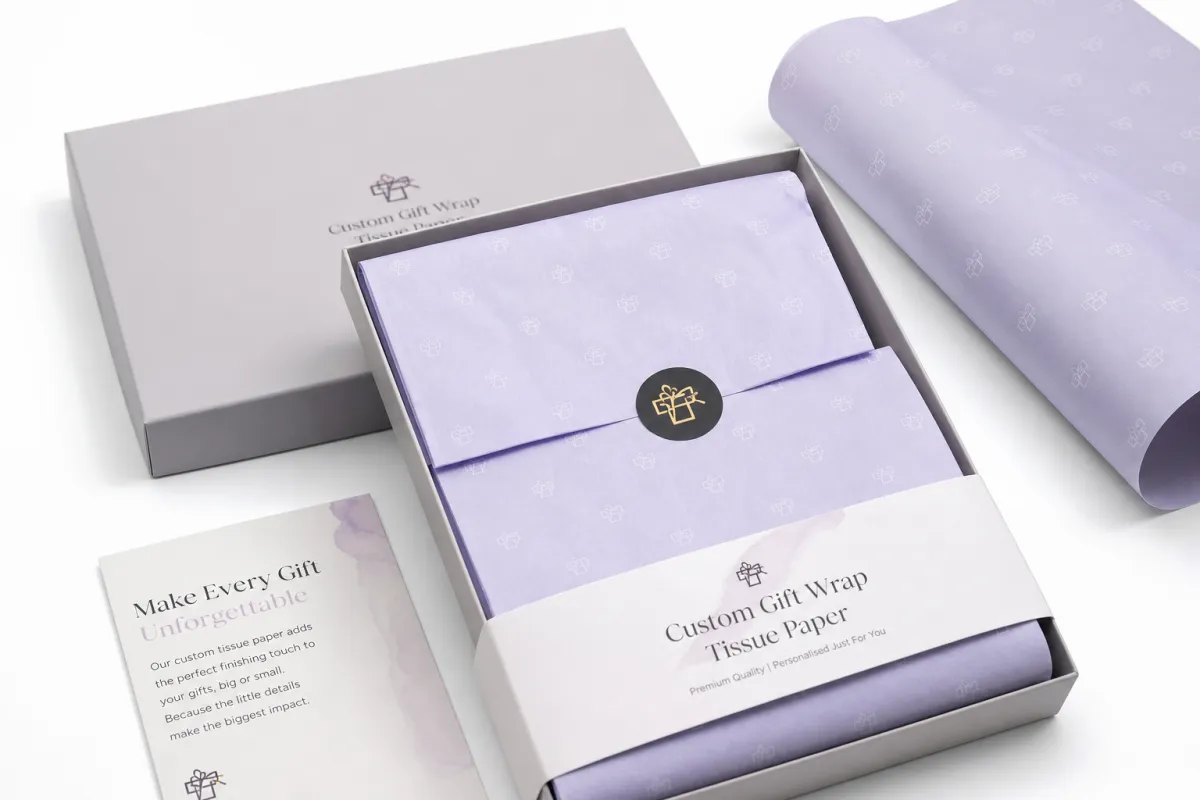
The first reason custom gift wrap tissue paper matters is simple: it changes perception fast. A shopper may not notice a shipping carton, but they always notice what happens after the carton opens. Tissue is the first layer that can signal color, care, and brand voice, even before the product itself appears. In that sense, custom gift wrap tissue paper often does more visual work per dollar than a heavier insert or a more complex structural component. A few cents of paper can shift whether the package feels mass-market, giftable, or genuinely premium.
There is also a practical reason brands choose it. Tissue helps hide voids inside bags and boxes, keeps smaller items from shifting, and makes fill look deliberate instead of improvised. That matters in custom printed boxes, folding cartons, kraft mailers, and gift bags alike. A well-chosen sheet size can make a package look fuller without adding bulky materials, which is why many teams treat custom gift wrap tissue paper as both a presentation layer and a light-duty protection layer. It is not cushioning in the ISTA sense, but it can keep a scarf from sliding, a candle from rattling, or a folded garment from arriving with an awkward reveal.
From a buyer's point of view, the appeal is flexibility. You can use custom gift wrap tissue paper for a one-week launch, a longer seasonal program, or an evergreen brand refresh. It supports retail packaging at the counter, ecommerce packaging in transit, and promotional packaging that needs to feel premium without a major structural redesign. That versatility is why tissue is often one of the first branded upgrades a packaging team approves. It is also easier to test than a new carton style, because the core pack remains the same while the outer presentation changes.
Brands also use it to keep the story consistent. If the box is minimal, the tape is plain, and the tissue carries the logo or pattern, the tissue becomes the visual bridge. If the outer carton is bold, tissue can soften the reveal and make the unboxing sequence feel paced rather than rushed. Either way, custom gift wrap tissue paper is rarely the loudest element; it is usually the one that makes the other elements feel finished. That matters especially for multi-channel Brands That Sell through stores, ecommerce, and wholesale partners, where the outer box may vary but the interior reveal should feel the same.
A brand does not need the most expensive tissue to look premium. It needs the right opacity, repeat, and fold behavior for the package it is actually using.
That point matters because tissue is often judged by eye alone. In practice, the better metric is fit. Does the sheet cover the product cleanly? Does the logo read at a glance? Does the pattern stay balanced when the tissue is folded, crumpled, or tucked into a bag? Good custom gift wrap tissue paper answers those questions without forcing a redesign of the box, bag, or label system. If the print looks beautiful only when perfectly flat, it may disappoint once a packer handles it with speed. Real packaging is rarely perfectly flat.
There is also a sustainability angle, and buyers should be precise here. FSC-certified tissue, recycled fiber content, and water-based or soy-based inks can support a better claim story, but the details still matter. A tissue sheet that is decorative yet difficult to recycle is not automatically a strong environmental choice. A smarter approach is to ask suppliers what percentage of the sheet is recycled content, whether the inks are compostable or recyclable under local conditions, and whether the finish changes the paper recovery path. That is the kind of question that keeps custom gift wrap tissue paper aligned with both brand and compliance goals.
For premium categories, the difference between good and average tissue is often tactile. A 17 gsm sheet can look airy and economical, but it can also show through too easily. A 22 gsm or 24 gsm sheet usually gives better opacity and more confident folding. In apparel, beauty, and gift retail, that difference can be noticeable the moment a customer lifts the top layer. A buyer does not need to know the gsm number to feel the result; they just notice whether the package reads as thin or intentional.
I have seen brands overpay for fancy structural packaging while using tissue that looked like it came from a warehouse supply bin. That mismatch is hard to miss. The box says premium. The tissue says "we got tired halfway through." Not exactly ideal.
How Custom Gift Wrap Tissue Paper Is Made
The production flow behind custom gift wrap tissue paper is more involved than many buyers expect. It starts with base tissue selection, where the supplier chooses sheet weight, fiber blend, opacity, and finish. From there, the artwork is prepared for the chosen press method, then the tissue is printed, dried, cut or rewound, counted, packed, and checked for color, registration, and defects. Each step affects how the final sheets behave in the hand. A print that looks perfect on a screen can look too busy once folded, or too light once wrapped around a darker product.
Base Tissue And Print Method
Print method is the first major decision. Flexographic printing is common for repeat patterns, simple logos, and larger runs because it can move efficiently once set up. Digital methods are useful for shorter runs, variable designs, or jobs that need faster proofing. Offset-style approaches may be used in some converting workflows when image quality or color control is a priority. There is no universal winner. The right method for custom gift wrap tissue paper depends on volume, color count, repeat complexity, and budget. If the design uses fine lines or a tight full-bleed pattern, the supplier should be able to show how registration holds at production speed, not just on a proof.
Material choice affects both feel and function. Lighter tissue can look elegant and airy, but it tears more easily and may show through the product beneath it. Heavier tissue offers better opacity and more resistance during packing, though it can feel stiffer and take up more storage space. In real production, the sweet spot is often a compromise: enough strength to survive handling, enough softness to fold neatly, and enough coverage that the print still reads through layers of tissue. Many brands land around 17-24 gsm for general presentation, then step up to 28-30 gsm for higher-opacity or more durable programs.
Artwork, Repeats, And Converting
There is also a manufacturing reality that buyers sometimes overlook. More colors mean more setup and more opportunities for color drift. Tight registration on fine logos can slow press speed. Specialty inks, metallic effects, and unusual repeats usually add proofing work. That is why early approvals matter so much for custom gift wrap tissue paper. The earlier the artwork is locked, the easier it is to keep sheet size, print layout, and converting details aligned. A repeat that works at 20 x 30 inches may fail at 15 x 20 inches if the logo lands awkwardly in the fold zone.
Sheet format matters just as much. Some brands order rolls and cut the tissue at pack-out; others prefer pre-cut sheets because they are faster on the line and easier to count. Folds, perforations, and custom sheet dimensions can all be added, but each option changes the converting work. A bag program that uses 15 x 20 inch sheets will not behave the same as a box insert built around 20 x 30 inch sheets, and that is why custom gift wrap tissue paper should be sized to the packaging, not the other way around. A good supplier will ask for the actual inner dimensions of the bag or carton, plus the fold style used by your packers.
Quality Checks And Standards
Quality control should not be an afterthought. Ask for drawdowns or press proofs, check for color consistency across the run, and inspect the first cartons against the approved sample. If the tissue is going into ecommerce packaging, it can be worth checking the complete pack under a transit protocol such as ISTA 3A or a similar distribution test. Tissue itself is not a protective engineered cushion, but the full system still needs to survive real shipping conditions. For paper properties, suppliers may reference ASTM methods for grammage, opacity, or moisture testing, and that is useful because it gives buyers a common language rather than a vague promise.
According to industry groups such as packaging.org, packaging decisions work best when they are made as a system rather than as isolated pieces. Tissue is a good example. If the bag size, insert count, and folding method are already known, the print run becomes cleaner and waste tends to drop. That is especially true in custom gift wrap tissue paper programs where the same format repeats across multiple SKUs. When the pack-out logic is settled early, the art can be set to the actual fold behavior rather than an idealized flat-sheet mockup.
One more practical detail: moisture and storage conditions matter. Tissue can curl, wrinkle, or lose crispness in humid environments, especially if it sits on a dock or in a warehouse with poor climate control. Flat-packed cartons and poly wrapping help, but they only go so far. If your program uses custom gift wrap tissue paper for retail floors or seasonal campaigns, ask about pack configuration and storage recommendations before the shipment arrives. A sheet that looked perfect in the proof stage can arrive with edge wave if it is stored badly.
Custom Gift Wrap Tissue Paper Costs, Options, and Tradeoffs
Cost is where most buyers move from inspiration to realism. Custom gift wrap tissue paper is usually priced by a mix of material weight, sheet size, print coverage, number of colors, packaging format, and order volume. The biggest lever, though, is often quantity. A smaller run spreads setup, proofing, and press time across fewer sheets, so unit price rises quickly. A larger run can lower per-sheet cost, but only if the artwork and sales volume justify the stock. For many brands, the real question is not "What is the cheapest tissue?" but "What spec gives the best mix of appearance, throughput, and inventory risk?"
Where The Money Goes
As a working range, a straightforward one-color repeat on standard pre-cut sheets might land around $0.12-$0.25 per sheet at 5,000 units, depending on size and paper weight. A denser multicolor design, metallic ink, or special sheet format can move into the $0.25-$0.45 range. At 20,000 sheets, the same job may drop by 20%-40% if the format is stable and the artwork does not require extra setup. These are not fixed prices, and region matters, but they are realistic enough to help a buyer plan. Custom gift wrap tissue paper is cheap only when the design is simple and the quantities are aligned.
Shipping and storage also belong in the budget. Tissue is light, but it is bulky. A pallet of flat-packed sheets can consume more floor space than a buyer expects, especially if the sheets are large and the run includes overage. If your warehouse charges by the pallet position or by cubic storage, that cost belongs in the unit economics. A modest price difference on the purchase order can disappear once the cartons are sitting in a fulfillment center for six months. That is one reason teams often choose custom gift wrap tissue paper sizes that match the order cycle rather than the broadest possible sheet format.
Spec Choices That Change The Price
Print coverage is another major driver. A small centered logo on white tissue costs less than an all-over repeat that uses more ink and more press control. White tissue is usually the lowest-cost base. Colored tissue adds an extra step, and deep saturated tones can raise waste if the color is hard to match consistently. If the brand only needs a seasonal lift, a restrained two-color repeat may be more efficient than a full-coverage design. In practice, the most expensive custom gift wrap tissue paper is not always the prettiest; it is often the one that demands the most time on press.
Finishes create tradeoffs too. A plain tissue sheet can be elegant if the fold and logo are right. A varnished or coated finish may improve handling, but it can also alter recyclability and cost more to source. If you are selling through premium retail, a slightly heavier sheet with a cleaner fold may be a better investment than an exotic finish. If you are packing high volumes in ecommerce, consistency and speed usually matter more than a special effect. Buyers should be honest about whether they need the tissue to be a hero element or a support element inside the package.
Sustainability claims can shift the spec and the cost. FSC-certified tissue, recycled content, and water-based inks may add a little to the price, but they can also improve the credibility of the pack story. If your brand publishes packaging claims, ask the supplier for documentation instead of relying on verbal assurance. It is easier to verify before purchase than to answer questions later. For many brands, custom gift wrap tissue paper is a useful place to make a visible sustainability move without redesigning the whole pack.
One tradeoff worth mentioning is overprint versus stock flexibility. A highly specific branded pattern looks great, but it can leave you with dead stock when a campaign ends. A more neutral repeat or a logo-only design can be reused across product lines and seasons. That is why some buyers split their programs: one evergreen custom gift wrap tissue paper design for year-round use and one seasonal print for launches or holiday spikes. The split keeps the brand fresh without forcing every order to become a one-off production challenge.
Another cost trap is trying to make the tissue solve problems that belong to the box. If the box is too large, tissue will not magically make it feel right. If the interior fit is sloppy, tissue will only hide it for about three seconds. After that, the customer still sees a loose pack. That is money spent on decoration instead of structure, and it usually shows.
Step-by-Step Process and Timeline for Ordering
The ordering process for custom gift wrap tissue paper is straightforward if the brief is solid. It becomes messy when the packaging team, marketing team, and operations team are not aligned on the actual use case. The most efficient projects usually start with the packaging format, then the artwork, then the production details. If those three pieces are settled in that order, the supplier can quote accurately and the buyer can avoid midstream changes.
Step 1: Define The Use Case
Start by naming where the tissue will live. Is it going into gift bags at retail, apparel boxes in ecommerce, or promotional mailers with a single item? Then measure the usable interior area, not just the outer pack size. A 15 x 20 inch sheet may be perfect for a narrow bag, while a 20 x 30 inch sheet may be better for a medium shirt box. If the product is fragile or oddly shaped, build a mock pack and test the fold. Custom gift wrap tissue paper should support the actual pack-out motion, not fight it.
Next, decide whether the tissue needs to feel premium, practical, or both. A luxury fragrance brand may want a softer hand and a restrained repeat. A fast-turn gift program may prefer a stronger white base with a bold logo stamp. If you know the role of the tissue, the supplier can recommend a reasonable gsm, sheet size, and print method. If you do not know the role, you may get a beautiful spec that is expensive, fragile, or hard to fold at speed.
Step 2: Prepare Artwork And Proofs
Artwork prep is where many delays happen. Keep logos vector-based, confirm spot colors or CMYK builds, and check that the repeat works across a full sheet. If the design includes a border, make sure the border does not disappear into a fold or trim edge. Many suppliers will provide a digital mockup first, then a printed proof or drawdown for final approval. Do not approve custom gift wrap tissue paper based only on a screen image if color accuracy matters. Screen color can be misleading, especially for red, black, and soft neutral tones.
Most standard jobs move from proof approval to production in roughly 12-15 business days, though digital or short-run work can be faster and highly customized flexo work can take longer. Add time if you need sampling, if the design changes after approval, or if the order ships internationally. A seasonal program should be scheduled early enough to leave room for one revision cycle. That buffer matters. Once a holiday campaign is locked, the printer is not the only bottleneck; freight, receiving, and warehouse putaway can all stretch the timeline.
Step 3: Produce, Inspect, And Receive
During production, ask for first-sheet approval where possible, then confirm the count and outer carton label before the run ships. When the goods arrive, open several cartons from different pallet positions. Check for curl, ink transfer, sheet count, color shift, and any crushed corners from transit. If the tissue is going straight into a packing line, verify that the carton height and stack orientation make sense for the team using it. Good custom gift wrap tissue paper should feel simple on the floor. If staff have to fight the packaging, something in the spec is off.
Receiving is also the right time to compare the actual stock against the intended use case. Some tissue looks beautiful in a sample pack but loses readability once folded three times. Some patterns read well flat but become visually noisy when wrapped around a product with a logo of its own. A quick internal test before launch can save a lot of customer-facing disappointment. For programs that ship thousands of units, one hour of pack-line testing is cheap insurance.
After receipt, store the cartons flat, in a dry space, and away from floor moisture. If the tissue will be used over several months, label cartons by campaign or SKU so the team does not open the wrong stock first. Inventory discipline matters more than people think. The best custom gift wrap tissue paper program is not the one with the fanciest artwork; it is the one that arrives on time, stays usable, and gets pulled in the right order.
If you are working with a seasonal calendar, build a buffer you actually trust. Holiday work has a habit of eating a week here and a week there. Nobody remembers the proof date, but everybody remembers the day the cartons showed up late. Packaging always finds a way to humble the optimistic plan.
Common Mistakes with Custom Gift Wrap Tissue Paper
Most problems with custom gift wrap tissue paper are predictable. They do not come from bad intent. They come from treating tissue as an afterthought, the final piece of a packaging spec rather than an engineered part of the pack. That mindset can create unnecessary waste, awkward pack-outs, and a finished look that is weaker than it should be. The good news is that nearly every common mistake has a practical fix.
Choosing The Wrong Sheet Size
The most common mistake is ordering by box size instead of by pack behavior. A sheet that looks large enough on paper may be too small once the folds are added. If the tissue needs to drape over the product, cover the top, and leave enough material to tuck, the working dimensions must be larger than the raw product footprint. I have seen buyers specify a tissue size for a box and then discover that the logo disappears every time the packer folds the sheet in the same place. That is not a printing issue. It is a sizing issue.
Overcomplicating The Design
Another mistake is pushing the artwork too far. Fine lines, tiny text, and low-contrast patterns can look elegant on a design board but weak in production. If the tissue is meant to wrap around merchandise, the design should still read when viewed partially folded or slightly crumpled. Simpler repeat patterns usually survive real use better than ornate graphics. The rule is brutal but useful: if the design cannot survive a quick fold test, it probably needs to be simplified before you commit to custom gift wrap tissue paper at scale.
Ignoring Line Speed And Storage
Operations teams get frustrated when the tissue slows pack-out. If the sheets stick together, tear too easily, or require too many adjustments, the line loses time. On the other side of the process, warehouse teams can struggle if cartons are oversized, awkward to stack, or sensitive to humidity. Tissue is lightweight, but the pack format can still create handling issues. This is especially true in high-volume ecommerce programs where the packer has only a few seconds per order. The safest spec is often the one that the line can move through without thought.
Forgetting About Reorder Behavior
Brands also forget to plan for reorders. A small first run may look safe, but if the campaign performs well, the reorder can arrive too late or with slightly different color because the original print parameters were not documented properly. Ask the supplier to retain the art files, record the ink references, and note the paper spec for later runs. That sounds basic, but it saves real money. Custom gift wrap tissue paper is easiest to manage when the brand treats it like a repeatable packaging component, not a disposable design project.
There is one more mistake that deserves its own mention: using tissue to hide a weak pack-out process. It does not. Tissue can make the first impression better, sure. It cannot rescue a box that collapses in transit or a bag that is too oversized for the product. If the structure is wrong, fix the structure. Otherwise, the tissue just becomes expensive camouflage.
Expert Tips for Better Results and Lower Waste
If the goal is better presentation with less waste, the answer is almost always in the setup. The smartest custom gift wrap tissue paper programs do not rely on dramatic decoration. They use a controlled spec, a predictable fold, and a repeat that behaves well in the package. That reduces rejects, keeps stock moving, and makes the tissue useful across more than one packaging scenario.
Match The Paper To The Product
Choose tissue weight based on what is inside the package. Apparel, paper goods, and lightweight accessories can often use a lighter sheet. Glass, cosmetics, or premium gift sets may need a heavier sheet with better opacity. If a customer should not be able to see the product silhouette clearly, stop trying to save a few cents on paper weight. A slightly heavier custom gift wrap tissue paper can improve the whole impression of the pack, and it may reduce the need for extra filler.
Design For Folds, Not Just For Flat Art
Ask for a folding mockup, not only a flat proof. The best tissue designs place the logo or repeat where it will still be visible after the most common fold. If the sheet is used in a bag, center the main mark where the top edge will not obscure it. If the tissue is packed around a box insert, keep critical elements away from the edges that fold first. This small change can transform the same artwork from ordinary to polished. It is one of the easiest improvements in custom gift wrap tissue paper work.
Use Sustainability Claims Carefully
If your brand wants the packaging story to be credible, ask for documentation. FSC certification, recycled content, and ink information should be traceable. If the tissue is sold as recyclable, make sure the finish and ink system do not undermine that claim. Buyers sometimes assume that all paper is equally recyclable, which is not always true once coatings or heavy ink coverage enter the picture. A few direct questions at quotation stage can save a lot of awkward wording later. That is especially true for custom gift wrap tissue paper used in premium retail, where the packaging copy is part of the experience.
Run A Small Test Before Scaling
Even a short pilot can expose issues that a proof will not show. Test the tissue in the actual bag, box, or mailer. Ask a packer to use it at normal speed. Check whether the tissue tears on sharp corners, whether the logo lands where expected, and whether the pack still looks tidy after shipping. If possible, send a few pilot units through your usual distribution path and inspect them on arrival. That kind of practical test is more useful than staring at a perfect mockup. It is the closest thing to a low-cost truth serum for custom gift wrap tissue paper.
Another useful habit is to keep one evergreen design and one seasonal design. The evergreen version handles steady orders and reduces the risk of obsolete stock. The seasonal version gives marketing a fresh look for launches and holidays. This split keeps the brand from overproducing one-off artwork while still giving the packaging team something flexible. It is a surprisingly effective way to lower waste without making the pack feel repetitive.
And yes, it also saves you from that awkward moment where everyone loves the holiday print in November and hates staring at it in March. Been there. Not fun.
What to Do Next With Custom Gift Wrap Tissue Paper
Once the use case is clear, the next move is usually simple: build a brief that a supplier can actually quote against. Include the package type, sheet size, tissue weight target, print colors, estimated annual volume, target launch date, and any sustainability requirement. If you can share a sample product or a photo of the pack-out, even better. A vendor can price custom gift wrap tissue paper much more accurately when they can see how it will be handled and folded.
It also helps to decide what tradeoff matters most. Do you want the lowest unit price, the most premium look, the fastest turnaround, or the most flexible reorder path? You usually get two of those, not all four. For a brand testing the market, a simple one-color solution on a standard sheet often makes sense. For a luxury gift set or a retail refresh, a heavier sheet and sharper artwork may be the better move. The right custom gift wrap tissue paper spec is the one that supports the business model, not just the mood board.
If you are comparing multiple suppliers, ask them the same questions: What gsm do you recommend? What is the minimum order? How much overrun should I expect? What is the typical proof-to-ship timeline? Can you document FSC or recycled content if needed? Those answers reveal a lot about whether the supplier understands practical packaging work or just decorative printing. The best partner will talk about line speed, storage, and fold behavior, not only about artwork.
At this point, many teams also review the rest of the pack. Sometimes tissue looks underwhelming because the bag is too large, the carton insert is poorly chosen, or the outer label clashes with the print. In that case, the issue is not the tissue alone. It is the overall package system. Custom gift wrap tissue paper works best when it is part of a coordinated sequence rather than a standalone decoration.
The cleanest path forward is boring in the best way: lock the sheet size, pick the print method, confirm the hand feel, and test the fold in the actual package. Do that, and the tissue does its job without drama. Ignore it, and you get pretty paper that wastes money.
Custom Gift Wrap Tissue Paper: decision table
| Decision area | Best fit | What to verify | Risk if skipped |
|---|---|---|---|
| Substrate | Labels, stickers, ribbons, inserts, tags, and tissue paper | Paper/film type, adhesive, GSM, roll direction, and finish | The print looks right but fails during application or handling |
| Artwork control | Brand color, barcode, QR code, and small text clarity | Vector file, Pantone target, safe area, and proof route | Small details blur or shift across a full production run |
| Use environment | Retail display, shipping, food-safe handling, or gift presentation | Moisture, rubbing, heat, and surface compatibility | A pretty sample fails in the real use case |
FAQ
What gsm should I choose for custom gift wrap tissue paper?
For most retail and ecommerce uses, 17-24 gsm is a practical range. Go lighter if you want a softer, airier feel and the product is not highly visible through the sheet. Go heavier if opacity and tear resistance matter more. For premium gift sets, many buyers prefer a slightly heavier sheet because it folds with more authority and hides the contents better.
Can custom gift wrap tissue paper be recycled?
Often yes, but not always in every local system. The answer depends on fiber content, ink coverage, coatings, and any added finish. If your brand wants to make a recycling claim, ask for supplier documentation and confirm whether the sheet is FSC-certified, recycled content, or printed with water-based inks. A clean paper spec is easier to position honestly than one with vague claims.
How many sheets should I order?
That depends on SKU count, usage per pack, and how often the design changes. If the tissue is used in multiple bag sizes or box styles, estimate by actual pack consumption rather than by total order volume alone. A pilot run of 5,000 sheets is common for testing, while larger programs may justify 20,000 sheets or more. For custom gift wrap tissue paper, it is usually smarter to start with one well-tested format than to overbuy a broad assortment of sheet sizes.
How long does production usually take?
From proof approval, many standard jobs land in the 12-15 business day range, with shipping added on top. Digital or simple short-run work can be faster, while complex artwork, special colors, or international freight can add time. If the tissue is tied to a launch or holiday window, build in extra buffer. A late tissue delivery can stall pack-out even when the rest of the packaging is ready.
What is the biggest mistake buyers make?
They approve tissue based on flat artwork instead of the actual folded package. That is how logos disappear, repeats break awkwardly, and otherwise good designs fail in the pack. A sample fold test on the real bag or box is the fastest way to avoid that problem. It is a small step, but it catches more issues than most teams expect.
Can custom gift wrap tissue paper be used across multiple product lines?
Yes, and that is usually the smarter move. A neutral evergreen design can support year-round orders, while a seasonal version can handle launches or holidays. If the sheet size and repeat are flexible enough, one tissue program can serve bags, boxes, and mailers without turning inventory into a mess.
Does custom gift wrap tissue paper replace protective packaging?
No. It can help with light product separation, presentation, and movement inside the pack, but it is not a substitute for proper protection. If the item needs cushioning, corner support, or drop resistance, build that into the structure. Tissue makes the pack look finished; it does not magically make fragile goods safe in transit.
What should I ask a supplier before ordering?
Ask about gsm, sheet size, print method, minimum order, proof process, overrun allowance, and documentation for recycled content or FSC certification if you need it. Also ask how the tissue behaves in a real pack-out. A supplier who can talk about fold behavior and line speed usually knows what they are doing. One who only talks about "premium appearance" without details is probably guessing.
How do I know if the artwork is too complex?
If the design depends on tiny type, narrow borders, or delicate color contrast, it may not hold up once the tissue is folded. The quickest test is simple: print or mock the design, fold it the way your team actually packs it, and see what survives. If the important part disappears, simplify the artwork before production.
Custom gift wrap tissue paper works best when it is treated like a real packaging component, not a decorative afterthought. The strongest programs are the ones where sheet size, print method, paper weight, and pack-out behavior all support the same goal: a cleaner unboxing, less waste, and a brand impression that feels deliberate from the first touch to the last fold. If you are planning your next packaging refresh, start by testing one sheet size in the actual pack, not on a flat mockup. That one step will tell you more than a dozen pretty renderings ever will.

