Buyer Fit Snapshot
| Best fit | Custom Glossy Labels Quote projects where brand print, material claims, artwork control, MOQ, and repeat-order consistency need to be specified before quoting. |
|---|---|
| Quote inputs | Share finished size, material target, print colors, finish, packing count, annual reorder estimate, ship-to region, and any compliance wording. |
| Proofing check | Approve dieline scale, logo placement, barcode or warning zones, color tolerance, closure strength, and carton packing before bulk production. |
| Main risk | Vague material claims, crowded artwork, missing packing details, or unclear freight terms can make a low unit price expensive after revisions. |
Fast answer: Custom Glossy Labels Quote: Pricing, Specs, and Lead Times should be specified like a repeatable production item. The safest quote records material, print method, finish, artwork proof, packing count, and reorder notes in one written spec.
Production checks before approval
Compare the actual filled-product size with the drawing, then confirm tolerance on folds, seals, hang holes, label areas, and retail display edges. Reserve space for logos, QR codes, warning copy, and material claims before decorative graphics fill the panel.
Quote comparison points
Review material grade, print process, finish, sampling route, tooling charges, carton quantity, and freight assumptions side by side. A quote is only useful when the supplier can repeat the same color, closure quality, and packing count on the next order.
A custom glossy labels quote can swing more than most buyers expect, and the biggest shift usually has less to do with shine than with the mix of size, shape, quantity, and setup behind the job. Two labels can look nearly identical once they are sitting on a bottle or carton, yet one may price out much lower because the press layout is cleaner, the die cut is simpler, and the material waste is easier to control. That is why the quote deserves more attention than the finish name alone.
Retail packaging gives glossy labels a lot to do. They brighten color, sharpen contrast, and make smaller products feel more finished on shelf. On a crowded display, that extra lift matters. For brands building package branding across product packaging, the label is often the first detail a shopper notices before the carton, cap, or closure ever comes into view. If you are comparing labels with Custom Packaging Products or coordinating with Custom Labels & Tags, a clean quote is the fastest way to separate good value from hidden cost.
The clearest way to read a custom glossy labels quote is line by line. Material. Finish. Adhesive. Format. Setup. Freight. Proofing. Once you know where the price comes from, it becomes much easier to remove features you do not need and keep the ones that protect the product. If you already know your size and artwork needs, you can move straight to Contact Us and ask for a precise estimate instead of a vague range.
The Surprising Cost Driver Behind a Custom Glossy Labels Quote
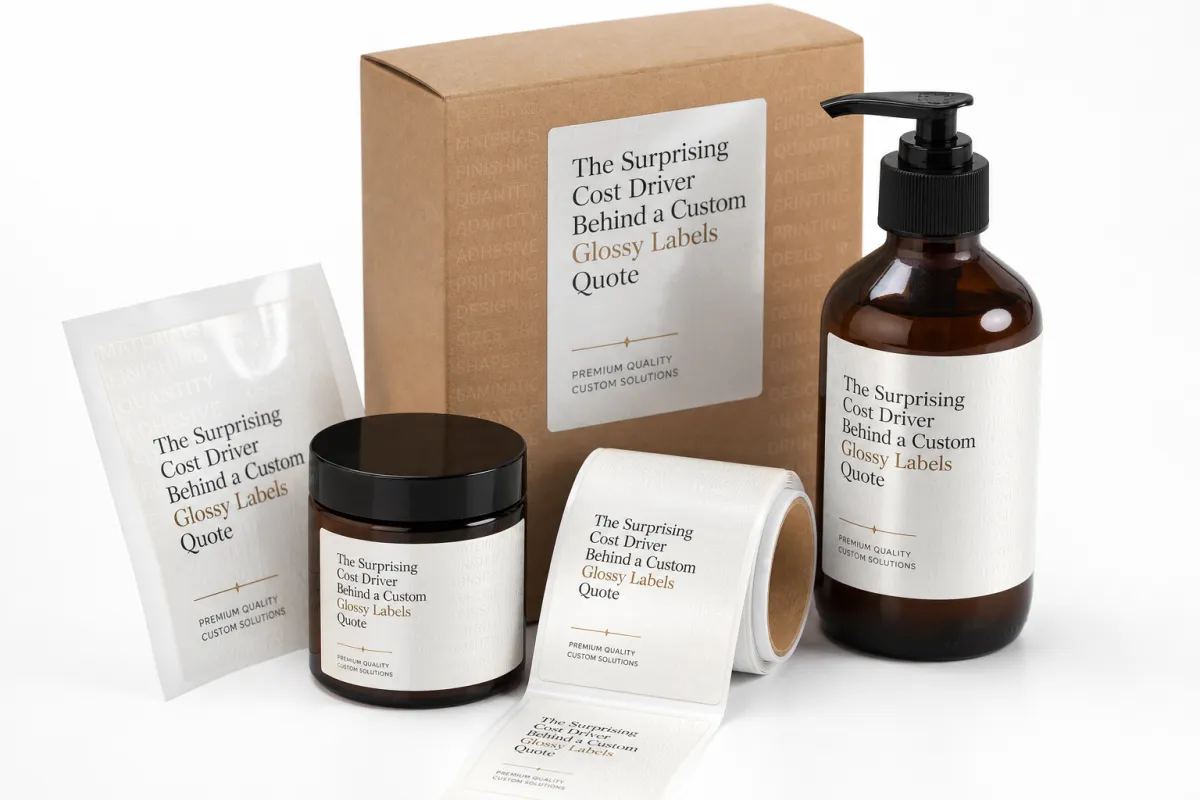
The first surprise for many buyers is simple: gloss does not drive the price nearly as much as people assume. In a custom glossy labels quote, the expensive parts are usually the ones hidden behind the visual finish. A small square label and a complex die-cut sticker can follow different setup paths, create different waste patterns, and need different finishing steps, even if both look equally shiny on the package.
Size is usually the first lever. A 2 x 3 inch label behaves differently from a 4 x 6 inch label on press, and the waste changes again if the design is circular, rounded corner, or irregular. Quantity comes next. The more labels you order, the more setup cost gets spread across the run, which is why a larger order often lowers the unit price sharply. A custom glossy labels quote should always be read as a production plan, not just a sticker price.
Glossy labels still earn their place because they hold their own in crowded retail environments. Bright color matters on a shelf with 20 competing SKUs. Clear contrast matters on a small jar where the copy space is tight. A gloss surface can make product packaging feel more premium without forcing a brand into a full carton redesign. For many teams, that is the sweet spot: polished enough for retail packaging, practical enough for repeat production, and stable enough to fit into a broader branding system.
From a packaging buyer’s point of view, the quote is a decision tool. It should help you compare paper versus film, standard adhesive versus freezer adhesive, and sheet format versus roll format. If a custom glossy labels quote does not show those distinctions, ask for them. A supplier that can explain the numbers clearly is usually easier to work with during reorders, artwork revisions, and launch timing.
A good label quote should answer three questions fast: what it is made of, how it will be applied, and what will change the price.
Glossy labels are not limited to beauty brands and beverage bottles. They show up on food jars, supplements, hand soap, mailers, and secondary packaging where a brand wants package branding to feel consistent across a whole line. In that sense, the custom glossy labels quote is part cost sheet, part launch map, and part risk check.
I have watched more than one good label project get expensive simply because the first quote skipped a detail that mattered later. A buyer sends over a rough mockup, the quote looks friendly, and then the job gets pulled back into prepress because the file needs white underprint, the container is colder than expected, or the roll needs a different unwind. That is not a disaster, but it is the sort of thing that makes a quote go kinda sideways if nobody asks the plain questions early.
Custom Glossy Labels Quote: Material and Finish Options
The material choice is where many buyers gain or lose real money. In a custom glossy labels quote, the substrate affects print result, moisture resistance, durability, and sometimes even the minimum order quantity. The finish matters too, but finish only makes sense after the base material fits the application.
Gloss paper is usually the entry-level option. It prints sharply, feels familiar, and works well for dry environments, cartons, jars, and short-life packaging. It can be a smart choice for food labels, bakery items, or products that will be used quickly. A custom glossy labels quote for paper stock often looks lower than film stock, especially on larger runs. The tradeoff is water resistance. Paper can hold up in moderate handling, but it is not the best option for condensation, refrigeration, or repeated contact with moisture.
Gloss BOPP is a common film choice. It is polypropylene, so it resists water much better than paper and tends to hold up on bottles, bath products, cold storage items, and damp environments. For a custom glossy labels quote, BOPP usually costs more than paper, but the performance difference is real. If your product sits in a cooler or gets handled in a wet sink area, that extra spend can prevent lifting corners, ink scuffing, and premature reprint costs.
Clear glossy stock gives the no-label look. It is popular on premium cosmetics, beverage bottles, and products where the container itself is part of the brand story. A clear label can look refined, but it is also less forgiving. White ink may be needed to keep text readable, and that changes the custom glossy labels quote. If the artwork relies on subtle tones or fine type, test the design against the clear film before you approve the run.
Vinyl is usually selected for durability, flexibility, or special-use conditions. It is less common for standard product labeling because it can cost more, but it makes sense for heavy-handling surfaces or applications where abrasion resistance matters. If you need a label that can tolerate repeated touching, movement, or rougher transit, vinyl may improve the value of the custom glossy labels quote even if the unit price is higher.
Finish changes the result in ways buyers can feel the moment they handle a sample. A bright white gloss surface tends to make color feel more vivid. A laminated gloss finish adds a layer of protection, which can help with scuff resistance and moisture exposure. In some cases, a laminate is worth the added cost because it lowers the chance of damage after application. That becomes especially useful for branded packaging that has to survive shipping, shelf handling, and customer use without looking tired after the first day.
If your labels must meet FSC expectations for paper sourcing, ask for certified stock and verify the claim through the FSC directory. For transit or distribution concerns, the testing methods referenced by ISTA can help frame what your label or package needs to survive during shipping.
| Material | Best Use | Typical Quote Impact | Durability | Practical Note |
|---|---|---|---|---|
| Gloss paper | Dry goods, cartons, short-run retail packaging | Lower unit cost on larger runs | Moderate | Best when moisture is limited and price pressure is high |
| Gloss BOPP | Bottles, jars, refrigerated products | Mid-range | High | Good balance of appearance and water resistance |
| Clear glossy film | Premium cosmetics, visible containers | Higher, especially with white ink | High | Needs careful artwork planning for readability |
| Gloss vinyl | Rough handling, specialty uses | Usually the highest of the four | Very high | Useful when abrasion and handling are the main risk |
As a practical rule, the best custom glossy labels quote is not the one with the cheapest stock. It is the one that matches the product’s actual environment. A 5,000-piece run on gloss paper may look inexpensive, but if the labels have to survive condensation, your reprint cost can erase the savings quickly. That is the kind of detail buyers often miss during early packaging design.
Specifications That Shape Your Custom Glossy Labels Quote
Specifications do most of the pricing work. In a custom glossy labels quote, the number of colors, label dimensions, cut shape, and artwork complexity all affect how the job moves through prepress and production. Buyers often focus on gloss level and forget that the back end of the job is where cost can rise fast.
Dimensions are the starting point. A larger label uses more material, but it can also reduce efficiency on the press sheet or roll. A small label with awkward proportions can be less efficient than a slightly bigger one that nests better. That means two labels with similar print areas may produce different custom glossy labels quote outcomes depending on how they fit into the manufacturing layout.
Shape matters for the same reason. A square or rectangle with rounded corners is easier to die-cut than a complex contour. Circles, ovals, and custom shapes can still be economical, but the die and finishing steps may add cost. If your branding can tolerate a simpler outline, it may improve the quote without changing the visual strength of the package.
Bleed and trim sound minor, but they are not. A full-bleed design typically needs room for cutting tolerance, and that can increase the effective artboard size. That is another reason a custom glossy labels quote should be built from the final file dimensions, not from a rough design mockup. If the label is meant to sit close to a border, the press setup has to be handled carefully.
Color count also matters. Full-color process printing is common, but spot colors, metallic effects, and white ink can shift the price. White ink is especially important on clear stock because it supports readability and color accuracy. Variable data such as batch codes, QR codes, serial numbers, or multilingual panels can raise the quote as well because each variable element adds complexity to print control and inspection.
Barcode readability deserves more attention than it gets. If your labels carry UPC, EAN, or internal inventory codes, ask the supplier how they verify scan performance. A barcode that prints beautifully but scans poorly is not a bargain. In the best case, the custom glossy labels quote should reflect whether barcode verification or proof testing is included.
Roll specs matter if the labels will move through an applicator. Core size, unwind direction, roll diameter, and gap spacing all affect usability. A 1-inch core may work for desktop applications, while a 3-inch core is more common for higher-volume labelers. If the unwind direction is wrong, the label can become a line stop. That kind of mistake is not a design issue; it is a production issue that should be visible in the quote.
Artwork files are often the hidden reason a custom glossy labels quote changes after the first draft. Vector formats like AI, EPS, or print-ready PDF are preferred for logos and type. Raster files should usually be high resolution, often 300 dpi or better at final size. If the file needs redraws, trapping, white underprint planning, or layout cleanup, those tasks may be priced separately. A buyer who sends clean files usually gets a cleaner quote.
What to prepare before requesting pricing
Before you ask for a custom glossy labels quote, gather the size, shape, quantity, finish, adhesive, and whether you need rolls or sheets. Add artwork files, a target delivery date, and any surface details that affect adhesion, such as glass, plastic, coated cardboard, or cold storage use. That small amount of preparation often saves an entire round of clarification.
From a packaging design standpoint, this is also the moment to think about consistency across the line. If your labels need to work with custom printed boxes, shipping cartons, or a broader branded packaging system, keep the typography and color system aligned now. It is much cheaper to make one design decision early than to fix three different versions later.
Useful specs for a quote request:
- Final label size in inches or millimeters
- Shape and corner style
- Quantity per version
- Material preference and finish
- Adhesive type and application surface
- Roll or sheet format
- Artwork file type and resolution
- Need for white ink, barcodes, or variable data
Once those details are on the table, the custom glossy labels quote becomes much easier to compare against other bids. It also becomes easier to see which supplier is truly solving the packaging problem and which one is only pricing the print.
Cost, MOQ, and Unit Price: Reading the Quote Line by Line
This is where buyers need the most clarity. A custom glossy labels quote is usually made of several smaller costs, and some are one-time charges while others scale with quantity. If you do not know which is which, the unit price can look higher than it really is or lower than it truly should be.
MOQ means minimum order quantity. For custom labels, it varies by material, shape, and printing method. Digital production can support lower quantities, sometimes in the 250 to 1,000 range for simpler jobs, while specialty materials and complex finishing can push the floor higher. A custom glossy labels quote for a small, highly customized order often costs more per piece because setup has to be recovered over fewer labels.
Unit price usually drops as quantity rises. That is normal. A 1,000-piece order may cost far more per label than a 10,000-piece order because the die setup, prepress check, and press adjustment are spread across a much smaller run. Buyers sometimes compare only the total price, but the smarter comparison is the cost per label at each tier. That is where the quote tells you whether a larger order improves your economics.
Die fees are another key line. A custom shape often requires a die or cutting tool, and that can be a one-time cost. Depending on size and complexity, the fee may be modest or more substantial. Some suppliers include it in the quote; others list it separately. Either way, it belongs in the full cost picture of a custom glossy labels quote.
Proof charges, if any, should be visible too. Many shops include a digital proof at no charge, but if color matching, variable content, or layout revisions are involved, there may be an extra fee. Freight also matters. A quote that looks attractive until shipping is added is not really a good comparison. Ask whether the price includes packing, palletizing, and delivery to your location.
Here is a realistic way to think about pricing bands for a standard 2 x 3 inch label with full-color print and permanent adhesive. These are illustrative ranges, not fixed rates, because artwork coverage, coating, and quantity change the result fast:
- Gloss paper, 1,000 pieces: about $0.18-$0.35 per label
- Gloss paper, 5,000 pieces: about $0.05-$0.10 per label
- Gloss BOPP, 5,000 pieces: about $0.07-$0.14 per label
- Clear glossy film, 5,000 pieces: about $0.08-$0.18 per label
- Gloss vinyl, 5,000 pieces: about $0.12-$0.24 per label
If those numbers feel broad, that is because the market is broad. A clean, simple label with one artwork version and standard adhesive can be priced very differently from a multi-version run with white ink, lamination, and a special contour cut. A good custom glossy labels quote should explain the difference instead of hiding behind a single number.
Cost-saving levers are usually straightforward. Simplify the outline. Standardize the size. Choose the lightest material that still fits the use case. Consolidate artwork versions. Reduce the number of special finishes. None of that weakens branding if the label was designed well in the first place. It simply removes waste from the production plan.
Almost every price surprise comes from missing details: artwork version count, roll specs, adhesive choice, or whether the label has to survive moisture.
One practical comparison helps. A buyer can spend less on a paper label today and more on replacements next month if the label fails in storage. That is why the best custom glossy labels quote is the one that balances purchase price with application risk, not the one that only looks cheapest on paper.
If you are pricing labels alongside a product launch, ask for tiered numbers. Request one quote at 1,000, one at 5,000, and one at 10,000 if the run size might grow. Tiered pricing makes the economics obvious, and it gives you a cleaner path to reorder planning.
Process and Timeline: From Proof to Delivery
A custom glossy labels quote should also tell you how the job will move. Good pricing means little if the schedule is fuzzy. Buyers Need to Know when the proof arrives, when production begins, and how long shipment will take once the labels are packed and cleared.
The process usually starts with an inquiry. You send the label size, material, quantity, artwork, and application details. A quote is prepared. If the details are complete, that first response can be fast. If not, expect clarifying questions. That back-and-forth is normal and usually worth the time because it prevents rework later.
Next comes the proof stage. The proof should show trim, layout, colors, and any special elements such as white ink or variable data. This is the moment to catch mistakes while they are still cheap to fix. If the proof looks wrong, stop and fix it before approval. A custom glossy labels quote becomes far more valuable when the proof process is treated as part of quality control rather than a formality.
Once the proof is approved, production begins. The general sequence is prepress, setup, printing, curing or finishing, die cutting, inspection, packing, and shipment. Each step matters. A strong prepress check catches file issues. Setup affects consistency. Printing determines color and coverage. Finishing can add protection. Die cutting determines final shape. Inspection and packing protect the job before it leaves the facility.
Timing depends on complexity and current shop volume, but realistic expectations help. Simple glossy label jobs may move from proof approval to production in 1-2 business days and ship within 7-12 business days after approval. More complex orders with white ink, lamination, or custom shapes may take longer. Rush work can be possible, but it usually adds cost to the custom glossy labels quote.
Where do delays happen most often? Artwork revisions. Missing approvals. Unclear adhesive requirements. Late changes in quantity. If your launch schedule is tight, protect the timeline by locking artwork early and confirming surface details before production begins. That is especially true for food, beverage, and supplement packaging, where label timing can affect the whole product release.
Shipping also needs to be stated clearly. A quote that says “complete” but does not mention transit method is incomplete in practice. If you need labels by a certain date, ask whether the estimate includes ground shipping, express shipping, or will-call pickup. The final custom glossy labels quote should make delivery timing as visible as unit price.
One more detail: if the labels will be applied automatically, confirm unwind direction and roll core before signoff. That sounds technical because it is. A wrong roll orientation can interrupt production faster than a color issue. For a buyer running packaging lines, that is not a minor detail. It is a line-stopper.
For teams building a larger launch package, label timing may need to align with cartons, inserts, and outer packaging. That is where coordinated planning with Custom Packaging Products becomes useful. A label job should not be treated as a separate island if the rest of the product packaging is shipping on the same schedule.
Why Choose Us for Custom Glossy Labels
Buyers do not just want a price. They want a supplier that can explain the price. That is the practical advantage of working with a team that treats a custom glossy labels quote as a planning document rather than a one-line answer. Clear communication matters because labels touch both branding and production, and mistakes in either area cost money.
Consistent print quality is the baseline. Glossy labels should show clean solids, readable small text, and stable color from batch to batch. If your brand uses the same label across product packaging, retail packaging, and secondary cartons, consistency becomes more important than a one-time savings of a few cents per piece. That is where a clear custom glossy labels quote helps, because it tells you what the run is built to deliver.
Dependable adhesion is just as important. A beautiful label that peels at the edges is a failed label. Surface type, temperature, condensation, and handling all matter. A good supplier should ask about those details before finalizing the quote. If they do, that is a good sign. It means they understand that package branding is not only about print appearance. It is about how the finished label behaves after application.
Transparency also matters. No one likes surprises after approval. Buyers should see whether the quote includes setup, proofing, die cutting, finishing, freight, and repeat-order pricing. A custom glossy labels quote that is built with clear assumptions is easier to compare, easier to approve, and easier to reorder later.
We also see a wide range of applications. Food jars, coffee bags, bath and body bottles, supplements, gift packaging, and shipping inserts all have different needs. That variety matters because the right label for a dry carton is not always the right label for a refrigerated bottle. Practical advice beats generic promises every time.
If you are building a broader launch or refresh, label work can be part of a larger packaging system that includes custom printed boxes and other branded packaging elements. That is where the right supplier should help you keep the visual language aligned without forcing you into a complicated process. A custom glossy labels quote should support the brand, not distract from it.
What should a buyer expect from the process here? Clear specs. Honest ranges. Proof visibility. Direct answers. If you need help sorting materials, adhesive options, or run sizes, the fastest route is to send the details through Contact Us. A precise custom glossy labels quote starts with precise input.
For product teams comparing label options across a line, our Custom Labels & Tags page is a useful place to start. It keeps the conversation focused on real production choices rather than abstract branding language. That is often what buyers need most: fewer adjectives, more specifics.
From years of reviewing label specs, one pattern shows up again and again: the strongest quote is usually not the shortest one. It is the one that matches the product environment, the application method, and the artwork reality without pretending any of those things are simple. That kind of honesty saves time later, and it tends to produce a better label too.
Next Steps to Secure Your Custom Glossy Labels Quote
If you want the most accurate custom glossy labels quote, gather the essentials before you ask for pricing. Include the final size, shape, quantity, material preference, finish, adhesive, and whether you want rolls or sheets. Add artwork files, a reference image if needed, and the target delivery date. The more complete the brief, the more useful the quote will be.
Ask for tiered pricing if the order might grow. That single request can reveal where the pricing breaks are and whether a larger run makes sense. It also helps you compare MOQ options without guessing. A custom glossy labels quote should show how cost changes at different quantities, not just present one number and hope for the best.
Request a proof before production starts. Confirm barcode placement, white ink needs, unwind direction, and any special finish. If the label is going onto a textured, curved, cold, or damp surface, mention that clearly. Adhesion is never something to leave implied. For glossy labels, a few extra minutes at the proof stage can prevent a slow and expensive problem later.
There is also a strategic reason to clarify everything now. If the label is part of a wider launch, the timing has to fit with cartons, inserts, and the rest of the product packaging. A clean custom glossy labels quote helps coordinate the sequence so the label is ready when the product is ready.
Send the specs, ask for the quantity breaks, and confirm the finish. That is the shortest route to a real number. If you need a supplier that can speak plainly about materials, lead times, and production tradeoffs, reach out today for a custom glossy labels quote that is specific enough to act on and practical enough to trust.
What do I need to request an accurate glossy label quote?
Provide label size, shape, quantity, and whether you want rolls or sheets. Include material preference, finish, adhesive type, and any special print needs like white ink or barcodes. Upload artwork or a reference file so the team can confirm setup and proofing details. The more complete the brief, the more accurate the custom glossy labels quote will be.
Why is my custom glossy labels quote higher than expected?
Small quantities, complex die cuts, and specialty materials usually raise the unit price. Extra steps like white ink, lamination, rush production, or freight can add cost. Quotes also rise when the label size creates more waste on the press or during finishing, which is why a custom glossy labels quote should always be reviewed with the production notes attached.
What MOQ should I expect for glossy labels?
MOQ depends on size, material, and print method, but digital runs often support lower quantities than premium specialty jobs. Larger labels and custom shapes may require higher minimums because setup cost is spread over fewer pieces. Ask for tiered pricing so you can compare the cost impact of each quantity break in the custom glossy labels quote.
How long does it take to move from proof to delivery?
Proof approval is usually the first time checkpoint, and delays there are often the biggest reason timelines slip. Production time depends on order complexity, finishing steps, and current shop volume. Shipping speed changes the final delivery date, so confirm the transit method when you approve the order and ask how it affects the custom glossy labels quote.
Can I get samples before placing a custom glossy labels order?
Yes, ask for material swatches or printed samples if you need to compare gloss level, adhesion, and color appearance. Samples are especially useful for refrigerated products, textured surfaces, or labels that need to survive handling. If exact samples are not available, request a proof and a material recommendation based on your application. That way, your custom glossy labels quote is built on real-world conditions, not assumptions.
The most practical next step is simple: collect the final size, material, adhesive, quantity, and artwork, then compare the quote against the product environment before you approve it. If the label has to handle moisture, cold storage, or machine application, say so up front. That one habit keeps the custom glossy labels quote honest and the finished labels a lot easier to live with.

