Buyer Fit Snapshot
| Best fit | Custom Gusseted Paper Bags projects where brand print, material claims, artwork control, MOQ, and repeat-order consistency need to be specified before quoting. |
|---|---|
| Quote inputs | Share finished size, material target, print colors, finish, packing count, annual reorder estimate, ship-to region, and any compliance wording. |
| Proofing check | Approve dieline scale, logo placement, barcode or warning zones, color tolerance, closure strength, and carton packing before bulk production. |
| Main risk | Vague material claims, crowded artwork, missing packing details, or unclear freight terms can make a low unit price expensive after revisions. |
Fast answer: Custom Gusseted Paper Bags: Uses, Pricing, and Steps should be specified like a repeatable production item. The safest quote records material, print method, finish, artwork proof, packing count, and reorder notes in one written spec.
Production checks before approval
Compare the actual filled-product size with the drawing, then confirm tolerance on folds, seals, hang holes, label areas, and retail display edges. Reserve space for logos, QR codes, warning copy, and material claims before decorative graphics fill the panel.
Quote comparison points
Review material grade, print process, finish, sampling route, tooling charges, carton quantity, and freight assumptions side by side. A quote is only useful when the supplier can repeat the same color, closure quality, and packing count on the next order.
Custom gusseted paper bags solve a packaging problem that shows up more often than people expect: a product may look simple on paper, then turn awkward the moment it needs to be packed, carried, displayed, or handed across a counter. The folded side panels give the bag more usable volume without turning it into a box, which is one reason custom gusseted paper bags are so common in retail packaging, food service, and branded carryout programs.
For buyers, that makes the format useful in a very practical way. These bags store flat, stack neatly, and still open up to hold items that would feel cramped in a plain envelope-style paper bag. Coffee, bakery goods, folded apparel, takeaway orders, and e-commerce insert kits all benefit from that extra room. Custom gusseted paper bags sit in a sweet spot between convenience and structure, and that balance is the main reason they keep showing up in production specs.
The important part is understanding what the gusset actually changes. It is not just a visual feature. It affects volume, wall support, stress at the seams, and even how the print appears once the bag is filled and creased. Get the spec right and custom gusseted paper bags feel tidy, efficient, and well made. Miss the mark and the same bag can bulge, sag, or tear right where nobody expected it to fail.
What Are Custom Gusseted Paper Bags?
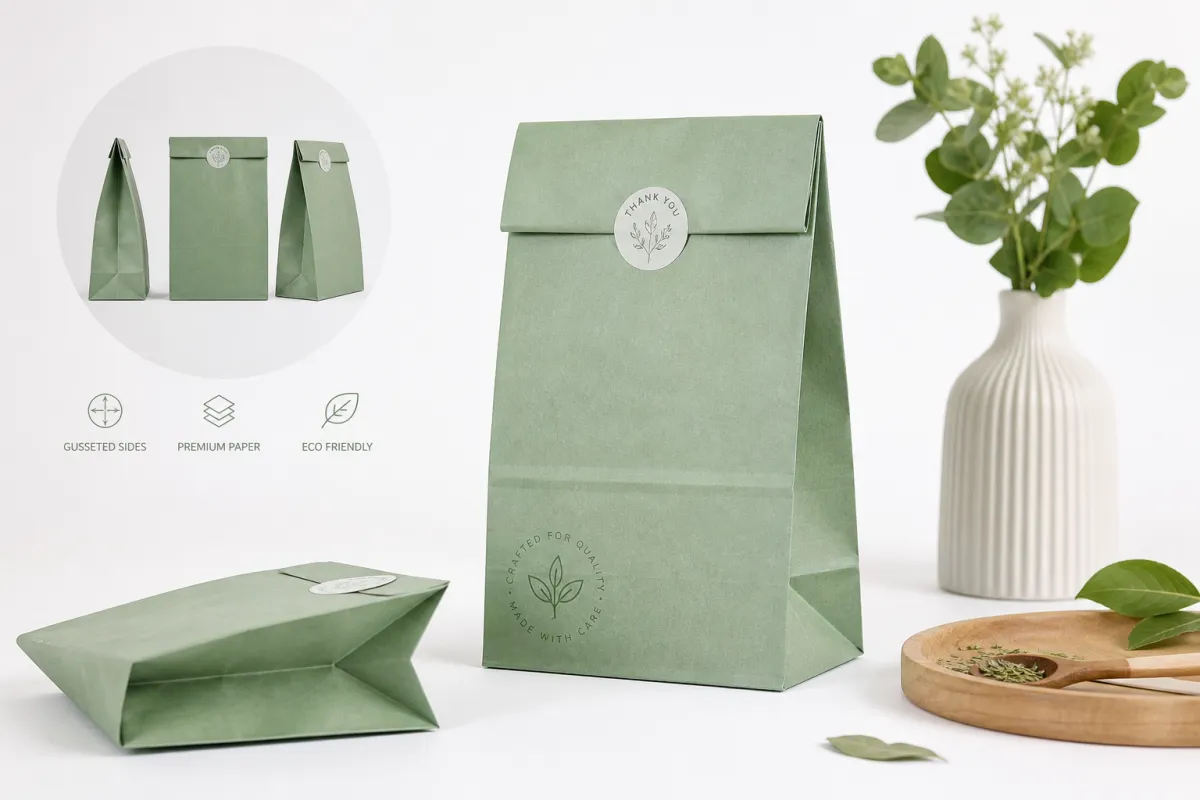
Custom gusseted paper bags are paper bags built with folded side panels, and in some versions a folded base, so the bag can expand as product is added. The flat form you see before filling is only part of the picture. Once the gussets open, the bag gains depth and usable capacity without needing a wider front panel or a box-like shape.
Each part of the construction affects performance. The side gussets determine how far the bag opens. The bottom fold helps support the load and influences whether the bag stands upright. The side seams carry stress when the bag is lifted, while the opening width controls how easy it is to fill. Put those details together and custom gusseted paper bags either feel crisp and dependable or loose and hard to manage.
They are especially handy for products with irregular or flexible shapes. Bakery loaves, cookies, coffee beans, tea, folded clothing, takeaway side items, sample packs, and small hardware all do better in a format that can expand without looking oversized. That is why custom gusseted paper bags show up across both food packaging and retail packaging. They hold the product without fighting it.
Customization goes beyond print. Dimensions, paper grade, gusset depth, handle style, coating, closure style, and finish all shape the final result. A kraft bag with a simple one-color logo communicates something very different from a premium white bag with full-coverage artwork, reinforced seams, and a matte finish. That flexibility is the real value of custom gusseted paper bags: the format can be plain and useful or polished and brand-forward without changing its basic structure.
A standard bag answers one question: can it hold the item? Custom gusseted paper bags ask a better one: can it hold the item, present it clearly, and fit the workflow without waste or extra boxing? That is a stricter standard, and in practice it usually leads to a better packaging system.
For brands comparing formats, the issue is rarely whether paper bags are useful. The real question is whether custom gusseted paper bags are the right paper bag for the product and the channel. A bakery window bag, a coffee bean pouch, and a branded carryout bag can all use paper, yet behave very differently once filled. Size, gusset depth, and closure method are what separate a decent sample from a package that is ready for production.
How Custom Gusseted Paper Bags Work
The mechanics are straightforward, and that simplicity is part of the appeal. The folded gussets sit flat until the bag is filled. Once the product goes in, the folds open and create a wider internal cavity. That expansion changes the bag’s footprint without making the exterior look bulky. With custom gusseted paper bags, you can keep a clean shelf presence while still accommodating more volume than a flat paper bag of similar height and face width.
Geometry matters more than many buyers expect. A narrow, tall bag with shallow gussets may stand well for lighter products, yet it can become unstable if contents settle unevenly. A deeper gusset may improve balance, but it can also increase side flex if the paper weight is too light. The best custom gusseted paper bags are designed around the packed product, not just the nominal dimensions on the spec sheet.
Load distribution is another small detail with a big effect. In a gusseted format, the weight is not carried by one panel alone. It spreads across the base fold, side panels, and seams. That can improve performance for heavier dry goods or awkward shapes, but only if the paper weight and seam construction are sized properly. With custom gusseted paper bags, a few extra grams of paper can be the difference between a bag that carries comfortably and one that starts to tear at the base after a short walk.
Compared with flat paper bags, this format wins on usable room and presentation control. Compared with rigid cartons, it is lighter, easier to nest, and usually less expensive to ship. Compared with flexible mailers, it gives you a cleaner retail appearance and more printable surface. That is why custom gusseted paper bags often fit Product Packaging That needs a retail-ready look without the cost or bulk of a full box.
There is a tradeoff. These bags do not protect as well as corrugated packaging, and they are not as moisture-resistant as laminated mailers. If the contents are fragile, oily, or exposed to condensation, the bag structure alone will not solve the problem. A liner, a barrier coating, or a different format may be the better answer. Good packaging design starts by matching the container to the environment, not by trying to force the environment to behave.
Testing should reflect real use. Does the bag stand while being filled? Does it collapse after the contents settle? Does the handle or top fold fail first? For higher-risk shipments, some teams borrow ideas from distribution testing standards such as ISTA procedures or ASTM-style package validation. That mindset helps even when the bag is never sent to a formal lab. Custom gusseted paper bags should survive the workflow, not just the mockup.
Key Cost and Pricing Factors
Price is where many projects get vague, and vague usually turns expensive. For custom gusseted paper bags, the biggest cost drivers are paper weight, bag dimensions, gusset depth, print coverage, and finishing choices. A basic kraft bag with one-color printing and a simple folded bottom can be relatively economical. Add heavier stock, larger dimensions, full-coverage graphics, a special coating, or reinforced construction, and the unit price rises quickly.
Quantity matters just as much. Setup costs, plates, die work, and prepress effort are spread across the run. That is why 5,000 units can look very different from 20,000 units even when the bag design stays the same. For a straightforward production run, buyers often see a rough range of about $0.18-$0.32 per unit at moderate volume. More detailed custom gusseted paper bags with stronger paper, richer print coverage, or finish work often land closer to $0.32-$0.65 per unit, and specialty structures can go higher depending on labor and material choices.
It helps to think about the full pricing stack. The bag itself is only one part of the cost. Freight, sampling, shipment packaging, storage, and possible rework all affect the landed total. A quote that looks low on paper may not be the best buy once inbound freight, carton configuration, and inventory holding costs are included. That matters especially for custom gusseted paper bags ordered for seasonal retail packaging, where timing and availability can matter more than a small unit-price difference.
| Option | Typical Spec | Relative Cost Impact | Best Fit |
|---|---|---|---|
| Basic kraft bag | 60-80 gsm kraft, one-color print, no coating | Lowest | Dry goods, samples, lightweight retail |
| Heavier branded bag | 80-100 gsm kraft or white paper, two-color print | Moderate | Bakeries, coffee, apparel, carryout |
| Premium finish bag | Heavier stock, full-coverage art, matte or gloss coating | Higher | Boutique retail, launch kits, branded packaging |
| Sustainability-led bag | FSC-certified paper, water-based inks, simple finish | Moderate to higher | Eco-positioned product packaging |
Print complexity is another major variable. One-color line art is easier to run than full-bleed artwork with tight registration. Special inks, metallic effects, and extra coating passes add time and handling. If the bag includes a barcode, regulatory copy, or ingredient panel, layout work and proofing time increase as well. Custom gusseted paper bags with simple graphics are usually easier to budget accurately than versions that try to do everything at once.
Order volume changes the risk profile too. Smaller runs work well for product launches and test markets, but the per-unit cost is naturally higher because setup is spread across fewer pieces. Larger runs reduce the unit price, though they increase storage and forecast risk. A practical buyer looks at launch timing, shelf life, reorder cadence, and warehouse space instead of chasing the lowest quoted number for custom gusseted paper bags without context.
If you are comparing packaging systems, it can help to contrast paper bags with other Custom Packaging Products before choosing the format. A box may cost more per unit but protect better in transit. A mailer may be more efficient for shipping but weaker on shelf appeal. Custom gusseted paper bags sit in the middle, and that middle is often exactly where a practical brand wants to be.
Design Choices That Change Performance
Paper stock is the first choice that changes both feel and function. Kraft paper signals a natural, practical look and usually hides scuffs fairly well. White paper gives a cleaner surface for branding, though it can show handling marks faster. Heavier stock improves stiffness and resistance to tearing, while also adding cost and changing how the folds behave. For custom gusseted paper bags, stock choice is not just a visual preference. It changes the bag’s backbone.
Coatings and barrier treatments deserve more attention than they often get. A light coating can improve moisture resistance, reduce rub-off, and make printed colors look sharper. A barrier liner can help with greasy bakery items or products that release oils. The tradeoff is real. Extra coatings may complicate recycling or raise cost, and not every barrier is needed. If the product is dry and short-lived, a simpler structure may be the better engineering choice. That is one reason custom gusseted paper bags should be specified from the product outward, not from the finish inward.
Functional add-ons can help, but only when they solve a real problem. Twisted-paper handles improve carry comfort for some retail uses. Flat handles may be enough for lighter loads. Tear features can help with food-service access. Clear windows help display the product, though they reduce printable area and introduce material complexity. Closures matter too: fold-over tops, adhesive strips, or simple tuck-in designs each fit different workflows. The right add-on makes custom gusseted paper bags easier to use; the wrong one just adds cost and clutter.
Branding decisions should be made with the expanded bag in mind. A logo centered on a flat mockup may shift once the gusset opens. Copy that looks balanced on screen can feel crowded after the bag is filled and creased. Keep the most important brand marks visible on the front panel, leave room for barcode placement if needed, and allow enough negative space so the design stays readable once the bag is in use. Good package branding is not about filling every inch. It is about guiding the eye.
FSC-certified paper can support a brand’s material story when sourcing matters. It does not automatically make a package sustainable, but it does show the fiber chain is being managed against an external standard. That can matter to retailers and consumers who ask harder questions about the materials behind the package. If your team is building a stronger sustainability claim, ask for documentation instead of relying on a vague green message. For many custom gusseted paper bags, that documentation is what turns a claim into something defensible.
From a broader packaging design view, it helps to compare the bag against the rest of the system. If the same brand also uses custom printed boxes, mailers, or labels, the visual language should feel intentional across channels. One package does not need to match another exactly, but the family resemblance should be clear. That is how branded packaging starts to feel coordinated rather than accidental. Custom gusseted paper bags can play that role well when the artwork and materials are handled with restraint.
Step-by-Step Order Process and Timeline
The cleanest projects start with a clear discovery brief. Before anyone talks about artwork, gather the packed product dimensions, the fill weight, the product’s settled shape, storage conditions, and the sales channel. A bag for shelf display faces different demands than a bag handed across a counter and carried home. Custom gusseted paper bags perform well only when the spec reflects the real use case.
- Measure the product in its packed form, not just its raw size.
- Confirm the target use: retail, food service, samples, or e-commerce inserts.
- Choose the bag style, gusset depth, and overall width and height.
- Select paper grade, print coverage, finish, and any performance add-ons.
- Review a proof and, if possible, a physical sample with the actual product inside.
- Approve the final spec only after checking handling, appearance, and pack-out.
The steps look basic, yet they are where many delays are avoided. A sample often reveals issues that a drawing will not. The top fold may be too tight for easy loading. The bag may stand too tall once filled. The logo may land too close to a fold line and disappear in use. That is why custom gusseted paper bags should be approved in context, not just on a PDF.
Timeline depends on complexity. A straightforward run with simple artwork may move from proof approval to production in roughly 12-15 business days, with freight added on top. If the job includes custom dimensions, special finishes, or multiple rounds of revisions, plan for longer. Sampling can add a few days, and freight can add more if the bags are shipping across regions or if the warehouse needs appointment scheduling. Lead time for custom gusseted paper bags is rarely only production time. It is production plus decisions, and decisions usually take longer than manufacturing.
Quality control should be built into the approval path. Check print alignment, seam integrity, gusset depth, fold accuracy, and carton pack count. Ask how the bags are boxed and whether the outer case protects the edges from crush during transit. For food-adjacent programs, confirm the ink and coating details as well. If a supplier cannot explain the spec in plain language, that is a signal to pause. Good suppliers make custom gusseted paper bags easier to buy because they remove uncertainty instead of adding it.
For more technical or regulated shipments, it may be worth asking whether the bag needs to align with a broader testing framework. The exact standard depends on the product and transit risk, but references to ISTA testing, seal integrity expectations, or internal quality checkpoints can help everyone stay aligned. Even a simple packaging program benefits from that discipline. In practice, it means fewer surprises after the first pallet arrives.
If your brand is building a broader packaging line, use the order process to compare formats side by side. Many teams order a few concepts from Custom Packaging Products so they can see how a gusseted bag performs against a carton or mailer before committing to a full run. That side-by-side view often makes it clearer whether custom gusseted paper bags are the best answer or only one good answer among several.
Common Mistakes Buyers Make
The first mistake is sizing the bag to the product’s raw dimensions instead of the packed form. A folded garment, a loaf of bread, or a pouch of coffee beans rarely behaves like a perfect rectangle. It settles, rounds out, and shifts under gravity. If you spec custom gusseted paper bags from a ruler alone, the result may look right on paper while wasting space or compressing the product in the real workflow.
The second mistake is underestimating gusset depth. A shallow gusset can make the bag look sleek, but it can also cause bulging, awkward closure behavior, and a sloppy shelf profile once the product is inside. Too much depth is not free either; it can make the bag feel floppy if the paper stock is too light. With custom gusseted paper bags, depth is a performance choice, not a decorative one.
The third mistake is choosing the cheapest paper weight and hoping it survives. Sometimes that works. Sometimes it fails quietly at the seam or bottom after repeated handling. Heavy products, greasy contents, and longer storage windows deserve more careful material selection. The lowest-cost option is not always the cheapest in practice if it leads to damage, returns, or a weaker brand impression. That is especially true for custom gusseted paper bags used in retail packaging, where customers see the package up close.
Another trap is designing for a mock workflow instead of the real one. A bag that looks perfect on a designer’s desk may be awkward to fill on a busy counter. A bag that stacks well in a simulation may arrive crushed in distribution. A bag that photographs beautifully may be hard for staff to open quickly. The useful question is not whether the rendering looks good. The useful question is whether the package holds up during actual handling.
“If the product changes shape as it settles, measure the filled form, not the raw item.”
That line sounds plain, and it saves money. It also keeps the bag from being blamed for problems caused by a poor spec. Good custom gusseted paper bags usually come from one unglamorous habit: measure carefully, sample honestly, and refuse to approve a design until the packed product has been tested.
If a buyer wants a stronger technical check, a few standards can help frame the conversation. Packaging and distribution testing references from ISTA are useful for transit risks, while fiber sourcing discussions may point back to FSC for chain-of-custody questions. Those are not magic answers. They are guardrails. For custom gusseted paper bags, guardrails are usually enough.
Expert Tips and Next Steps for Custom Gusseted Paper Bags
Start with a sample that includes the real product. Not a stand-in. Not a similar item. The actual filled configuration. That single step reveals more about custom gusseted paper bags than a stack of spec meetings, because it shows how the bag behaves under true load, how the top closes, and whether the print still reads clearly once the gussets expand.
Compare vendors on more than unit price. A lower quote can hide weak spec support, slow proofing, poor sampling, or vague freight assumptions. A better partner will tell you the paper range, explain the seam construction, estimate a realistic timeline, and flag design choices that may hurt performance. When buyers evaluate custom gusseted paper bags that way, the decision becomes more rational and less guess-driven.
Use a simple approval checklist. Measure, sample, review print, confirm pack-out, and sign off on shipping details. If the program needs storage in a warm or humid area, say so early. If the bag will be handed to customers with wet hands, greasy items, or heavier contents, say that too. The more honestly the environment is described, the less likely custom gusseted paper bags will surprise you later.
It also helps to think beyond the first order. A strong first run is useful, but a smart packaging system is repeatable. Ask whether the same bag can be reordered without changing the artwork every time. Ask how much inventory makes sense before obsolescence risk begins to rise. Ask whether the design should leave space for seasonal copy or regulatory updates. These questions sound small, yet they are where real packaging efficiency lives.
If your brand is building out a broader assortment of product packaging, consider where the bag sits relative to the rest of the line. A coffee brand might pair custom gusseted paper bags with labels, boxes, and shipping mailers so the in-store and direct-to-consumer experience feel connected. A bakery might use one style for daily service and another for gift packs. A retail label may need different formats for display, gifting, and transport. That is where Custom Packaging Products become more than a catalog. They become a system.
My practical advice is simple: let the product, the workflow, and the shelf dictate the spec. Not the other way around. If the bag needs a heavier stock, use it. If a simpler finish will do the job, skip the extras. If a different package shape fits better, be willing to compare it. Custom gusseted paper bags are versatile, but versatility is not the same as universal fit. The best version is the one that matches your product, your handling conditions, and your brand story without piling on avoidable cost.
Done well, custom gusseted paper bags can carry a lot of weight for a modest spend. They can improve presentation, simplify packing, and support branded packaging without forcing the brand into a rigid carton. Done poorly, they become a lesson in wasted material and avoidable rework. The difference usually comes down to sampling, clear specifications, and a willingness to look at the bag in use, not just on a screen. That is kinda the whole job.
Before you place the order, measure the packed product, test one sample with the real fill, and check whether the bag still opens, stands, and closes the way the team needs it to. That single round of practical testing usually tells you more than a dozen spec notes ever will.
Frequently Asked Questions
What are custom gusseted paper bags used for?
They are used for products that need extra internal room without moving to a box, including bakery goods, coffee, retail items, and takeaway packaging. The gussets help the bag expand around the product, which improves capacity and presentation compared with a flat paper bag. They are especially useful when the package needs to look clean on shelf or stay compact during transport, which is why custom gusseted paper bags show up in both food and retail packaging.
How do I choose the right custom gusseted paper bags size?
Measure the product in its packed form, not just its raw dimensions, because the fill shape often changes the final fit. Choose gusset depth based on how much the bag needs to expand and whether the product settles, stacks, or shifts during handling. Request a sample with the real product before approving production so you can confirm size, comfort, and appearance. That is the safest way to spec custom gusseted paper bags without guessing.
Are custom gusseted paper bags strong enough for heavier products?
They can be, but strength depends on paper weight, seam construction, gusset depth, and how the load is distributed inside the bag. Heavier items usually need a more durable paper stock or a reinforced format to reduce tearing and bottom failure. Testing with the actual product is the safest way to confirm performance before placing a full order, especially if the custom gusseted paper bags will be carried by hand or stacked in storage.
What affects custom gusseted paper bags pricing the most?
Paper grade, size, gusset depth, print complexity, and finish choices are usually the biggest cost drivers. Quantity matters because setup costs spread out more efficiently in larger runs, lowering unit price. Freight, sampling, and packaging can also change the final total, so compare landed cost instead of only the quote per bag. That is the difference between a good quote and a useful budget for custom gusseted paper bags.
How long does it take to produce custom gusseted paper bags?
The timeline usually depends on artwork approval, sampling, material availability, and the complexity of the printed design. Simple orders can move faster, while custom sizes, special finishes, or revisions add time before production begins. Build in time for proof review and shipping so the schedule stays realistic and the bags arrive when the product launch needs them. For most teams, the safest planning assumption is that custom gusseted paper bags need a little buffer, not just a production slot.

