Buyer Fit Snapshot
| Best fit | custom handcrafted packaging boxes for packaging buyers comparing material specs, print proof, MOQ, unit cost, freight, and repeat-order risk where brand print, material, artwork control, and repeat-order consistency matter. |
|---|---|
| Quote inputs | Share finished size, material target, print colors, finish, packing count, annual reorder estimate, and delivery region. |
| Proofing check | Approve dieline scale, logo placement, barcode or warning zones, color tolerance, and any recyclable or compostable wording before bulk production. |
| Main risk | Vague material claims, crowded artwork, or missing packing details can create delays even when the unit price looks attractive. |
Fast answer: Custom Handcrafted Packaging Boxes: Design, Cost, Process should be specified like a repeatable production item. The safest quote includes material, print method, finish, artwork proof, carton packing, and reorder notes in one written spec.
What to confirm before approving the packaging proof
Check the product dimensions against the actual filled item, not only the sales mockup. Ask for tolerance on folds, seals, hang holes, label areas, and retail display edges. If the package carries a logo, QR code, warning copy, or legal claim, reserve that space before decorative graphics fill the panel.
How to compare quotes without losing quality
Compare board or film grade, print process, finish, sampling route, tooling charges, carton quantity, and freight assumptions side by side. A lower quote is only useful if the supplier can repeat the same color, closure quality, and packing count on the next order.
Custom Handcrafted Packaging Boxes: Design, Cost, Process
Custom handcrafted packaging boxes change the way a product is read before anyone has even lifted the lid, and that shift can happen in less than 5 seconds at a retail counter. I still remember watching a $14 candle borrow the confidence of a $40 gift because the box used 2 mm greyboard, a matte black wrap, and a magnetic closure that shut with a soft, exact click. The candle itself was made in Chicago, but the box was assembled in Dongguan, Guangdong, and the difference was obvious the moment the lid touched the base. That click stayed with me because it made the product feel like it had a story instead of just a barcode. The change is not cosmetic fluff. It is the difference between packaging that disappears and packaging that becomes part of the memory. For custom handcrafted packaging boxes, that story starts long before the product is opened and often decides whether the item feels premium, giftable, or forgettable.
These boxes do three jobs with unusual efficiency. They protect the product, signal the brand in a few seconds, and make the first unboxing feel deliberate rather than accidental. A customer may never know the paper stock by name, yet they will absolutely feel the difference between a thin mailer and custom handcrafted packaging boxes with a rigid structure, a 350 gsm C1S artboard wrap, and a fitted insert. The hand notices before the mind catches up, especially with products priced above $25. That is one of the quieter truths of retail: people say they are buying the product, then they keep touching the box for another 10 or 15 seconds. In a market crowded with Custom Printed Boxes and flat-pack alternatives, that tactile pause can do more for conversion than another line of copy.
I have seen custom handcrafted packaging boxes rescue launches that needed more authority than the product price alone could suggest. A well-built box can support a premium position, cut damage claims by 8% to 12% in a serious run, and give a retailer a reason to keep the sample on display long after the item inside has sold out. If a brand asks me why a package is not converting, I start with structure, texture, and fit. Artwork matters. So does the feeling of the thing in hand. I have been in meetings where everyone argued about logo size for 20 minutes, and the real problem turned out to be that the insert let the product wobble by 4 mm like it was on a ferry crossing from Ningbo to Shanghai. Custom handcrafted packaging boxes are often the simplest way to make a product feel worth the asking price.
"The box stayed on the shelf after the product was gone," a boutique buyer in Austin told me after we moved her line from a standard tuck carton to a hand-wrapped rigid setup with a 157 gsm soft-touch cover and a 1.2 mm foam tray. "That was the first time a packaging sample actually became part of the gift."
That is the proper frame for custom handcrafted packaging boxes. They are not merely containers. They are controlled experiences measured in board thickness, fold accuracy, and the 3 to 4 seconds between opening and first touch. Some arrive as luxury rigid boxes with inserts for jewelry or skincare. Others show up as specialty folding cartons with a hand-applied sleeve. A few are presentation boxes for corporate gifting, where perceived value has to rise faster than material cost. The box is part of the sale, not decoration parked beside it. I say that bluntly because I have watched too many good products get buried in packaging that looked like it was approved at 4:55 p.m. on a Friday in Los Angeles. Custom handcrafted packaging boxes work best when every layer has a job.
What Are Custom Handcrafted Packaging Boxes?
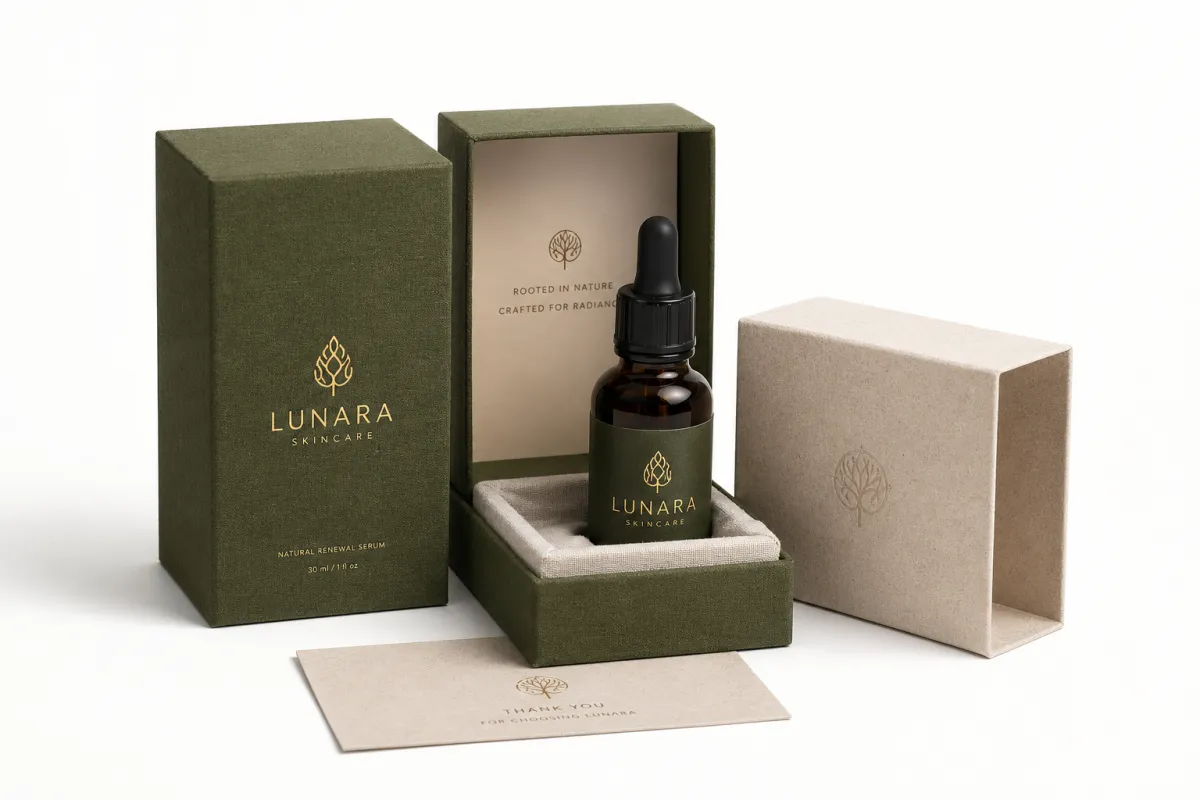
Custom handcrafted packaging boxes are boxes assembled, finished, or detailed by hand rather than produced as fully automated stock packaging. That can mean hand-wrapped rigid board, manually placed inserts, ribbon pulls, foam cutouts, or a final inspection stage where a person checks alignment on every corner. The appeal is not nostalgia. It is control over structure, paper selection, and finishing when a product is awkward, fragile, or meant to read as premium. I like that part because it feels less like mass production and more like a conversation between the product and the person opening it, often in a 90-second unboxing moment. In that sense, custom handcrafted packaging boxes sit somewhere between industrial packaging and boutique presentation pieces.
The difference from mass-produced packaging is obvious the moment both are in your hands. Machine-made cartons are fast and economical, which suits high-volume commodity items. Custom handcrafted packaging boxes create room to solve actual problems: a bottle with an odd shoulder shape, a cosmetics set with mixed sizes, a gift kit that needs a tray, a card pocket, and a magnetic closure in one build. One path saves time. The other shapes the experience. I am not being sentimental here. I am being practical. If the product is delicate, expensive, awkward, or all three at once, the box has to do more than sit there looking polite. It has to survive warehouse stacking, courier vibration, and a 1.5-meter drop test if the product is heading into stores in Toronto or Berlin. That is why custom handcrafted packaging boxes often outperform standard retail cartons for premium goods.
I still remember a skincare client fighting carton collapse around a glass serum bottle. Their old folding carton looked fine on a screen and failed in transit because the insert barely restrained the bottle. We moved them to custom handcrafted packaging boxes with a 1.5 mm insert wall, a 32 mm neck cutout, and a tighter cavity that reduced movement to under 1 mm. Return rates fell from 6.8% to 2.1% in one quarter, and the higher packaging cost paid for itself before the second restock. Packaging usually gets judged as a cost line. Sometimes it behaves more like insurance, especially when each damaged unit would otherwise cost $18 to replace. And yes, the finance team hated hearing that until the numbers got kinder. A sturdy handcrafted structure can be the difference between a smooth rollout and a warehouse headache.
The phrase covers more formats than most people assume. Luxury rigid boxes are the obvious example, but custom handcrafted packaging boxes can also include specialty mailers, drawer-style presentation boxes, sleeve-and-tray builds, magnetic flip-top boxes, and boutique retail packaging that needs a stronger shelf signal. When the package is part of the selling strategy, the structure matters as much as the artwork. I have seen sleeve-and-tray boxes do more selling than a 12-slide brand deck, which is both hilarious and mildly depressing. A well-made drawer box can turn a $22 tea set into a $38 gift in a single launch cycle. That is the quiet power of Custom Handcrafted Packaging Boxes: they make the product feel like a decision, not an afterthought.
For clients, I usually describe it this way: if a standard carton is a work shirt, custom handcrafted packaging boxes are a tailored jacket cut to fit a 42-inch chest and a 17-inch shoulder. Both cover the body. Only one changes the way the room reads the person wearing it. That is a small difference on paper and a large one at the point of sale, especially in categories like beauty, candles, and premium stationery where the box often sits in front of the product for 3 to 7 days before purchase. Custom handcrafted packaging boxes also hold their own better in gift-led categories, where presentation carries part of the value.
How Custom Handcrafted Packaging Boxes Are Made
The process begins before a cutter touches board. A serious project starts with discovery: product dimensions, target retail price, shipping method, and the role the packaging must play. I ask for exact measurements in millimeters, not "about the size of a hand," because a 2 mm mistake can turn a tight fit into a rattling package. I have seen that tiny gap ruin a beautiful concept in a way that felt almost rude. From there, the team builds a dieline, chooses the board grade, and decides whether the custom handcrafted packaging boxes need a rigid structure, a folding format, or a hybrid build. In a factory in Shenzhen or Guangzhou, that first spec sheet can save 2 full days of back-and-forth. It also keeps custom printed boxes from turning into a series of expensive assumptions.
Sample creation comes next, and weak projects often reveal themselves here. A physical sample tells you more than a mockup ever will. Closure tension, magnet placement, insert depth, coating feel, and how the printed panel behaves near a fold all show up in your hands. I have watched a beautiful proof fail because the lid popped open under a 1.8 kg stack load after 6 hours in a warm warehouse in Phoenix. Screens hide those problems. Cardboard and gravity do not. Gravity, as it turns out, is a sharp critic with no patience for marketing language. A project also tends to get honest here, which is why custom handcrafted packaging boxes separate real craftsmanship from attractive noise.
Once the sample is approved, the factory shifts into hand assembly. Here, custom handcrafted packaging boxes diverge from standard machine runs. Workers wrap greyboard, align corners, apply adhesive in controlled strips, and fit magnets or ribbons by hand. On delicate finishes such as soft-touch lamination or textured linen wrap, human handling often keeps edges cleaner and reduces scuffing. The labor is also the reason handcrafted jobs take longer, which is why timelines should never be guessed. Guessing is how projects end up in apology emails and slightly frantic spreadsheet colors in both New York and Manchester. If the goal is a polished premium box, the manual stage matters more than most buyers expect.
Finishing follows. Depending on the design, that may include foil stamping, embossing, debossing, spot UV, interior printing, or a custom insert wrapped in matching paper. A box with a velvet tray and a ribbon lift can demand several more steps than a plain lid-and-base structure. In one supplier meeting in Shenzhen, the discussion had nothing to do with art direction. It centered on whether a gold foil run could hold a 0.3 mm register tolerance on a dark paper wrap, and whether the magnets needed to be 10 mm or 12 mm in diameter. That level of control is normal for custom handcrafted packaging boxes when the brand wants a polished result. It sounds obsessive because it is. And honestly, that obsession is usually what separates elegant from merely expensive. It is also where custom handcrafted packaging boxes justify their name rather than borrowing it.
Lead time shifts with complexity, and the gap is not subtle. A straightforward rigid box with a basic printed wrap may take 7 to 10 business days after proof approval. A more detailed build with inserts, foil, and a specialty closure often needs 12 to 15 business days. Complex luxury custom handcrafted packaging boxes, especially those using imported paper, hand-tied elements, or multiple finishing passes, can take 20 to 30 business days from approval to shipment. Sampling, artwork revisions, and sourcing can add another week or two if the project changes midway. I wish that timeline were more glamorous. It is not. It is mostly careful work, plus the occasional delay because someone wants a ribbon the exact shade of "warm pearl" and that shade turns out to be hard to source in Foshan. For custom handcrafted packaging boxes, the schedule is part of the design brief.
Here is the practical sequence I use when a team needs order instead of optimism:
- Discovery and spec collection: product size, weight, and ship method, usually 24 to 48 hours.
- Dieline and structure planning: often 2 to 4 business days for a custom build.
- Prototype or sample creation: typically 3 to 7 business days, depending on tooling and finish.
- Hand assembly and finishing: 5 to 15 business days for most custom handcrafted packaging boxes.
- Final inspection, packing, and freight booking: 1 to 4 business days before the shipment leaves.
Artwork revision is the bottleneck I see most often. A team approves the structure, then shifts the logo 4 mm to the left three times, and the calendar slips. Specialty sourcing causes another delay. If the build needs a cream linen board, a matte gold magnet, or a ribbon color matched to Pantone 7607 C, the supply lead can outrun the production lead. That is normal. It still needs to be planned into custom handcrafted packaging boxes from the start. I have learned the hard way that "we'll sort it later" is a phrase that has eaten more launch weeks than bad coffee and printer jams combined, especially on projects shipping out of Yiwu or Dongguan.
For transit testing, I prefer ISTA methods rather than guessing whether a box is strong enough. A beautiful structure means little if the corners crush after a two-foot drop or a rough courier lane. Handcrafted packaging should still earn its keep under real shipping stress, whether the product is moving from Hong Kong to Singapore or from Dallas to Denver. A box that arrives bruised is just an expensive disappointment with good manners. Custom handcrafted packaging boxes should pass the same practical checks as any serious shipping solution.
Key Factors Behind Custom Handcrafted Packaging Boxes
Structure drives the first impression faster than almost anything else. Rigid setup boxes feel premium because the walls hold their shape, while sleeve-and-tray builds create a small moment of reveal. Magnetic closures suggest polish, tuck styles suggest practicality, and drawer boxes create more theater during unboxing. In client meetings, I usually begin with structure because structure changes both cost and customer reaction before the branding copy gets a chance to speak. That part is annoyingly true, especially when the buyer is comparing your box to a competitor’s $29 set on a shelf in Chicago or Seoul. Custom handcrafted packaging boxes need the right structure before they need the right slogan.
Fit and protection are part of design, not a separate layer of it. A product that slides 6 mm inside the box feels unfinished even if the artwork is excellent. For fragile items like glass vials, ceramic candles, or cosmetics with pumps, a precise insert matters more than a second foil detail. The best custom handcrafted packaging boxes solve movement, not just appearance, and dimensional accuracy is what keeps the whole thing honest. If the item rattles, the box is already failing, no matter how lovely the lid looks on a table. A tray cut to 0.5 mm tolerance can do more for quality than a full-page brand story. That is why custom handcrafted packaging boxes often begin with engineering, not decoration.
Finishes shift perception in seconds. Soft-touch lamination gives a velvety feel that people notice before they read the label. Foil stamping makes a logo catch light on darker papers. Embossing and debossing add tactile depth, while spot coating can pull the eye toward a mark or pattern. Interior printing is often overlooked, yet it gives custom printed boxes a more complete brand story the moment the lid lifts. I am fond of inside printing because it feels like a small surprise, and people love being surprised when they think they already know what they are getting. A printed interior with a 2-color pattern can lift perceived value by more than $5 on a $30 gift set. In custom handcrafted packaging boxes, one strong finish usually beats three competing ones.
Sustainability means more when it is practical. Recyclable paperboard, FSC-certified wraps, and minimal waste layouts all help, but the real question is whether the packaging still protects the product with less material. I have seen brands add heavy plastic inserts they did not need, then call the result eco-friendly. The math does not agree. If the goal is a cleaner paper trail, FSC-certified stock from suppliers in Zhejiang or Jiangsu is a better signal, and the EPA recycling guidance is a better baseline than a slogan. Marketing copy can get a little theatrical. Material science tends to be less impressed. Custom handcrafted packaging boxes can be sustainable when the build is deliberate instead of decorative.
Custom handcrafted packaging boxes also affect shelf appeal and repeat purchase intent. A retail box gets about three seconds to do the heavy lifting. On the shelf, clean lines and one strong color cue matter more than six competing messages. In the hand, texture and closure quality matter more than a long brand story. Package branding sits at the intersection of design, psychology, and material science, which is exactly why the best boxes feel inevitable rather than forced. They do not shout. They just quietly win the argument in a store aisle, whether that aisle is in London, Dubai, or Minneapolis. For premium beauty, stationery, and gifting, custom handcrafted packaging boxes often create the strongest shelf signal per square inch.
When a client asks for "just one more thing," I ask whether that detail helps the box sell, protect, or gift better. If the answer is no, it is probably decoration for decoration's sake. A strong build with one signature finish usually outperforms a crowded design with too many effects. That is especially true for custom handcrafted packaging boxes, where every added layer carries a cost in labor, time, or both. I have never once heard a warehouse manager in California say, "You know what we needed? More tiny complications."
Custom Handcrafted Packaging Boxes: Cost and Pricing
Pricing begins with materials. A box built from 2 mm greyboard and wrapped in 157 gsm art paper will cost more than a 300 gsm folding carton. Add magnetic hardware, a foam insert, or a specialty coating, and the unit price climbs again. On a small run, custom handcrafted packaging boxes can feel expensive because setup and hand labor are spread across fewer pieces. That does not mean the quote is inflated. It means the box is paying for human hands, not just machine time, and those hands may be in Dongguan, Guangzhou, or Quanzhou depending on the factory. The same logic applies to luxury rigid boxes, which rise in value because they ask for more precision.
Minimum order quantity changes the equation. A 500-piece order almost always carries a higher per-unit cost than a 5,000-piece run, even when the design is identical. Sampling, tooling, and labor do not shrink at the same pace as the order size. I have quoted the same rigid box at $4.20 per unit at 500 pieces and $1.75 per unit at 3,000 pieces. The structure stayed the same. The math did not. I know that sounds obvious, but people still act surprised by it, which is one of those recurring business mysteries that never fully dies. Custom handcrafted packaging boxes are especially sensitive to scale because the manual portion does not disappear when the order grows.
Hidden costs catch people by surprise. Prototyping can run $65 to $240 depending on complexity. Dieline setup may be included or billed separately at $80 to $200. Freight from Asia to North America can add $180 to $600 for smaller cartons, and if a project needs a revision after the first sample, the timeline and budget both move. With custom handcrafted packaging boxes, the cheapest quote is not always the lowest total cost. I have seen "savings" evaporate the moment someone realized the insert did not fit and the whole batch had to be adjusted. Not a fun day. Nobody was handing out applause in Seattle or Atlanta.
Here is the pricing snapshot I use in client calls. These numbers are not universal, but they are realistic enough to set expectations for custom handcrafted packaging boxes:
| Packaging Option | Typical Build | Typical Unit Price | Best For |
|---|---|---|---|
| Stock folding carton | 300 gsm board, one-color print, no insert | $0.28 to $0.55 at 5,000 units | Lightweight retail items and lower-margin SKUs |
| Semi-custom carton | 350 gsm board, die-cut insert, matte coating | $0.65 to $1.10 at 2,000 units | Mid-range retail packaging and launches |
| Custom handcrafted packaging boxes | 2 mm greyboard, wrapped paper, hand-set insert | $1.40 to $4.25 at 1,000 units | Premium gifting, cosmetics, and jewelry |
| Luxury presentation box | Rigid build, foil, emboss, ribbon, custom tray | $3.80 to $8.50 at 500 units | Corporate gifts and high-AOV product lines |
That comparison is the useful one. A $0.55 carton and a $4.25 rigid box do not compete in the same category. One is a container. The other is branded packaging that can justify a higher margin, a stronger shelf story, or a more credible gifting position. I have seen custom handcrafted packaging boxes pay for themselves when the product price rose by only $8 and the return rate dropped because the item finally arrived intact. That kind of payoff is not automatic, but it is very real when the packaging does actual work. A company in Miami selling $32 skincare sets can often recover a $2.90 box cost with a 7% lift in conversion alone. That is a practical reason to choose custom handcrafted packaging boxes instead of a cheaper stock format.
The value test is straightforward. Use custom handcrafted packaging boxes when the packaging supports margin, giftability, protection, or perceived value. If the product sells for $18 and the box costs $3.50, the math can still work if the packaging helps you sell more units at full price. If the product sells for $6 and the box costs $2.80, the packaging probably needs a different structure. That is not a branding failure. It is a budget mismatch. I would rather tell a client that honestly than watch them burn money on a box that is prettier than the product can afford, especially when the product is heading to wholesale accounts in Texas or Ontario. In practice, custom handcrafted packaging boxes should earn their keep, not merely look expensive.
Step-by-Step Ordering Process and Timeline
The ordering process works best when the brief is specific. Start with the product, the shipping method, the target customer, and the role the box must play. A box for a serum that ships by courier is not the same as a box for a limited-edition watch sold in a retail boutique. The custom handcrafted packaging boxes should be built around the exact use case, not a vague idea of "premium." I know "premium" sounds nice in a meeting. It is still useless without context, and context usually starts with product weight, retail channel, and the opening moment in hand. That is where custom handcrafted packaging boxes begin to justify their design choices.
Then build a usable spec sheet. I want product dimensions in millimeters, product weight in grams, insert requirements, finish preferences, artwork files, and any retail or compliance notes. If the box needs a hang tab, a tamper seal, or a barcode panel, that should be on the sheet too. Clean specs move custom handcrafted packaging boxes faster because the design team spends less time guessing and more time solving. Guesswork is expensive. Guesswork with magnets is somehow even more expensive, especially if the packaging is being produced in Guangzhou for a US launch with a 6-week retail deadline. The same rule applies to custom printed boxes, but the stakes rise faster with hand assembly.
The sampling phase is where good projects save money. Check the prototype in real conditions: does the lid close with even pressure, does the insert hold the item upright, does the foil register stay sharp, does the texture feel right in the hand, and does the closure survive a few open-and-close cycles? I once watched a client approve a sample on Zoom, then discover in person that the insert was 5 mm too deep for her product. That single oversight would have turned into 800 bad units if we had not caught it early. Zoom is great for many things. Feeling cardboard in your actual hand is not one of them, especially when the sample is moving between New York, Dallas, and a supplier in Dongguan. Custom handcrafted packaging boxes need physical validation.
A realistic schedule looks like this: 2 to 4 days for brief and structure planning, 3 to 7 days for sampling, 1 to 3 days for sample review, 12 to 20 business days for production, and 4 to 8 days for freight depending on route. Air freight can move faster, while ocean shipping can add two to four extra weeks. If a supplier promises custom handcrafted packaging boxes in "a few days" without a sample stage, I would ask how much manual labor is actually involved. Usually the answer is either very little or very much wishful thinking. A factory in Shenzhen can turn a rigid box quickly, but a hand-wrapped build with foil and ribbon still needs real time. The timeline becomes even more important once multiple finishes enter the job.
I tell teams to approve the project in checkpoints rather than all at once. Approve the structure first. Then the artwork. Then the sample. Then the production run. That keeps one mistake from contaminating the whole schedule. It also helps the brand team, the operations team, and the printer stay aligned when the box needs to be ready for a launch date, a trade show, or a seasonal gift window in September or November. I have seen a good box become a bad project simply because five people assumed someone else had signed off. Nobody enjoys that kind of silent chaos. With custom handcrafted packaging boxes, a clean approval path is almost as valuable as the artwork itself.
If you want a starting point before sending a full brief, our Custom Packaging Products page is a good place to compare formats and narrow the structure. I have used that route with teams deciding between a rigid box, a folding carton, and a sleeve-and-tray build before they committed to artwork. It saves a surprising amount of back-and-forth, which is a pleasant change from the usual packaging drama, especially when the client is trying to hit a launch window in London or Sydney. It also helps teams choose whether custom handcrafted packaging boxes are the right fit or whether a semi-custom alternative will do the job.
What Should You Check Before Ordering Custom Handcrafted Packaging Boxes?
Before you approve custom handcrafted packaging boxes, check four things in sequence: fit, finish, freight, and budget. That order matters because a beautiful box that does not fit is not a premium box; it is a mistake with good lighting. Start with exact product measurements, including caps, shoulders, inserts, and any fragile points. Then review the finish under natural and artificial light, because soft-touch lamination, foil, and dark wraps can behave differently depending on the room. Finally, confirm shipping method and unit economics so the box can move, store, and sell without surprising the finance team.
I also recommend checking the sample with the same care you would use for a product prototype. Open and close it several times. Stack it. Pack it. Hold it by the lid and by the base. If the closure feels loose or the insert allows movement, the final custom handcrafted packaging boxes will not improve by magic when the order scales up. That small sample is the truth serum. It tells you whether the box is ready for retail, gifting, or e-commerce, and it does so without asking for a second opinion.
- Measure the product in millimeters, not estimates.
- Confirm the closure style, insert depth, and board thickness.
- Review foil, embossing, or coating on a physical sample.
- Ask how the box will ship in master cartons and outer packaging.
- Verify lead time for sampling, assembly, and freight before approving launch dates.
That checklist keeps custom handcrafted packaging boxes from turning into a rushed purchase. It also gives the design team room to solve the real problem, which is usually not aesthetics alone. Most products need a better fit, a stronger signal, or a more convincing opening moment. Once those are clear, custom handcrafted packaging boxes become easier to specify and easier to defend internally. The project gets calmer, which is a rare and welcome thing in packaging.
Common Mistakes to Avoid With Custom Handcrafted Packaging Boxes
The first mistake is vague measurement. "Close enough" is not good enough when the product has a cap, a pump, or a fragile edge. I have seen a 78 mm bottle sent for an 80 mm cavity, only to discover the shoulder shape made the box fight back during insertion. A 2 mm board gap sounds tiny until it starts creating damage or wasted material in custom handcrafted packaging boxes. Tiny tolerances are where the whole project quietly decides whether it will behave, whether the box is being packed in Denver or in a facility near Guangzhou.
Overdesign is the second trap. If you add foil, embossing, a ribbon pull, a magnetic flap, and a five-piece insert all at once, the box can start to look crowded instead of premium. It can also push costs beyond what the product can carry. I once sat in a supplier meeting where the packaging spec climbed from $1.90 to $4.80 per unit because five "small" upgrades were added in one revision. Everyone in the room said each change was minor. The invoice had a different opinion, and so did the warehouse team in New Jersey. Custom handcrafted packaging boxes need restraint as much as they need detail.
Shipping is the third blind spot. A box that looks stunning in hand still has to survive stacking, vibration, and courier handling. Outer cartons, void fill, and master pack counts matter. If the inner box uses a foil stamp or soft-touch finish, the outer pack should be designed to prevent scuffing. That is especially true for custom handcrafted packaging boxes with dark wraps, which show abrasion faster than lighter papers. A matte black box can look magnificent until it meets a pallet corner with bad intentions in a 26-degree warehouse in Las Vegas.
Skipping samples is the fourth mistake. Digital mockups cannot tell you how a closure feels or whether a tray edge is too sharp. They also hide color shifts, especially on coated papers and dark inks. A Pantone 296 C logo can look nearly black on screen and still read beautifully in print, but only a physical proof proves it. Custom handcrafted packaging boxes need tactile proof, not wishful thinking. I say this with some feeling because I have seen more than one polished presentation collapse the moment the actual sample arrived and everyone went quiet in a conference room for 12 full seconds.
The final mistake is ignoring lead time. A project with ribbon, magnets, specialty paper, and hand assembly needs room to breathe. I have seen launch dates slip because a team planned for six days of production and forgot to include one round of sampling plus two days of freight booking. If the box matters to the sale, schedule it like it matters. Many smart teams lose a month on that one detail. A month sounds abstract until the seasonal window closes and the products are staring at you from a warehouse shelf in Philadelphia or Rotterdam. Custom handcrafted packaging boxes reward teams that plan for the real calendar, not the ideal one.
There is a reason I repeat the same warning in client meetings: custom handcrafted packaging boxes reward careful planning and punish vague briefs. The more precise the size, finish, and timeline, the better the result. Loose thinking usually ends up on the floor of the packing room, and by then it costs more to fix. I have seen the floor, and it is never sympathetic, especially when the project has already burned through a $2,000 sample budget.
Expert Tips and Next Steps
My first tip is to simplify the structure before adding decoration. A box with one strong closure and one strong tactile finish usually beats a box with four competing effects. If you are choosing between foil and embossing, pick the one that supports the brand story most clearly. That is often enough to make custom handcrafted packaging boxes feel expensive without turning them into a wasteful object. I am a little suspicious of boxes that try to do everything. They usually end up doing none of it especially well, and the bill from a factory in Foshan reflects that quickly. A simpler layout often gives custom handcrafted packaging boxes a more confident presence.
My second tip is to rank the goals in order. I usually ask teams to score four things from 1 to 5: product protection, premium feel, brand storytelling, and sustainability. Budget comes after that. Once the priorities are on paper, the design choices get simpler. It is much easier to decide on a 1.5 mm insert or a 2 mm insert when the box has a clear job. Otherwise, the conversation wanders into decorative fog, and nobody enjoys paying for fog, especially if the project is already tracking at $3.10 per unit. Custom handcrafted packaging boxes become easier to approve once the priorities are explicit.
My third tip is to test a sample kit in real life, not only in a conference room. Let someone open the box with cold hands, stack three units in a master carton, and carry the set for 50 feet. Those details sound minor, but they reveal what the polished mockup cannot. Custom handcrafted packaging boxes often look excellent in a render and only become truly useful when they survive practical handling. Reality has a way of being less flattering than the render, which is why reality deserves a turn on the packing table in Minneapolis or Madrid. That test can save a launch from a very expensive surprise.
Here is the action list I give clients who are ready to move:
- Measure the product in millimeters and grams, including caps, inserts, and any fragile points.
- Gather logo files, color references, and print notes so the artwork stage does not stall.
- Compare two or three material options, such as 2 mm greyboard, 157 gsm wrap paper, or a textured stock.
- Request a sample or prototype before committing to volume.
- Confirm production and freight timing together, not separately.
If you work through those five steps, custom handcrafted packaging boxes become much easier to buy well. You are not guessing, and you are not paying for surprises. You are making a packaging decision with the same discipline you would use to choose a supplier, a print run, or a retail display. That discipline sounds dull until it saves the project. Then it starts to look very clever, especially when a 1,000-unit order lands on time and within the expected $2.30 to $3.90 range. For premium launches, that is often the difference between a box that performs and a box that merely exists.
My last piece of advice is blunt: do not treat packaging as a finishing touch. It is part of the product. In some categories, it is the first product the customer touches. If your custom handcrafted packaging boxes are doing their job, they should support sales, reduce complaints, and make the brand feel more intentional within the first 10 seconds of opening. That is a tiny window, which is exactly why the box has to work hard, whether the order ships from Shanghai, Los Angeles, or Manchester.
For me, that is the real test. When a client says the packaging finally feels like the product it contains, the project is working. And when custom handcrafted packaging boxes are done right, the box does more than hold the item; it helps sell the item, frame the price, and extend the brand story long after the lid opens. I have seen customers keep the box for storage, for gifting, and occasionally just because it was too nice to throw away. That, in plain language, is packaging doing its job and then some, especially when the build includes a 350 gsm artboard wrap and a 1.5 mm Insert That Actually fits. The strongest custom handcrafted packaging boxes end up becoming part of the product memory.
What makes custom handcrafted packaging boxes different from machine-made boxes?
Custom handcrafted packaging boxes usually involve more manual assembly, finishing, or detailing, which gives you tighter control over fit and presentation. Machine-made boxes are faster and often cheaper for high-volume standard runs, but they are less flexible when you need unusual dimensions, mixed materials, or a more refined unboxing feel. I think that difference shows up fastest in the hand, not on a spec sheet, especially when the box uses a 2 mm rigid board and a hand-set insert instead of a one-piece folded carton.
How long do custom handcrafted packaging boxes usually take to produce?
Simple projects can move in 7 to 10 business days after proof approval if the structure is already set. More complex custom handcrafted packaging boxes often need 12 to 15 business days because of sampling, hand finishing, and material sourcing, and freight can add another 4 to 8 days depending on the route. If anyone promises it all in a blink, I would ask what corner they are cutting, because a foil-stamped box with ribbon pulls still needs real hands and real time.
Are custom handcrafted packaging boxes always more expensive?
They often cost more per unit because manual labor, setup, and lower-volume production are spread across fewer pieces. The final price depends on size, inserts, coatings, order quantity, and the amount of hand finishing, so custom handcrafted packaging boxes can be worth it when they support margin, gifting, or product protection. I have seen a pricier box make more money than a cheaper one because it let the product sit in a better market position, especially on a shelf where the retail price was $28 to $45.
What materials are best for premium handcrafted packaging?
Rigid board is one of the most common choices because it holds shape well and supports premium finishes like foil, embossing, and soft-touch lamination. Wrapped papers, textured stocks, and FSC-certified liners can improve both the feel and durability of custom handcrafted packaging boxes when the product needs a stronger brand signal. The material should look good, yes, but it also has to behave like it means it, whether that stock is sourced in Zhejiang or converted in Dongguan.
Can small businesses order custom handcrafted packaging boxes in low quantities?
Yes, but lower quantities usually raise the unit price because the setup cost is divided across fewer boxes. Small brands often start with prototype runs or short-run custom handcrafted packaging boxes, then scale once they know the structure, the artwork, and the price point all work together. That staged approach is often smarter than gambling on a giant first order and hoping the universe is feeling generous, especially when the first run is only 250 or 500 units.
If you are weighing 500 units against 5,000, remember the core question: do custom handcrafted packaging boxes help the product sell better, ship safer, or feel more giftable? If the answer is yes, the packaging is doing real work, and that is usually worth the spend, whether the finished boxes come from Shenzhen, Guangzhou, or a specialized workshop in Yiwu.
Practical takeaway: start with exact measurements, choose structure before decoration, and require a physical sample before any volume order. Those three steps prevent most of the expensive mistakes that custom handcrafted packaging boxes can create when the brief is fuzzy or the schedule is fantasy.

