Buyer Fit Snapshot
| Best fit | Custom Post Consumer Boxes Wholesale projects where brand print, material claims, artwork control, MOQ, and repeat-order consistency need to be specified before quoting. |
|---|---|
| Quote inputs | Share finished size, material target, print colors, finish, packing count, annual reorder estimate, ship-to region, and any compliance wording. |
| Proofing check | Approve dieline scale, logo placement, barcode or warning zones, color tolerance, closure strength, and carton packing before bulk production. |
| Main risk | Vague material claims, crowded artwork, missing packing details, or unclear freight terms can make a low unit price expensive after revisions. |
Fast answer: Custom Post Consumer Boxes Wholesale: Pricing and Specs should be specified like a repeatable production item. The safest quote records material, print method, finish, artwork proof, packing count, and reorder notes in one written spec.
Production checks before approval
Compare the actual filled-product size with the drawing, then confirm tolerance on folds, seals, hang holes, label areas, and retail display edges. Reserve space for logos, QR codes, warning copy, and material claims before decorative graphics fill the panel.
Quote comparison points
Review material grade, print process, finish, sampling route, tooling charges, carton quantity, and freight assumptions side by side. A quote is only useful when the supplier can repeat the same color, closure quality, and packing count on the next order.
I still remember the first time I stood beside a corrugator line in Dongguan and watched recovered fiber move through the stack at 300 meters per minute. From ten feet away, the board looked clean and ordinary. Up close, one small change in the furnish mix altered edge crush, fold memory, and the way the carton behaved under a 26-pound top load. That was the moment I stopped treating packaging as surface decoration. It was the beginning of understanding Custom Post Consumer Boxes wholesale as a material decision, not a branding exercise. You are not buying a pretty shell. You are buying a system that has to protect product, carry graphics, survive handling, and still look like it meant to be there.
At Custom Logo Things, brands usually come to us with a simple idea: they want Packaging That Feels cleaner, lighter, and less wasteful. Fair enough. That instinct makes sense. But recycled packaging only earns its keep if the box also survives a 36-inch drop, stacks properly on a pallet, and keeps a 4-pound serum kit from turning into a broken mess by the time it reaches a fulfillment center. That is where custom post consumer boxes wholesale starts to make commercial sense. The numbers get interesting once volume moves past a few thousand units, and the performance gets easier to defend when the spec is built with some discipline instead of a mood board and hope.
The strongest projects I have seen were never the flashiest. They were the ones where the brand knew the product weight, the outside dimensions, the shipping method, and the target cost before sample one hit the table. A beauty brand in Chicago once sent me a 7.2-ounce bottle spec, a 6 x 6 x 2.75 inch target size, and a packaging ceiling of $0.85. That was enough to build something useful. Compare that with the startup that asked for "something premium" and nothing else. One of those projects moved fast. The other wandered. That difference is the whole story behind custom post consumer boxes wholesale.
There is also a more practical truth that gets lost in polite packaging language: recycled does not automatically mean weak, and fancy does not automatically mean better. Board grade, flute profile, coating choice, and artwork coverage decide whether the box feels crisp or flimsy. A box can be environmentally responsible and still look sharp enough to sit next to prestige products without apology. That is kinda the sweet spot.
Why Recycled Wholesale Boxes Make Sense
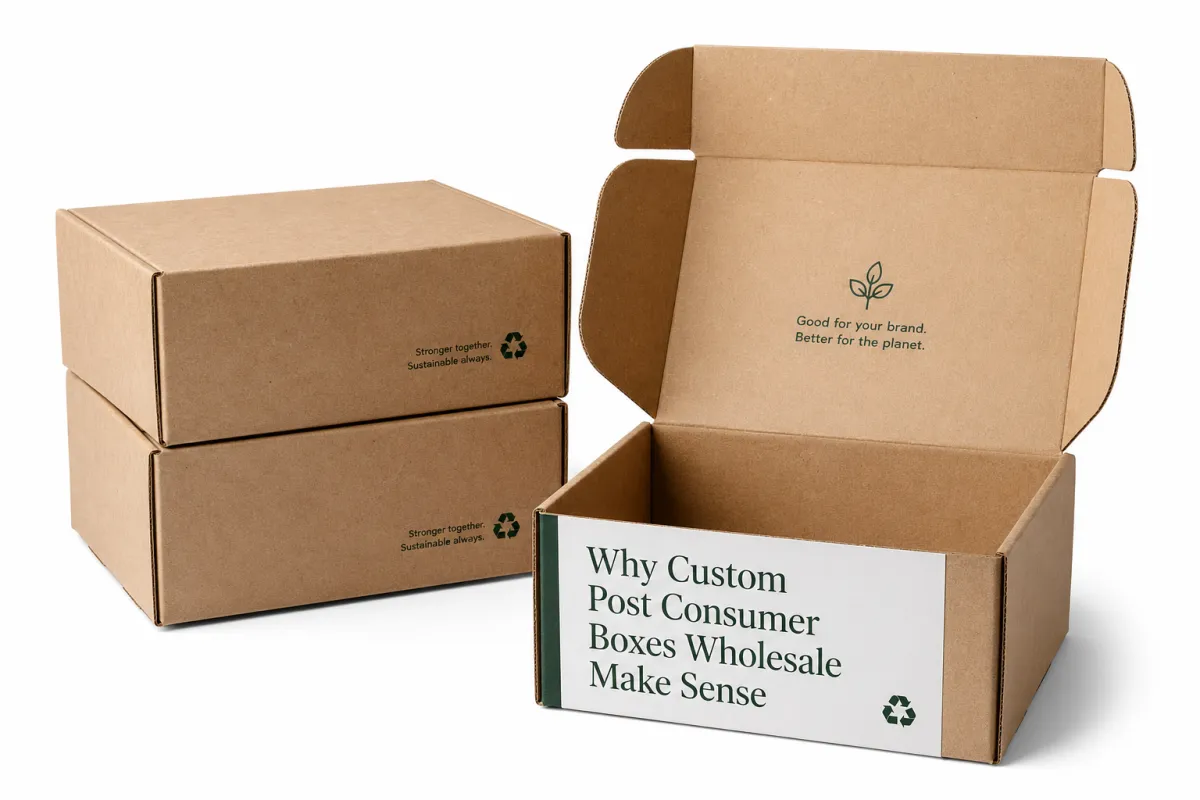
The first time I watched a board mill blend post-consumer fiber into recycled furnish, the plant manager in Suzhou held up two folded sheets and pointed to the numbers in marker: 32 ECT on one, 44 ECT on the other. Same category. Different behavior. One grade packed better and printed cleaner; the other carried more weight and resisted crush more effectively. The difference was not subtle. That is why wholesale recycled boxes should never be treated like a feel-good accessory. They are engineered materials with limits, and those limits matter the moment a carton leaves the design table and enters a warehouse.
Brands buy recycled packaging for practical reasons. E-commerce sellers want fewer crushed corners and fewer refund requests. Subscription brands want consistent presentation across multiple SKUs. Retail shippers want cartons that fit shelves, bins, and master cases without wasting cubic space. Private-label sellers want packaging that speaks before the lid opens. Custom post consumer boxes wholesale can do all of that, but only if the board and structure are matched to the product instead of copied from another brand's spec sheet.
Cost matters too, even if people like to pretend they are only talking about sustainability. Wholesale buying lowers the unit price because setup, plate work, and die charges spread across a larger run. A carton that costs $0.15 each at 5,000 pieces can drop to $0.11 or lower at 10,000 pieces if the structure stays stable. That kind of predictable pricing matters when a company is standardizing packaging across several product lines or planning replenishment for a seasonal launch. With custom post consumer boxes wholesale, the economics start to look smart once the volumes are real.
I learned that the hard way in a meeting with a beauty brand that kept paying for inserts with far more material than the product needed. We changed the tray structure, moved from 400gsm SBS to 350gsm C1S artboard for the retail sleeve, and cut cost by $0.14 per unit on a 12,000-piece order. Freight cube improved. Assembly became easier. The CFO stopped sending follow-up emails, which honestly felt like a bonus metric. That is what good custom post consumer boxes wholesale does when the spec is grounded in reality.
"If the recycled board is chosen well, the sustainable choice should feel deliberate, not accidental. The box should look like the brand meant to do it, from the first ink hit to the final fold."
Environmental claims need a factual anchor. Post-consumer content is part of the recovered fiber stream, but that label alone does not tell the whole story. Coatings, lamination, and local recycling rules all affect whether a finished box can go back into the system after use. The EPA keeps a clear overview of recycling basics at EPA recycling guidance, and that is a useful place to start if a buyer wants the language to match the material. A green claim without supply-chain traceability is just a green claim. I have seen brands wave around the word "eco" while using packaging that would make a materials engineer in Guangdong wince.
These cartons also work well outside the usual sustainability narrative. Beauty kits, apparel mailers, candle packs, wellness boxes, electronics sleeves, and retail-ready accessory cartons all fit the format. If the product needs structure, print, and shipping tolerance at the same time, recycled packaging belongs near the top of the list. That is why custom post consumer boxes wholesale keeps appearing in categories that once relied on plain brown shippers and a prayer.
What Custom Post Consumer Boxes Wholesale Include
The range is broader than most buyers expect. custom post consumer boxes wholesale can include mailer boxes, folding cartons, Tuck End Boxes, rigid-style wraps, sleeves, and corrugated shipper formats. I have seen each one work, but never for the same job. Mailers suit DTC and subscription programs. Folding cartons fit retail shelves and light product packaging. Corrugated shippers win when product weight climbs above 2 pounds and the carton has to survive parcel handling without shrugging its shoulders and giving up.
On the factory floor, the question is rarely "Can we print this?" The question is "What does the board do under load?" One plant I visited in Shenzhen had a stack of sample trays that looked identical from across the room. Up close, one folded cleanly and another cracked on the score because the recycled furnish was too coarse for the crease pattern. That is why custom post consumer boxes wholesale has to balance appearance with structure. A sharp-looking edge means very little if the carton opens in transit.
Customization is where the value becomes visible. You can set dimensions down to the millimeter, choose an insert that hugs the product, and decide whether the print should cover the whole surface or stay restrained with a single logo and one or two spot colors. For custom post consumer boxes wholesale, I usually push brands to map the opening sequence: what appears first, where the product sits, how the customer lifts it out, and whether an insert or closure actually improves the experience. If a feature only adds $0.18 to the unit cost and does not protect the item, cut it.
Here are the formats I see most often in custom post consumer boxes wholesale work:
- Mailer boxes: 200 lb test or E-flute board for e-commerce shipments with a clean printed exterior and a typical unit price of $0.72-$1.15 at 5,000 pieces.
- Folding cartons: Lightweight retail packaging for cosmetics, supplements, candles, and small electronics, often made from 300gsm to 350gsm C1S artboard.
- Tuck end boxes: Fast assembly and tidy shelf presentation for products that need a low MOQ of 1,000 to 2,500 pieces.
- Corrugated shippers: Better protection for heavier loads, usually with B-flute or E-flute structure depending on whether the item weighs 12 ounces or 4 pounds.
- Rigid-style wraps and sleeves: Premium presentation for gift sets or limited runs where tactile feel matters and the budget can support $1.80-$3.90 per unit at 3,000 pieces.
The finish matters too, though not for vanity alone. A matte aqueous coating can protect print without making the box slick. A soft-touch laminate can feel expensive, but it raises cost and can complicate recycling depending on the board and the local collection stream. That is why I tell clients to choose finishes from the product outward, not from the mood board inward. custom post consumer boxes wholesale still has to protect what is inside, because nobody wants to replace damaged orders after a shipping week goes sideways.
If you want a technical anchor, look at how boards are built and tested. ASTM and ISTA frameworks are useful references, especially when you are checking compression and transit performance. For parcel testing language, I often point buyers to ISTA. For chain-of-custody context, the FSC site can be helpful if a retail buyer asks for documentation tied to sourcing. Neither replaces a proper spec sheet, but both keep the conversation honest.
Specifications for Custom Post Consumer Boxes Wholesale
If a buyer sends a vague brief, the quote becomes vague too. That is not mystery. That is logistics. For custom post consumer boxes wholesale, the basic specs should always include dimensions, box style, board grade, recycled content target, print method, and whether the product needs an insert or tamper feature. I can price a 6 x 4 x 2 inch mailer very differently from a 10 x 8 x 3 inch shipper, even if both are described as "small boxes." That word has caused more confusion than I care to admit.
Material choice sits at the center of the spec. Kraft-look recycled stock works well for natural branding and understated product packaging. Coated recycled board gives you a cleaner print surface for logos, gradients, and tight typography. E-flute is common for lighter shipping cartons because it balances printability and cushioning. B-flute gives more crush resistance. Paperboard works for lighter items and retail packaging, especially when the box is mostly display and not freight abuse. custom post consumer boxes wholesale only works well when the material matches the load.
Print and finish need the same level of attention. CMYK is the default for full-color graphics. Spot color is useful when brand consistency matters more than photo realism. Water-based coatings can protect the surface without burying the recycled look. Matte finish keeps the box refined. Soft-touch adds a velvet-like feel, but I have seen brands spend an extra $0.22 per unit just to make the box feel like a luxury item nobody asked for. Fine, if the margin supports it. Wasteful, if it does not. That tradeoff matters in custom post consumer boxes wholesale, where every extra step can show up in freight, labor, or delay.
Structural options are where packaging design becomes useful instead of decorative. Self-locking bottoms save assembly time. Dust flaps improve closure. Inserts keep a serum bottle from rattling around like loose change in a glove box. Tear strips let customers open the box without hunting for a kitchen knife. Tamper-evident details matter for supplements and sealed retail goods. For custom post consumer boxes wholesale, these details protect both the product and the customer experience.
When I review specs with a buyer, I ask three technical questions every time. First, what is the product weight including inner packaging, right down to the gram or ounce. Second, what is the shipping method, because parcel abuse is different from palletized freight. Third, what is the stacking plan, because a box that looks fine on a desk may fail under a 40-inch warehouse stack. That is where compression testing, fit tolerance, and shipping weight checks matter. custom post consumer boxes wholesale should be built around actual handling, not hopeful assumptions.
Documentation shows up faster than many teams expect. Larger retailers may ask for recycled content disclosures, transit test results, or chain-of-custody records where applicable. Fulfillment partners may want case pack counts, master carton dimensions, and pallet configuration. If your team sells into retail, import, or subscription channels, prepare those notes before production begins. It saves time later. Time, unlike brand language, always leaves a bill, especially in warehouses in Los Angeles, Rotterdam, and Singapore.
| Box Option | Typical MOQ | Typical Unit Price | Best Use | Notes |
|---|---|---|---|---|
| Simple E-flute mailer, 1-color print | 500-1,000 | $0.72-$1.15 at 5,000 pcs | DTC shipping, subscription kits | Good balance of strength and print quality |
| Folding carton, full-color CMYK | 1,000-2,500 | $0.38-$0.88 at 10,000 pcs | Retail packaging, cosmetics, supplements | Lower material weight, cleaner shelf presentation |
| Corrugated shipper with insert | 1,000-3,000 | $1.05-$2.10 at 5,000 pcs | Heavier product packaging, fragile items | Insert and board grade drive the final cost |
| Rigid-style wrap or sleeve | 500-1,000 | $1.80-$3.90 at 3,000 pcs | Premium kits, gift sets, limited editions | Best for high perceived value, not always the cheapest route |
That table is a planning frame, not a promise. The final quote for custom post consumer boxes wholesale changes with material selection, print coverage, insert count, and freight destination. Still, it helps to start with honest ranges instead of fairy tales. A supplier who prices a premium recycled carton too low is often hiding die charges, plates, or shipping from Ningbo or Xiamen. Surprise fees are just a rude way of saying the quote was rushed.
Pricing and MOQ for Custom Post Consumer Boxes Wholesale
Pricing for custom post consumer boxes wholesale comes down to five drivers: board grade, size, print coverage, special finishing, and quantity. Bigger boxes use more material. Full-color art takes more press time. Inserts add converting steps. Matte lamination, foil, embossing, and specialty coatings add labor and setup. Once those drivers are visible, the quote starts to make sense. Without them, the number looks random even when it is not.
The cheapest way to buy custom post consumer boxes wholesale is not to chase the lowest number on the first line. It is to simplify the spec. A one-color exterior on recycled kraft stock can land dramatically lower than a fully coated box with soft-touch film and a custom insert. I have seen a beauty client cut $0.31 per unit by removing a foil accent and moving the logo to a single Pantone black. The product sold the same. The box still looked polished. The margin improved.
MOQ logic is tied to setup economics. Small sample runs are possible, but they cost more per unit because the press, die, and labor are still there. Move into 3,000, 5,000, or 10,000 pieces and custom post consumer boxes wholesale starts to show its real value. Setup cost gets spread across more cartons, and the unit number drops. That is why brands planning a launch should think in production batches, not in emergency reprints.
Here is the buying framework I use with clients:
- Sample run: Best for fit checks, artwork proofing, and small pilot launches; unit cost is highest, often 30 percent to 50 percent above production pricing.
- Short production run: Good for seasonal items, lower-risk tests, and regional rollouts, usually 1,000 to 3,000 pieces.
- Wholesale production run: Best for stable SKUs, repeat orders, and consistent retail or ecommerce demand, often 5,000 pieces and above.
One negotiation stayed with me because the details were so ordinary. It happened in a Guangdong meeting room with recycled board swatches spread across the table and three cups of very bad tea going cold. The supplier wanted to sell a "premium recycled grade" at a premium price, but their compression data was barely better than the standard sheet. We pushed for the furnish breakdown, and the client saved $0.09 per carton on an 18,000-unit order. That is the level of detail that matters in custom post consumer boxes wholesale. If a supplier cannot explain the price gap between board grades, they are guessing or hiding something.
For a realistic planning range, I usually tell buyers to expect this: a simple recycled mailer may start under a dollar each in volume, a folding carton can sit well below that, and premium structural boxes can climb quickly once finish work enters the conversation. Freight is a separate line item unless the quote says otherwise. Proofing, tooling, and plates should be stated clearly. If they are not, ask. The cheapest quote on paper can become the most expensive one after the add-ons show up, especially on orders shipping to New York, Dallas, or Toronto.
Compare suppliers on what the quote actually includes, not just the unit price. Does it cover dieline setup? Does it include a hard proof? Are plates extra? Is the die charged once or spread across the job? Does freight leave from the plant or arrive at your door? custom post consumer boxes wholesale is a sourcing exercise, not a guess. A good supplier can walk through every line without getting defensive.
Process and Timeline for Ordering
The order flow is simple when the inputs are clean. For custom post consumer boxes wholesale, the usual sequence is spec review, quote, dieline confirmation, artwork prep, proofing, production, and shipment. I like that order because it keeps the factory from printing the wrong thing on the wrong substrate. People skip straight from "we need boxes" to "where is the tracking number" more often than they should. That is not a process. That is anxiety with a shipping label.
What slows a project down most is usually not the press. It is missing dimensions, artwork that does not fit the dieline, and buyers who keep changing finishes after approval. A recycled carton with one logo and one ink color can move quickly. A complex custom post consumer boxes wholesale run with embossing, inserts, and specialty coatings needs more coordination. If the proof comes back with changes on page three and nobody knows who signs off, the schedule slips by several business days before anyone notices.
As a rough timeline, I plan for 3-5 business days on quote and dieline work, 2-4 business days for proofing, 10-15 business days for standard production after approval, and longer if the job involves special finishing or a new structural setup. Reorders can move faster, sometimes 7-10 business days after approval if material is in stock. That said, custom post consumer boxes wholesale should never be scheduled on hope alone. Material availability, press queue, and freight booking all affect the calendar.
I had one client in the wellness category rush approval by two days, then discover their product bottle had a 2 mm taller cap than the sample. That tiny difference turned into a loose fit on 8,000 cartons. We fixed it, but only after a revised insert and another proof cycle. The lesson was plain: testing is cheaper than rework. A physical sample, especially for a fragile or oddly shaped product, protects both the timeline and the budget.
Packaging testing is not dramatic, but it saves money. I like to see a fit check, a compression check, and at least one transit test for higher-value product packaging. For parcel shippers, ISTA methods are useful because they reflect real handling conditions. For compression and structural checks, ASTM references help keep the discussion precise. If a supplier cannot speak in those terms, they may still sell boxes, but they probably cannot protect a complex fulfillment program very well.
One more thing: packaging does not ship on vibes. It ships on approvals, machine time, and material availability. That sounds blunt because it is blunt. custom post consumer boxes wholesale rewards buyers who stay organized. Product dimensions, artwork files, and finish decisions should be ready before the job hits the plant queue. That is how you move from "we need a box" to "the pallet left on Friday" from a facility in Guangzhou or, for specialty finishing, a converting partner in Jiaxing.
Why Choose Us for Custom Post Consumer Boxes Wholesale
I do not believe in pretending every supplier is special. Most are not. What matters is whether the team understands recycled materials, print realities, and the cost of bad specs. At Custom Logo Things, we approach custom post consumer boxes wholesale like production work, not a design contest. If a decision adds cost without improving protection, branding, or sales, I will say so. That saves everyone time and usually saves the buyer money.
I have walked board mills where the recycled furnish was sorted before it ever hit the machine, and I have stood beside converting lines where a weak score ruined a whole stack of otherwise decent cartons. That is why supplier relationships and inspection discipline matter. A stable board supply, reliable print partners, and realistic lead times outweigh a shiny promise every time. Good custom post consumer boxes wholesale is built on repeatable work, not dramatic talk. Flashy language never held a flap closed.
Quality control should be visible, not hidden behind a logo. I want material checks on arrival, print verification before full production, die alignment checks during the run, glue performance checks at converting, and compression testing for jobs that will stack in a warehouse or ride in a parcel network. For custom post consumer boxes wholesale, the difference between an acceptable order and a costly reorder often comes down to one missed checkpoint.
We also help buyers avoid waste. That can mean reducing box size by 0.25 inch, changing from a six-color design to a three-color build, or replacing a custom insert with a tighter tuck structure. I have watched brands save $2,000 to $8,000 on a single production order just by removing unnecessary features. That is not flashy. It is practical. Practical is what wholesale packaging should be, even if nobody wants to say it on a mood board.
If you are comparing options, start with our Custom Packaging Products page and then review the fit of our Wholesale Programs before you commit to a spec. Those two steps usually tell you whether your project belongs in a simple recycled mailer, a retail carton, or a stronger corrugated format. That is the kind of routing decision that keeps custom post consumer boxes wholesale from turning into an expensive experiment.
We also keep package branding grounded in reality. A box can be clean, sharp, and memorable without carrying a $0.90 surcharge in finish work. Sometimes the smartest move is a kraft-look board, a single-ink logo, and a structural design that fits the product like it was made for it. Because it was. That is the point. Good packaging should not need a speech to explain itself, whether it is headed to an Amazon FC in Nevada or a boutique in Austin.
Next Steps for Ordering Custom Post Consumer Boxes Wholesale
If you are ready to move, prepare four things first: product dimensions, target quantity, preferred box style, and a rough print idea. Those four inputs let us build a real quote for custom post consumer boxes wholesale instead of a placeholder number that needs three revisions before it makes sense. Add product weight if you have it. Add a sample if the item is fragile, unusually shaped, or heavier than it looks.
Send the minimum useful information, not a folder of guesswork. A good starting brief includes the outside dimensions of the product, whether you want a mailer or folding carton, the expected monthly volume, and whether the box is for shipping, shelf display, or both. For custom post consumer boxes wholesale, that is enough to tell us whether the job needs E-flute, paperboard, 350gsm C1S artboard, or a different structure entirely.
Ask for a dieline before artwork goes to production. Ask for a sample proof before signoff if the product has tight tolerances. Ask about freight, tooling, and proofing so the quote does not grow teeth later. I have seen too many buyers accept a low unit number and then discover $450 in tooling, $180 in plates, and a freight line that belongs in a different budget. That is not a surprise. That is a sloppy quote, and it usually arrives with a smile.
Here is the order I recommend:
- Confirm dimensions and product weight.
- Pick the box style and recycled board grade.
- Approve the quote with all add-ons listed.
- Review the dieline and proof carefully.
- Release production only after the sample matches the spec.
That sequence keeps custom post consumer boxes wholesale efficient and keeps the factory from making expensive assumptions on your behalf. If you want a box that ships well, prints cleanly, and supports your brand without drama, start with facts, not slogans. Send the dimensions, send the quantity, and send the artwork direction. We will take it from there, whether the final run ships from Dongguan, Ningbo, or Suzhou.
When the numbers are real, packaging gets easier. That is the part people miss. custom post consumer boxes wholesale is not only about recycled content. It is about board strength, fit, print quality, freight efficiency, and a quote that actually matches the job. Do those things in order, and you end up with packaging that earns its keep.
FAQ
What is the minimum order for custom post consumer boxes wholesale?
MOQ depends on box style, board type, and print complexity. Simple corrugated runs for custom post consumer boxes wholesale can start at 500 pieces, while premium paperboard or specialty-finish jobs may need 1,000 to 2,500 pieces. A clean quote based on your exact dimensions is the fastest way to find out whether your run belongs at 500 pieces, 1,000 pieces, or higher.
Are custom post consumer boxes wholesale strong enough for shipping?
Yes, when the flute, board weight, and structure match the product load. Recycled content does not automatically mean weak packaging. For custom post consumer boxes wholesale, the real check is compression, fit, and transit testing. A box built with 32 ECT or 44 ECT board can handle shipping very well if the spec matches the product.
How much do custom post consumer boxes wholesale cost?
Pricing depends on size, quantity, print coverage, inserts, and finishing choices. Higher volume lowers unit cost because setup charges are spread across more boxes. For custom post consumer boxes wholesale, a simple mailer may land around $0.15 per unit at 5,000 pieces in a plain one-color build, while a premium rigid-style box can move above $2.00 depending on finishing and freight.
Can I print full color on custom post consumer boxes wholesale?
Yes, full-color printing is available on many recycled board options. The final look depends on whether the stock is coated, uncoated, or kraft-style. For custom post consumer boxes wholesale, artwork should be checked against the dieline before production so logos, text, and images land exactly where they should, especially on 350gsm C1S artboard or E-flute board.
How long does production take for custom post consumer boxes wholesale?
Timelines vary by sample approval, material availability, and print complexity. Clean artwork and fast proof approval shorten the schedule. Reorders usually move faster than first-time projects. For custom post consumer boxes wholesale, standard runs typically take 12-15 business days from proof approval, while complex jobs with inserts or special finishes can take longer.

