Buyer Fit Snapshot
| Best fit | To Custom Window Boxes projects where brand print, material claims, artwork control, MOQ, and repeat-order consistency need to be specified before quoting. |
|---|---|
| Quote inputs | Share finished size, material target, print colors, finish, packing count, annual reorder estimate, ship-to region, and any compliance wording. |
| Proofing check | Approve dieline scale, logo placement, barcode or warning zones, color tolerance, closure strength, and carton packing before bulk production. |
| Main risk | Vague material claims, crowded artwork, missing packing details, or unclear freight terms can make a low unit price expensive after revisions. |
Fast answer: To Custom Window Boxes: Board, Finish, Dieline, and Unit Cost should be specified like a repeatable production item. The safest quote records material, print method, finish, artwork proof, packing count, and reorder notes in one written spec.
Production checks before approval
Compare the actual filled-product size with the drawing, then confirm tolerance on folds, seals, hang holes, label areas, and retail display edges. Reserve space for logos, QR codes, warning copy, and material claims before decorative graphics fill the panel.
Quote comparison points
Review material grade, print process, finish, sampling route, tooling charges, carton quantity, and freight assumptions side by side. A quote is only useful when the supplier can repeat the same color, closure quality, and packing count on the next order.
Guide to custom window Boxes: Design, Cost, and tips. I still remember the first time I watched a buyer change nothing but the window shape on a carton and then call me two weeks later, sounding almost offended that sell-through had jumped 17% in six weeks. Same product. Same price. Different opening. That little moment is exactly why this guide to Custom Window Boxes starts with visibility instead of decoration, because the window is often doing the heavy lifting before the shopper ever reads a line of copy, especially on a 300 mm shelf in a high-traffic store in Chicago or Manchester.
I have spent enough time on factory floors in Shenzhen, Dongguan, and Ningbo to know packaging gets judged in about 3 seconds, sometimes less if the aisle is busy and the shopper is carrying a coffee in one hand and a grumpy child in the other. If the product is visible, trust rises faster. If the box feels flimsy, people assume the product is flimsy too, which is annoying but very real. That is the hard truth behind retail packaging, and it is exactly why this guide to Custom Window Boxes matters for brands that care about package branding, not just another pretty carton that looks good for a sample photo and falls apart in a warehouse in Newark.
How Do Custom Window Boxes Improve Shelf Appeal?
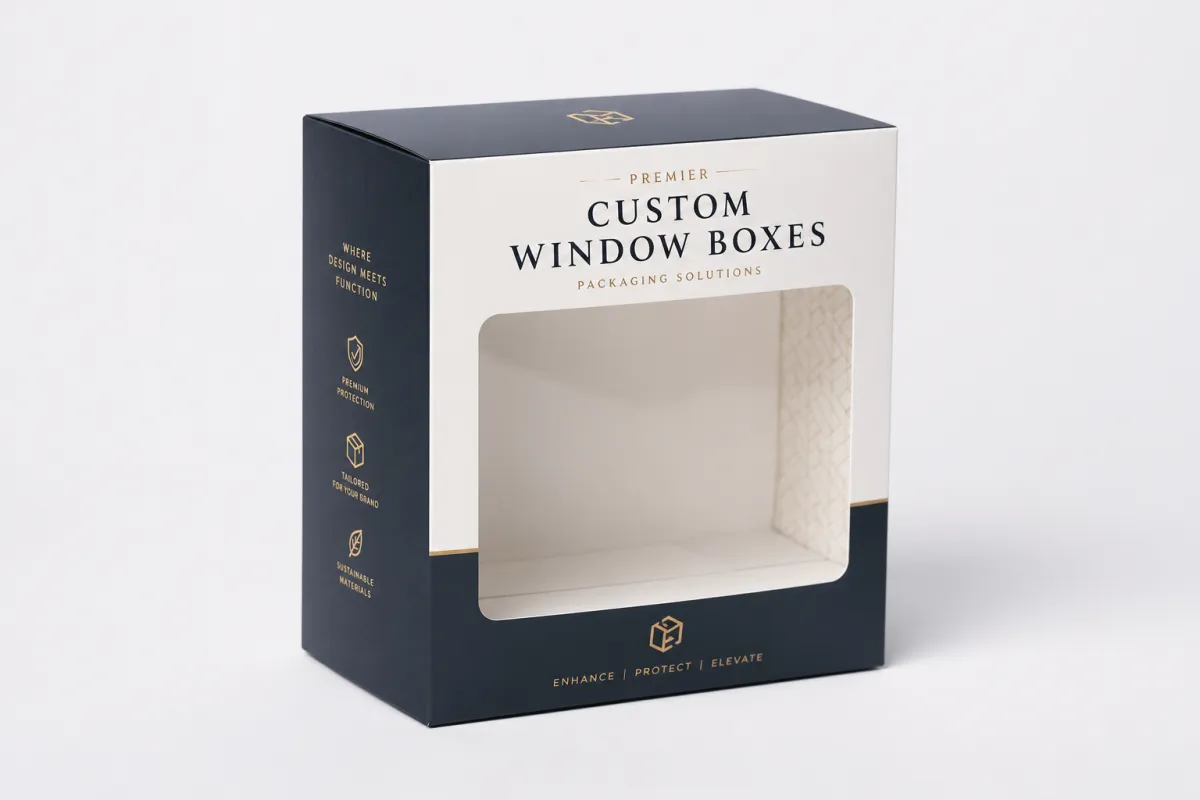
A custom window box is a carton with a die-cut opening, often backed by clear film, so the buyer can see the product before paying for it. That opening can be round, oval, rectangular, or shaped to follow a bottle shoulder, a candle curve, or a stack of cookies that honestly looks better than most people’s pantry organization. The idea stays simple: the guide to custom window boxes is really a guide to reducing doubt, and doubt is expensive when a retailer in Los Angeles is deciding between two nearly identical SKUs.
I saw that play out in a Shenzhen plant about 8 years ago. A tea client wanted a full-front window, but the sample kept bowing at the corners on the packing line. We trimmed the opening by 22 mm, moved it 6 mm higher, and added a 0.12 mm PET film. The carton gained strength, the sachets stopped sliding, and the buyer called the product “more expensive” without touching the formula. That is packaging design doing real work, and frankly, I wish more people would admit how much of buying is just controlled panic about whether the thing inside is any good.
Visibility works because people hate guessing. A shopper looking at Custom Printed Boxes with a product window can confirm color, size, texture, and fill level in one glance. That matters in cosmetics, baked goods, candles, supplements, and any category where product packaging has to earn trust before it can sell features. It also helps e-commerce unboxing, where a clear window adds a little theater without adding much material, and a 0.15 mm film patch can do the job for a box that ships from Atlanta to Dallas in a corrugated master case.
The guide to custom window boxes solves a few practical problems right away:
- Trust: the shopper sees the product instead of a promise printed on paper.
- Premium perception: a clean window can make 350gsm C1S board feel more upscale than a fully closed carton on a shelf in Toronto or Austin.
- Faster decision-making: people stop comparing abstract claims and start comparing the thing in front of them.
- Retail control: buyers can check fill count, product color, and quality at shelf level in under 5 seconds.
“The box sold the product better than the ad did.” A buyer said that after we switched her bakery line from plain sleeves to a kraft window carton with a 45 mm oval cutout and a 0.1 mm PET backer.
That is the reason this guide to custom window boxes keeps coming up in brand meetings in Chicago, Guangzhou, and Amsterdam. It is not about cutting a hole in cardboard. It is about building a box that tells the truth faster than the shelf can steal attention, and honestly, the shelf is a pretty ruthless competitor when a store manager only gives you 280 mm of facings.
How Custom Window Boxes Are Engineered
The anatomy is straightforward, but the details decide whether the box saves money or burns it. Most window cartons use a paperboard or corrugated base, a printed outer layer, a die-cut opening, and sometimes a clear film patch. If the product is loose, an insert or product lock keeps it from rattling around. That is the engineering side of the guide to custom window boxes, and it matters more than the artwork does, even if the marketing team would prefer we all pretend otherwise.
Anatomy of a window carton
A basic setup might use 18pt SBS or 350gsm C1S artboard for lightweight retail items. Heavier pieces usually move to E-flute or B-flute corrugated, because a cosmetic jar, small candle, or ceramic item can crush a weak panel if the carton stacks 6 high on a warehouse pallet in Dallas or Rotterdam. The window itself can be die-cut directly into the board or backed with 0.1 mm PET, 0.15 mm PVC, or a compostable PLA film depending on the brief and the budget. I have seen people try to save two cents and lose the whole box structure, which is a bargain nobody asked for.
The guide to custom window boxes also has to account for how the box closes. Tuck end, reverse tuck, straight tuck, tray-and-sleeve, and display-ready retail styles all behave differently on a line. A tuck-end carton is quick to assemble. A tray-and-sleeve style looks more premium. A reverse tuck can be easier for automated insertion on a line running 60 to 90 units per minute in a plant outside Dongguan. I have watched line workers fight a beautiful box that slowed them down by 14 minutes per 1,000 units, and let me tell you, that kind of slowdown makes even a pretty package feel deeply annoying.
How the window affects performance
A large window increases visibility, yet it also reduces panel strength. On a 250gsm board, a front window that takes up 52% of the panel can leave the side walls too soft for stacking. On a 400gsm board with a film patch and a well-placed insert, the same display concept might perform fine. That is why the guide to custom window boxes should never be copied from a mood board pinned by a team in Brooklyn or Singapore. It needs to be built around product weight, center of gravity, and transit path.
Here is the decision path I use in real production meetings:
- What needs to be visible in the first 3 seconds?
- What must stay protected during a 36-inch drop or a 1.2-meter conveyor transfer?
- Does the box need to survive retail handling, e-commerce shipment, or both?
- Will the opening sit in a shelf-facing area, a hang tab area, or a shipping-safe side panel?
If you can answer those four questions, the structure usually becomes obvious. That is the practical side of the guide to custom window boxes. It pushes the box to serve the product instead of the other way around, which is a relief because products tend to have a much better sense of purpose than most packaging brainstorms I have sat through.
If you want to compare a few structural families before going custom, our Custom Packaging Products page is a good starting point. I use that kind of reference when a client wants to move fast but still keep the structure honest, especially for carton styles built around 350gsm C1S, E-flute, or rigid board.
Custom Window Boxes Cost and What Drives Pricing
Price is where the romance dies. Good packaging looks simple until someone asks for a quote. Then every detail gets a dollar attached to it, and the guide to custom window boxes turns into a budgeting exercise. The usual cost drivers are board grade, window size, film type, print colors, special finishes, quantity, and insert complexity, plus where the job is produced, whether that is Shenzhen, Suzhou, or a finishing shop in Illinois.
I had one client in Chicago ask for foil, embossing, matte lamination, and a custom PET insert on a 5,000-piece run. The packaging looked gorgeous. It also added $0.19 per unit, which erased most of her margin. We dropped the embossing, kept the foil on one panel, and switched to a cleaner insert. She saved about $950 on the order, and the carton still looked premium. That is the sort of tradeoff the guide to custom window boxes should help you make before production starts, not after somebody has already fallen in love with a pricey sample.
Small runs cost more per unit because setup and tooling get spread over fewer boxes. A prototype or short run of 250 to 500 pieces might land around $1.10 to $2.40 per unit for a simple paperboard window carton, depending on print and film. At 5,000 pieces, that same style can drop into the $0.28 to $0.85 range. At 10,000 units or more, simple builds often land lower still, especially if the die line is reused and the print count stays reasonable. I have seen a plain 350gsm C1S carton with a 0.1 mm PET window hit $0.15 per unit at 5,000 pieces in a large Shenzhen order when the structure was already on file.
Here is a table I use to frame the budget side of the guide to custom window boxes:
| Material / Format | Typical Unit Cost Range | Best For | Main Tradeoff |
|---|---|---|---|
| 18pt SBS paperboard with PET window | $0.28 - $0.85 at 5,000+ | Light retail items, cosmetics, tea, candles | Less crush resistance than corrugated |
| 350gsm C1S artboard with film patch | $0.32 - $0.95 at 5,000+ | Premium branded packaging with sharp print | Needs careful stacking and handling |
| E-flute corrugated window carton | $0.55 - $1.45 at 3,000+ | Heavier product packaging and shipping protection | Thicker walls reduce shelf elegance |
| Rigid setup box with window | $1.80 - $4.50 at 1,000+ | Luxury retail packaging and gift sets | Highest material and labor cost |
That table is not fantasy math. It reflects the kind of quotes I have seen from Shenzhen, Dongguan, and a few U.S. finishing shops in Ohio and New Jersey that charge more but move faster. The exact number depends on print coverage, the shape of the window, and whether you need a hand-applied film patch or a machine-applied one. A die-cut oval with a simple PET backer costs less than a scalloped shape that needs a custom blade, and yes, the blade really can be the thing that wrecks the budget. Packaging is cheerful like that.
Budget for more than the per-unit carton price. The guide to custom window boxes gets expensive fast if you ignore setup charges, tooling, samples, freight, and waste allowance. I usually tell buyers to account for 3% to 7% waste on the first run, plus a sample budget of $75 to $250 if the structure is new. Freight can swing wildly: a small air shipment from Guangzhou to Los Angeles might add $0.12 to $0.40 per box, while ocean freight can be much lower but slower by 18 to 30 days.
Finishes matter too. Matte lamination, spot UV, soft-touch film, foil stamping, and embossing all look nice on a quote sheet and very different on a margin sheet. The trick is not to kill the design. It is to choose the one upgrade that makes the box feel intentional. That is the kind of decision a serious guide to custom window boxes should teach, because a good carton should feel considered, not overcooked.
Step-by-Step Guide to Ordering Custom Window Boxes
If you want the order to go right the first time, start with product data, not artwork. The guide to custom window boxes always begins with the boring stuff: exact dimensions, weight, fragility, fill method, and whether the box will live on a retail shelf, in a subscription shipper, or in a warehouse rack. I have seen a 2 mm height mismatch create an entire week of rework in a facility outside Chicago. That is a painful way to learn math, and the invoice usually arrives with a smug little grin.
What to send first
Send the supplier the product length, width, and height in millimeters, plus the packed weight per unit and the carton count per master case. If the item is fragile, say so. If it has a lid, pump, handle, or irregular shoulder, include that too. The more exact the brief, the less junk you get back. This is the part of the guide to custom window boxes that saves the most money because it prevents a bad structure before it exists.
A useful quote package usually includes:
- Product dimensions and weight, in both mm and grams.
- Quantity target, such as 2,000, 5,000, or 20,000 units.
- Board preference, like 18pt SBS, 350gsm C1S, or E-flute.
- Artwork files, preferably AI, PDF, or layered EPS.
- Finish goals, such as matte lamination, foil, or spot UV.
- Delivery zip code or port, because freight changes the real number.
Then move to structure. Some brands start with an existing dieline and adapt it. Others need a custom structural design from scratch. If the product is tall and narrow, I often recommend a window closer to shoulder height so the visible area feels balanced. If the item is short and wide, a centered window with a clean border can look better than a giant cutout. The best guide to custom window boxes advice I can give is this: do not design the artwork until the structure is locked. I learned that the hard way after approving a beautiful front panel that had no room left for the actual product. Embarrassing, yes. Educational, absolutely.
Approve the window style before sampling. That means deciding whether the opening is film-backed, bare die-cut, or covered with a clear patch that protects the product from dust and fingerprints. I have watched brands spend $600 on a sample round because they kept changing the window after seeing the first proof. That is not clever. That is expensive, and it tends to make everyone in the room suddenly very interested in their laptops.
Once the structure is set, review the sample for fit, strength, print accuracy, and shelf appeal. Put the actual product inside. Shake it. Stack 5 or 10 cartons. Check the corners. Open and close it 20 times if the box is going to sit in retail packaging conditions. The guide to custom window boxes is not complete if the sample only looks good on a desk. It has to behave on a line, on a shelf, and in transit, which is a much less glamorous test but the one that matters.
If the sample passes, confirm three things before press time: production quantity, carton pack-out, and shipping destination. That sounds basic, but I have seen an order leave the factory with the wrong inner pack count and a pallet label that pointed to the wrong warehouse in Texas. It took 2 calls, 1 repack, and a very annoyed buyer to fix it. Clear paperwork is cheaper than heroics, and heroics are overrated anyway.
Custom Window Boxes Process and Timeline
The production sequence is usually quote, design, structural approval, prepress, sampling, revisions, production, inspection, and freight. That sounds tidy on paper. In real life, the guide to custom window boxes moves at the speed of approval emails, and those emails can be painfully slow. I once watched a launch slip 11 days because the logo moved 3 mm to the left and the brand team wanted one more color proof. Three millimeters. I still remember staring at that note and wondering if the universe was testing my patience.
A simple run with a reused dieline can move quickly. I usually see 12 to 15 business days from final proof approval to shipment for straightforward paperboard window cartons. If the job needs new tooling, a custom insert, or premium finishes, 18 to 25 business days is more realistic. Add 18 to 30 days for ocean freight if the shipment is leaving Asia. The guide to custom window boxes gets much easier once people stop promising impossible dates and start respecting the calendar like it has feelings.
Fast-track orders exist, and they cost more. If a supplier has to jump a job ahead of another run, expect a premium of roughly 10% to 25% depending on how much labor and press time gets reshuffled. That extra fee is not the factory being dramatic. It is the cost of changing the queue. A buyer who understands that usually gets better service because they stop arguing with physics, which is a surprisingly effective strategy.
Here is what slows the schedule down most often:
- Artwork changes after dieline approval.
- First-time tooling for a custom window shape.
- Insert tweaks after the sample is already cut.
- Matte lamination, foil, or spot UV across multiple panels.
- Seasonal backlog during Q4, especially for retail packaging.
When I talk buyers through the guide to custom window boxes, I always tell them to build in buffer time around approvals. If a product launch date is tied to a trade show in Las Vegas, a retail reset in Austin, or a subscription drop in Seattle, give yourself at least 7 extra business days. That cushion saves face when a supplier catches a registration issue on prepress or a carrier slips a sailing by 4 days.
This is also where standards matter. If the box must survive distribution, ask whether the pack-out has been checked against ISTA testing standards. If the board is supposed to come from responsibly managed forests, request FSC certification. I have seen buyers skip those questions and then scramble later when a retailer in California asked for documentation. The guide to custom window boxes is easier when compliance is part of the brief, not an afterthought.
One more practical note: if you are comparing material sourcing claims, trade organizations such as packaging.org can help separate real materials knowledge from sales fluff. That kind of reference is useful because packaging talk gets fuzzy fast, and a buyer should not have to decode a spec sheet like it is a treasure map.
Common Mistakes to Avoid With Custom Window Boxes
The most common mistake is making the window too large. A giant opening looks bold on screen, then turns into a weak panel that crushes in shipping. I have seen this happen on a 240gsm box with a 62% front cutout. The carton looked nice for 9 seconds and failed as soon as a master case got stacked in a warehouse near Atlanta. The guide to custom window boxes should protect you from that kind of self-inflicted damage.
Bad sizing comes next. People sometimes design the box before finalizing the product dimensions or the insert layout, which is backwards. If the inner tray is 2 mm too tight, the product scuffs. If it is 3 mm too loose, it rattles. I had a candle client in Ohio lose nearly $400 in sample and freight charges because the jar changed by 1.5 mm after the wax fill was adjusted. That tiny shift made the original dieline useless, which was a very expensive reminder that “close enough” is not a measurement.
Wrong board thickness causes a different mess. Too light, and the corners crush. Too heavy, and the box feels expensive in all the wrong places because the cost jumps without adding shelf value. A 14pt board might work for a 30 g tea sachet set. It will not work for a 450 g glass jar. The guide to custom window boxes is supposed to teach fit, not optimism, and optimism is not a substitute for a load test.
Here are the mistakes I see most often, plus the fix:
- Window too big: shrink the cutout and add a stronger border or a film patch.
- Product not finalized: lock dimensions before dieline work starts.
- Skipping samples: order at least 1 physical proof before bulk production.
- Ignoring shipping tests: run ISTA-style transit checks or equivalent drop testing.
- Overloading finishes: choose 1 or 2 upgrades, not 5.
Skipping tests is especially risky. If the box ships through a distributor, the carton should survive compression, vibration, and a few bad drops. That is where standards like ISTA matter more than the mood board. I am not saying every project needs a formal lab test, but I am saying the buyer should know the transit risk before releasing a production run, because fixing damage after launch is an expensive hobby.
“We made the packaging prettier and more fragile at the same time.” That was a painful quote from a brand manager who learned, after one rejected pallet in New Jersey, that beauty without logistics is just expensive clutter.
Another mistake is overpaying for finishes that the buyer will never notice. A soft-touch coat on a dark carton can feel gorgeous, but if the product is sold in a brightly lit discount chain, a clean matte finish and a sharp print might perform just as well for $0.06 less per unit. The best guide to custom window boxes keeps the margin visible right next to the design, because a beautiful carton that starves the business is not actually a win.
Expert Tips and Next Steps for Custom Window Boxes
Here is the field-tested advice I wish more buyers used: show the highest-value part of the product in the window. Not the side edge. Not the bottom. The part that signals quality in one glance. For a lipstick set, that might be the shade lineup. For tea, it might be the color of the sachet paper. For a candle, it might be the glass finish or label. That small choice can make the entire guide to custom window boxes feel more expensive without adding a cent of material, which is one of my favorite kinds of packaging math.
If the budget is tight, upgrade the part people actually touch. A cleaner insert, a better film, or a sharper print layout often does more than piling on foil, embossing, and spot UV. I have negotiated plenty of supplier quotes where one smart change saved $0.04 to $0.09 per box and improved the box more than a second finish ever would. That is real packaging design, not decoration theater, and it usually keeps everybody calmer, which is no small thing when a launch team in London has already revised the timeline three times.
For a useful quote, send a supplier a brief that includes product dimensions, quantity, board preference, artwork files, finish goals, and delivery zip code. If you do not know the board yet, say what the box needs to survive: shelf display, courier shipment, or warehouse stacking. If you want faster answers, point the supplier to a specific structure family on Custom Packaging Products and say which details you want to keep. Good briefs get good numbers. Vague briefs get guessing, and guessing is a terrible procurement strategy.
My practical next steps are simple:
- Audit the current product packaging and measure the actual product again, not the old spec sheet.
- Collect exact dimensions, weight, and fill method in millimeters and grams.
- Ask 2 or 3 suppliers for quotes on the same brief so the numbers can be compared cleanly.
- Request a sample or structural proof before placing a bulk order.
- Decide which upgrade matters most: visibility, protection, or premium feel.
If you are rebuilding branded packaging from scratch, start with the functional choice first and the visual choice second. That sounds boring. It also keeps the order from turning into a costly lesson in retail packaging. The best guide to custom window boxes I know is the one that gets the product on shelf, holds up in transit, and still leaves enough margin for the business to breathe.
For teams working with Custom Logo Things, I would use the guide to custom window boxes as the briefing tool, then move into samples only after the dimensions, window placement, and finishing plan are all fixed. That sequence saves time, saves money, and usually makes the final carton look cleaner too, which is a pleasant bonus when everybody is already tired of revising proofs.
Frequently Asked Questions
What is the best material for custom window boxes?
Paperboard works well for lightweight retail items and premium presentation, especially if the box sits on a shelf and needs sharp print. Corrugated board is better for heavier products or anything that needs extra shipping protection. The best choice in the guide to custom window boxes depends on product weight, display use, and whether the carton has to survive transit from a plant in Shenzhen or a finishing line in Ohio.
How much do custom window boxes usually cost per unit?
Pricing changes based on quantity, board grade, print complexity, film, and finishes. Small runs cost more per box because setup and tooling get spread over fewer units, while larger runs bring the per-unit number down fast. Ask for a quote with the exact product size and order volume so the numbers are real, not fantasy math from a spreadsheet someone guessed at over coffee. A simple 5,000-piece run can land near $0.15 to $0.85 depending on material and finish.
Do custom window boxes need a plastic film over the opening?
Not always, but film helps hold shape, block dust, and protect the product. Some categories can use a clean die-cut window without film if the product is protected inside and the carton will not sit around exposed for long. If the box will be on a shelf for a while in a store in Phoenix or Toronto, film is often the safer choice in the guide to custom window boxes.
How long does it take to produce custom window boxes?
The timeline usually depends on design approvals, sampling, tooling, and the production queue. Simple runs move faster; new structures, inserts, or premium finishes add time. Build in buffer time so the order is not rushed at the last minute, because a 3 mm artwork tweak can become a 3-day delay if nobody is paying attention. For many straightforward jobs, 12 to 15 business days from proof approval is a realistic target.
What should I send to get an accurate quote for custom window boxes?
Send product dimensions, weight, and quantity, plus the type of window box you want. Include artwork files, finish preferences, and whether the boxes are for retail display or shipping. The more specific the brief, the less likely you are to get a useless quote, and the more useful the guide to custom window boxes becomes when you are ready to place the order, especially if you are comparing bids from Shenzhen, Dongguan, and a domestic converter in the Midwest.
Measure the product again, choose the smallest window that still shows the part customers need to trust, and lock the dieline before anyone starts polishing artwork. That one sequence keeps the box honest, the budget under control, and the final pack looking like it was designed on purpose instead of improvised in a rush.

