The custom hang tags for cosmetics Brands Reorder Planning guide begins with an uncomfortable truth: the second run is where packaging systems reveal whether they were ever documented properly. A top-selling serum can keep the same artwork and still come back looking slightly wrong if the paper shifts, the foil tone changes, or the attachment method is substituted. On shelf, that kind of difference is not cosmetic in the casual sense. It is operational noise, and it spreads fast across approvals, inventory, and retail presentation.
Buyers tend to underestimate hang tags because they are small and easy to file under “simple repeat.” That assumption is expensive. A tag reorder can trigger the same kind of friction as a carton rerun if the original spec was never locked, the proof was archived loosely, or the pack-out instructions lived only in someone’s inbox. Cosmetics brands feel that pain more than most because shade families, seasonal sets, and claim-heavy labels often sit adjacent to one another. One inconsistency is enough to make the whole shelf look off.
Well-run reorder planning does not just save money. It preserves visual consistency, protects launch timing, and reduces the chance that a replenishment job turns into a mini redesign. The difference between a smooth repeat order and a messy one usually comes down to the same handful of decisions: spec control, artwork discipline, unit-cost planning, and supplier documentation.
Why Repeat Orders Go Wrong When Tags Are Treated as Afterthoughts
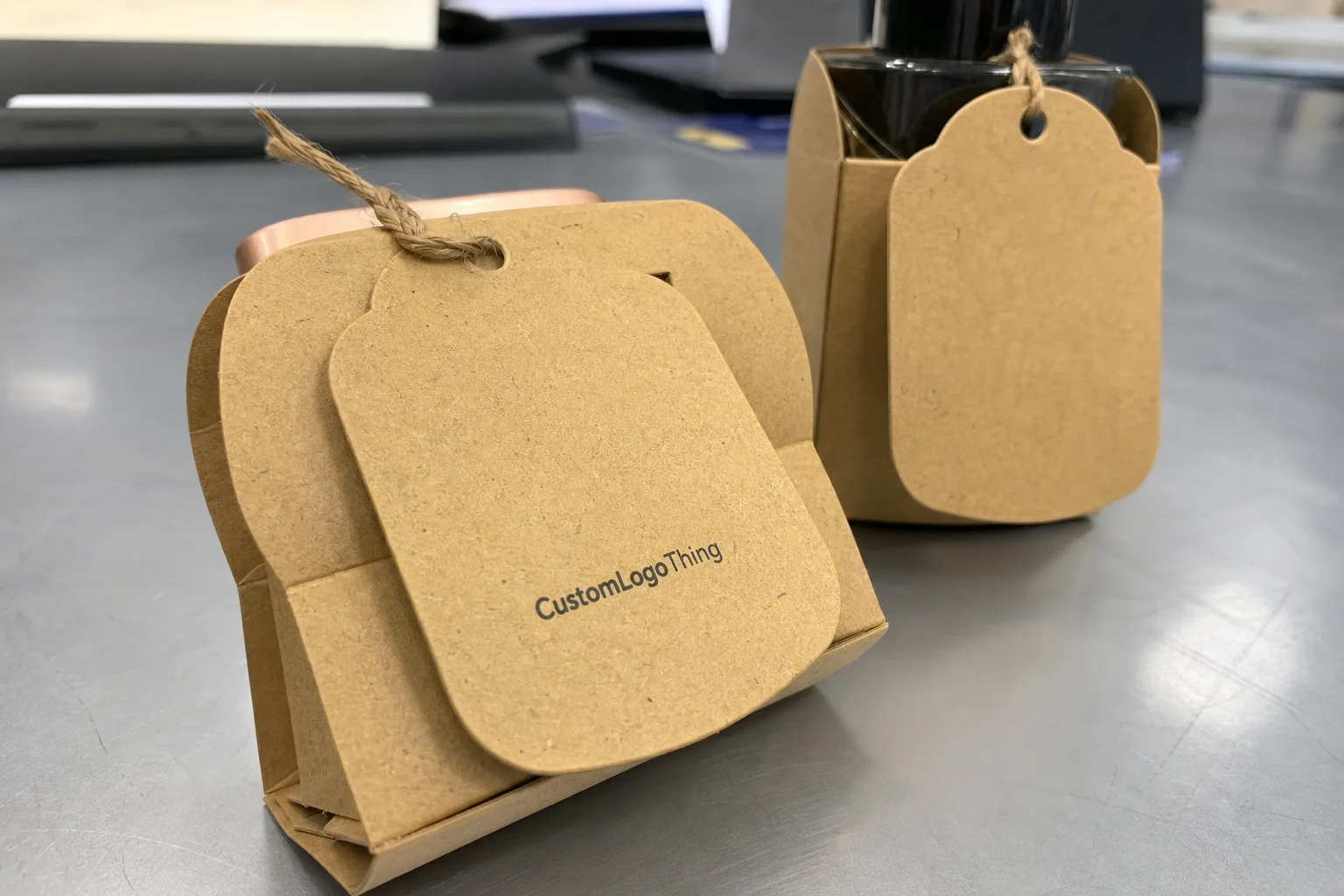
Repeat orders fail for ordinary reasons. The team assumes the previous job can simply be copied, so no one checks whether the prior run used a slightly brighter stock, a different foil roll, or a cord that was only available for that one batch. The artwork may be unchanged, but the physical object is no longer the same.
That matters because cosmetic packaging is rarely isolated. A tag may sit beside a bottle, carton, sample insert, or retail display, and buyers are often managing several SKUs at once. If one reorder lands with a different sheen or trim edge, it can stand out against the rest of the line in a way that shoppers notice immediately, even if they cannot explain why.
The hidden cost is time. A mismatch starts with a sample review, then a proof correction, then a production hold. By the time the issue is identified, the reorder may have already lost the schedule advantage that made a repeat run attractive in the first place. A “quick top-up” becomes another round of coordination across packaging, procurement, and fulfillment.
There is also a margin effect that is easy to miss. A bad repeat order can create rush freight, scrapped inventory, or a temporary out-of-stock that forces a more expensive emergency print run. On paper, the original quote may still look acceptable. In practice, the landed cost is higher because the order had to be fixed twice.
The safest mindset is to treat every reorder as a controlled production event, not a copy-paste job. That does not mean overcomplicating the process. It means documenting the job well enough that the next purchase order can be matched against a real standard instead of memory.
Lock the Physical Spec Before You Place the Reorder
The first control point is the physical spec. Before any quote goes out, the buyer should confirm the substrate, caliper or weight, coating, finish, attachment style, and trimming requirements. For cosmetic tags, the difference between a 14pt coated board, a heavier SBS stock, and a textured premium paper is noticeable in hand and under retail lighting. It affects stiffness, print sharpness, and how the tag hangs beside the product.
Finishes deserve equal attention. If the approved run used matte aqueous, soft-touch lamination, foil stamping, or embossing, the reorder should state whether those effects must match exactly or simply stay visually close. A supplier cannot guess how much variation is acceptable. If the prior job had a specific tactile feel or reflected light in a certain way, write that down. The same goes for FSC-certified stock, recycled content, or other material claims that may need to remain consistent from one order to the next.
Attachment details can make or break the repeat run. Record the hole diameter, eyelet type, cord or ribbon style, cord color, knot method, and whether the tag is single-panel or folded. A 3 mm hole with waxed cotton cord is a different build from a 4 mm hole with satin ribbon, even if the printed face is identical. That kind of detail is easy to ignore until the reorder arrives and the pack-out team says the tags do not feel right.
- Substrate: board weight, coating, texture, stiffness.
- Finish: matte, gloss, foil, emboss, spot UV, lamination.
- Attachment: hole size, eyelet, cord, ribbon, fold style.
- Tolerance: acceptable variation in trim, color, and layout.
If the reference sample changed, the job changed with it.
That is the practical rule many teams miss. A reorder quote should be built against the archived spec, not against a verbal description of what was “close enough” last time. If a buyer changes one element, the production record should be updated before the price is finalized. Otherwise, the order may be approved against one assumption and manufactured against another.
For repeat work, the spec sheet is the source of truth. Keep the approved sample, production notes, and any tolerances together in one place. That single habit prevents a long list of avoidable problems later, especially when multiple SKUs are being replenished at the same time.
Artwork, SKU, and Claims Checks That Prevent Reprint Waste
Artwork is where repeat orders quietly go off track. The file may look familiar, but the barcode might have changed, the shade name may have been revised, or the legal copy may need to reflect a different market. For cosmetics, that is not a minor issue. Claims, ingredients, net contents, and country-specific copy can all affect approval.
Version control matters more than most teams admit. Keep the last approved PDF, the dieline, and the production notes together so the reorder can be compared against the exact file that ran before. A folder called “final” is not enough. If the previous order used a proof marked with production comments, that version should be easy to retrieve, or the supplier may have to reconstruct the job from scattered files.
SKU review should be line by line, not glance by glance. Product families often share branding, but that does not mean the content is identical. A lip oil tag, a fragrance tag, and a body lotion tag may look related while carrying different claims, dimensions, and regulatory text. If one shade code or barcode is wrong, a reorder can turn into waste before it ever reaches the packing table.
Claims changes require special caution. If a benefit statement, ingredient callout, or compliance line has shifted, treat the order as a controlled revision. That is slower than a blind rerun, but it is still faster than scrapping finished tags. The same applies when a brand is updating a logo lockup, moving a QR code, or revising a multilingual panel.
Teams that manage several packaging formats at once should keep related assets linked. A tag reorder often needs to line up with labels, cartons, and inserts so the package system stays consistent. Resources such as Custom Labels & Tags and Case Studies can help buyers compare how a repeat run should be structured across the broader packaging mix.
Pricing, MOQ, and Unit Cost on Repeat Runs
Repeat pricing is usually easier than first-run pricing, but only if the spec stays stable. If the supplier can reuse setup work and approved files, prepress time drops and some one-time tooling charges may disappear. That is where reorders earn their value. The savings are not magical; they come from fewer hours spent recreating decisions that were already made.
MOQ is shaped by several variables: substrate, finish complexity, die-cut shape, and how much manual work the pack-out requires. A standard cosmetic hang tag with a single hole and a basic matte finish can often run at a lower minimum than a tag with heavy foil coverage, embossing, or custom cord. If multiple SKUs share one dieline, the effective order size improves because setup cost gets spread across more units.
| Option | Typical MOQ | Typical Unit Cost at 5,000 | Best Fit |
|---|---|---|---|
| Standard paper tag, matte aqueous, basic string | 1,000 to 3,000 | $0.10 to $0.18 | Core skincare and mass-market cosmetics |
| Premium stock, foil, spot UV, custom hole and cord | 3,000 to 5,000 | $0.18 to $0.32 | Prestige skincare and fragrance |
| Heavy board, emboss, specialty cord, folded insert | 5,000 plus | $0.28 to $0.55 | Hero launches and gift sets |
Those numbers are directional, not fixed. Paper availability, freight, print coverage, and pack-out labor can move the quote quickly. Some suppliers keep the headline price low and recover margin through finish charges, setup fees, or hand assembly. That is why the cheapest quote on paper is not always the lowest-cost order.
A better comparison is total landed cost. If a reorder saves four cents per tag but misses a launch date, the savings vanish fast. For beauty brands that work on seasonal calendars, that time cost can matter more than the unit price difference. A stable reorder plan often beats a marginally cheaper quote that introduces risk.
Buyers should also watch for hidden scope changes. A supplier may quote one number for paper and another for cord attachment, proof rounds, or carton labeling. Ask what is included, what is excluded, and whether the quoted minimum assumes a standard production sequence. The quote should answer the job the brand actually needs, not an idealized version of it.
Lead Time, Quality Control, and Pack-Out Details
A repeat order moves fastest when the supplier already has the previous production record. The usual workflow is familiar: quote, file review, proof approval, production, quality control, packing, and shipment. What changes on a reorder is the amount of clarification needed. If the documentation is strong, the job can move without a long back-and-forth.
Lead time stretches in predictable places. Foil stamping adds setup. Specialty stocks require sourcing. Custom cords, folded structures, or mixed-SKU pack-outs add manual steps. For a standard tag, 12 to 15 business days from proof approval is a common planning window. For premium finishes or more complex assembly, 15 to 25 business days is more realistic. Tight turnaround is possible, but only when the material and tooling are already available and the queue allows it.
Quality control should be specific, not generic. The supplier should confirm trim accuracy, color consistency, finish placement, attachment quality, and pack counts. If the reorder has a reference sample, that sample should be used to check the new run under the same lighting and inspection conditions whenever possible. Cosmetic buyers often focus on print color and forget the small things that affect perceived quality: edge cracking, foil registration, string length, or the way a folded tag closes.
Pack-out is another place where repeat orders get derailed. Carton labeling, count per bundle, bundle orientation, and outer case marking should all be documented. If the tags will be distributed through a retailer network, ask how the cartons are identified and whether the counts are easy to verify on receipt. An accurate print run can still become a receiving problem if the pack-out is sloppy.
Transportation deserves the same discipline. If the order will move through multiple hands, it helps to know whether the carton spec matches the expected route and whether any transit testing standard was used. Organizations such as ISTA are useful references for shipment testing methodology, while FSC remains relevant when material claims need to be retained across repeat orders. Not every job needs every test, but the shipping method should fit the destination.
The simplest safeguard is a locked reference sample and a current shipping profile. Those two items answer most of the questions that slow a repeat run. They also reduce the chance of a supplier making assumptions about destination, handling, or acceptable variation.
What to Expect from a Reliable Reorder Supplier
A good reorder supplier is not the one with the lowest first quote. It is the one that can reproduce the same tag without improvisation. That starts with recordkeeping. The supplier should retain past specs, proofs, packing details, and production notes so the next run starts from a real baseline instead of a vague email thread.
Material substitutions are a key test. Good suppliers flag changes before production if a paper mill, foil source, or finishing material has shifted. Weak suppliers mention it after the cartons are packed. For cosmetics brands, even a slight shift in board shade or surface texture can throw off a carefully controlled packaging system.
Operational detail is where capability becomes visible. Does the supplier confirm pack counts? Are cartons labeled clearly? Can they state the color tolerance they can actually hold, rather than promising perfection? Can they handle both short replenishment orders and larger restocks without changing the material story? These questions separate a real repeat-order partner from a vendor that treats every job as a one-off.
Service depth matters because reorders are often time-sensitive. A supplier that understands retail packaging timing can prevent internal churn by catching a spec issue before it becomes a delay. A slightly lower quote is not much of a win if the team has to rebuild the job from scratch or wait another week for corrected proofs. The real value is consistency: same look, same build, same delivery expectation.
For buyers managing broader packaging programs, the best suppliers are usually the ones that can keep Custom Hang Tags aligned with labels, cartons, and related components without making the brand re-explain the same details every quarter. That kind of continuity is rarely visible in a quote sheet, but it shows up immediately in the reorder process.
Build Your Trigger List Before the Next Run
The most useful reorder tool is a trigger list. For each SKU, record on-hand quantity, forecast demand, approved dieline, current proof, pack count, shipping destination, and required arrival date. Then add the details that tend to disappear first: board stock, finish, cord style, carton label language, and whether the order must match an existing shelf set or a refreshed launch kit.
Set reorder points by velocity, not instinct. A fast-moving serum should not be managed like a limited-edition holiday item. If a product sells steadily, the reorder trigger should account for sell-through plus lead time, with a safety buffer for proof changes or freight delays. For seasonal launches, the buffer should be wider because the calendar is less forgiving and there is less room for correction.
Before requesting pricing, send the last approved artwork, the notes from the previous run, and any updated delivery constraint. If the next order needs to match exactly, say so plainly. If it is a revision, mark the change clearly instead of burying it in a paragraph. The cleaner the input, the cleaner the quote.
It also helps to keep tag reorders aligned with the wider packaging calendar. A cosmetic brand that is also reprinting labels or cartons should not treat those jobs as unrelated. When the packaging schedule is coordinated, the next shipment lands as a coherent set rather than a collection of near-matches.
That is the real value of the Custom Hang Tags for Cosmetics brands reorder planning guide: it replaces panic ordering with a repeatable system. Freeze the spec. Hold the proof. Check the SKU details. Reorder before inventory falls into the danger zone.
How far in advance should I reorder custom cosmetic hang tags?
Reorder based on stock trigger levels, not on the moment inventory becomes critical. For standard tags, many teams work with a 12 to 15 business day production window, then add buffer for proofing, freight, and any special finishing. Faster-moving SKUs need a larger cushion because a small delay can create a stockout before the next shipment arrives.
Can I reuse the same artwork for a custom hang tag reorder?
Yes, if the size, material, finish, and compliance copy stay unchanged. Keep the last approved proof and dieline together so the supplier can match the prior run quickly. If the barcode, shade name, claim, or regulatory text changed, treat the order as a revised proof rather than a straight rerun.
What drives MOQ on custom hang tags for beauty brands?
MOQ is usually shaped by substrate, finishing complexity, die-cut shape, and pack-out labor. Standard stocks and simple finishes usually support lower minimums than foil, embossing, or unusual attachment methods. If several SKUs share the same base spec, combining them can improve the effective order size.
How can I lower unit cost on repeat cosmetic tag orders?
Standardize tag size, stock, and finish across related SKUs where the design system allows it. Order enough volume to spread setup cost across more units without creating obsolete inventory. Reduce variation in cords, coatings, and special effects when the visual outcome still meets the brand standard.
What should I send for the fastest reorder quote?
Send the last approved artwork, quantity by SKU, target ship date, and delivery ZIP or destination country. Include notes from the previous run if there were color targets, pack counts, or attachment details that must be repeated. If you have a reference sample, mention it clearly so the supplier can quote against the correct production standard.


