The failure usually starts small. A barcode is placed too close to the trim line. A warning sentence is copied from an old file. A finish that looked clean on screen becomes unreadable once the ink hits coated stock. In cosmetics, that is enough to stall a launch because the hang tag is treated as both a branding element and a controlled production item.
That is why Custom Hang Tags for Cosmetics brands factory audit questions matter before the order goes out. The point is not to collect a long list of polite supplier questions. The point is to find out whether the factory can reproduce the same result in volume, with the same dimensions, legibility, and production control that the sample implied.
A quote is only cheap if it includes the same spec you think you are buying.
Why a small tag error can delay a cosmetics launch
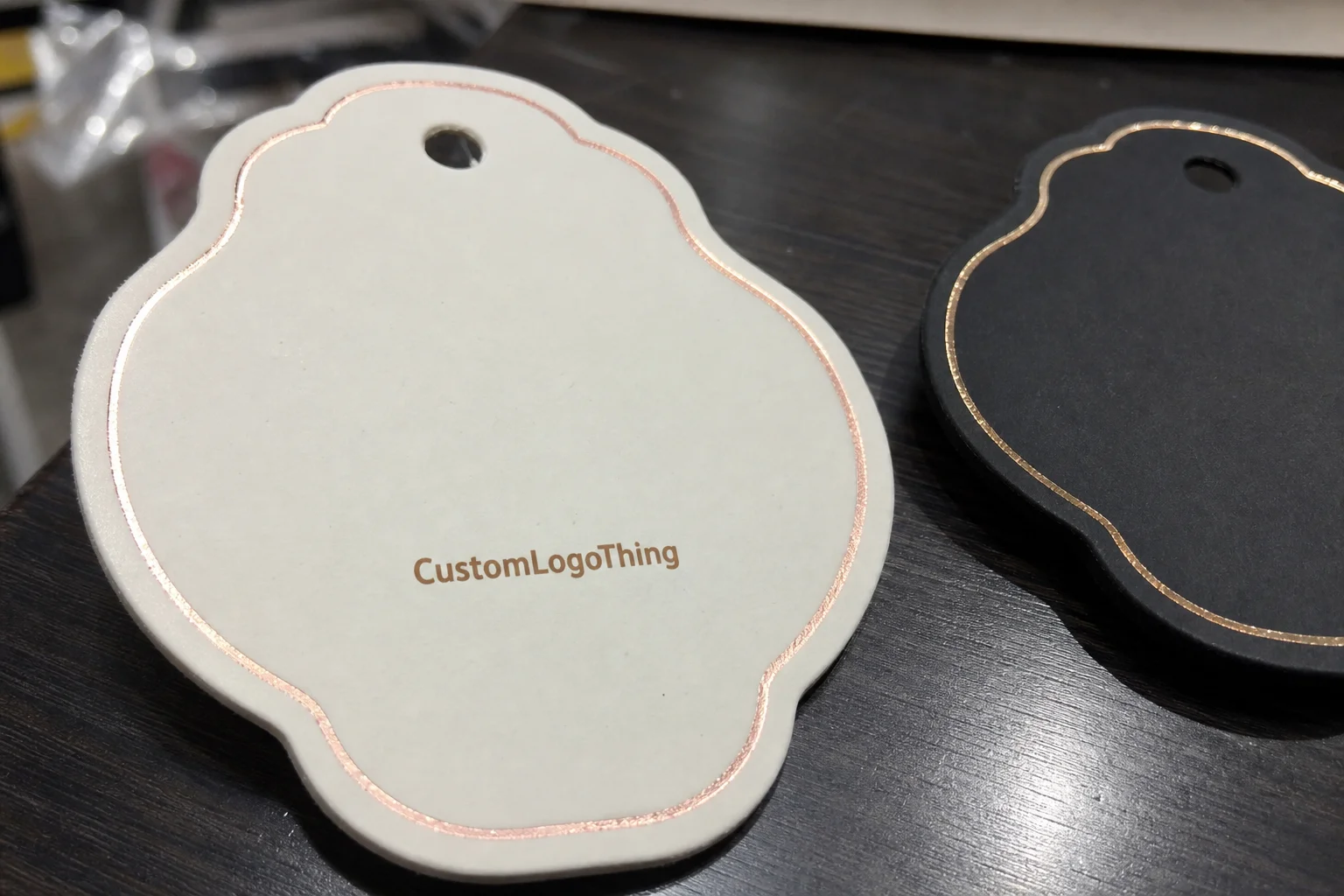
Cosmetics Hang Tags look simple because they are small. In production, small often means dense with risk. Shade name, product claims, ingredient notes, barcode, batch code, and caution copy can all end up on one piece of card stock. If any one of those fields is wrong, the tag is no longer usable.
Brands tend to underestimate how quickly that happens. A designer may build a beautiful proof with tight margins and elegant typography, but the factory has to inspect something more practical: can the code scan, can the text survive trimming, and can the final tag be packed without bending or contamination? If the answer is no, the tag fails its real job.
Typical problems are boring, which is exactly why they are expensive:
- The barcode scans poorly because the contrast is too low or the quiet zone is too narrow.
- Legal or warning copy is missing a required line, symbol, or qualifier.
- The brand color shifts when a coated stock absorbs ink differently than expected.
- The hole punch cuts too close to the logo or the key product text.
Once the factory has already printed, every correction becomes waste. If the launch also depends on custom printed boxes or gift sets, the schedule becomes more fragile because multiple packaging components are waiting on the same approval chain. That is why the safest approach is to treat the hang tag like a controlled component, not an accessory.
Custom hang tags for cosmetics brands factory audit questions
Factory audit questions are useful only if they expose process, not sales language. For custom Hang Tags for Cosmetics brands factory audit questions, ask about proof control, material control, print control, and inspection control. If a supplier cannot answer those areas clearly, the quote is not as reliable as it looks.
Use questions that force specificity:
- Who checks the final artwork, and who signs off on the proof?
- Which file format do you want, and which version is considered final?
- What tolerance do you hold on finished size and hole position?
- How do you verify barcode readability before bulk production?
- What parts of the job are documented in writing: stock, finish, string, packing, carton count?
- What happens if the buyer changes copy after approval?
- How is a failed run handled if inspection rejects the first batch?
These questions test whether the factory has repeatable control, not just a polished sample. Ask for the proof trail: what was checked, against which artwork version, and by whom. In cosmetics packaging, vague answers become expensive fast.
For buyers coordinating multiple packaging items, it also helps to keep the tag brief aligned with the rest of the order stack. Our FAQ covers common print questions, and the Custom Labels & Tags page is useful if the tag has to match other branded packaging components.
One practical detail matters more than most teams expect: version control. If marketing, regulatory, and packaging each keep a different file, the factory will eventually print the wrong one. The supplier is not guessing at that point. They are following the last instruction they received.
Materials, finishes, and print specs that hold up under review
Material choice should begin with use case, not finish. That is where many briefs go sideways. A tag for dry retail shelving does not need the same stock as a premium skincare set that will be handled repeatedly, sit near damp products, or travel inside a kit. Choosing the right substrate early prevents a lot of cosmetic disappointment later.
For many standard cosmetic tags, 300gsm to 350gsm coated artboard or FSC-certified card stock is a practical baseline. It gives enough stiffness for retail presentation without pushing the price into premium territory. If the tag is going to face humidity, frequent handling, or rough packing conditions, synthetic stock such as PP or PET is worth considering. It costs more, but it resists moisture and scuffing better than plain paper.
Finish affects readability as much as appearance. Matte and soft-touch finishes feel upscale, but they can reduce the contrast of small text if the layout is crowded. Gloss increases color impact, though strong reflection can make barcodes harder to scan if the placement is careless. Foil and spot UV are effective on prestige lines, but they add another inspection point and another chance for defects to appear.
For an audit-minded buyer, these are the details that matter:
- Size tolerance: the finished cut must match the dieline closely enough to avoid layout drift.
- Trim accuracy: uneven edges make the tag look lower quality even when the print itself is good.
- Hole placement: a punch that drifts can crowd the logo or hide required text.
- Ink stability: the surface should not smear, rub, or crack during handling.
- Barcode contrast: scanners need clean contrast, not decorative interpretation.
- Attachment method: cotton, waxed cotton, satin, and elastic loops behave differently during packing.
For most brands, the best spec is the one that solves the actual problem. A low-price cleanser line does not need the same stock as a prestige serum. A holiday set does not need the same finish as a permanent SKU. That distinction sounds simple, but it is often missing from the brief.
Pricing, MOQ, and the quote details that change the real cost
The cost of custom tags is rarely just a unit price. A quote may leave out tooling, proofs, attachment string, packing method, or freight, then add those items later. The first number looks competitive, and the final number does not.
For a standard 90 x 50 mm paper tag at 5,000 units, a simple one-color or two-color job may land around $0.07 to $0.14 per unit, depending on stock and finish. Add a second side, die cutting, or upgraded paper and the range may move to $0.12 to $0.22. If the tag includes foil, soft-touch coating, spot UV, or synthetic stock, $0.18 to $0.35 is a more realistic working range. Small runs of 500 to 1,000 pieces usually cost much more per unit because setup is spread over fewer tags.
| Option | Typical Use | Approx. Unit Cost at 5,000 | Main Tradeoff |
|---|---|---|---|
| Simple coated paper tag | Everyday skincare, mass retail | $0.07-$0.14 | Lowest cost, less moisture resistance |
| Premium paper with foil or spot UV | Prestige makeup, gift sets | $0.18-$0.30 | Higher impact, more setup and inspection |
| Synthetic or water-resistant tag | Humid environments, handling-heavy SKUs | $0.20-$0.35 | Better durability, higher material cost |
| Short-run digital tag | Launches, tests, seasonal edits | $0.20-$0.50+ | Fast and flexible, but expensive per unit |
MOQ is where the economics become visible. A lower quantity does not remove setup work. Die cutting, plate making, proofing, and packing still have to happen. That is why 1,000 pieces can look unexpectedly expensive compared with 10,000.
Watch for these traps:
- Die or plate fees hidden after the attractive unit price.
- Proof charges that appear after the file is already under review.
- Split shipment fees if part of the order needs to ship early.
- Packing assumptions that change carton count or inner pack method.
- MOQ pressure that forces you to buy far more than the launch requires.
To compare quotes properly, line up the same spec on every sheet: exact dimensions, stock, print sides, finish, attachment, packing method, and delivery terms. If one supplier is quoting a premium build and another is quoting a stripped-down version, the lower price is not better. It is a different product.
Process and timeline: from proof to bulk run
A clean workflow keeps the project from drifting. For Custom Hang Tags for Cosmetics brands factory audit questions, the typical path is brief intake, artwork review, digital proof, pre-press check or sample, bulk production, inspection, and packing. If any step is vague, delays usually show up later in the schedule.
- Brief intake: send the final size, material, finish, print method, attachment style, and barcode data.
- Artwork review: the factory checks bleed, safety margins, image resolution, and file structure.
- Digital proof: the buyer confirms layout, copy, code, and the version number.
- Sample or pre-press check: useful for complex, visible, or compliance-heavy jobs.
- Bulk production: printing, cutting, punching, finishing, and attachment prep.
- Inspection and packing: count, carton, label, and ship.
Delays usually happen in dull places. Someone changes the copy after proof approval. A barcode is sent in the wrong format. The brand sends a reference photo instead of a real dieline. Three people from marketing each approve a slightly different sentence.
Simple paper tags may move through production in roughly 12 to 15 business days after proof approval if the file is clean and the finish is basic. More complex jobs with foil, special die lines, synthetic stock, or extra verification often stretch to 15 to 25 business days. Add a sample round and the schedule moves again.
Common mistakes brands make before factory review
The recurring mistakes are predictable, which makes them harder to forgive. They are not creative errors. They are process errors that show up after the design team has already fallen in love with the mockup.
Common problems include:
- Tiny text that reads well on a monitor and turns mushy in print.
- Vague claims such as “clean,” “natural,” or “dermatologist approved” without support copy.
- Missing legal lines like warning text, origin details, or shade identifiers.
- Bad barcode contrast that fails a quick scan test.
- Color drift between the tag, the carton, and the rest of the packaging.
- No written spec sheet, which leaves every person to interpret the job differently.
Another common miss is approving a sample that does not match the final stock. Bright white proof paper can behave very differently from textured board or a matte synthetic sheet. If the tag must coordinate with other branded packaging, review all components under the same lighting and from the same distance.
The strongest safeguard is a disciplined brief. Keep one file with the approved dimensions, material, finish, barcode, legal copy, attachment method, and packing instructions. One approver. One version. One source of truth.
Build an audit-ready tag brief
The cleanest way to avoid rework is to send one complete brief before RFQs go out. Include the tag size, stock, finish, print method, attachment style, barcode requirements, legal copy, quantity, packing instructions, and any brand references. Attach the final dieline, approved artwork, and one reference image so the factory can review structure and appearance together.
Then lock the internal process. Name one approver. Confirm the budget. Set the production calendar. If the team still wants to debate wording, settle it before the proof is signed, not after.
The same brief structure works for inserts, cartons, and display pieces too. It keeps custom printed boxes, retail packaging, and tag specs from drifting apart during the order cycle. If the team needs a reference point for common buyer questions, our FAQ covers the basics without forcing every decision to start from scratch.
Bottom line: Custom Hang Tags for cosmetics brands factory audit questions should be answered before purchase order approval, not after the reprint.
What factory audit questions should I ask before ordering custom hang tags for cosmetics brands?
Ask who checks artwork, who approves proofs, and what tolerance the factory guarantees on size and hole placement. Confirm the material, finish, barcode, and attachment specs before you compare prices, then ask how the supplier handles revisions, inspection, and reprints.
Which hang tag materials are safest for skincare and makeup packaging?
Choose the stock based on exposure. Standard paper works for dry retail, while coated or synthetic materials are safer for moisture, heavy handling, or prestige sets. Match finish to function because some coatings reduce scuffing while others can make small text harder to read.
How do I compare quotes for custom hang tags without getting fooled by low pricing?
Compare the same spec on every quote: size, stock, print sides, finish, attachment, packing, and delivery terms. Check whether setup, tooling, proofing, and freight are included or billed later. A low unit price that depends on a much higher MOQ is not a bargain.
What is a realistic turnaround for custom hang tags after approval?
Simple paper tags can move faster than jobs with foil, special die cuts, or custom attachments. A clean proof-to-bulk cycle may take 12 to 15 business days, while more complex work often needs 15 to 25 business days or more. File quality and revision speed change the calendar quickly.
What files should I prepare before the factory audit or quote request?
Send the final dieline, print-ready artwork, brand colors, copy, barcode data, and any legal text. Include a reference image or sample so the factory understands the expected finish and presentation, and name one internal approver so revisions do not bounce around and waste production time.


