For a cosmetics buyer, Custom Hang Tags for Cosmetics brands wholesale pricing factors are not just a print-line issue. A small tag can shift a product from clinical to premium, or from premium to generic, in a matter of seconds. That impression comes from the stock, the finish, the typography, and the way the tag fits the bottle or carton. The invoice matters, but the visual result usually tells you whether the spec was set intelligently.
Beauty programs complicate pricing fast. A single serum may ship in multiple sizes, shades, or scent variants. A body-care line may need tags for bundles, gift sets, and seasonal releases. Every variant creates setup work, and every change to the build increases the chance of waste or a delayed proof. Buyers who focus only on the first unit price usually miss the full cost of production, reorders, and packaging mismatch. For a broader sourcing view, see our Wholesale Programs, Custom Labels & Tags, and Case Studies.
Custom Hang Tags for Cosmetics Brands: Wholesale Pricing Factors
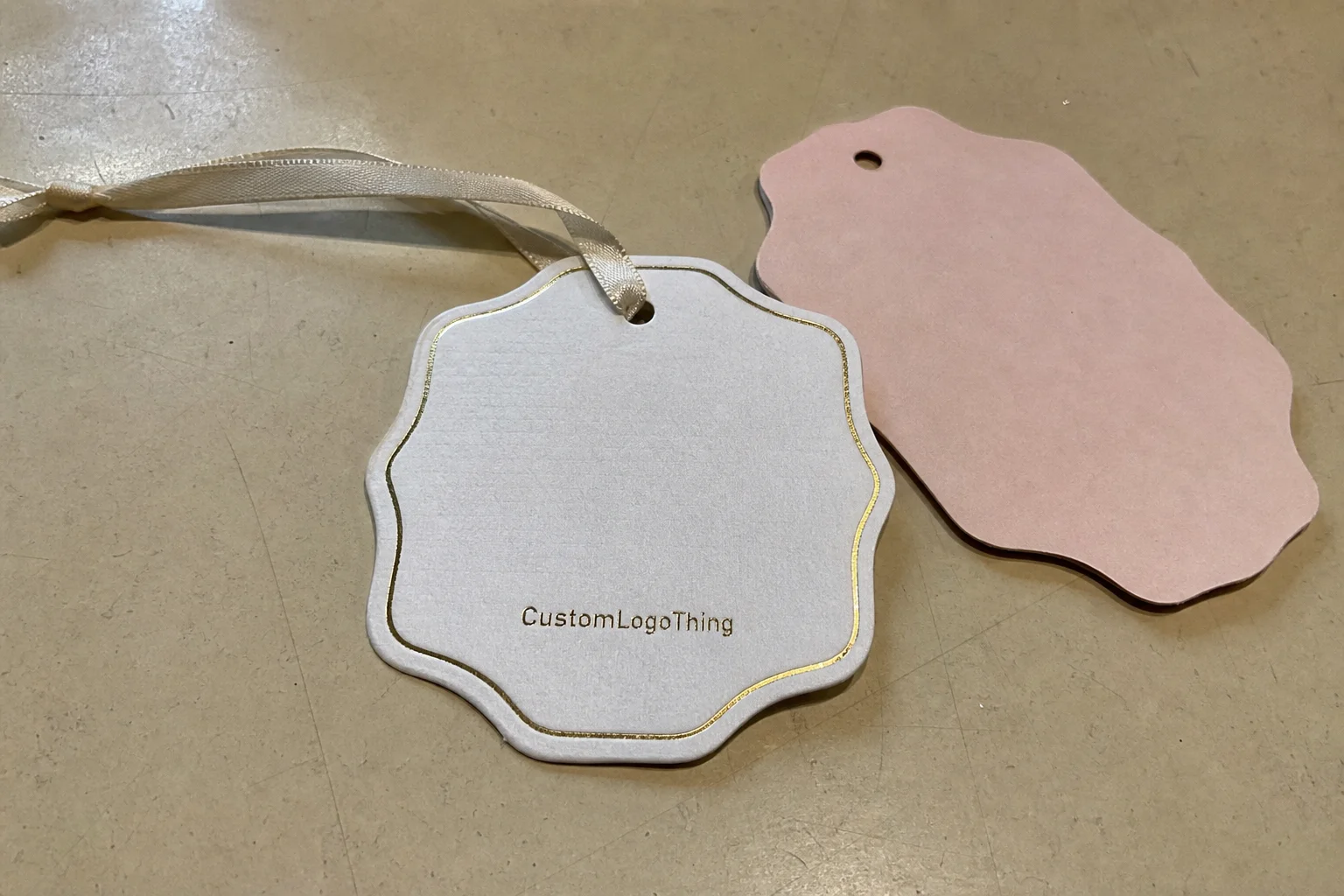
The pricing model is grounded in production reality. A hang tag has to pass through prepress, printing, finishing, cutting, counting, and packing before it reaches a shelf or fulfillment center. Each stage can be simple or expensive depending on the spec. A standard rectangle on coated card keeps the job efficient. A shaped tag with foil, soft-touch lamination, and variable copy moves into a different cost bracket quickly.
Cosmetics brands also ask more from a tag than many other categories do. A skincare tag may need to communicate ingredients, usage, claims, barcode placement, and brand hierarchy without feeling crowded. A fragrance tag may need to carry scent family, notes, and a premium visual finish. A shade tag may need to stay legible while carrying several SKU-specific variables. In other words, the tag is often doing the work that a box or insert would do elsewhere in the packaging system.
That makes structure more valuable than ornament. If the tag tries to hold too much information, the design stops working long before the print bill does. A good spec keeps the front fast and the back functional. Buyers should expect the supplier to flag layout risk during proofing, not after production starts.
"A cosmetic hang tag should earn its space. If it cannot identify the variant, support the claim, and still look deliberate at arm's length, the spec is too busy."
SKU count changes everything. Beauty lines often launch one formula across several shades or scents, then reorder only the strongest performers. That means the best tag spec is usually the one that can be reused without revision across multiple runs. Stable dimensions, repeatable color targets, and a supplier that stores the approved file matter more than chasing a small discount on the first order.
What a Cosmetic Hang Tag Must Communicate at Shelf Distance
A customer rarely studies a tag. Most of the time, the tag gets one glance. That means the front face has a narrow job: identify the brand, the product line, the variant, and the clearest selling point. For a shade-driven line, the variant may matter most. For skincare, the function or hero ingredient may need to lead. For fragrance, the scent family usually needs to read first.
The back can carry what the front cannot. That side is better suited for barcode placement, ingredients, net contents, handling cues, and legal copy. Good packaging design separates the premium surface from the functional one. The result is not just cleaner visually; it is easier to scale across distributor channels, retail shelves, and e-commerce fulfillment.
Readability causes more trouble than most buyers expect. Fine text on tinted stock, weak contrast, and over-stacked claims can make a polished design unreadable once it is printed. The same layout that looks balanced on screen may vanish under store lighting. In practice, spacing and contrast matter more than decorative effects. If the copy is dense, hierarchy should get stronger, not smaller.
There is a compliance edge as well. Cosmetic tags often sit close to regulated claims or usage copy, so the brand team should verify the text before production is approved. A supplier is not a regulatory adviser, but a good one can still point out when the tag is trying to carry too much information for its size. That kind of warning saves both time and reprints. For external standards around packaging and materials, resources from packaging.org can be useful context.
A simple test helps. If the tag had to be read in three seconds, what should still be visible? If the answer is unclear, the layout needs another pass before the quote is locked.
Materials, Finishes, and Attachment Options That Change the Quote
Material choice is one of the largest Custom Hang Tags for cosmetics brands wholesale pricing factors because it affects raw cost and production speed. A 14pt or 16pt coated cover stock is usually the most efficient option for standard beauty tags. It prints cleanly, cuts predictably, and handles most common finishes without trouble. Recycled stocks can work well for clean beauty positioning, although they may show more fiber texture and slightly softer color reproduction. That is not a flaw; it is part of the material profile.
Specialty stocks sit higher on the cost ladder. Soft-touch board, textured paper, thick premium stock, and cotton-feel sheets can elevate the perceived value of a line, but they also increase handling sensitivity and finishing cost. For a hero serum or fragrance launch, that can be justified. For a routine promo tag, a well-built standard stock often gives a better return than an expensive surface treatment on a weak layout.
Finishes are where budgets move quickly. A matte or gloss aqueous coating is usually modest. Lamination, foil stamping, embossing, debossing, and spot UV all add setup, labor, or both. A small foil accent can be efficient if the design is restrained. A large foil field, by contrast, can slow the run and increase waste because registration and handling become harder. The correct question is not which finish looks expensive. It is which finish supports the product story at the right price point.
Attachment choice matters more than many buyers expect. A die-cut hole is standard, but string type, elastic loops, and special inserts all shift labor and packing time. Cotton string or waxed cord can support a craft-driven aesthetic. Elastic loops are practical for curved bottles or bundle kits. Custom cut shapes add individuality, but they usually add tooling complexity too. If the tag is part of a wider packaging system, the attachment should work with labels, cartons, and inserts instead of fighting them.
| Spec Style | Typical Use | Approx. Wholesale Range | What Drives the Cost |
|---|---|---|---|
| Standard coated card, one or two colors | Mass-market skincare, promos, starter sets | $0.06-$0.14 per tag at 5,000+ units | Simple print setup, standard die, minimal finishing |
| Premium board with soft-touch or matte lamination | Prestige skincare, hero SKUs, gift sets | $0.12-$0.28 per tag at 5,000+ units | Laminate cost, slower finishing, tighter handling |
| Foil, emboss, or spot UV accents | Fragrance, premium launches, limited editions | $0.18-$0.40 per tag at 5,000+ units | Extra tooling, registration control, higher waste risk |
| Short-run digital on specialty stock | Trials, regional tests, seasonal variants | $0.22-$0.55 per tag at 250-1,000 units | Small quantity, setup spread, and stock choice |
Two practical rules help keep the spec sensible. First, match the build to the line. A fragrance launch and a cleanser promo should not share the same construction by default. Second, align the tag with the rest of the retail packaging program. When label stock, carton finish, and tag material feel coordinated, the brand reads as a system rather than a collection of separate purchases.
Wholesale Pricing, MOQ, and Unit Cost: What Actually Drives the Number
MOQ is usually misunderstood. It is not a random threshold pulled from a sales sheet. It is the point where the factory can run the job efficiently enough to cover setup, waste, and labor. That is why volume is the biggest driver in wholesale pricing. A 500-piece run absorbs a heavy share of the setup. A 10,000-piece run spreads that same setup across far more units, so the per-tag price drops sharply at first and then flattens.
Several variables shape the final number:
- Quantity: the strongest lever on per-unit cost.
- Print method: digital usually works better at small volumes; offset becomes more efficient as the run grows.
- Color count: more colors increase setup and raise the risk of registration drift.
- Finishes: lamination, foil, embossing, and spot UV add cost and time.
- Die complexity: standard shapes are cheaper than custom contours.
- Attachment method: strings, loops, and extra assembly steps add labor.
Quote comparison only works if the specs match. If one supplier is pricing coated board with a standard hole and another is pricing soft-touch stock with a custom die-cut shape, the two numbers are not comparable. The cheapest quote may be the most expensive once all the hidden variables are normalized. Buyers who work through a single spec sheet usually see the real difference much faster.
A useful sourcing routine looks like this:
- Lock the dimensions, stock, finish, and attachment method.
- Request pricing at two or three quantities instead of one.
- Ask for setup, unit cost, and finishing charges separately.
- Confirm whether tooling, dies, and proof fees are one-time or recurring.
- Check whether reorder pricing stays stable if the artwork does not change.
That level of detail is not bureaucracy. It is how a packaging buyer avoids discovering a hidden die fee, a revised proof charge, or an assumed stock upgrade after the quote has already been approved. The same discipline should apply across the broader packaging order, including any Custom Packaging Products that sit alongside the tag.
Production Process, Proofing, and Lead Time Before the First Shipment
The production path is simple on paper and less simple in practice. A typical job moves from brief to dieline, then to proof or sample, then to approval, printing, finishing, cutting, packing, and shipment. Delays usually happen when key details are still moving after the proof is out. If the buyer already knows the final size, hole placement, copy, finish, and quantity split by SKU, the schedule tends to hold. If any of those change late, lead time stretches.
Digital proofing is useful for catching layout mistakes, text overflow, and barcode placement. It is not a color guarantee. A physical sample takes longer, but it gives a better read on stock feel, surface interaction, and how the finish behaves in real light. For prestige beauty, that extra step is often justified because a minor sheen shift can change the perceived value of the tag. For simpler programs, a well-reviewed digital proof may be enough if the build is already stable.
Lead time depends on complexity and factory load. A straightforward tag run can sometimes ship in 7-12 business days after proof approval. Add foil, embossing, or a custom die, and 12-18 business days becomes more realistic. Large seasonal orders, mixed-SKU sorting, and overseas shipping add more time again. For launch planning, slack matters more than the shortest possible date on a quote sheet.
Quality control should be explicit before the order is released. Final approval should be tied to a clear sample reference, a count tolerance, and a packing method. If mixed variants are involved, the cartons should be labeled plainly. If the tags need to survive distribution across several warehouses, ask how corners are protected and whether the stack is packed to limit curl or edge damage. For shipping validation and transport handling, standards from ISTA can be useful. If paper sourcing matters to the brand, FSC is worth reviewing as well.
How to Compare Suppliers on Color Accuracy, Reorder Consistency, and Waste
Cosmetics buyers usually care about color more than buyers in many other categories, and that makes sense. Beauty packaging depends on visual trust. A gold accent that drifts toward brass on the next run reads as sloppiness. A black fragrance tag that comes back washed out weakens the line immediately. Color accuracy is not just an aesthetic issue; it is part of brand memory.
Ask how a supplier handles Pantone targets, press calibration, and approved samples. If the answer is vague, treat that as a warning sign. Strong suppliers can explain how they maintain references between reprints, how they store prior specs, and how they preserve the cutting file or die reference for later orders. Reorder consistency matters because it protects the brand from drift. A buyer who has to reapprove every small run is paying an administrative cost even if the unit price looks sharp.
Waste control is another hidden factor. Trim tolerance, packing format, and press setup all affect how many good pieces end up in the carton. Some waste is normal. Unexplained waste is not. If a supplier cannot describe how they minimize overruns, short counts, and misprints, the quote may be hiding process problems. That becomes more expensive in multi-SKU beauty programs, where a small waste rate can multiply across variants.
A simple due-diligence question usually reveals the quality of the operation: what stays unchanged on a reorder? The best answer is a stable file, the same stock, the same finish, and an existing reference record. If every repeat order is treated like a first-time job, expect friction later. For package branding across labels, cartons, and tags, consistency is part of the value, not a bonus.
Price should not be judged in isolation. A supplier that costs a little more but keeps counts tight, color stable, and reorders clean can outperform a cheaper vendor that forces rework or creates visible variation. Over several runs, the gap becomes obvious.
What to Send for a Fast Quote and a Clean First Run
The fastest quote requests look like finished specs, not rough ideas. To get reliable pricing on custom Hang Tags for Cosmetics brands wholesale pricing factors, send the exact size, quantity, stock, finish, print sides, attachment method, and target ship date. If the tag is for skincare, fragrance, hair care, or a promotional bundle, include that too. The product context helps the supplier identify a better build or catch a risk early.
Artwork should be clean before production starts. Fonts should be outlined, images packaged correctly, and compliance copy checked internally. If the tag includes a barcode, test it on the final layout rather than a placeholder. If there are several SKUs, say whether the order uses one shared build with variable names or separate files for each version. That changes both cost and scheduling.
A first-run checklist keeps the order grounded:
- Approve a final proof or sample reference.
- Confirm count tolerance and packing method.
- Lock the color target, especially if the tag must match labels or cartons.
- Verify the reorder plan so the supplier can store the spec correctly.
- Check whether the tag should coordinate with custom printed boxes or other retail packaging components.
That last point carries more weight than many teams expect. A tag can look excellent by itself and still feel disconnected if the box, label, and insert were sourced without a shared standard. The cleaner the system, the less you need to compensate with extra finishing or oversized claims.
Final pricing becomes predictable when the spec is locked before the quote request goes out. The buyer who does that gets more useful numbers, fewer surprises, and a cleaner first run. Pairing the tag order with your broader Custom Packaging Products plan usually makes the whole program easier to repeat.
What affects custom hang tags for cosmetics brands wholesale pricing the most?
Quantity is usually the biggest factor because setup costs are spread across more units. After that, stock choice, finish complexity, die-cut shape, and attachment method move the price. To compare quotes accurately, the specs have to match line for line.
What is a realistic MOQ for cosmetic hang tags?
MOQ depends on the print method and the amount of finishing involved. Small digital runs are easier to start, but the unit price stays higher. Offset and specialty finish jobs usually need more volume before the pricing becomes efficient.
Which materials keep custom hang tags for beauty brands looking premium without inflating cost?
Standard coated or lightly coated cardstock usually gives the best balance of cost and appearance. Soft-touch and specialty boards look elevated, but they make more sense for hero SKUs, launch kits, or fragrance lines. Strong typography on a good stock usually outperforms an expensive finish on a weak layout.
How long does production usually take after proof approval?
A simple run can move in roughly 7-12 business days after approval. Special finishes, custom dies, and mixed-SKU sorting usually extend that timeline. If the launch date is fixed, build in extra time rather than relying on the fastest estimate.
Can I reorder the same cosmetic tag later and keep color consistent?
Yes, if the supplier keeps the approved file, stock, finish, and production reference on record. Color consistency is strongest when the spec stays unchanged. Any change in substrate or coating should trigger a fresh proof or sample review before the reorder runs.


