Buyer Fit Snapshot
| Best fit | Custom Hang Tags Wholesale for Retail Packaging Needs projects where brand print, material claims, artwork control, MOQ, and repeat-order consistency need to be specified before quoting. |
|---|---|
| Quote inputs | Share finished size, material target, print colors, finish, packing count, annual reorder estimate, ship-to region, and any compliance wording. |
| Proofing check | Approve dieline scale, logo placement, barcode or warning zones, color tolerance, closure strength, and carton packing before bulk production. |
| Main risk | Vague material claims, crowded artwork, missing packing details, or unclear freight terms can make a low unit price expensive after revisions. |
Fast answer: Custom Hang Tags Wholesale for Retail Packaging Needs should be specified like a repeatable production item. The safest quote records material, print method, finish, artwork proof, packing count, and reorder notes in one written spec.
Production checks before approval
Compare the actual filled-product size with the drawing, then confirm tolerance on folds, seals, hang holes, label areas, and retail display edges. Reserve space for logos, QR codes, warning copy, and material claims before decorative graphics fill the panel.
Quote comparison points
Review material grade, print process, finish, sampling route, tooling charges, carton quantity, and freight assumptions side by side. A quote is only useful when the supplier can repeat the same color, closure quality, and packing count on the next order.
Custom Hang Tags wholesale changes the first read of a product before anyone lifts it off the hook. Apparel, candles, bags, gift items, and accessories all rely on that small rectangle to do a surprising amount of work: identify the item, support the brand, carry pricing, and sometimes satisfy compliance rules that would otherwise live on a separate insert. The tag is tiny. The effect is not.
For brands trying to balance branded packaging with practical retail packaging, Custom Hang Tags Wholesale gives them a way to add structure without building an expensive package system around every SKU. A tag can carry the visual language of the line, keep shelf presentation tidy, and still stay light enough to reorder without creating budget drag. That is one reason the format keeps showing up in apparel programs that care about package branding but cannot afford unnecessary complexity.
I have watched buyers spend weeks debating box finishes, then realize the hang tag is the piece customers actually touch first. That is where a lot of perception gets set. If the tag feels flimsy, the product can feel rushed even when the sewing, stitching, or formulation is excellent. If it feels considered, the whole item gains a little more authority. Funny how that works.
Why Custom Hang Tags Wholesale Earns Attention Fast
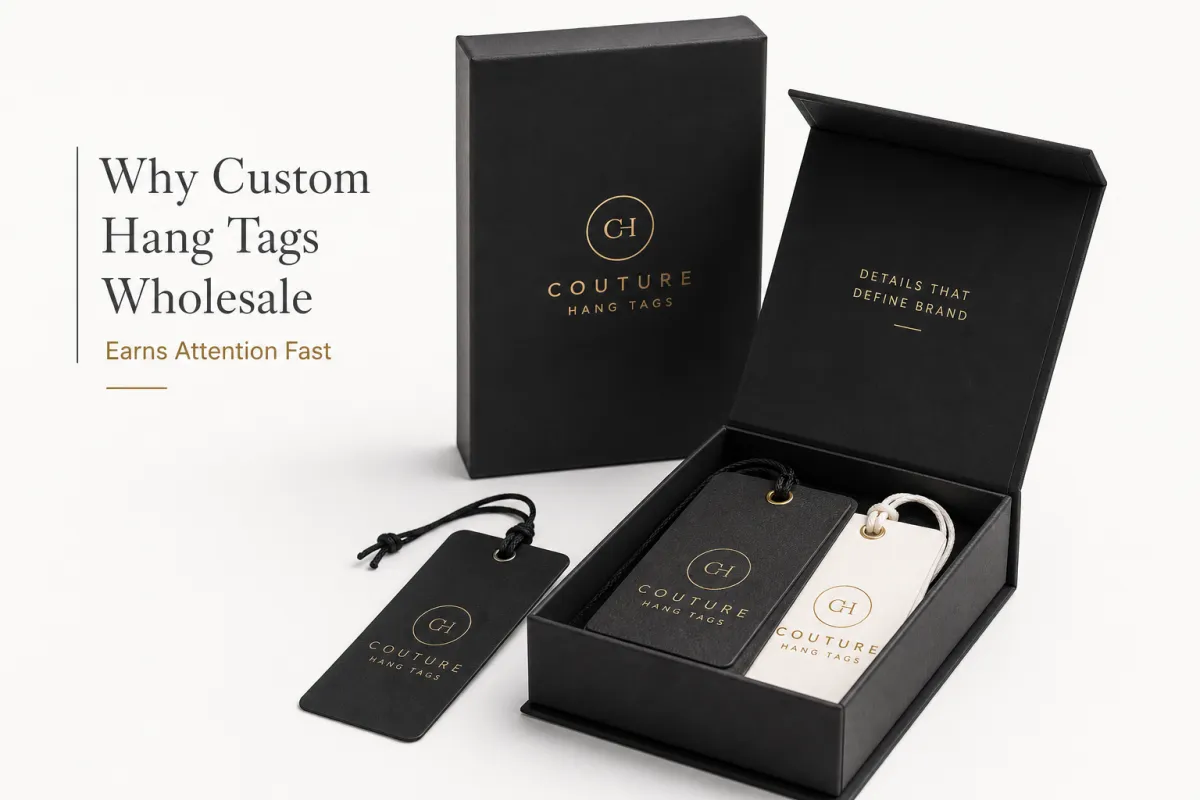
A hang tag often does more than the packaging around it. In a store, the buyer sees the tag before they read the label inside the garment or examine the stitching. That sequence matters. A clean, well-made tag can imply care, consistency, and a better retail experience. A flimsy one does the opposite. Custom Hang Tags wholesale gives a brand a fast way to control that impression without redesigning the entire packaging stack.
From a sourcing perspective, the attraction is easy to explain. A tag can hold size, SKU, barcode, care notes, origin information, and a short brand message in one narrow footprint. No padded mailer. No custom insert tray. No extra material burden in shipping. For that reason, custom hang tags wholesale often arrives before more elaborate product packaging programs do. It is a small spend with visible impact, and in retail that combination is rare.
Wholesale ordering also reduces the friction that creeps in as a line grows. Once a design is set, the same layout can move across colorways, seasonal drops, or related collections with only small changes. That is not glamorous, but it is efficient. Consistency lowers the chance of mismatch, speeds reorders, and gives the whole range a more disciplined look. In practical terms, custom hang tags wholesale helps a brand keep unit costs steadier while making the product line easier to manage from one production cycle to the next.
There is also a warehouse angle that gets ignored too often. Staff can identify a product faster when the tag is readable and organized. Retail associates can scan a barcode without hunting through paperwork. Buyers can explain the item without opening the package or searching for a folded spec sheet. The tag moves with the item, and that simple fact reduces handling time. For a buyer trying to keep a line moving through the supply chain, custom hang tags wholesale is not a decorative extra. It is a functional tool.
One detail I keep seeing: the better hang tags are rarely the fanciest ones. They are the ones that make the product easier to understand in three seconds or less. That means clean hierarchy, readable type, and enough contrast to survive under store lighting. A glittery finish can be fun, sure, but if it muddies the product name or price, it starts working against itself.
"A hang tag should help a product earn trust in seconds. If it slows down fulfillment, obscures the data, or looks expensive without adding clarity, the spec needs another pass."
Product Details: Materials, Shapes, and Finishing Options
The first decision in custom hang tags wholesale is usually the stock, and that choice changes both the look and the handling. Coated cardstock gives crisp print, bright color, and a polished retail feel, which works well for fashion, lifestyle, and gift products that need to look sharp on a rack. Uncoated stock feels quieter and more natural, and it accepts writing better. That matters for price marks, limited-run notes, or personalized items. Kraft paper pushes the design toward an earthy, handmade direction, while textured papers add tactile character without needing much finishing. Brands making sustainability claims often prefer FSC-certified options when chain-of-custody matters to the story, and the right paper choice can carry that message before a salesperson says a word.
Shape changes the psychology of the tag. Rectangles are still the default for custom hang tags wholesale because they print efficiently, stack cleanly, and keep setup predictable. Squares look more modern and can suit minimalist brands that want a tighter, quieter visual read. Rounded corners soften the silhouette and help with wear during handling. Circles, ovals, and custom die-cut forms create a stronger visual signature, though they also add tooling decisions and may increase waste. A custom shape should justify itself by improving recognition or product fit, not by simply being different for its own sake.
Finishing can transform a tag, and it can also inflate the bill faster than most buyers expect. Foil stamping adds a reflective accent that pulls the eye toward a mark or logo. Embossing and debossing create depth you can feel with your fingers, which is useful when a product needs a premium cue without adding color. Spot UV can isolate one detail on a matte field. Soft-touch lamination gives the tag a velvety surface that often reads as more expensive than it actually is. Gloss and matte laminates help with abrasion resistance, which matters when tags will be handled repeatedly in retail. For many orders, custom hang tags wholesale works best with one strong finish instead of a pile of effects competing for attention.
Small production details can save time later. Pre-punched holes simplify assembly. String, twine, elastic loops, and plastic fasteners all serve different product needs. Variable data fields make it possible to change pricing, batch information, or SKUs without rebuilding the design. Writable areas help merchandise teams mark stock by hand when the floor needs flexibility. If the line already uses Custom Labels & Tags, echoing the same visual structure across the tag and label family creates a more unified shelf presence. That connection matters more than many buyers admit, because package branding becomes more believable when each piece feels like it belongs to the same system.
I once reviewed a sample set where the only difference was stock thickness, and the heavier card instantly made the garment line look more intentional. Same artwork, same ink coverage, same die line. Different feel entirely. That is the kind of change that does not show up in a mockup but jumps out the moment the tag is in your hand.
- Coated stock for crisp color and a polished retail finish
- Uncoated stock for writable surfaces and a softer, natural feel
- Kraft stock for handmade, eco-minded, or rustic branding
- Textured stock for tactile depth without heavy decoration
- Die-cut shapes for stronger shelf recognition and brand recall
Specifications That Matter Before You Order
Fast custom hang tags wholesale orders usually begin with a complete spec sheet. Size, stock thickness, print sides, color count, finish, hole placement, and attachment method all need to be pinned down before quoting starts. That sounds obvious until a one-sided tag turns into a two-sided tag, or a standard rectangle turns into a custom dieline. Each of those changes affects cost and schedule. Most delays in this category are not dramatic; they are the product of small gaps in the brief.
Artwork setup deserves more attention than it usually gets. A tag needs bleed so the color reaches the edge cleanly. It needs a safe zone so text does not get trimmed. It needs a dieline that shows where the cut, fold, or punch will land. Logo placement also behaves differently on a small tag than on a brochure or box mockup. A design that feels balanced on an 8 x 10 layout can look crowded on a 2 x 3 retail tag. Treat custom hang tags wholesale as a production item, not just a design file.
Quantity changes the design logic as much as the price. A 500-piece run gives a buyer more room to test. A 10,000-piece run rewards restraint, because every extra finish or setup choice echoes across the order. That is where clear thinking matters. When the budget is tight, simpler artwork usually performs better than a design overloaded with metallic layers and decorative cut lines. Custom hang tags wholesale should reflect how the product is actually used, not every visual idea that surfaced in the first brainstorm.
Many products need more than a logo and a price. Apparel tags may need care symbols, fiber content, and country-of-origin details. Gift items often need a barcode, web address, or usage note. Accessories may need batch information or a short message about materials. A spec-first approach saves money because it reduces revisions and keeps the proof closer to final on the first round. For teams that already work through Wholesale Programs, standardizing the hang tag format across categories can make sourcing much less chaotic.
There is a trust factor here, too. If the brief is vague, the quote will be vague, and the proof usually carries that confusion forward. Clear specs do not just save time; they protect the brand from accidental changes that are expensive to fix once printing has started. That is especially true for seasonal drops, where one missing detail can throw off the entire reorder schedule.
- Size: common retail sizes include 2 x 3 inches, 2 x 4 inches, and 2.5 x 4.5 inches
- Thickness: often ranges from 14 pt to 24 pt depending on stiffness and finish
- Print sides: one-sided for simple branding, two-sided for product data and storytelling
- Color count: single-color, two-color, or full-color process depending on the design
- Hole placement: top center, corner punch, or custom placement for special attachment methods
- Attachment: string, twine, elastic loop, plastic fastener, or pre-tied assembly
Buyers comparing multiple Custom Packaging Products often get a cleaner quote when they submit one written brief with the exact format, attachment method, and artwork requirements. That is especially useful for custom hang tags wholesale because the tag is small, but the number of variables is not. A precise brief cuts down on back-and-forth and usually produces a better first proof.
Custom Hang Tags Wholesale Pricing, MOQ, and Value
Custom hang tags wholesale pricing usually comes down to a small set of variables: stock, size, print complexity, finishing, quantity, and whether the order requires custom tooling. A standard coated tag in a common size sits in a very different range from a soft-touch tag with foil, embossing, and a custom silhouette. That gap is not mysterious. Each extra choice adds setup, labor, or material usage. Buyers tend to get better results once they can separate features that improve perception from features that merely decorate.
MOQ matters because a wholesale order has to absorb press setup and finishing setup before unit pricing starts to fall. A simple tag on standard stock can often start at a lower entry point, while a specialty shape or layered finish needs a larger commitment to make the numbers work. That is normal. The useful question is not whether a minimum exists, but where the price bends at different volumes. In custom hang tags wholesale, the real savings often show up after the order moves past a test quantity and into repeatable production.
Unit economics matter more than sticker price. A better tag can lift the perceived value of the product, particularly in apparel and gifts where presentation affects how the item is judged. A tag with unnecessary embellishment can also drain margin without moving sell-through at all. If a 10 percent increase in cost does not change the shelf read, the handling experience, or the resale appeal, the upgrade may be hard to defend. That is why custom hang tags wholesale should be weighed against both retail value and reorder efficiency.
Typical planning ranges for common wholesale scenarios are below. These are reference figures, not fixed pricing, and they shift with quantity, stock, and finishing.
| Option | Best Fit | Typical Wholesale Range at 5,000 Pieces | What It Delivers |
|---|---|---|---|
| Standard coated card, full color | Apparel basics, promotional items, retail restocks | $0.08-$0.14 per unit | Clean graphics, efficient production, solid value |
| Uncoated or kraft stock, one or two colors | Natural, handmade, or eco-minded brands | $0.09-$0.16 per unit | Writable surface, tactile feel, straightforward handling |
| Soft-touch lamination with foil detail | Premium apparel, accessories, gift packaging | $0.22-$0.45 per unit | High-end feel and stronger shelf impact |
| Custom die-cut shape with specialty finish | Flagship branding, seasonal launches, collection pieces | $0.20-$0.50 per unit | Distinct look, more tooling, higher setup complexity |
Where do the savings usually appear? Standard sizes help. Fewer finishes help. A single strong brand element helps more than three competing effects. Larger quantities help when the same tag structure repeats across seasons. Brands already disciplined about product packaging usually understand this instinctively: the smartest purchase is the one that balances appearance, handling, and budget instead of chasing the highest-cost finish in the catalog. Custom hang tags wholesale makes that balance easier to hit because the tag can carry a lot of information without forcing the rest of the package into a higher cost band.
The better internal question is not, “What is the cheapest tag?” It is, “Which version gives the best brand lift at the lowest workable total cost?” That framing matters for seasonal apparel, store displays, and repeating assortments because the tag can stay consistent across multiple SKUs without requiring a fresh design each time. In that sense, custom hang tags wholesale is less about buying paper and more about building a repeatable system that does not collapse under its own complexity.
Proofing, Production, and Turnaround Timeline
The workflow for custom hang tags wholesale is predictable when the files are ready. Request the specs. Confirm the quote. Submit artwork. Review the proof. Approve final files. Move into production, finishing, and packing. Each stage is simple by itself. The job slows down when one of those steps starts with missing information. A printer who can move cleanly through that sequence usually understands actual production, not just graphic files.
Proofing is where preventable problems get caught before they cost money. Spelling, SKU numbers, price fields, barcode placement, bleed, trim lines, hole position, and any variable data all need to be checked line by line. This is also the moment to make sure the tag matches the rest of the retail packaging system, including any other branded packaging pieces in the range. If the product already uses custom printed boxes, the hang tag should feel like it belongs to the same line, with the same hierarchy and the same tone.
Turnaround depends on quantity, stock, finishing, and proof response time. A straightforward custom hang tags wholesale job can move faster than one with foil, embossing, or custom cutting, but only if the production queue allows it. Any quote that promises a single universal turnaround without looking at the spec is too vague to be useful. A better answer gives a range tied to the actual work: standard production for simple tags, extra time for specialty finishing, and more time again if the job needs tooling or unusual assembly.
The slowdowns are usually plain old paperwork problems. Missing artwork. An unapproved dieline. A logo file at the wrong resolution. A proof that sits untouched for three days. A last-minute color change after approval. These are the issues that shift launch dates more often than machine time does. The safest route is to build a buffer into the schedule, approve artwork early, and keep the reorder spec ready before inventory gets thin. For teams that need broader testing references for shipping cartons or display packs, the ISTA test standards and the materials at the Institute of Packaging Professionals are useful for understanding how the packaging system performs as a whole.
Turnaround gets a lot easier to manage once one person owns the proof checklist. I have seen that one role save an entire launch because the reviewer caught a barcode mismatch before print. No drama, no blame, just a clean save. That is the kind of operational detail that separates a tidy reorder from a last-minute scramble.
A reliable custom hang tags wholesale schedule is not about bragging on speed. It is about removing friction before the job reaches press. Final artwork, clean copy, clear quantity, and quick proof approval keep the launch moving. That holds true for a new apparel line, a gift assortment, or a packaging refresh spread across several stores.
Why Choose Custom Logo Things for Wholesale Hang Tags
Custom Logo Things is a practical choice for buyers who want custom hang tags wholesale without turning the order into a guessing exercise. The point is not hype. It is being able to talk through stock, finish, quantity, and application in concrete terms. A packaging partner should know how paper behaves on press, how finish changes the print result, and how one small tag can support the larger package branding system without creating waste or confusion.
That matters because custom hang tags wholesale usually sits inside a broader packaging program. The tag may need to match retail packaging in stores, align with branded packaging used for e-commerce, or sit beside inserts, sleeves, and labels that already define the line. When those pieces speak the same visual language, the product feels deliberate. When they do not, the presentation looks patched together. A slightly cheaper quote is not worth much if it creates more rework, more mismatched inventory, and more back-and-forth later.
Clarity is another advantage. Wholesale Buyers Need to Know what they are paying for, what files are required, and what happens after proofing starts. There should be no mystery about custom tooling, stock suitability, or whether a finish is worth the added cost. That is especially helpful if you are ordering Custom Labels & Tags alongside other components, or if your team is comparing tag options inside a broader Wholesale Programs plan.
Custom hang tags wholesale also has to work across categories, not just one. Apparel may need a firmer card and sharper hierarchy. Accessories may call for smaller dimensions and a more restrained finish. Gift products often need writable space or a cleaner story panel. A supplier that understands those differences can help you choose the tag that fits the product rather than forcing the product to adapt to the tag. That kind of judgment pays off after the first shipment, not just on the proof.
From a buyer’s standpoint, the best partner is the one that makes the next order easier. A well-chosen size, stock, and finish can carry across seasons and reprints with less friction, more consistency, and fewer surprises. That is where custom hang tags wholesale stops being a one-off purchase and becomes part of the operating system for the product line.
Next Steps for Custom Hang Tags Wholesale Orders
If custom hang tags wholesale is on the calendar, start by gathering the details that move pricing most: quantity, size, stock preference, finish, attachment method, and the exact copy that needs to fit on the tag. If the tag needs a barcode, care details, a price field, or SKU information, include those items at the start. A complete brief shortens the path to both quoting and proofing.
Ask for a quote that shows how the price shifts by quantity and finish. That view makes the break point visible, which is where smart buying usually happens. The lowest entry number is not always the best answer. Sometimes the better choice is a slightly stronger stock or a cleaner finish that supports retail presentation and reduces handling problems later. Custom hang tags wholesale rewards that kind of comparison because the differences are small on paper and visible in the store.
Before approving production, review the proof against the original product plan with a sharp eye. Check logo scale, text hierarchy, hole placement, trim lines, and any variable fields. Save the approved spec for the next run if the line will repeat. That habit keeps reorders cleaner across seasons, collections, and restocks, and it prevents one crooked revision from becoming a permanent part of the system.
If the next step is ready, request a sample, send the artwork, or begin a wholesale quote with Custom Logo Things. For brands that want package branding to feel intentional and retail-ready, custom hang tags wholesale is one of the most direct places to start. A well-specified tag makes the product look more finished, improves shelf read, and makes the next custom hang tags wholesale run easier to manage.
The simplest takeaway is also the most useful: decide the tag’s job before you decide its finish. If the goal is pricing, keep the layout readable. If the goal is premium perception, choose one finishing move and do it well. If the goal is speed across reorders, lock the spec and keep it consistent. That approach keeps custom hang tags wholesale practical, not fussy.
What is the usual minimum order for custom hang tags wholesale?
Minimums vary by size, stock, and finishing, but wholesale orders are usually set so press time and setup stay cost-effective. Simple tags on standard stock often allow lower entry quantities than specialty shapes or heavily finished pieces. For planning, ask for pricing at multiple quantities so you can see where the best unit cost begins, especially if you expect to reorder custom hang tags wholesale for more than one season.
Which material is best for custom hang tags wholesale apparel orders?
A sturdy coated or uncoated cardstock is common for apparel because it prints cleanly and holds shape on racks and in shipping. Kraft works well for natural, handmade, or eco-focused branding, while textured stocks add a more premium tactile feel. The best choice depends on garment weight, brand style, handling conditions, and whether you want a matte, premium, or rustic look in custom hang tags wholesale.
Can I get custom shapes or rounded corners in wholesale quantities?
Yes, custom die-cuts and rounded corners are common in wholesale production when the artwork and tooling are approved early. Custom shapes usually add setup cost, so they make the most sense when the tag design will be reused across multiple runs. If budget is tight, rounded corners can give a polished look without the higher tooling cost of a fully custom silhouette in custom hang tags wholesale.
How long does custom hang tags wholesale production usually take?
Turnaround depends on quantity, finishing, and how quickly proofs are approved. Straightforward runs move faster than jobs with foil, embossing, or custom cutting. The fastest path is to provide final artwork, confirm specs early, and reply quickly on proof changes so custom hang tags wholesale can stay on schedule.
What files do you need for a custom hang tags wholesale quote?
Send your logo or artwork in a vector format when possible, plus the size, quantity, and any finish or shape requirements. If the tag needs pricing, care details, or barcode space, include that copy up front so the layout can be quoted accurately. A reference image or sample tag also helps if you want the new piece to match an existing style, and it makes custom hang tags wholesale quoting much faster.

